


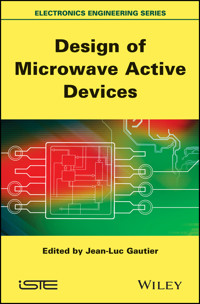
Design of Microwave Active Devices E-Book
144,99 €
Mehr erfahren.
- Herausgeber: John Wiley & Sons
- Kategorie: Wissenschaft und neue Technologien
- Sprache: Englisch
This book presents methods for the design of the main microwave active devices. The first chapter focuses on amplifiers working in the linear mode. The authors present the problems surrounding narrowband and wideband impedance matching, stability, polarization and the noise factor, as well as specific topologies such as the distributed amplifier and the differential amplifier. Chapter 2 concerns the power amplifier operation. Specific aspects on efficiency, impedance matching and class of operation are presented, as well as the main methods of linearization and efficiency improvement. Frequency transposition is the subject of Chapter 3. The author presents the operating principle as well as the different topologies using transistors and diodes. Chapter 4 is dedicated to the operation of fixed frequency and tunable oscillators such as the voltage controlled oscillator (VCO) and the yttrium iron garnet (YIG). The final chapter presents the main control functions, i.e. attenuators, phase shifters and switches.
Sie lesen das E-Book in den Legimi-Apps auf:
Seitenzahl: 284
Veröffentlichungsjahr: 2014
Ähnliche




















Table of Contents
Chapter 1 Amplification in Linear Mode
1.1. Principles of microwave amplification
1.2. Narrowband amplifiers with maximum gain.
1.3. Low-noise narrowband amplifier
1.4. Specific configurations for transistors
1.5. Wideband amplification.
1.6. Differential amplifier
1.7. Bibliography
Chapter 2 Power Amplification
2.1. Characteristics of power amplifiers.
2.2. Analysis of the operation of a power amplifier
2.3. Classes of operation.
2.4. Architectures of power amplifiers.
2.5. Design example of an amplifier in class B
2.6. Linearization and efficiency improvement
2.7. Bibliography
Chapter 3 Frequency Transposition
3.1. Operating principles.
3.2. Mixer characteristics
3.3. Simple mixer operation
3.4. Balanced mixer topologies
3.5. Topology of passive and active mixers.
3.6. Frequency multipliers
3.7. Bibliography
Chapter 4 Oscillators.
4.1. Operating principles.
4.2. Analysis of one-port circuit-type oscillators.
4.3. Oscillator characteristics.
4.4. Impedance with a negative resistive component
4.5. Fixed-frequency oscillators
4.6. Electronically tunable oscillators
4.7. Bibliography
Chapter 5 Control Functions
5.1. Semiconductor components for control functions
5.2. Variable attenuators.
5.3. Variable phase shifters
5.4. Switches
5.5. Bibliography
Appendix 1 Lossless Two-Port Network: Mismatching
Appendix 2 Noise in a Balanced Amplifier
Appendix 3 Specific Topologies with Transistors.
A3.1. Common-grid and common-drain topologies
A3.2. Cascade association of 2 two-port networks
Appendix 4 Wideband Impedance Matching: Reactive Two-Port Networks
A4.1. Use of filters’ theory
A4.2. Darlington’s equivalences
A4.3. Applying Darlington’s equivalences to the impedance-matching circuits
A4.4. Implementation with complex impedance-matching
A4.5. Synthesis methodology
Appendix 5 Wideband Impedance Matching: Dissipative Two-Port Networks.
A5.1. Series-RC circuit
A5.2. Parallel-RC circuit
Appendix 6 Wideband Amplification: Parallel Resistive Feedback
Appendix 7 Graphical Method.
A7.1. Constant SijT modulus and argument circles
A7.2. Constant maximum transducer power gain circles
Appendix 8 Distributed Amplifier.
A8.1. Analysis of the grid line
A8.2. Study of the drain line
A8.3. Study of the amplifier
Appendix 9 Differential Amplifier.
A9.1. Differential operation of a four-port network
A9.2. Symmetrical four-port network
A9.3. Purely differential operation mode
Appendix 10 Third-order Intermodulation
A10.1. Compression–intermodulation relationship
A10.2. Amplifier cascade intermodulation
List of Authors
Index
First published 2014 in Great Britain and the United States by ISTE Ltd and John Wiley & Sons, Inc.
Apart from any fair dealing for the purposes of research or private study, or criticism or review, as permitted under the Copyright, Designs and Patents Act 1988, this publication may only be reproduced, stored or transmitted, in any form or by any means, with the prior permission in writing of the publishers, or in the case of reprographic reproduction in accordance with the terms and licenses issued by the CLA. Enquiries concerning reproduction outside these terms should be sent to the publishers at the undermentioned address:
ISTE Ltd
27-37 St George’s Road
London SW19 4EU
UK
www.iste.co.uk
John Wiley & Sons, Inc.
111 River Street
Hoboken, NJ 07030
USA
www.wiley.com
© ISTE Ltd 2014
The rights of Jean-Luc Gautier to be identified as the author of this work have been asserted by him in accordance with the Copyright, Designs and Patents Act 1988.
Library of Congress Control Number: 2014931647
British Library Cataloguing-in-Publication Data
A CIP record for this book is available from the British Library
ISBN 978-1-84821-630-3
Chapter 1
Amplification in Linear Mode
Chater written by Jean-Luc GAUTIER and Sébastien QUINTANEL.
1.1. Principles of microwave amplification
An amplifier is a device used to convert some of the power supplied by a direct current (DC) signal from a continuous power source into alternating current (AC) power at the frequency of the microwave signal applied on the input. It consists of the following elements:
Figure 1.1.Principle of amplification
It is possible to essentially classify microwave amplifiers according to various criteria, although this list is not exhaustive:
1.1.1. Characteristics of an amplifier in linear mode
The linear dynamic operation of an amplifier can be represented by the circuit diagram shown in Figure 1.2.
Figure 1.2.Diagram of the linear amplifier principle
The impedance value of the generator and the load is standardized and generally equal to 50 Ω.
The essential characteristic values of an amplifier are:
G0 ± ΔG in dB
The port reflection coefficient is usually expressed in dB and sometimes as a standing wave ratio (SWR).
Figure 1.3 shows the gain and matching curves defining the circuit bandwidth.
Figure 1.3.Linear characteristics of an amplifier
Lesen Sie weiter in der vollständigen Ausgabe!
Lesen Sie weiter in der vollständigen Ausgabe!
Lesen Sie weiter in der vollständigen Ausgabe!
Lesen Sie weiter in der vollständigen Ausgabe!
Lesen Sie weiter in der vollständigen Ausgabe!
Lesen Sie weiter in der vollständigen Ausgabe!
Lesen Sie weiter in der vollständigen Ausgabe!
Lesen Sie weiter in der vollständigen Ausgabe!
Lesen Sie weiter in der vollständigen Ausgabe!
Lesen Sie weiter in der vollständigen Ausgabe!
Lesen Sie weiter in der vollständigen Ausgabe!
Lesen Sie weiter in der vollständigen Ausgabe!
Lesen Sie weiter in der vollständigen Ausgabe!
Lesen Sie weiter in der vollständigen Ausgabe!
Lesen Sie weiter in der vollständigen Ausgabe!
Lesen Sie weiter in der vollständigen Ausgabe!




