


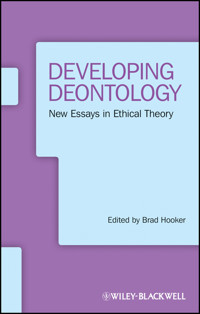
Developing Deontology E-Book
21,99 €
Mehr erfahren.
- Herausgeber: John Wiley & Sons
- Kategorie: Geisteswissenschaft
- Serie: Ratio Special Issues
- Sprache: Englisch
Developing Deontology consists of six new essays in ethical theory by leading contemporary moral philosophers. Each essay considers concepts prominent in the development of deontological approaches to ethics, and these essays offer an invaluable contribution to that development.
- Essays are contributed by Michael Smith, Philip Stratton-Lake, Ralph Wedgewood, David Owens, Peter Vallentyne, and Elizabeth Harman - all leading contemporary moral philosophers
- Each essay offers an original and previously unpublished contribution to the subject
- A significant addition to the field for anyone with an interest in the development of deontology
- The collection is edited by a leading philosophical scholar
Sie lesen das E-Book in den Legimi-Apps auf:
Seitenzahl: 250
Veröffentlichungsjahr: 2012
Ähnliche




















Table of Contents
Cover
Ratio Book Series
Title page
Copyright page
NOTES ON CONTRIBUTORS
1 DEONTOLOGICAL MORAL OBLIGATIONS AND NON-WELFARIST AGENT-RELATIVE VALUES
1. A Familiar Puzzle
2. Rethinking Hume’s Strictures
3. Moral Obligations, Reasons for Action, and Agent-relative Values
4. Conclusion
2 RECALCITRANT PLURALISM
Introduction: Moral foundationalism
Deontic Reasons
Moral reasons and moral motivation.
Being wronged and reasons to resent
Moral reasons and recalcitrant pluralism
Expanding the good
Family relations
The son’s motive
3 DEFENDING DOUBLE EFFECT
4 THE POSSIBILITY OF CONSENT
1. The Problem of Normative Power
2. Consent and Choice
3. Promise, Consent and Normative Interests
4. Permissive Interests
5 ENFORCEMENT RIGHTS AGAINST NON-CULPABLE NON-JUST INTRUSION
1. Background on the Problem: Intrusion, Unjust Infringement, and Enforcement Rights
2. Intrusion-Harm Reduction
3. Sufficient Conditions for Enforcement Rights against Non-Culpable Non-Just Intrusions
4. A Defence
5. Conclusion
6 DOES MORAL IGNORANCE EXCULPATE?
1. Rosen’s Argument
2. Objections to Rosen’s Argument
3. The Significance of the Narrower Conclusion
4. My Proposed View
5. Objections to the Proposed View
6. Understanding My Disagreement with Rosen
7. Conclusion
Index
Ratio Book Series
Each book in the series is devoted to a philosophical topic of particular contemporary interest, and features invited contributions from leading authorities in the chosen field.
Volumes published so far:
Developing Deontology: New Essays in Ethical Theory, edited by Brad Hooker
Agents and Their Actions, edited by Maximilian de Gaynesford
Philosophy of Literature, edited by Severin Schroeder
Essays on Derek Parfit’s On What Matters, edited by Jussi Suikkanen and John Cottingham
Justice, Equality and Constructivism, edited by Brian Feltham
Wittgenstein and Reason, edited by John Preston
The Meaning of Theism, edited by John Cottingham
Metaphysics in Science, edited by Alice Drewery
The Self?, edited by Galen Strawson
On What We Owe to Each Other, edited by Philip Stratton-Lake
The Philosophy of Body, edited by Mike Proudfoot
Meaning and Representation, edited by Emma Borg
Arguing with Derrida, edited by Simon Glendinning
Normativity, edited by Jonathan Dancy
This edition first published 2012
Originally published as Volume 24, Issue 4 of Ratio
Chapters © 2012 The Authors
Book compilation © 2012 Blackwell Publishing Ltd
Blackwell Publishing was acquired by John Wiley & Sons in February 2007. Blackwell’s publishing program has been merged with Wiley’s global Scientific, Technical, and Medical business to form Wiley-Blackwell.
Registered Office
John Wiley & Sons Ltd, The Atrium, Southern Gate, Chichester, West Sussex, PO19 8SQ, United Kingdom
Editorial Offices
350 Main Street, Malden, MA 02148-5020, USA
9600 Garsington Road, Oxford, OX4 2DQ, UK
The Atrium, Southern Gate, Chichester, West Sussex, PO19 8SQ, UK
For details of our global editorial offices, for customer services, and for information about how to apply for permission to reuse the copyright material in this book please see our website at www.wiley.com/wiley-blackwell.
The right of Brad Hooker to be identified as the author of the editorial material in this work has been asserted in accordance with the UK Copyright, Designs and Patents Act 1988.
All rights reserved. No part of this publication may be reproduced, stored in a retrieval system, or transmitted, in any form or by any means, electronic, mechanical, photocopying, recording or otherwise, except as permitted by the UK Copyright, Designs and Patents Act 1988, without the prior permission of the publisher.
Wiley also publishes its books in a variety of electronic formats. Some content that appears in print may not be available in electronic books.
Designations used by companies to distinguish their products are often claimed as trademarks. All brand names and product names used in this book are trade names, service marks, trademarks or registered trademarks of their respective owners. The publisher is not associated with any product or vendor mentioned in this book. This publication is designed to provide accurate and authoritative information in regard to the subject matter covered. It is sold on the understanding that the publisher is not engaged in rendering professional services. If professional advice or other expert assistance is required, the services of a competent professional should be sought.
Library of Congress Cataloging-in-Publication Data
Developing deontology : new essays in ethical theory / edited by Brad Hooker.
p. cm.
Includes index.
ISBN 978-1-4443-6194-0 (pbk.)
ISBN 978-1-1183-2125-6 (epub)
ISBN 978-1-1183-2127-0 (mobi)
1. Ethics. I. Hooker, Brad, 1957–
BJ21.D48 2012
171′.2--dc23
2012001062
A catalogue record for this book is available from the British Library.
NOTES ON CONTRIBUTORS
Elizabeth Harman is an associate professor of Philosophy and Human Values at Princeton University. Her articles include ‘Creation Ethics: The Moral Status of Early Fetuses and the Ethics of Abortion’ (Philosophy and Public Affairs) and ‘ “I’ll Be Glad I Did It” Reasoning and the Significance of Future Desires’ (Philosophical Perspectives).
David Owens became a professor at the University of Reading after having taught at University of Sheffield for 17 years. He has held visiting positions at London, Yale, Oxford’s All Souls College, Sydney and Lublin. He is the author of Causes and Coincidences (Cambridge University Press, 1992), Reason Without Freedom (Routledge, 2002) and Shaping the Normative Landscape (Oxford University Press, 2012).
Michael Smith is McCosh Professor of Philosophy at Princeton University. He is the author of The Moral Problem (Blackwell, 1994) and Ethics and the A Priori: Selected Essays on Moral Psychology and Meta-Ethics (Cambridge University Press, 2004), and the co-author, with Frank Jackson and Philip Pettit, of Mind, Morality, and Explanation: Selected Collaborations (Oxford University Press, 2004).
Philip Stratton-Lake is a professor at the University of Reading. He is the author of Kant, Duty, and Moral Worth (Routledge, 2000) and the editor of Ethical Intuitionism: Re-evaluations (Oxford University Press, 2002), the new edition of W. D. Ross’s The Right and the Good (Oxford University Press, 2002), and On What We Owe to Each Other (Blackwell, 2004).
Peter Vallentyne is Florence G. Kline Professor of Philosophy at the University of Missouri. He writes on issues of liberty and equality in the theory of justice (and left-libertarianism in particular) and, more recently, on enforcement rights (rights to protect primary rights). He is an associate editor of Ethics.
Ralph Wedgwood is a professor of Philosophy at the University of Southern California; he previously taught at Merton College, University of Oxford and at the Massachusetts Institute of Technology. He is the author of many articles on various aspects of ethics and epistemology, and of The Nature of Normativity (Oxford University Press, 2007).
1
DEONTOLOGICAL MORAL OBLIGATIONS AND NON-WELFARIST AGENT-RELATIVE VALUES
Michael Smith
Abstract
Many claim that a plausible moral theory would have to include a principle of beneficence, a principle telling us to produce goods that are both welfarist and agent-neutral. But when we think carefully about the necessary connection between moral obligations and reasons for action, we see that agents have two reasons for action, and two moral obligations: they must not interfere with any agent’s exercise of his rational capacities and they must do what they can to make sure that agents have rational capacities to exercise. According to this distinctively deontological view of morality, though we are obliged to produce goods, the goods in question are non-welfarist and agent-relative. The value of welfare thus turns out to be, at best, instrumental.
Many theorists think that two related claims will occupy centre stage in any plausible moral theory. The first is that we should bring about more rather than less of what’s of intrinsic value. The second is that welfare has intrinsic value. Putting these two claims together, they suppose that any plausible moral theory will tell us that we should produce more rather than less welfare.
Lesen Sie weiter in der vollständigen Ausgabe!
Lesen Sie weiter in der vollständigen Ausgabe!
Lesen Sie weiter in der vollständigen Ausgabe!
Lesen Sie weiter in der vollständigen Ausgabe!
Lesen Sie weiter in der vollständigen Ausgabe!
Lesen Sie weiter in der vollständigen Ausgabe!




