


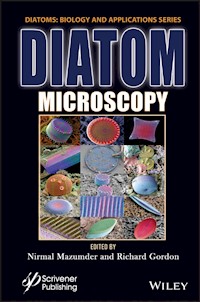
Diatom Microscopy E-Book
212,99 €
Mehr erfahren.
- Herausgeber: John Wiley & Sons
- Kategorie: Wissenschaft und neue Technologien
- Serie: Diatoms: Biology and Applications
- Sprache: Englisch
DIATOM MICROSCOPY The main goal of the book is to demonstrate the wide variety of microscopy methods being used to investigate natural and altered diatom structures. This book on Diatom Microscopy gives an introduction to the wide panoply of microscopy methods being used to investigate diatom structure and biology, marking considerable advances in recent technology including optical, fluorescence, confocal and electron microscopy, surface-enhanced Raman spectroscopy (SERS), atomic force microscopy (AFM) and spectroscopy as applied to diatoms. Each chapter includes a tutorial on a microscopy technique and reviews its applications in diatom nanotechnology and diatom research. The number of diatomists, diatom research, and their publications are increasing rapidly. Although many books have dealt with various aspects of diatom biotechnology, nanotechnology, and morphology, to our knowledge, no volume exists that summarizes advanced microscopic approaches to diatoms. Audience The intended audience is academic and industry researchers as well as graduate students working on diatoms and diatom nanotechnology, including biosensors, biomedical engineering, solar panels, batteries, drug delivery, insect control, and biofuels.
Sie lesen das E-Book in den Legimi-Apps auf:
Seitenzahl: 506
Veröffentlichungsjahr: 2022
Ähnliche




















Table of Contents
Cover
Title Page
Copyright
Preface
References
1 Investigation of Diatoms with Optical Microscopy
1.1 Introduction
1.2 Light Microscopy
1.3 Fluorescence Microscopy
1.4 Confocal Laser Scanning Microscopy
1.5 Multiphoton Microscopy
1.6 Super-Resolution Optical Microscopy
1.7 Conclusion
Acknowledgement
References
2 Nanobioscience Studies of Living Diatoms Using Unique Optical Microscopy Systems
Abbreviations
2.1 Trajectory Analysis of Gliding Among Individual Diatom Cells Using Microchamber Systems
2.2 Direct Observation of Floating Phenomena of Individual Diatoms Using a “Tumbled” Microscope System
2.3 Three-Dimensional Physical Imaging of Living Diatom Cells Using a Holographic Microscope System
Acknowledgements
References
3 Recent Insights Into the Ultrastructure of Diatoms Using Scanning and Transmission Electron-Microscopy
3.1 Introduction
3.2 Scanning Electron Microscopy (SEM) of Diatoms
3.3 Transmission Electron Microscopy (TEM) of Diatoms
3.4 Conclusion
References
4 Atomic Force Microscopy Study of Diatoms
4.1 Introduction
4.2 Types of AFM Modes
4.3 Sample Preparation and Methods
4.4 Study of Diatom Ultrastructure Under AFM
4.5 Conclusion
Glossary
Acknowledgement
References
5 Refractive Index Tomography for Diatom Analysis
5.1 Introduction
5.2 Fundamentals of PC-ODT
5.3 Experimental Setup for PC-ODT
5.4 Diatom RI Reconstructions with Bright-Field Illumination
5.5 Illumination Impact on PC-ODT Performance
5.6 Concluding Remarks
Acknowledgement
References
6 Luminescent Diatom Frustules: A Review on the Key Research Applications
6.1 Introduction
6.2 Key Research Applications of Luminescence Properties of Diatom Frustules
6.3 Future Perspectives
6.4 Conclusion
Acknowledgement
References
7 Micro to Nano Ornateness of Diatoms from Geographically Distant Origins of the Globe
7.1 Introduction
7.2 Materials and Methods
7.3 Diatoms from Different Geographical Origins of the World
7.4 Conclusion
7.5 Acknowledgements
References
8 Types of X-Ray Techniques for Diatom Research
8.1 Introduction
8.2 Applications
8.3 Conclusions
Glossary
References
9 Diatom Assisted SERS
9.1 Introduction
9.2 Diatom
9.3 Raman Scattering
9.4 SERS Through Diatom: Fundamentals and Application Overview
9.5 Conclusion and Future Outlook
References
10 Diatoms as Sensors and Their Applications
10.1 Introduction
10.2 Diatoms as Biosensors
10.3 Conclusion
Acknowledgments
References
11 Diatom Frustules: A Transducer Platform for Optical Detection of Molecules
11.1 Introduction
11.2 Optical Properties of Diatom Frustules
11.3 Methods Involved in Thin Film Deposition of Diatom Frustules
11.4 Diatom as an Optical Transducer for Biosensors
11.5 Diatom as an Optical Transducer for Gas/Chemical Sensors
11.6 Conclusion
References
12 Effects of Light on Physico-Chemical Properties of Diatoms
12.1 Introduction
12.2 Effect of Light on Diatom Function and Morphology
12.3 Conclusion
Acknowledgment
References
Index
Also of Interest
End User License Agreement
List of Illustrations
Chapter 1
Figure 1.1 Selected diatoms taxa in the Baryczka stream obtained using phase con...
Figure 1.2 Comparison of diatom defects and man-made photonic crystal fiber. The...
Figure 1.3 Quantitative phase image of diatom cell recorded using 20 x/0.45 micr...
Figure 1.4 QPIs results showing a variety of diatom samples; (a) diatom recorded...
Figure 1.5 Images illustrating the relationship between the bacterium L. monocyt...
Figure 1.6 Dark field micrographs of control cells and cells exposed to Ag NPs. ...
Figure 1.7 (a) Dark field image of single valve of
C. wailesii
diatom and (b) co...
Figure 1.8 Images of new silicon deposits and chlorophyll a (Chl
a)
of coastal a...
Figure 1.9 Hyperspectral analysis of a single valve of
Coscinodiscus centralis
o...
Figure 1.10 Laser confocal microscope images of
H. hauckii-R
. intracellularis sy...
Figure 1.11 Live cells, biosilica and biosilica-associated organic matrix from t...
Figure 1.12 Quantification of carbolines in healthy and oomycete-infected diatom...
Figure 1.13 Evaluation of siRNA uptake and cellular internalization using confoc...
Figure 1.14 Specific particle endocytosis of FITC/PEI/FA-functionalized silica n...
Figure 1.15 Left: Multi-photon image of living centric diatoms Coscinodiscus wai...
Figure 1.16 (a)
Asterionellopsis glacialis
and (b)
Proboscia alata
captured usin...
Figure 1.17 (a) Average fluorescence lifetime images of
T. weissflogii
exposed t...
Figure 1.18 PALM analysis of tpSil3. (a) Comparison of epifluorescence image and...
Chapter 2
Figure 2.1 Diatom studies from the viewpoint of nanobiological physics using opt...
Figure 2.2 Microscopy images of (a) PDMS microchamber, (b) spiral grooves, and (...
Figure 2.3 Trajectories (red lines) of movements of the same diatom cell (a) bef...
Figure 2.4 Overview of a “tumbled” microscope system with a microchamber. A phot...
Figure 2.5 A typical example of snapshots and trajectories of the settlement of ...
Figure 2.6 Typical examples of snapshots and trajectories of floating diatom cel...
Figure 2.7 A DHM image of a living
Cylindrotheca
spp. cell. Ranges of refractive...
Chapter 3
Figure 3.1 SEM images of dehydrated mucilage, (a) 5 μm, (b) 2 μm [3.9]. From Top...
Figure 3.2 (a) Overall view of
Karayevia amoena
, (b) valve without raphe (c) val...
Figure 3.3 (a–c) Scanning electron micrographs of Pd3Co-D(100)-G [3.55], and bef...
Figure 3.4 TEM micrographs of (a–c) Pd3Co-D (100)-G [3.55], (d) T. pseudonana, (...
Figure 3.5 TEM micrographs of
Pseudo-nitzschia
species (a–c)
P. calliantha
, (d—f...
Figure 3.6 CCMP470 structures obtained using (a) bright field LM, (b) phase cont...
Chapter 4
Figure 4.1 Schematic setup of an Atomic Force Microscope. Reproduced with permis...
Figure 4.2 Comparison of the cell jackets fibrillar network obtained with (a) SE...
Figure 4.3 Mesoscale structures of diatomaceous silica studied under AFM, (a) Li...
Figure 4.4 The hypothetical path insertion of TiO
2
in the diatom frustule by a t...
Figure 4.5 Ultrastructure of
Cyclotella cryptica
observed under AFM: (a) Wide an...
Figure 4.6 The centric
Coscinodiscus
sp. diatom frustule with mesh-like porous s...
Figure 4.7 (a, b) showing the effect of stretching of polysaccharide network ove...
Chapter 5
Figure 5.1 (p
x
-p
z
) slices of the normalized OTFs corresponding to a microscope e...
Figure 5.2 Experimental setup for PC-ODT, consisting of a bright-field microscop...
Figure 5.3 (a1–a2) Volumetric representation of the reconstructed 3D RI contrast...
Figure 5.4 Intensity images and the corresponding RI for a
Cocconeis placentula
...
Figure 5.5 Reconstructed RI for (a)
Cymbella subturgidula
and (b) Diploneis elli...
Figure 5.6 Intensity distributions in the condenser plane
(x
c
, y
c
)
along with th...
Figure 5.7 Normalized p
x
-p
z
section of AOTFs for (a) BFI with NA
c
=0.48, (b) BFI ...
Figure 5.8 |POTF| sections calculated for ideal (theoretical) illumination: (a) ...
Figure 5.9 RI contrast slices of a diatom immersed in oil and reconstructed with...
Chapter 6
Figure 6.1 Fluorescence images of the single valve of
C. wailesii
frustule with ...
Figure 6.2 Schematic representation of the steps in the synthesis of the composi...
Figure 6.3 (a) Photoluminescence quenching of diatoms in the presence of several...
Figure 6.4 (a) Photoluminescence spectra of silicon diatoms after each functiona...
Chapter 7
Figure 7.1 (a) Diatoms and Desmids from biofilm at rocks of Rajghat, Sagar, Madh...
Figure 7.2.I (a)
Hyalodiscus sp.;
(b) (Calcareous nannofossil, Chiasmolithus sp....
Figure 7.2.II (a) Unknown
Stephanopyxis;
(b, c)
Distephanosira architecturalis;
...
Figure 7.2.III (a, b)
Hemiaulus polymorphus;
(c) Actinocyclus octonarius var. te...
Figure 7.2.IV (a, b)
Silicoflagellates;
(c)
Corbisema apiculata;
(d)
Corbisema;
...
Figure 7.3 (a, b) Slipway of River Thames, UK; (c) Sieve Trap for diatoms; (d) D...
Figure 7.4.I (a, b)
Calcareous nannofossils;
(c–f)
Cocconeis lineata
.
Figure 7.4.II (a–f) Different ornate architecture of
Cyclostephamos sp
.
Figure 7.4.III (a–f) Different ornate architecture of various centric diatoms.
Figure 7.4.IV Different ornate architecture of (a–c)
Thallassiosira sp.;
(d–f) N...
Figure 7.4.V Different ornate architecture of (a, b)
Stephanodiscus sp.;
(c) Amp...
Figure 7.5 Diatom community composition from the 11 different sites with commonl...
Figure 7.6 (a)
Cyclotella menenghiniana
found at site H18 (Mahendergarh, Haryana...
Figure 7.7.I Site Hot spring bathing place lower Himalayas: (a)
Achnanthes sp.;
...
Figure 7.7.II Site Vyas River lower Himalayas: (a)
Cocconeis sp.;
(b) Diatoma me...
Figure 7.7.III Vyas riverlower northern Himalayas (a)
Achnanthese sp
. (G.V.); (b...
Figure 7.7.IV Site Bishit Kalath lower Northern Himalayas (a)
Gomphonema sp.;
(b...
Figure 7.7.V Tatttapani(Hot spring) (a)
Cyclotella meneghininana;
(b) Encyonema ...
Figure 7.8.I (a, b)
Reimeria;
(c)
Hantzschia amphioxys;
(d) Ctenophora pulchella...
Figure 7.8.II (a)
Asterionella;
(b)
Achnanthes austriaca;
(c) Cymatopleura solea...
Figure 7.8.III (a, b)
Reimeria;
(c)
Hantzschia amphioxys;
(d) Ctenophora pulchel...
Figure 7.8.III (a)
Rhoicosphenia abbreviata
; (b) Unknown.; (c)
Brachysera vitera
...
Figure 7.9.I Nanoarray view of silica architecture at different views and positi...
Figure 7.9.II (a, b)
Petroneis humerosa;
(c) diatoms fragmets of Petroneis humer...
Chapter 8
Figure 8.1 X-ray microscopy of diatoms. (A) X-PEEM images of a diatom frustule d...
Figure 8.2 X-ray spectroscopy of diatoms. (A) Percentage of adsorbed zinc as a f...
Chapter 9
Figure 9.1 Representation of diatoms (adapted from [9.33]).
Figure 9.2 Schematics of SERS (a) normal raman scattering (b) SERS.
Figure 9.3 Schematic illustration of diatom assisted SERS.
Chapter 10
Figure 10.1 SEM images of the diatom valves of
Coscinodiscus wailesii
at differe...
Figure 10.2 SEM images of diatoms fabricated by
in situ
growth and self-assembly...
Figure 10.3 Diatom-based immunoassay sensors made by a covalent bond between the...
Figure 10.4 Schematic representation of the preparation of diatom-based immunose...
Figure 10.5 Schematic representation of SERS-based diatom immunosensor. (a) Modi...
Figure 10.6 Photoluminescence emission from diatom-based optical sensors upon (a...
Figure 10.7 Schematic representation of dissolved ammonia sensing mechanism in b...
Figure 10.8 Schematic representation of ribose-induced conformational change in ...
Chapter 11
Figure 11.1 PL spectra of diatom frustules with multiple emission peaks when exc...
Figure 11.2 Various types of optical properties present in diatom frustules.
Figure 11.3 Methods involved in thin film deposition.
Figure 11.4 Monolayer formation of diatom frustules.
Figure 11.5 Steps involved in the coating antibody over diatom and bonding proce...
Figure 11.6 Schematic representation of functionalization of diatom frustules.
Figure 11.7 (a) Electron micrograph of amine functionalized diatom (AFD) and (b)...
Figure 11.8 Electron micrographs of (a)
Nitzschia sp
. (b) its pore arrangement.
Figure 11.9 Mechanism of Meisenheimer complex formation.
Figure 11.10 Photoluminescent spectra of AFD with different concentration of 4-N...
Chapter 12
Figure 12.1 Eukaryotic phylogenetic tree showing major groups. Diatoms belong to...
Figure 12.2 Single valves of centric diatoms (a)
C. wailessi
(b) Actinoptychus s...
Figure 12.3 Effect of monochromatic LED lights (red, green and blue) on the cell...
Figure 12.4 (a) Effect of monochromatic lights on fatty acid composition in Gole...
Figure 12.5 Growth and photosynthetic ability of
T. pseudonana
and P. tricornutu...
Figure 12.6 (a) The association between growth rates and absorption coefficient ...
Figure 12.7 Light absorption spectra of various characteristic pigments of Nitzs...
Figure 12.8 Depending on the depth, the diatoms are subjected to different wavel...
Figure 12.9 (a) Fucoxanthin content and productivities of
N. laevis
in different...
Figure 12.10 Differences in the photosynthetic apparatus organization, thylakoid...
Figure 12.11 Growth curves of
P. tricornutum
under (a) mFL after high light of 1...
Figure 12.12 Incorporation of molecular antennae, Cy5 antennae dye
in vivo
in T....
List of Tables
Chapter 3
Table 3.1 SEM and TEM analysis of diatoms.
Chapter 4
Table 4.1 Comparison of characteristics of various microscopic techniques [4.45]...
Table 4.2 Difference between pennate and centric diatoms based on AFM studies.
Chapter 5
Table 5.1 Main works which have contribute to PC-ODT development.
Chapter 6
Table 6.1 Some representative examples in which luminescence properties of diato...
Chapter 7
Table 7.1 Twenty one water bodies of Haryana selected for sampling for the year ...
Table 7.2 Diatom Map (D-Map) from different water bodies of Haryana during year ...
Table 7.3 Diatom Map (D-Map) from different water bodies of Haryana during year ...
Chapter 8
Table 8.1 Various X-ray techniques for diatom studies.
Chapter 10
Table 10.1 Various diatoms used in the bio-derived sensors and their application...
Chapter 12
Table 12.1 Role of chlorophylls and carotenoids presents in diatoms.
Table 12.2 Changes in the content of pigments in response to light intensity and...
Guide
Cover
Table of Contents
Title Page
Copyright
Preface
Begin Reading
Index
Also of Interest
End User License Agreement
Pages
v
ii
iii
iv
xi
xii
xiii
xiv
xv
1
2
3
4
5
6
7
8
9
10
11
12
13
14
15
16
17
18
19
20
21
22
23
24
25
26
27
28
29
30
31
33
34
35
36
37
38
39
40
41
42
43
44
45
46
47
48
49
50
51
52
53
54
55
56
57
58
59
60
61
62
63
64
65
66
67
68
69
70
71
72
73
74
75
76
77
78
79
81
82
83
84
85
86
87
88
89
90
91
92
93
94
95
96
97
98
99
100
101
102
103
104
105
106
107
108
109
111
112
113
114
115
116
117
118
119
120
121
122
123
124
125
126
127
128
129
130
131
132
133
134
135
136
137
139
140
141
142
143
144
145
146
147
148
149
150
151
152
153
154
155
156
157
158
159
160
161
162
163
164
165
166
167
168
169
170
171
172
173
174
175
176
177
178
179
180
181
182
183
184
185
186
187
188
189
190
191
192
193
194
195
196
197
198
199
200
201
202
203
204
205
206
207
208
209
210
211
212
213
214
215
216
217
218
219
221
222
223
224
225
226
227
228
229
230
231
232
233
234
235
236
237
238
239
240
241
242
243
244
245
246
247
248
249
251
252
253
254
255
256
257
258
259
260
261
262
263
264
265
266
267
268
269
270
271
272
273
274
275
276
277
278
279
280
281
283
284
285
286
287
288
289
290
291
292
293
294
295
296
297
298
299
300
301
302
303
304
305
307
308
309
310
311
312
313
314
315
316
317
318
319
320
321
322
323
324
325
326
327
328
329
330
331
332
333
334
335
336
337
338
339
340
341
343
344
345
Scrivener Publishing100 Cummings Center, Suite 541JBeverly, MA 01915-6106
Diatoms: Biology and Applications
Series Editors: Richard Gordon ([email protected]) and Joseph Seckbach([email protected])
Scope: The diatoms are a single-cell algal group, with each cell surrounded by a silica shell. The shells have beautiful attractive shapes with multiscalar structure at 8 orders of magnitude, and have several uses. 20% of the oxygen we breathe is produced by diatom photosynthesis, and they feed most of the aquatic food chain in freshwaters and the oceans. Diatoms serve as sources of biofuel and electrical solar energy production and are impacting on nanotechnology and photonics. They are important ecological and paleoclimate indicators. Some of them are extremophiles, living at high temperatures or in ice, at extremes of pH, at high or low light levels, and surviving desiccation. There are about 100,000 species and as many papers written about them since their discovery over three hundred years ago. The literature on diatoms is currently doubling every ten years, with 50,000 papers during the last decade (2006-2016). In this context, it is timely to review the progress to date, highlight cutting-edge discoveries, and discuss exciting future perspectives. To fulfill this objective, this new Diatom Series is being launched under the leadership of two experts in diatoms and related disciplines. The aim is to provide a comprehensive and reliable source of information on diatom biology and applications and enhance interdisciplinary collaborations required to advance knowledge and applications of diatoms.
Publishers at Scrivener Martin Scrivener ([email protected]) Phillip Carmical ([email protected])
Diatom Microscopy
Edited by
Nirmal Mazumder
Manipal Academy of Higher Education, Karnataka, India
and
Richard Gordon
Gulf Specimen Marine Laboratory & Aquarium, Panacea, FL., USA and C.S. MottCenter for Human Growth & Development, Department of Obstetrics & Gynecology,Wayne State University, Detroit MI., USA
This edition first published 2022 by John Wiley & Sons, Inc., 111 River Street, Hoboken, NJ 07030, USA and Scrivener Publishing LLC, 100 Cummings Center, Suite 541J, Beverly, MA 01915, USA © 2022 Scrivener Publishing LLC For more information about Scrivener publications please visit www.scrivenerpublishing.com.
All rights reserved. No part of this publication may be reproduced, stored in a retrieval system, or transmitted, in any form or by any means, electronic, mechanical, photocopying, recording, or otherwise, except as permitted by law. Advice on how to obtain permission to reuse material from this title is available at http://www.wiley.com/go/permissions.
Wiley Global Headquarters111 River Street, Hoboken, NJ 07030, USA
For details of our global editorial offices, customer services, and more information about Wiley products visit us at www.wiley.com.
Limit of Liability/Disclaimer of WarrantyWhile the publisher and authors have used their best efforts in preparing this work, they make no representations or warranties with respect to the accuracy or completeness of the contents of this work and specifically disclaim all warranties, including without limitation any implied warranties of merchant-ability or fitness for a particular purpose. No warranty may be created or extended by sales representatives, written sales materials, or promotional statements for this work. The fact that an organization, website, or product is referred to in this work as a citation and/or potential source of further information does not mean that the publisher and authors endorse the information or services the organization, website, or product may provide or recommendations it may make. This work is sold with the understanding that the publisher is not engaged in rendering professional services. The advice and strategies contained herein may not be suitable for your situation. You should consult with a specialist where appropriate. Neither the publisher nor authors shall be liable for any loss of profit or any other commercial damages, including but not limited to special, incidental, consequential, or other damages. Further, readers should be aware that websites listed in this work may have changed or disappeared between when this work was written and when it is read.
Library of Congress Cataloging-in-Publication Data
ISBN 978-1-119-71153-7
Cover image: Provided by the editorsCover design by Russell Richardson
Set in size of 11pt and Minion Pro by Manila Typesetting Company, Makati, Philippines
Printed in the USA
10 9 8 7 6 5 4 3 2 1
Preface
Diatoms are photosynthetic, unicellular algae and estimated to have more than 20,000 to 2 million species. They are abundantly found in marine and freshwater ecosystems with their cell walls made of silica. This book on Diatom Microscopy provides an introduction to the wide panoply of microscopy methods being used to investigate diatom structure and biology, marking considerable advances in recent technology including wide-field, fluorescence, confocal, super-resolution optical microscopy, electron microscopy, surface enhanced Raman spectroscopy, atomic force microscopy (AFM) and spectroscopy as applied to diatoms. Each chapter includes a tutorial on a microscopy technique and reviews its applications in diatom research. It will be of great value to both students and researchers working in the field of development of biosensors and biomedical devices using diatoms. The number of diatomists, diatom research and their publications are increasing rapidly. Although a number of books have dealt with various aspects of diatom biotechnology, nanotechnology and morphology, to our knowledge, no volume exists that summarizes advanced microscopic approaches to diatoms.
In Diatom Microscopy, we’ve gathered articles exploring the various exciting aspects of advanced microscopy techniques and their aspects in technology development as well as applications. The first chapter by Khan et al. [1.5], electron microscopic images are observed to study the ornate structures of diatoms from about 65 geographically distant origins of water bodies in India, the river Thames in the United Kingdom, samples from the Natural History Museum Basel, Switzerland and fossilized diatoms from Oamaru. Studying the wide distribution of different site-specific diatom genera from fresh and marine waterbodies contributes to gaining information about biodiversity and its wide application in life and material sciences. In many biological studies, it is highly desirable to visualize and analyze three-dimensional (3D) views of any organism before extending its applications. Since the size of diatoms ranges between 2-500 μm, optical microscopy can be used to visualize them. Shih-Ting Lin et al. [1.6], have given a detailed insight into the importance of optical microscopy in the study of diatoms. Optical imaging provides spatial resolution at the submicrometer scale without harming the specimens. Image post-processing and reconstruction also make it possible to render the structure of samples in 3D via optical sectioning. The authors have explored various types of light microscopy, fluorescence microscopy, confocal laser scanning microscopy, multiphoton microscopy, and super-resolution optical microscopy, within the context of diatom research and the applicability of this work to eco-environmental science and biomedicine. Further, Umemura et al. [1.11], have described the application of a unique optical microscopy system called the ‘tumbled’ microscope to observe cell gliding and floating cells in water and on solid surfaces using a microchamber. In addition, the authors also explained the use of digital holographic microscopy to study the internal structures of diatom cells. Soto et al. [1.8], have explained the use of additional advanced techniques, namely partially coherent optical diffraction tomography (PC-ODT), which allows reconstruction of the three-dimensional distribution of the diatom’s refractive index (RI). The RI image is more consistent than the image intensity of light transmitted through the specimen. These results, obtained from such advanced optical microscopy techniques, will be valuable in diatom nanotechnology, such as the fabrication of optimal diatom biofilms.
Despite the several applications of optical microscopy, a higher spatial resolution is necessary to uncover the deeper structural details of diatoms. Gopal et al. [1.4], have given recent insights into the ultrastructure of diatoms using scanning electron microscopy (SEM) and transmission electron microscopy (TEM). The topography of diatom frustules is studied using atomic force microscopy (AFM). Chakraborty et al. [1.2], have explored biomineral formation in diatoms using AFM. In addition, the authors have revealed the applications of AFM in studying the characteristics and function of the mucilage layer, micromechanical properties of the diatom frustule, and taxonomical classification of diatoms. The AFM study of diatoms can inspire designs and manufacturing of nanostructured materials with significant applications. In addition to AFM, X-ray based techniques are also used to analyse the properties of marine frustules, as they provide better results and information on diatom features as well as properties of the diatoms. Sunder et al. [1.9], summarised various X-ray based techniques to assess morphological, chemical, and functional properties of diatoms of various species. However, several factors exist that affect the physicochemical properties of diatoms. Biswas & Biswas [1.1], briefly describe the application of the surface enhanced Raman scattering (SERS) technique for various biophysical, physiological and optoelectronic properties of diatoms. Where diatoms are one of the preferred substrates for accomplishing analysis of common molecular species and the advent of fabrication protocols has enabled comprehensive analysis of diatom assisted SERS. Sen et al. [1.7], have discussed light as an essential factor that alters the properties of diatoms including their morphology, cellular structure, the composition of cell membrane lipids, and metabolism. The detailed characterization of diatoms helps in uncovering their applications in various fields. Tisso et al. [1.10], have discussed the potential application of luminescent diatom frustules in the optoelectronic, sensing, and biomedical fields. De et al. [1.3], have further elaborated on the application of diatoms as bio-derived transducers for label-free sensing, and based on their mechanisms they can be divided into various types such as optical, plasmonic, electrochemical, immunosensors, etc. Diatom-based sensors can be used in agriculture, industry, and medicine especially in the detection of biomarkers and point-of-care biosensing. Diatom frustules are an excellent cost-effective source of bio-silica, which can replace synthetic nanoporous silica materials. Viji S et al. [1.12], have highlighted the various optical properties of diatom frustules, thin film deposition, and eventual implementations in biological and chemical sensors with wide applications including biomedicine, sensing, photonics, energy storage, and conversion techniques. In summary, each chapter in this book gives detailed insight into the microscopic world of diatoms that deals with all aspects, from morphology, topography, ultrastructure, to detailed applications using several advanced microscopic techniques. We hope that researchers who occasionally use diatoms in their work, including archaeologists, forensic scientists, climatologists, etc., will also find the book useful.
We appreciate the authors for their contributions towards our book. We thank the authors for patience and timely submission and responses to the reviewers’ comments. We are grateful to the reviewers who spent their valuable time providing fruitful suggestions/comments for the chapters. We wish to acknowledge all of our colleagues who assisted us with their advice for this volume. Special appreciation to Martin Scrivener and Linda Mohr (Scrivener Publishing) for their cooperation on this book. Most importantly, we would like to thank all the contributors and wish our readers enjoyable and profitable browsing.
References
[1.1] Biswas, R. and Biswas, S. (2022) Chapter 9: Diatom assisted SERS. In: Diatom Microscopy [DIMI, Volume in the series: Diatoms: Biology & Applications, series editors: Richard Gordon & Joseph Seckbach]. N. Mazumder and R. Gordon, (eds.) Wiley-Scrivener, Beverly, MA, USA: 237-250.
[1.2] Chakraborty, I., Chakrabarti, S., Managuli, V. and Mazumder, N. (2022) Chapter 4: Atomic force microscopy study of diatoms. In: Diatom Microscopy [DIMI, Volume in the series: Diatoms: Biology & Applications, series editors: Richard Gordon & Joseph Seckbach]. N. Mazumder and R. Gordon, (eds.) Wiley-Scrivener, Beverly, MA, USA: 81-110.
[1.3] De, P. and Mazumder, N. (2022) Chapter 10: Diatoms as sensors and their applications. In: Diatom Microscopy [DIMI, Volume in the series: Diatoms: Biology & Applications, series editors: Richard Gordon & Joseph Seckbach]. N. Mazumder and R. Gordon, (eds.) Wiley-Scrivener, Beverly, MA, USA: 251-282.
[1.4] Gopal, D., Chakrabarti, S., Venkata, D., Keshav, S., Gordon, R. and Mazumder, N. (2022) Chapter 3: Recent insights into the ultrastructure of diatoms using scanning and transmission electron-microscopy. In: Diatom Microscopy [DIMI, Volume in the series: Diatoms: Biology & Applications, series editors: Richard Gordon & Joseph Seckbach]. N. Mazumder and R. Gordon, (eds.) Wiley-Scrivener, Beverly, MA, USA: 57-80.
[1.5] Khan, M.J., Mathy, D. and Vinayak, V. (2022) Chapter 7: Micro to nano ornateness of diatoms from geographically distant origins of the globe. In: Diatom Microscopy [DIMI, Volume in the series: Diatoms: Biology & Applications, series editors: Richard Gordon & Joseph Seckbach]. N. Mazumder and R. Gordon, (eds.) Wiley-Scrivener, Beverly, MA, USA: 179-220.
[1.6] Lin, S.-T., Lee, M.-X. and Zhuo, G.-Y. (2022) Chapter 1: Investigation of diatoms with optical microscopy. In: Diatom Microscopy [DIMI, Volume in the series: Diatoms: Biology & Applications, series editors: Richard Gordon & Joseph Seckbach]. N. Mazumder and R. Gordon, (eds.) Wiley-Scrivener, Beverly, MA, USA: 1-32.
[1.7] Sen, J., Dhawan, P., De, P. and Mazumder, N. (2022) Chapter 12: Effects of light on physico-chemical properties of diatoms. In: Diatom Microscopy [DIMI, Volume in the series: Diatoms: Biology & Applications, series editors: Richard Gordon & Joseph Seckbach]. N. Mazumder and R. Gordon, (eds.) Wiley-Scrivener, Beverly, MA, USA: 307-334.
[1.8] Soto, J.M., Rodrigo, J.A. and Alieva, T. (2022) Chapter 5: Refractive index tomography for diatom analysis. In: Diatom Microscopy [DIMI, Volume in the series: Diatoms: Biology & Applications, series editors: Richard Gordon & Joseph Seckbach]. N. Mazumder and R. Gordon, (eds.) Wiley-Scrivener, Beverly, MA, USA: 111-138.
[1.9] Sunder, M., Acharya, N., Nayak, S., Gordon, R. and Mazumder, N. (2022) Chapter 8: Types of x-ray techniques for diatom research. In: Diatom Microscopy [DIMI, Volume in the series: Diatoms: Biology & Applications, series editors: Richard Gordon & Joseph Seckbach]. N. Mazumder and R. Gordon, (eds.) Wiley-Scrivener, Beverly, MA, USA: 221-236.
[1.10] Tisso, J., Shetty, S., Mazumder, N., Gogoi, A. and Ahmed, G.A. (2022) Chapter 6: Luminescent diatom frustules: A review on the key research applications. In: Diatom Microscopy [DIMI, Volume in the series: Diatoms: Biology & Applications, series editors: Richard Gordon & Joseph Seckbach]. N. Mazumder and R. Gordon, (eds.) Wiley-Scrivener, Beverly, MA, USA: 139-178.
[1.11] Umemura, K. (2022) Chapter 2: Nanobioscience studies of living diatoms using unique optical microscopy systems. In: Diatom Microscopy [DIMI, Volume in the series: Diatoms: Biology & Applications, series editors: Richard Gordon & Joseph Seckbach]. N. Mazumder and R. Gordon, (eds.) Wiley-Scrivener, Beverly, MA, USA: 33-56.
[1.12] Viji S., Ponpandian N. and Viswanathan C. (2022) Chapter 11: Diatom frustules: A transducer platform for optical detection of molecules. In: Diatom Microscopy [DIMI, Volume in the series: Diatoms: Biology & Applications, series editors: Richard Gordon & Joseph Seckbach]. N. Mazumder and R. Gordon, (eds.) Wiley-Scrivener, Beverly, MA, USA: 283-306.




