


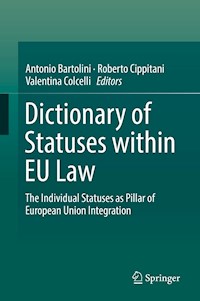
Dictionary of Statuses within EU Law E-Book
0,0
181,89 €
181,89 €
-100%
Sammeln Sie Punkte in unserem Gutscheinprogramm und kaufen Sie E-Books und Hörbücher mit bis zu 100% Rabatt.
Mehr erfahren.
Mehr erfahren.
- Herausgeber: Springer International Publishing
- Kategorie: Fachliteratur
- Sprache: Englisch
This Dictionary analyses the ways in which the statuses of European citizens are profoundly affected by EU law. The study of one’s particular status (as a worker, consumer, family member, citizen, etc.) helps to reconsider the legal notions concerning an individual’s status at the EU level. The Dictionary includes a foreword by Evgeni Tanchev, Advocate General at the Court of Justice of the European Union, which illustrates some interesting features of the Court’s case law on statuses.
The Dictionary’s core is composed of 79 chapters, published in alphabetical order. Each brief chapter analyses how the individual status was conditioned or created by contemporary EU law, or how the process of European integration modified the traditional juridical definition of the respective status.
The Dictionary provides answers to the following questions: Has the process of European integration modified the traditional juridical definition of individual status? Has the concept oflegal status now acquired a new function? What role has EU law played in developing a new modern function for the concept of individual status? Are the selection of a specific individual status by EU law and the proliferation of such statuses, which is synonymous with the creation of new privileges, collectively undermining the goal of achieving substantive equality between EU citizens? Does this constitute a return to the past? Under EU law, is it possible to create a uniform definition of the legal status of the person, over and above the definition that is provided by a given Member State’s legal system?
Das E-Book können Sie in einer beliebigen App lesen, die das folgende Format unterstützt:
Veröffentlichungsjahr: 2019
0,0
Bewertungen werden von Nutzern von Legimi sowie anderen Partner-Webseiten vergeben.
Legimi prüft nicht, ob Rezensionen von Nutzern stammen, die den betreffenden Titel tatsächlich gekauft oder gelesen/gehört haben. Wir entfernen aber gefälschte Rezensionen.
























