


1,99 €
Mehr erfahren.
- Herausgeber: Quickie Classics
- Kategorie: Sachliteratur, Reportagen, Biografien
- Sprache: Englisch
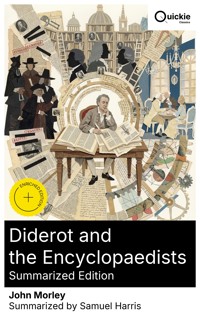
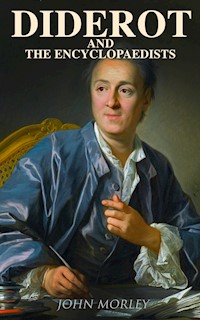
In Diderot and the Encyclopaedists (1878), John Morley offers a lucid intellectual biography of Denis Diderot and a history of the Encyclopédie, the Enlightenment's boldest machine for organizing knowledge. He reads Rameau's Nephew, Le Rêve de d'Alembert, Jacques le fataliste, the Salons, and technical entries alongside episodes of censorship and salon sociability. The style is Victorian but bracingly exact, blending narrative and moral analysis while profiling collaborators—d'Alembert, Voltaire, d'Holbach—and the project's materialist, secular ambitions. A leading Victorian liberal and editor of the Fortnightly Review, Morley writes with a reformer's sympathy for free inquiry and a respect for scientific method. His earlier portraits of Voltaire and Rousseau and his public advocacy for toleration and education inform a critical, non-hagiographic approach, grounded in letters, memoirs, and journalism that chart patronage, conflict, and clandestine presses. Scholars of intellectual history and literature, as well as curious newcomers, will find an authoritative, readable synthesis that clarifies how Enlightenment ideas met institutions. For its grasp of texts and contexts and its steady judgment, this remains a rewarding guide to Diderot, the Encyclopédie, and the making of modern secular culture. Quickie Classics summarizes timeless works with precision, preserving the author's voice and keeping the prose clear, fast, and readable—distilled, never diluted. Enriched Edition extras: Introduction · Synopsis · Historical Context · Brief Analysis · 4 Reflection Q&As · Editorial Footnotes.
Das E-Book können Sie in Legimi-Apps oder einer beliebigen App lesen, die das folgende Format unterstützen:
Veröffentlichungsjahr: 2026
Ähnliche








Diderot and the Encyclopaedists (Summarized Edition)
Table of Contents
Introduction
At the heart of Diderot and the Encyclopaedists lies a drama of intellect and authority, in which the desire to map all human knowledge collides with institutions determined to control what can be known, and John Morley follows that collision not as a tale of solitary genius but as a study of collaboration, controversy, and the stubborn costs of candor, tracing how a philosophy that exalts reason and inquiry must face the pressures of church, court, and custom, and how the making of a book becomes, in turn, an argument about how a society organizes truth.
Diderot and the Encyclopaedists is a work of literary biography and intellectual history by John Morley, composed in the late nineteenth century when Victorian scholars were reassessing the European Enlightenment. It studies eighteenth‑century France, with Parisian salons, academies, and printing houses as its principal stage, and places Denis Diderot at the center of a far‑reaching editorial enterprise. Morley writes from Britain to interpret a French movement, balancing narrative portraiture with critical appraisal. The result is neither fiction nor detached antiquarianism, but a sustained analysis of people, texts, and institutions that shaped the Encyclopédie and the broader conversation of the age.
Morley’s premise is straightforward: to recount how Diderot’s career, convictions, and friendships converged in the effort to assemble a comprehensive encyclopedia, and to consider what that effort reveals about the Enlightenment. Readers move through portraits of Diderot’s collaborators and contemporaries, the editorial puzzles of coordinating articles, and the pressures exerted by censorship. The voice is lucid and argumentative, with periodic pauses for measured evaluation. The style reflects wide reading and a preference for clear exposition over ornament. The tone remains principled yet patient, and the narrative keeps the focus on ideas in action rather than on gossip or digression.
Several themes recur with force. Knowledge is presented as a collective labor that depends on networks of trust, debate, and practical craft, not merely on brilliant insights. Reason confronts dogma, but Morley avoids caricature by attending to the social mechanisms that make dogma resilient. Censorship is treated not only as prohibition but as a set of constraints that shape strategy, rhetoric, and publication. The moral responsibilities of writers and editors are debated alongside questions about utility, taste, and scientific method. Throughout, the Encyclopédie serves as a case study in how ideas seek publics and how publics are created.
Methodically, Morley proceeds by synthesizing published writings, correspondence, and contemporary accounts, drawing lines between an individual’s temperament and the institutional settings that conditioned his work. He treats biography as an instrument for intellectual history, using episodes from Diderot’s life to illuminate philosophical commitments and editorial choices. The Victorian liberal perspective is evident in his respect for secular inquiry and civic reform, yet he is attentive to the frictions between theory and practice. The prose is steady and ample, favoring careful causation over epigram. Argument grows from evidence, and character studies are embedded in the textures of printing, patronage, and publicity.
For contemporary readers, the book resonates where it considers the circulation of expertise, the building of shared reference works, and the ethics of public reasoning. It speaks to enduring disputes about freedom of expression, the responsibilities of publishers and platforms, and the boundaries between criticism and offense. Morley’s attention to collaboration shows how large projects depend on compromise and design as much as on conviction. His account of institutional resistance clarifies why reforms provoke backlash and why persuasion requires patience. The work remains useful as a guide to thinking about knowledge infrastructures and as a reminder that intellectual courage is cumulative.
Approached as a narrative of ideas, Diderot and the Encyclopaedists rewards readers who want both context and argument. It is not a hagiography, nor a neutral chronicle; it is a disciplined attempt to evaluate a pivotal figure and a landmark project without losing sight of contingencies and limits. The pacing allows sustained reflection on episodes and texts, while the analysis keeps the stakes visible. Newcomers to Enlightenment studies will find a clear map; seasoned readers will find judicious synthesis. Above all, Morley offers a framework for reading Diderot and his circle with empathy sharpened by scrutiny and historical scale.
Synopsis
John Morley’s Diderot and the Encyclopaedists is a nineteenth-century study that interweaves an intellectual biography of Denis Diderot with a group portrait of the collaborators behind the Encyclopédie. Morley situates his subjects within the institutions, censorship regimes, and salon culture of the ancien régime, using a calm, documentary tone to explain how ideas traveled and were contested. He balances narrative with appraisal, tracing Diderot’s mind across philosophy, literature, and criticism while attending to the practical work of editing a monumental reference. Throughout, he brings a liberal historian’s concern for toleration, inquiry, and civic utility to his reading of the Enlightenment’s ambitions and limits.
Morley begins with Diderot’s formation, showing a restless intellect moving from odd jobs and translation to original speculation and controversy. The portrait emphasizes sociability, improvisation, and resourcefulness, alongside a growing independence from religious authority. A decisive episode is the state’s response to one of his early philosophical essays, which briefly confined him and clarified the risks attached to heterodox argument. Rather than dramatize, Morley uses the episode to mark the emergence of Diderot’s durable themes: the value of observation, suspicion of metaphysical system, and a humane ethics rooted in ordinary experience. The personal sketch anchors later chapters on editorial leadership and polemical stamina.
At the center stands the Encyclopédie, presented as both an intellectual map and a logistical enterprise. Morley recounts how Diderot joined with Jean le Rond d’Alembert to transform an initial translation scheme into a comprehensive, original survey of arts and sciences. He details the recruitment of contributors across trades and disciplines, the design of articles that elevated mechanical arts, and the crafting of cross-references that suggested a connected order of knowledge. The narrative tracks bouts of suppression and the careful protections afforded by sympathetic officials, together with the clandestine workarounds that kept printing alive. Editorial perseverance becomes a touchstone of Diderot’s character.
Turning to philosophy, Morley parses Diderot’s speculative writings as experiments rather than a closed system. Dialogues and essays probe sensation, physiology, and the formation of ideas, pressing toward a materialist view of mind while refusing dogmatic finality. Skepticism about theological claims coexists with a practical ethics grounded in sympathy and the social consequences of actions. Morley chronicles how these stances drew attack, yet he keeps emphasis on method: vivid example, conjecture tested by experience, and readiness to revise. The analysis sets Diderot in European debates over authority and empiricism without reducing him to a single school, highlighting flexibility as strength.
Morley gives sustained attention to Diderot as critic and artist, especially in theater and art. He shows how dramatic theory and practice aimed to dignify domestic life and moral conflict, and how an influential tract on acting explored the relation between feeling, technique, and truth on stage. The extensive Salon writings are treated as a new kind of art criticism, attentive to painterly means and viewer response, and written in a direct, animated style. Morley acknowledges volatility and excess alongside insight. He also surveys the prose fictions, noting their formal play and ethical provocation as extensions of the same exploratory temperament.
Beyond the central figure, Morley sketches the circle commonly called the philosophes, contrasting temperaments and strategies among allies and near-allies. The account includes mathematicians, men of letters, and naturalists, and it considers salons, patronage, publishers, and police as forces shaping what could be said. Points of friction—over religion, politics, style, or personal pride—are traced without sensationalism, illuminating how cooperation persisted despite quarrels. Morley’s judgments stress the movement’s civic aims: to rationalize institutions, reform education, and make useful knowledge public. He also records the unevenness of the enterprise and the compromises required to secure readers, privilege, and material production.
The study closes by weighing legacy rather than claiming direct causal lines. Morley credits Diderot’s editorial energy and intellectual curiosity with widening the range of legitimate questions and readers, and he treats the Encyclopédie as a durable symbol of collaborative inquiry under constraint. He notes limits of doctrine and temperament, yet he finds exemplary courage in the defense of criticism, candor, and secular instruction. Without collapsing history into prophecy, the book presents the movement’s lasting resonance in modern ideas of publicity, tolerance, and the dignity of work. Its enduring significance lies in showing how a culture of argument can be made and sustained.
Historical Context
John Morley’s subject unfolds in mid-eighteenth-century France, centered on Paris under the Bourbon monarchy of Louis XV. Royal censorship, administered through the Direction de la Librairie and supervised at times by Guillaume-Chrétien de Lamoignon de Malesherbes, shaped the book trade. The Sorbonne, the Parlement of Paris, and the Jesuit order guarded doctrinal boundaries, while salons such as those of Madame Geoffrin and Madame d’Épinay fostered exchange among savants and writers. Within this setting, the Enlightenment prized reason, experiment, and utility. The Encyclopédie project emerged as an ambitious attempt to map and disseminate knowledge across sciences, arts, and mechanical trades.
Denis Diderot, born in 1713 at Langres to a cutler’s family, was educated by Jesuits and earned a Master of Arts in Paris. He abandoned intended clerical or legal careers for literary work, translating and editing before publishing philosophical essays. His Lettre sur les aveugles (1749), questioning religious authority, led to arrest and confinement at Vincennes for several months. Diderot married Antoinette Champion in 1743 and entered circles of mathematician Jean le Rond d’Alembert, Baron d’Holbach, and other philosophes. By the early 1750s he had become the driving editor of the Encyclopédie, known for industrious coordination and practical curiosity.
The Encyclopédie grew from plans to translate and expand Ephraim Chambers’s Cyclopaedia (1728). A publishing consortium led by André Le Breton, with Laurent Durand, Michel-Antoine David, and Antoine-Claude Briasson, backed the venture. Diderot and d’Alembert announced the project in the Prospectus and issued the first volume in 1751, accompanied by d’Alembert’s Discours préliminaire outlining a tree of knowledge influenced by Bacon and Locke. Over a hundred contributors supplied articles, among them Voltaire, Rousseau, and Montesquieu. The enterprise aimed to integrate scientific advances with descriptions of crafts and manufactures, culminating in extensive engraved plates that documented tools, processes, and machines.
Official resistance followed early success. After two volumes, the Conseil d’État suspended the royal privilege in 1752 following denunciations from the Sorbonne and Jesuit writers. D’Alembert’s article “Genève,” praising Genevan pastors’ moderation, provoked controversy, and he withdrew from active editorship in 1758. In 1759 the papal Index condemned the Encyclopédie, and the French privilege was revoked; yet Malesherbes discreetly enabled continued work. Printer Le Breton also clandestinely altered or cut passages to placate censors. The seventeen text volumes were completed by 1765, and eleven volumes of plates appeared from 1762 to 1772, securing wide European circulation despite prohibitions.
The Encyclopedists worked amid vigorous debates over religion, morality, and political economy. Paris salons and Baron d’Holbach’s gatherings connected figures such as Helvétius, whose De l’Esprit (1758) was condemned by both Church and Parlement, and La Mettrie, advocate of materialist physiology. Questions about tolerance, utility, and education animated their articles. At the same time, the physiocrats around François Quesnay advanced a doctrine privileging agriculture and laissez-faire, influencing reform-minded officials. Institutional conflict was intense: the Parlement of Paris battled royal ministers, and the Jesuit order, a persistent critic of philosophes, was expelled from France in 1764, altering censorship dynamics.
European currents sharpened the Encyclopédie’s stakes. The Seven Years’ War (1756–1763) exposed fiscal weaknesses and stimulated debate about administration and science. Printed matter crossed borders through Dutch and Swiss channels, while Malesherbes sometimes granted permissions tacites to manage sensitive works. Diderot’s reputation reached courts: in 1765 Catherine II purchased his library, paying him a stipend as its lifetime custodian, and he visited St. Petersburg in 1773–1774 to discuss education and legislation. Knowledge circulated through reprints and compendia, including de Felice’s Encyclopédie d’Yverdon (1770–1780), extending the encyclopedic model and signaling demand for practical, secular instruction across the continent.
Morley wrote as a Victorian Liberal steeped in rationalist debate. Editor of the Fortnightly Review, he had already published studies of Voltaire (1872) and Rousseau (1873) before Diderot and the Encyclopaedists appeared in 1878. He drew on newly edited sources, notably the Assézat–Tourneux Oeuvres complètes de Diderot (1875–1877), and on correspondences and memoirs circulating in nineteenth-century editions. British controversies over evolution, secular education, and church establishments framed his interest in French freethought. Morley’s method combined biography with intellectual history, assessing arguments about tolerance, materialism, and reform in relation to institutions—courts, churches, academies, and the regulated press.
Viewed against this background, Morley’s book interprets Diderot’s editorial labor and the Encyclopedists’ network as a test of Enlightenment commitments under the Ancien Régime. He highlights practical knowledge, artisan skill, and the circulation of ideas as engines of improvement, while examining the interplay of censorship, patronage, and public opinion. The narrative underscores conflicts that shaped later calls for legal and educational reform without reducing them to foregone revolution. It reflects a late nineteenth-century liberal conviction that scrutiny of authority, open debate, and organized knowledge could advance civic life—and it critiques the era’s dogmas by recounting how they were contested.




