


0,49 €
Niedrigster Preis in 30 Tagen: 2,49 €
Niedrigster Preis in 30 Tagen: 2,49 €
Mehr erfahren.
- Herausgeber: Booksell-Verlag
- Kategorie: Geisteswissenschaft
- Sprache: Englisch
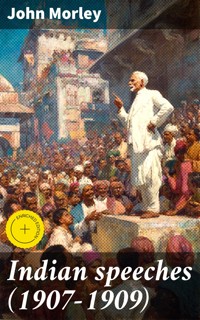
In "Indian Speeches (1907-1909)", John Morley presents a meticulously curated collection of his public addresses and writings focused on the pressing socio-political issues of India during the early 20th century. Rich with eloquence and vigorous rhetoric, Morley's prose navigates the complexities of colonial rule, advocating for reform and greater Indian participation in governance. The book captures the zeitgeist of a transformative era, deeply contextualizing the relationship between Britain and India, while illuminating the aspirations of an emerging nationalist consciousness. Morley's literary style is both passionate and scholarly, demonstrating an earnest commitment to justice and equity for the Indian populace amidst colonial hegemony. John Morley, a prominent British politician, author, and advocate for liberal reform, infused his work with profound insights garnered from his extensive political experiences. His role as a Secretary of State for India positioned him at the nexus of British-Indian relations, allowing him to witness firsthand the struggles and inequities faced by the Indian people. Through these speeches, Morley articulates a vision for a more equitable society, balancing empathy with the political pragmatism necessary for reform. For readers interested in colonial history, political discourse, and the intricate dynamics of British rule in India, "Indian Speeches (1907-1909)" offers a compelling exploration of the complexities of governance and the human drive for self-determination. Morley's carefully articulated arguments resonate with contemporary discussions about justice and representation, making this collection a timeless addition to both historical and political literature. In this enriched edition, we have carefully created added value for your reading experience: - A succinct Introduction situates the work's timeless appeal and themes. - The Synopsis outlines the central plot, highlighting key developments without spoiling critical twists. - A detailed Historical Context immerses you in the era's events and influences that shaped the writing. - A thorough Analysis dissects symbols, motifs, and character arcs to unearth underlying meanings. - Reflection questions prompt you to engage personally with the work's messages, connecting them to modern life. - Hand‐picked Memorable Quotes shine a spotlight on moments of literary brilliance. - Interactive footnotes clarify unusual references, historical allusions, and archaic phrases for an effortless, more informed read.
Das E-Book können Sie in Legimi-Apps oder einer beliebigen App lesen, die das folgende Format unterstützen:
Veröffentlichungsjahr: 2019
Ähnliche


















Indian speeches (1907-1909)
Table of Contents
Introduction
At its core, Indian Speeches (1907-1909) follows a liberal statesman’s attempt to reconcile imperial responsibility with India’s rising political aspirations, weighing order against liberty, continuity against change, and the obligations of distant authority against the claims of those governed, while seeking a constitutional path that could temper administrative fear, answer nationalist impatience, and persuade audiences in both Westminster and the subcontinent that reform grounded in principle and prudence might enlarge participation without unravelling the fabric of government, in a rhetoric that distills the dilemmas of public policy into an idiom of conscience and calculation.
Indian Speeches (1907-1909) is a collection of political addresses by John Morley, later Viscount Morley of Blackburn, delivered during his tenure as Secretary of State for India (1905–1910) and first published in 1909. As nonfiction, it belongs to the tradition of parliamentary oratory and ministerial statements, rooted in the constitutional life of the United Kingdom and the administrative realities of the British Raj. The setting is at once Westminster and the subcontinent, since the policies discussed in London were meant to shape governance in India. Readers encounter speeches crafted for legislative debate and public explanation at a pivotal moment in imperial reform.
The premise is straightforward yet rich: a senior minister presents, defends, and clarifies the rationale of British Indian policy during years of high scrutiny. The experience is that of sustained public reasoning—measured in tone, argumentative in structure, and attentive to competing pressures. Morley’s voice is lucid and steady, favoring definition of terms, careful distinctions, and appeals to constitutional principle alongside administrative practicality. The mood is sober rather than celebratory, with a preference for persuasion over polemic. As a record of political speech, the book rewards readers who appreciate the craft of state communication and the cadence of early twentieth-century parliamentary prose.
Several themes recur across the volume: the place of representative institutions in an empire, the limits and possibilities of gradual reform, and the ethical demands placed on governments that claim to rule by law. Morley argues from a liberal standpoint that seeks to widen consultation and accountability without precipitating institutional breakdown. The collection situates the case for changes associated with what became known as the Morley–Minto reforms, culminating in the Indian Councils Act of 1909, and explains their intended scope and safeguards. Throughout, abstract principles are tied to practical questions of administration, procedure, and the responsibilities borne by executive and legislative authorities.
Context matters, and these speeches emerge from a period of intense debate about the future of British India between 1907 and 1909. They respond to heightened political mobilization, official anxieties about stability, and the need to articulate a credible path for constitutional development. Without dramatization, Morley addresses the tension between security and liberty, and between centralized control and local participation. He contemplates how to include Indian voices more substantively within existing frameworks while maintaining coherence in policy. The result is a portrait of reform pursued deliberately, with an awareness that changes in representation and procedure would set precedents for governance well beyond the moment.
For contemporary readers, the book’s relevance lies in its sustained engagement with perennial questions: how institutions adapt to claims for inclusion, how leaders justify incremental change, and how political language shapes the horizon of possibility. The arguments resonate with modern debates about constitutional design, plural representation, and the balance between authority and consent. As a primary source, the speeches illuminate not only what policies were proposed but how they were framed for multiple audiences. The text invites reflection on the ethics of power, the rhetoric of reform, and the responsibilities of officials who must make decisions in the shadow of pressing demands and constrained options.
Approached today, Indian Speeches (1907-1909) can be read as both historical document and exercise in political reasoning. It will interest students of imperial history, constitutional development, and liberal thought, as well as readers curious about the language by which governments explain themselves. The collection rewards slow reading and contextual cross-checking with parliamentary records and the statutory changes of 1909. It offers analytical clarity rather than dramatic flourish, and it asks its audience to think with it, not merely about it. In doing so, it provides a durable window onto the methods, limits, and ambitions of reformist statecraft at a defining moment.
Synopsis (Selection)
Indian Speeches (1907–1909) collects addresses delivered by John Morley during his tenure as Secretary of State for India, a period marked by political ferment and administrative reassessment. The speeches, arranged chronologically, span parliamentary debates and public occasions, and trace the government’s response to unrest following the Partition of Bengal, the rise of nationalist agitation, and demands for constitutional change. Morley presents the policy aims of a Liberal administration committed to order and reform, laying out the guiding principles of justice, conciliation, and continuity with earlier pledges. The volume thus outlines a program that seeks to reconcile imperial responsibility with a measured expansion of Indian participation in governance.
Early speeches establish Morley’s framework: fidelity to the Proclamation of 1858, impartial administration regardless of race or creed, and firm opposition to coercion as policy. He outlines the limits and responsibilities of the India Office and the Viceroy’s government, insisting that reforms must suit Indian conditions while maintaining executive effectiveness. Budget statements highlight fiscal priorities, including railway expansion, irrigation projects, famine insurance, and careful control of military expenditure. Morley situates financial prudence within broader aims of economic development and public welfare, while affirming the centrality of law and order. Throughout, he links administrative improvements to the credibility of future constitutional adjustments.
As unrest intensifies, Morley addresses the balance between public security and political concessions. He condemns violence and incitement, insisting that reform must not be perceived as a reward for intimidation. At the same time, he rejects governing by panic, arguing that exceptional measures must be temporary, specific, and legally grounded. He defends limited steps to check sedition and conspiracies, while emphasizing judicial safeguards where feasible. Morley underscores the difference between peaceful agitation and criminal conspiracy, pointing to the government’s duty to protect life and property. This dual approach frames subsequent proposals: repression of terrorism on one hand, and the advancement of representative institutions on the other.
Central to the volume is the elaboration of constitutional reform culminating in the Indian Councils Act of 1909. Morley explains the intent to enlarge central and provincial legislative councils, increase the number of non-official and Indian members, and widen opportunities for interpellation, discussion of the budget, and debate on public measures. He stresses that these councils are not replicas of parliamentary government but instruments for training, consultation, and responsible criticism. The process he describes includes consultations with the Viceroy, provincial administrators, Indian leaders, and representatives of the princely states, with the goal of shaping a workable scheme that expands political space without weakening the core responsibilities of the executive.
A recurring theme is representation and the status of minorities. Morley discusses electoral arrangements designed to encourage broader participation while safeguarding communities with distinct interests. He defends provisions that recognize separate representation where necessary, presenting them as pragmatic safeguards rather than permanent constitutional fixtures. The speeches outline the rationale for mixed methods of election and nomination to ensure competence and balance. Morley emphasizes that the reforms aim to reduce distrust, open avenues for Indian opinion in legislation, and avoid friction by acknowledging social realities. He also clarifies the limits of change: the executive remains responsible to the Crown, not to the new councils.
Beyond constitutional design, Morley addresses administration and social policy. He supports gradual Indianization of the higher civil services, coupled with standards of merit and training. On education, he endorses university development and improved curricula as foundations for public life. Economic topics include land revenue policy, public works, and a cautious approach to tariffs, while emphasizing the importance of famine relief machinery and sanitary reforms. He notes progress in railways and irrigation as pillars of growth and security. The speeches link material development to political stability, asserting that trust in government is strengthened when administrative efficiency and fairness are visibly maintained across provinces and communities.
Morley’s parliamentary surveys also cover external and frontier questions that affect Indian governance. He outlines a restrained policy along the North-West Frontier, avoiding avoidable military entanglements while ensuring security. Relations with Afghanistan and Persia are treated in terms of strategic prudence rather than territorial ambition. Civil-military expenditures are scrutinized for economy and effectiveness. He relates these topics to the Indian budget, arguing that fiscal sustainability underpins any credible reform program. Throughout, he reiterates that imperial obligations abroad must not derail domestic development priorities or distort administrative focus within India.
As the reform scheme advances in 1908 and 1909, Morley addresses anxieties in Britain and India. He explains measures enacted against seditious propaganda and terrorist conspiracies, distinguishing them from lawful criticism and political association. He insists that reforms proceed on their merits, not as a concession to disorder. With his elevation to the House of Lords, he presents the Indian Councils Bill, detailing its clauses on council enlargement, powers of discussion, and electoral arrangements, along with safeguards for executive authority. The speeches record both the rationale for change and the engagement with critics who feared either excessive innovation or insufficient responsiveness to Indian aspirations.
The volume concludes with the passage and early interpretation of the 1909 Act. Morley summarizes its purpose as the creation of a broader, more responsible forum for Indian opinion under stable executive rule. He characterizes the reforms as an experiment to be tested by experience, neither a final constitutional settlement nor a symbolic gesture. The closing speeches reaffirm the government’s pledge to impartial justice, the rule of law, and steady development. They convey a consistent message: political inclusion and administrative efficiency must advance together, strengthening trust between rulers and ruled while laying foundations for future progress within a coherent, cautiously evolving constitutional framework.
Historical Context
John Morley’s Indian speeches were delivered between 1907 and 1909, when he served as Secretary of State for India in the Liberal administrations of Campbell-Bannerman and Asquith. They were spoken in the House of Commons until his elevation to the peerage in 1908, and thereafter in the House of Lords, as well as at select public gatherings in Britain. Their subject is British rule in India at a moment of acute unrest and reform. The geographic focus alternates between London’s India Office and parliamentary chambers, and the Indian centers of administration and protest, notably Calcutta, Bombay, and the Punjab. The collection captures the dialogue between metropolitan policy and colonial realities in late Edwardian imperial governance.
The Partition of Bengal, effected on 16 October 1905 by Viceroy Curzon, created the new province of Eastern Bengal and Assam with its capital at Dacca, provoking intense nationalist resistance. The Swadeshi movement (1905–1908) organized boycotts of British textiles, promoted indigenous industry, and founded national schools; leaders included Surendranath Banerjee, Bal Gangadhar Tilak, and Aurobindo Ghose. Strikes, picketing, and patriotic festivals reshaped civic life in Calcutta and beyond. In Indian Speeches (1907–1909), Morley repeatedly acknowledges the grievances generated by the partition and the economic force of Swadeshi, while refusing precipitous reversal. He frames the agitation as a political education of India’s middle classes that necessitated measured constitutional concessions without capitulation to disorder.
A crucial prelude to reform was Muslim political mobilization. On 1 October 1906 the Simla Deputation, led by Aga Khan III, petitioned Viceroy Lord Minto for recognition of Muslim political interests, notably separate electorates. Two months later, on 30 December 1906, the All-India Muslim League was founded at Dacca under the patronage of Nawab Salimullah. The League advocated safeguards to prevent majoritarian dominance within representative institutions. Morley’s speeches directly engage these developments, endorsing communal representation as a pragmatic measure to broaden participation. He argues in Parliament that accommodating distinct electorates would stabilize governance by integrating conservative Muslim elites into the new councils, thereby tempering the more radical currents unleashed by Swadeshi politics.
The Indian Councils Act of 1909, engineered by Morley in London and Viceroy Minto in India, enlarged legislative councils at the center and in the provinces, introduced an element of election alongside nomination, and permitted members to move resolutions and ask supplementary questions on the budget and administration. It also instituted separate electorates for Muslims. In 1909 Morley appointed S. P. Sinha to the Viceroy’s Executive Council, the first Indian to hold such office, symbolizing the policy of inclusion. The speeches in this volume present and defend the bill in the Commons and later in the Lords, casting it as political education rather than parliamentary government, and insisting on official majorities at the center to preserve executive control.
The Indian National Congress fractured at its Surat session in December 1907, as moderates led by Gopal Krishna Gokhale clashed with extremists aligned with Bal Gangadhar Tilak, Lala Lajpat Rai, and Bipin Chandra Pal over boycott tactics and constitutional strategy. Simultaneously, agrarian discontent in the Punjab, driven by canal colony policies and the Colonization Bill, triggered protests; in May 1907, Lajpat Rai and Ajit Singh were deported without trial under Regulation III of 1818. Morley’s speeches navigate these ruptures, defending executive powers used in Punjab while courting moderate Congressmen with promises of council reform. He interprets the Surat split as both a warning against revolutionary adventurism and an opportunity to strengthen constitutionalist interlocutors.
Revolutionary violence escalated in 1908. On 30 April 1908, Khudiram Bose and Prafulla Chaki targeted Magistrate Kingsford at Muzaffarpur; the bomb killed two civilians, Mrs and Miss Kennedy. The ensuing Alipore Bomb Case (1908–1909) prosecuted members of the Anushilan Samiti; Aurobindo Ghose was acquitted, while his brother Barindra Ghose and others received harsh sentences. Assassinations and bombings in Bengal and Maharashtra challenged colonial authority. In this collection, Morley condemns terror as politically futile and morally indefensible, yet pledges that reforms will not be derailed by outrage. He defends the legal process, emphasizing jury trials and appellate safeguards, to rebut claims that the Raj responded with indiscriminate repression.
To curb agitation, the Government of India enacted coercive measures: the Seditious Meetings Act (1907), the Newspapers (Incitement to Offences) Act (1908) to restrain incendiary presses, and the Criminal Law Amendment Act (1908) against unlawful associations. Deportations under Regulation III continued. In Britain, the assassination of Sir Curzon Wyllie by Madan Lal Dhingra on 1 July 1909 in London galvanized fears of transnational radicalism. Morley’s speeches justify these statutes as temporary instruments of order while warning against their overreach, insisting that press controls be judicially supervised and narrowly drawn. He links the Dhingra case to the urgency of countering extremism through both security and inclusion, arguing that political concessions reduce the constituency for violence.
As a social and political critique, the book exposes the contradictions of liberal imperialism. Morley dissects the rigidity of bureaucratic rule, the narrow social base of the Indian Civil Service, and the risk that communal and class divisions will be exacerbated if constitutional space remains closed to educated Indians. He indicts economic grievances revealed by Swadeshi and Punjab agrarian protests, yet resists populist shortcuts that might imperil legality. By defending representative councils while retaining executive checks, he critiques both reaction and revolution. The volume thus illuminates structural inequities of the era—limited participation, communal segmentation, and coercive law—while proposing calibrated reform as the ethical alternative to either stagnation or insurgent rupture.




