


5,00 €
Mehr erfahren.
- Herausgeber: Edizioni Aurora Boreale
- Kategorie: Geisteswissenschaft
- Sprache: Englisch
John Morley, 1st Viscount Morley of Blackburn, (1838-1923), was a British Liberal statesman, writer and newspaper editor.
Initially a journalist in the North of England and then editor of the newly Liberal-leaning
Pall Mall Gazette from 1880 to 1883, he was elected a Member of Parliament for the Liberal Party in 1883. He was Chief Secretary for Ireland in 1886 and between 1892 and 1895; Secretary of State for India between 1905 and 1910 and again in 1911; and Lord President of the Council between 1910 and 1914.
Morley was a Trustee of the British Museum from 1894 to 1921, Honorary Professor of Ancient Literature at the Royal Academy of Arts, member of the Royal Commission on Historical Manuscripts and Chancellor of the Victoria University of Manchester from 1908 until 1923. He was nominated for a Nobel Prize in Literature eleven times and received an honorary degree (LL.D.) from the University of St. Andrews in October 1902.
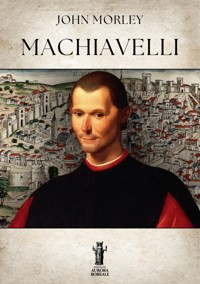
Machiavelli, the Morley’s essay which we propose to our readers today, dedicated to the life and personality of the great diplomat, philosopher, historian, writer of the Renaissance, internationally famous for his political work
The Prince, is based on a Romanes Lecture delivered by the British writer and statesman in the Sheldonian Theatre in Oxford on June 2, 1897.
Das E-Book können Sie in Legimi-Apps oder einer beliebigen App lesen, die das folgende Format unterstützen:
Veröffentlichungsjahr: 2025
Ähnliche


















SYMBOLS & MYTHS
JOHN MORLEY
MACHIAVELLI
Edizioni Aurora Boreale
Title:Machiavelli
Author: John Morley
Publishing series: Symbols & Myths
Editing by Nicola Bizzi
ISBN e-book edition: 979-12-5504-792-6
Edizioni Aurora Boreale
© 2025 Edizioni Aurora Boreale
Via del Fiordaliso 14 - 59100 Prato - Italia
www.auroraboreale-edizioni.com
INTRODUCTION BY THE PUBLISHER
John Morley, 1st Viscount Morley of Blackburn, OM, PC, FRS, FBA (1838-1923), was a British Liberal statesman, writer and newspaper editor.
Initially a journalist in the North of England and then editor of the newly Liberal-leaning Pall Mall Gazette from 1880 to 1883, he was elected a Member of Parliament (MP) for the Liberal Party in 1883. He was Chief Secretary for Ireland in 1886 and between 1892 and 1895; Secretary of State for India between 1905 and 1910 and again in 1911; and Lord President of the Council between 1910 and 1914.
Morley was a distinguished political commentator, and biographer of his hero, William Ewart Gladstone. He is best known for his writings and for his "reputation as the last of the great nineteenth-century Liberals". He opposed imperialism and the Second Boer War and supported Home Rule for Ireland. His opposition to British entry into the First World War as an ally of Russia led him to leave the government in August 1914.
Morley was born in Blackburn, Lancashire, the son of Jonathan Morley, a surgeon, and of Priscilla Mary (née Donkin). He attended Cheltenham College. While at Oxford, he quarrelled with his father over religion, and had to leave the university early without an honours degree; his father had wanted him to become a clergyman. He wrote, in obvious allusion to this rift, On Compromise (1874).
Morley was called to the bar by The Honourable Society of Lincoln's Inn in 1873, before deciding to pursue a career in journalism. He later described his decision to abandon the law "my long enduring regret". He edited the newly Radical-Liberal Pall Mall Gazette from 1880 to 1883, with William Thomas Stead as his assistant editor before going into politics.
Morley first stood for Parliament at the 1869 Blackburn by-election, a rare double by-election held after an election petition led to the results of the 1868 general election in Blackburn being voided. He was unsuccessful in Blackburn, and also failed to win a seat when he contested the City of Westminster at the 1880 general election. He was then elected as Liberal Member of Parliament (MP) for Newcastle upon Tyne at a by-election in February 1883.
Morley was a prominent Gladstonian Liberal. In Newcastle, his constituency association chairman was the effective Robert Spence Watson, a leader of the National Liberal Federation and its chairman from 1890 to 1902. Newcastle, however, was a dual member constituency and Morley's parliamentary colleague, Joseph Cowen, was a radical in perpetual conflict with the Liberal Party, who owned the Newcastle Daily Chronicle. Cowen attacked Morley from the left, and sponsored working men candidates on his retirement from the seat, showing favour to the local Tory candidate, Charles Hamond. Morley, with Watson's machine, withstood the Cowen challenge until the 1895 general election, when the tactics caused the ejection of Morley and the loss of Newcastle to the Tories.
In February 1886, Morley was sworn to the Privy Council and made Chief Secretary for Ireland, only to be turned out when Gladstone's government fell over Home Rule in July of the same year and Lord Salisbury became prime minister. After the severe defeat of the Gladstonian party at the 1886 general election, Morley divided his life between politics and letters until Gladstone's return to power at the 1892 general election, when he resumed as Chief Secretary for Ireland. He had during the interval taken a leading part in parliament, but his tenure of the chief secretaryship of Ireland was hardly a success. The Irish gentry made things as difficult for him as possible, and the path of an avowed Home Ruler installed in office at Dublin Castle was beset with pitfalls. In the internecine disputes that agitated the Liberal party during Lord Rosebery's administration and afterwards, Morley sided with Sir William Harcourt and was the recipient and practically co-signatory of his letter resigning the Liberal leadership in December 1898. He lost his seat in the 1895 general election but soon found another in Scotland, when he was elected at a by-election in February 1896 for the Montrose Burghs.
From 1889 onwards, Morley resisted the pressure from labour leaders in Newcastle to support a maximum working day of eight hours enforced by law. Morley objected to this because it would interfere in natural economic processes. It would be "thrusting an Act of Parliament like a ramrod into all the delicate and complex machinery of British industry". For example, an Eight Hours Bill for miners would impose on an industry with great diversity in local and natural conditions a universal regulation. He further argued that it would be wrong to "enable the Legislature, which is ignorant of these things, which is biased in these things—to give the Legislature the power of saying how many hours a day a man shall or shall not work".
Morley told trade unionists that the only right way to limit working hours was through voluntary action from them. His outspokenness against any eight hours bill, rare among politicians, brought him the hostility of labour leaders. In September 1891, two mass meetings saw labour leaders such as John Burns, Keir Hardie and Robert Blatchford all calling for action against Morley. In the election of 1892, Morley did not face a labour candidate but the Eight Hours League and the Social Democratic Federation supported the Unionist candidate. He kept his seat but came second to the Unionist candidate. When he was appointed to the government and the necessary by-election ensued, Hardie and other socialists advised working men to vote for the Unionist candidate (who supported an Eight Hours Bill for miners), but the Irish vote in Newcastle rallied to Morley and he comfortably kept his seat. After a vote on an Eight Hours Bill in the Commons in March 1892, Morley wrote: "That has taken place which I apprehended. The Labour party—that is, the most headstrong and unscrupulous and shallow of those who speak for labour—has captured the Liberal party. Even worse—the Liberal party, on our bench at any rate, has surrendered sans phrase, without a word of explanation or vindication".
John Morley
In 1880, Morley wrote to Auberon Herbert, an extreme opponent of state intervention, that "I am afraid that I do not agree with you as to paternal government. I am no partisan of a policy of incessant meddling with individual freedom, but I do strongly believe that in so populous a society as ours now is, you may well have a certain protection thrown over classes of men and women who are unable to protect themselves". In 1885, he spoke out against those Liberals who believed that all state intervention was wrong and proclaimed: "I am not prepared to allow that the Liberty and the Property Defence League are the only people with a real grasp of Liberal principles, that Lord Bramwell and the Earl of Wemyss are the only Abdiels of the Liberal Party". Later that year Morley defined his politics: "I am a cautious Whig by temperament, I am a Liberal by training, and I am a thorough Radical by observation and experience".




