


154,99 €
Mehr erfahren.
- Herausgeber: John Wiley & Sons
- Kategorie: Wissenschaft und neue Technologien
- Sprache: Englisch
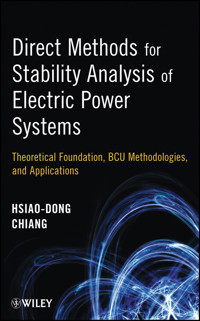
Learn how to implement BCU methods for fast direct stability assessments of electric power systems
Electric power providers around the world rely on stability analysis programs to help ensure uninterrupted service to their customers. These programs are typically based on step-by-step numerical integrations of power system stability models to simulate system dynamic behaviors. Unfortunately, this offline practice is inadequate to deal with current operating environments. For years, direct methods have held the promise of providing real-time stability assessments; however, these methods have presented several challenges and limitations.
This book addresses these challenges and limitations with the BCU methods developed by author Hsiao-Dong Chiang. To date, BCU methods have been adopted by twelve major utility companies in Asia and North America. In addition, BCU methods are the only direct methods adopted by the Electric Power Research Institute in its latest version of DIRECT 4.0.
Everything you need to take full advantage of BCU methods is provided, including:
-
Theoretical foundations of direct methods
-
Theoretical foundations of energy functions
-
BCU methods and their theoretical foundations
-
Group-based BCU method and its applications
-
Numerical studies on industrial models and data
Armed with a solid foundation in the underlying theory of direct methods, energy functions, and BCU methods, you'll discover how to efficiently solve complex practical problems in stability analysis. Most chapters begin with an introduction and end with concluding remarks, making it easy for you to implement these tested and proven methods that will help you avoid costly and dangerous power outages.
Sie lesen das E-Book in den Legimi-Apps auf:
Seitenzahl: 785
Veröffentlichungsjahr: 2011
Ähnliche



















Table of Contents
Cover
Table of Contents
Title page
Copyright page
Preface
Acknowledgments
Chapter 1 Introduction and Overview
1.1 INTRODUCTION
1.2 TRENDS OF OPERATING ENVIRONMENT
1.3 ONLINE TSA
1.4 NEED FOR NEW TOOLS
1.5 DIRECT METHODS: LIMITATIONS AND CHALLENGES
1.6 PURPOSES OF THIS BOOK
Chapter 2 System Modeling and Stability Problems
2.1 INTRODUCTION
2.2 POWER SYSTEM STABILITY PROBLEM
2.3 MODEL STRUCTURES AND PARAMETERS
2.4 MEASUREMENT-BASED MODELING
2.5 POWER SYSTEM STABILITY PROBLEMS
2.6 APPROACHES FOR STABILITY ANALYSIS
2.7 CONCLUDING REMARKS
Chapter 3 Lyapunov Stability and Stability Regions of Nonlinear Dynamical Systems
3.1 INTRODUCTION
3.2 EQUILIBRIUM POINTS AND LYAPUNOV STABILITY
3.3 LYAPUNOV FUNCTION THEORY
3.4 STABLE AND UNSTABLE MANIFOLDS
3.5 STABILITY REGIONS
3.6 LOCAL CHARACTERIZATIONS OF STABILITY BOUNDARY
3.7 GLOBAL CHARACTERIZATION OF STABILITY BOUNDARY
3.8 ALGORITHM TO DETERMINE THE STABILITY BOUNDARY
3.9 CONCLUSION
Chapter 4 Quasi-Stability Regions: Analysis and Characterization
4.1 INTRODUCTION
4.2 QUASI-STABILITY REGION
4.3 CHARACTERIZATION OF QUASI-STABILITY REGIONS
4.4 CONCLUSIONS
Chapter 5 Energy Function Theory and Direct Methods
5.1 INTRODUCTION
5.2 ENERGY FUNCTIONS
5.3 ENERGY FUNCTION THEORY
5.4 ESTIMATING STABILITY REGION USING ENERGY FUNCTIONS
5.5 OPTIMAL SCHEMES FOR ESTIMATING STABILITY REGIONS
5.6 QUASI-STABILITY REGION AND ENERGY FUNCTION
5.7 CONCLUSION
Chapter 6 Constructing Analytical Energy Functions for Transient Stability Models
6.1 INTRODUCTION
6.2 ENERGY FUNCTIONS FOR LOSSLESS NETWORK-REDUCTION MODELS
6.3 ENERGY FUNCTIONS FOR LOSSLESS STRUCTURE-PRESERVING MODELS
6.4 NONEXISTENCE OF ENERGY FUNCTIONS FOR LOSSY MODELS
6.5 EXISTENCE OF LOCAL ENERGY FUNCTIONS
6.6 CONCLUDING REMARKS
Chapter 7 Construction of Numerical Energy Functions for Lossy Transient Stability Models
7.1 INTRODUCTION
7.2 A TWO-STEP PROCEDURE
7.3 FIRST INTEGRAL-BASED PROCEDURE
7.4 ILL-CONDITIONED NUMERICAL PROBLEMS
7.5 NUMERICAL EVALUATIONS OF APPROXIMATION SCHEMES
7.6 MULTISTEP TRAPEZOIDAL SCHEME
7.7 ON THE CORRECTED NUMERICAL ENERGY FUNCTIONS
7.8 CONCLUDING REMARKS
Chapter 8 Direct Methods for Stability Analysis: An Introduction
8.1 INTRODUCTION
8.2 A SIMPLE SYSTEM
8.3 CLOSEST UEP METHOD
8.4 CONTROLLING UEP METHOD
8.5 PEBS METHOD
8.6 CONCLUDING REMARKS
Chapter 9 Foundation of the Closest UEP Method
9.1 INTRODUCTION
9.2 A STRUCTURE-PRESERVING MODEL
9.3 CLOSEST UEP
9.4 CHARACTERIZATION OF THE CLOSEST UEP
9.5 CLOSEST UEP METHOD
9.6 IMPROVED CLOSEST UEP METHOD
9.7 ROBUSTNESS OF THE CLOSEST UEP
9.8 NUMERICAL STUDIES
9.9 CONCLUSIONS
Chapter 10 Foundations of the Potential Energy Boundary Surface Method
10.1 INTRODUCTION
10.2 PROCEDURE OF THE PEBS METHOD
10.3 ORIGINAL MODEL AND ARTIFICIAL MODEL
10.4 GENERALIZED GRADIENT SYSTEMS
10.5 A CLASS OF SECOND-ORDER DYNAMICAL SYSTEMS
10.6 RELATION BETWEEN THE ORIGINAL MODEL AND THE ARTIFICIAL MODEL
10.7 ANALYSIS OF THE PEBS METHOD
10.8 CONCLUDING REMARKS
Chapter 11 Controlling UEP Method: Theory
11.1 INTRODUCTION
11.2 THE CONTROLLING UEP
11.3 EXISTENCE AND UNIQUENESS
11.4 THE CONTROLLING UEP METHOD
11.5 ANALYSIS OF THE CONTROLLING UEP METHOD
11.6 NUMERICAL EXAMPLES
11.7 DYNAMIC AND GEOMETRIC CHARACTERIZATIONS
11.8 CONCLUDING REMARKS
Chapter 12 Controlling UEP Method: Computations
12.1 INTRODUCTION
12.2 COMPUTATIONAL CHALLENGES
12.3 CONSTRAINED NONLINEAR EQUATIONS FOR EQUILIBRIUM POINTS
12.4 NUMERICAL TECHNIQUES FOR COMPUTING EQUILIBRIUM POINTS
12.5 CONVERGENCE REGIONS OF EQUILIBRIUM POINTS
12.6 CONCEPTUAL METHODS FOR COMPUTING THE CONTROLLING UEP
12.7 NUMERICAL STUDIES
12.8 CONCLUDING REMARKS
Chapter 13 Foundations of Controlling UEP Methods for Network-Preserving Transient Stability Models
13.1 INTRODUCTION
13.2 SYSTEM MODELS
13.3 STABILITY REGIONS
13.4 SINGULAR PERTURBATION APPROACH
13.5 ENERGY FUNCTIONS FOR NETWORK-PRESERVING MODELS
13.6 CONTROLLING UEP FOR DAE SYSTEMS
13.7 CONTROLLING UEP METHOD FOR DAE SYSTEMS
13.8 NUMERICAL STUDIES
13.9 CONCLUDING REMARKS
Chapter 14 Network-Reduction BCU Method and Its Theoretical Foundation
14.1 INTRODUCTION
14.2 REDUCED-STATE SYSTEM
14.3 ANALYTICAL RESULTS
14.4 STATIC AND DYNAMIC RELATIONSHIPS
14.5 DYNAMIC PROPERTY (D3)
14.6 A CONCEPTUAL NETWORK-REDUCTION BCU METHOD
14.7 CONCLUDING REMARKS
Chapter 15 Numerical Network-Reduction BCU Method
15.1 INTRODUCTION
15.2 COMPUTING EXIT POINTS
15.3 STABILITY-BOUNDARY-FOLLOWING PROCEDURE
15.4 A SAFEGUARD SCHEME
15.5 ILLUSTRATIVE EXAMPLES
15.6 NUMERICAL ILLUSTRATIONS
15.7 IEEE TEST SYSTEM
15.8 CONCLUDING REMARKS
Chapter 16 Network-Preserving BCU Method and Its Theoretical Foundation
16.1 INTRODUCTION
16.2 REDUCED-STATE MODEL
16.3 STATIC AND DYNAMIC PROPERTIES
16.4 ANALYTICAL RESULTS
16.5 OVERALL STATIC AND DYNAMIC RELATIONSHIPS
16.6 DYNAMIC PROPERTY (D3)
16.7 CONCEPTUAL NETWORK-PRESERVING BCU METHOD
16.8 CONCLUDING REMARKS
Chapter 17 Numerical Network-Preserving BCU Method
17.1 INTRODUCTION
17.2 COMPUTATIONAL CONSIDERATIONS
17.3 NUMERICAL SCHEME TO DETECT EXIT POINTS
17.4 COMPUTING THE MGP
17.5 COMPUTATION OF EQUILIBRIUM POINTS
17.6 NUMERICAL EXAMPLES
17.7 LARGE TEST SYSTEMS
17.8 CONCLUDING REMARKS
Chapter 18 Numerical Studies of BCU Methods from Stability Boundary Perspectives
18.1 INTRODUCTION
18.2 STABILITY BOUNDARY OF NETWORK-REDUCTION MODELS
18.3 NETWORK-PRESERVING MODEL
18.4 ONE DYNAMIC PROPERTY OF THE CONTROLLING UEP
18.5 CONCLUDING REMARKS
Chapter 19 Study of the Transversality Conditions of the BCU Method
19.1 INTRODUCTION
19.2 A PARAMETRIC STUDY
19.3 ANALYTICAL INVESTIGATION OF THE BOUNDARY PROPERTY
19.4 THE TWO-MACHINE INFINITE BUS (TMIB) SYSTEM
19.5 NUMERICAL STUDIES
19.6 CONCLUDING REMARKS
Chapter 20 The BCU–Exit Point Method
20.1 INTRODUCTION
20.2 BOUNDARY PROPERTY
20.3 COMPUTATION OF THE BCU–EXIT POINT
20.4 BCU–EXIT POINT AND CRITICAL ENERGY
20.5 BCU–EXIT POINT METHOD
20.6 CONCLUDING REMARKS
Chapter 21 Group Properties of Contingencies in Power Systems
21.1 INTRODUCTION
21.2 GROUPS OF COHERENT CONTINGENCIES
21.3 IDENTIFICATION OF A GROUP OF COHERENT CONTINGENCIES
21.4 STATIC GROUP PROPERTIES
21.5 DYNAMIC GROUP PROPERTIES
21.6 CONCLUDING REMARKS
Chapter 22 Group-Based BCU–Exit Method
22.1 INTRODUCTION
22.2 GROUP-BASED VERIFICATION SCHEME
22.3 LINEAR AND NONLINEAR RELATIONSHIPS
22.4 GROUP-BASED BCU–EXIT POINT METHOD
22.5 NUMERICAL STUDIES
22.6 CONCLUDING REMARKS
Chapter 23 Group-Based BCU–CUEP Methods
23.1 INTRODUCTION
23.2 EXACT METHOD FOR COMPUTING THE CONTROLLING UEP
23.3 GROUP-BASED BCU–CUEP METHOD
23.4 NUMERICAL STUDIES
23.5 CONCLUDING REMARKS
Chapter 24 Group-Based BCU Method
24.1 INTRODUCTION
24.2 GROUP-BASED BCU METHOD FOR ACCURATE CRITICAL ENERGY
24.3 GROUP-BASED BCU METHOD FOR CUEPS
24.4 NUMERICAL STUDIES
24.5 CONCLUDING REMARKS
Chapter 25 Perspectives and Future Directions
25.1 CURRENT DEVELOPMENTS
25.2 ONLINE DYNAMIC CONTINGENCY SCREENING
25.3 FURTHER IMPROVEMENTS
25.4 PHASOR MEASUREMENT UNIT (PMU)-ASSISTED ONLINE ATC DETERMINATION
25.5 EMERGING APPLICATIONS
25.6 CONCLUDING REMARKS
Appendix
A1.1 MATHEMATICAL PRELIMINARIES
A1.2 PROOFS OF THEOREMS IN CHAPTER 9
A1.3 PROOFS OF THEOREMS IN CHAPTER 10
Bibliography
Index
Copyright © 2011 John Wiley & Sons, Inc. All rights reserved.
Published by John Wiley & Sons, Inc., Hoboken, New Jersey
Published simultaneously in Canada
No part of this publication may be reproduced, stored in a retrieval system, or transmitted in any form or by any means, electronic, mechanical, photocopying, recording, scanning, or otherwise, except as permitted under Section 107 or 108 of the 1976 United States Copyright Act, without either the prior written permission of the Publisher, or authorization through payment of the appropriate per-copy fee to the Copyright Clearance Center, Inc., 222 Rosewood Drive, Danvers, MA 01923, (978) 750-8400, fax (978) 750-4470, or on the web at www.copyright.com. Requests to the Publisher for permission should be addressed to the Permissions Department, John Wiley & Sons, Inc., 111 River Street, Hoboken, NJ 07030, (201) 748-6011, fax (201) 748-6008, or online at http://www.wiley.com/go/permissions.
Limit of Liability/Disclaimer of Warranty: While the publisher and author have used their best efforts in preparing this book, they make no representations or warranties with respect to the accuracy or completeness of the contents of this book and specifically disclaim any implied warranties of merchantability or fitness for a particular purpose. No warranty may be created or extended by sales representatives or written sales materials. The advice and strategies contained herein may not be suitable for your situation. You should consult with a professional where appropriate. Neither the publisher nor author shall be liable for any loss of profit or any other commercial damages, including but not limited to special, incidental, consequential, or other damages.
For general information on our other products and services or for technical support, please contact our Customer Care Department within the United States at (800) 762-2974, outside the United States at (317) 572-3993 or fax (317) 572-4002.
Wiley also publishes its books in a variety of electronic formats. Some content that appears in print may not be available in electronic formats. For more information about Wiley products, visit our web site at www.wiley.com.
Library of Congress Cataloging-in-Publication Data is available.
ISBN: 978-0-470-48440-1
oBook ISBN: 978-0-470-87213-0
eBook ISBN: 978-0-470-87212-3
Preface
Power system instabilities are unacceptable to society. Indeed, recent major blackouts in North America and in Europe have vividly demonstrated that power interruptions, grid congestions, or blackouts significantly impact the economy and society. At present, stability analysis programs routinely used in utilities around the world are based mostly on steby-step numerical integrations of power system stability models to simulate system dynamic behaviors. This off-line practice is inadequate to deal with current operating environments and calls for online evaluations of changing overall system conditions.
Several significant benefits and potential applications are expected from the movement of transient stability analysis from the off-line mode to the online operating environment. However, this movement is a challenging task and requires several breakthroughs in measurement systems, analytical tools, computation methods, and control schemes. An alternate approach to transient stability analysis employing energy functions is called the direct method, or termed the energy function-based direct method. Direct methods offer several distinctive advantages. For example, they can determine transient stability without the time-consuming numerical integration of a (postfault) power system. In addition to their speed, direct methods can provide useful information regarding the derivation of preventive control and enhancement control actions for power system stability.
Direct methods have a long developmental history spanning six decades. Despite the fact that significant progress has been made, direct methods have been considered impractical by many researchers and users. Several challenges and limitations must be overcome before direct methods can become a practical tool. This book seeks to address these challenges and limitations.
The main purpose of this book is to present a comprehensive theoretical foundation for the direct methods and to develop comprehensive BCU solution methodologies along with their theoretical foundations. In addition, a comprehensive energy function theory, which is an extension of the Lyapunov function theory, is presented along with general procedures for constructing numerical energy functions for general power system transient stability models. It is believed that solving challenging practical problems efficiently can be accomplished through a thorough understanding of the underlying theory, in conjunction with exploring the special features of the practical problem under study to develop effective solution methodologies.
There are 25 chapters contained in this book. These chapters are classified into the following subjects:
The following stages of research and development can lead to fruitful and practical applications:
Stage 1. Development of theoretical foundations
Stage 2. Development of the solution methodology
Stage 3. Development of reliable methods to numerically implement the solution methodology
Stage 4. Software implementation and evaluation
Stage 5. Industry user interactions
Stage 6. Practical system installation
The first three stages are suitable for university and research institution application, while the last four stages are more suitable for commercial entities. This text focuses on Stages 1 and 2 and touches upon Stage 3. In the following volume, Stage 3 will be more thoroughly explored along with Stages 4 through 6.
HSIAO-DONG CHIANG
Ithaca, New York
May 2010
Acknowledgments
I started my work on direct methods for power system stability analysis while I was a Ph.D. student at the University of California, Berkeley. The advice I received from my advisors, Felix Wu and Pravin Varaiya, I carry with me to this day. Shankar Sastry’s instruction on nonlinear systems and Leon Chua’s instruction on nonlinear circuits were also very important to my research. In addition, I really appreciate the time Professor Morris Hirsch spent teaching me nonlinear dynamic systems and stability regions. He often spent many hours explaining the world of complex nonlinear phenomena to me, and he was a very inspirational role model.
Several PhD students at Cornell have made significant contributions to the development of the material presented in this book. In particular, I would like to acknowledge Dr. Chia-Chi Chu, Dr. Lazhar Fekih-Ahmed, Dr. Matthew Varghese, Dr. Ian Dobson, Dr. Weimin Ma, Dr. Rene Jean-Jumeau, Dr. Alexander J. Flueck, Dr. Karen Miu, Dr. Chih-Wen Liu, Dr. Jaewook Lee, Mr. Tim Conneen, and Mr. Warut Suampun. Without their hard work, this book would have been incomplete.
Likewise, my former BCU team research associates have made significant contribution to the development of the solution methodologies and the BCU method prototype. I would especially like to acknowledge Dr. Jianzhong Tong, Dr. Chen-Shan Wang, Dr. Yan Zheng, and Dr. Wei Ping. My continual exchange and discussion with Dr. Jianzhong Tong on the general topics of power system dynamic security assessments and control were very enlightening. Furthermore, my joint work with Dr. Hua Li over the past several years has been instrumental to overcoming the challenges of applying the BCU method to practical applications, and he has made significant contribution to the development of groubased BCU methods. My joint work with Dr. Byoung-Kon Choi on the development of new forms of energy functions and the prototype for a new numerical implementation of the BCU method has been very fruitful. Similarly, my discussions with Dr. Bernie Lesieutre, Dr. Zhou Yun, and Dr. Yoshi Suzuki have been very insightful. Dr. Lesieutre and his team’s work on the one-parameter transversality condition of the BCU method has been inspirational, and my discussions with Professor Lounan Chen on DAE systems have been invaluable. Lastly, I am greatly indebted to Dr. Luis Fernando Costa Alberto for visiting me every year and for working with me on the areas of stability regions, the BCU method, and direct methods. His insightful and constructive perspective, I believe, will lead to new developments in these areas.
My research associates at the Tokyo Electric Power Company (TEPCO) have been extremely instrumental to the development of TEPCO-BCU and its practical applications in real-world power system models. I would like to express my thanks and appreciation to the following: Dr. Yasuyuki Tada, Dr. Takeshi Yamada, Dr. Ryuya Tanabe, Dr. Hiroshi Okamoto, Dr. Kaoru Koyanagi, Dr. Yicheng Zhou, Mr. Atsushi Kurita, and Mr. Tsuyoshi Takazawa. My working experience with the TEPCO-BCU team has been truly remarkable. In particular, I am grateful for the continued support, guidance, and vision Dr. Tada has given me all these years. I would also like to thank Mr. Yoshiharu Tachibana and Mr. Kiyoshi Goto, general managers of the R&D center at TEPCO, for their great vision and continued support of my work.
A special thanks goes to my industry friends and associates who have taught me the practical aspects of power system stability problems. Through our joint research and development, I have learned a great deal from them. In particular, I would like to thank Mr. Gerry Cauley, Dr. Neal Balu, Dr. Peter Hirsch, Dr. Tom Schneider, Dr. Ron Chu, Dr. Mani Subramanian, Dr. Dan Sobajic, Dr. Prabha Kundur, Mr. Kip Morison, Dr. Lei Wang, Dr. Ebrahim Vaahedi, Mr. Carson Taylor, Mr. Dave Takash, Mr. Tom Cane, Dr. Martin Nelson, Dr. Soumen Ghosh, Dr. Jun Wu, Mr. Chi Tang, and Mr. William Price. In addition, I would like to thank Mr. Yakout Mansour for his advice on working with 12,000-bus power systems to gain insight into the practical aspects of power systems. His advice has helped shape my research and development these last 15 years.
I am very grateful to Director Chia-Jen Lin and to Director Anthony Yuan-Tian Chen of the Department of System Planning at the Tai-Power Company for their support and for sharing their practical experience with me. My joint research work with China’s Electric Power Research Institute (EPRI) in the 1990s was very enjoyable. I would like to thank Mr. Zhou Xiao-Xin, Mr. Zhang Wen-Tao, Mr. Ying Young-Hua, and Mr. Tang Yong. My joint work on the practical application of BCU methods with Si-Fang Automation of Beijing has also been very constructive. In particular, I would like to express my appreciation to Professor Yang Qi-Xun, Professor Wang Xu-Zhao, Mr. Zhang You, Dr. Wu Jing-Tao, Mr. Qi Wen-Bin, and Mr. Sheng Hao.
My academic colleagues have also been a guiding source of support and encouragement. I am very thankful to my colleagues at Cornell University. My working relationship with Professor James S. Thorp and Professor Robert J. Thomas has been very fruitful. In encouraging my work on both the practical and theoretical aspects of power systems, they have inspired my active work on practical applications of nonlinear system theory and nonlinear computation. I thank Professor Peter Sauer for his great advice and guidance over the years and Professor Chen-Ching Liu, who was a great mentor during my early career and who, since then, has become a good friend. Moreover, I would like to thank Professors Anjan Bose, Christ DeMarco, Joe Chow, Robert Fischl, Frank Mercede, David Hill, Ian Hiskens, Vijay Vittal, Aziz Fouad, Maria Pavella, Xia Dao-Zhi, Han Zhen Xiang, Liu Shen, Xue Yu-Shang, Min Yong, Gan Dequing, Li Yinhong, Shi Dong-Yuan, and M. A. Pai for their technical insight into direct methods.
Finally, I would like to thank my family, especially my grandfather Chiang Ah Mu, for their love, sacrifice, and unwavering support.
H-D. C.
Chapter 1
Introduction and Overview
1.1 INTRODUCTION
Power system instabilities are unacceptable to society. Indeed, recent major blackouts in North America and in Europe have vividly demonstrated that power interruptions, grid congestions, or blackouts significantly impact the economy and society. In August 1996, disturbances cascaded through the West Coast transmission system, causing widespread blackouts that cost an estimated $2 billion and left 12 million customers without electricity for up to 8 h. In June 1998, transmission system constraints disrupted the wholesale power market in the Midwest, causing price rises from an average of $30 per megawatt hour to peaks as high as $10,000 per megawatt hour. Similar price spikes also occurred in the summers of 1999 and 2000. In 2003, the Northeast blackout left 50 million customers without electricity and the financial loss was estimated at $6 billion. According to a research firm, the annual cost of power outages and fluctuations worldwide was estimated to be between $119 and $188 billion yearly. Power outages and interruptions clearly have significant economic consequences for society.
The ever-increasing loading of transmission networks coupled with a steady increase in load demands has pushed the operating conditions of many worldwide power systems ever closer to their stability limits. The combination of limited investment in new transmission and generation facilities, new regulatory requirements for transmission open access, and environmental concerns are forcing transmission networks to carry more power than they were designed to withstand. This problem of reduced operating security margins is further compounded by factors such as (1) the increasing number of bulk power interchange transactions and non-utility generators, (2) the trend towards installing higher-output generators with lower inertia constants and higher short circuit ratios, and (3) the increasing amount of renewable energies. Under these conditions, it is now well recognized that any violation of power system dynamic security limits leads to far-reaching consequences for the entire power system.
By nature, a power system continually experiences two types of disturbances: event disturbances and load variations. Event disturbances (contingencies) include loss of generating units or transmission components (lines, transformers, and substations) due to short circuits caused by lightning, high winds, and failures such as incorrect relay operations, insulation breakdowns, sudden large load changes, or a combination of such events. Event disturbances usually lead to a change in the network configuration of the power system due to actions from protective relays and circuit breakers. They can occur as a single equipment (or component) outage or as multiple simultaneous outages when taking relay actions into account. Load variations are variations in load demands at buses and/or power transfers among buses. The network configuration may remain unchanged after load variations. Power systems are planned and operated to withstand certain disturbances. The North American Electric Reliability Council defines security as the ability to prevent cascading outages when the bulk power supply is subjected to severe disturbances. Individual reliability councils establish the types of disturbances that their systems must withstand without cascading outages.
A major activity in power system planning and operation is the examination of the impact a set of credible disturbances has on a power system’s dynamic behavior such as stability. Power system stability analysis is concerned with a power system’s ability to reach an acceptable steady state (operating condition) following a disturbance. For operational purposes, power system stability analysis plays an important role in determining the system operating limits and operating guidelines. During the planning stage, power system stability analysis is performed to assess the need for additional facilities and the locations at which additional control devices to enhance the system’s static and dynamic security should be placed. Stability analysis is also performed to check relay settings and to set the parameters of control devices. Important conclusions and decisions about power system operations and planning are made based on the results of stability studies.
Transient stability problems, a class of power system stability problems, have been a major operating constraint in regions that rely on long-distance transfers of bulk power (e.g., in most parts of the Western Interconnection in the United States, Hydro-Québec, the interfaces between the Ontario/New York area and the Manitoba/Minnesota area, and in certain parts of China and Brazil). The trend now is that many parts of the various interconnected systems are becoming constrained by transient stability limitations. The wave of recent changes has caused an increase in the adverse effects of both event disturbances and load variations in power system stability. Hence, it is imperative to develop powerful tools to examine power system stability in a timely and accurate manner and to derive necessary control actions for both preventive and enhancement control.
1.2 TRENDS OF OPERATING ENVIRONMENT
The aging power grid is vulnerable to power system disturbances. Many transformers in the grid approach or surpass their design life. The transmission system is often under-invested and overstrained. These result in vulnerable power grids constantly operating near their operating limits. In addition, this operating environment encounters more challenges brought about by dispersed generations whose prime movers can be any renewable energy source such as wind power. As is well recognized, these small-size dispersed generation systems raise even greater concerns of power system stability. Hence, with current power system operating environments, it is increasingly difficult for power system operators to generate all the operating limits for all possible operating conditions under a list of credible contingencies.
At present, most energy management systems periodically perform online power system static security assessment (SSA) and control to ensure that the power system can withstand a set of credible contingencies. The assessment involves selecting a set of credible contingencies and evaluating the system’s response to those contingencies. Various software packages for security assessment and control have been implemented in modern energy control centers. These packages provide comprehensive online security analysis and control based almost exclusively on steady-state analysis, making them applicable to SSA and control but not to online transient stability assessment (TSA). Instead, off-line transient stability analysis has been performed for postulated operating conditions. The turn-around time for a typical study can range from hours to days depending on the number of postulated operating conditions and the dynamic study period of each contingency. This off-line practice is inadequate to deal with current operating environments and calls for online evaluations of the constantly changing overall system conditions.
The lack of performing online TSAs in an energy management system can have serious consequences. Indeed, any violation of dynamic security limits has far-reaching impacts on the entire power system and thus on the society. From a financial viewpoint, the costs associated with a power outage can be tremendous. Online dynamic security assessment is an important tool for avoiding dynamic security limit violations. It is fair to say that the more stressed a power system, the stronger the need for online dynamic security assessments.
Several significant benefits and potential applications are expected from the movement of transient stability analysis from the off-line mode to the online operating environment. The first benefit is that a power system can be operated with operating margins reduced by a factor of 10 or more if the dynamic security assessment is based on the actual system configuration and actual operating conditions instead of assumed worst-case conditions, as is done in off-line studies. This ability is especially significant since current environments have pushed power systems to operate with low reserve margins closer to their stability limits. A second benefit to online analysis is that the large number of credible contingencies that needs to be assessed can be reduced to those contingencies relevant to actual operating conditions. Important consequences obtained from this benefit are that more accurate operating margins can be determined and more power transfers among different areas, or different zones of power networks, can be realized. Compared to off-line studies, online studies require much less engineering resources, thereby freeing these resources for other critical activities.
1.3 ONLINE TSA
Online TSA is designed to provide system operators with critical system stability information including (1) TSA of the current operating condition subject to a list of contingencies and (2) available (power) transfer limits at key interfaces subject to transient stability constraints. A complete online TSA assessment cycle is typically in the order of minutes, say, 5 min. This cycle starts when all necessary data are available to the system and ends when the system is ready for the next cycle. Depending on the size of the underlying power systems, it is estimated that, for a large-size power system such as a 15,000-bus power system, the number of contingencies in a contingency list is between 2000 and 3000. The contingency types will include both a three-phase fault with primary clearance and a single line-to-ground fault with backup clearance.
When a cycle of online TSA is initiated, a list of credible contingencies, along with information from the state estimator and topological analysis, is applied to the online TSA program whose basic function is to identify unstable contingencies from the contingency list. An operating condition is said to be transiently stable if the contingency list contains no unstable contingencies; otherwise, it is transiently unstable. The task of online TSA, however, is very challenging.
The strategy of using an effective scheme to screen out a large number of stable contingencies, capture critical contingencies, and apply detailed simulation programs only to potentially unstable contingencies is well recognized. This strategy has been successfully implemented in online SSA. The ability to screen several hundred contingencies to capture tens of the critical contingencies has made the online SSA feasible. This strategy can be applied to online TSA. Given a set of credible contingencies, the strategy would break the task of online TSA into two stages of assessments (Chadalavada et al., 1997; Chiang et al., 1997):
Step 1. Perform the task of dynamic contingency screening to quickly screen out contingencies that are definitely stable from a set of credible contingencies.
Step 2. Perform detailed assessment of dynamic performance for each contingency remaining in Stage 1.
Dynamic contingency screening is a fundamental function of an online TSA system. The overall computational speed of an online TSA system depends greatly on the effectiveness of the dynamic contingency screening, the objective of which is to identify contingencies that are definitely stable and thereby to avoid further stability analysis for these contingencies. It is due to the definite classification of stable contingencies that considerable speedup can be achieved for TSA. Contingencies that are either undecided or identified as critical or unstable are then sent to the time–domain transient stability simulation program for further stability analysis.
Online TSA can provide an accurate determination of online transfer capability constrained by transient stability limits. This accurate calculation of transfer capability allows remote generators with low production cost to be economically dispatched to serve load centers. We consider a hypothetical power system containing a remote generator with low production cost, say, a hydro generator of $2 per megawatt hour and a local generator with a high production cost of $5 per megawatt hour that all supply electricity to a load center of 2500 MW (see Figure 1.1). According to the off-line analysis, the transfer capability between the remote generator and the load center was 2105 MW. With a 5% security margin, the output of the remote generator was set to 2000 MW. The local generator then needs to supply 500 MW to the load center to meet the load demand. On the other hand, the actual transfer capability between the remote generator and the load center, according to online TSA, was 2526 MW instead of 2105 MW. With a 5% security margin, the output of the remote generator was set to 2400 MW, while the output of the local generator was set to 100 MW to meet the load demand. By comparing these two different schemes of real power dispatch based on two different transfer capability calculations, the difference in production cost is about $1200 per hour or $28,800 per day. It can be observed that even for such a relatively small load demand of 2500 MW, online TSA allows for significant financial savings amounting to about $10.5 million per year. We recognize that practical power systems may not resemble this hypothetical power system; however, it does illustrate the significant financial benefits of online TSA.
Figure 1.1 A hypothetical power system and analysis of financial savings.
1.4 NEED FOR NEW TOOLS
At present, stability analysis programs routinely used in utilities around the world are based mostly on step-by-step numerical integrations of power system stability models used to simulate system dynamic behaviors. This practice of power system stability analysis based on the time–domain approach has a long history. The stability of the postfault system is assessed based on simulated postfault trajectories. The typical simulation period for the postfault system is 10 s and can go beyond 15 s if multiswing instability is of concern, making this conventional approach rather time-consuming.
The traditional time–domain simulation approach has several disadvantages. First, it requires intensive, time-consuming computation efforts; therefore, it has not been suitable for online application. Second, it does not provide information as to how to derive preventive control when the system is deemed unstable nor how to derive enhancement control when the system is deemed critically stable, and finally, it does not provide information regarding the degree of stability (when the system is stable) and the degree of instability (when the system is unstable) of a power system. This information is valuable for both power system planning and operation.
From a computational viewpoint, online TSA involves solving a large set of mathematical models, which is described by a large set of nonlinear differential equations in addition to the nonlinear algebraic equations involved in the SSA. For a 14,000-bus power system transient stability model, one dynamic contingency analysis can involve solving a set of 15,000 differential equations and 40,000 nonlinear algebraic equations for a time duration of 10–20 s in order to assess the power system stability under the study contingency. Online TSA requires the ability to analyze hundreds or even thousands of contingencies every 5–10 min using online data and system state estimation results. Thus, the traditional time–domain simulation approach cannot meet this requirement.
The computational effort required by online TSA is roughly three magnitudes higher than that of the SSA. This explains why TSA has long remained an off-line activity instead of an online activity in the energy management system. Extending the functions of energy management systems to take into account online TSA and control is a challenging task and requires several breakthroughs in measurement systems, analytical tools, computation methods, and control schemes.
1.5 DIRECT METHODS: LIMITATIONS AND CHALLENGES
An alternate approach to transient stability analysis employing energy functions, called direct methods, or termed energy function-based direct methods, was originally proposed by Magnusson (1947) in the late 1940s and was pursued in the 1950s by Aylett (1958). Direct methods have a long developmental history spanning six decades. Significant progress, however, has been made only recently in the practical application of direct methods to transient stability analysis. Direct methods can determine transient stability without the time-consuming numerical integration of a (postfault) power system. In addition to their speed, direct methods also provide a quantitative measure of the degree of system stability. This additional information makes direct methods very attractive when the relative stability of different network configuration plans must be compared or when system operating limits constrained by transient stability must be calculated quickly. Another advantage to direct methods is that they provide useful information regarding the derivation of preventive control actions when the underlying power system is deemed unstable and the derivation of enhancement control actions when the underlying power system is deemed critically stable.
Despite the fact that significant progress has been made in energy function-based direct methods over the last several decades, they have been considered impractical by many researchers and users for power system applications. Indeed, direct methods must overcome several challenges and limitations before they can become a practical tool.
From an analytical viewpoint, direct methods were originally developed for power systems with autonomous postfault systems. As such, there are several challenges and limitations involved in the practical applications of direct methods for power system transient stability analysis, some of which are inherent to these methods while others are related to their applicability to power system models. These challenges and limitations can be classified as follows:
Challenges
The modeling challengeThe function challengeThe reliability challengeLimitations
The scenario limitationThe condition limitationThe accuracy limitationThe modeling challenge stems from the requirement that there exists an energy function for the (postfault) transient stability model of study. However, the problem is that not every (postfault) transient stability model admits an energy function; consequently, simplified transient stability models have been used in direct methods. A major shortcoming of direct methods in the past has been the simplicity of the models they can handle. Recent work in this area has made significant advances. The current progress in this direction is that a general procedure of constructing numerical energy functions for complex transient stability models is available. This book will devote Chapters 6 and 7 to this topic.
The function limitation stipulates that direct methods are only applicable to first swing stability analysis of power system transient stability models described by pure differential equations. Recent work in the development of the controlling UEP method has extended the first-swing stability analysis into a multiswing stability analysis. In addition, the controlling UEP method is applicable to power system transient stability models described by differential and algebraic equations. This book will devote Chapters 11 through 13 to this topic.
The scenario limitation for direct methods comes from the requirement that the initial condition of a study postfault system must be available and the requirement that the postfault system must be autonomous. It is owing to the requirement of the availability of the initial condition that makes numerical integration of the study fault-on system a must for direct methods. Hence, the initial condition of a study postfault system can only be obtained via the time–domain approach and cannot be available beforehand. On the other hand, the requirement that the postfault system be autonomous imposes the condition that the fault sequence on the system must be well-defined in advance. Currently, the limitation that the postfault system must be an autonomous dynamical system is partially removed. In particular, the postfault system does not need to be a “pure” autonomous system and it can be constituted by a series of autonomous dynamical systems.
The condition limitation is an analytical concern related to the required conditions for postfault power systems: a postfault stable equilibrium point must exist and the prefault stable equilibrium point must lie inside the stability region of the postfault stable equilibrium point. This limitation is inherent to the foundation of direct methods. Generally speaking, these required conditions are satisfied on stable contingencies, while they may not be satisfied on unstable contingencies. From an application viewpoint, this condition limitation is a minor concern and direct methods can be developed to overcome this limitation.
The accuracy limitation stems from the fact that analytical energy functions for general power system transient stability models do not exist. Regarding the accuracy limitation, it has been observed in numerous studies that the controlling UEP method, in conjunction with appropriate numerical energy functions, yields accurate stability assessments. Numerical energy functions are practically useful in direct methods. In this book, methods and procedures to construct accurate numerical energy functions will be presented.
The reliability challenge is related to the reliability of a computational method in computing the controlling UEP for every study contingency. From a theoretical viewpoint, this text will demonstrate the existence and uniqueness of the controlling UEP with respect to a fault-on trajectory. Furthermore, the controlling UEP is independent of the energy function used in the direct stability assessment. Hence, the task of constructing an energy function and the task of computing the controlling UEP are not interrelational. From a computational viewpoint, the task of computing the controlling UEP is very challenging. We will present in Chapter 12 the computational challenges in computing the controlling UEP. A total of seven challenges in computing the controlling UEP will be highlighted. These challenges call into doubt the correctness of any attempt to directly compute the controlling UEP of the original power system stability model. This analysis serves to explain why previous methods proposed in the literature fail to compute the controlling UEP.
The above analysis reveals three important implications for the development of a reliable numerical method for computing controlling UEPs:
1. These computational challenges should be taken into account in the development of numerical methods for computing the controlling UEP.
2. It is impossible to directly compute the controlling UEP of a power system stability model without using the iterative time–domain method.
3. It is possible to directly compute the controlling UEP of an artificial, reduced-state power system stability model without using the iterative time–domain method.
In this book, it will be shown that it is fruitful to develop a tailored solution algorithm for finding the controlling UEPs by exploiting special properties as well as some physical and mathematical insights into the underlying power system stability model. We will discuss in great detail such a systematic method, called the BCU method, for finding controlling UEPs for power system models in Chapters 14 through 17. The BCU method does not attempt to directly compute the controlling UEP of a power system stability model (original model); instead, it computes the controlling UEP of a reduced-state model and relates the computed controlling UEP to the controlling UEP of the original model. This book will devote Chapters 14 through 24 to present the following family of BCU methods:
The BCU methodThe BCU–exit point methodThe group-based BCU–exit point methodThe group-based BCU–CUEP methodThe group-based BCU methodThis book will also explain how to develop tailored solution methodologies by exploring special properties as well as some physical and mathematical insights into the underlying power system stability model. For instance, it will be explained how the group properties of contingencies in power systems are discovered. These group properties will be explored and incorporated into the development of a group-based BCU method. This exploration of group properties leads to a significant reduction in computational efforts for reliably computing controlling UEPs for a group of coherent contingencies and to the development of effective preventive control actions against a set of insecure contingencies and enhancement control actions for a set of critical contingencies.
1.6 PURPOSES OF THIS BOOK
The main purpose of this book is to present a comprehensive theoretical foundation for direct methods and to develop comprehensive BCU solution methodologies along with their theoretical foundations. BCU methodologies have been developed to reliably compute controlling UEPs and to reliably compute accurate critical values, which are essential pieces of information needed in the controlling UEP method. In addition, a comprehensive energy function theory, which is an extension of the Lyapunov function theory, is presented along with a general procedure for constructing numerical energy functions for general power system transient stability models.
This author believes that solving challenging practical problems efficiently can be accomplished through a thorough understanding of the underlying theory, in conjunction with exploring the special features of the practical problem under study, to develop effective solution methodologies. This book covers both a comprehensive theoretical foundation for direct methods and comprehensive BCU solution methodologies.
There are 25 chapters contained in this book. These chapters can be classified into the following (see Figure 1.2):
Chapter 2: System Modeling and Stability Problems
Theory of Stability Regions
Chapter 3: Lyapunov Stability and Stability Regions of Nonlinear Dynamical Systems
Chapter 4: Quasi-Stability Regions: Analysis and Characterization
Energy Functions: Theory and Constructions
Chapter 5: Energy Function Theory and Direct Methods
Chapter 6: Constructing Analytical Energy Functions for Transient Stability Models
Chapter 7: Construction of Numerical Energy Functions for Lossy Transient Stability Models
Direct Methods: Introduction and Foundations
Chapter 8: Direct Methods for Stability Analysis: An Introduction
Chapter 9: Foundation of the Closest UEP Method
Chapter 10: Foundations of the Potential Energy Boundary Surface Method
Controlling UEP Method: Theoretical Foundation and Computation
Chapter 11: Controlling UEP Method: Theory
Chapter 12: Controlling UEP Method: Computations
Chapter 13: Foundations of Controlling UEP Methods for Network-Preserving Transient Stability Models
BCU Methods: Methodologies and Theoretical Foundations
Chapter 14: Network-Reduction BCU Method and Its Theoretical Foundation
Chapter 15: Numerical Network-Reduction BCU Method
Chapter 16: Network-Preserving BCU Method and Its Theoretical Foundation
Chapter 17: Numerical Network-Preserving BCU Method
Chapter 18: Numerical Studies of BCU Methods from Stability Boundary
Perspectives
Chapter 19: Study of Transversality Conditions of the BCU Method
Chapter 20: The BCU–Exit Point Method
Group-Based BCU Methods: Group Properties and Methodologies
Chapter 21: Group Properties of Contingencies in Power Systems
Chapter 22: Group-Based BCU–Exit Method
Chapter 23: Group-Based BCU–CUEP Methods
Chapter 24: Group-Based BCU Method
Chapter 25: Perspectives and Future Directions
Figure 1.2 An overview of the organization and content of this book.
In summary, this book presents the following theoretical developments as well as solution methodologies with a focus on practical applications for the direct analysis of large-scale power system transient stability; in particular, this book
provides a general framework for general direct methods, particularly the controlling UEP method;develops a comprehensive theoretical foundation for the controlling UEP method, the potential energy boundary surface (PEBS) method, and the closest UEP method;presents the BCU methodologies, including the network-reduction BCU method and the network-preserving BCU method;presents the theoretical foundation for both the network-reduction BCU method and the network-preserving BCU method;develops numerical implementations of both the network-reduction BCU method and the network-preserving BCU method;demonstrates the computational procedure of numerical BCU methods using the stability boundary of the original system model and that of the reduced-state model;conducts analytical studies of the transversality condition of the BCU method and relates the transversality condition with the boundary condition;presents the BCU–exit point method;develops group properties of power system contingencies;explores the static and dynamic group properties of power system coherent contingencies;develops the group-based BCU–exit point method and the group-based BCU–CUEP method; anddevelops group-based BCU methodologies, including the group-based BCU–exit point method, the group-based BCU–CUEP method, and the group-based BCU method.Chapter 2
System Modeling and Stability Problems
Electric power systems are nonlinear in nature. Their nonlinear behaviors are difficult to predict due to (1) the extraordinary size of the systems, (2) the nonlinearity in the systems, (3) the dynamic interactions within the systems, and (4) the complexity of component modeling. These complicating factors have forced power system engineers to analyze the complicated behaviors of power systems through the process of modeling, simulation, analysis, and validation.
2.1 INTRODUCTION
The complete power system model for calculating system dynamic response relative to a disturbance comprises a set of first-order differential equations:
(2.1)
describing the internal dynamics of devices such as generators, their associated control systems, certain loads, and other dynamically modeled components. The model is also comprised of a set of algebraic equations,
(2.2)
describing the electrical transmission system (the interconnections between the dynamic devices) and the internal static behaviors of passive devices (such as static loads, shunt capacitors, fixed transformers, and phase shifters). The differential equation (Eq. 2.1) typically describes the dynamics of the speed and angle of generator rotors; the flux behaviors in generators; the response of generator control systems such as excitation systems, voltage regulators, turbines, governors, and boilers; the dynamics of equipment such as synchronous VAR compensators (SVCs), DC lines, and their control systems; and the dynamics of dynamically modeled loads such as induction motors. The stated variables typically include generator rotor angles, generator velocity deviations (speeds), mechanical powers, field voltages, power system stabilizer signals, various control system internal variables, and voltages and angles at load buses (if dynamic load models are employed at these buses). The algebraic equations (Eq. ) are composed of the stator equations for each generator, the network equations of transmission networks and loads, and the equations defining the feedback stator quantities. An aggregated representation of each local distribution network is usually used in simulating power system dynamic behaviors. The forcing functions acting on the differential equations are terminal voltage magnitudes, generator electrical powers, signals from boilers, automatic generation control systems, and so on.
Lesen Sie weiter in der vollständigen Ausgabe!
Lesen Sie weiter in der vollständigen Ausgabe!
Lesen Sie weiter in der vollständigen Ausgabe!
Lesen Sie weiter in der vollständigen Ausgabe!
Lesen Sie weiter in der vollständigen Ausgabe!
Lesen Sie weiter in der vollständigen Ausgabe!
Lesen Sie weiter in der vollständigen Ausgabe!
Lesen Sie weiter in der vollständigen Ausgabe!
Lesen Sie weiter in der vollständigen Ausgabe!
Lesen Sie weiter in der vollständigen Ausgabe!
Lesen Sie weiter in der vollständigen Ausgabe!
Lesen Sie weiter in der vollständigen Ausgabe!
Lesen Sie weiter in der vollständigen Ausgabe!
Lesen Sie weiter in der vollständigen Ausgabe!
Lesen Sie weiter in der vollständigen Ausgabe!
Lesen Sie weiter in der vollständigen Ausgabe!
Lesen Sie weiter in der vollständigen Ausgabe!
Lesen Sie weiter in der vollständigen Ausgabe!
Lesen Sie weiter in der vollständigen Ausgabe!
Lesen Sie weiter in der vollständigen Ausgabe!
Lesen Sie weiter in der vollständigen Ausgabe!
Lesen Sie weiter in der vollständigen Ausgabe!
Lesen Sie weiter in der vollständigen Ausgabe!
Lesen Sie weiter in der vollständigen Ausgabe!
Lesen Sie weiter in der vollständigen Ausgabe!
Lesen Sie weiter in der vollständigen Ausgabe!




