


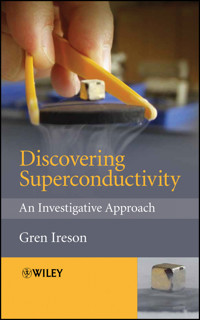
Discovering Superconductivity E-Book
38,99 €
Mehr erfahren.
- Herausgeber: John Wiley & Sons
- Kategorie: Wissenschaft und neue Technologien
- Sprache: Englisch
Superconductivity is a quantum phenomenon that manifests itself in materials showing zero electrical resistance below a characteristic temperature resulting in the potential for an electric current to run continually through such a material without the need for a power source. Such materials are used extensively in medical and power applications, e.g. MRI and NMR machines.
Discovering Superconductivity uses a series of practical and investigative activities, which can be used as tutor demonstrations or as student lab exercises.
This highly illustrated text features the following sections:
- Introduction - including a brief history of superconductivity
- Superconductivity - an explanation of the phenomenon and its effects
- Superconducting materials – including High & Low temperature superconductors
- Applications – how superconductivity is used in medical imaging, at CERN and in the Maglev trains
This text will serve as an excellent introduction for students, with or without a physics background, to superconductivity. With a strong practical, experimental emphasis, it provides readers with an overview of the topic preparing them for more advanced texts used in advanced undergraduate and post-graduate courses.
PowerPoint files of the figures presented within this text are available at: booksupport.wiley.com
A word from the author: "The intention of this text is to introduce the reader to the study of superconductivity via a minds-on approach .... The minds-on approach takes this a stage further by requiring the learner to engage with the process to a greater extent."
Sie lesen das E-Book in den Legimi-Apps auf:
Seitenzahl: 154
Veröffentlichungsjahr: 2012
Ähnliche




















Contents
Cover
Title Page
Copyright
List of Figures
List of Tables
Preface
Acknowledgements
To the Teacher
To the Student
Section I: Introduction
Chapter 1: Resistivity and Conduction in Metals
1.1 INTRODUCTION
1.2 RESISTIVITY
1.3 CONDUCTION IN METALS
1.4 REVISITING OHM'S LAW
Chapter 2: A Brief History of Superconductivity
2.1 INTRODUCTION
2.2 THE BEGINNING: KWIK NAGENOEG NUL
2.3 1933 – PERFECT DIAMAGNETISM?
2.4 THE LONDON BROTHERS
2.5 1957 – THE BCS THEORY
2.6 1962 – THE JOSEPHSON EFFECT
2.7 1986 – BEDNORZ AND MüLLER AND OXIDE SUPERCONDUCTORS
2.8 2003 – ABRIKOSOV, GINZBURG AND LEGGETT – AND THE FUTURE
2.9 GETTING COLD ENOUGH
Section II: Superconductivity
Chapter 3: An Explanation of Superconductivity?
3.1 TRANSITION TEMPERATURE
3.2 TWO-FLUID MODEL
3.3 CRITICAL FIELD, CRITICAL CURRENT
3.4 SCHAWLOW AND DEVLIN
3.5 THE LONDON EQUATION
3.6 BCS THEORY
3.7 AN ALTERNATIVE APPROACH TO THE ENERGY GAP
Chapter 4: The Meissner–Ochsenfeld Effect
Chapter 5: Diamagnetic Effects
5.1 DIAMAGNETISM, PARAMAGNETISM AND FERROMAGNETISM
Chapter 6: Persistence of Current
6.1 QUINN AND ITTNER
Chapter 7: Type I and Type II Superconductors
7.1 CRITICAL MAGNETIC FIELD
Chapter 8: Flux Pinning
8.1 VORTEX AND FLUX LINES
8.2 THE ORIGINAL ABRIKOSOV
Section III: Superconducting Materials
Chapter 9: Low-Temperature Superconductors
Chapter 10: Organic Superconductors
Chapter 11: High-Temperature Superconductors
11.1 MAGNESIUM DIBORIDE
11.2 TRANSITION TEMPERATURE OF HIGH-Tc SUPERCONDUCTORS
Section IV:
Chapter 12: Superconducting Wire
Chapter 13: Medical Imaging
13.1 MAGNETIC RESONANCE IMAGING (MRI)
13.2 MAGNETOENCEPHALOGRAPHY
Chapter 14: CERN and the LHC
Chapter 15: Maglev Trains
Appendices
Appendix A: The BCS Theory
Appendix B: Flux Penetration
Appendix C: The Josephson Junction and the SQUID
Appendix D: MRI
GENERATING THE MRI SIGNAL
Appendix E: A Note on Superfluidity
Appendix F: A Note on Safety
Index
This edition first published 2012 © 2012 John Wiley & Sons, Ltd
Registered officeJohn Wiley & Sons Ltd, The Atrium, Southern Gate, Chichester, West Sussex, PO19 8SQ, United Kingdom
For details of our global editorial offices, for customer services and for information about how to apply for permission to reuse the copyright material in this book please see our website at www.wiley.com.
The right of the author to be identified as the author of this work has been asserted in accordance with the Copyright, Designs and Patents Act 1988.
All rights reserved. No part of this publication may be reproduced, stored in a retrieval system, or transmitted, in any form or by any means, electronic, mechanical, photocopying, recording or otherwise, except as permitted by the UK Copyright, Designs and Patents Act 1988, without the prior permission of the publisher.
Wiley also publishes its books in a variety of electronic formats. Some content that appears in print may not be available in electronic books.
Designations used by companies to distinguish their products are often claimed as trademarks. All brand names and product names used in this book are trade names, service marks, trademarks or registered trademarks of their respective owners. The publisher is not associated with any product or vendor mentioned in this book. This publication is designed to provide accurate and authoritative information in regard to the subject matter covered. It is sold on the understanding that the publisher is not engaged in rendering professional services. If professional advice or other expert assistance is required, the services of a competent professional should be sought.
The publisher and the author make no representations or warranties with respect to the accuracy or completeness of the contents of this work and specifically disclaim all warranties, including without limitation any implied warranties of fitness for a particular purpose. This work is sold with the understanding that the publisher is not engaged in rendering professional services. The advice and strategies contained herein may not be suitable for every situation. In view of ongoing research, equipment modifications, changes in governmental regulations, and the constant flow of information relating to the use of experimental reagents, equipment, and devices, the reader is urged to review and evaluate the information provided in the package insert or instructions for each chemical, piece of equipment, reagent, or device for, among other things, any changes in the instructions or indication of usage and for added warnings and precautions. The fact that an organization or Website is referred to in this work as a citation and/or a potential source of further information does not mean that the author or the publisher endorses the information the organization or Website may provide or recommendations it may make. Further, readers should be aware that Internet Websites listed in this work may have changed or disappeared between when this work was written and when it is read. No warranty may be created or extended by any promotional statements for this work. Neither the publisher nor the author shall be liable for any damages arising herefrom.
Library of Congress Cataloging-in-Publication Data
Ireson, Gren. Discovering superconductivity : an investigative approach / Gren Ireson. p. cm. Includes index. ISBN 978-1-119-99141-0 (hardback) – ISBN 978-1-119-99140-3 (paper) 1. Superconductivity–Study and teaching (Higher)–Activity programs. I. Title. QC611.96.I74 2012 537.6′23076–dc23 2012017363
A catalogue record for this book is available from the British Library.
HB ISBN: 978-111-999-1410 PB ISBN: 978-111-999-1403
List of Figures
Lesen Sie weiter in der vollständigen Ausgabe!
Lesen Sie weiter in der vollständigen Ausgabe!
Lesen Sie weiter in der vollständigen Ausgabe!
Lesen Sie weiter in der vollständigen Ausgabe!
Lesen Sie weiter in der vollständigen Ausgabe!
Lesen Sie weiter in der vollständigen Ausgabe!
Lesen Sie weiter in der vollständigen Ausgabe!
Lesen Sie weiter in der vollständigen Ausgabe!
Lesen Sie weiter in der vollständigen Ausgabe!
Lesen Sie weiter in der vollständigen Ausgabe!
Lesen Sie weiter in der vollständigen Ausgabe!
Lesen Sie weiter in der vollständigen Ausgabe!
Lesen Sie weiter in der vollständigen Ausgabe!
Lesen Sie weiter in der vollständigen Ausgabe!
Lesen Sie weiter in der vollständigen Ausgabe!
Lesen Sie weiter in der vollständigen Ausgabe!
Lesen Sie weiter in der vollständigen Ausgabe!
Lesen Sie weiter in der vollständigen Ausgabe!
Lesen Sie weiter in der vollständigen Ausgabe!
Lesen Sie weiter in der vollständigen Ausgabe!
Lesen Sie weiter in der vollständigen Ausgabe!
Lesen Sie weiter in der vollständigen Ausgabe!
Lesen Sie weiter in der vollständigen Ausgabe!
Lesen Sie weiter in der vollständigen Ausgabe!
Lesen Sie weiter in der vollständigen Ausgabe!
Lesen Sie weiter in der vollständigen Ausgabe!
Lesen Sie weiter in der vollständigen Ausgabe!
Lesen Sie weiter in der vollständigen Ausgabe!
Lesen Sie weiter in der vollständigen Ausgabe!
Lesen Sie weiter in der vollständigen Ausgabe!
Lesen Sie weiter in der vollständigen Ausgabe!
Lesen Sie weiter in der vollständigen Ausgabe!




