


19,99 €
Mehr erfahren.
- Herausgeber: John Wiley & Sons
- Kategorie: Wissenschaft und neue Technologien
- Sprache: Englisch
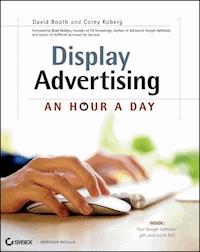
A complete guide to developing, implementing, monitoring, and optimizing an online display ad campaign The display business is online advertising's fastest growing field. Google and others are starting to provide easy tools to enable small- and medium-sized businesses to take advantage of this opportunity. This guide provides marketers, consultants, and small-business owners with the knowledge and skills to create and optimize a display advertising campaign. It covers concepts, trends, and best practices, and presents a day-to-day plan for developing, managing, and measuring a successful campaign. * Online display advertising is a hot topic, and this hands-on guide helps marketing professionals and small-business owners gain the skills to create and manage their own campaigns * Provides an overview of display advertising concepts, including types, formats, and how they're placed on websites * Explains how to plan a campaign, including defining goals and planning resources, contextual and placement targeting, and keyword use * Covers campaign launch and measurement, ad creation, social media advertising, how to optimize a campaign, and much more Display Advertising: An Hour a Day helps anyone promote a business successfully with effective online display ad campaigns.
Sie lesen das E-Book in den Legimi-Apps auf:
Seitenzahl: 848
Veröffentlichungsjahr: 2012
Ähnliche



















Table of Contents
Cover
Praise for Display Advertising: An Hour A Day
Acknowledgments
About the Authors
Introduction
Chapter 1: Online Advertising
An Overview of Search Engine Marketing
Search Advertising vs. Display Advertising
Problem Solving and Distraction
Chapter 2: Overview of Display Advertising
The Display Advertising Landscape
Identifying Display Ad Types and Formats
Defining Advertising Objectives
Chapter 3: Fundamental Display Advertising Concepts
The Ecosystem: Advertisers and Publishers
Starting Out with the Google Network
Campaign Targeting Strategies
The Big Picture: The Process of Display Advertising
Chapter 4: Month 1: Planning Your Campaigns
Week 1: Define Your Display Advertising Goals
Week 2: Showcase What You Do Best
Week 3: Take Stock of Your Resources
Week 4: Plan Your Budget
Chapter 5: Month 2: Targeting Your Audience
Week 5: Understand Targeting Options
Week 6: Find Good Keywords
Week 7: Find Good Placements
Week 8: Organize Campaigns and Ad Groups
Chapter 6: Month 3: Building Your First Display Campaign
Week 9: Choose Your Display Campaign Settings
Week 10: Choose Your Bidding Style and Budget
Week 11: Configure Advanced Campaign Settings
Week 12: Create Your First Ad Group
Chapter 7: Month 4: Creating Image Ads
Week 13: Study the Science behind Great Image Ads
Week 14: Understand the Rules
Week 15: Dig Deeper on Image Ads
Week 16: Build Ads with Display Ad Builder
Chapter 8: Month 5: Video Ads
Week 17: Understand AdWords Video Ads
Week 18: Create Video Ads
Week 19: Advertise on YouTube
Week 20: Advertise on Television with AdWords
Chapter 9: Month 6: Launch and Measure Your Campaign’s Performance
Week 21: Launch the Campaign
Week 22: Use AdWords Reports
Week 23: Use Google Analytics
Week 24: Measure Branding and Positioning Goals
Chapter 10: Month 7: Optimizing the Performance of Your Campaigns
Week 25: Refine Your Campaigns and Ad Groups
Week 26: Expand Your Reach
Week 27: Test Your Ads
Week 28: Create Effective Landing Pages
Chapter 11: Month 8: Advanced Topics
Week 29: Retarget and Remarket
Week 30: Learn Tools for Testing Landing Pages
Week 31: Go beyond Clickstream Analytics
Week 32: Target Topics
Chapter 12: Month 9: Using LinkedIn and Facebook Display Ads
Week 33: Advertise on LinkedIn
Week 34: Launch and Measure LinkedIn Campaigns
Week 35: Advertise on Facebook
Week 36: Launch and Measure Facebook Campaigns
Glossary
Index
Advertisement
Praise for Display Advertising: An Hour A Day
The Google Display Network can be an amazing source of new customers if you do it right. However, for years it’s been misused causing many to have a negative impression of display. Finally, there is a book that concentrates solely on display and tells you how to do it correctly. Display Advertising: An Hour a Day is a must read for anyone serious about expanding their AdWords reach beyond search to finding new sources of revenue in the massive world of display advertising.
Brad Geddes, Author, Advanced Google Adwords & Founder of Certified Knowledge
Display advertising represents an incredible opportunity to do three delightful things: Engage consumers, deliver relevance and impact your bottom-line. In this wonderful book David and Corey provide a blueprint for going from Zero to Awesome!
-Avinash Kaushik, Author: Web Analytics 2.0 & Web Analytics: An Hour A Day (Wiley/Sybex)
Dave and Corey are two of the most respected digital marketing professionals in the industry today serving some of the largest companies around the world. For a fast moving field such as Display Advertising, their new book is adding the much needed clarity on the latest development in this area. Their metrics focused approach offers the critical perspective to how to be successful in Display Advertising.
Phil Mui, Ph.D., EVP, Chief Product & Engineering Officer, Acxiom Corporation
Contrary to popular belief, display advertising is not dead: It’s alive and well and will continue its explosive growth in the coming years. Now more than ever before, you as a business owner have more and more choices about where and how to spend your advertising budget. Dave and Corey help you navigate the complex landscape of ad networks and ad formats, and present a logical overview of the tools and techniques you need to effectively use and measure display ads. These are data-driven guys that have put together a roadmap that will help you focus your ad spend on productive display campaigns that can drive your bottom line.
Justin Cutroni, Analytics Advocate, Google
No longer is display advertising a black art. Written by master practitioners, this book breaks down the practical details for mastering your online campaigns. Get it before your competitors do, and put it to work!
Tim Ash, CEO of SiteTuners, chair of Conversion Conference, author of Landing Page Optimization (Wiley/Sybex)
Winning in Paid Search Advertising has become a numbers game and proper ROI is almost impossible to achieve without a data driven attitude. Surprisingly, Display Advertising is, to this day, managed far less diligently—Dave and Corey are here to change that and their book is a great first step toward realizing that robust ROI you should demand from your display campaigns!
Dennis R. Mortensen, author of Data Driven Insights (Wiley) and CEO and Founder of Visual Revenue Inc.
In an increasingly noisy digital marketing environment, competing for consumers’ attention online is no easy task. Deciding where to allocate your advertising dollars, determining which ad networks deliver the most targeted audiences, and managing your daily operations can be overwhelming for even the most seasoned veteran. Dave and Corey take the guesswork out of display advertising with this pragmatic approach to managing your investments in time and money using sound judgment and quantifiable measurement tactics. This is a must read for anyone managing display advertising.
John Lovett, President, Digital Analytics Association, Senior Partner at Web Analytics Demystified, author of Social Media Metrics Secrets (Wiley)
I’ve been fortunate to know Dave and Corey for many years. They stand out as being truly passionate about data-driven marketing (I’m not exaggerating, they really love it) and are two of the most knowledgeable, intelligent people I know. This book shares their experience with actionable insights that will help take your Display campaigns to a new level of success and accountability.
Anastasia Holdren, Author, Google AdWords (O’Reilly) & President of SEM Training
Throughout its lifetime the Google AdWords Display Network has been viewed by advertisers as a dark, scary, dangerous place. Google has never done a good job of explaining the crucial differences between Search and Display advertising, and as a result many advertisers have written off the Display Network as a source of poor-quality traffic that burns cash and fails to convert. With Display Advertising: An Hour A Day, Koberg and Booth have demystified the topic with tons of meaty, specific advice on profiting from display advertising. The ROI on this book is huge!
David Szetela, AdWords expert and author of PPC SEM: An Hour a Day (Wiley/Sybex)
It’s not very common to find people in the online market who understand the whole lifecycle of a digital strategy. From the mysterious realm of branding campaigns to the most concrete analysis of direct response objectives, there’s no doubt that David and Corey are two of the few people who can gather it all together in a comprehensive yet easy to understand piece. In this book they do an extraordinary job explaining the high level importance of your digital strategy while providing clear, tactical steps to achieve any goal you define for your company. Whether you’re starting your online business or have years of experience in the market, you’ll find tons of actionable information and tips in this book. A must-read, for sure!
Enrique Quevedo, Google Latin America
Display advertising can be complicated and difficult to master. Without a core understanding of how display advertising functions, and how to manage and optimize campaigns, advertisers are setting themselves up for failure. The day-by-day plan laid out in this book will provide campaign managers with a deep comprehension on targeting, ad messaging, and every other aspect of display advertising. If you’ve never done display advertising, this book is a great starting point. If you’ve been doing display for a while, this book can provide new ideas on how to re-vamp and optimize your campaigns.
Joseph Kerschbaum, Vice President of Clix Marketing and co-author of PPC Advertising: An Hour a Day (Wiley/Sybex)
This book covers the basics from the fundamentals of advertising campaigns and targeting the right audience to building and executing a campaign, measuring its effectiveness and making necessary adjustments. It’s appealing in its layout and provides a step-by-step recipe for success. Kudos to Dave Booth and Corey Koberg.
Fredric Kropp, PhD, Professor of Entrepreneurship, Creativity and Innovation; Chair of the Fisher
International MBA Program, Monterey Institute of International Studies.
Dave & Corey wrote this book in the midst of some amazing but major changes to Google’s Display Network. How quickly they reacted to those changes says a lot about their core knowledge of display advertising and this industry. The book is full of step by step instructions but it is also full of concepts that are timeless and won’t change...even if interfaces, editors and user panels do.
Shelley Ellis, Display Advertising and Retargeting Writer and Speaker, ContentNetworkPulse.com
Aristotle wrote ‘Those that know, do. Those that understand, teach.’ Corey and Dave are the kind of professionals that both know and understand, which put them in a perfect place to write an encompassing book about any subject. And since they have such a vast experience in the online advertising and analytics worlds, this is a book you should certainly read!
Daniel Waisberg, Founder & Editor, Online Behavior
Senior Acquisitions Editor: Willem Knibbe
Development Editor: Richard Mateosian
Technical Editor: Howie Jacobson
Production Editor: Rebecca Anderson
Copy Editor: Judy Flynn
Editorial Manager: Pete Gaughan
Production Manager: Tim Tate
Vice President and Executive Group Publisher: Richard Swadley
Vice President and Publisher: Neil Edde
Book Designer: Happenstance Type-O-Rama
Compositor: Maureen Forys, Happenstance Type-O-Rama
Proofreader: Josh Chase, Word One New York
Indexer: J&J Indexing
Project Coordinator, Cover: Katherine Crocker
Cover Designer: Ryan Sneed
Cover Image: © Huchen Lu / iStockPhoto
Copyright © 2012 by John Wiley & Sons, Inc., Indianapolis, Indiana
Published simultaneously in Canada
ISBN: 978-1-118-17971-0
ISBN: 978-1-118-22734-3 (ebk.)
ISBN: 978-1-118-24029-8 (ebk.)
ISBN: 978-1-118-26494-2 (ebk.)
No part of this publication may be reproduced, stored in a retrieval system or transmitted in any form or by any means, electronic, mechanical, photocopying, recording, scanning or otherwise, except as permitted under Sections 107 or 108 of the 1976 United States Copyright Act, without either the prior written permission of the Publisher, or authorization through payment of the appropriate per-copy fee to the Copyright Clearance Center, 222 Rosewood Drive, Danvers, MA 01923, (978) 750-8400, fax (978) 646-8600. Requests to the Publisher for permission should be addressed to the Permissions Department, John Wiley & Sons, Inc., 111 River Street, Hoboken, NJ 07030, (201) 748-6011, fax (201) 748-6008, or online at http://www.wiley.com/go/permissions.
Limit of Liability/Disclaimer of Warranty: The publisher and the author make no representations or warranties with respect to the accuracy or completeness of the contents of this work and specifically disclaim all warranties, including without limitation warranties of fitness for a particular purpose. No warranty may be created or extended by sales or promotional materials. The advice and strategies contained herein may not be suitable for every situation. This work is sold with the understanding that the publisher is not engaged in rendering legal, accounting, or other professional services. If professional assistance is required, the services of a competent professional person should be sought. Neither the publisher nor the author shall be liable for damages arising herefrom. The fact that an organization or Web site is referred to in this work as a citation and/or a potential source of further information does not mean that the author or the publisher endorses the information the organization or Web site may provide or recommendations it may make. Further, readers should be aware that Internet Web sites listed in this work may have changed or disappeared between when this work was written and when it is read.
For general information on our other products and services or to obtain technical support, please contact our Customer Care Department within the U.S. at (877) 762-2974, outside the U.S. at (317) 572-3993 or fax (317) 572-4002.
Wiley publishes in a variety of print and electronic formats and by print-on-demand. Some material included with standard print versions of this book may not be included in e-books or in print-on-demand. If this book refers to media such as a CD or DVD that is not included in the version you purchased, you may download this material at http://booksupport.wiley.com. For more information about Wiley products, visit www.wiley.com.
Library of Congress Control Number: 2012937915
TRADEMARKS: Wiley, the Wiley logo, and the Sybex logo are trademarks or registered trademarks of John Wiley & Sons, Inc. and/or its affiliates, in the United States and other countries, and may not be used without written permission. All other trademarks are the property of their respective owners. John Wiley & Sons, Inc. is not associated with any product or vendor mentioned in this book.
10 9 8 7 6 5 4 3 2 1
Dear Reader,
Thank you for choosing Display Advertising: An Hour A Day. This book is part of a family of premium-quality Sybex books, all of which are written by outstanding authors who combine practical experience with a gift for teaching.
Sybex was founded in 1976. More than 30 years later, we’re still committed to producing consistently exceptional books. With each of our titles, we’re working hard to set a new standard for the industry. From the paper we print on, to the authors we work with, our goal is to bring you the best books available.
I hope you see all that reflected in these pages. I’d be very interested to hear your comments and get your feedback on how we’re doing. Feel free to let me know what you think about this or any other Sybex book by sending me an email at [email protected]. If you think you’ve found a technical error in this book, please visit http://sybex.custhelp.com. Customer feedback is critical to our efforts at Sybex.
Best regards,
Neil Edde
Vice President and Publisher
Sybex, an Imprint of Wiley
Acknowledgments
Throughout the journey of creating this book we’ve been extremely fortunate to have had the help and support of many people who have provided insight, research, and encouragement.
First and foremost, we owe a deep debt of gratitude to our wives, children, and extended family who knew better than we did what a time commitment this would be and encouraged us anyway. The late nights and weekends holed up writing added to an already extremely demanding day job, and we look forward to spending time with families who have patiently waited for Daddy’s book to finally be done!
The team at Wiley are true professionals and have been beyond patient with us as we juggled travel schedules and other constraints. Throughout the course of writing this book, not a single chapter has escaped significant rewrites as the pace of this industry has continued to quicken. Willem, Pete, Richard, Howie, Becca, and the rest of the team listened to many calls beginning with, “Bad news, there was yet another change” and took them in stride.
We’d also like to thank our fellow Partners at Cardinal Path for their support of this project. Bringing three companies together to successfully create an entirely new type of agency is more than a full time job, and taking on a commitment such as this book right in the middle of a merger wasn’t without risk. Their support and enthusiasm speaks volumes to the trust and foresight of the other Partners to have faith in our vision and embrace the project.
A huge thanks is also due to the incredible team at Cardinal Path, many of whom contributed through conversations, ideas, and words. Heather Cooan, Michael Straker, Mark Geyer, Bethany Bey, and Charlie Stone (of The Owned Agency) deserve special recognition for their direct involvement—their expertise and contributions are very much appreciated!
We are also very appreciative of the continued support from Google that has grown and grown over the years. We are particularly indebted to Rachel Greenberg, Brad Bender, and Andrea Faville for their help on this project.
Finally, we wouldn’t be here without our clients, whom we consider true partners and who allow us the opportunity to use the tools and techniques in this book across a wide spectrum of industries and organizations. We’d like to give a special thanks to those who allowed us to share their stories through case studies and other examples. This is a better book because of folks like Matthew Tippins of Breezes Resorts, Stephanie Harris at Scrubs and Beyond, Richard Linevsky at Catalogs.com, David Peterson and JoLyn Laney of TravelNevada.com, and Ross Twiddy, Joe Akinc, and Evan Roberts at Twiddy & Company.
—Dave and Corey
About the Authors
David Booth is a founding partner and principal consultant at Cardinal Path as well as an author, instructor, adjunct professor, and regular speaker. As a consultant, David has advised and worked with top companies and organizations, such as Google, NPR, Teach for America, Lollapalooza, Zappos, Ethan Allen, and others across five continents in web analytics and business intelligence, statistical analysis and testing, technology selection and deployment, and online and search marketing. David is the author of Google AdWords Essential Training (Lynda.com, 2011) and Google Website Optimizer Essential Training (Lynda.com, 2010) and served as a technical editor of Performance Marketing with Google Analytics (Wiley, 2010) and Google Analytics Essential Training (Lynda.com, 2011). He also teaches a master’s-level course on web analytics and online marketing at the Monterey Institute of International Studies.
As an instructor and speaker, David has keynoted numerous events and has led seminars and sessions focused on digital analytics and search and conversion marketing all around the world for audiences ranging from C-level executives to agencies and technical implementation teams.
He has been involved in web application development as an engineer and consultant since the late 1990s, beginning his career with Intel Corporation. Prior to Cardinal Path, he was a founder and Partner of WebShare, LLC, and spent two years with the United States Peace Corps developing and deploying websites and web applications to support local initiatives, attract grants, and draw international aid for Guatemalan NGOs and development organizations.
David earned his Master of Business Administration in International Management from the Monterey Institute of International Studies and holds a BS in Electrical and Computer Engineering from the University of Illinois at Urbana-Champaign. Proud husband and father, David spends his free time with his family traveling the world on frequent flier points and enjoying the outdoors on foot, bike, ropes or kayak.
Corey Koberg is a founding partner at Cardinal Path where he leads the advertising, social, user experience, development, and search optimization practices. He is a well-known speaker, having keynoted and led sessions on advertising, analytics, and optimization at conferences and events across the globe. Over the last decade he has taught thousands on the topics of online marketing measurement, statistical analysis, and optimization. He is the author of Google Analytics Essential Training (Lynda.com, 2011) and technical editor of several works, among them Performance Marketing with Google Analytics (Wiley, 2010), Google AdWords Essential Training (Lynda.com, 2011), and Google Website Optimizer Essential Training (Lynda.com, 2010).
As a consultant, he has worked with dozens of Fortune 500 companies, such as Google, Chevron, NBC, Papa John’s, National Geographic, Time Warner, Universal Music, DeVry University, and others, to improve the effectiveness of their online presence through results-oriented, data-driven optimization.
Corey holds a degree in Electrical and Computer Engineering from the University of Illinois and has been involved in Internet-related engineering and consulting for over 15 years, beginning his career in the NCSA labs that developed the world’s first web browser.
Corey began his love of international travel while living in Hong Kong and covering the 14 countries of the APAC region for Intel. After a year in Germany with HP (DEC), Corey went on to design and deploy high-speed Internet backbone infrastructure for international telecom providers, banks, universities, and governments across South America, Eastern Europe, Asia, and Scandinavia. He was then part of the team at Qualcomm that deployed an advanced IP-based messaging system across the United States and Europe. As a founder and Partner at WebShare, Corey was responsible for the advertising and analytics practice prior to the merger with Cardinal Path.
Corey is a proud husband and father of three children and enjoys sailboat racing, downhill skiing, and photography. He is involved on a volunteer basis with the University of Illinois Alumni Association and the local emergency response team.
Foreword
I’ve been advertising online for well over a decade. I’ve written hundreds of articles, spent thousands of hours talking to companies about online marketing, and overseen more than a billion dollars in marketing spend with everyone from mom-n-pop shops to such brands as Red Lobster, YellowPages.com, and Encyclopedia Britannica.
Over the years, I’ve watched performance marketers dismiss display advertising as a too-expensive-time-wasting-useless inventory source. These marketers have made a mistake and missed one of the largest growth areas in effective online advertising that exists.
Years ago this was the correct decision—but not any longer.
When I started advertising online in 1998, banners were the preferred ad format. These banners were untargeted, overpriced, often quite ugly, and only bought by large companies who wanted to feel like they were participating in the new advertising revolution. They were ignored by those who wanted results, and unaffordable to those with small budgets.
A few years later, AdWords launched contextual targeting. Suddenly, you could choose a few words about your products and Google would place your ads next to website content that was based upon your keywords. The targeting was good, the idea was great, but the control was lousy.
Then Google finally understood that there was more inventory in display advertising than in search marketing. So, Google made their system transparent, took their brilliant search targeting and refined it for display advertising. This change rewrote the rules for how you can buy and manage display advertising.
Consider this: You can choose to serve an ad to someone who is viewing the New York Times Business section on their iPad, when the article is about stock brokers, it’s a Monday morning, and the user is in Miami and has shown an interest in finance related content. While this example might result in little inventory, this is an unprecedented level of targeting that has never been seen before in marketing.
If you have a small budget, you can serve incredibly targeted ads to a small group of potential customers. If you have a large budget, you can redefine your ‘branding campaigns’ to be performance campaigns.
It requires a good teacher to take these complex subjects and break them down into understandable bits of information and then provide an action plan to make sure you can meet your display goals. Luckily, David Booth and Corey Koberg are good teachers.
I first met David when we were both teaching Google Seminars for Success, which are live training workshops that are actually endorsed by Google. It was during this time that I got to know David. I was really impressed at how well he can take the interwoven complexities of paid search and analytics, and then demonstrate how each piece fits together so anyone can understand and execute on these concepts.
Now, you can only take advantage of the new revolution in display advertising if you have both the knowledge and the time to accomplish your goals. That’s what this book will give you: The knowledge of how to create successful display campaigns, and then the step-by-step, easy-to-understand action plan to implement, monitor, and optimize a successful display strategy.
In particular, Chapter 4 is invaluable because it lays out all of the possible goals of display advertising. There are many reasons to buy display ranging from direct response and brand positioning to site interaction. This chapter will help you determine what you should accomplish with display to ensure that you are ultimately successful in reaching your advertising goals.
The display revolution is happening right now—of the millions of dollars I’ll oversee in marketing just this month, more will be spent in display than in search—and now with this book you have no excuse for not mastering the new rules of display marketing.
Brad Geddes
Founder, Certified KnowledgeAuthor, Advanced Google AdWordsLeader, AdWords Seminars for Success
Introduction
At training and speaking events, we’re often asked if we recommend any good books for further study. For paid search, SEO, analytics, and even niches like form design, there exist many well-written volumes that we easily recommend. But we always draw a blank when it comes to display advertising—at the time of this writing, there simply aren’t any.
That is somewhat shocking considering it’s not new (display is the oldest form of online advertising) and it is one of the most visible and common forms of advertising in the world. It’s so common that display ad impressions far outnumber search impressions, and Neal Mohan, VP of display at Google, expects display ad spend to soon exceed $200 billion annually (a 4x increase since 2010). That significant a rise in display ad activity means that it’s not just for the big agencies and media buyers anymore, and there is a critical need to lay the foundation for successful display ad campaigns.
Historically, the advertising industry has not been self-serve: Businesses had to go through agencies and media desks to place any significant volume or gain a reasonable reach, but the rise of online advertising has drastically changed that model, and now businesses can reach global audiences directly in a very short time. This democratization of advertising has revolutionized the paid search arena, but the penetration on the display side has been far less prevalent. Display has remained largely the domain of large advertisers with big budgets and big agencies. We believe the new tools and technologies available today and those arriving in the near future will change that, allowing more advertisers to access and harness the power of display advertising. This book is intended to kick-start that journey.
Who Should Read This Book
While we hope this book will provide value for anyone interested in the topic, we do cater to certain audiences. Advanced display advertisers with large budgets and access to sophisticated real-time bidding and audience data tools will find our coverage of those topics brief at best. Instead, we wrote the book with the following groups in mind:
Search marketers (agencies or businesses themselves) who are looking to expand beyond their paid search campaigns. Perhaps they have exhausted their audience there and are experiencing diminishing returns and thus looking to the display network to expand reach. Or perhaps an agency account manager is looking to grow the agency’s advertising relationship beyond search and is interested in display as a logical and complementary next step or as a foray into branding and positioning initiatives. In many cases, we have drawn parallels and analogies to search advertisers to help ease this transition.
Advertisers who are new to online altogether. Knowledge and experience with paid search is certainly not a prerequisite, and chapters are written so that no prior knowledge is assumed. This also includes job seekers or job switchers who are looking to educate themselves in preparation for the many career opportunities that an industry poised to grow to $200 billion and beyond will undoubtedly bring.
Display advertisers who have previously used the medium only for branding or awareness purposes but are now interested in performance display. Many of the new tools and techniques discussed in this book are intended to pave the way for direct response advertisers to optimize for performance and deploy display ads profitably, while measurement strategies for more traditional branding and positioning objectives are also presented.
Experienced display advertisers who are simply looking to fill gaps, reinforce their existing knowledge of the fundamentals, learn about new techniques and technologies, or simply hear another perspective.
What You Will Learn
Over the course of this book you will be introduced to the landscape and taken through the process of planning, building, launching, measuring, and optimizing your campaigns. We will take you step by step through specific examples using market-leading platforms such as Google (and YouTube), Facebook, and LinkedIn but always with an eye toward the bigger concepts that can be applied to any network or publisher you choose.
Core activities such as creating campaigns and image ads are covered in detail. Important, but somewhat tangential, topics such as landing page optimization and analytics are discussed, but they are by no means covered as comprehensively as in a book dedicated to those subjects.
A journey of a thousand miles begins with a single step, and our display ad journey is broken into 1-hour steps that will take about three months if taken one per day. However, those willing to put in the time can easily accelerate the schedule. While some “days” may take longer than one hour for large or complex campaigns, we also believe experienced advertisers may be able to accomplish some steps in less time, depending on their familiarity with the subject.
The book is designed such that you will get the most out of reading it all the way through in order, but each chapter also stands on its own to be used as a reference. When information discussed in previous chapters is required, we’ve tried to include references back to those earlier chapters.
The following is a quick summary of the chapters:
Keep Up-to-Date: The Companion Site
This industry is reinventing itself at a blistering pace. During the course of writing this book we’ve had to revise chapters several times because requirements changed, features were introduced, interfaces changed, and functionality was replaced or deprecated. Because change is constant, we know that certain parts of this book will become outdated over time, and we’ll periodically post changes and updates on the companion site at www.DisplayAnHourADay.com.
How to Contact the Authors
We welcome feedback from you about this book or about books you’d like to see from us in the future, and we encourage you to reach out to us in the following ways:
For more information about what we’re up to, please visit the Cardinal Path blog at www.cardinalpath.com/blog.
More information about further training opportunities in Google AdWords and Google Analytics is available at http://training.cardinalpath.com.
Readers of this book can claim a discount on many of the training programs offered by Cardinal Path by using the discount code displaybook.
Chapter 1
Online Advertising
Today’s world can perhaps be characterized by one thing above all others: that we as consumers are always online. As marketers, we are constantly presented with opportunities to get our message in front of the right kind of person at just the right time, and never before have we had this kind of ability to reach, target, and measure the reaction of audiences around the globe. Display advertising gives us the ability to widen our nets as advertisers and get our message out to more and more potential customers.
Chapter Contents:
An Overview of Search Engine Marketing
Search Advertising vs. Display Advertising
Problem Solving and Distraction
An Overview of Search Engine Marketing
Let’s go ahead and admit it: At this point in history, we’re in the middle of the digital age, and it’s getting more and more difficult to find anyone clinging to the notion that the Internet is just a passing fad. This is no latest craze; it is indeed the new normal by which we live our connected lives in a connected world. The combination of ever-increasing accessibility to higher and higher speed connections and a constantly growing variety of web-enabled devices makes it just plain hard to find a place where you can’t be online.
It wasn’t more than a few years ago when airlines were sending out email announcements to their frequent fliers saying, “We’re proud to announce Internet access in some of our airplanes!” In a completely opposite reaction than what we’re sure those nice marketing folks had in mind, many of us immediately pledged to avoid those airlines at all costs. An altitude of 30,000 feet was the last remaining place on earth that a person still wasn’t expected to be online, and there were more than a few of us that weren’t going to book a Wi-Fi enabled flight and risk those few precious hours of freedom from the digital leash.
Times are changing, and the point is, we’re now online all the time. And what are we doing? Well, as it turns out, young or old, you’re probably checking your email more than anything else—at least, according to the Pew Internet & American Life Project.
These days, if when we end up on a flight that doesn’t have Internet access, we start to exhibit signs of what we’re pretty sure is clinical withdrawal after about an hour, and by the time the plane is in its descent, passengers throughout the plane are looking out the window, clutching with shaking hands a phone with a screen so big it barely fits in their pocket, desperately scanning the approaching horizon for cell towers close enough to connect to that 4G network well before the flight attendant announces that it’s safe to return from the land of airplane mode. Take a look around on your next flight and see if you don’t have a plane full of passengers with their Blackberries, Androids, and iSomethings out, downloading the last hours of life as we know it before the wheels hit the runway.
But second to email, we go online to search for something. Search engines have become our gateway to the vast and ever expanding list of things we do on the Web. It’s how we keep up with our news and how we do our banking. It’s how we’re entertained by everything from games and 30-second videos to the latest record label-less sensation or a rant against a nameless fan of the rival team on a sports forum. It’s how we shop for everything from books and televisions to groceries and cars. It’s how we annoy a new generation of doctors by self-diagnosing long before we’ve made it to the waiting room. It’s how we book our flights and choose hotels in the places we’ve already decided to visit based upon the reviews of thousands of other consumers. It’s how we learn. It’s how we share our lives among our closest 10,000 friends. And for a rapidly growing number of us, it’s even how we get our work done, collaborating in real time on the latest sales numbers spreadsheet, scheduling that next meeting, or walking through the latest presentation. Sound like most of your day? Well, in the world in which we now live, that just makes you “normal.”
Lesen Sie weiter in der vollständigen Ausgabe!
Lesen Sie weiter in der vollständigen Ausgabe!
Lesen Sie weiter in der vollständigen Ausgabe!
Lesen Sie weiter in der vollständigen Ausgabe!
Lesen Sie weiter in der vollständigen Ausgabe!
Lesen Sie weiter in der vollständigen Ausgabe!
Lesen Sie weiter in der vollständigen Ausgabe!
Lesen Sie weiter in der vollständigen Ausgabe!
Lesen Sie weiter in der vollständigen Ausgabe!
Lesen Sie weiter in der vollständigen Ausgabe!
Lesen Sie weiter in der vollständigen Ausgabe!
Lesen Sie weiter in der vollständigen Ausgabe!
Lesen Sie weiter in der vollständigen Ausgabe!
Lesen Sie weiter in der vollständigen Ausgabe!




