


8,99 €
Mehr erfahren.
- Herausgeber: Dissensi Edizioni
- Kategorie: Bildung
- Sprache: Englisch
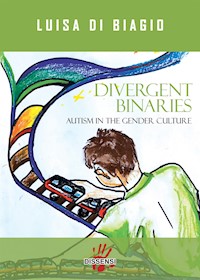
In the recent yers, many of those who receive the autism
diagnosis ask for privacy as the society’s reaction to the
autistic condition is very negative. This is why the autistic
people offer a possibility of a more profound and complete
comprehension of what happens in our brain. The autistic
persons are prevalently non-heterosexual and not necessarily
cisgender.
Why?
Das E-Book können Sie in Legimi-Apps oder einer beliebigen App lesen, die das folgende Format unterstützen:
Veröffentlichungsjahr: 2022
Ähnliche













Indice dei contenuti
L u i s a D i B i a g i o
Binaries
GiorNolo Radio #140, July 1st 2022
for Milan Pride 2022
Preface
President and Peer Educator of Cascina Blu® Onlus
Forewords
Divergence, according to which parameters?
Gender identity and autism
Identity, Sexual Orientation, and Autism
Milan Pride 2022
Autism, identity, orientation and education
The Capitol Geese
Changing the Body and Gender Culture
Pride of belonging and identity
Minority stress
Binary culture pros and cons
Identity and etiquette
Trading the sign for the substance
Sexuality and autism,
Diversity and brains, a cautious and humble
Sensoriality and gender fluid condition
Representation of identity
Sensoriality and autism
Sexism disguised as a politically correct attitude,
even though it is huge
The Chest of Treasures: the value of education
Princess Knight
(Illustrations, featured in the original, by Luisa Di Biagio)
The Queen and her Seeds
(Illustrations, featured in the original, by Luisa Di Biagio)
Princess Knight
Children and the future:
© DISSENSI
D I S S E N S I
© 2021 – DISSENSI EDIZIONI
www.dissensi.it
Distribuzione MESSAGGERIE
ISBN
Disegno in copertina di Luisa Di Biagio
L u i s a D i B i a g i o
Divergent
Binaries
Autism in the gender culture
GiorNolo Radio #140, July 1st 2022
An interview given to Christian D’Antonio
for Milan Pride 2022
“ The missions of Cascina Blu© Onlus include enhancing the quality of life of autistic persons and their families, and facilitate the adjustment of the social system to the needs of diversity. This is exactly why it is no surprise that they are present at Pride. We asked Luisa Di Biagio about the significance of their presence during the entire manifestation.”
“ We are here today as Cascina Blu©, an association which works to promote integration, which fights emargination in all its forms. And we are here because, finally, thanks to the non-binary model and a model, which, let us say, is not exactly schematically heterosexual, the entire autistic community can be perceived in anew light. Different studies reveal that the autistic community is prevalently non-binary and not heterosexual. Thus, we are here today to represent neurodiversity, which is linked to the needs of identity and gender orientation different from the established clichés.
The gender culture is a fine thing, it is fantastic that there are the fashion, the history, and the criteria for males and females, as long as they are not an obligation. Therefore, pay attention to education, especially of the autistic people, who take everything literally. It is important to have romantic, and not only pornographic, models of non-heterosexual sexuality. And pay attention to words, to what we say, and to how we encounter the diversity of others.”
Preface
by Marco Elviri,
President and Peer Educator of Cascina Blu® Onlus
Some years ago, together with other parents, I decided to create the Association to fill the lack of services that caused me many a sleepless night thinking about the future my children would have. I found myself catapulted in the reality of autism, no unlike many others, without any warning, and any preparation. In our case the diagnosis was delivered like a verdict, we had never been accompanied, guided or supported. The fact that autism would involve both our twins,made everything extraordinarily surreal and the reaction of others made us even more confused.
Our children are autistic and thus have a severe handicap; this is how I, like many other neurotypical parents and non, had perceived autism.
I couldn’t have been more wrong.
Thanks to the constant commitment to the projects of Cascina Blu©, all of which are dedicated to people with diverse needs, and to all the autistic people in particular, I have discovered that I nevere stop learning.
Over the time, getting to know each other well, my colleague, Dr. Di Biagio, has become my partner and her world of autistic perception, and that of her youngest child, so similar, and yet, so different from that of my children, never cease to surprise me.
Day after day, I become more and more aware how the society and the organization of work, school and the relationships, is not even close to understanding the needs of autism. We are not ready yet, at the moment there is no room.
But we are not going to stop, we firmly believe in the slogan I had created for the project: “Let us together construct an ordinary extraordinarity.”
I grew up convinced of having an open mind, but the extent of the truth, and the transparency of my life partner, challenge this conviction.
I presumed I had an open mind and I did not notice that, on the contrary, I was and still am full of cultural prejudices instilled in us by our culture.
The serenity and the power with which Luisa speaks about bisexuality, rather acceptable in private, perceived by me as a form of confidentiality, put my neurotypical self in crisis every time it happened in public. And seeing the price she must pay every time she speaks up, I ask myself who might have the same question regarding my children who, unlike Luisa, are unable to describe what they feel.
The question of sexual education in my family is constantly postponed, but we know that it does not do anyone a favor. Have we ever asked ourselves wether Edoardo’s and Giulio’s feelings will be directed at a girl or a boy?
This issue seems so distant for us, yet it is so close for them, and it is for them, I, as a father, that I choose to tackle it.
I am investing everything I can in the drean of Cascina Blu© as a safe place for all the diverse people who encounter marginalization, and I am proud that I am able to contribute to this step towards popularization and education in the field of Autism and Gender Culture.
Forewords
Thank you for choosing to read this work. Thank you for being here, for being aware of present issue, for being sensitive to it and for granting this space for Cascina Blu©. I am a psychologist, an autistic person, an activist for the rights of autistic people and all the victims of violence. I am proudly bisexual and I work for the right of the entire LGBTQIA+ community. I am also the vice president, the representative and the project manager of the Cascina Blu© Onlus association.
What do we do?
Among many other things, Cascina Blu© Onlus promotes integration, inclusion, work placement, education and support, without any limits. We fight in an intelligent manner against the dreadful dynamics that is marginalization, in particular, marginalization based on diversity: “I reject you, I exclude you, because you are different from me, from us”. We prevalently, but not exclusively, focus on autism.
Why are we proudly supporting LGBTQIA+ rights and participating in the Pride movement? Because minority rights guarantee human rights for everyone, and also because the question of sexual identity and non-binary gender orientation closely regards the autistic population.
To think that within the autistic spectrum, the proportions in what comes to sexual identity and orientation, are inverted compared with the neurotypical population.
A recent study estimates that the percentage of autistic population who do not recognize themselves as heterosexually oriented, amounts to 69,7%. Other studies indicate statistically significant correlation between autism and non-binary identity.
However, we must make an assumption that probably we are used to associating autism with the necessity of support, special needs and a significant cognitive distress.
The cognitive disability is a democratic condition which regards both autistic people and non, and it manifests itself in different ways according to the type of basic neurological organization. It means that there are individuals with severe cognitive limitation both among autistics and neurotypicals, and although there are single characteristic unique to each human being, the two groups are clearly distinct due to the fact that the disability manifests itself through signals that are determinated by the structure of the neurological system.
What has happened during the recent years?
For the last twenty years, “the more we know about autism, the more we recognize it”, as stated by Francesca Happè of King’s College of London, and there is an increasing number of people who are recognized as autistic and who receive the diagnosis, a recognition of their model of neurological organization. Professionals, parents, husbands, wives, people who not only need support, but who provide support for others.
Your dentist, your lawyer, the surgeon who saved the life of your family member, the vet who takes care of your animal companions, your teacher, the store assistant, your neighbour, any of them could be autistic.
In the recent yers, many of those who receive the autism diagnosis ask for privacy as the society’s reaction to the autistic condition is very negative. This is why the autistic people offer a possibility of a more profound and complete comprehension of what happens in our brain. The autistic persons are prevalently non-heterosexual and not necessarily cisgender.
Why?
This is a question that both the academic world and the clinical professionals are aiming to answer. It is a question with an enormous ethical load as it carries serious social implications in regard of relational dynamics, communication, acceptance, group behaviour and most and foremost, well-being, protection and quality of life. Maybe it has something to do with the fact that autistic persons do not lie, or better, are not good at lying? And therefore do not have a swift access to information dislocation necessary in order to easily receive approval benefited by lying, and thus adapting in real time to the needs of the majority whatever is referred. Is it so that an autistic person does not know, can not, does not manage, does not like to pronounce something that is not true? This hypothesis comes across as an interesting theory because it adresses the question of the effective prevalence of gender orientation and identity in the entire social
system, and also, why the social system forces individuals to recognize themselves in a cliché?
The present research also addresses a wonderful topic, the educational issue.




