


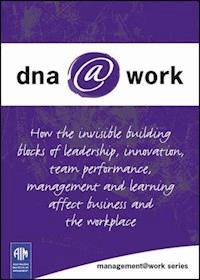
DNA@Work E-Book
22,99 €
Mehr erfahren.
- Herausgeber: John Wiley & Sons
- Kategorie: Fachliteratur
- Sprache: Englisch
Just as with humans, the genetics of organisations are unique. DNA is, after all, how we function. Why should it be any different at work? The DNA approach focuses on the glue that holds people and structures together. By uncovering the invisible building blocks or individual blueprint, we can gain a new understanding of what makes organisations ?and people ?tick. DNA @ Work takes a head-on approach to essential concepts in business today, exploring leadership, knowledge, innovation, learning, people, career, money and organisational structures. With a clear focus, the Australian Institute of Management explores the real story behind what ?olds it all together? Contributing authors: * Fred Hilmer * Kate Andrews * Vivienne Anthon * Jill Gray * Christina Turner * Janine Walker * Malcolm Johnson * Melanie O?onnor * Christo Norden-Powers The groundbreaking Management @ Work series uses the lens approach to the world of work in Australia from brand new perspectives. The books borrow from the short story genre to present individual chapters by different authors, each a journey in and of itself. With down-to-earth theory, real-life examples, personal anecdotes, passionate opinion and practical guidelines, the series is a must-read for those wanting to discover more about leadership, self and the art of management. Other titles in the series include: * Love @Work * Speed @ Work
Sie lesen das E-Book in den Legimi-Apps auf:
Seitenzahl: 395
Veröffentlichungsjahr: 2012
Ähnliche




















Contents
Preface
Part 1: dna @ work: Leadership DNA
Chapter 1: Leadership DNA
Summary
Introduction
Leadership
A lack of trust
The compensation conundrum
Rebuilding trust
Conclusion
Part 2: dna @ work: Knowledge DNA
Chapter 2: Knowledge DNA
Summary
What’s new about the knowledge era?
What value does knowledge contribute?
What does ‘knowledge’ mean?
How is knowledge transferred?
How do we use knowledge to support performance?
Conclusion
For further exploration
Notes
Part 3: dna @ work: Innovation DNA
Chapter 3: Innovation DNA
Summary
Introduction: innovate or perish
Innovation profiling
Closer examination — the genetic structure of innovation
Innovation enablers
Innovation endeavours
Innovation as a unique identifier
Conclusion: innovate and thrive
For further exploration
Notes
Part 4: dna @ work: Learning DNA
Chapter 4: Learning DNA
Summary
Introduction
How and why people learn
The building blocks for learning
Types of learning
Bringing it all together
Conclusion
For further exploration
Notes
Part 5: dna @ work: Social DNA
Chapter 5: Social DNA
Summary
Introduction
The workplace as a diverse social unit
Causes of conflict in today’s workplace
The conflict syndromes
The people in conflict
Some assumptions that underpin our management of people today
What will be the new challenge affecting the way we interact in the workplace?
Organisational responses
Conclusion
For further exploration
Part 6: dna @ work: Career DNA
Chapter 6: Career DNA
Summary
Introduction
The Me Inc career planner
The domains of Me Inc
Establishing your career plan
Capability inventory
Risk management
Personal development actions
Conclusion
For further exploration
Part 7: dna @ work: Organisational DNA
Chapter 7: Organisational DNA
Summary
Introduction: which is the successful team?
What is organisational DNA?
How does organisational DNA link to high performance?
Is there such a thing as ‘good DNA?
How is organisational DNA used to improve performance and what are the traps?
Conclusion
For further exploration
Notes
Part 8: dna @ work: The DNA of the DNA
Chapter 8: The DNA of the DNA
Background
High-performance people
Values in organisations
Leadership
Culture
Love
Where to from here for business?
For further exploration
Index
First published 2006 by Wrightbooks
an imprint of John Wiley & Sons Australia, Ltd
42 McDougall Street, Milton, Qld, 4064
Offices also in Sydney and Melbourne
© Management Press, a division of the Australian Institute of Management Queensland & Northern Territory, 2006
The moral rights of the authors have been asserted.
National Library of Australia Cataloguing-in-publication data:
DNA@work.
Includes index.
ISBN 0 7314 0428 9.
1. Organizational behavior. 2. Management. I. Barker, Carolyn. II. Payne, Alexandra. (Series : Management@work).
658.3
All rights reserved. Except as permitted under the Australian Copyright Act 1968 (for example, a fair dealing for the purposes of study, research, criticism or review), no part of this book may be reproduced, stored in a retrieval system, communicated or transmitted in any form or by any means without prior written permission. All inquiries should be made to the publisher at the address above.
Cover design by Brad Maxwell
Disclaimer
The material in this publication is of the nature of general comment only, and neither purports nor intends to be advice. Readers should not act on the basis of any matter in this publication without considering (and if appropriate, taking) professional advice with due regard to their own particular circumstances. The authors and publisher expressly disclaim all and any liability to any person, whether a purchaser of this publication or not, in respect of anything and of the consequences of anything done or omitted to be done by any such person in reliance, whether whole or partial, upon the whole or any part of the contents of this publication, whether whole or partial, upon the whole or any part of the contents of this publication.
Preface
Imagine the Australian Institute of Management conceiving a business book drawing on the concept of DNA and genetics. We knew that at first pass it sounded odd, but we also knew that it was an appropriate lens through which to examine an organisation at work — capturing all facets of the way people think and act at work, while exploring the impact of the systems and frameworks that have been developed to ensure successful and efficient organisations operate at peak performance.
DNA molecules carry the instructions for making all the structures and materials the body needs to function well or, in some cases, not so well. It is the genetic blueprint that determines the features of a cell, a body and, we would propose, an organisation. As with humans each entity is unique, different from the next and made up of that fragile combination of molecules that is like no other. In our minds this represents the culture — the invisible script that tells people ‘that’s the way we do things around here’.
This book of collected chapters focuses on that script — the glue that holds organisations together. By taking an approach that looks to uncover the building blocks, we can gain a new understanding of what makes organisations (and ourselves) tick, and how the invisible building blocks of leadership, innovation, team performance, management and learning affect business and the workplace.
In conceptualising the Management @ Work series, we wanted to examine leadership, management, culture and work through a range of different lenses. We listened to the management community and heard them asking fundamentally different questions, many of them philosophical, as leaders everywhere grapple with finding the formula to build a resilient, loyal and innovative workforce.
There are many aspects of management and work that would benefit from this approach. We chose areas that we felt could apply both to the organisation and the individual, exploring some fascinating questions including:
What does it take to be an effective leader?How is an innovative organisation’s DNA different from one that is not so innovative?What is the value of knowledge and knowledge management in the 21st century?How and why do people learn?Why do people behave in certain ways?How can you reprogram your career DNA to find a career you love?What differentiates team performance, and what really is organisational DNA?Seven chapters take a different aspect using the framework of DNA, with the final contribution taking the reader to an entirely different place.
As the voice of management in this country it is important that the Australian Institute of Management chronicles the practice, learnings and mood of the time. The Management @ Work series does just that by presenting a range of views, experiences, original thought and hard-earned practice in an accessible format. Enjoy!
Carolyn Barker AM, FAIM
National Director, Australian Institute of Management
dna @ work
Leadership DNA
by Frederick G. Hilmer, AO
About the author
Fred Hilmer, AO, was Chief Executive Officer of John Fairfax Holdings Limited from 1998–2005. He was appointed Vice Chancellor of the University of New South Wales in October 2005 and takes up that position in June 2006.
Prior to joining Fairfax he was Dean and Director of the Australian Graduate School of Management (AGSM) in the University of New South Wales and a director of Port Jackson Partners Limited. Prior to joining AGSM Mr Hilmer was a director of McKinsey & Company, responsible for managing the Australian practice. He holds a degree in law from the University of Sydney, a Master of Laws (LLM) from the University of Pennsylvania and a Master of Business Administration from the Wharton School of Finance where he was appointed a Joseph Wharton Fellow. In 1991 the Australian Institute of Management awarded him a special John Storey medal for distinguished contribution to the advancement of management thinking in Australia.
Earlier in his career Fred was a member of the Faculty of Law at the University of Pennsylvania and he also practised law in Australia. He served on the Committee of Inquiry into Management Education during 1981 and 1982.
Fred was a member of the Commonwealth Higher Education Council and Chairman of the Business Council of Australia’s Employee Relations Study Group. In 1992 and 1993 he chaired the National Competition Policy Review Committee. He is Deputy Chairman of Westfield Holdings Limited. He previously served as Chairman of Pacific Power, Deputy Chairman of Foster’s Brewing Group Limited and as a director of a number of other Australian companies.
He has written extensively on strategy, organisation and economic reform, and is the author of a number of books, including When The Luck Runs Out and New Games/New Rules, and co-author of Strictly Boardroom, Working Relations and Management Redeemed.
Chapter 1
Leadership DNA
Summary
This chapter discusses four questions about leadership today.
First, what does it take to be an effective leader, particularly of a large complex enterprise? Five characteristics are seen as critical — brains, energy, determination, trustworthiness and ethics.
Second, why is there perceived to be a lack of confidence in leaders today? The argument is put that the issues are not about the lack of brains, energy or determination. Rather, the issues relate to trustworthiness and ethics.
Third, what can leaders and aspiring leaders do to reverse this situation? The key is in their day-to-day behaviour, which shapes the culture of their organisations more profoundly than platitudes or values statements about commitment to high standards.
Finally, what are some of the implications of the preceding topics for public policy, especially with respect to governance and executive remuneration? The argument is made that current pay systems need to be reformed to reflect judgement rather than so-called objective measures of performance and that the portion of pay based on these so-called objective measures be reduced.
Introduction
By googling the phrase ‘business leadership’ and selecting just the Australian websites, at the time of writing this chapter, you get about 800 000 entries in 0.6 seconds! This phrase has become so pervasive because after two decades of prominence in advanced market economies, CEOs have become one of the most talked about or written about groups of leaders in our society. Moreover, we expect them to be leaders not only of their companies but also in terms of a larger role as representatives of an elite, and well-compensated, group.
Consequently, CEO views have become more influential and receive extensive coverage in the media. Business sections in major newspapers are meatier than ever. Business news features more prominently on television, in radio bulletins and on the internet. Business executives can become celebrities, and their interests, consumption patterns, political allegiances, excesses and misdeeds make the front pages.
Unfortunately, much of the media attention — particularly at this time — is about the negative rather than the positive aspects of executive leadership. Consequently, executive leadership has become far more regulated, especially with respect to compensation, potential conflicts of interest and the raising of capital.
Lesen Sie weiter in der vollständigen Ausgabe!
Lesen Sie weiter in der vollständigen Ausgabe!
Lesen Sie weiter in der vollständigen Ausgabe!
Lesen Sie weiter in der vollständigen Ausgabe!
Lesen Sie weiter in der vollständigen Ausgabe!
Lesen Sie weiter in der vollständigen Ausgabe!
Lesen Sie weiter in der vollständigen Ausgabe!
Lesen Sie weiter in der vollständigen Ausgabe!
Lesen Sie weiter in der vollständigen Ausgabe!
Lesen Sie weiter in der vollständigen Ausgabe!
Lesen Sie weiter in der vollständigen Ausgabe!
Lesen Sie weiter in der vollständigen Ausgabe!
Lesen Sie weiter in der vollständigen Ausgabe!
Lesen Sie weiter in der vollständigen Ausgabe!
Lesen Sie weiter in der vollständigen Ausgabe!




