


6,49 €
Mehr erfahren.
- Herausgeber: BQB Publishing
- Kategorie: Gesellschafts- und Liebesromane
- Sprache: Englisch
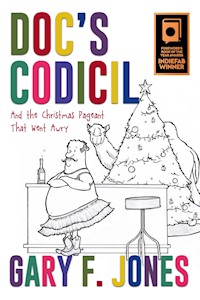
When Wisconsin veterinarian Doc dies, his family learns that to inherit his fortune, they must decipher the cryptic codicil he added to his will---"Take Doofus squirrel-fishing." And they can only do that by talking to Doc's friends, reading the memoir Doc wrote of a Christmas season decades earlier, searching through Doc's correspondence, and discovering clues around them.
Humor abounds as this mismatched lot tries to find time in their hectic lives to work together to solve the puzzle. In the end, will they realize that fortune comes in many guises?
"Doc's Codicil" is a mystery told with abundant humor. It tells the story of a veterinarian who teaches his heirs a lesson from the grave.
Das E-Book können Sie in Legimi-Apps oder einer beliebigen App lesen, die das folgende Format unterstützen:
Veröffentlichungsjahr: 2015
Ähnliche



















© 2015 Gary F. Jones. All rights reserved.
No part of this book may be reproduced in any form or by any means, electronic, mechanical, digital, photocopying, or recording, except for the inclusion in a review, without permission in writing from the publisher.
This is a work of fiction. All of the characters, names, incidents, organizations, and dialogue in this novel are either the products of the author’s imagination or are used fictitiously.
Published in the United States by BQB Publishing
(Boutique of Quality Books Publishing Company)
www.bqbpublishing.com
Printed in the United States of America
978-1-939371-83-6 (p)
978-1-939371-84-3 (e)
Library of Congress Control Number: 2015941806
Book design by Robin Krauss, www.bookformatters.com
Cover design by Ellis Dixon
CONTENTS
Chapter 1
The Heirs’ Story
Rockburg, Northern Wisconsin, September 2013
Chapter 2
The Heirs’ Story
Rockburg, September 2013
Chapter 3
The Heirs’ Story
Rockburg, September 2013
Doc’s Manuscript
Part I
Chapter 4
Doc’s Manuscript
Rockburg, Wisconsin, 1987
Prologue
Chapter 5: We Meet
Doc’s Manuscript
Rockburg, Northern Wisconsin, December 2, 1987
Chapter 6: Linda’s Problem
Doc’s Manuscript
New Orleans, December 3, 1987
Chapter 7: Nativity Rehearsal
Doc’s Manuscript
New Orleans, December 4, 1987
Chapter 8: Ventum Mingit
Doc’s Manuscript
Rockburg, December 12, 1987
Chapter 9: Costumes
Doc’s Manuscript
New Orleans, December 13, 1987
Chapter 10
The Heirs’ Story
Rockburg, September 2013
Doc’s Manuscript
Part II
Chapter 11: Dress Rehearsal
Doc’s Manuscript
New Orleans, December 18, 1987
Chapter 12: Camel Riding
Doc’s Manuscript
New Orleans, December 18, 1987
Chapter 13: Plots and Pranks
Doc’s Manuscript
New Orleans, December 18, 1987
Chapter 14: Pageants and Plans
Doc’s Manuscript
Rockburg, December 18, 1987
Chapter 15: Professor Rodgers
Doc’s Manuscript
Rockburg, Evening, December 18, 1987
Chapter 16: Emergency Calls
Doc’s Manuscript
Rockburg, December 19, 1987
Chapter 17
The Heirs’ Story
Rockburg, 2013
Doc’s Manuscript
Part III
Chapter 18: Last-Minute Preparations
Doc’s Manuscript
New Orleans, Afternoon, December 19, 1987
Chapter 19: The Living Nativity
Doc’s Manuscript
New Orleans, Evening, December 19, 1987
Chapter 20: Officer Williams
Doc’s Manuscript
New Orleans, Evening, December 19, 1987
Chapter 21
The Heirs’ Story
Rockburg, 2013
Doc’s Manuscript
Part IV
Chapter 22: Jed’s Friend
Doc’s Manuscript
Rockburg, December 20, 1987
Chapter 23: Cost vs. Price
Doc’s Manuscript
Rockburg, December 20, 1987
Chapter 24: Wood Putty
Doc’s Manuscript
Rockburg, December 20, 1987
Chapter 25: Old Ben
Doc’s Manuscript
Chapter 26
Doc’s Manuscript
New Orleans, December 27 and 28, 1987
Chapter 27: The Nativity’s Final Act
Doc’s Manuscript
New Orleans, A Week After the Nativity, 1987
Chapter 28
The Heirs’ Story
Rockburg, January, 2014
Chapter 29: Jed’s Mentor
Doc’s Manuscript
Rockburg, January 1, 1988
Chapter 30: Back to School
Doc’s Manuscript
Rockburg, January 10, 1988
Chapter 31: The Shopping Trip
Doc’s Manuscript
Rockburg, January 12, 1988
Chapter 32: The Farm
Doc’s Manuscript
Rockburg, late January 1988
Chapter 33: The Seminar
Doc’s Manuscript
Rockburg, January to February, 1988
Chapter 34
The Heirs’ Story
Rockburg, March 2014
Chapter 35: The Speech
Doc’s Manuscript
Rockburg, March 10, 1988
Chapter 36: Blizzard
Doc’s Manuscript
Rockburg, March 11, 1988
Chapter 37: Romance in Winter
Doc’s Manuscript
Rockburg, March 11, 1988
Chapter 38: Nutrition
Doc’s Manuscript
Rockburg, May 10, 1988
Chapter 39: Father and Son
Doc’s Manuscript
Rockburg, May 23, 1988
Chapter 40: Moving On
Doc’s Manuscript
Rockburg, April 1988
Chapter 41
The Heirs’ Story
Julie’s Home, St. Paul, Minnesota, April 2014
Chapter 42: Squirrel Fishing
The Heirs’ Story
Chapter 43
The Heirs’ Story
Rockburg, May 12, 2014
Chapter 44
The Heirs’ Story
Rockburg, May 14, 2014
CHAPTER 1
Codicil: a document that amends a previously executed will.
THE HEIRS’ STORY
Rockburg, Northern Wisconsin, September 2013
Al finished tying his tie and looked at himself in the mirror. A halo of wispy, white hair edged his shining pate; his back was stooped; and his face lined and creased. You’re kind of an old fossil for this nonsense, he thought. He reached for his suit coat, hesitated, and left it where it was. “Too damned hot today,” he grumbled. “I wouldn’t bother with a tie if I knew these kids better.”
His wife Jan, white haired and dressed in her robe, looked at him from the master bathroom and mumbled something as she brushed her teeth.
He snorted quietly. Together forty-five years, and she still thinks I can understand her when she talks with a toothbrush in her mouth. “What was that, dear?”
Jan set the toothbrush aside and rinsed her mouth. “How do you think your meeting will go?” she asked.
“I do not know. You can’t play games with bank stock and not expect consequences, even if you are dead.” He scanned his dresser and the bed. “Where the hell are my socks? I had ’em in my hand a second ago.”
Jan sighed. “On your left shoulder, Al,” she called to him, “where you put them while you tied your tie.”
He saw her roll her eyes. I guess I deserved that.
Thirty minutes later in the bank’s board room, Al Huss watched Seth, Doc’s oldest son, pace back and forth at the other end of the conference table. Six foot tall, frowning, muscular, and shaved bald, Seth looked intimidating. Al followed Seth’s eyes as they lingered over the dark wainscoting, wide moldings around the doors, windows, ceiling, and the wood flooring that groaned as he paced. Al had seen the look before. Kids move to a big city and think our bank is a museum piece.
Seth’s sister, Julie, an attractive, willowy brunette, the youngest of the family, was dressed casually in shorts and blouse and sat halfway down the mahogany conference table to Al’s left. Her pixie haircut set off a wicked grin. Al saw her flick something, maybe a paper clip, across the table at her brother Jed. Jed, in jeans and T-shirt, had a beard, thinning auburn hair, and was slightly shorter and leaner than Seth. Whatever Julie had aimed at him, Jed deflected toward his cousin Mark, a thin, dark-haired young man sitting next to him. Mark, the only one wearing a suit, gave a start, and looking puzzled, glanced around the room. A smile flickered across Jed’s face; as with studied innocence, both he and Julie used magazines from a rack by the wall to fan themselves. Both have graduate degrees and families, and they get home and act like fourth graders, Al thought. Just like Doc said.
Yellowed curtains behind Al fluttered pleasantly in a light breeze from an open window behind him. Wally picked up a newspaper and began to fan himself. Apparently natural ventilation isn’t enough for a generation raised with air conditioning, Al thought. They don’t look happy that I haven’t turned the lights on, either.
The light from the windows was enough for Al. He drafted the will years ago and reread it after the funeral last week. Al had agreed to do this as a favor for Doc. That was before the codicil. Crazy bastard, I told him not to do this. Just like him, though, the stubborn SOB.
He looked at Doc’s sons. Both appeared to be in their mid-forties, Seth slightly older. Jed whispered something to Wally and smiled. Al recognized something of old Doc in that smile. Ah, hell, I owe it to him. We had some great times, but for Christ’s sake, squirrel fishing?
Al glanced at his watch and the door. Late, he thought. Doc warned me.
The pendulum clock on the wall struck ten o’clock. Al looked over his glasses at it, then toward the heirs lining the table. “Julie, Jed, and Seth, thank you for coming. Do any of you know if Josh plans to be here?”
“He’s coming,” Julie said and shrugged her shoulders. “At least, that’s what he said, yesterday.”
Seth took a chair, sprawling more than sitting. “Josh hasn’t been on time in twenty years. Let’s get started.”
Al, elbows resting on the table, pressed his fingertips together in front of him. It was an old habit, a pose he struck to make it clear he was in charge. “That’s what your father said. He also left instructions I was not to begin until all of his children were present, barring accident or catastrophe.”
He turned his attention to the cousin. “Mark, as . . .”
Mark looked up from his newspaper. At thirty-three, he was the youngest in the room. “I stopped using my first name—too much confusion with my dad’s. I go by M. Wallace for legal documents, otherwise, call me Wally.”
“I’ll make a note of that. As you know, there is not a financial settlement for you and your family in the will, but all of your grandmother’s descendants share equally in properties covered by the codicil. Will the rest of your family be joining us?”
“Nope,” Wally said. “Mom isn’t well enough to travel, and my brother and sister were detained by business. They asked me to represent them.”
The door opened, and Josh, a harried-looking man in his late thirties, with a beard and ponytail, and dressed in cutoffs, sandals, and T-shirt, peeked into the room. He looked toward Julie and grinned, “Guess I’m in the right room. Sorry I’m late.”
Al introduced himself and got down to business. He explained that they had three items on the agenda: the will, the safety deposit box, and the codicil. He passed out copies of the will to each of Doc’s children. Wally busied himself with his cell phone while the will was read. The terms were straightforward; all assets, except the farm and those covered by the codicil, were to be divided equally.
The bank president, another old friend of Doc’s, brought in the safety deposit box, and behind him came his secretary with her laptop. They sat on either side of Al; the president opened the box and gave it to Al, as his secretary booted her computer.
Al went through the contents—insurance policies, stock certificates, deed to the family farm, certificates of deposit, outdated contracts—naming each item aloud, accompanied by the soft clicks of the secretary’s keyboard, as she prepared the inventory. The routine was broken when Al came to four sealed envelopes.
Al paused a moment. He hadn’t expected this. Probate could be a legal nightmare if the envelopes contained valuables and the kids fought over something. “These envelopes have your names on them. I will assume they are yours and are not part of the estate. I suggest you open them later.” He passed them out to Julie, Seth, Jed, and Josh.
Only a brown envelope remained in front of Al. He put it aside earlier, hoping to get the bulk of his work completed before the fireworks, just as he turned off the air conditioning before meetings to encourage people to leave rather than argue. Al planned ahead.
Doc had given Al the envelope five years earlier. It still mystified him. It resembled a standard business envelope, but was heavier and made of card stock rather than paper. “Buy War Bonds” was printed in large blue letters across the front, and in the upper corners were an eagle to the left and an American flag on the right. It was an antique in its own right, a survivor from World War II. Doc insisted the codicil be stored and delivered to his children and his sister Linda’s children only in this envelope.
Al didn’t recognize the name “Tim Wilson” or the handwriting on the front. Maybe, it had something to do with the final request in the codicil. Al glanced at each of the heirs and hoped Doc had passed on his sense of humor. Guess this is when I find out.
“Doc and Linda inherited two properties. One is the family farm, now being managed by the son of your grandmother Elspeth’s, ah, grandmother’s . . .” Al was a bit prudish, and finding the right words with the lady’s granddaughter in the room came hard for him. “Ahem, ah, your grandmother’s companion.”
“You mean Grandma’s boy toy,” Julie said.
The heirs giggled, and Al felt himself turn red. At least, they had a sense of humor. “Whatever. The codicil states that the farm is to be sold at a discount to the current manager. The proceeds will go to fund the codicil and your expenses incurred in discovery.”
“Discovery?” asked Seth. “What’s that all about? And why does the manager get a deal?”
Al remembered Doc had warned him about Seth. “Your father recommended the young man to your grandmother and helped her hire him away from another farm decades ago. It was only later that they discovered the relationship to, ah, the relationship. Doc and Linda have, or had, great respect and affection for the young man.”
“There’s a property other than the farm?” Wally asked.
“Stock in this bank. It was purchased by your grandfather in 1950, when he served on the board.”
“Grandpa was on the Board of Directors? Here?” Julie asked.
“He was the Chairman of the Board. There were two factions on the board, and the only person in town who could get along with both of them was your grandfather. Board members sold him bank stock at a discount to get him on the Board. He left the stock to your grandmother, and she put it in trust until Linda was fifty. Apparently, neither of your grandparents thought people under fifty should be trusted with money. Doc and Linda agreed to set the stock aside for the next generation. They saw it as a means to bring you together, bring you back to their home town, and to teach all of you a lesson.”
Al knew he’d made a mistake as soon as he finished the sentence.
Seth came out of his chair. “What? Teach us a lesson!”
Al tried putting his fingertips together again and looked over his glasses at Seth. This was not going well, and he hadn’t even gotten to the hard part. “Doc was one of my best friends. Wally, your mother Linda is another. Your mother and Doc prepared this codicil together, against my advice, and over my objections.”
Two crazy bastards, Al thought, but immediately regretted it. No matter how crazy Doc could be, Linda was always a lady, Al thought. He looked at the heirs again. They were staring back at him. He took a deep breath and forged ahead.
“Doc, with the approval of Linda, requested I read the following: ‘Linda and Mark and I and Mary are proud of all of you. You are honest, hardworking, and bright. That’s a good start in life, but we are asking more of you.
‘We would like you to laugh and sing, loudly and often. Be kind to others, help your fellow man, love those close to you, study for the sheer joy of learning, seek out difficult tasks, and go at them. Do not fear failure; it happens.
‘Your checking accounts will be empty before the end of the month from the time your kids are in high school until they’re out of college, maybe longer. Buck up; it will pass. Enjoy them while they’re with you.
‘Be honest, be truthful, and always, always remember to take Doofus squirrel fishing.’”
“Squirrel what? With who?” asked Seth.
Al ignored him, and without pause or looking up to check the other heirs’ reactions, he went straight into the financials.
“The bank stock is to be sold within five years, or as needed, to allow the estate to get the best price. The proceeds will be deposited in the bank as long-term CDs until they are dispersed. The initial CDs will be given to each of you when one of you answers the first question.”
“What’s the question?” asked Jed.
Jed was the only one of the heirs who was smiling. Al remembered Doc had told him Jed was a puzzle fan.
Al swallowed hard. He’d be lucky if he weren’t committed for psychiatric evaluation after this meeting. “The first question is, ‘Would you like to go squirrel fishing?’”
Silence. Al had never seen five such clueless people. Make that six, counting himself. He had no idea what the answer was. That was in a smaller envelope.
Al continued reading the codicil. “The second set of CDs will be given to those of you who take Doofus squirrel fishing, and—”
Seth snorted, stood, and resumed pacing the floor. The squeaking floor was the only sound in the room, until Al resumed reading.
“The last CD will be given to the person who returns this envelope to its rightful owner. If any of you do not take Doofus squirrel fishing, your share of the proceeds will be given to your issue upon your death.”
Seth scowled, Josh looked at Wally and shrugged his shoulders, and Jed dropped his pen. The soft clatter sounded like an overturned garbage can in the quiet room.
Jed retrieved his pen and broke the silence. “Who is Doofus, and where does he fish?”
“I do not know. I suspect it is allegorical,” Al said. “The answer for each question—”
“I think Doofus was a character Dad invented for his stories,” Josh said. “I’m not—”
Al coughed. “Allow me to finish, please. The answer for each question is in a sealed envelope. There are three. Each is to be opened only when necessary.”
“How much is the bank stock worth?” Wally asked.
The heirs nodded in agreement.
“Yeah, what’s the payout on this dizzy game?” Seth asked.
This is where it gets unpleasant, Al thought. Maybe nasty. “My guess, which is only a guess, as shares in the bank are sold infrequently, is somewhere between 150 and 200. Sale of the farm could add over ten times that, depending on the appraised value.”
Seth made a quick calculation. “So, 2,000 bucks divided between seven of us?”
Al fidgeted. Even with the breeze from the window behind him, he was sweating. “You misunderstood me; 150 to 200 is 150 to 200 thousand dollars. With the proceeds of the farm, that could be 350 to 450,000 dollars for each of you, with a possible $100,000 bonus CD.”
Josh whistled. The rest of the heirs looked, in turn, incredulous, happy, and upset.
“Why in hell tie everything up in bank CDs?” Seth asked.
“None of you are fifty yet. Linda and Doc agreed with their parents about young people and money,” Al said.
The heirs, some scribbling on scraps of paper, some looking into space, each quietly calculated how the money would affect them.
Al interrupted their reverie. “I didn’t mention it before, as the value is uncertain, but your father’s book is due to be published in November. Proceeds from the publisher’s contract will add $2,000 per heir to the CDs. That figure could be increased substantially, if the book sells well.”
Wally looked surprised. “Unk wrote a book?”
“It was a fantasy,” Jed said. “That’s the story about Doofus. He talked about it a lot after Mom died, but I never paid attention.”
Julie thought for a minute. “I did. So did your kids. All our kids did. Dad told those stories every Thanksgiving, silly stories, stories about the family and his work. The kids ate it up.”
Seth nodded. “Marcie learned a bunch of new words from Dad’s stories. Martha was furious. That’s why we cut back on holidays with the family.”
Josh snickered. “Yeah, Dad’s language could be salty.”
Seth stopped his pacing. “I’ll be damned if I’m going to—”
Al interrupted. “One of the reasons I mentioned the book was that Doc and Linda signed the codicil before he wrote the book and negotiated with the publisher. I would suggest you contest the codicil were it not for that, as the sums involved and the bizarre requests bring Doc’s sanity into question. I don’t think that’s open to you now.”
Seth wasn’t mollified. “Well, I’m not going to give up that kind of money. He wanted an answer? Okay, I’ll go squirrel fishing.”
Al already had the appropriate envelope in hand. He had hoped someone would answer the question, today. It gave him a chance to look at the response Doc wanted, which might give him an idea of what the hell the old fool had been up to.
A small piece of paper fell from the envelope. Handwritten. Great. Doc’s handwriting was nearly indecipherable. Al read the answer, straightened a crease in the paper to see if that would help, pulled out his handkerchief, and wiped his glasses. The answer remained the same.
Al reevaluated his friendship with Doc, trying to remember if there were reasons Doc would deliberately torture him. The last time he’d seen Doc was after Doc’s retirement. They’d been having a beer on the deck at Doc’s. A couple of squirrels had been in a tree above them.
Al remembered. He tried not to, but he started to laugh. He gave up any pretense of self-control and let loose, howling with laughter. Tears were running down his face by the time he regained his composure. God, I loved being around that guy.
Al turned to Seth. “No. That is not the correct answer.”
Seth’s face was dark. The other heirs were silent; the men, other than Jed, were sullen.
Al decided he’d better do something. “Doc didn’t say I couldn’t give you a hint. Remember the backyard of your parent’s home. They were inveterate gardeners. One structure was unusual. That structure is the key to your father’s question, ‘Do you want to go squirrel fishing?’”
Silence, again. Al felt a trickle of sweat running down his back. He held his breath as the trickle turned into a stream.
Julie started to laugh. “Dad, you crazy . . .” Grinning, she looked at Seth. “Will I go squirrel fishing? Freshwater or marine?”
Al exhaled. “I believe we are done for today. With your permission, I’ll sell 30 percent of the bank stock and have the initial payment for the question mailed to each of you.”
He began to gather the papers before him. “There are no limits on the number of answers you submit or the time you require to take Doofus fishing. You are to discuss this amongst yourselves, as Doc and Linda did this, in part, to ensure continued communication between the branches of the family. Contact me if—”
“What the hell. That was the answer?” Seth asked. “A question was the answer?”
“Yes. Congratulations, Julie. You read your father’s mind.” Al stood, put the brown envelope in his briefcase and moved around the table, shaking hands.
Seth’s handshake was uncomfortably firm.
As they left, the heirs passed the door to a cloakroom. It was a long, narrow room of a type common in public buildings built before 1920. Seth energetically waved the others over and held a finger to his lips when he was next to the door. With exaggerated care, he turned the doorknob, stepped to the side, and jerked the door open.
What the hell is he up to now, Al thought, and watched in consternation as the heirs behaved as though they’d been teargassed.
Josh slapped a handkerchief over his nose. “Wheeuww. For God’s sake, close it. Smells as bad as when they clean Grandma’s barn.”
“What possessed you to open that?” Julie asked.
Seth didn’t answer. He took a gulp of air, flipped the old-fashioned light switch next to the door, and quickly explored the windowless room. “I heard somebody in here,” he said, as he came out. “He was listening to our meeting. I heard him laughing.”
The room was empty, and Seth was standing in the only door.
CHAPTER 2
THE HEIRS’ STORY
Rockburg, September 2013
Julie and the other heirs stood on the street corner outside the bank and looked up and down Main Street for a place to talk. The town, population 926, wasn’t as much a town as a hamlet with pretensions, Julie thought. Main Street itself was only two hundred yards long. Other than the bank behind her, she could see five stores, four taverns, a barbershop, two feed mills, and a café on Main Street. Several commercial buildings displayed their 1880s date of construction, molded in concrete and set in the false front, while the narrow storefronts and small size belied the age of the remaining stores.
Seth stood in one place, but his hands, fingers, and elbows were in continuous motion.
“We need to talk. This codicil crap. God! If Dad had something to say to us, why didn’t he just say it? He was never shy before.” He looked at the signs above the nearby taverns.
“Where can we get a cold drink and go over this?” he asked the others.
Julie looked up and down the street again. “You know, I didn’t appreciate this street when I lived here. I’ll bet it hasn’t changed in seventy years. There isn’t a parking lot in town. The storefronts are out of the nineteenth century—all dark brick and wood-framed glass. It’s like a Hollywood set.”
“It was one for a couple of months,” Jed reminded her.
Julie remembered. She’d been away at college when a Hollywood director used the town to film a period movie. Letters from Josh had kept her informed. The backdrop for the climactic scene of the movie was to have been the hand-carved 1882 vintage bar in Johnny’s Tavern.
The director’s mercurial temperament was ill suited to working with the locals who didn’t do lunch and whose weekends lasted four hours, from the end of Sunday services to the start of evening chores. Their outlook on life was unfathomable to the director, and California-speak indecipherable to them. Alcohol and pharmaceuticals helped the director cope with the novelty, until the studio pulled the plug and he went into rehab. His prolonged treatment became the town’s dubious claim to fame. Even girls on the same floor at Liz Waters, her dormitory at the UW-Madison, had asked Julie about it the following year.
Wally announced he was more hungry than thirsty and led the group to the Coffee Cup Café across the street. The dining room was small and narrow, with stools and the counter on one side and booths on the other. The heirs slid into a booth where Julie rediscovered how different small-town life was to what she’d grown used to.
Dinner was served at noon, and widowed and bachelor farmers had already taken their places on stools at the counter. Julie was the sole female patron in the restaurant. The only waitress, stout, white haired and ancient, took the orders and traded insults with her regulars before attending to the heirs.
Finished at the counter, she moved to the booth. “I haven’t seen you kids in, gosh, it must be twenty years.”
Julie was taken aback at being called a kid. She was about to object, when she recognized the lady as the same waitress who served her when she was in kindergarten. The lady had looked a lot taller to her then, younger, too, with smooth skin and dark brown hair.
“The special today is an open-faced beef sandwich, gravy, mashed potatoes, and string beans, or you can have it with chicken or ham. Coffee, pumpkin pie, and whipped cream goes with the meal. Who wants to start?”
Seth gulped. “Could I get a garden salad with—”
“This is the noon rush, kid. I don’t have time for special orders. I didn’t take any guff from your grandpa or your dad—my condolences by the way—and I’m sure as the daylights not going to take any from you. Beef, chicken, or ham?”
“Ah, start with him,” Seth pointed to Wally.
The waitress pivoted to Wally. “How’s Linda? Haven’t seen her in ages.” She turned to answer a question from one of the men at the counter, told him to stuff it, and yelled something to the cook, as her regulars guffawed. The cook nodded, and she turned back to Wally. “Tell your mother that Gert said hello.”
Wally was speechless for a moment. “How did, ah . . . Mom isn’t well. She—”
“Sorry to hear that. Beef, chicken, or ham?”
“Chicken. Can I split it with Julie?” he asked.
“You look just like your mother, Julie. Your dad talked about you all the time. Coffee?”
“Um, yes.”
The orders were taken, and the food was promptly delivered—bread covered by slabs of meat crowded mountains of mashed potatoes, all swimming in what seemed like lakes of gravy. The plates were so full the vegetables had to be served on a side dish. The waitress talked as she handed out the plates. “Just let me know when you want the pie. I figure you want to talk about your dad’s will and that stupid codicil, but this is my rush hour, and I can’t let you tie up the booth.” She nodded toward the back of the café. “We’ll serve your pie in the back room, first door past the restroom. Your dad always got a kick out of eating there; it was where old Doc Rohr did surgery until 1925, or so I was told.” She didn’t wait for an answer.
Seth leaned toward the middle of their table. “Goddamn it! How the hell does she know about—?”
Julie glanced around the crowded room, put her hand on Seth’s and a finger to her lips. “Shh. We can talk about it later in the private room.”
As they ate, Jed put into words what Julie thought. “Isn’t it freaky?” he said. “It seems everyone recognizes us, and I haven’t recognized anyone. I wouldn’t have known Al if I’d met him on the street.”
The others agreed and hashed it over as they ate. Twenty minutes later, Julie felt stuffed on her half-portion of dinner. The other heirs sat behind plates that were cleaner than she suspected any of them had intended. The canned and reheated vegetables were largely untouched, but the meat and potatoes had disappeared.
Josh looked at Seth. “I thought you weren’t hungry?”
Seth glared at him briefly and suggested they take their meeting to the private room. The heirs left the booth, the men stretching as they stood. A few groaned softly as Julie led the group into the back room. The room was modest and the table an old, nondescript folding table, possibly from a church or school, Julie thought. A window at the rear of the room looked out over railroad tracks a few feet away. The coffee and slabs of pumpkin pie slathered with mountains of whipped cream arrived as soon as they sat down.
“Is there an extra charge for the private room?” Julie asked.
Gert, on her way out of the room, paused at the door. “No. Your dad took care of that before he died. Paid your bill for lunch, too. He said you kids would be upset about the codicil and come over here to whine. ‘When they do,’ he said, ‘tell them to quit bellyaching and start working together.’
“Now, if you kids have what you need, I’ve got customers to serve. You’ve got the room until closing if you need it.” She closed the door behind her as she left.
Jed was already eating. “This pie is great, and the whipped cream, it’s real. My god, it’s good.”
Seth gave him a disgusted look. “Isn’t anybody else bothered that we’re the only ones who don’t know what the hell is going on? The waitress knew about the codicil. She’s even been paid ahead of time for our meal and this room.”
Julie was chewing thoughtfully on the pie. “Jed’s right. This is the best pumpkin pie I’ve tasted since Mom died.” She kept her face a mask as she checked Seth’s expression. His face was red, his brows furrowed, his jaw clenched. Knife inserted, wait . . . wait . . . twist, she thought. “I wonder if she’d give me the recipe.”
Seth dropped his fork, picked up his napkin, and threw it on the table. “Goddamn it. Will you guys pay attention? I don’t have time for this shit. How the hell do we satisfy terms no sane man can understand?”
Josh and Wally exchanged smirks, irritating Seth even more. “What the hell do you guys think is so—”
“Seth, take it easy. Think a minute,” Julie said. She toyed with the pie and whipped cream with her fork. He needs to learn patience. “Dad and Aunt Linda set up an elaborate game to bring us back home, bring us together, and make a point.”
Seth slouched in his chair. He pushed the dessert plate away and held his cup of coffee in both hands.
Julie continued. “Since they both loved us, let’s just ride with it, and see what happens. You can take some time off for $400,000.” She had another bite of pie. “I earned the first 50,000 for you, so you have nothing to gripe about. None of us have even opened our envelopes.”
Jed, Seth, and Josh brought out their envelopes and tore them open, as Julie fished for hers in her purse. She pulled out the letter, opened it and took a moment to read.
Another riddle, she thought. Jed and Josh scowled at their letters. Seth slammed his letter on the table. “Aw, Christ. More damned riddles. Mine says, ‘Ideas are important, but most of them are bullshit.’ What the hell is that supposed to mean?”
“You’re the big city detective, Seth,” Josh said. “Quit your bitching, and let’s put these together. Mine is, ‘Truth doesn’t depend on the profit to be made or the number of people who believe.’”
“I’ve got, ‘Grow a large garden, but weed like hell, and thin the growth often.’ That sounds like Dad.” Julie giggled. “He didn’t like vegetables, but Mom made him eat them to set a good example. Remember how he’d take a tiny helping and push it around his plate?”
“According to mine, ‘Your most important tools are the measures by which you test truth, and they will always be wrong, sometimes, especially at the extremes.’” Jed put his letter down, sat back in his chair, and looked at the others. “Did you notice that each of these fit the recipient? Seth’s used the language Seth uses. Julie, a plant scientist, was given a clue couched as advice about gardening. Josh’s fit business and marketing, and mine is true for every lab test I ever developed or used.”
Julie reread her letter and looked at her brothers. “These seem to fit together, but—I’m not sure how. Let’s sleep on it and compare them again tomorrow.”
The others agreed, though Seth continued to sulk.
Jed and Josh finished their desserts, and Julie saw them eye Seth’s abandoned slice. They glanced at each other and nodded almost imperceptibly toward Seth. Julie shook her head and silently mouthed, “No,” at Jed. She’d seen this act before. Over a million dollars at stake and these guys are angling for a free piece of pie.
Seth slid the untouched slice of pie across the table to them. “Jesus, you guys are garbage hounds. Don’t you think of anything but your guts?”
Josh intercepted the plate, split the pie, and gave half—well, almost half—to Jed.
Julie guessed that Wally missed the nonverbal communications between the brothers, as he looked, in turn, confused and thoughtful.
“What are you thinking, Wally?” she asked.
“Remember the attorney’s expressions when we asked questions about the codicil?” Wally asked. “He was clueless, if I read his face right. Our waitress knew more about the codicil and what Mom and Doc meant than he did. I say we cultivate the old lady and see if she can help us figure this out.”
Josh finished his half of Seth’s pie. “Right, and the first thing we need is a copy of Dad’s book. It’s the key to this puzzle and these letters.” He shrugged and looked at the others. “So let’s check Dad’s computer. Who has the keys to the house?”
Jed raised a hand. “I do.” He wiped whipped cream from his upper lip and pushed himself away from the table. “Let’s go.”
Wally didn’t move. “Guys, IT is my job. Every computer I’ve ever seen has a password. How do we figure out your dad’s?”
Julie looked at her brothers and Wally. All but Seth were looking blankly at each other. He was looking at the table in front of him. “I know where the list is,” he said, quietly. “Dad told me where it’d be if I ever needed it.”
“And you’ve been sitting there feeling sorry for yourself? Ugghh.” Julie took a breath and closed her eyes. I don’t bug him as much as he deserves.
Wally stood and grabbed his jacket. The others followed suit, as though on signal. Julie was the last to leave the room, right behind Jed and Josh. Josh caught Jed’s arm at the door. “What the hell’s gotten into Seth? He’s on a hair-trigger today.”
Jed looked ahead to Wally and Seth, who were already leaving the café, before he turned to Josh and Julie. “He doesn’t want anyone to know, but Martha found a lump. She’s scheduled for a biopsy next week.”
Fifteen minutes later, they were in Doc’s house, the home that all but Wally were raised in. It felt strange for Julie to walk into the house without calling out to her father. She gathered from her brothers’ faces that they felt the same. Concentrate on the job at hand, she thought. Now isn’t the time for grief. Dad was seventy-one and tired of living without Mom.
Seth turned on the computer, rummaged through the top drawer of the computer desk, and extracted a yellow pad.
Julie slid into the chair in front of the keyboard and waited for Seth to decide if he had the right paper.
“Try ‘25Walter.’ See if that gets us anywhere,” he said.
Julie typed it in. “Wrong password” popped onto the screen.
Seth thought a moment. “Okay, try ‘2stanley.’”
Again, the computer refused the password. “What are you reading?” Julie asked him.
“Dad’s clues. He was too cautious to write his passwords down. He described them. We’re looking for ‘anniversary of the old fool.’” Seth showed her the pad.
“So, who’s the old fool, and when was his anniversary?” she asked.
Silence.
Josh’s face lit up. “I’m ready for another piece of pie. How about you guys?”
Seth snorted, but for once didn’t gripe. “Let’s wait until after two. The noon rush will be over, and the old lady might have time to talk.” He groaned and hit himself on the forehead with the flat of his hand. “Did anybody leave her a tip?”
The heirs walked into the Coffee Cup Café at two fifteen. The only customers in the place were two gray-haired ladies having coffee. Gert, now wearing a sweater over her white blouse, was resting in one of the booths, eating a bit of pie.
She smiled wryly. “Back so soon, kids? Was the pie that good?”
Josh, apparently not trusting Seth’s temper, took the lead. “The pie was fantastic, but we wondered if you’d have time to help us out? Dad’s computer passwords are riddles about the town and people he knew. We’ve been away too long to know the answers.”
The old lady nodded slowly. “I’ll try to help, but my heart medicine wipes me out in the afternoon. Your dad was a crafty old geezer.” She sat up and took a sip of coffee. “What’s the first riddle?”
Julie took the seat opposite her. “We think it’s ‘the old fool’s anniversary. ’”
“Everybody calls me, ‘Gert,’ by the way.” Gert buried her face in her hands and thought. “There was a couple your parents vacationed with a few times. She was a nice lady, older than her husband and rich, at least for this area, but not very bright and too trusting. Suzy, yeah, her name was Suzy. Your dad never forgave her husband for dumping her for a younger woman, a little gold digger from a farm on the hills south of town.
“What was that jerk’s name? Anyway, he took half of Suzy’s money, married the little hussy, and left town.”
Gert stared into space, straining to remember. “Suzy fell for some creep who took the rest of her money. Left her broke and sick. She crawled into a bottle and died in a mental hospital five years later.”
Gert massaged her temples, took another sip of coffee, and thought. “Andy, that was her first husband’s name. Andy’s new wife took him the same way he took Suzy, only faster. Miserable goddamned jackass, and it served him right. He was back in town and broke in ten years.” Gert nodded to Julie, “Andy, Andy’s the name you’re looking for.”
“How does ‘anniversary’ come in?” Julie asked.
Gert pursed her lips and stared at her empty dessert plate for a few seconds before looking up in triumph. “That’s it. That’s what pissed your mom and dad off so much. Andy walked out on Suzy on their thirtieth wedding anniversary. Try the number thirty and ‘Andy’ or ‘Andy’ and ‘thirty’. See if that does it.”
The heirs looked at each other. Seth nodded to Jed and Josh, and the four men started for the door.
“That sounds like Dad,” Julie said. “Can we give you a tip for your help?”
Gert shook her head, emphatically. “Nah. I always liked your parents. Your mom was only a year ahead of me in high school. She set me straight about a soldier at the base who was sweet-talking me, the lying bastard. Your mom and grandma were the only women in town who didn’t turn their backs on me when I showed up pregnant. Just get out of here for a while, and let me take my nap. Come back around five, and let me know if it works.”
Gert put her feet up, leaned back, and closed her eyes without waiting for a response.
CHAPTER 3
THE HEIRS’ STORY
Rockburg, September 2013
Jan set the dining room table as Al relaxed in his living room. He read the paper, one eye on the six o’clock television sports news.
This was the home Jan had always wanted. It was open and spacious. Al could see the big TV from the kitchen or dining room, and she could interrupt his game from the same rooms.
“How did the meeting go?” Jan called. She popped another packaged dinner into the microwave. It hardly paid to cook for the two of them, which was a waste of a beautiful kitchen, but she had put in her years at the stove.
There was no response. Jan asked again, louder, as carpet and drapes in the living room absorbed sound, and Al was next to the television.
“What’s that, hun?”
“Dinner’s ready. Come to the kitchen, so I don’t have to yell.” Someday, I’ll tell him he can fix his own dinner, Jan thought. Maybe, he’d appreciate what I do. She put the dinners on a small table in the kitchen. Nah. He’s never given me credit for the information I dig up. Why would he start now?
“What were you mumbling about?” Al stood right behind her.
She told him to sit, put two cups of decaf on the table, and took a seat. “I asked you about the meeting with Doc and Mary’s kids. How did it go?”
“Fine, I had everything under control.” Al turned to peek at the sports show. “Why’d you ask?”
He deserves this. “Oh, no reason.” Jan took a bite and waited until she judged the timing right. “I was in the Coffee Cup this afternoon talking to Karen Jensen, when the heirs came in. They sat right behind me, with Gert.”
She stopped talking until Al took his eyes off a touchdown replay and turned to face her. “Gert and the kids were talking about the codicil and their dad’s book. Sounded like Gert had information for them.”
Al stopped in mid-chew and stared at Jan. “How does Gert know about it? Did you hear what she said?”
“Of course not, dear. That would be eavesdropping.” Jan pretended to be engrossed in removing a bit of shell from a shrimp on her plate. Let him steam a little, she thought.
Al watched her warily for a couple of minutes before going back to his meal and the sports news.
Jan was quiet until she served dessert. “Hank at the hardware store asked about the codicil, too.”
Al dropped his fork. “What? This was confidential. I haven’t said a word about it to anyone.” He drummed his fingers on the table, absently staring at the butter dish.
Yeah, never said a word. That’s rich. Complained to anybody who’d listen! “I might be able to learn what’s going on, if you’d tell me a little more about the codicil and Doc’s book.”
Al seemed lost in thought. “I wonder what Gert and Hank know?” he muttered. Could be more than I do. Doc ate at Gert’s, and he played cards with Hank.”
Jan coughed, cleared her throat, and waited. Rolling pin? Frying pan? Do I have to hit him upside the head to be noticed?
“Oh, sorry, dear.” Al paused and glanced around the table. “Hmmm, ah . . . yes, please,” and held out his empty coffee cup.
Rolling pin, hell. Meat Cleaver. Jan gritted her teeth and repeated her request for information as she poured the coffee.
Al sat back in his chair and looked in the distance. “I think, I think Doc started on the book and the codicil about the same time. It was after he retired. The book was about something that happened to him between Thanksgiving and Easter the year before he left his practice. Linda and Mark had problems over Christmas that year, too.”
“Financial problems?”
“No, no. Whatever it was, Doc grew a lot that year. By the time he left practice for research, he was more confident in himself than I’d ever seen him—and we started kindergarten together. Linda seemed happier, too, although I rarely saw her. She and Mark were already living in New Orleans by then.”
Jan sipped her coffee. “What does the codicil have to do with the book?”
“I, ah, I’m not sure. Doc and Linda wrote the codicil while Doc was working on the book.” Al pursed his lips and rubbed his chin. “When did I first hear him mention Doofus? That was . . .”
Jan saw Al’s eyes begin to glaze and decided to intercede before he left again for that happy land his mind wandered to when she was talking. “Al, Al! Who is Doofus?”
“Uhh, yes, dear?”
“Who is Doofus?”
“Oh, I, I don’t know. I don’t even know if he exists. Doc said he’d introduce me to him once, but he didn’t show up. I think, yeah, it was the same day he told me about squirrel fishing.”
“Squirrel fishing?”
“Some fool game Doc played after he retired. I think he did it to irritate one of his neighbors, or maybe it was the squirrels. I couldn’t tell when he was pulling my leg.”
“Do his kids know Doofus?”
“No. They were emphatic on that.” Al absently pushed a crumb around his dessert plate with his fork. “Something strange happened at the end of our meeting this morning. Doc’s oldest son claimed he heard someone laughing in the cloakroom, and when he opened the door, the kids complained about a smell.”




