


9,59 €
Mehr erfahren.
- Herausgeber: Seren
- Kategorie: Poesie und Drama
- Sprache: Englisch
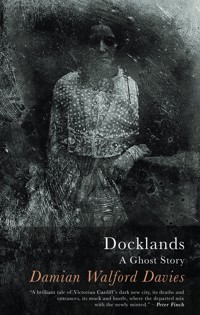
Victorian Cardiff – the world's busiest port, booming on the back of the coal mined in the Welsh valleys. It is 1890, and three dark terraces down the docks are to be levelled to make way for a new square. The commission is given to the chief of a successful Cardiff architectural firm – a man supremely sure of himself. Yielding to docklands' temptations, he becomes ever more estranged from a wife tormented by the death of their child. As the square rises from the ruins of the terraces, the louche architect encounters 'the girl'. A disquieting fin-de-siècle ghost story in verse, Docklands explores grey worlds at the edges of the eye, conjuring late-Victorian Cardiff's hustling, booming, sullied docks – and the horrors they conceal. A study of the violences perpetrated against wives and daughters, and of patterns of grief and longing, this disturbing sequence summons lost children and dark desires. 'When much new poetry looks no further than the poet's navel, this kind of imaginative leap is a tonic.' – The Telegraph Docklands is a meticulous study of place, time and atmosphere, which opens the reader's eyes to a city behind the city, and to lives behind our own. – Wales Arts Review
Das E-Book können Sie in Legimi-Apps oder einer beliebigen App lesen, die das folgende Format unterstützen:
Seitenzahl: 28
Veröffentlichungsjahr: 2019

















Docklands
for Martin and Filó
Docklands
A Ghost Story
Damian Walford Davies
Seren is the book imprint of Poetry Wales Press Ltd.
57 Nolton Street, Bridgend, Wales, CF31 3AE
www.serenbooks.com
facebook.com/SerenBooks
twitter@SerenBooks
The right of Damian Walford Davies to be identified as the author of this work has been asserted in accordance with the Copyright, Designs and Patents Act, 1988.
© Damian Walford Davies, 2019
ISBN: 978-1-78172-493-4
ebook: 978-1-78172-494-1
Kindle: 978-1-78172-495-8
A CIP record for this title is available from the British Library.
All rights reserved. No part of this publication may be reproduced, stored in a retrieval system, or transmitted at any time or by any means, electronic, mechanical, photocopying, recording or otherwise without the prior permission of the copyright holder.
The publisher acknowledges the financial assistance of the Welsh Books Council.
Author photograph: Brychan Rhydderch Davies.
Printed in Bembo by Latimer Trend & Company Ltd, Plymouth.
Contents
Commission
Cardiff, August–November 1890
Perspective
Firm
Lecture
Salvage
Spouse
Villa
Commission
Consumption
Thirst
Fruit
Girl
December 1890–March 1891
Solus
Wives
Trade
Saw
Warp, Weft
Ceremony
Reflections
Bestiary
Decadent
Chattel
Square
April–August 1891
Butcher’s
Flora
Migrants
Interior
Opening
Spectrum
Bouquet
Dessert
Tea
Vesper
House
September–December 1891
Play
Trail
O
Visitation
Rime
Nocturne
Unto us
Siren
Periphrastic
À deux
Fountain
January–May 1892
Gauge
Cemetery
Gifts
Stole
Figure
Cross-section
Recipe
Waist
Nereid
Return
Note
Acknowledgements
About the Author
Commission
Cardiff, August–November 1890
Perspective
From this gothic bay, flung out
above the hansoms
where O’Driscoll’s pony
rests a ruined fetlock
on a backturned hoof,
I can see St Mary Street run plumb
until, a quarter-mile away,
it curves to kiss itself
beyond the French arcades.
I lead each client to this
balanced brink; instinctively,
they back away. Revelation-
thin, O’Driscoll’s nag
evacuates the day in coarse, tan
gobs, heady sweetness
mixing with my new bay rum.
Firm
They’re passable, as partners –
Prichard hidebound, wan,
unmacassared; Seddon fleshy,
soft-soaped by his wife,
able botcher of a country church;
both petted daft by flocks
of daughters, fond
of metaphors concerning bees;
temperate in everything
except the riot act
they read our Butetown lad
who grins and wrings the postbag
as he scans the ample camber
of our punters’ wives
from bosom down to bustle.
Myself, I like the boy enormously.
Lecture
Their stipulations tickle me.
This Friday I address
St Mary’s Mothers’ Union
on that frothy text, ‘The Architect
and God’. Mrs Aston’s invitation
on the cream-wove paper,
blind-embossed, was breathless
as the messenger. Each month
I speak to guilds and schools,
but savour most the vestry’s
chaste proximities. I can smell
each just-bathed body, each lavender-
dabbed wrist, the trail of scent
a woman draws from throat
to chest. Ladies, I’ll begin; I take
the swallow as my starting point.
Salvage
Abercarn the godforsaken.
They asked me for a church;
what their blistered spirits
longed for was a monument
to firedamp and flood,
to bodies gaffed up black;
to those beyond the reach
of grappling hooks,
past even pity’s plumbline…
So on the pediment
I gave them such a pietà! –
the son’s dead heft
deposed along his mother’s
knees, the cross and ladder
in the background conjuring
a headframe and the winding gear.
Spouse
Past ten, she has the desk lamp
in my study lit, to lure me
like a moth, she taunted,




