


Erhalten Sie Zugang zu diesem und mehr als 300000 Büchern ab EUR 5,99 monatlich.
- Herausgeber: Seren
- Kategorie: Poesie und Drama
- Sprache: Englisch
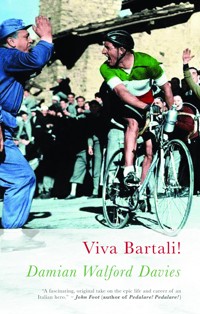
Inspired by the lyrical, mythic mode of Italian sports journalism from the 1930s to the 1950s, Viva Bartali! is a biography-in-verse of the iconic Italian cyclist Gino Bartali (1914—2000), two-time winner of the Tour de France (1938, 1948), known both as 'Gino the Pious' because of his fervent Catholic faith, and as Ginettaccio ('Gino the Terrible'), owing to the short shrift he so often gave the Press. Conjuring Bartali at crux moments in his personal and professional career, through joy and tragedy, defeat and victory, the collection places us alongside the young rider proving his mettle and adding to his palmarès in the edgy atmosphere of Mussolini's Fascist Italy, whose political ideology he loathed. From amateur races to the professional one-day classics and on to Tour de France glory, Bartali is seen alongside his fellow riders as both vulnerable body and élite athlete; both cycling's hard man and fond and bereaved father; both kneeling believer and climbing god. The collection gives us an insight into the complex relationship that underpinned his great rivalry with the campionissimo ('champion of champions') Fausto Coppi – the 'man of glass' against Bartali's 'man of iron'. It was a rivalry that a divided a nation and defined a sport. We are with Bartali at the 1948 Tour de France when he takes a phone call from the Italian prime minister, who asks him to do his part in diffusing a political crisis that could have tipped over into violence. And we witness his remarkable secret missions in the saddle as a courier throughout Tuscany during World War 2, carrying forged identity documents that helped save the lives of hundreds of Italian Jews. It was a deed he never spoke about – one for which he was named 'Righteous Among the Nations' by Yad Vashem in 2013. "A fascinating, original take on the epic life and career of an Italian hero." John Foot, author of 'Pedalare! Pedalare!' "Stylish and sophisticated, this poetic record of an extraordinary life confirms Damian Walford Davies' status as one of the finest poets writing in Wales today." Jem Poster
Sie lesen das E-Book in den Legimi-Apps auf:
Seitenzahl: 41
Veröffentlichungsjahr: 2023
Das E-Book (TTS) können Sie hören im Abo „Legimi Premium” in Legimi-Apps auf:















Viva Bartali!
for
Bronwen Price
velocista
and
Matthew Williams
scalatore
Seren is the book imprint of
Poetry Wales Press Ltd.
Suite 6, 4 Derwen Road, Bridgend, Wales, CF31 1LH
www.serenbooks.com
facebook.com/SerenBooks
twitter@SerenBooks
The right of Damian Walford Davies to be identified as the author of this work has been asserted in accordance with the Copyright, Designs and Patents Act, 1988.
© Damian Walford Davies, 2023
ISBN: 9781781727089
Ebook: 9781781727096
A CIP record for this title is available from the British Library.
All rights reserved. No part of this publication may be reproduced, stored in a retrieval system, or transmitted at any time or by any means, electronic, mechanical, photocopying, recording or otherwise without the prior permission of the copyright holder.
The publisher acknowledges the financial assistance of the Books Council of Wales.
Cover artwork: Gino Bartali at the Giro di Lombardia, 1952.
Printed in Bembo by Severn, Gloucester
Contents
Ponte a Ema
Vista
Resurrection
Yolks
Amateur
Prayer
Succession
Anointing
Adriana
Martyr
Solo
Tongue
Fiat 508 ‘Balilla’
Vault
Glacial
Revenant
Maglia Rosa
Order
Jordan
Commune
Vicarious
Posy
Capitano
Dog
Peau
Assumption
Choice
Dedication
Publicity
Mass
Headline
Signs
Acolyte
Draft
Marriage
Present
Blue
Nocturne
Screen
Commission
Drop
Diversion
Cache
Aubade
Ruota
Cellar
Strafe
Pastoral
Charity
Break
Oddments
Superannuate
Renaissance
Benediction
Plea
Selves
Pilgrim
Summit
Farfalle
Gino Bartali: Palmarès
Glossary
Acknowledgements and Afterword
Ponte a Ema
Tuscany, 1924
You’d wake to the tang
of lye ash soap, to women singing
on the river bank, beating laundry
vestment-white and laying it to dry
like snow on furze and rock.
From bridge to ox-bow bend,
the pools were fishless, fizzing,
glib with suds. Some days,
what brought you round like salts
was Primo’s dung cart, hauling
two weeks’ worth from sties and coops
to strew across the flint-set fields.
Opening the shutters on a frozen street,
raffia iron-hard around the balcony,
you’d watch your father move
from lamp to lamp down Crucifixion Lane,
mount his ladder, snuff each sallow
oilflame with a shale-cut hand.
Vista
Florence, 1926
The ride to school was on a cast-off
butcher’s bike, sin-black,
through lanes that dyed the tyres
white. You’d pass the blind man
on his daughter’s doorstep
crying Go, my boy!, a girl
with wasted legs propped
puppet-like against a wayside shrine.
Then up the killing incline, scrip
rebounding off your back, along
a line of cypress flames until
the terracotta city opened out
before you at Piazza Michelangelo,
where blackshirts massed
below the copy of the David,
the manboy’s weight thrown right,
a star of hair above the groin,
great lodes of blood across his hand.
Resurrection
Ponte a Ema, 1929
Midwinter afternoon, the cold
belligerent. A game of cops
and robbers, run all day in random
rat-tat-tats through barns
and steaming byres, gathered
to a shootout in the drifts
in Salvatore’s field, snowball-bullets
ripping through the Boys in Blue.
Later, trailing moons of lantern glow
along the ground, Babbo
found you where the Scarface Swells
had tommy-gunned you down –
snow-sepulchred, heartbeat
hibernation-slow, a chrysalis
that took six months to thaw
to speech, ragazzo-Lazarus
who somewhere in that whiteout
promised never to be killed again.
Yolks
1933
Your summer regimen: dawn raid
on Babbo’s hen-hutch, bantams
palmed aside for alabaster eggs
that clack inside your jersey’s
pouch; a flask of ebony espressos
with the taste of cigarettes;
the weighed canteen of water, gram-
precise; your one spare tyre, torqued
figure-of-eight across your back;
goggles for the Tuscan dust;
three rattled-through Hail Marys
for the road. The morning full of grace –
gathered to the wicked slug of coffee
at the San Donato bend,
and your breaking of the shells
against the handlebars, eggwhites
trailing from the metal, gold hearts
wolfed down on your slick descents.
Amateur
1934
The tyke who’d trailed you
from the shabby starting flag
you knew from afternoons
in dim repair shops, where they hung
new tyres to cure like eels
above the bench-end vices
and the shining virgin cogsets
stacked like secret currencies.
In the final cobbled sprint –
pitched towards a May Queen
cradling flagging flowers
on a cock-eyed dais –
you let him have the mercy
of your slipstream, knowing
from the way he broke
he’d never make it past his cousin’s
cast-off jersey and the pittance
of a feast-day parish purse.
Prayer
St Thérèse of Lisieux, 1873–97
St Thérèse, Little Flower –
keep us from the blind dog
blundering into our path;
the devils in the ruts; pride,
swaggering in victors’
yellow and pink. Be our shield
on broiling cols; steel us
for cloudburst and crosswind,
bullet-hail and brume’s
deceptions. Shepherd us
through corridors of grasping
hands and gurning faces;
gird us in the peloton’s
press; be lodestar on the lonely
breakaways. We have seen
Despair ride close beside us
on setts and cinderways.
Brace us; bring us home to flowers.
Succession
Giro d’Italia, 1935; Stage 6, Portocivitanova–L’Aquila, 25 May
Salt savour of the docklands start




