


Erhalten Sie Zugang zu diesem und mehr als 300000 Büchern ab EUR 5,99 monatlich.
- Herausgeber: Paraclete Press
- Kategorie: Religion und Spiritualität
- Sprache: Englisch
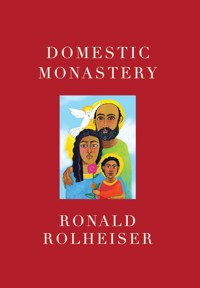
Transform Your Everyday Life into a Sacred Space In Domestic Monastery, bestselling author and spiritual guide Fr. Ronald Rolheiser offers a profound yet practical invitation: discover the sacredness of daily life and find peace, purpose, and grace amidst the chaos of modern living. Through ten short, insightful chapters, Fr. Rolheiser explores how the principles of monastic life can transform our homes, relationships, and routines into spaces of reflection, prayer, and spiritual growth. Whether you're a parent overwhelmed by the demands of family life, a professional navigating the busyness of work, or simply longing for a deeper connection to God, Domestic Monastery shows how the contemplative wisdom of monasticism can bring meaning and balance to your everyday world. Let Domestic Monastery show you that a holy and fulfilling life doesn't require a cloister—it begins at home. Inside This Thoughtful Book, You'll Discover: - Parallels Between Monastic and Family Life: Learn how parenting and daily duties mirror the self-giving love and discipline of monastic life. - The Sacredness of Time and Rituals: Find simple, practical ways to infuse your routines with spiritual reflection and intentionality. - The Value of Powerlessness: Embrace life's limitations as opportunities to surrender, grow, and experience God's grace. - Inspiration for Every Season of Life: Explore the wisdom of balancing action with contemplation, community with solitude, and love with self-abandonment. Perfect for parents, caregivers, and anyone seeking solace in the midst of life's demands, Domestic Monastery is a gentle, inspiring guide to cultivating a life of prayer and presence right where you are. Whether you're looking to deepen your faith, navigate parenting with more grace, or discover beauty in life's smallest moments, Domestic Monastery will uplift and inspire you. This timeless book makes an ideal gift for busy parents, spiritual seekers, and anyone longing for a sense of sacred calm in today's fast-paced world.
Sie lesen das E-Book in den Legimi-Apps auf:
Seitenzahl: 48
Veröffentlichungsjahr: 2022
Das E-Book (TTS) können Sie hören im Abo „Legimi Premium” in Legimi-Apps auf:
Ähnliche














PRAISE FOR RONALD ROLHEISER’S WRITING
“Ronald Rolheiser is one of the great Christian spiritual writers of our time.”
—JAMES MARTIN, SJ, author of Jesus: A Pilgrimage
“When Ron Rolheiser writes, it is clear, compelling, and challenging, plus it is about issues that matter to the soul.”
—FR. RICHARD ROHR, OFM, Center for Action and Contemplation
“A master weaver is at work here.”
—SISTER HELEN PREJEAN, author of Dead Man Walking
“Rolheiser dares to ask the hard questions but they are our questions—the deep ones we are slow to let surface. Then he dares to answer them with clear answers delivered in simple, straightforward language.”
—FR. BASIL PENNINGTON, OCSO
“He is never sentimental—and all the time he is absolutely grounded in reality.”
—HERBERT O’DRISCOLL, author of A Doorway in Time
Domestic Monastery
Domestic Monastery
RONALD ROLHEISER
2019 First Printing
Domestic Monastery
Copyright © 2019 by Ronald Rolheiser
Cover image copyright © 2019 by Brother Michael O’Neill McGrath, OSFS
ISBN 978-1-64060-372-1
Library of Congress Cataloging-in-Publication data is available.
10 9 8 7 6 5 4 3 2 1
The Paraclete Press name and logo (dove on cross) are trademarks of Paraclete Press, Inc.
All rights reserved. No portion of this book may be reproduced, stored in an electronic retrieval system, or transmitted in any form or by any means—electronic, mechanical, photocopy, recording, or any other—except for brief quotations in printed reviews, without the prior permission of the publisher.
Published by Paraclete Press
Brewster, Massachusetts | www.paracletepress.com
Printed in Korea
CONTENTS
ONE
Monasticism and Family Life
TWO
The Domestic Monastery
THREE
Real Friendship
FOUR
Lessons from the Monastic Cell
FIVE
Ritual for Sustaining Prayer
SIX
Tensions within Spirituality
SEVEN
A Spirituality of Parenting
EIGHT
Spirituality and the Seasons of Our Lives
NINE
The Sacredness of Time
TEN
Life’s Key Question
ABOUT THE AUTHOR
ONE
Monasticism and Family Life
There is a tradition, strong among spiritual writers, that we will not advance within the spiritual life unless we pray at least an hour a day privately. I was stressing this one day in a talk, when a lady asked how this might apply to her, given that she was home with young children who demanded her total attention.
“Where would I ever find an uninterrupted hour each day?” she moaned. “I would, I am afraid, be praying with children screaming and tugging at my pant legs.”
A few years ago, I might have been tempted to point out to her that if her life was that hectic then she, of all people, needed time daily away from her children, for private prayer, among other things. As it is, I gave her different advice: “If you are home alone with small children whose needs give you little uninterrupted time, then you don’t need an hour of private prayer daily. Raising small children, if it is done with love and generosity, will do for you exactly what private prayer does.”
Left unqualified, that is a dangerous statement. It, in fact, suggests that raising children is a functional substitute for prayer.
However, in making the assertion that a certain service—in this case, raising children—can in fact be prayer, I am bolstered by the testimony of contemplatives themselves. Carlo Carretto, one of the twentieth century’s best spiritual writers, spent many years in the Sahara Desert by himself praying. Yet he once confessed that he felt that his mother, who spent nearly thirty years raising children, was much more contemplative than he was, and less selfish. If that is true, and Carretto suggests that it is, the conclusion we should draw is not that there was anything wrong with his long hours of solitude in the desert, but that there was something very right about the years his mother lived an interrupted life amid the noise and demands of small children.
St. John of the Cross, in speaking about the very essence of the contemplative life, writes: “But they, O my God and my life, will see and experience your mild touch, who withdraw from the world and become mild, bringing the mild into harmony with the mild, thus enabling themselves to experience and enjoy you” (The Living Flame, 2.17).
In this statement, John suggests that there are two elements crucial to the contemplative’s experience of God—namely, withdrawal from the world, and the bringing of oneself into harmony with the mild. Although his writings were intended primarily for monks and contemplative nuns who physically withdraw from the world so as to seek a deeper empathy with it, his principles are just as true for those who cannot withdraw physically.
“But they,
O my God and my life,
will see and experience
your mild touch,
who withdraw
from the world and
become mild,
bringing the mild into
harmony with the mild,
thus enabling themselves
to experience
and enjoy you”
— ST. JOHN OF THE CROSS
Certain vocations—for example, raising children—offer a perfect setting for living a contemplative life. They provide a desert for reflection, a real monastery. The mother who stays home with small children experiences a very real withdrawal from the world. Her existence is certainly monastic. Her tasks and preoccupations remove her from the centers of social life and from the centers of important power. She feels removed.




