


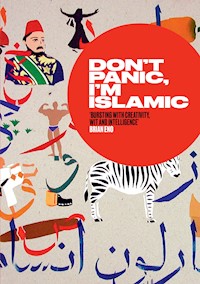
Don't Panic, I'm Islamic E-Book
Erhalten Sie Zugang zu diesem und mehr als 300000 Büchern ab EUR 5,99 monatlich.
- Herausgeber: Saqi Books
- Kategorie: Lebensstil
- Sprache: Englisch
A Sunday Times Best Humour Book of the Year 2017 How can you tell if your neighbour is speaking Muslim? Is a mosque a kind of hedgehog? Can I get fries with that burka? You can't trust the media any longer, but there's no need to fret: Don't Panic, I'm Islamic: Words and Pictures on How to Stop Worrying and Learn to Love the Alien Next Door provides you with the answers. Read this book to learn how you too can spot an elusive Islamist. Discover how Arabs (even 21-year-old, largely innocuous and totally adorable ones) plant bombs and get tips about how to interact with Homeland Security, which may or may not involve funny discussions about your sexuality. Commissioned in response to the US travel ban, Don't Panic, I'm Islamic includes cartoons, graffiti, photography, colouring in pages, memoir, short stories and more by 34 contributors from around the world. Provocative and at times laugh-out-loud funny, these subversive pieces are an explosion of expression, creativity and colour. Contributors: Hassan Abdulrazzak, Leila Aboulela, Amrou Al-Kadhi, Shadi Alzaqzouq, Chant Avedissian, Tammam Azzam, Bidisha, Chaza Charafeddine, Molly Crabapple, Carol Ann Duffy, Moris Farhi, Negin Farsad, Joumana Haddad, Saleem Haddad, Hassan Hajjaj, Omar Hamdi, Jennifer Jajeh, Sayed Kashua, Mazen Kerbaj, Arwa Mahdawi, Sabrina Mahfouz, Alberto Manguel, Esther Manito, Aisha Mirza, James Nunn, Chris Riddell, Hazem Saghieh, Rana Salam, Karl Sharro, Laila Shawa, Bahia Shehab, Sjon, Eli Valley, Alex Wheatle.
Sie lesen das E-Book in den Legimi-Apps auf:
Seitenzahl: 178
Veröffentlichungsjahr: 2017
Das E-Book (TTS) können Sie hören im Abo „Legimi Premium” in Legimi-Apps auf:
Ähnliche




















Shadi Alzaqzouq: MUSLIM PANIK PERFORMANCE
Stylist: Hélène Roy
CONTENTS
Arwa Mahdawi
A PERSONAL GUIDE TO EXTREME VETTING
Chant Avedissian
ARE YOU TALKIN’ TO ME?
Karl Sharro
THE JOYS OF APPLYING FOR A US VISA
James Nunn
COLOUR ABDULLAH!
Negin Farsad
MY OWN PEOPLE DON'T LIKE ME VERY MUCH
Bidisha
50 STATES OF AMERICA FIRST
Chris Riddell
LA LA LAND
Hazem Saghieh
TRUMP AND GADDAFI
Molly Crabapple
TRUMPINATION
Omar Hamdi
ISLAM IS NOT SPIRITUAL, BUT IT IS A USEFUL IDENTITY
Esther Manito
A SIDON-GATESHEAD UPBRINGING (IN ESSEX)
Hassan Hajjaj
’KESH ANGELS
Saleem Haddad
DO I UNDERSTAND THAT YOU ARE A HOMOSEXUAL, SIR?
Rana Salam
SEXY SOUK
Amrou Al-Kadhi
HOW ISLAM TAUGHT ME TO BE A DRAG QUEEN
Chaza Charafeddine
DIVINE COMEDY
Leila Aboulela
MAJED
Jennifer Jajeh
WHITE LIKE ME
Hassan Abdulrazzak
TUESDAY'S CHILD
Eli Valley
ARE NAZI ANALOGIES KOSHER TODAY?
Moris Farhi
OF DOLPHIN CHILDREN AND LEVIATHANS
Tammam Azzam
FROM SYRIA, WITH LOVE
Alex Wheatle
SHADE-ISM
Carol Ann Duffy
COMPREHENSIVE
Aisha Mirza
YESTERDAY I STEPED ON A WHITE WOMAN'S YOGA MAT
Laila Shawa
DISPOSABLE BODIES
Joumana Haddad
THE JOKE'S ON THEM
Mazen Kerbaj
COLA
Sabrina Mahfouz
POSTCARD FROM A MUSLIM MERMAID
Sayed Kashua
PREPARING MY KIDS FOR THE NEW AMERICA
Alberto Manguel
FABULOUS CREATURES
Bahia Shehab
THERE ARE PEOPLE: CAIRO 2012
Sjón
THE MUSLIM: A CAUTIONARY TALE
Afterword
About the Contributors
Permissions
Say what you like about Donald Trump, you’ve got to admit that he tells it like it is. His directness of expression is unpresidented in the White House. He’s a real American and he talks real American.
Which is why Trump’s obsession with ‘extreme vetting’ is troubling. Not only is extreme vetting a multi-syllabic phrase, it lacks the compelling comprehensibility that characterises Trump’s other policies, like ‘build a wall’ or ‘lock her up’. I’m afraid to say that it smacks of politicking. After all, what does ‘extreme vetting’ actually mean? Judging by the amount of debate the term has provoked, nobody is entirely sure.
The ambiguity of extreme vetting has been cause for consternation in some quarters. Progressives, in particular, have done much fretting about extreme vetting. Many have argued that it is nothing more than thinly-veiled Islamophobia; that Trump is trying to impose a blanket ban on Muslims entering America. I would be wary of this analysis. If anything is clear, it’s that extreme vetting is designed with animals in mind. It’s supposed to protect America from rabid jihadists and, really, isn’t that something we all want? Liberals may enjoy trotting out smartass facts like ‘lawnmowers kill more Americans than Islamic jihadist immigrants each year’, but you can’t deny that Islam and Islamic terrorism are strongly linked.
Let us imagine for a moment a future for American kids without the threat of radical Islamic terror. Shouldn’t these kids be able to go to school secure in the knowledge that all they have in the world to worry about is being caught in the path of a rogue lawnmower? Or becoming a victim of police brutality? Or perhaps being mown down in a mass shooting perpetuated by a classmate? The less gory options are no less frightening for their innocent minds. What about succumbing to a nationwide opioid crisis? Dying an avoidable death due to a lack of affordable healthcare? And even if they escape these horrors, there’s always the very real possibility of getting grabbed by the pussy by an aspirational president.
I digress. Whatever your politics, we ought to remember that now is the time for national unity. Don’t we all want to make America safe again? I have a modest proposal. (Hear me out, I’m being practical here. I’m not going to suggest that Muslims eat their own children in order to pre-emptively stop terrorism. That would be too time consuming). Quite simply: I think that we should embrace extreme vetting all the time. We shouldn’t just be vetting people at the borders; we should be vetting everyone we meet. We shouldn’t just be banning suspicious people from coming in; we should be kicking suspicious people out. I’ve been proactive and have put together a few pointers that make extreme vetting extremely easy… and incredibly equitable. Commit these guidelines to memory and you’ll be able to distinguish an acceptable Arab from a potential terrorist in no time. You’ll be part of making America safe again.
Do they have an iPhone or an isisPhone?
Thanks to the FBI’s much-publicised attempts to hack their way into the San Bernadino shooters’ phones, it’s common knowledge that the shooters had iPhones. It might be tempting to thus surmise that everyone with an iPhone is a potential terrorist. However common sense suggests that this is too narrow: iPhone screens, as I know from my own tragic experience, crack easily – making them less than ideal for vigorous terrorist activity. The San Bernadino shooters were outliers and should not be considered representative of terrorists as a whole. Particularly as there is clear data that shows that the Nokia 105 is the preferred phone brand of ISIS fighters. So to be on the safe side, if you spot someone with an iPhone or a Nokia, regard them with immediate suspicion as they’re probably a terrorist. Either that or they think it’s the 1990s.
Is that body odour or eau de cologne?
Research shows that you can quite literally sniff out a terrorist. According to a terrorist behaviour checklist used by America’s Transportation Security Administration for airport screening, ‘strong body odour’ can be a sign that someone has evil intentions. Other dead giveaways include exaggerated yawning, whistling, verbally expressing contempt for the screening process, and a cold penetrating stare. This checklist, by the way has nothing to do with Trump; it was part of a program (costing almost $1billion) called the Screening of Passengers by Observation Techniques initiated under President Obama. Ah, remember the Obama years? Islamophobia was nonexistent, vetting was extremely benevolent and America welcomed immigrants with open arms, giant hugs and expensive observation techniques. But enough nostalgia already. While a pungent aroma may signal that there’s something a little fishy about someone, don’t forget that Middle Eastern men wear a lot of perfume. Even little baby Jesus got a bottle of Frankincense as soon as he was born. So both those guilty of unmasked body odour and overmasked body odour are potential terrorist suspects. Even if they are in fact innocent, it’s sensible to keep your distance from these groups of people for your own good.
Are they wearing all-black everything?
I don’t want to throw shade here but ISIS really needs to expand its wardrobe. Have you ever seen a jihadist wearing colour? No. They seem to accessorise their monochromatic worldview with a monochromatic wardrobe; everything is just black and white, all the time. Which is a shame because peacock blue looks great on olive skin. This doesn’t mean that black clothes always go hand in hand with dark intentions. Many people enjoy wearing black because it’s slimming. It’s not necessarily Muslimming. Ultimately the key thing to take away from all this is that terrorists generally own some sort of clothing, and some of that clothing is quite likely to be black. The safest holiday hangouts are nudist beaches.
Are they surrounded by kittens and Nutella?
Back in 2015 CNN broke the news that ISIS recruits women with kittens and Nutella. CN’s Carol Costello said: ‘ISIS recruiters lure Westerners into their fight because they want people to believe their life on the battlefield isn’t so different than yours. They actually eat Nutella, and I guess they have pet kittens.’ So if you spot someone surrounded by kittens, languorously spooning Nutella from the jar you should be afraid. Be very afraid.
What’s in their pantry?
A predilection for extra virgin olive oil is a sign that someone might be thinking a little too much about the afterlife. You are what you eat. Watch out for foodamentalists.
Are they talking terrorist?
Hearing someone speak Arabic can be alarming for obvious reasons – Arabic being the official language of terrorists and all. So, it’s worth becoming familiar with some common Arabic words in order to understand when you should panic and when the conversation is simply Islamic.
Allahou Akbar
I’m going to kill every infidel in this room right now
Inshallah
I’m going to kill every infidel in this room right now. Hopefully, maybe, we’ll see.
Shibshib
While this is just the word for a flipflop/sandal it’s sort of Arab tradition to turn shibshib into dangerous weapons. If you hear someone say shibshib then duck. Or get socked by a shoe. Your call.
Falafel
If you get a group of Arabs together in a restaurant they will inevitably start arguing about who invented falafel. The Egyptians will say they did; the Iraqis will say did; and on and on and on. Then the bill will come and the argument will escalate as they all bicker about who gets to pay the bill. Things can turn violent quickly.
Habibi
Arabic for friend or significant other (millennials say Habi-bae). Not related in any way to Netanyahu. This is A Good Word.
Hummus
A chickpea-based edible dip that has done a wonderful job of integrating into America. If only more Arabs could be like hummus!
Yallah
It would be logical to think that, because it contains ‘Allah’, ‘yallah’ is a dangerous word. On the contrary, however, ‘yallah’ is very common and largely benign. It means anything from ‘OK, we’re done with this conversation’ to ‘hurry up’. Of course, you should always stay vigilant. If someone dressed in black and wielding a Nokia 105 yells ‘yallah’ at a litter of slow-moving kittens, then—
Barlon Ansambel – to learn Arabic letters.
50 x 70 cm. Gouaches paint stencilled on recycled paper.
Haya Natakalam – to learn Latin letters.
50 x 70 cm. Gouaches paint stencilled on recycled paper.
FIRST THE IDEA WAS FOR a Muslim travel ban – but that didn’t work. Then it became a ban on certain Muslim-majority countries – but that wasn’t workable either. Then it mutated into a ban on travelling with laptops and iPads. It was as if the Trump administration was thinking: ‘We can’t stop them coming here, but at least we will deprive them of the pleasure of choosing their own entertainment on the flight.’ What next? Travel pillows are denied and strait jackets enforced? America’s security, it seems, relies on causing maximum discomfort to travellers from the Middle East.
As anyone who has ever attempted to obtain a US visa will know, the process is so absurd and the odds of success so low that back in the 1980s a man from my hometown in Lebanon became an instant celebrity when he managed to get his hands on one. For the next five years, which is the standard validity of an American visa, the man acquired a mythical status. People would gather around him in the café as he retold the story of how he got the visa. He would pause to take a sip from his Coca Cola, which he never had to pay for, and recount his heroic tale. Years later, people would still refer to him as ‘the man with the American visa’.
And yet, here we are. Trump tweeted, ‘Our country needs strong borders and extreme vetting, NOW’. Extreme vetting. NOW. I, and millions of others, scratched our collective Middle Eastern head. ‘The vetting can get more extreme?!’ Naturally, this was ominous news. Millions could lose the ability to travel to the US for work, study, visiting family or, God forbid, tourism.
Allow me to give you a glimpse into the process, which I have pieced together from my own experience and from the man with the American visa’s tales. First you must fill out the application forms. Many, many questions designed to weed out the absent-minded terrorist, the careless smuggler, or the sloppy illegal immigrant who would fail to answer simple questions and give themselves away. Have you ever been involved in, or do you seek to engage in, money laundering? Do you seek to engage in espionage, sabotage, export control violations, or any other illegal activity while in the United States? Have you ever ordered, incited, committed, assisted, or otherwise participated in genocide?
When answering these questions, it is important to resist the temptation to express your views about US foreign policy. Like, What about the shady characters the US deals with who would fail to answer these questions in the negative? Or: What about the US’s own engagement in espionage, sabotage and clandestine operations in the Middle East?
In fact, it is best to avoid any kind of elaborate commentary at all, and simply reply ‘No’, except to question 27 which asks if you have ever eaten falafel. That’s a trick question. Composure must be kept at all times.
When you finish filling out the forms, you will need to pay hundreds of dollars in application fees for the honour of being interrogated in person by officials at a US Embassy. Don’t balk at the required sum; the US visa is the gold standard of visas and is worth every penny. It’s like buying an expensive bottle of wine to impress your friends.
Then you need to assemble a large collection of documents to support your application. These will include details of your financial records, property deeds, pay slips, bank statements, tax receipts, criminal records, letters from your employers, airline tickets, hotel reservations and your grandparents’ love letters. Now the latter is not strictly required, but be prepared because you never know which topics will come up in the interview. Oh, and original documents only, photocopies are not accepted. You would have liked to show them the documents on your laptop or iPad, but you aren’t sure whether the electronics ban extends to embassies, too. You will be grateful, after all, to that long lost aunt who kept old laundrette receipts in cardboard boxes under the floorboards ‘because they might come in handy one day’. What foresight.
And now for the fun part, the interview. You are given an appointment at seven in the morning, which means you will be seen any time between seven and five in the afternoon. You sit there among the aspiring masses, as the hours pass slowly, afraid to go to the toilet in case your name comes up. A human drama unfolds, as people are called up one by one, leaving with despair, dejection, sorrow or, quite infrequently, elation. Those are the lucky few. The chosen ones. They are patted on the back jealously by the others, as they leave hurriedly, perhaps worrying that the embassy officials might change their minds and revoke their visas instantly. A gold glow and star spangled halo already glitters in their wake as they hurry home to throw parties to celebrate, where friends, neighbours and the son of the man who used to run the bakery where your mum’s neighbour bought her bread will visit to congratulate them. Or perhaps you’re just slightly hysterical at this stage.
The interview is the high point of the process and requires you to be at your sharpest mentally, nimbly avoiding the verbal traps that the highly-trained embassy official will set up for you. Try to get tips from the people who have already been interviewed, they will give you instant reviews of the different officials. ‘Number 5 is tough. He will ask a lot of questions about your finances’. ‘Number 3 hasn’t approved a single visa today!’ ‘Number 4 looks like my cousin’s dog!’
And then your number comes up.
You realise that you have been sweating despite the arctic air con because there’s a bit of dandruff on the lapel of your starchy suit jacket, which is only wheeled out for funerals and these kinds of special occasions, and you’re paranoid that the applications officer might mistake it for cocaine. Although the voice of reason, baffled and oppressed by the current unfolding events, points out that being a cocaine addict is probably preferable to being a terrorist, so maybe you should encourage this impression. Should I frown and risk upsetting Number 2, or smile and make him think I’m hiding something? At this stage your brain is near melting point as it tries to negotiate its way through these impossible paradoxes. Thankfully, the blank-faced official speaks.
– What do you do?
Straight to it, no hello, how are you doing or how can I help you today. Visa officials dispense with all the courtesies and social conventions of the outside world to establish the power balance instantly. Which feels odd, because this is the most intimate encounter you will have with a stranger, short of a blind date. Over the next twenty minutes or so, you will reveal your most personal details to this person you’ve never seen before in your life.
– What do you do?
– I am an architect.
– How much do you earn?
Gee, don’t you want to buy me a glass of wine first before asking?
– 1500.
– That’s not much.
Too bad, I thought we were hitting it off, you and I.
– I should ask for a raise. Any tips?
He examines me briefly with a stone-faced expression, and to my disappointment, doesn’t offer any.
– Are you happy at your work?
– Yes, I love my work.
At least I don’t have to speed date people and then deny them entry into the US for a living.
– Do you have a car?
– 1990 VW Golf.
– Where do you live?
– Ras Beirut.
– Do you own the place?
– No, I rent.
When is it my turn to ask the questions? I have a few good ones.
– Do you own any property?
– I inherited an orchard.
– Where and when were your grandparents born?
– Sometime, somewhere in the Ottoman Empire.
– Their birth certificates?
– I don’t have them.
– Why not?
– Well, the Ottoman Empire doesn’t exist anymore. It’s not like I can just pop into its consulate.
– Are you trying to be funny?
– No, sir.
– Why are you planning to visit the United States?
– To see my friends.
Judgmental look, as if he doesn’t believe that I have friends.
– Why?
– Why?
– Yes, why?
The conversation is clearly taking on a philosophical dimension. Do I need to explain the concept of friendship to him? It is important to avoid being snarky and remain as earnest as possible, for US officials are easily threatened by sarcasm.
– I haven’t seen them for a long time and I thought I could visit New York. I hear it’s an amazing city.
The official fails to reveal his own thoughts about New York, despite my own eagerness. He changes direction suddenly.
– Bank statements?
– It’s that one.
– You only have two hundred dollars in your bank account?
Alright, no need to criticise my finances. I have to justify my spending habits to you now?
– I was invited to a lot of weddings this summer.
He looks unconvinced.
– Do you have any relatives in the United States?
Well, there is my mother’s second cousin but we don’t talk to them. Do they still qualify as relatives? Should I come clean and explain the situation? What if he asks about the reasons for the family feud? I mean not even my grandmother remembers that. But what if I say no and they have supercomputers that know that we are related and he’s trying to trick me?
This is the insidious nature of the visa interview process: it forces you to confront aspects of your life you have never thought about. It digs deep into the fibre of your being, asking historical questions, querying family relationships, inquiring about your finances, assessing your character. You need to have prepared answers for all these questions, and yet answer them casually, nonchalantly, off the cuff. You do this all the time. You are a citizen of the world. The best way to succeed is to approach it as if you are preparing to play yourself in a black and white movie about your own life. A somewhat two-dimensional character that would appeal to the US embassy officials. You are not a real person anymore; the usual rules do not apply here. You are a statistic, and your stamp on the world, all you have achieved, has climaxed here, in this 12 by 12 foot cubicle, in a neat pile of a dead great aunt’s laundrette receipts.
And so you see, when I first heard that Trump was planning on making it even more difficult for us to travel to the US, I was stunned. What questions would they be asking now? ‘Do you know anyone who goes by the name of Muhammad? How about Mohamed?’ ‘Is this a hipster beard or a religious statement?’ ‘Does watching Homeland make you angry?’ ‘What was President Trump’s golf score this weekend?’
Perhaps it’s finally time to start searching for my grandparents’ Ottoman birth certificates after all.
Negin Farsad
MUSLIMS DON’T NECESSARILY HAVE




