


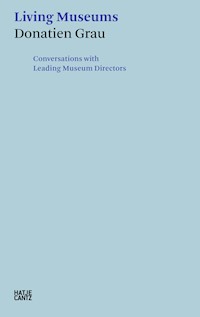
Donatien Grau. Living Museums E-Book
21,99 €
Mehr erfahren.
- Herausgeber: Hatje Cantz Verlag
- Kategorie: Geisteswissenschaft
- Serie: Hatje Cantz Text
- Sprache: Englisch
A rare glimpse behind the scenes of the world's most influential museums Who are the people shaping the world's most renowned museums? In this captivating book, Donatien Grau offers a rare glimpse behind the scenes of leading art institutions and their visionary directors. Through insightful conversations with some of the most influential figures in the museum world, he reveals how they opened their doors to ever-growing audiences while preserving artistic excellence. From the Louvre in Paris to the Guggenheim in New York, these personal accounts explore the balance between curatorial vision, cultural responsibility, and the evolving role of museums in society. The book sheds light on the people, ideas, and strategies that have transformed museums into cultural landmarks. Part personal reflection, part cultural history, this volume reads like a thrilling journey through the corridors of power, art, and public engagement. A must-read for art lovers, cultural professionals, and anyone curious about what happens beyond the museum walls. Featuring interviews with: Michel Laclotte (Louvre), Sir Alan Bowness (Tate), Sir Timothy Clifford (National Galleries of Scotland), Philippe de Montebello (Metropolitan Museum of Art), Irina Antonova (Pushkin Museum), Peter-Klaus Schuster (Staatliche Museen zu Berlin), Sir Mark Jones (V&A), Tom Krens (Guggenheim), Wilfried Seipel (KHM), Henri Loyrette (Musée d'Orsay, Louvre). DONATIEN GRAU(1987) is an internationally recognized critic, scholar, and museum executive. Named one of Apollo Magazine's "Forty under Forty Europe" in 2014, he is a leading voice in the dialogue between contemporary culture and classical institutions. Grau currently serves as Head of Contemporary Programs at the Musée d'Orsay in Paris, where he shapes innovative exhibitions and fosters global conversations on art, museums, and cultural policy. His work bridges scholarship and practice, making him one of the most influential cultural figures of his generation.
Das E-Book können Sie in Legimi-Apps oder einer beliebigen App lesen, die das folgende Format unterstützen:
Seitenzahl: 591
Veröffentlichungsjahr: 2020
Ähnliche




















Living Museums
Donatien Grau
Conversations with Leading Museum Directors
Colophon
Editor
Donatien Grau
Project management
Richard Viktor Hagemann
Copyediting
Aaron Bogart
Production
Vinzenz Geppert
© 2020 Hatje Cantz Verlag, Berlin, and the author
Published by
Hatje Cantz Verlag GmbH
Mommsenstraße 27
10629 Berlin
www.hatjecantz.de
A Ganske Publishing Group Company
isbn 978-3-7757-4753-0 (Print)
isbn 978-3-7757-4798-1 (eBook)
We cannot be held responsible for external links; the content of external links is the full responsibility of the operators of these sites.
Contents
Title
Colophon
Introduction
Part iThe Connoisseurial Museum
Michel Laclotte
Director of the Musée du Louvre, Paris, 1987–95
Sir Alan Bowness
Director of the Tate, London, 1980–88
Sir Timothy Clifford
Director of the National Galleries of Scotland, Edinburgh, 1984–2006
Philippe de Montebello
Director of the Metropolitan Museum of Art, New York, 1977–2009
Part iiThe Political Museum
Irina Antonova
Director of the Pushkin Museum of Fine Arts, Moscow, 1961–2013
Peter-Klaus Schuster
Director General of the Staatliche Museen zu Berlin, 1998–2008
Sir Mark Jones
Director of the Victoria and Albert Museum, London, 2001–11
Part iiiThe Museum in the Global World
Tom Krens
Director of the Guggenheim Museum, New York, Venice, Bilbao, 1988–2008
Wilfried Seipel
Director General of the Kunsthistorisches Museum, Vienna, 1990–2008
Henri Loyrette
Director of the Musée d’Orsay, Paris, 1994–2001, and of the Musée du Louvre, Paris, 2001–13
Introduction
Museums have a striking ability to make us believe in the present moment that they have been here, and will be here, forever. When we enter the Louvre, whose architecture has been consistently changing over the last half-century, we have the sensation that the display of objects has always been what it is now. But the museum has expanded beyond its limitations, adding new wings to a growing ensemble. Ieoh Ming Pei’s pyramid was built on the esplanade. New departments have been founded—most recently, one devoted the arts of Islam. A new entrance was added in the 1990s, which was restructured at the beginning of Jean-Luc Martinez’s tenure in 2013. The Louvre now has a president-director, who oversees all aspects of the museum—it had no such position until Michel Laclotte’s appointment in 1987. When the Grand Louvre was conceived, under Laclotte’s supervision, it hosted roughly two million visitors and was planned for five million. Ten years later, it hosted more than ten million. In the 1990s, there was only one Louvre, whose borders kept shifting. In 2017, there were three: the Louvre in Paris, the sanaa-designed Louvre-Lens in northern France, and the Louvre Abu Dhabi, newly opened in a Jean Nouvel building. The museum of museums, as the Louvre is known, has changed. And so have all museums of comparable scope and relevance.
In the same way as museums can appear eternal—eternal in the present—it is a commonplace to say that leadership does not play any role in the history of museums; museums are places for the community, where individuality does not matter; they are collaborative endeavors of a group of equals: the curators. Art museums are devoted exclusively—following Ruskin’s ideal for London’s National Gallery—to the contemplation of works created by human genius. But as the number of visitors who go into museums has kept growing at an unprecedented pace over the last three decades, they have become institutions with a constituency. Not only do they reflect the politics of the time—those of the states in which they are located and to which they often belong—but they have, more importantly, become political players in their own right. The directors of institutions have been leading this specific political impetus of the museum as a force in itself; every museum, therefore, is increasingly taken between two forms of positioning: as political force or as device for political forces. They have to confront and address the changes in our cultures, which allow us to look at history outside of the solidified narrative that for so long repressed other narratives. They are forums.
This empowerment of museums is tied to an empowerment of the directors, embodying the institution they lead. They have become, over the last thirty years, public figures, to the point that some of them might be better-known for their high profile than for their action. They are far away from the previous generations of old-school curators-turned-directors and, as such, paved the way for figures that are emerging today. Some have had a vast amount of political, financial, and institutional power and have played, perhaps quietly, a major role in contemporary diplomacy. We have witnessed the shift of figure from the museum director as connoisseur to the museum director as ambassador, cabinet minister, or even as statesman.
From my many conversations with Philippe de Montebello, the longest serving director of the Metropolitan Museum of Art, who, for thirty years acted as the museum’s face and voice, while radically shaping the institution, I understood how important museum directors had been in making those shifts. I understood that something essential had happened in the world of museums—and, in fact, in the world’s cultural and political history—and that it had happened silently, without anyone paying much attention to those changes that touched the very core of time—the place where every moment fantasizes its own eternity. Philippe told me about his peers, their achievements and collaborations; I said I might go and visit them, and he generously provided introduction letters.
Encounters with Art
As I met some of the museum leaders, I was struck at how much they had to say, for us, for history. They were deeply aware of history, having worked in institutions that emanate from it and engage with it; but they had also made history in their own right. My first encounter was in Paris, with Michel Laclotte. Born in 1929, Laclotte is one of the world’s most-respected experts on fourteenth- and fifteenth-century Italian art. Appointed as chairman of the painting department at the Louvre—the “king” department—by the author and then French Culture Minister André Malraux, he reorganized his department before creating two museums: the Musée du Petit Palais in Avignon, one of the most comprehensive and beautifully presented collections of primitive Italian art, essentially from the reunited Campana Collection; and the Musée d’Orsay, which we now feel to be somehow eternal, but which was only opened to the public in 1986. After that, he went on to serve as the first president-director of the Louvre.
His acquisitions—what matters most, eventually, in a connoisseurial director’s tenure—are a list of masterpieces: Vermeer, Della Francesca, Bernini. We see them in the rooms of the Louvre, naturally, but thirty years ago they were not there. He got the celebrated designer Pierre Paulin to work for the Louvre. He is at the same time a remarkable scholar and an extremely radical museum leader, with very considerate manners. Listening to Michel Laclotte, I was struck at how modest he was. There was a man who had made history, and in whose legacy we are living, not only as art lovers, but in fact as human beings who are somehow exposed to culture. He was kindly sharing with me his thoughts, his stories. I could not help but listen to him and think: “We owe him so much.”
This encounter was followed by many others, with figures who had, each in their own right, proven that institutions can be moved, and that, when they are, the shifts have a considerable impact on the public. Some of them have remained famous and infamous in the world at large: such is Tom Krens, the director and chief artistic officer of the Guggenheim Museum and Foundation (1988–2008), where he forever changed what museums can do, in terms of their relation to the market, in terms of their financial and geographical policy. Krens developed the system of multiple venues for an institution with the many Guggenheims, built or to be realized, from Guadalajara to Tokyo, from Bilbao to Abu Dhabi and Las Vegas. He opened wide what is possible for a contemporary museum, a type of institution he contributed to shaping, designing a program that included installations, a focus on cultural issues, and historical exhibitions. Krens had gone off the radar after leaving the Guggenheim Foundation, consulting for museums in China as well as returning to Williamstown, Massachusetts, where in the late 1980s he founded the large Kunsthalle-type institution, the Massachusetts Museum of Contemporary Art (MASS MoCA), in North Adams. No one could get ahold of Krens, but Michael Govan, director of the Los Angeles County Museum of Art and Krens’s long-time deputy at MASS MoCA and the Guggenheim, shared his cell phone number. I later called him and he picked up. He eventually agreed to be interviewed, provided I would travel to the place of his original and current achievements, Williamstown—a flight to New York, a train to Albany, and a taxi to Williamstown. I was invited to stay at his house, and he guided me through the premise of a methodology and agreed to explain his career as he had never done.
But behind what was the method for the Guggenheim museums—you pay, we operate—there was another figure, now very much part of history, who created that model for the sake of public service: Sir Alan Bowness. Bowness was director of the Tate from 1980 to 1988, founder of Tate’s first outpost, the Tate Liverpool, and developer of Tate St. Ives, for which he established the model later used by Krens for the Guggenheim.
Beginning in the 1980s, we can see broad modernization in the world of museums. We can sense it in the voice of Peter-Klaus Schuster, director general of the Berlin Museums (Staatliche Museen zu Berlin) after the reunification, who had to rethink the purpose of all the separated museums once they had become one again; and from Wilfried Seipel, director general of the Kunsthistorisches Museum in Vienna, which he brought from a sleeping beauty into modernity, while also being confronted with the theft of one of the museum’s masterpiece, Cellini’s Salt Cellar, or Saliera. Timothy Clifford, first in Manchester then at the National Galleries of Scotland, merely altered what the museum looked like, how the galleries were presented. He recreated eighteenth-century English houses decoration, with the combination of decorative arts, painting, and sculpture. It was his idea to redefine the display, and the sensation of the time—though this style of presenting works stopped after he retired.
Museum directors who came into office at large museums in the 2000s entered a considerably different world than at earlier times. What Tom Krens had fostered in the 1990s—a global approach—was the rule, and it still is today. Museums such as Mark Jones’s Victoria and Albert and Henri Loyrette’s Louvre gained power and timeliness from embracing the energy of the moment to which they belonged: being global, and being extremely local as well, which, in the case of the Louvre, was manifested in it being present in the Persian Gulf area as well as in Lens.
This global take was accompanied with the acknowledgment that museums were somehow speaking from the world and for the world; located mostly in cosmopolitan cities, with inhabitants often of multiple descent, and with visitors coming from all over the globe, they took on the mission of acting as forums where the world would meet itself. These encounters could be with anyone, and from anyone, drawing from Malraux’s great modern hope, as stated in his vision for a “Musée imaginaire,” that every work was a profane way into transcendence.
Museums today inherit from those two different moments, from the entrance into a global world as well as from the still relevant tradition of connoisseurship, but also from the economic and institutional shifts that have been taking place since the 1990s and the 2000s.
It was quite a wonder to finally interview the legendary Irina Antonova, who, for fifty years, had run the Pushkin Museum in Moscow, fiercely advocating against the restitution of the works taken by the Soviet Union from Germany in 1945 as “compensation” for the damage inflicted by the Nazis during World War II. She began working at the Pushkin in 1945, became director in 1961, and left the directorship in 2013. Her eyes saw the Pushkin Museum destroyed during the war, and then, after the war, she saw it hosting the Dresden Painting Gallery. She saw museums being divided, being torn apart. She oversaw the expansion of her museum in Moscow. For decades she claimed there were no more compensation works in storage at the Pushkin than those already catalogued and made public. In this conversation, held in French, Antonova spoke fluent German and French, but no English, and when asked about restituting works, she replied, “Nous avons fait beaucoup d’expositions, mais je dois dire que pour notre musée, comme les autres musées au monde et en France, la plus grande partie des pièces est dans le dépôt” (We’ve done many exhibitions, but I must say that in our museum, as in museums throughout the world and in France, most of the pieces are in storage). I looked at her, wondering what that signified. A few seconds later, she added, “Tout ce qui vaut la peine d’être montré, nous l’avons montré” (Everything that’s worth exhibiting we have exhibited).
Three months after this conversation was held, on September 18, 2015, Vasily Rastorguev, curator of Italian Renaissance Art at the Pushkin Museum, when speaking at a conference titled “Donatello und das Verschwundene Museum” (Donatello and the Lost Museum) at the Bode Museum in Berlin, revealed that two Donatello sculptures, considered lost during the war, were in fact in storage at the Pushkin. The words Irina Antonova had uttered on that day implied a lot.
These Conversations
In each of those conversations, conducted face-to-face in English, French, and German, in Ampthill, Berlin, Castelnau, Moscow, Oxford, New York, Paris, Vienna, Williamstown, contain personal stories, institutional history, art history, and political history deeply intertwined. We get to sense how the choice of a color for the walls on which the paintings are hung is much more than simply an aesthetic matter: it belongs to a history of taste, which in itself belongs to culture; we also get to sense that decisions which may seem disconnected from art—concerning public relations, the restroom facility, or diplomacy—in fact stand at the very heart of art’s relevance today.
Several of the protagonists of this venture say that museums are today’s cathedrals—which is why they came to be built bigger and bigger—and that art is our most timely belief system. What is certain is that art stands at the core of today’s culture: from those who have access to it every day to those who do not, and for whom it represents a social, cultural, and eventually economic and political ideal. As an idea, it belongs to the value system of the West, whose manifestations expand across millennia of the history of representations. In these interviews, we can read the words of true believers, aiming to spread their certainties, but aware that they belong to a changing world. Through their words we understand that they belong to a world that is changing fast—they witness its metamorphosis.
In these accounts legendary figures appear as seen by those who, in museums, have known them: this involves art historians such as Anthony Blunt, Roberto Longhi, and Charles Sterling, the head of a region in France, sheikhs, members of the Basque government, of the communist regime, designers, artists, patrons, mafiosi, star architects, heads of state, and cabinet ministers in different countries, as well as every visitor who has entered the museum, and about whom every single one of those museum directors so passionately care.
Museums are places where actions, art, and culture are interconnected to question the nature of human existence in today’s world: they have entered an age of awareness, and what they do can no longer limit itself to the credo of artistic contemplation—however relevant it may still be. What primarily comes across in these conversations is how humane the life in a museum actually is—and how much every one of those figures devoted their life to the institutions of which they were part, and which they led. In this book some of the stories of some of the figures who have made museums over the last fifty years are brought together for every reader to discover.
We hear their voices, we listen to them as they tell us what they did, how they did it, what their motivations were. These individuals have given so much of their life to museums, and it only felt natural that their experience should be shared with the readers who might be inspired. Each of them provides a striking example of the love of art—in many different ways—on which museums are based; they are models for the present and the future of that love, and show that even in such large institutions as the ones these figures led change is always possible and always makes a difference.
This is the reason why a number of museum directors who had just left their institution when this book was written were not included in the book—because the dust had not settled, and we were not able yet to fully assess what had been achieved. Croesus’s criteria are met; since their time at the museum has finished, we can have a sense of what they have achieved. In their words we get a sense of how history has shifted, from the connoisseurial museum, open to skilled amateurs, well-funded by the state, especially in Europe, to a place far more event-driven than collection-driven, open to a wider public whose funding sources were to be reinvented, and whose political mission was newly asserted. We also get a sense of how they have negotiated those shifts to preserve the museum’s knowledge-oriented mission, as well as create the best environment for the many new visitors.
We further get a sense of how art museums, this quintessentially Western construct, became an object for cultures all over the world, and how they began to share their collections in Asia, Africa, and Latin America. It was the mission of the Louvre, said Henri Loyrette in the following conversation, to have its collection seen everywhere: when works could not be shipped, for example for security reasons (as was the case in Haiti), then photographs of the works were to be shipped, for the universality of the museum to be sensed everywhere. As well as these political aims for the museum, we sense the other side of it: the possibility of using the collection as “assets,” to borrow Tom Krens’s word, to find sources of income for the museum at a time when state subsidies were consistently being lowered.
We read about the many lives of collections. As museums are collecting institutions, decisions made, to collect this rather than that, are often much more than what they are generally considered to be: they shape the notion the institution has of itself, and therefore how it resonates in the world. This is the case, for instance, of Philippe de Montebello’s action at the Metropolitan Museum of Art, of establishing what is now known as the “Met criteria,” criteria of quality for deciding acquisitions. Museums in Europe can hardly sell their collections since deaccessioning is not a practice there nor in UK. The Metropolitan Museum is not much of a seller itself, especially since its director has made quality a valid criterion for a work to be accepted into the collection.
The fact that a museum does not sell and renew its collection signifies that the artifacts it acquires are considered there forever: the collection, as the building in which the museum is located, is a fiction of permanence, even though it may keep changing. As such, there are issues related to museum directors that do not make any sense in the case of Kunsthalle-type institutions: the model of the museum does not relate to the trend that has expanded since the 1990s of temporary exhibitions—mostly for contemporary art—in places that often were not designed as museums. The museum was to be brought outside of the museum, instead of the world entering the museum. Museums collect things, and as such they have a responsibility to the human past, present, and future.
Curators and Directors
In England, museum curators were—and in some institutions still are—called “keepers”: their mission is to “keep” objects, to preserve them. But increasingly the word “keeper” is replaced by “curator”: one can care (curare) for something and not keep it; so goes the contemporary trend for curators, living at a much faster pace, in the “accelerated culture” of the present.
Hans Ulrich Obrist once said that artists stay in history, while curators disappear from it. He then began what he called “a brief history of curating,” and paved the way for what has since become “the hype of curators”: since we “curate” everything, from food to TV, and since the Internet can easily be considered the ultimate manifestation of curating, there was certainly the need to gather the words of curators, who, after all, have worked with artists in conceiving what was to be an artist-enabling activity. For that reason, curators—Hans Ulrich Obrist first among them—have become stars in their own right. Museum directors, especially those included in this book, were at the same time too visible and too invisible to have such a visibility in the present: they embodied their institutions, and therefore were very much present in public debates, but the media landscape was different during their tenures.
They were, as a matter of fact, visible. But they were only part of the public sphere as heads of their institution, which overruled their own personal relevance. Hans Ulrich Obrist might serve as artistic director of the Serpentine Galleries, London, but he is Hans Ulrich Obrist, H. U. O.; the same can be said for Germano Celant, foremer superintendent of the Prada Foundation, and much more than that; or of Massimiliano Gioni, artistic director of the New Museum, New York, and of the Trussardi Foundation; the point of them being curators is that they are never overshadowed by the institution for which they work.
Museum directors, when at their most efficient, become the institution itself—and this can be said of any figure included in this book. The great success of any museum person is to become the institution he or she heads, however provocative and different their statements for the institution might be. Mark Jones made a very radical reading of what the Victoria and Albert Museum should be: this museum of arts and design was to place an emphasis on “design” and dedicate itself to the studies of the many forms of design—though this is not the choice made his successor, Martin Roth, during his five-year tenure (2011–16). But this reading of the museum gave it a coherence, and led to displays, exhibition policies, and a whole methodology for what this then-troubled institution should be. Mark Jones’s reading of the V&A was the V&A.
Henri Loyrette’s attempt at unifying the Louvre, creating new departments, reconsidering the displays, having esteemed guests come and conceive an exhibition and a series of lectures, consisted in making the museum into an actual forum. These decisions radically were not what the museum had been until then: a connoisseurial structure for each of the eight departments, each of which had been, since the founding of the Louvre in 1793, its own “museum”: a “museum of paintings,” an “Egyptian museum,” and so on. He broke the tradition, and yet he was the tradition.
There is an extraordinary modesty and an outstanding ambition in everything these museum figures have achieved: they have managed to implement something so grand that it erased their own participation. They had made themselves into figures, not persons, and yet their approach was by nature very individual. Here, we get an entry into the lives of the persons they were, into the decisions they made. We have a sense—perhaps for the first time—of how individual history shapes the narratives of institutions, to the point of disappearing. Today, we can see many museum executives embodying their institutions, and accepting that they are the servants and the faces of the institution: leaders of a new generation have agreed that they are the voices of the museums, now modest, open, and certain.
The lives of these museum directors are the opposite to the current trend of curating, where personality can matter more. What matters most, even in the most controversial cases, is not a person, but it is the institution, which always began before the director took office, and keeps going after the director leaves. And yet, we could hardly understand Timothy Clifford’s remarkable period rooms without his own interest in collecting, in bringing together objects of different values and different times because they caught his eye. We could hardly understand Wilfried Seipel’s rebranding of the Kunsthistorisches Museum if we were not aware of his past as one of the first organizers of scholarly/popular exhibitions. With the many stories they tell, we have an entry into the private life of museums by some of those people who have made them. We discover that museums, although they have kept going, are living entities, driven by human beings; that they are part of a moment, but that they crystallize much more than the moment itself.
The structure of the book follows the three major modes of engaging with the museum every director manifested him or herself: the connoisseurial museum; the political museum; and the museum in the global world. Every conversation could have somehow placed itself in all three categories, and therefore they will only serve as guidelines for the stories of the directors tell and their history with museums—but how could it be otherwise, as they are, indeed, living museums.
Philippe de Montebello was an extremely radical director for the Metropolitan: expanding the building, acquiring a vast quantity of objects, developing fundraising, and dealing with the exponential growth of the number of exhibitions at the museum. But he was considered conservative, and managed to implement a number of reforms because of his charm, but also because of his passionate love for art; and the manifestation of this love was the audio guides he realized himself for every exhibition. Here we can read the multiple voices of those museum directors as if they were our own guide, telling us about their admiration and love for art.
Part i
The Connoisseurial Museum
Conversation with Michel Laclotte
Director of the Musée du Louvre, Paris, 1987–95
Donatien GrauYou are an art historian. Could you tell me a bit about your early years?
Michel Laclotte At the beginning, I was interested in architecture. I wanted to be an architect so that I could build museums. I have no specific memory of an art-history “vocation” or of any very early interest in the Italian Primitives
DGWhy did you want to build museums, then?
ML We were right in the middle of postwar reconstruction. Some of the museums had been destroyed or severely damaged, and most of the rest needed full restoration. France’s museums needed to be put back on their feet. I shifted pretty quickly from an architectural to a curatorial vocation.
DGYou take a constructive approach to France’s patrimony.
ML Yes. It was in my nationalist fiber, no doubt born of the war, to feel a need to explore France’s patrimony for myself and promote it for others, and to make that my line of work.
My thesis at the École du Louvre was to catalogue fourteenth- and fifteenth-century Tuscan painting—Florence, Sienna—in France’s museums outside Paris. Dozens of years later that research still interests me. I’ve launched a repertoire of Italian paintings in France’s state collections through the Institut national d’histoire de l’art. My interest in patrimony as such, in what the museums contain, has been imperative to me from the beginning.
I’ve sought to identify—that is, to give a specific identity to—any anonymous or misattributed work. Attribution is the work of experts, and connoisseurs. But back then connoisseurship was not French art history’s strong suit. Several of us at the Louvre, alongside Sylvie Béguin and Roseline Bacou, thought it best to seek elsewhere for exemplars and guidelines.
That was made possible by André Chastel, who, though certainly not a “connoisseur,” understood the importance of stylistic criteria in the analysis of artworks. He was a font of ideas, and also a builder. I was never his student but his disciple. He would allow each of “his” youngsters to have his own personality. He had understood that I would never be a scholar rummaging in the archives, or wrestling with the decryption of iconographic enigmas, or still less a historian able to construct grand “cultural” syntheses. What interested me was to find out whether a painting was by Simone Martini or Lippo Vanni. So he quickly showed me the way. He introduced me to Roberto Longhi, who had a big influence on me. Longhi is not just a great “attributer.” He is also an immense historian. He pieced together the art-historical map of Italy, not just for the Caravaggisti or Piero della Francesca, but also for certain fundamental aspects of the Trecento and Quattrocento.
DGBeneath that lay the very ideal of connoisseurship.
ML In my case it wasn’t just connoisseurship, it was the usefulness of connoisseurship—not just to say, “This painting is by so-and-so” or “This painting is a copy,” but “This painting is by so-and-so and should hang here, like so.” So I’m talking about the idea of installation, of museum creation, of architecture.
DGIn that case, it’s the link between the art historian’s work and the curator’s. You are between the two. You’ve come up with a sort of hybrid.
ML Yes. I was a student at the École du Louvre and at the Sorbonne at the same time. I frequented Henri Focillon’s great students: Chastel, Sterling, Grodecki, Baltrušaitis.
DGYou knew Sterling well.
ML I knew him very well. He had brought a connoisseur’s eye to the Louvre’s Department of Paintings. In 1934, he put together what is remembered today as a mythic exhibition: Painters of Reality in Seventeenth-Century France. He was one of my role models. I’d been asked, in 1960, to put together a book on the Primitives of the Avignon school. Sterling, after studying the French seventeenth century and the painters of reality, had devoted himself to the French Primitives of the fourteenth, fifteenth, and early sixteenth centuries. We were thus able to talk about them often and at length. Like Chastel, he was never a university professor of mine. An intellectual master, yes.
DGArt history has remained integral to your career throughout.
ML I’ve written a lot of articles and catalogues on the fourteenth and fifteen centuries, and edited books as well.
Which prompts me to say something about the work I’ve opted to undertake, the work of curatorship. It’s imperative that those in charge of museums be more or less connoisseurs, or that, for the nineteenth and twentieth centuries, they have the “eye,” as we say in the business. When you’re an expert in some area—Chinese ceramics, Italian drawing, Cubism, or Persian carpets—the methods don’t vary much from one technique to another, from one era to another. The important thing is to have direct, fleshly contact with the artworks. The professional curator is imbued with experience, sensibility, and professional ethics, whether he specializes in archaeology, Greece, Italian Primitives, or the French seventeenth and eighteenth centuries. That is why a museum should be directed by a curator, even if said curator has at his side an administrator of the first rank. I was lucky enough to have one when I was director of the Louvre.
DGYou yourself, then, as a young art historian, took part from the beginning in the reshuffling of France’s museums.
ML My career began at the Inspection générale des musées de Province. I had the remarkable good fortune after 1956 to get a leg up from my boss, Jean Vergnet-Ruiz. It was he, with that mind of his resolutely open to all cultures, all techniques, who was the impetus behind the renaissance of France’s provincial museums.
The reform, prepared by Jacques Jaujard during the war and applied afterwards, called for technically trained curators to be dispatched to all the museums. Naturally, there was a certain number of great curators in provincial France, like Hans Haug, in Strasbourg—he’d been able to stay in France during the Occupation and even pass along some ideas to his German replacement, Kurt Martin, during the occupation of Alsace—or like Pierre Quarré, in Dijon. But before the war a museum’s curator in provincial France would often be an artist or a professor. It changed everything when at that time, from about 1945 to 1950, they appointed very well-trained art historians. The collections had to be classified, identified, restored, and returned to their rightful place within a convincing museographic framework. Some of those curators had the merit, too, of introducing modern art into the museums they were in charge of. Before the war only Lyon and especially Grenoble already had collections of contemporary art.
So I was working for the Inspection générale and traveling all over France. For years I was charged with lending a hand here and there, especially when it came to attributing old paintings. This forced me, in the good sense of the word, to see many works of all kinds and to train my eye. It forced me to look, and look, both to make identifications and also to determine the condition of the pictures, and decide which needed restoration. Most fortunately, a big restoration office for the national museums had been set up in Paris to work with the provincial museums.
This led to exhibitions to get those collections seen and known. In 1956, I put on an exhibition at the Orangerie, which, along with the Petit Palais, was at the time the only place used to exhibit old art. The Grand Palais wasn’t yet available for that. The exhibition, From Giotto to Bellini, began with Berenson’s first discoveries but was clearly inspired by Longhi and his finds in the realm of fourteenth- and fifteenth-century Italian painting at French museums outside Paris.
DGYou had a whole career curating exhibitions before you ever started working at the Louvre.
ML Yes. That was what I did. In 1958, to promote France’s museums outside the Louvre, we worked with Anthony Blunt to put together a big exhibition at London’s Royal Academy of Art on the seventeenth-century French paintings, drawings, and sculptures in our provincial museums. The Royal Academy was and still is London’s largest institution for that kind of exhibition. I enjoyed the advice of a young École normale graduate, Jacques Thuillier, who had done a lot of work on the French seventeenth century and would do a lot to change the general view of it, already much enriched by Sterling’s Painters of Reality. In addition to contributing to our recognition of known masters of “classical” painting—Poussin, Claude, Vouet, La Tour, Le Brun— Thuillier would raise the profile of what he called Parisian Atticism: La Hyre, Le Sueur, Patel. The exhibition of 1958, shown later in Paris and then, with some changes, in the United States, as The Splendid Century, was a milestone in that reinstatement. Later, thanks to Antoine Schnapper, it was the latter half of the seventeenth century that took up its rightful place in history.
Then, in 1963, still within the framework of the provincial museums, we organized an exhibition at the Musée des arts Décoratifs, in Paris, showing the paintings of the Spanish school, from the Primitives to Goya. This led me to undertake closer personal study of international exchanges in the fifteenth century: Flanders, France, Italy, Spain.
In 1965, we organized a very ambitious exhibition at the Petit Palais on the sixteenth century in Europe. The idea was to show the best paintings and drawings of sixteenth-century Europe, still drawn from French collections outside the Louvre. With me I had a team of young curators and researchers. The exhibition expanded. At the Louvre, Roseline Bacou showed the drawings and engravings of the era, while Jean Coural, whom Malraux had appointed to head the Mobilier national,1 put on an exhibition of sixteenth-century European tapestries. Malraux very much liked it. It’s no doubt for that reason that he appointed me to the Louvre’s Department of Paintings, in 1966. I was welcomed to the department by the very people I had just worked with: Sylvie Béguin, Jeannine Baticle, Jacques Foucart, and Pierre Rosenberg.
DGThe Department of Paintings was at that time being completely redefined.
ML René Huyghe, before and after the war, had initiated a complete renovation of the department. In 1950, he was called to the Collège de France. I remember how disappointed we were. We were hoping that Sterling would succeed him. It was Germain Bazin instead. In 1966, when I replaced him, Bazin was put in charge of the restoration office, and he carried it off very competently indeed.
I was thus appointed chief curator of paintings, charged with pursuing the department’s complete renovation. We enjoyed a great territorial expansion when, thanks to Malraux, we recovered the Aile and Pavillon de Flore, which had been occupied by the Ministry of Finance—the National Lottery. This allowed us to extend the presentation of paintings and sculptures and set up the Cabinet des Dessins.
The years from 1967 to 1980 were a laborious period for the entire department. We had to set out the collections in the Grande Galerie, the Salon Carré, the Aile de Flore and Pavillon de Flore, and we had to continue to set up the rooms of the upper floor, around the Cour Carrée.
DG You changed considerably the hanging of the paintings.
ML We had to settle on a museographic approach. With the counsel of two great decorators, Emilio Terry and Jean-Charles Moreux, Germain Bazin had opted for historicizing arrangements in certain rooms—the small collections, the Galerie Médicis—with the idea of restoring the former atmosphere, nearly to the point of pastiche. That didn’t suit us. I had much admired Italian museology, especially what had just been done in Perugia, Venice, and Verona. Carlo Scarpa, the great architect-museographer, and opponent of all stylistic parasitism had been able to establish a certain distance between the artwork and its known or supposed origin. He leaned toward a purification of presentation, emphasizing the artwork itself. The architecture of the rooms at the Louvre imposed its own historical framework. For all new museographic elements we opted for sobriety. To remodel the presentation we brought aboard a trio of designers to work with the chief architect for historic monuments. They were Pierre Paulin, André Monpoix, and Joseph-André Motte, all recommended to me by Jean Coural. They designed the new partitions—in the Salon Carré, for example—the banisters, the seats, the showcases, and the lighting system, and helped us select colors for the walls.
There were, of course, several options when it came to distributing the artworks. First of all, though, did we have to retain the division by schools? The answer was yes. In painting, the Musée du Louvre strives to be as complete as possible, from the thirteenth to the nineteenth century, despite the gaps in its collections. It was thus incumbent on us to determine the weight of three blocks in the collections—Italy, France, and, finally, the schools of northern Europe—with an unbroken history over several centuries, which entailed a division by schools. Germain Bazin had tried to make the scheme a little more flexible. In the Salon Carré he had composed a very seductive room for international Mannerism. We could have done the same for the Caravaggisti. It would certainly be just as interesting in Caravaggism to see Valentin next to Manfredi as it would be to see Valentin next to Vouet.
Thus, we came to a first decision: despite the drawbacks, we would retain the distribution of the collections by schools. Also, we would not mix techniques. From time to time a few sculptures would be presented in the painting rooms, but we observed that on entering, say, the Grande Galerie, visitors would almost never look at the sculptures, which blend in to the grand décor conceived by Hubert Robert and magnificently restored in the time of René Huyghe.
Beware changing tastes, however. There is no absolute, permanent truth in certain areas, notably in the color of walls. When I arrived at the Louvre everything was white or light gray. The Dutch museums, back in the 1930s, were the first to launch the purist fashion for very light backgrounds. We’ve preferred darker colors, beiges or warm grays that avoid brutal chromatic contrasts between artworks and their background. This did not prevent us from taking up the original saturated red, perfected by Soulages, for the great rooms of the French nineteenth century. I’m a bit taken aback by certain museums, which I won’t name, where stridently red, blue, or violet walls visually absorb the paintings. But, again, this is a generational matter. I’m probably a victim of my own age!
DGYou were able to address the question of picture hanging in 1976, when you gathered the extraordinary Campana Collection of Italian Primitives at the Musée du Petit Palais, in Avignon.
ML A quick word about that collection. Marquis Campana was director of Rome’s Monte di Pietà. He had put together an enormous collection of paintings, most of them Primitives, and funded archaeological digs on Etruscan land, and in so doing committed acts that today we would call misuse of corporate property. He pawned his own collection. The collection was seized by the pontifical government and put up for sale in 1861. Campana’s wife, an Englishwoman, persuaded her friend Napoleon III to take an interest in the sale. The emperor had the collection purchased, and it was put on display at the Palais de l’Industrie, which was more or less on the present-day Champs-Élysées. The “Louvre people” were upset at having competition. As was his wont, Napoleon III flip-flopped and agreed to abolish the Musée Napoléon III he had just created. The Louvre snatched up the Greek and Etruscan antiquities, selected what it considered the best of the paintings, and scattered the rest in two batches to the provinces, in an absurd manner, with some of the altarpieces cut into little bits. Protests erupted, notably from Ingres and Delacroix, but in vain. At the close of the century the polemic started up again. Scholars said, “Let’s at least try to find the artworks.” Paintings were discovered pretty much all over the place—in more than ninety-five museums!—and catalogued. Jean Vergnet-Ruiz was to turn this virtual project into a physical reality and bring the paintings together in one place. He hesitated between several locations for the collection. One possibility was the Musée Fesch, in Ajaccio, whose importance was just being rediscovered. For good reasons Avignon was selected. When the popes resided in Avignon, in the fourteenth century, Simone Martini and Matteo Giovannetti had left behind some frescoes. For the new museum the city decided to take over the Petit Palais, which had been the bishops’ palace, where Giuliano della Rovere, the future Julius II, had sojourned.
I’d been charged with scouting for paintings and implementing a policy of resourcefulness, where we compensated from whatever we took from the museums with new deposits from the Louvre. Things had to be done reasonably. When a museum that was retroceding artworks already had Italian Primitives—as was the case with Le Mans, for example—we had to replace those artworks with other Primitives. Elsewhere our selection of new deposits depended on the collections of the museum. I had a free hand, both in bringing the paintings back together and in arranging them museographically and hanging them at the Petit Palais. We decided to transfer paintings and sculptures of the Middle Ages and Renaissance in Provence from the museums of Avignon to the Petit Palais. The presentation was sober, in the Italian style. The historical “ambiance” was provided naturally by the old architecture of the rooms and by the views from the windows: the Rhone to one side and the Palais des Papes to the other.
DGYou did the same with the nineteenth century. At the Department of Paintings the question arose of extending the collections that were at the Jeu de Paume and slated to go elsewhere.
ML The Jeu de Paume, devoted to the Impressionists since the war, was in the 1970s an administrative branch of the Department of Paintings. We knew that the Centre Pompidou was going to be created, and thus that the oldest part of the collections of the Musée national d’Art moderne, at the Palais de Tokyo—Nabis, the Post-Impressionists—was probably going to join the Impressionists at the Jeu de Paume. But it was at this time that tastes—grand tastes in the art-historical sense—had determined that Art Nouveau was fundamental. In 1960, the great museum director Jean Cassou had organized an exhibition, called The Sources of the Twentieth Century, within the framework of the Council of Europe. It was striking precisely in the importance it laid on the revolution of Art Nouveau, long neglected or disdained. Moreover, new studies were taking an interest in symbolism as well as in academic painting and sculpture and the practitioners of l’art pompier. With all these retrospectives we were arriving at a better definition of the late nineteenth century. The Jeu de Paume was obviously much too small to hold all that.
In 1972, the decision was made by the minister of culture, Jacques Duhamel, and by President Georges Pompidou to defer the planned razing of the Gare d’Orsay, and then to accept our proposal to exhibit there the works that were to leave the Jeu de Paume and the works that recent research had brought back into favor: that is, to create a museum for the art of the second half of the nineteenth century. We started working on it in 1973–75. Valéry Giscard d’Estaing, elected to the presidency in 1974, decided that it was a priority. The train station was named a historical monument, and they decided to make it into the museum of the nineteenth century, which was a misnomer.
At the time I was very busy at the Louvre itself, and there was no reason for me to be in charge of the new museum. After all, I was in no way a nineteenth-century specialist. But for reasons unknown to me—maybe because I was something of an old hand with big refurbishments—I was asked whether I’d agree to assemble and lead a team of curators that would be the curators of the future museum. I later found out that one of the reasons for my appointment was less flattering. It was simply that certain works—notably Courbet, Millet, and the Barbizon school—were supposed to leave the Louvre for the Orsay and it’d be easier if I were in on it.
I set one formal condition: I would stay in paintings, and would not become director when the museum was finished. And I asked the successive directors of the Musées de France, my government overseers, to grant me broad responsibilities and not oblige me to report to them weekly on the decisions I’d made. They agreed to that.
I enjoyed great leeway. So, in 1977–78, we assembled a first team of curators. On the one hand, we had the people already in charge of the Jeu de Paume. On the other, we had curators specialized in different techniques, among them Françoise Cachin, who did not want to stay at the Musée d’Art moderne, and Henri Loyrette, who had worked on the Viollet-le-Duc exhibition and was interested in painting. I cite only those two names because they belong to two successive directors of the future museum.
Right from the beginning we wanted it to be a multidisciplinary museum: all the artistic techniques of the late nineteenth century, including cinema and photography, would be represented. We thus built a program around which the architects could make their proposals. It was a difficult competition, because there was by no means an obvious way to adapt a train station for new purposes. We’d established a pre-program; we needed to find sufficient space outside the nave to display the artworks. The three winning architects—the ACT group, comprising Renaud Bardon, Pierre Colboc, and Jean-Paul Philippon—who had proposed we create a central aisle in the nave and lateral terraces, decided to add a fourth architect for the interior architecture. This was Gae Aulenti, one of the stars of Italian design, who played a key role in the museographic organization of the Orsay.
The question was raised as to the chronological limits of the program. The magniloquent title “museum of the nineteenth century” made it sound as if the whole century were going on display. We had thought at first that it would be good to start around 1863, the date of Manet’s Déjeuner sur l’herbe, and end around 1907, the date of Picasso’s Demoiselles d’Avignon. But Valéry Giscard d’Estaing wanted us to include Romanticism as well. I remember one day, as we walked the president to his car after a look at the architectural models, he asked, “Where will you be putting Delacroix’s La Liberté?” “We won’t be putting it in,” I answered. “If we include it, we’ll also have to include all the other great Delacroix, and thus Géricault. There isn’t room.” He was pretty upset, but we had support for our position from the minister of culture, Jean-Philippe Lecat, who had come to the Louvre. He knew the rooms and understood our reasons. The crisis was in fact beneficial, because it led us to revise our program and start earlier, in 1848, which was reasonable. 1848 marks the year not only of social and political revolutions throughout Europe, but also of the public revelation of Courbet and the Pre-Raphaelites. And in 1851 came Joseph Paxton’s Crystal Palace, in London, the architecture of glass and iron, which completely changed our idea of what architecture could be. So that mid-century date was perfectly justified from an art-historical standpoint.
DGYou stopped a little before 1907.
ML The endpoint is a little vague. The Fauves rightly stayed at the Centre Pompidou. Change of government in 1981. Construction hadn’t yet begun. I was summoned by the president of the Republic, François Mitterrand, who I must say was rather intimidating. He told me he was in complete agreement with the project and that it would continue, but he asked me a question: “You want to call it the Musée d’Orsay. What does that mean?” “Monsieur le Président,” I said, “Uffizi, Prado, Louvre—what do they mean?” That made him smile, and it became the Musée d’Orsay.
DGWhat was the extent of your role?
ML Under the authority of Jacques Rigaud, president of the museum as a public institution, with whom I got on swimmingly, I was in charge of the program for the collections, museographic projects, and acquisitions, with the specialized curators of the various artistic techniques.
Acquisitions were fundamental for a collection that, truth be told, had considerable gaps, especially in Art Nouveau, the style of the European movement’s capitals: Brussels, Nancy, Paris, Glasgow, Vienna. A vigorous acquisitions campaign in those areas allowed us to assemble a collection that is without a doubt one of the most complete in existence.
Second gap: foreign painting, very poorly represented. No Klimt, no Munch. Hodler figured in the collection with the portrait of his dying mistress, but it wasn’t enough. We consulted all the Swiss merchants, and they finally offered us some landscapes, which are not among Holder’s most popular pictures but do figure among his masterpieces. We acquired one, a magnificent specimen. It was the same with Klimt and Munch. For academic art we quite simply had to find works that changing tastes had relegated to storage.
Third domain: architecture, to be represented regularly in exhibitions and permanently by a space dedicated specifically to opera, designed by Richard Peduzzi, with a model of the Opéra Garnier, model sets, and a plunging panorama of the Opéra’s neighborhood.
DGYou came out of painting, and you immediately gave the museum a very strong multidisciplinary element.
ML Yes. It was a starting point, a perfectly justified one. We were lucky enough to have some tremendous sculptures by Carpeaux, and Rodin. Moreover, the museum’s immense nave leant itself perfectly to laying out a grand vision of sculpture, from Rude to Maillol, while from the museographic standpoint it could play on the juxtaposition of great works and sketches. We sought to show sculpture in all its stages, if you will.
DGThere is this ideal for museums of composing a story, and you had a chance to put one together from scratch. What was that story?
ML The idea was to climb each side of the nave, toward Impressionism, toward the Galerie des Hauteurs. To the left you’d have the Realist tradition, which is to say Millet, the Barbizon school, Courbet, Manet. We’d also add artists like Carolus-Duran, Tissot, and Stevens, who belong to the same current even if they were not avant-garde painters. To the right you’d have more of the classical and Romantic tradition, starting with Ingres, Delacroix, and Chassériau, which would lead on to the one hand to Degas, on the other to Gustave Moreau.
It was a rather flexible story that could lend itself to variants, as has recently been the case. In the acquisitions we paid particular attention to photographs. The collection, put together through to deposits of old collections and a vigorous purchasing policy, has taken on considerable importance. Regular hangings would show the available resources.
For music, concerts would be organized in the auditorium in accordance with a program, with or without links to other museum events. The auditorium, finally, would serve also for film showings, conferences, and colloquiums evoking the era in every aspect.
DGYou were in the process of assembling those collections, and you had planned to associate them with exhibitions.
ML Several places within the museum itself would allow us to hang drawings or photographs, and hold exhibitions of various size. We had also planned to organize large-scale exhibitions at the Grand Palais. But all of that was done after my departure from the Orsay, in 1986.
DGThen, within the Grand Louvre, the decision was made to appoint a director who would reign supreme over the entire institution. It was unheard of.
ML Before the Second World War, the Louvre was under the director of the Musées nationaux, Henri Verne, followed by Jacques Jaujard. The aforementioned great administrative reform during and after the war allowed France to establish the Direction des Musées de France, which encompassed all the museums, notably the ones in provincial France. But the director of the Musées de France remained in charge of the Louvre’s six departments. Under Malraux the dean of curators, the great archaeologist André Parrot, became director of the museum, but really in name only. The director had little power over the chief curators. He was in charge of coordinating all matters pertaining to administration and personnel. He was succeeded by Pierre Quoniam, himself an archaeologist. There followed three pure administrators. They did a very good job of overseeing things, ensuring security, and following up on construction, but they held no real intellectual sway over the departments.
Naturally, the launch of the Grand Louvre changed the game. In September 1981, President François Mitterrand announced that the minister of finance would be leaving the Aile Richelieu, which would henceforth be devoted to the Louvre. And so operation Grand Louvre was launched. Émile Biasini, a man of great intelligence, was selected to get the project under way. And he understood from the start that he could never succeed without establishing strong relations with the chief curators of the seven departments, which quickly led to genuine collaboration.
In 1982, as soon as the decision to create the Grand Louvre was made, we put out a call for programming proposals. I had been in on the Orsay, so it was thought that I could represent the other curators on the jury. I thus took part in all the discussions, and later, when the polemic raged over Ieoh Ming Pei’s Pyramid, I was able to take the initiative to ask my six comrades to sign an open letter to the director of the Musées de France, to be published in the newspapers, asserting that we were in total agreement with all of Pei’s proposals.
It was fairly quickly felt that the museum needed its own management, and in 1987 it was decided to create a true director’s post, which was then offered to me. I laid down one definite condition: to have at my side a supremely competent personality for administrative matters. This was granted with the appointment of Francine Mariani-Ducray. Thus we were able to take the museum’s very organization completely in hand. The director of the Musées de France left for the premises on Rue des Pyramides, and the Louvre’s directorship moved into the now-vacant offices.
It was then that a whole series of offices was set up: the cultural office, which had much broader duties than those of the old “pedagogical office”; offices in charge of the auditorium, visitor policy, human resources, and museographic work, with chiefs that we recruited from the outside.
But in managing our budget we were still rather subservient to the directorship of the Musées de France. It was in 1992 that the idea took hold of creating an autonomous public institution. I was a little reluctant at first, fearing that one day the post of president would go to a pure administrator, but I obtained a statutory guarantee that the post would always go to a curator. I held the post for two years, long enough to set the public institution on firm footing.
So we established the museum’s mode of operation. Every Thursday morning the chief curators would meet to make any important decisions, each department remaining relatively independent and master of its domain. Every Monday the administrative office chiefs would meet, and there would be a big general meeting every month.
DGSo the director was president while also directing the Louvre. He was in a truly supreme position.
ML Yes, but I didn’t abuse my power! The public institution had a budget. In other words, it could make use of admission fees, which was previously not the case. Since 1987, the Louvre had had enjoyed true intellectual autonomy in deciding on exhibitions and the auditorium’s program, but the budget depended directly on the directorship of the Musées de France, whereas now it depends on the Ministry of Culture, and is directly entrusted to the Louvre.
DGYou had a chance to rethink the Louvre entirely.
ML It was an immense program. All of the departments were being affected, and all were expanding, most either by adding to their current offices or by moving out. Such was the case with the Department of Sculptures, which was moved entirely from the Aile de Flore to the Aile de Richelieu.
I can’t describe in detail what those years of intense work were like. The departments were to be led to work with the programmers, then with the architects, so as to set out their collections in the new spaces vacated by the old Ministry of Finance, the Aile Richelieu, all while the traditional rooms were being remodeled. I. M. Pei was working with several architects from his team, and then Michel Macary and Jean-Michel Wilmotte joined in. For all of us who took part it was an unforgettable project, right up to the Pyramid’s official inauguration, in 1989, and the opening of the new rooms that followed.
Rather than give a hasty overview, I’ll focus on two examples of the discussions that arose during the work. First question: What sculpture to set beneath the Pyramid, on the central pillar? For this we actually conducted some tests: Pigalle’s Mercury and Adriaen de Vries’s whirling Mercury Abducting Psyche both turned out to be too small. Rodin’s The Thinker looked great from the outside, but was intolerably scatological from below. The most intriguing proposal of all was Brâncuși’s Le Coq, which existed in the form of a large-scale plaster at Brâncuși’s studio. We were convinced of the sculpture’s great power and symbolic value, and Brâncuşi’s heirs were more or less in favor of casting a bronze,




