


9,59 €
Mehr erfahren.
- Herausgeber: Carcanet Poetry
- Kategorie: Poesie und Drama
- Sprache: Englisch
This sixth collection by one of Carcanet's most celebrated Irish poets gathers together lyric poems musing on history, on archaeology, geology and on the deep need of the human spirit to find expression in music and song.
Das E-Book können Sie in Legimi-Apps oder einer beliebigen App lesen, die das folgende Format unterstützen:
Seitenzahl: 38
Veröffentlichungsjahr: 2019
Ähnliche










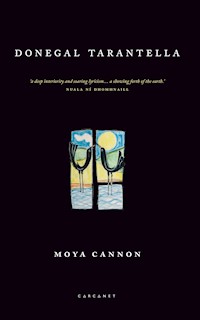
DONEGAL TARANTELLA
MOYA CANNON
for Máiréad and Tim Robinson
CONTENTS
ACKNOWLEDGEMENTS
Acknowledgements are due to the editors and publishers of Irish Pages, Poetry Ireland Review, New Hibernia Review, PN Review, Cyphers, IASIL Journal of Irish Studies, Blood Orange Review, Japanese Journal of Irish Studies, Windharp, Connemara and Aran, The Strokestown Anthology, Reading the Future and Fermata.
The author wishes to thank Aosdána and the Arts Council of Ireland for their continued, invaluable support.
ISLAND CORRIE
Curving back by the northern cliffs,
where a pale scar shows
that another slice of mountain
has succumbed
to this century’s
hard seas
and grey storms,
we halt at a rim,
and, far below us,
in June sunlight,
blows the big, elongated O
of Lough Bunnafreva,
ringed, in this summer’s long drought,
with a necklace of bleached schist.
Cupped palm of Croaghaun,
gift of a glacier,
silver doubloon of Achill.
AT THREE CASTLES HEAD WE CATCH OUR BREATH
We come from a hidden ocean and go to an unknown ocean.
– Antonio Machado
A flat, faulted slab of cliff soars
and shimmers far above us
then slants far below,
into a young ocean
we call the Atlantic.
Bedded sandstones
have been tilted on edge here –
dust of disappeared mountains,
compressed beneath the weight
of disappeared oceans.
What cosmic accident engendered
this relentless complexity of being –
the hot metal core, the mantle heavily swirling
under new hills, thin-floored oceans, fragile cities,
and under the flowering bank of earth behind us,
which responds again to the nearing of a star,
each unfolding primrose an inch of yellow velvet,
each heavy violet teetering on its slim stem,
and us, latecomers,
balanced between cliff and flowers,
trying to comprehend both,
trying to catch our breath.
FOUR HERDS OF DEER
at the back of Djouce mountain,
blent into the heather, hardly visible –
they stared at us, whistled
and sprang away,
white rumps in the air,
light, light, as deer on cave walls.
FLOWERS KNOW NOTHING OF OUR GRIEF
for Eivlin, Kieran and Patrick
The dog creeps out of her bed at night,
pads towards the bedroom door,
bumps against it as she turns to lie down,
whimpers, stays close
and licks her paw.
But the roses, pink and delicate,
unfurl their buds in the sunshine,
scent the steps up to the front door.
Their indifference should break us,
instead, they shore up a dyke
against despair;
they play a tune in a minor key;
they whisper among themselves
in an old Esperanto;
they intimate
that hope is never dead
until this bewildered earth stops
throwing up roses.
11.06.2016
MAL’TA BOY, 22,000 BC
The palaces of the tsars rise up again
newly gilded and painted, along the Neva.
Curled up in a dusty display case
in a corner of their great palace
is the rickle of a four-year-old child’s bones,
found under a stone slab
by a lake in eastern Siberia.
Half of his skull painted red,
he was buried with his necklet and bracelet,
his arrowheads and swan amulet.
Small nomad, buried as your people
moved on their circuits, tracking herds
of reindeer and mammoth,
flocks of waterbirds,
a slice of your arm bone is pored over
by tribes of scientists in laboratories.
On bright screens,




