


1,99 €
Mehr erfahren.
- Herausgeber: e-artnow Collections
- Kategorie: Gesellschafts- und Liebesromane
- Sprache: Englisch
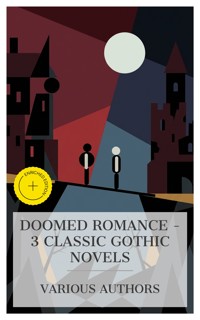
Doomed Romance – 3 Classic Gothic Novels presents a haunting exploration of love's darker dimensions, encapsulating the essence of the Gothic tradition's fascination with romance, mystery, and decay. This anthology is a compendium of masterpieces that juxtapose the eerie with the passionate, intertwining both the specters of tumultuous relationships and the foreboding ambiance of Gothic settings. The collection masterfully traverses varied literary landscapes—each story distinctively contributing to the macabre allure, yet collectively forging a vivid tapestry of fate and choice's relentless dance in the realm of romance. The anthology features the talents of Jane Austen, Walter Scott, and Ann S. Stephens, each renowned for their unique contributions to literature. Austen's and Scott's ventures beyond their quintessential styles enrich the Gothic narrative with nuanced depth, delving into emotional and psychological undercurrents often overshadowed by societal discourse. Stephens, celebrated for her pioneering in American sensational novels, adds a unique transatlantic perspective. Together, they encapsulate the sombre elegance and the philosophical undertones of the Gothic revival, showcasing characters entrapped in the splendid melancholy of doomed love. This volume offers readers a rare opportunity to indulge in a veritable symposium of Gothic style, allowing a rich immersion into the multifaceted exploration of doomed romance. Ideal for both the seasoned aficionado of the Gothic and new enthusiasts, the collection beckons readers to reflect on the intricate interplay of love and loss. As a textual mosaic, it promises an enlightening journey through the shadows of human emotion, crafting a dialogue between its diverse narratives that is as engaging as it is academically enriching.
Das E-Book können Sie in Legimi-Apps oder einer beliebigen App lesen, die das folgende Format unterstützen:
Veröffentlichungsjahr: 2025
Ähnliche



![Emma (Centaur Classics) [The 100 greatest novels of all time - #38] - Jane Austen. - E-Book](https://legimifiles.blob.core.windows.net/images/ba91eea69a27a8fd52d9e1952c7c4a74/w200_u90.jpg)









Doomed Romance – 3 Classic Gothic Novels
Table of Contents
Introduction
Under the sign of doomed romance, these three Gothic novels—Walter Scott’s The Bride of Lammermoor, Jane Austen’s Northanger Abbey, and Ann S. Stephens’s The Old Countess; or, The Two Proposals—form a coherent constellation. Each title places intimate attachment at the center while hinting at forces larger than desire: a bride circumscribed by circumstance, an abbey that embodies inherited mystery, a countess presiding over proposals that weigh choice against obligation. Together they illuminate how passion is staged, tested, and disciplined within settings charged by lineage, rumor, and ritual. The Gothic mood sharpens this scrutiny, lending corporeal shape to anxiety, memory, and social constraint.
Read side by side, the novels converse about courtship as a negotiation conducted under shadow. Scott’s title promises ceremony and fracture; Austen’s points toward a dwelling whose stones seem to remember; Stephens’s foregrounds a double decision that refracts power through a noble title. Recurring motifs arise: invitations and interdictions, thresholds and locked rooms, vows imagined before they are spoken. The protagonists’ desires are entangled with ancestral claims and public reputations, suggesting that love’s path is not a private lane but a corridor lined with witnesses, rumors, and debts. Where hope advances, omen and obligation answer, and the dialogue hardens into dilemma.
In this collection, space is an active character. An abbey promises cloisters, corridors, and the interpretive labor of reading signs embedded in stone. A countess’s domain suggests salons, antechambers, and the etiquette that arranges bodies and sentences. A bride’s passage intimates thresholds, rites, and rooms prepared for destinies not fully chosen. Architecture concentrates time; halls and chambers become echo chambers for inherited stories and private resolutions. The characters navigate these interiors as if traversing a palimpsest, measuring themselves against walls that outlast them. The Gothic draws power from such settings, making the built world a register of what cannot be confessed aloud.
Variation of tone strengthens the set’s unity. The Bride of Lammermoor anchors tragedy in the very promise of union, its title casting the ceremony itself as ordeal. Northanger Abbey folds curiosity into apprehension, exploring how fascination with old places complicates the ethics of perception and trust. The Old Countess; or, The Two Proposals foregrounds choice and consequence, dramatizing the moment when feeling confronts hierarchy. Across these vectors—ordeal, curiosity, decision—the Gothic shifts from thunderous portent to subtle unease and social pressure. The differences in emphasis allow readers to hear a chord rather than a single note, sustaining tension across multiple registers.
At the heart of doomed romance lies the question of agency. A proposal imagines consent yet may be framed by leverage; a bride moves toward vows that may be spoken under duress; an abbey invites interpretation that can mislead. The novels press on this friction between will and foreordination, showing how declarations of love acquire meanings in contexts they do not control. Rituals can promise shelter yet also bind; titles can confer dignity yet also demand sacrifice. As choices narrow, the Gothic vocabulary of omen and atmosphere becomes a language for ethical uncertainty, translating private hesitation into palpable weather.
These concerns carry contemporary resonance because they dramatize how institutions shape intimacy. Modern culture continues to debate the pressures that family, status, and narrative expectations place on relationships. The Gothic’s way of animating fear and desire through rooms, rumors, and relics remains a potent artistic strategy for examining consent, credibility, and the lure of tradition. In an era attuned to the stories that spaces tell and the scripts that roles impose, these novels offer both caution and clarity. They remind us that love does not unfold in a vacuum but in environments where power attaches to names, places, and ceremonies.
Gathered under one cover, these works by Walter Scott, Jane Austen, and Ann S. Stephens offer a triptych of haunted courtship. Each novel frames romance as a passage through constraint, yet each calibrates the weight of doom differently, from severe inevitability to interpretive ambiguity to decisive crisis. Their conversation models how the Gothic can be capacious, accommodating stark fate, skeptical inquiry, and social negotiation. The result is a sustained meditation on how people read signs—architectural, emotional, ceremonial—while hoping to be read rightly themselves. The collection thus extends an invitation to consider why, and how, love persists amid foreboding.
Historical Context
Socio-Political Landscape
Set against early eighteenth-century Scotland, The Bride of Lammermoor embodies a post-Union political topography where local lairds broker power through land, kinship, and patronage. The erosion of clan jurisdictions and the consolidation of centralized law unsettle customary obligations, while confessional tensions between Episcopalian and Presbyterian communities shadow civil authority. Marriage functions as a diplomatic instrument, negotiating debts, entails, and status in a volatile economy. Rumors of dynastic uncertainty and the looming specter of rebellion inflect private decisions with public risk. Scott’s narrative registers how estates, titles, and legal processes can entangle families in conflicts that are simultaneously intimate and national.
For Northanger Abbey, late-Georgian England appears through the sociable circuits of Bath and country houses, where rank, income, and reputation govern mobility. The novel charts a marriage market shaped by inheritance practices, officer patronage, and the professionalization of the clergy, revealing how polite leisure masks hard calculations about property. The rhythms of assembly rooms, lodgings, and carriage travel signal an expanding consumer economy entwined with print culture. Austere patriarchal authority collides with youthful desire and naïve trust, and the subtle policing of manners enforces power without open coercion. Austen’s comic poise exposes the political stakes of taste, conversation, and “prudence.”
In The Old Countess; or, The Two Proposals, mid-nineteenth-century American society surfaces in anxieties about wealth, respectability, and lineage. The tale navigates a republic fascinated by aristocratic signs yet driven by speculative markets and urban expansion. Domestic ideology asserts moral order, but legal regimes of coverture and evolving property statutes complicate women’s security and leverage within courtship and marriage. Family fortunes hinge on wills, guardianship, and social performance, situating private vows within public economies of credit and notoriety. Stephens dramatizes the friction between inherited prestige and self-made ambition, mapping an American politics of class visibility and intimate governance.
Intellectual & Aesthetic Currents
The authors engage Gothic machinery as a vehicle for inquiry rather than mere fright. In The Bride of Lammermoor, superstition, prophetic tokens, and haunted spaces are threaded through a historicist method attentive to documents, customs, and regional speech. Antiquarian detail and the picturesque render landscape as archive, where ruined houses and legal charters carry competing claims to truth. The dialectic between Enlightenment reason and local lore yields a tragic ambiance without collapsing into pure irrationalism. Scott’s synthesis of romance with chronicle forged techniques—frame tales, editorial intrusions, interpolated testimony—that shaped how readers imagine the past as contested, embodied experience.
Northanger Abbey refracts Gothic tropes through comic epistemology and innovative narration. Free indirect discourse lets readers inhabit Catherine’s credulous perceptions while gauging the social scripts that produce them. The novel tests sentimental responsiveness against empirical caution, suggesting that moral judgment depends on disciplined imagination. It also stages debates about reading: circulating-library pleasures, fashionable titles, and hermeneutic overreach. By bringing suspense into drawing rooms and abbey corridors alike, Austen turns sensation into a critique of credulity, gendered education, and authority. Her poised minimalism turns candles, keys, and letters into instruments for measuring probability, rhetoric, and the ethics of attention.
Ann S. Stephens blends Gothic atmosphere with American sensation and sentimental craft, exploiting serial pacing and cliffhangers to anatomize desire, secrecy, and reputation. The Old Countess; or, The Two Proposals mobilizes doubles, concealed identities, and aristocratic relics while grounding melodrama in domestic spaces—parlors, boudoirs, and legal offices—where documents and objects govern fate. The prose courts immediacy through vivid description and moral asides, inviting readers to adjudicate conduct. Commercial innovations in inexpensive editions and magazine installments shaped its style: modular scenes, recapitulatory dialogue, and episodic revelations. The result is a portable Gothic attuned to urban audiences and democratic curiosity.
Legacy & Reassessment Across Time
Reception histories trace how these British novels migrated from popular entertainment to curricular fixtures. The Bride of Lammermoor inspired theatrical and operatic adaptations that condensed its tragic arc, reinforcing the tale’s emblematic status in the Gothic imagination. Critics have revisited its politics of law and custom, using it to debate the historical novel’s power to structure national memory. Northanger Abbey, long treated as a light parody, now anchors discussions of novelistic self-reflexivity, gendered reading, and the ethics of suspicion. Screen and stage versions amplify the comedy while highlighting its critique of class calculation, surveillance, and the disciplining of desire.
Ann S. Stephens’s reputation has shifted from dismissive judgments of “dime novel” sensationalism to recognition of her formal agility and cultural acuity. The Old Countess; or, The Two Proposals circulates today through reprints and anthologies that position it within a transatlantic Gothic matrix alongside domestic fiction. Scholars examine its treatments of inheritance, secrecy, and female agency to reassess how popular genres theorize law, money, and emotion. Attention to serial publication has prompted textual recoveries, comparing magazine installments with later book forms. Stage dramatizations and reissue cycles extended the story’s reach, inviting new readings of class performance, aspiration, and moral theater.
Doomed Romance – 3 Classic Gothic Novels
Doomed Love and Gothic Tragedy
Gothic Form, Satire and Social Critique
Walter Scott
The Bride of Lammermoor
Chapter I
Old Song.
Few have been in my secret while I was compiling these narratives, nor is it probable that they will ever become public during the life of their author. Even were that event to happen, I am not ambitious of the honoured distinction, digito monstrari. I confess that, were it safe to cherish such dreams at all, I should more enjoy the thought of remaining behind the curtain unseen, like the ingenious manager of Punch and his wife Joan, and enjoying the astonishment and conjectures of my audience. Then might I, perchance, hear the productions of the obscure Peter Pattieson praised by the judicious and admired by the feeling, engrossing the young and attracting even the old; while the critic traced their fame up to some name of literary celebrity, and the question when, and by whom, these tales were written filled up the pause of conversation in a hundred circles and coteries. This I may never enjoy during my lifetime; but farther than this, I am certain, my vanity should never induce me to aspire.
I am too stubborn in habits, and too little polished in manners, to envy or aspire to the honours assigned to my literary contemporaries. I could not think a whit more highly of myself were I found worthy to "come in place as a lion" for a winter in the great metropolis. I could not rise, turn round, and show all my honours, from the shaggy mane to the tufted tail, "roar you an't were any nightingale," and so lie down again like a well-behaved beast of show, and all at the cheap and easy rate of a cup of coffee and a slice of bread and butter as thin as a wafer. And I could ill stomach the fulsome flattery with which the lady of the evening indulges her show-monsters on such occasions, as she crams her parrots with sugar-plums, in order to make them talk before company. I cannot be tempted to "come aloft" for these marks of distinction, and, like imprisoned Samson, I would rather remain—if such must be the alternative—all my life in the mill-house, grinding for my very bread, than be brought forth to make sport for the Philistine lords and ladies. This proceeds from no dislike, real or affected, to the aristocracy of these realms. But they have their place, and I have mine; and, like the iron and earthen vessels in the old fable, we can scarce come into collision without my being the sufferer in every sense. It may be otherwise with the sheets which I am now writing. These may be opened and laid aside at pleasure; by amusing themselves with the perusal, the great will excite no false hopes; by neglecting or condemning them, they will inflict no pain; and how seldom can they converse with those whose minds have toiled for their delight without doing either the one or the other.
In the better and wiser tone of feeling with Ovid only expresses in one line to retract in that which follows, I can address these quires—
Parve, nec invideo, sine me, liber, ibis in urbem.
Nor do I join the regret of the illustrious exile, that he himself could not in person accompany the volume, which he sent forth to the mart of literature, pleasure, and luxury. Were there not a hundred similar instances on record, the rate of my poor friend and school-fellow, Dick Tinto, would be sufficient to warn me against seeking happiness in the celebrity which attaches itself to a successful cultivator of the fine arts.
Dick Tinto, when he wrote himself artist, was wont to derive his origin from the ancient family of Tinto, of that ilk, in Lanarkshire, and occasionally hinted that he had somewhat derogated from his gentle blood in using the pencil for his principal means of support. But if Dick's pedigree was correct, some of his ancestors must have suffered a more heavy declension, since the good man his father executed the necessary, and, I trust, the honest, but certainly not very distinguished, employment of tailor in ordinary to the village of Langdirdum in the west.. Under his humble roof was Richard born, and to his father's humble trade was Richard, greatly contrary to his inclination, early indentured. Old Mr. Tinto had, however, no reason to congratulate himself upon having compelled the youthful genius of his son to forsake its natural bent. He fared like the school-boy who attempts to stop with his finger the spout of a water cistern, while the stream, exasperated at this compression, escapes by a thousand uncalculated spurts, and wets him all over for his pains. Even so fared the senior Tinto, when his hopeful apprentice not only exhausted all the chalk in making sketches upon the shopboard, but even executed several caricatures of his father's best customers, who began loudly to murmur, that it was too hard to have their persons deformed by the vestments of the father, and to be at the same time turned into ridicule by the pencil of the son. This led to discredit and loss of practice, until the old tailor, yielding to destiny and to the entreaties of his son, permitted him to attempt his fortune in a line for which he was better qualified.
There was about this time, in the village of Langdirdum, a peripatetic brother of the brush, who exercised his vocation sub Jove frigido, the object of admiration of all the boys of the village, but especially to Dick Tinto. The age had not yet adopted, amongst other unworthy retrenchments, that illiberal measure of economy which, supplying by written characters the lack of symbolical representation, closes one open and easily accessible avenue of instruction and emolument against the students of the fine arts. It was not yet permitted to write upon the plastered doorway of an alehouse, or the suspended sign of an inn, "The Old Magpie," or "The Saracen's Head," substituting that cold description for the lively effigies of the plumed chatterer, or the turban'd frown of the terrific soldan. That early and more simple age considered alike the necessities of all ranks, and depicted the symbols of good cheer so as to be obvious to all capacities; well judging that a man who could not read a syllable might nevertheless love a pot of good ale as well as his better-educated neighbours, or even as the parson himself. Acting upon this liberal principle, publicans as yet hung forth the painted emblems of their calling, and sign-painters, if they seldom feasted, did not at least absolutely starve.
To a worthy of this decayed profession, as we have already intimated, Dick Tinto became an assistant; and thus, as is not unusual among heaven-born geniuses in this department of the fine arts, began to paint before he had any notion of drawing.
His talent for observing nature soon induced him to rectify the errors, and soar above the instructions, of his teacher. He particularly shone in painting horses, that being a favourite sign in the Scottish villages; and, in tracing his progress, it is beautiful to observe how by degrees he learned to shorten the backs and prolong the legs of these noble animals, until they came to look less like crocodiles, and more like nags. Detraction, which always pursues merit with strides proportioned to its advancement, has indeed alleged that Dick once upon a time painted a horse with five legs, instead of four. I might have rested his defence upon the license allowed to that branch of his profession, which, as it permits all sorts of singular and irregular combinations, may be allowed to extend itself so far as to bestow a limb supernumerary on a favourite subject. But the cause of a deceased friend is sacred; and I disdain to bottom it so superficially. I have visited the sign in question, which yet swings exalted in the village of Langdirdum; and I am ready to depone upon the oath that what has been idly mistaken or misrepresented as being the fifth leg of the horse, is, in fact, the tail of that quadruped, and, considered with reference to the posture in which he is delineated, forms a circumstance introduced and managed with great and successful, though daring, art. The nag being represented in a rampant or rearing posture, the tail, which is prolonged till it touches the ground, appears to form a point d'appui, and gives the firmness of a tripod to the figure, without which it would be difficult to conceive, placed as the feet are, how the courser could maintain his ground without tumbling backwards. This bold conception has fortunately fallen into the custody of one by whom it is duly valued; for, when Dick, in his more advanced state of proficiency, became dubious of the propriety of so daring a deviation to execute a picture of the publican himself in exchange for this juvenile production, the courteous offer was declined by his judicious employer, who had observed, it seems, that when his ale failed to do its duty in conciliating his guests, one glance at his sign was sure to put them in good humour.
It would be foreign to my present purpose to trace the steps by which Dick Tinto improved his touch, and corrected, by the rules of art, the luxuriance of a fervid imagination. The scales fell from his eyes on viewing the sketches of a contemporary, the Scottish Teniers, as Wilkie has been deservedly styled. He threw down the brush took up the crayons, and, amid hunger and toil, and suspense and uncertainty, pursued the path of his profession under better auspices than those of his original master. Still the first rude emanations of his genius, like the nursery rhymes of Pope, could these be recovered, will be dear to the companions of Dick Tinto's youth. There is a tankard and gridiron painted over the door of an obscure change-house in the Back Wynd of Gandercleugh——But I feel I must tear myself from the subject, or dwell on it too long.
Amid his wants and struggles, Dick Tinto had recourse, like his brethren, to levying that tax upon the vanity of mankind which he could not extract from their taste and liberality—on a word, he painted portraits. It was in this more advanced state of proficiency, when Dick had soared above his original line of business, and highly disdained any allusion to it, that, after having been estranged for several years, we again met in the village of Gandercleugh, I holding my present situation, and Dick painting copies of the human face divine at a guinea per head. This was a small premium, yet, in the first burst of business, it more than sufficed for all Dick's moderate wants; so that he occupied an apartment at the Wallace Inn, cracked his jest with impunity even upon mine host himself, and lived in respect and observance with the chambermaid, hostler, and waiter.
Those halcyon days were too serene to last long. When his honour the Laird of Gandercleugh, with his wife and three daughters, the minister, the gauger, mine esteemed patron Mr. Jedediah Cleishbotham, and some round dozen of the feuars and farmers, had been consigned to immortality by Tinto's brush, custom began to slacken, and it was impossible to wring more than crowns and half-crowns from the hard hands of the peasants whose ambition led them to Dick's painting-room.
Still, though the horizon was overclouded, no storm for some time ensued. Mine host had Christian faith with a lodger who had been a good paymaster as long as he had the means. And from a portrait of our landlord himself, grouped with his wife and daughters, in the style of Rubens, which suddenly appeared in the best parlour, it was evident that Dick had found some mode of bartering art for the necessaries of life.
Nothing, however, is more precarious than resources of this nature. It was observed that Dick became in his turn the whetstone of mine host's wit, without venturing either at defence or retaliation; that his easel was transferred to a garret-room, in which there was scarce space for it to stand upright; and that he no longer ventured to join the weekly club, of which he had been once the life and soul. In short, Dick Tinto's friends feared that he had acted like the animal called the sloth, which, heaving eaten up the last green leaf upon the tree where it has established itself, ends by tumbling down from the top, and dying of inanition. I ventured to hint this to Dick, recommended his transferring the exercise of his inestimable talent to some other sphere, and forsaking the common which he might be said to have eaten bare.
"There is an obstacle to my change of residence," said my friend, grasping my hand with a look of solemnity.
"A bill due to my landlord, I am afraid?" replied I, with heartfelt sympathy; "if any part of my slender means can assist in this emergence——"
"No, by the soul of Sir Joshua!" answered the generous youth, "I will never involve a friend in the consequences of my own misfortune. There is a mode by which I can regain my liberty; and to creep even through a common sewer is better than to remain in prison."
I did not perfectly understand what my friend meant. The muse of painting appeared to have failed him, and what other goddess he could invoke in his distress was a mystery to me. We parted, however, without further explanation, and I did not see him until three days after, when he summoned me to partake of the "foy" with which his landlord proposed to regale him ere his departure for Edinburgh.
I found Dick in high spirits, whistling while he buckled the small knapsack which contained his colours, brushes, pallets, and clean shirt. That he parted on the best terms with mine host was obvious from the cold beef set forth in the low parlour, flanked by two mugs of admirable brown stout; and I own my curiosity was excited concerning the means through which the face of my friend's affairs had been so suddenly improved. I did not suspect Dick of dealing with the devil, and by what earthly means he had extricated himself thus happily I was at a total loss to conjecture.
He perceived my curiosity, and took me by the hand. "My friend," he said, "fain would I conceal, even from you, the degradation to which it has been necessary to submit, in order to accomplish an honourable retreat from Gandercleaugh. But what avails attempting to conceal that which must needs betray itself even by its superior excellence? All the village—all the parish—all the world—will soon discover to what poverty has reduced Richard Tinto."
A sudden thought here struck me. I had observed that our landlord wore, on that memorable morning, a pair of bran new velveteens instead of his ancient thicksets.
"What," said I, drawing my right hand, with the forefinger and thumb pressed together, nimbly from my right haunch to my left shoulder, "you have condescended to resume the paternal arts to which you were first bred—long stitches, ha, Dick?"
He repelled this unlucky conjecture with a frown and a pshaw, indicative of indignant contempt, and leading me into another room, showed me, resting against the wall, the majestic head of Sir William Wallace, grim as when severed from the trunk by the orders of the Edward.
The painting was executed on boards of a substantial thickness, and the top decorated with irons, for suspending the honoured effigy upon a signpost.
"There," he said, "my friend, stands the honour of Scotland, and my shame; yet not so—rather the shame of those who, instead of encouraging art in its proper sphere, reduce it to these unbecoming and unworthy extremities."
I endeavoured to smooth the ruffled feelings of my misused and indignant friend. I reminded him that he ought not, like the stag in the fable, to despise the quality which had extricated him from difficulties, in which his talents, as a portrait or landscape painter, had been found unavailing. Above all, I praised the execution, as well as conception, of his painting, and reminded him that, far from feeling dishonoured by so superb a specimen of his talents being exposed to the general view of the public, he ought rather to congratulate himself upon the augmentation of his celebrity to which its public exhibition must necessarily give rise.
"You are right, my friend—you are right," replied poor Dick, his eye kindling with enthusiasm; "why should I shun the name of an—an—(he hesitated for a phrase)—an out-of-doors artist? Hogarth has introduced himself in that character in one of his best engravings; Domenichino, or somebody else, in ancient times, Morland in our own, have exercised their talents in this manner. And wherefore limit to the rich and higher classes alone the delight which the exhibition of works of art is calculated to inspire into all classes? Statues are placed in the open air, why should Painting be more niggardly in displaying her masterpieces than her sister Sculpture? And yet, my friend, we must part suddenly; the carpenter is coming in an hour to put up the—the emblem; and truly, with all my philosophy, and your consolatory encouragement to boot, I would rather wish to leave Gandercleugh before that operation commences."
We partook of our genial host's parting banquet, and I escorted Dick on his walk to Edinburgh. We parted about a mile from the village, just as we heard the distant cheer of the boys which accompanied the mounting of the new symbol of the Wallace Head. Dick Tinto mended his pace to get out of hearing, so little had either early practice or recent philosophy reconciled him to the character of a sign-painter.
In Edinburgh, Dick's talents were discovered and appreciated, and he received dinners and hints from several distinguished judges of the fine arts. But these gentlemen dispensed their criticism more willingly than their cash, and Dick thought he needed cash more than criticism. He therefore sought London, the universal mart of talent, and where, as is usual in general marts of most descriptions, much more of each commodity is exposed to sale than can ever find purchasers.
Dick, who, in serious earnest, was supposed to have considerable natural talents for his profession, and whose vain and sanguine disposition never permitted him to doubt for a moment of ultimate success, threw himself headlong into the crowd which jostled and struggled for notice and preferment. He elbowed others, and was elbowed himself; and finally, by dint of intrepidity, fought his way into some notice, painted for the prize at the Institution, had pictures at the exhibition at Somerset House, and damned the hanging committee. But poor Dick was doomed to lose the field he fought so gallantly. In the fine arts, there is scarce an alternative betwixt distinguished success and absolute failure; and as Dick's zeal and industry were unable to ensure the first, he fell into the distresses which, in his condition, were the natural consequences of the latter alternative. He was for a time patronised by one or two of those judicious persons who make a virtue of being singular, and of pitching their own opinions against those of the world in matters of taste and criticism. But they soon tired of poor Tinto, and laid him down as a load, upon the principle on which a spoilt child throws away its plaything. Misery, I fear, took him up, and accompanied him to a premature grave, to which he was carried from an obscure lodging in Swallow Street, where he had been dunned by his landlady within doors, and watched by bailiffs without, until death came to his relief. A corner of the Morning Post noticed his death, generously adding, that his manner displayed considerable genius, though his style was rather sketchy; and referred to an advertisement, which announced that Mr. Varnish, a well-known printseller, had still on hand a very few drawings and painings by Richard Tinto, Esquire, which those of the nobility and gentry who might wish to complete their collections of modern art were invited to visit without delay. So ended Dick Tinto! a lamentable proof of the great truth, that in the fine arts mediocrity is not permitted, and that he who cannot ascend to the very top of the ladder will do well not to put his foot upon it at all.
The memory of Tinto is dear to me, from the recollection of the many conversations which we have had together, most of them turning upon my present task. He was delighted with my progress, and talked of an ornamented and illustrated edition, with heads, vignettes, and culs de lampe, all to be designed by his own patriotic and friendly pencil. He prevailed upon an old sergeant of invalids to sit to him in the character of Bothwell, the lifeguard's-man of Charles the Second, and the bellman of Gandercleugh in that of David Deans. But while he thus proposed to unite his own powers with mine for the illustration of these narratives, he mixed many a dose of salutary criticism with the panegyrics which my composition was at times so fortunate as to call forth.
"Your characters," he said, "my dear Pattieson, make too much use of the gob box; they patter too much (an elegant phraseology which Dick had learned while painting the scenes of an itinerant company of players); there is nothing in whole pages but mere chat and dialogue."
"The ancient philosopher," said I in reply, "was wont to say, 'Speak, that I may know thee'; and how is it possible for an author to introduce his personae dramatis to his readers in a more interesting and effectual manner than by the dialogue in which each is represented as supporting his own appropriate character?"
"It is a false conclusion," said Tinto; "I hate it, Peter, as I hate an unfilled can. I grant you, indeed, that speech is a faculty of some value in the intercourse of human affairs, and I will not even insist on the doctrine of that Pythagorean toper, who was of opinion that over a bottle speaking spoiled conversation. But I will not allow that a professor of the fine arts has occasion to embody the idea of his scene in language, in order to impress upon the reader its reality and its effect. On the contrary, I will be judged by most of your readers, Peter, should these tales ever become public, whether you have not given us a page of talk for every single idea which two words might have communicated, while the posture, and manner, and incident, accurately drawn, and brougth out by appropriate colouring, would have preserved all that was worthy of preservation, and saved these everlasting 'said he's' and 'said she's,' with which it has been your pleasure to encumber your pages."
I replied, "That he confounded the operations of the pencil and the pen; that the serene and silent art, as painting has been called by one of our first living poets, necessarily appealed to the eye, because it had not the organs for addressing the ear; whereas poetry, or that species of composition which approached to it, lay under the necessity of doing absolutely the reverse, and addressed itself to the ear, for the purpose of exciting that interest which it could not attain through the medium of the eye."
Dick was not a whit staggered by my argument, which he contended was founded on misrepresentation. "Description," he said, "was to the author of a romance exactly what drawing and tinting were to a painter: words were his colours, and, if properly employed, they could not fail to place the scene which he wished to conjure up as effectually before the mind's eye as the tablet or canvas presents it to the bodily organ. The same rules," he contended, "applied to both, and an exuberance of dialogue, in the former case, was a verbose and laborious mode of composition which went to confound the proper art of fictitious narrative with that of the drama, a widely different species of composition, of which dialogue was the very essence, because all, excepting the language to be made use of, was presented to the eye by the dresses, and persons, and actions of the performers upon the stage. But as nothing," said Dick, "can be more dull than a long narrative written upon the plan of a drama, so where you have approached most near to that species of composition, by indulging in prolonged scenes of mere conversation, the course of your story has become chill and constrained, and you have lost the power of arresting the attention and exciting the imagination, in which upon other occasions you may be considered as having succeeded tolerably well."
I made my bow in requital of the compliment, which was probably thrown in by way of placebo, and expressed myself willing at least to make one trial of a more straightforward style of composition, in which my actors should do more, and say less, than in my former attempts of this kind. Dick gave me a patronising and approving nod, and observed that, finding me so docile, he would communicate, for the benefit of my muse, a subject which he had studied with a view to his own art.
"The story," he said, "was, by tradition, affirmed to be truth, although, as upwards of a hundred years had passed away since the events took place, some doubts upon the accuracy of all the particulars might be reasonably entertained."
When Dick Tinto had thus spoken, he rummaged his portfolio for the sketch from which he proposed one day to execute a picture of fourteen feet by eight. The sketch, which was cleverly executed, to use the appropriate phrase, represented an ancient hall, fitted up and furnished in what we now call the taste of Queen Elizabeth's age. The light, admitted from the upper part of a high casement, fell upon a female figure of exquisite beauty, who, in an attitude of speechless terror, appeared to watch the issue of a debate betwixt two other persons. The one was a young man, in the Vandyke dress common to the time of Charles I., who, with an air of indignant pride, testified by the manner in which he raised his head and extended his arm, seemed to be urging a claim of right, rather than of favour, to a lady whose age, and some resemblance in their features, pointed her out as the mother of the younger female, and who appeared to listen with a mixture of displeasure and impatience.
Tinto produced his sketch with an air of mysterious triumph, and gazed on it as a fond parent looks upon a hopeful child, while he anticipates the future figure he is to make in the world, and the height to which he will raise the honour of his family. He held it at arm's length from me—he helt it closer—he placed it upon the top of a chest of drawers—closed the lower shutters of the casement, to adjust a downward and favourable light—fell back to the due distance, dragging me after him—shaded his face with his hand, as if to exclude all but the favourite object—and ended by spoiling a child's copy-book, which he rolled up so as to serve for the darkened tube of an amateur. I fancy my expressions of enthusiasm had not been in proportion to his own, for he presently exclaimed with vehemence: "Mr. Pattieson, I used to think you had an eye in your head."
I vindicated my claim to the usual allowance of visual organs.
"Yet, on my honour," said Dick, "I would swear you had been born blind, since you have failed at the first glance to discover the subject and meaning of that sketch. I do not mean to praise my own performance, I leave these arts to others; I am sensible of my deficiencies, conscious that my drawing and colouring may be improved by the time I intend to dedicate to the art. But the conception—the expression—the positions—these tell the story to every one who looks at the sketch; and if I can finish the picture without diminution of the original conception, the name of Tinto shall no more be smothered by the mists of envy and intrigue."
I replied: "That I admired the sketch exceedingly; but that to understand its full merit, I felt it absolutely necessary to be informed of the subject."
"That is the very thing I complain of," answered Tinto; "you have accustomed yourself so much to these creeping twilight details of yours, that you are become incapable of receiving that instant and vivid flash of conviction which darts on the mind from seeing the happy and expressive combinations of a single scene, and which gathers from the position, attitude, and countenance of the moment, not only the history of the past lives of the personages represented, and the nature of the business on which they are immediately engaged, but lifts even the veil of futurity, and affords a shrewd guess at their future fortunes."
"In that case," replied I, "Paining excels the ape of the renowned Gines de Passamonte, which only meddled with the past and the present; nay, she excels that very Nature who affords her subject; for I protest to you, Dick, that were I permitted to peep into that Elizabeth-chamber, and see the persons you have sketched conversing in flesh and blood, I should not be a jot nearer guessing the nature of their business than I am at this moment while looking at your sketch. Only generally, from the languishing look of the young lady, and the care you have taken to present a very handsome leg on the part of the gentleman, I presume there is some reference to a love affair between them."
"Do you really presume to form such a bold conjecture?" said Tinto. "And the indignant earnestness with which you see the man urge his suit, the unresisting and passive despair of the younger female, the stern air of inflexible determination in the elder woman, whose looks express at once consciousness that she is acting wrong and a firm determination to persist in the course she has adopted——"
"If her looks express all this, my dear Tinto," replied I, interrupting him, "your pencil rivals the dramatic art of Mr. Puff in The Critic, who crammed a whole complicated sentence into the expressive shake of Lord Burleigh's head."
"My good friend, Peter," replied Tinto, "I observe you are perfectly incorrigible; however, I have compassion on your dulness, and am unwilling you should be deprived of the pleasure of understanding my picture, and of gaining, at the same time, a subject for your own pen. You must know then, last summer, while I was taking sketches on the coast of East Lothian and Berwickshire, I was seduced into the mountains of Lammermoor by the account I received of some remains of antiquity in that district. Those with which I was most struck were the ruins of an ancient castle in which that Elizabeth-chamber, as you call it, once existed. I resided for two or three days at a farmhouse in the neighbourhood, where the aged goodwife was well acquainted with the history of the castle, and the events which had taken place in it. One of these was of a nature so interesting and singular, that my attention was divided between my wish to draw the old ruins in landscape, and to represent, in a history-piece, the singular events which have taken place in it. Here are my notes of the tale," said poor Dick, handing a parcel of loose scraps, partly scratched over with his pencil, partly with his pen, where outlines of caricatures, sketches of turrets, mills, old gables, and dovecots, disputed the ground with his written memoranda.
I proceeded, however, to decipher the substance of the manuscript as well as I could, and move it into the following Tale, in which, following in part, though not entirely, my friend Tinto's advice, I endeavoured to render my narrative rather descriptive than dramatic. My favourite propensity, however, has at times overcome me, and my persons, like many others in this talking world, speak now what then a great deal more than they act.
Chapter II
Henry VI. Part II.
In the gorge of a pass or mountain glen, ascending from the fertile plains of East Lothian, there stood in former times an extensive castle, of which only the ruins are now visible. Its ancient proprietors were a race of powerful and warlike carons, who bore the same name with the castle itself, which was Ravenswood. Their line extended to a remote period of antiquity, and they had intermarried with the Douglasses, Humes, Swintons, Hays, and other families of power and distinction in the same country. Their history was frequently involved in that of Scotland itself, in whose annals their feats are recorded. The Castle of Ravenswood, occupying, and in some measure commanding, a pass betweixt Berwickshire, or the Merse, as the southeastern province of Scotland is termed, and the Lothians, was of importance both in times of foreign war and domestic discord. It was frequently beseiged with ardour, and defended with obstinacy, and, of course, its owners played a conspicuous part in story. But their house had its revolutions, like all sublunary things: it became greatly declined from its splendour about the middle of the 17th century; and towards the period of the Revolution, the last proprietor of Ravenswood Castle saw himself compelled to part with the ancient family seat, and to remove himself to a lonely and sea-beaten tower, which, situated on the bleak shores between St. Abb's Head and the village of Eyemouth, looked out on the lonely and boisterous German Ocean. A black domain of wild pasture-land surrounded their new residence, and formed the remains of their property.
Lord Ravenswood, the heir of this ruined family, was far from bending his mind to his new condition of life. In the civil war of 1689 he had espoused the sinking side, and although he had escaped without the forfeiture of life or land, his blood had been attainted, and his title abolished. He was now called Lord Ravenswood only in courtesy.
This forfeited nobleman inherited the pride and turbulence, though not the forture, of his house, and, as he imputed the final declension of his family to a particular individual, he honoured that person with his full portion of hatred. This was the very man who had now become, by purchase, proprietor of Ravenswood, and the domains of which the heir of the house now stood dispossessed. He was descended of a family much less ancient than that of Lord Ravenswood, and which had only risen to wealth and political importance during the great civil wars. He himself had been bred to the bar, and had held high offices in the state, maintaining through life the character of a skilful fisher in the troubled waters of a state divided by factions, and governed by delegated authority; and of one who contrived to amass considerable sums of money in a country where there was but little to be gathered, and who equally knew the value of wealth and the various means of augmenting it and using it as an engine of increasing his power and influence.
Thus qualified and gifted, he was a dangerous antagonist to the fierce and imprudent Ravenswood. Whether he had given him good cause for the enmity with which the Baron regarded him, was a point on which men spoke differently. Some said the quarrel arose merely from the vindictive spirit and envy of Lord Ravenswood, who could not patiently behold another, though by just and fair purchase, become the proprietor of the estate and castle of his forefathers. But the greater part of the public, prone to slander the wealthy in their absence as to flatter them in their presence, held a less charitable opinion. They said that the Lord Keeper (for to this height Sir William Ashton had ascended) had, previous to the final purchase of the estate of Ravenswood, been concerned in extensive pecuniary transactions with the former proprietor; and, rather intimating what was probable than affirming anything positively, they asked which party was likely to have the advantage in stating and enforcing the claims arising out of these complicated affairs, and more than hinted the advantages which the cool lawyer and able politician must necessarily possess over the hot, fiery, and imprudent character whom he had involved in legal toils and pecuniary snares.
The character of the times aggravated these suspicions. "In those days there was no king in Israel." Since the departure of James VI. to assume the richer and more powerful crown of England, there had existed in Scotland contending parties, formed among the aristocracy, by whom, as their intrigues at the court of St. James's chanced to prevail, the delegated powers of sovereignty were alternately swayed. The evils attending upon this system of government resembled those which afflict the tenants of an Irish estate, the property of an absentee. There was no supreme power, claiming and possessing a general interest with the community at large, to whom the oppressed might appeal from subordinate tyranny, either for justice or for mercy. Let a monarch be as indolent, as selfish, as much disposed to arbitrary power as he will, still, in a free country, his own interests are so clearly connected with those of the public at large, and the evil consequences to his own authority are so obvious and imminent when a different course is pursued, that common policy, as well as common feeling, point to the equal distribution of justice, and to the establishment of the throne in righteousness. Thus, even sovereigns remarkable for usurpation and tyranny have been found rigorous in the administration of justice among their subjects, in cases where their own power and passions were not compromised.
It is very different when the powers of sovereignty are delegated to the head of an aristocratic faction, rivalled and pressed closely in the race of ambition by an adverse leader. His brief and precarious enjoyment of power must be employed in rewarding his partizans, in extending his influence, in oppressing and crushing his adversaries. Even Abou Hassan, the most disinterested of all viceroys, forgot not, during his caliphate of one day, to send a douceur of one thousand pieces of gold to his own household; and the Scottish vicegerents, raised to power by the strength of their faction, failed not to embrace the same means of rewarding them.
The administration of justice, in particular, was infected by the most gross partiality. A case of importance scarcely occurred in which there was not some ground for bias or partiality on the part of the judges, who were so little able to withstand the temptation that the adage, "Show me the man, and I will show you the law," became as prevalent as it was scandalous. One corruption led the way to others still mroe gross and profligate. The judge who lent his sacred authority in one case to support a friend, and in another to crush an enemy, and who decisions were founded on family connexions or political relations, could not be supposed inaccessible to direct personal motives; and the purse of the wealthy was too often believed to be thrown into the scale to weigh down the cause of the poor litigant. The subordinate officers of the law affected little scruple concerning bribery. Pieces of plate and bags of money were sent in presents to the king's counsel, to influence their conduct, and poured forth, says a contemporary writer, like billets of wood upon their floors, without even the decency of concealment.
In such times, it was not over uncharitable to suppose that the statesman, practised in courts of law, and a powerful member of a triumphant cabal, might find and use means of advantage over his less skilful and less favoured adversary; and if it had been supposed that Sir William Ashton's conscience had been too delicate to profit by these advantages, it was believed that his ambition and desire of extending his wealth and consequence found as strong a stimulus in the exhortations of his lady as the daring aim of Macbeth in the days of yore.
Lady Ashton was of a family more distinguished than that of her lord, an advantage which she did not fail to use to the uttermost, in maintaining and extending her husband's influence over others, and, unless she was greatly belied, her own over him. She had been beautiful, and was stately and majestic in her appearance. Endowed by nature with strong powers and violent passions, experience had taught her to employ the one, and to conceal, if not to moderate, the other. She was a severe adn strict observer of the external forms, at least, of devotion; her hospitality was splendid, even to ostentation; her address and manners, agreeable to the pattern most valued in Scotland at the period, were grave, dignified, and severely regulated by the rules of etiquette. Her character had always been beyond the breath of slander. And yet, with all these qualities to excite respect, Lady Ashton was seldom mentioned in the terms of love or affection. Interest—the interest of her family, if not her own—seemed too obviously the motive of her actions; and where this is the case, the sharp-judging and malignant public are not easily imposed upon by outward show. It was seen and ascertained that, in her most graceful courtesies and compliments, Lady Ashton no more lost sight of her object than the falcon in his airy wheel turns his quick eyes from his destined quarry; and hence, somethign of doubt and suspicion qualified the feelings with which her equals received her attentions. With her inferiors these feelings were mingled with fear; an impression useful to her purposes, so far as it enforced ready compliance with her requests and implicit obedience to her commands, but detrimental, because it cannot exist with affection or regard.
Even her husband, it is said, upon whose fortunes her talents and address had produced such emphatic influence, regarded her with respectful awe rather than confiding attachment; and report said, there were times when he considered his grandeur as dearly purchased at the expense of domestic thraldom. Of this, however, much might be suspected, but little could be accurately known: Lady Ashton regarded the honour of her husband as her own, and was well aware how much that would suffer in the public eye should he appear a vassal to his wife. In all her arguments his opinion was quoted as infallible; his taste was appealed to, and his sentiments received, with the air of deference which a dutiful wife might seem to owe to a husband of Sir William Ashton's rank adn character. But there was something under all this which rung false and hollow; and to those who watched this couple with close, and perhaps malicious, scrutiny it seemed evident that, in the haughtiness of a firmer character, higher birth, and more decided views of aggrandisement, the lady looked with some contempt on her husband, and that he regarded her with jealous fear, rather than with love or admiration.
Still, however, the leading and favourite interests of Sir William Ashton and his lady were the same, and they failed not to work in concert, although without cordiality, and to testify, in all exterior circumstances, that respect for each other which they were aware was necessary to secure that of the public.
Their union was crowned with several children, of whom three survived. One, the eldest son, was absent on his travels; the second, a girl of seventeen, adn the third, a boy about three years younger, resided with their parents in Edinburgh during the sessions of the Scottish Parliament and Privy Council, at other times in the old Gothic castle of Ravenswood, to which the Lord Keeper had made large additions in the style of the 17th century.
Allan Lord Ravenswood, the late proprietor of that ancient mansion adn the large estate annexed to it, continued for some time to wage ineffectual war with his successor concerning various points to which their former transactions had given rise, and which were successively determined in favour of the wealthy and powerful competitor, until death closed the litigation, by summoning Ravenswood to a higher bar. The thread of life, which had been long wasting, gave way during a fit of violent and impotent fury with which he was assailed on receiving the news of the loss of a cause, founded, perhaps, rather in equity than in law, the last which he had maintained against his powerful antagonist. His son witnessed his dying agonies, and heard the curses which he breathed against his adversary, as if they had conveyed to him a legacy of vengeance. Other circumstances happened to exasperate a passion which was, and had long been, a prevalent vice in the Scottish disposition.
It was a November morning, and the cliffs which overlooked the ocean were hung with thick and heavy mist, when the portals of the ancient and half-ruinous tower, in which Lord Ravenswood had spent the last and troubled years of his life, opened, that his mortal remains might pass forward to an abode yet more dreary and lonely. The pomp of attendance, to which the deceased had, in his latter years, been a stranger, was revived as he was about to be consigned to the realms of forgetfulness.
Banner after banner, with the various devices and coats of this ancient family and its connexions, followed each other in mournful procession from under the low-browed archway of the courtyard. The principal gentry of the country attended in the deepest mourning, and tempered the pace of their long train of horses to the solemn march befitting the occasion. Trumpets, with banners of crape attached to them, sent forth their long and melancholy notes to regulate the movements of the procession. An immense train of inferior mourners and menials closed the rear, which had not yet issued from the castle gate when the van had reached the chapel where the body was to be deposited.
Contrary to the custom, and even to the law, of the time, the body was met by a priest of the Scottish Episcopal communion, arrayed in his surplice, and prepared to read over the coffin of the deceased the funeral service of the church. Such had been the desire of Lord Ravenswood in his last illness, and it was readily complied with by the Tory gentlemen, or Cavaliers, as they affected to style themselves, in which faction most of his kinsmen were enrolled. The Presbyterian Church judicatory of the bounds, considering the ceremony as a bravading insult upon their authority, had applied to the Lord Keeper, as the nearest privy councillor, for a warrant to prevent its being carried into effect; so that, when the clergyman had opened his prayer-book, an officer of the law, supported by some armed men, commanded him to be silent. An insult which fired the whol assembly with indignation was particularly and instantly resented by the only son of the deceased, Edgar, popularly called the Master of Ravenswood, a youth of about twenty years of age. He clapped his hand on his sword, and bidding the official person to desist at his peril from farther interruption, commanded the clergyman to proceed. The man attempted to enforce his commission; but as an hundred swords at once glittered in the air, he contented himself with protesting against the violence which had been offered to him in the execution of his duty, and stood aloof, a sullen adn moody spectator of the ceremonial, muttering as one who should say: "You'll rue the day that clogs me with this answer."




