


25,99 €
Mehr erfahren.
- Herausgeber: John Wiley & Sons
- Kategorie: Wissenschaft und neue Technologien
- Serie: RGS-IBG Book Series
- Sprache: Englisch
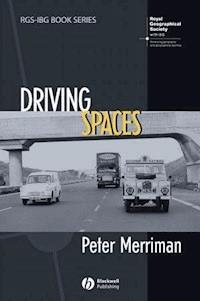
Peter Merriman traces the social and cultural histories and geographies of driving spaces through an examination of the design, construction and use of England's M1 motorway in the 1950s and 1960s. * * A first-of-its-kind academic study examining the production and consumption of the landscapes and spaces of a British motorway * An interdisciplinary approach, engaging with theoretical and empirical work from sociology, history, cultural studies, anthropology and geography * Contains 38 high quality illustrations * Based on extensive, original archive work
Sie lesen das E-Book in den Legimi-Apps auf:
Seitenzahl: 588
Veröffentlichungsjahr: 2011
Ähnliche




















Contents
List of Figures
Series Editors’ Preface
Acknowledgements
Chapter One Introduction: Driving Spaces
Mobilities
Driving, Space, Social Relations
Driving, Landscape, Visuality
Geographies of the Modern Road
Contents of the Book
Chapter Two Envisioning British Motorways
Motoring and the Motor-Car Way, 1896–1930
The German Autobahnen: The Politics and Aesthetics of a Nation’s Roads
Motorways for Britain? National Plans, National Defence
Motorways, War and Reconstruction
Motorways and the British Landscape
Chapter Three Designing and Landscaping the M1
Legislating and Campaigning: Towards a National Motorway Network
Locating the M1: Regional Planning, Local Protests and the Authority of the Engineer
Landscape Architecture and the Post-war, Modern Road
‘A New Look at the English Landscape’: Landscape Architecture, Movement and the Aesthetics of a Modern Motorway
Towards a Road Style: Service Areas in the Landscape
‘Cutting Holes in the Landscape’: Britain’s Motorway Signs
Chapter Four Constructing the M1
‘Operation Motorway’: Constructing the M1 Motorway
Song of a Road: Folk Song, Working-Class Culture and the Labour of a Motorway
Chapter Five Driving, Consuming and Governing the M1
Motorway Driving, Embodiment, Competence
‘Motorway Madness’: Driving, Governing, Expertise
Motorway Modern: Consuming the M1
Motorway Service Areas and the Motorist-Consumer
Assessing the M1’s Performance: Cost-Benefit Analysis, Scientific Experiments, Accidents
Chapter Six Motorways and Driving since the 1960s
The ‘M1 Corridor’
Motorways and ‘the Environment’
Dystopian and Marginal Landscapes?
Placeless Environments?
Placing the M1 in the Late Twentieth and Twenty-First Centuries
Appendix: Archival Sources
Notes
CHAPTER 1 INTRODUCTION: DRIVING SPACES
CHAPTER 2 ENVISIONING BRITISH MOTORWAYS
CHAPTER 3 DESIGNING AND LANDSCAPING THE M1
CHAPTER 4 CONSTRUCTING THE M1
CHAPTER 5 DRIVING, CONSUMING AND GOVERNING THE M1
CHAPTER 6 MOTORWAYS AND DRIVING SINCE THE 1960S
References
DISCOGRAPHY
FILMS
Index
RGS-IBG Book Series
The Royal Geographical Society (with the Institute of British Geographers) Book Series provides a forum for scholarly monographs and edited collections of academic papers at the leading edge of research in human and physical geography. The volumes are intended to make significant contributions to the field in which they lie, and to be written in a manner accessible to the wider community of academic geographers. Some volumes will disseminate current geographical research reported at conferences or sessions convened by Research Groups of the Society. Some will be edited or authored by scholars from beyond the UK. All are designed to have an international readership and to both reflect and stimulate the best current research within geography.
The books will stand out in terms of:
the quality of researchtheir contribution to their research fieldtheir likelihood to stimulate other researchbeing scholarly but accessible.For series guides go to www.blackwellpublishing.com/pdf/rgsibg.pdf
Published
Driving Spaces: A Cultural-Historical Geography of England’s M1 Motorway
Peter Merriman
Badlands of the Republic: Space, Politics and Urban Policy
Mustafa Dikeç
Geomorphology of Upland Peat: Erosion, Form and Landscape Change
Martin Evans and Jeff Warburton
Spaces of Colonialism: Delhi’s Urban Governmentalities
Stephen Legg
People/States/Territories
Rhys Jones
Publics and the City
Kurt Iveson
After the Three Italies: Wealth, Inequality and Industrial Change
Mick Dunford and Lidia Greco
Putting Workfare in Place
Peter Sunley, Ron Martin and Corinne Nativel
Domicile and Diaspora
Alison Blunt
Geographies and Moralities
Edited by Roger Lee and David M. Smith
Military Geographies
Rachel Woodward
A New Deal for Transport?
Edited by Iain Docherty and Jon Shaw
Geographies of British Modernity
Edited by David Gilbert, David Matless and Brian Short
Lost Geographies of Power
John Allen
Globalizing South China
Carolyn L. Cartier
Geomorphological Processes and Landscape Change: Britain in the Last 1000 Years
Edited by David L. Higgitt and E. Mark Lee
Forthcoming
Politicizing Consumption: Making the Global Self in an Unequal World
Clive Barnett, Nick Clarke, Paul Cloke and Alice Malpass
Living Through Decline: Surviving in the Places of the Post- Industrial Economy
Huw Beynon and Ray Hudson
Swept up Lives? Re-envisaging ‘the Homeless City’
Paul Cloke, Sarah Johnsen and Jon May
Climate and Society in Colonial Mexico: A Study in Vulnerability
Georgina H. Endfield
Resistance, Space and Political Identities
David Featherstone
Complex Locations: Women’s Geographical Work and the Canon 1850–1970
Avril Maddrell
Geochemical Sediments and Landscapes
Edited by David J. Nash and
Sue J. McLaren
Mental Health and Social Space: Towards Inclusionary Geographies?
Hester Parr
Domesticating Neo-Liberalism: Social Exclusion and Spaces of Economic Practice in Post Socialism
Adrian Smith, Alison Stenning, Alena
Rochovská and Dariusz witek
Value Chain Struggles: Compliance and Defiance in the Plantation Districts of South India
Jeffrey Neilson and Bill Pritchard
© 2007 by Peter Merriman
BLACKWELL PUBLISHING
350 Main Street, Malden, MA 02148–5020, USA
9600 Garsington Road, Oxford OX4 2DQ, UK
550 Swanston Street, Carlton, Victoria 3053, Australia
The right of Peter Merriman to be identified as the Author of this Work has been asserted in accordance with the UK Copyright, Designs, and Patents Act 1988.
All rights reserved. No part of this publication may be reproduced, stored in a retrieval system, or transmitted, in any form or by any means, electronic, mechanical, photocopying, recording or otherwise, except as permitted by the UK Copyright, Designs, and Patents Act 1988, without the prior permission of the publisher.
Designations used by companies to distinguish their products are often claimed as trademarks. All brand names and product names used in this book are trade names, service marks, trademarks, or registered trademarks of their repective owners. The publisher is not associated with any product or vendor mentioned in this book.
This publication is designed to provide accurate and authoritative information in regard to the subject matter covered. It is sold on the understanding that the publisher is not engaged in rendering professional services. If professional advice or other expert assistance is required, the services of a competent professional should be sought.
First published 2007 by Blackwell Publishing Ltd
1 2007
Library of Congress Cataloging-in-Publication Data
Merriman, Peter.
Driving spaces: a cultural-historical geography of England’s M1 Motorway / Peter Merriman.
p. cm. – (RGS-IBG book series)
Includes bibliographical references and index.
ISBN: 978-1-4051-3072-1 (pbk.: alk. paper)
ISBN: 978-1-4051-3073-8 (hardcover: alk. paper) 1. M1 Motorway (England)-Design and construction-History. 2. Express highways-Social aspects-England-History. 3. Auto-mobile driving on highways-History. 4. England-Social life and customs. 5. Cultural landscapes–England. I. Title.
TE57.M47 2007
388.1′220942-dc22
2007011998
To Mum and Dad
Figures
2.1An artist’s impression of the Northern and Western Motorway, commissioned by Lord Montagu of Beaulieu, c.19232.2‘Suggested scheme of motorways’ by the County Surveyors’ Society, May 19382.3The front cover of George Curnock’s New Roads for Britain, published by the British Road Federation, 19442.4Photomontage by Geoffrey Jellicoe of two motorway carriageways passing alongside the banks of a river in the Trough of Bowland, Lancashire, 19443.1The Ministry of Transport’s 1946 map of future national routes, including motorways and reconstructed trunk roads3.2Cover of the British Road Federation’s The Case for Motorways, 1948, featuring a photo-montage by Geoffrey Jellicoe3.3Map showing the location of Watford Gap in relation to the communications corridors linking London, the Midlands and the North-West, 19603.4Map by A. J. Thornton showing the location of the first sections of the London to Birmingham/Yorkshire Motorway, 19593.5Landscapes composed for appreciation by pedestrians and motorists travelling at different speeds3.6The Shadowed Road, c.1808–10. Watercolour by John Crome (1768–1821)3.7‘The average landscape of the average motor-road in Britain…’3.8‘The Shadowed Road – modern style’3.9Motorway embankments in England and Germany3.10Two-span over-bridges spanning the M1 motorway3.11Two contrasting underpasses designed by Sir Owen Williams and Partners3.12Design by Clough Williams-Ellis of a footbridge for Watford Gap service area, 19593.13Hampton Court Bridge, by Canaletto, c.17543.14A maintenance depot loading hopper designed by Sir Owen Williams and Partners4.1Blackwood Hodge advertisement, 19594.2Caterpillar advertisement, 19594.3London to Birmingham Motorway During Construction at Milton Near Northampton. Oil painting by Terence Cuneo, 19584.4Sir Robert Marriott and four Iranian journalists studying a model of the motorway in John Laing and Son Limited’s news-room at construction headquarters, Newport Pagnell, September 19584.5Song of a Road. Advertisement from the Radio Times, 19595.1Cover of the Automobile Association’s Guide to the Motorway, 19595.2Cover of Motorway insert from The Motor magazine, 19595.3India Tyres advertisement, 19595.4Automotive Products Associated Limited advertisement, 19595.5Automobile Association patrol vehicles, spotter plane and patrolmen on parade at junction 14 on 19 October 19595.6Monthly figures for the number of breakdown telephone calls received by the Automobile Association, November 1959 to October 19605.7Cover of the sheet music for ‘M1’ by the Ted Taylor Four5.8The front cover of The Mystery of the Motorway, by Robert Martin5.9The front cover of The Motorway Chase, by Bruce Carter5.10British Industrial Plastics and Midland Red’s Motorway Express coach5.11‘The M.1. Motorway’, black and white postcard, c.1960–35.12‘M1. Flyover, Dunstable Road, Luton’. Colour postcard of a bridge, embankment and roundabout at junction 11 of the M15.13‘Ye olde “A5” transport cafe’. Cartoon by Giles5.14The movements of vehicles involved in accidents on M1 in 1960 and 19615.15‘Approximate position of accidents at Park St. Terminal (A5/A405) in twelve months ending Oct. 31, 1960’Series Editors’ Preface
Like its fellow RGS-IBG publications, Area, the Geographical Journal and Transactions, the RGS-IBG Book Series only publishes work of the highest international standing. Its emphasis is on distinctive new developments in human and physical geography, although it is also open to contributions from cognate disciplines, such as anthropology, chemistry, geology and sociology, whose interests overlap with those of geographers. The Series places strong emphasis on theoretically-informed and empirically-strong texts. Reflecting the vibrant and diverse theoretical and empirical agendas that characterize the contemporary discipline, contributions are expected to inform, challenge and stimulate the reader. Overall, the RGS-IBG Book Series seeks to promote scholarly publications that leave an intellectual mark and that change the way readers think about particular issues, methods or theories.
For series guides go to www.blackwellpublishing.com/pdf/rgsibg.pdf
Kevin Ward (University of Manchester, UK) and Joanna Bullard (Loughborough University, UK) RGS-IBG Book Series Editors
Acknowledgements
A great many people have helped me during the research and writing of this book. The initial research was undertaken for my doctorate at the University of Nottingham, and I would like to thank staff and postgraduate students at the School of Geography for making it an enjoyable and invigorating place to research. I am particularly grateful to David Matless and Charles Watkins for their invaluable guidance and advice as my supervisors, and Stephen Daniels and Nigel Thrift for advising me to publish my research in book form. I have had the fortune of working in two supportive geography departments. At the University of Reading, Sophie Bowlby, Carl Cater, Erlet Cater, Steven Henderson, Sally Lloyd-Evans, JoAnn McGregor, Erika Meller, Gavin Parker, Rob Potter, Mike Raco, and the students I was fortunate enough to teach and supervise, all created a stimulating working environment and helped the book along in different ways. At the University of Wales, Aberystwyth I would like to thank staff and students in the Institute of Geography and Earth Sciences, including Pete Adey, Luke Desforges, Deborah Dixon, Bob Dodgshon, Bill Edwards, Kate Edwards, Gareth Hoskins, Martin Jones, Rhys Jones, Heidi Scott, Mark Whitehead and Mike Woods. Tim Cresswell and George Revill have provided a constant source of intellectual stimulation, as have members of the Historical Geography Research Group of the RGS-IBG.
I would like to thank Angela Cohen and Jacqueline Scott at Blackwell Publishing and Nick Henry and Kevin Ward, successive editors of the RGS-IBG series, for helping the smooth production of this book. Seminar and conference audiences in New York, Paris, Peckham … Aberdeen, Aberystwyth, Bristol, Cheltenham, Hull, Lancaster, Liverpool, London, Milton Keynes, Nottingham, Reading, Washington, DC, Windsor Great Park, and successive AAG and RGS-IBG annual conferences have provided useful and supportive feedback. Staff at the British Library, National Library of Wales, Trinity College Dublin, British Library of Political and Economic Science, Imperial College and Science Museum Library, Landscape Institute Library, Automobile Association, Royal Automobile Club, Laing, Royal Institute of British Architects, Owen Williams, National Motor Museum, British Road Federation, Civic Trust and university libraries in Aberystwyth, Nottingham and Reading provided access to materials and invaluable help, as did archivists at The National Archives, Birmingham City Archives, the Institution of Civil Engineers, BBC Written Archives Centre, Hertfordshire County Record Office, and the Museum of English Rural Life at the University of Reading. Steve Biczysko, DI Evans and Bob Rogers provided me with invaluable information, and Michael May and Douglas Elbourne kindly agreed to talk to me about their work in the construction of the M1.
The author and publisher gratefully acknowledge the permission granted to reproduce the copyright material in this book. We would like to thank Hodder Arnold for permission to reprint an amended version of my article from Cultural Geographies as part of chapter 3. The first half of chapter 4 has been reprinted (in edited form) from Journal of Historical Geography, vol. 31, Peter Merriman, ‘“Operation motorway”: landscapes of construction on England’s M1 motorway’, pp. 113–33, Copyright (2005), with permission of Elsevier. The BBC Written Archives and Peggy Seeger kindly granted permission to reproduce extracts from the interviews and script of ‘Song of a Road’ in chapter 4. Copyright holders are acknowledged in the credit lines for individual figures. Every effort has been made to trace copyright holders and to obtain their permission for the use of copyright material. The publisher apologizes for any errors or omissions and would be grateful if notified of any corrections that should be incorporated in future reprints or editions of this book.
Finally, I would like to thank my friends and family, who have provided support and entertainment along this motorway journey.
Chapter One
Introduction: Driving Spaces
So, like earlier generations of English intellectuals who taught themselves Italian in order to read Dante in the original, I learned to drive in order to read Los Angeles in the original…. the freeway system in its totality is now a single comprehensible place, a coherent state of mind, a complete way of life, the fourth ecology of the Angeleno…. The freeway is where the Angelenos live a large part of their lives…. the actual experience of driving on the freeways prints itself deeply on the conscious mind and unthinking reflexes. As you acquire the special skills involved, the Los Angeles freeways become a special way of being alive…. (Banham 1971: 23, 213, 214)
The integrated [rural] freeway, married to its landscape, is an elegant composition in space, geared to high speed mobility. Its sculptural qualities can be enormous; it speaks of movement and the kinesthetic qualities of driving on it are vastly exciting…. It is further, a form of action calligraphy where the laws of motion generate a geometry which is part engineering, part painting, part sculpture, but mostly an exercise in choreography in the landscape…. At their best, these great ribbons of concrete, swirling through the land, give us the excitement of an environmental dance, where man can be in motion in his landscape theater. (Halprin 1966: 37)
… the Santa Monica/San Diego intersection is a work of art, both as a pattern on the map, as a monument against the sky, and as a kinetic experience as one sweeps through it. (Banham 1971: 89–90)
In the past decade, geographers have been drawing upon theories of mobility, embodiment, performance, materiality and practice in an attempt to provide increasingly nuanced understandings of the ways in which people more or less consciously and creatively inhabit and move through particular kinds of spaces, environments, places and landscapes.1 Activities as diverse as dwelling in buildings, dancing, driving, walking and holiday-making are increasingly being examined in studies across the social sciences and humanities which are sensitive to the embodied inhabitation of, and movement through, particular spaces. Of course, few of these practices are new, and there is a fairly long history of critical commentaries, explorations and aesthetic interventions by writers, artists, landscape practitioners, engineers, dancers, musicians and film-makers, as well as academics and cultural commentators, who have explored the relations and tensions between landscape, movement, practice, perception and being. This is evident in the opening quotations (above) by the California landscape architect and environmental designer Lawrence Halprin, and the English architecture and design historian and cultural critic Reyner Banham.
In their focus on the motorist’s embodied experience of the vernacular landscape, Reyner Banham and Lawrence Halprin’s writings in the 1960s and early 1970s paralleled other well-known studies of the driving landscape – including Donald Appleyard, Kevin Lynch and John Myer’s study of Boston’s urban expressways in The View from the Road, Robert Venturi, Denise Scott Brown and Steven Izenour’s architectural study of the Las Vegas strip, Learning from Las Vegas, and J. B. Jackson’s extensive writings on the vernacular American landscape (Appleyard et al. 1964; Venturi et al. 1972; Jackson 1997). Banham and Halprin, like J. B. Jackson before, asserted the importance of a driver’s embodied skills, and their kinaesthetic experiences of both the freeway and the landscape. Freeways are seen to be practised and experienced as ‘places’, as distinctive systemic environments which are bound up with people’s everyday experiences and actions: ‘The freeways create a new geography and a new sense of place’ (Brodsly 1981: 46). While Banham was clearly fascinated with the distinctive, exoticized spaces of LA and its freeways, he expressed a similar appreciation for Europe’s largest multi-level junction (known as ‘Spaghetti Junction’), situated on the M6 at Gravelly Hill, Birmingham. When it was opened in 1972, he wrote a review of this ‘complex- intersection’ for , preparing an itinerary for ‘kinaesthetes’ wishing to tour ‘the inner complexities of this agreeable little suburban megastructure’ by car (Banham 1972b: 84, 85). The article was just one of many commentaries Banham wrote during the 1950s, 1960s and 1970s about the vernacular landscapes and pop-modern architecture of post-war Britain. Banham repeatedly encountered and wrote about distinctive, though often quite ordinary, structures and environments, tracing the ecologies of particular landscapes, spaces and places.
Lesen Sie weiter in der vollständigen Ausgabe!
Lesen Sie weiter in der vollständigen Ausgabe!
Lesen Sie weiter in der vollständigen Ausgabe!
Lesen Sie weiter in der vollständigen Ausgabe!
Lesen Sie weiter in der vollständigen Ausgabe!
Lesen Sie weiter in der vollständigen Ausgabe!
Lesen Sie weiter in der vollständigen Ausgabe!
Lesen Sie weiter in der vollständigen Ausgabe!
Lesen Sie weiter in der vollständigen Ausgabe!




