


1,99 €
Mehr erfahren.
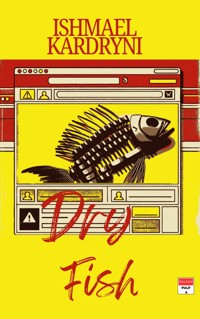
A meta-noir of bodies, forums, and fables, where a killer stalks online writers. When two turn up dead and a third narrowly survives an "accident," Tirana's detectives wade into secret-service meddling, café conspiracies, and literary blood feuds. As qofte-wrapped reports, forum flame wars, and gallery shocks pile up, the case veers toward an answer that isn't forensic at all.
Das E-Book können Sie in Legimi-Apps oder einer beliebigen App lesen, die das folgende Format unterstützen:
Seitenzahl: 43
Veröffentlichungsjahr: 2025
Ähnliche
















DRY FISH
Ishmael KARDRYNI
Series: BALKAN PULP 6
Copyright © 2024 Ishmael Kardryni All rights reserved
The characters and events portrayed in this book are fictitious. Any similarity to real persons, living or dead, is coincidental and not intended by the author.
No part of this book may be reproduced, stored in a retrieval system, or transmitted in any form or by any means, electronic, mechanical, photocopying, recording, or otherwise, without the express written permission of the publisher.
© 2024 Ishmael Kardryni. All rights reserved.
Cover design by: Ishmael Kardryni
This is a work of fiction inspired by true events. Some characters and events are products of the author's imagination, and any resemblance to actual persons or events is partly coincidental. Although the story is based on real events, certain events and characters have been altered for dramatic effect.
Roni
It was horrible. The victim hung above our heads, snagged in a snarl of old telegraph wires, power lines, internet and TV cables, and illegal surveillance cameras.
His face was swollen and blue. His head drooped like a testicle with elephantiasis. Twisted in the cables and naked, his body reminded me of those grotesque roasts served at Albanian weddings. Blood dripped from his buttocks and thighs. Someone had set a bucket beneath him.
From the bar across the street came Ardit Gjebrea’s voice singing “Jon.” In the background, a chorus rose from the street. Beni, the café owner, shot me a knowing look. He and the usual gang of bums and drunks had abandoned the pool table to revel in the horror.
It was certainly more exciting than the Turkish telenovelas on Gang TV; even a knot of housewives had left their kitchens with the televisions still on. They strolled through the street under the predatory gaze of Bami the cobbler, famed for his knowledge of adulteresses—and their broken heels and worn soles.
“Where did you get that?” Aldo asked, pointing to a book of poems by Rita Petro sticking from my back pocket.
“I confiscated it during a raid on an erotic hair salon.” The owner had a taste for erotic literature. It lay on a sofa in the waiting room, surrounded by dildos, porn magazines, sex machines, and hair dryers.
“She must have been Albanian. Maybe Rita Petro knows how to work those dryer hoods in the illegal brothel.”
"I don't know. The women were from Venezuela. Maybe she was just advertising."
"For the hair dryers?" Aldo smiled.
"Rita is quite popular with horny teenagers. So far, we've only seen the pussy, touched it, and tasted it, but she's the first writer to write about pussies in Albanian. Even if her style is too dry for such a wet topic.”
"It's all kitsch," Aldo said and walked on.
"Looks like suicide, doesn't it?"
“Aldo,” a police officer called. “We also found this sign. Some kids knocked it over and threw stones at it as if it were a target. According to witnesses, it was tied around the victim’s neck.”
“What does that mean?” Aldo asked, pointing to the sign with a fish painted on it and the word “Roni” written beneath.
“The murderers, and the writers, in this country are becoming increasingly enigmatic,” I said, nodding toward two gaunt men in new suits, their hair cut like shrubs by a grumpy gardener. “Security,” I whispered.
“Well, you can’t let barbershops close,” Aldo said with a laugh.
They glanced at us and hurried away.
Terxhuman
The chief of police gathered us in the bar next to the station. Miti had arrived early and was already drunk when Aldo and I walked in.
He scanned the report. “So, who is this Spider-Man? A telecommunications technician, maybe newly hired? A burglar? A lover? I once had a lover in that neighborhood—God, she was hot. Who knows if she still lives there.” Then he ordered a beer and a plate of meatballs.
“This person—the victim’s name is Ron Telegrafi—was a so-called internet writer,” I said.
“Interesting,” Miti cut in. “Until now I’d only heard of combine or cooperative writers.”
“And what was he doing up there? Which building did he jump from? Why?” the boss asked. He popped a meatball into his mouth, took a big gulp of vinegar water, and went on: “Man, these meatball are good. Vinegar’s supposed to lower cholesterol. I take raki for my blood pressure.”
“We don’t know yet. The whole ‘Komuna e Parisit’ area is a spaghetti block—a concrete barricade of balconies and windows that you can’t tell where they lead,” I said.
“And we don’t yet know whether it was suicide or murder,” Aldo added.
“What did he write? Maybe his notes hold an answer. What did he want to tell us with his death?” the boss asked.
“He wanted to be an Albanian David Foster Wallace. He wrote difficult texts no one understood. He was a postmodernist,” I replied.
“A postmodernist? Wallace?” the boss said. “You mean gay? As if we don’t have enough of those types. And the European Union wants even more. Should we import them from Thailand? They’ll pillory us.”
“No, boss—postmodernists are the ones who question the truth.”
“Well, at least now he knows what’s true. And we need to find out, too. The stats aren’t good. Crime is up.”
“I thought the Albanian Wallace was that writer in France, I. Azizi,” Miti said.




