Table of Contents
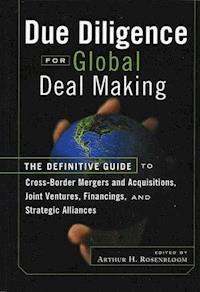
Due Diligence for Global Deal Making
Praise
Title Page
Copyright Page
Preface
Acknowledgements
About the Contributors
Chapter 1 - Due Diligence in the Global Economy
What Is Due Diligence?
Types of Due Diligence
Who Is Involved in Due Diligence?
What Constitutes Legal Due Diligence?
What Constitutes Financial Due Diligence?
What Constitutes Operational Due Diligence?
Integrating Due Diligence Efforts
Chapter 2 - Strategic Due Diligence
Strategy Precedes Due Diligence
Reviewing Your Strategy
Achieving Value
Factoring in Cross-Border Complexities
Identifying Your Strategic Rationale
Undertaking Thorough Due Diligence
Cross-Border Complications
Key Factors in Evaluating Strategic Rationales
Due Diligence for Scale-Driven Transactions
Due Diligence for Adjacency-Driven Transactions
Due Diligence for Scope-Driven Transactions
Due Diligence for Transformation-Driven Transactions
Assessing Your Findings
Chapter 3 - Operational Due Diligence
Operational Due Diligence in the Cross-Border Context
Designing Due Diligence from a Strategic Perspective
Validating and Integrating Other Due Diligence Efforts
What Should Operational Due Diligence Cover?
Mapping the Value-Creation Process
Systems and Know-How Support of the Value-Creation Process
People, Training, and Corporate Culture
What Can Go Wrong
Deals That Got It Right
Chapter 4 - Financial and Accounting Due Diligence
Addressing All Aspects—Whether Large or Small
Financial Due Diligence Procedures
Accounting Due Diligence Procedures
Chapter 5 - Legal Due Diligence
“Legalese” across Borders
The Purpose of Legal Due Diligence: Insurance against the Unknown
A Good Deal Is Vastly Better Than a Good Lawsuit
Defensive Due Diligence in U.S. Public Securities Issuance Transactions: ...
Forces Working to Limit Due Diligence: Quick Decision Makers versus Slow Scriveners
Avoiding Ruffled Feathers and Missed Opportunities
Fitting Due Diligence into the Structure and Timing of the Deal: Sooner Is Better
Organizing and Executing Legal Due Diligence: The Buck Stops at the Top
Certain Key Risk Exposure Areas in Legal Due Diligence
The Preferred Result of Legal Due Diligence: No News Is Good News
Chapter 6 - Tax Due Diligence
Compliance versus Planning
Due Diligence Coordination
Local, National, and International Perspective
A Word about Joint Ventures
Taxable Purchase of Assets
Taxable Share Purchases
Tax-Free Exchanges
Chapter 7 - People and Organizational Due Diligence
General Considerations
Key Components of Organizational Due Diligence
Chapter 8 - Due Diligence Investigative Technology and Know-How
How Investors Use Private Investigators
How Investigative Technology Can Help
The Backgrounds of Key Executives
The Business Practices of the Target Company
Increased Pressure on Due Diligence Professionals
APPENDIX: Cross-Border Due Diligence in an Age of International Terrorism
Index
About Bloomberg
Due Diligence for Global Deal Making
The Definitive Guide to Cross-Border Mergers and Acquisitions, Joint Ventures, Financings, and Strategic Alliances
Companies of all sizes have been initiating international transactions—mergers and acquisitions, joint ventures, strategic alliances, and private placements—in record numbers. Targeted due diligence is crucial to effectively research, value, and complete these complex deals. With an evolving climate of uncertainty and new, unpredictable threats to business, it is more essential than ever before.
Due Diligence for Global Deal Making is an invaluable guidebook for companies trying to capitalize on the opportunities in both developed and emerging cross-border markets. All too often global transactions fail to meet the parties’ expectations, and the leading culprit is inadequate due diligence. Especially when the target partner lacks a financial performance track record and significant assets, expanding businesses must answer difficult questions, such as: Why (if at all) should we do this deal? What are the rules going in, and what happens if things go wrong? Where are the tax, legal, financial, and operational traps, and what are the opportunities? This book provides what’s needed to avoid devastating mistakes and to master the steps that ensure success:
• Expert analysis, insights, and strategies from experienced practitioners and leading authorities in cross-border matters
• In-depth coverage of critical topics decision makers need to understand in order to succeed in cross-border transactions—from corporate planning to operational, financial, legal, tax, accounting, and people/organizational considerations
• Best practices of corporate investors and professional advisers in conducting critical due diligence
Noted experts discuss critical topics corporate executives—and all those involved with their company’s legal, operational, accounting, and tax matters—need to know to successfully complete complex global transactions today.
PRAISE FOR
Due Diligence for Global Deal Making
EDITED BY ARTHUR H. ROSENBLOOM
“Thoughtful due diligence has never been more important in deal making, and this book gives you all the tools to get the job done. It also goes beyond diligence to clarify strategy and long-term objectives. It’s a critical business reference.”
RICK RICKERTSEN Chief Operating Officer Thayer Capital Partners Author, Buyout: The Insider’s Guide toBuying Your Own Company
“Arthur Rosenbloom has succeeded in compiling, distilling, and explaining the many complex issues related to performing due diligence for global opportunities. This excellent book provides valuable insights for private equity principals, investment bankers, CEOs, CFOs, and anyone else who participates in such transactions.”
PETER E. BERGER Managing Director Ripplewood Holdings LLC
“A nice primer on the importance and multidimensional facets of due diligence in cross-border transactions. The due diligence checklists included are great reference tools for either the practitioner or the student.”
THOMAS A. MASTRELLI Chief Operating Officer VNU Inc.
“This is a timely book that brings back the commonsense, in addition to the applied forensics, approach to due diligence. In light of recent dramatic due diligence failures, deal participants need to make sure they fully understand the company that is undergoing a corporate transaction. Due diligence issues are often exacerbated in cross-border deals, making this book’s global focus very relevant.”
JAMES H. ZUKIN Senior Managing Director Houlihan Lokey Howard & Zukin Capital
“It’s hard to find a book more timely thanDue Diligence for GlobalDeal Making. The rapid growth of global markets in the last decade of the twentieth century increased the risk of fraud and problems in understanding legal and financial documents and assessing operations. Arthur Rosenbloom, a top authority on due diligence, has correctly diagnosed the situation and edited a useful and strategically important book. Manyof the recent financial scandals to which we are witness mighthave been avoided had the lessons appearing in this work beenheeded.”
VLADIMIR KVINT, PH.D. Professor of Management Systems and International Business Fordham University Author, The Global Emerging Market in Transition Contributing Editor, Forbes Global magazine
“The fact of globalization makes reading Due Diligence for Global DealMakinga must for those contemplating cross-border transactions. The work offers a much needed discussion of the strategic planning, human relations, and critical operational components of the due diligence process.”
MARK LOWENTHAL Former President Revlon Europe and the Middle East
ATTENTION CORPORATIONS
This book is available for bulk purchase at special discount. Special editions or chapter reprints can also be customized to specifications. For information, please e-mail Bloomberg Press,
[email protected], Attention: Director of Special Markets, or phone 212-617-7966.
A complete list of our titles is available atwww.bloomberg.com/books
BLOOMBERG MARKETS ® magazine is for and about professional investors, the places they work, and the companies they invest in. It is specially edited for the BLOOMBERG PROFESSIONAL® service subscriber who needs to be constantly informed on new functions, trends, and strategies that can help tilt the financial playing field in their favor. See www.bloomberg.com for subscription information.
© 2002 Arthur H. Rosenbloom. All rights reserved. Protected under the Berne Convention. No part of this book may be reproduced, stored in a retrieval system, or transmitted, in any form or by any means, electronic, mechanical, photocopying, recording, or otherwise, without the prior written permission of the publisher except in the case of brief quotations embodied in critical articles and reviews. For information, please write: Permissions Department, Bloomberg Press, 731 Lexington Avenue, New York, NY 10022 or send an e-mail to
[email protected].
BLOOMBERG, BLOOMBERG ANYWHERE, BLOOMBERG.COM, BLOOMBERG MARKET ESSENTIALS, Bloomberg Markets, BLOOMBERG NEWS, BLOOMBERG PRESS, BLOOMBERG PROFESSIONAL, BLOOMBERG RADIO, BLOOMBERG TELEVISION, and BLOOMBERG TRADEBOOK are trademarks and service marks of Bloomberg Finance L.P. (“BFLP”), a Delaware limited partnership, or its subsidiaries. The BLOOMBERG PROFESSIONAL service (the “BPS”) is owned and distributed locally by BFLP and its subsidiaries in all jurisdictions other than Argentina, Bermuda, China, India, Japan, and Korea (the “BLP Countries”). BFLP is a wholly-owned subsidiary of Bloomberg L.P. (“BLP”). BLP provides BFLP with all global marketing and operational support and service for these products and distributes the BPS either directly or through a non-BFLP subsidiary in the BLP Countries. All rights reserved.
This publication contains the authors’ opinions and is designed to provide accurate and authoritative information. It is sold with the understanding that the authors, publisher, and Bloomberg L.P. are not engaged in rendering legal, accounting, investment-planning, compliance, or other professional advice. The reader should seek the services of a qualified professional for such advice; the authors, publisher, and Bloomberg L.P. cannot be held responsible for any loss incurred as a result of specific investments or planning decisions made by the reader.
ISBN-13: 978-1-57660-092-4
The Library of Congress has cataloged the earlier printing as follows:
Due diligence for global deal making : the definitive guide to cross-border mergers and acquisitions, joint ventures, financings, and strategic alliances / edited by Arthur H. Rosenbloom.
p. cm.
Includes bibliographical references and index.
1. Consolidation and merger of corporations--Handbooks, manuals, etc. 2. International business enterprises. 3. Joint ventures. 4. Strategic alliances (Business) I. Rosenbloom, Arthur H.
HD2746.5 .D84 2002
658.1’6--dc21
2002008649
Acquired and edited by Kathleen A. Peterson
Preface
EFFECTIVE DUE DILIGENCE in all transactions—but especially those involving parties across national borders—is a critical component of the deal process. This is an absolute if parties are to be spared the enormous loss of time, money, and reputation (not to mention personal anguish) of deals that fail to meet expectations. Cross-border due diligence encompasses all of the elements found in purely domestic transactions, overlain with an extra level of complexity due to its international character. (Thus, a double-barreled benefit for readers of this book!)
Paradoxically, the transactions in which strategic, operational, financial, tax, legal and people/organizational due diligence is practiced effectively often don’t make the headlines but are observable only dimly in the accreted earnings of the acquirer. However with failed or aborted transactions, the story is otherwise. Daimler-Chrysler’s shrunken market capitalization evidences a corporate marriage flawed in many cultural, financial, and operational ways. Better due diligence might have made a difference.
Could better legal due diligence have more effectively anticipated the European Union’s anti-monopoly response, now on appeal, in General Electric-Honeywell? Perhaps. Had Enron, Global Crossing, Sunbeam, Adelphia, or WorldCom been the subject of cross-border deal offers, would the many issues surrounding these companies that later surfaced have been unearthed by means of effective due diligence? Unprovable, of course, but reasonably likely, we assert.
In many respects, twenty-first century cross-border due diligence resembles the classic due diligence of prior periods, but in two distinct ways it does not. One is the specter of international terrorism, whose implications for cross-border due diligence are the subject of the Appendix to this book. A second is the proliferation of intellectual property-driven transactions in fields like biotech, software, and communications. These sorts of deals require new levels of due diligence resourcefulness, and we have more than a little guidance for you in this regard in the pages that follow.
To the corporate executives, attorneys, accountants, consultants, and the graduate students and others who aspire to become skilled in any of these areas, and to those who teach these aspirants, we hope and believe that you’ll find in this volume a wealth of practical advice on how to become more effective professionals in cross-border due diligence. Good luck and good deals to you all.
Acknowledgments
PUTTING TOGETHER a book like this is a work of the heart as well as the mind. All of the contributors to this volume either advise clients in cross-border deals, have been corporate executives engaged in the process of doing deals, or teach graduate students in this field. (Some of us do more than one of these.) From professional experience, we know how integral a role effective due diligence plays in the cross-border transactional process. As practitioners, we’re pleased to share our insights with you because we believe that better due diligence means making better deals that result in greater increase in shareholder wealth. Such due diligence also may result in deals that, for good reason, should be aborted—an outcome that also serves shareholder interests.
Thanks are due to many staff persons at each of our places of work through whose efforts our chapters have emerged. Special thanks are due to Orietta Ramirez of CFC Capital LLC, who coordinated the general production of the manuscript, and Kathleen Peterson, Senior Acquisitions Editor at Bloomberg Press, for her valuable advice at every step of the way from conceptualization to manuscript production.
About the Contributors
Linda D. Arrington has spent nine years in banking at Chase Securities (and its predecessor institutions). Her investment banking experience has covered corporate finance activities in the retail industry group, media and telecommunications group, mergers and acquisitions group, private equity group, debt capital markets, and cross-border M&A analysis while covering clients in Johannesburg, South Africa. Ms. Arrington holds an M.B.A. from Columbia Business School and a B.S. degree from William Smith College.
(Chapter 3)
Robert T. Bossart is of counsel in the New York office of Greenberg Traurig, LLP and chair of the firm’s corporate international tax group. Formerly an international tax partner with the New York office of a Big Five CPA firm, he specializes in corporate and international tax matters. Mr. Bossart’s client responsibilities include U.S. multinationals as well as non-U.S. multinationals investing in the United States. With more than twenty-five years of experience advising multinational manufacturing and service corporations, Mr. Bossart has frequently been involved in helping companies develop global tax strategies, including funding and movement of intellectual property, cross-border structuring and financing, mergers and acquisitions, transfer pricing issues, manufacturing/ distribution/Internet reengineering, revenue agent examinations, and strategic repatriation planning. In addition to an LL.M. in taxation from New York University’s Graduate School of Law, Mr. Bossart holds a B.S. from the Wharton School of the University of Pennsylvania, an M.B.A. from Cornell University’s Johnson Graduate School of Management; and a J.D. from Fordham Law School.
(Chapter 6)
Geoff Cullinan is a director in Bain & Company’s London office, where he leads the European private equity practice and the London M&A practice. Mr. Cullinan has more than twenty-five years of general management, strategy consulting, and investor experience in a wide range of industries, including consumer products, retail, automotive, chemicals, engineering, and financial services. Prior to joining Bain, Mr. Cullinan was chief executive officer of Hamleys Plc, a retail business in the toys and games industry. Previous to this, Mr. Cullinan was the founder and managing director of OC&C Strategy Consultants and the head of the European consumer goods practice for Booz Allen & Hamilton Inc. He has a B.A. degree from the University of Essex and earned an M.B.A. with highest distinction from IMEDE, Lausanne.
(Chapter 2)
Jorge M. Diaz is a partner at Ernest & Young LLP with more than twenty-eight years of experience working with organizations in various industries including telecommunications, international banking, domestic banking, investment funds, fresh produce, professional sports, real estate, airlines, manufacturing, and distribution. He has provided audit and business advisory services to many international public and privately held companies, and has expertise in initial and secondary public offerings, capital formation, and mergers and acquisitions. Mr. Diaz is actively involved in the international business community and has assisted numerous clients in accomplishing financial and operational objectives, including privatizations. He is a member of the Florida Institute of Certified Public Accountants, the California Society of Certified Public Accountants, the Florida International Bankers Association, the Florida International University Council of 100, and the Greater Miami Chamber of Commerce. Mr. Diaz has a Bachelor of Accounting degree from the University of Southern California.
(Chapter 4)
Nelson M. Fraiman is codirector of the W. Edwards Deming Center for Quality, Productivity and Competitiveness and professor in the Division of Decision, Risk and Operations at Columbia Business School. Professor Fraiman joined the business school faculty after a seventeen-year career at International Paper Company, where he was chief technology officer for eight manufacturing divisions. He specializes in the retailing, consulting, and process industries and studies general areas of operations management and technology. Professor Fraiman holds B.S., M.S., M.B.A., and Ph.D. degrees, all from Columbia University.
(Chapter 3)
Tom Holland is a director in Bain & Company’s San Francisco office, where he heads the global business consulting firm’s worldwide private equity practice. For nearly twenty years, Mr. Holland has worked with companies in a variety of industries, including technology, telecommunications, transportation, consumer goods, and manufacturing. He has advised clients on growth strategies, cost and asset restructuring, reengineering, and mergers and acquisitions. He has also helped clients facing major turnarounds or repositionings in turbulent industries, such as telecommunications, transportation, and aerospace. Prior to joining Bain, Mr. Holland held positions with Clorox and Bain Capital. He earned his M.B.A. with distinction from Stanford University and holds a B.S. degree in engineering from the University of California at Berkeley.
(Chapter 2)
James B. Mintz, president of James Mintz Group, Inc., has spent the past twenty-five years conducting investigations worldwide, primarily for law firms and general counsel. Mr. Mintz helped pioneer the use of sophisticated resources by law firms in the late 1970s, as an in-house investigator at the Washington, D.C., law firm of Wald, Harkarader & Ross. He cofounded Investigative Group, Inc. in 1984, serving as its president for a decade, and founded the James Mintz Group in 1994. Mr. Mintz has participated in seminars on corporate investigations, including the Practicing Law Institute’s “Conducting Complex Fact Investigations—Techniques and Issues for Lawyers.” His articles have appeared in the Wall Street Journal, the Conference Board’s Across the Board magazine, Directors & Boards, and Corporate Legal Times. Mr. Mintz can be reached at
[email protected].
(Chapter 8)
Carolyn E.C. Paris is a fellow at the W. Edwards Deming Center for Quality, Productivity and Competitiveness at Columbia Business School. She was previously a partner at the law firm of Davis Polk & Wardwell in New York City, specializing in corporate finance, including domestic and international acquisition finance, structured finance, and bankruptcy/ workouts. Ms. Paris was also director of practice information and professional development at Davis Polk, working in intranet-based knowledge management. She is the author of How to Draft for Corporate Finance (Practicing Law Institute, 2000). She has a B.A. degree from the University of Illinois, an M.A. degree from the University of Texas, a J.D. from Stanford University, and an M.B.A. from Columbia University.
(Chapter 3)
Michael L. Pinedo is the Julius Schlesinger Professor of Operations Management and deputy chair of the department of information, operations, and management sciences at the Stern School of Business, New York University. He has previously taught at Columbia University, Instituto Venezolano de Investigaciones Cientificas (Caracas), and the Georgia Institute of Technology. Mr. Pinedo has worked extensively in industrial systems development, with a focus on planning and scheduling of production and service systems, for clients such as Philips Electronics, Siemens, and Merck. He is the author or coauthor/editor of several books on operations scheduling, queueing networks, and value creation in financial services, as well as editor of the Journal of Scheduling. He holds an Ir degree from the Delft University of Technology and M.S. and Ph.D. degrees from the University of California at Berkeley.
(Chapter 3)
Richard C. Porter is a human resources consultant specializing in advising global companies on organizational issues. Experienced working with industry leaders in North America, Europe, Asia, South America, and Africa, he possesses particular expertise in multinational mergers, acquisitions, divestitures, and joint ventures. Most recently he was the global head of human resources for Young & Rubicam Advertising, an agency with operations in more than eighty countries. Previously Mr. Porter served in a number of international human resource appointments for Guinness and United Distillers Inc., part of the Diageo Group. He is an economics graduate of the University of Strathclyde and holds a master’s qualification from the CIPD in London. Mr. Porter is an International Fellow at Tulane University’s AB Freeman School of Business, regularly lectures at New York University’s Stern School of Business, and has lectured at universities in Beijing and Cairo. He serves as human resources adviser to the National Foreign Trade Council.
(Chapter 7)
Clifford A. Rathkopf, a partner at the Greenwich, Connecticut, law firm of Gilbride Tusa Last & Spellane, began his career as an antitrust litigator and has since concentrated in corporate, hi-tech, and intellectual and industrial property matters. He has represented the commercial interests of numerous clients from Europe and the Far East as well as a wide range of domestic clients, with much of his work focusing on acquisitions, licensing, and contract negotiations. Other areas of his practice include leasing, purchase and sale of real estate; creditor’s rights in bankruptcy and distress situations, and commercial dispute resolution. Mr. Rathkopf graduated cum laude from Colgate University and received his J.D. cum laude from Columbia University Law School, where he was coeditor in chief of the Journal of Transnational Law. He studied at the International Court of Justice in the Hague and received his LL.M. degree in International Trade Law from Georgetown University, which included studies at Goethe Universität in Frankfurt am Main, Germany.
(Chapter 5)
Norman J. Resnicow, a partner at the New York law firm of Fox Horan & Camerini, has many years of cross-border transactional experience. He counsels inbound (non-U.S.) clients, primarily from Europe and Asia, on establishing and expanding their U.S. operations. His work encompasses a broad range of corporate and commercial transactions, including mergers and acquisitions; joint ventures and partnerships; distribution /marketing/licensing arrangements and disputes; executive employment and terminations; and real estate purchases, sales, and leases. A graduate of Yale College and Yale Law School, Mr. Resnicow was for nineteen years a partner at the world’s largest international law firm. He now serves on the Committee on International Employment Law of the New York State Bar Association, previously was on its Committee on International Law, and is a member of its International Law section. Also a member of the International Law and Practice and Business Law sections of the American Bar Association, he has been a term member of the Council on Foreign Relations. Mr. Resnicow has lectured on international legal topics at New York University’s Stern School of Business, the American Management Association, and the World Trade Institute.
(Chapter 5)
Arthur H. Rosenbloom, managing director of CFC Capital Corp. in New York, is a thirty plus-year veteran of the domestic and cross-border M&A marketplace, with client representations that include Continental Airlines, Hyatt Corp., and American Express. His contributions on investment banking topics have appeared in The Harvard Business Review, Forbes, Business Week, Mergers and Acquisitions magazine, and the National Law Journal. The coauthor of several books on international mergers and acquisitions, he is an adjunct professor of finance at the Stern School of Business at New York University. Mr. Rosenbloom holds B.A., M.A., and J.D. degrees from Bucknell University, Columbia University, and Cornell Law School, respectively.
(Chapter 1)
Cynthia N. Wood is a principal in Wood Associates, a consulting firm specializing in change management, organizational development, international mergers and acquisitions, and executive training. Her clients have included international food and beverage companies, automobile manufacturers, paper bag manufacturers, institutions of higher education, and software companies. Dr. Wood has assisted clients in profiling their organizational cultures and understanding the implications for the successful acquisition of new business units. She has also developed plans for the post-merger integration of global businesses and assisted with the implementation of those plans. Dr. Wood has published extensively in the journals of the International Academy of Business Disciplines and the Society for the Advancement of Management. She received a Ph.D. from the University of Virginia and completed postdoctoral work at the Johns Hopkins University. She also studied at the University of Salamanca in Spain.
(Chapter 7)
1
Due Diligence in the Global Economy
ARTHUR H. ROSENBLOOM
CROSS-BORDER TRANSACTIONS are an integral feature of business in the twenty-first century. Expansion in the Asia-Pacific region as well as in North America, with NAFTA-incentivized trade by and among the United States, Canada, and Mexico, continues apace. Much the same may be said for the salutary effects of the economic cooperation among countries in the European Union. Latin American cross-border transactions abound, and U.S. investors await the emergence of a post-Castro era and opportunities to join the Canadian and European companies already transforming Cuba’s trade. The trend is less pronounced in most of Africa, whose time for significant cross-border transactions is yet to come. On the whole, however, increasing numbers of cross-border transactions are likely to occur going forward. The purpose of this chapter and of the book itself is to suggest how effective due diligence can result in more thoughtfully planned and better executed transactions in an ever shrinking world.
These days, even small and middle-market firms regularly engage in cross-border transactions. As capital and technology move more frequently across borders and international trade agreements expand, cross-border deals are no longer the sole domain of corporate behemoths. Yet it’s a sad fact of life that many deals fail to live up to the parties’ expectations. Mergerstat reports that in the period 1992-2000, outbound mergers and acquisitions (those involving a U.S. buyer and a non-U.S. target) went from 403 to 1,400, a 247 percent jump, and their total dollar value (where reported) rose from $14.05 billion to $136.75 billion, an 872 percent increase. In that same period, inbound M&A transactions (those involving a non-U.S. buyer and a U.S. target) soared from 167 to 1,248, a 647 percent rise, and their total value (where reported) went from $9.3 billion to $299.2 billion, an unprecedented 2,217 percent increase. While the number of such transactions decreased in 2001 and 2002 (but only to about 1997 levels), one may confidently predict a rebound in such transactions when economies and capital markets turn upward.
Given the huge increase in the number of cross-border M&A transactions that has characterized much of the past ten years, one might expect to hear of boardroom bliss and satisfied stockholders. Quite the contrary has been the case. A 1995 Business Week/Mercer Management study that echoed the results of many prior and subsequent studies found, in examining 150 M&A transactions worth over $500 million in the period January 1990 to July 1995, only 17 percent resulted in substantial shareholder returns to the investing party, with 30 percent resulting in a substantial erosion of shareholder returns to the investor. Results in cross-border transactions have been especially unattractive. A 1999 KPMG study of the top 700 cross-border M&A deals between 1996 and 1998 concluded that over 53 percent diminished the buyer’s shareholder value.
Lesen Sie weiter in der vollständigen Ausgabe!
Lesen Sie weiter in der vollständigen Ausgabe!
Lesen Sie weiter in der vollständigen Ausgabe!
Lesen Sie weiter in der vollständigen Ausgabe!
Lesen Sie weiter in der vollständigen Ausgabe!
Lesen Sie weiter in der vollständigen Ausgabe!
Lesen Sie weiter in der vollständigen Ausgabe!
Lesen Sie weiter in der vollständigen Ausgabe!
Lesen Sie weiter in der vollständigen Ausgabe!
Lesen Sie weiter in der vollständigen Ausgabe!