


Erhalten Sie Zugang zu diesem und mehr als 300000 Büchern ab EUR 5,99 monatlich.
- Herausgeber: Scratch Books
- Kategorie: Gesellschafts- und Liebesromane
- Sprache: Englisch
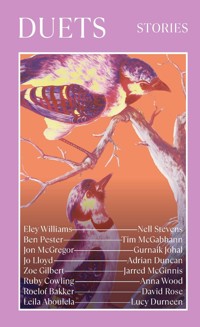
A collection of stories written in duet. Eight highly original stories, each woven from the joint inspiration of two amazing writers. Sixteen celebrated authors respond, play, twist and develop their story in turn. Without the certainty of being in full control, Duets brings a new dimension to the drama of reading and writing.
Sie lesen das E-Book in den Legimi-Apps auf:
Seitenzahl: 238
Veröffentlichungsjahr: 2024
Das E-Book (TTS) können Sie hören im Abo „Legimi Premium” in Legimi-Apps auf:
Ähnliche



















DUETS
First published in 2024
by Scratch Books Ltd
London
The moral rights of the contributing authors of this anthology to be identified as such is asserted in accordance with the Copyright, Designs and Patents Act of 1988.
Jacket design © Alice Haworth-Booth, 2024
Original cover image: McGill Library
Typesetting and e-book by Will Dady, 2024
All rights reserved. No part of this publication may be reproduced, stored in a retrieval system, or transmitted in any form or by any means, electronic, mechanical photocopying, recording, or otherwise, without the prior permission of both the copyright owner and the above publisher of this book.
This is an anthology of fiction. All characters, organisations, and events portrayed in each story are either products of each author’s imagination or are used fictitiously.
Print ISBN 9781739830168
Contents
Introduction
Merrily Merrily Merrily Merrily
Nell Stevens & Eley Williams
Keep Your Miracles to Yourself
Zoe Gilbert & Jarred McGinnis
The Girl Chewing Gum
Adrian Duncan & Jo Lloyd
Morphic Resonance
Roelof Bakker & David Rose
Junction 11
Gurnaik Johal & Jon McGregor
The Backyard of Fuck Around and Find Out
Anna Cowling & Ruby Wood
The Grief Hour
Leila Aboulela & Lucy Durneen
Apricots
Tim MacGabhann & Ben Pester
Contributors
Notes
Introduction
This is a book of stories, each written by two people. After the Reverse Engineering series, I wanted to commission stories that made a feature of their craft, where the drama of their writing is palpable in our reading them.
When introducing the project to the authors, I suggested they send the work back and forth, as though weaving the story between them. However – as they set out in their notes at the back of the book – the methods they came to use were more inventive and challenging, giving their stories greater scope for correspondence, greater richness and, yes, a greater drama.
Tom Conaghan
Scratch Books
Merrily Merrily Merrily Merrily
Nell Stevens & Eley Williams
When I strip the wallpaper in the new flat, I find, underneath it, strange scratches in the plasterwork, lines and curves like an unknown alphabet, finger marks covering the wall behind my bed. I’m anxious to get rid of the wallpaper, though there are countless more urgent things; faced with the splintered floorboards and rotting window frames left behind by the previous owner, and a leaking pipe under the kitchen sink that drips into an old lemonade bottle, it seems easier to worry first about the bedroom walls. I have it in my head that if I can just replace the yellowed chintzy pattern with something calm, I too might feel calmer. If I can just get that done, everything else might feel more manageable.
But now there are the marks, which could perhaps be nothing, maybe something to do with the way the wallpaper glue dried, but which seem intentionally communicative somehow, ubiquitous and affronting. I do not feel calm at all, even when I cover the walls with fresh plasterboard and then with blue-green-grey paint from an expensive paint company. I sense the scratches underneath, lingering and emphatic. I convince myself I can still see them, despite everything.
I practise saying, ‘this is home,’ as I move around the space. The dog runs from room to room, tail wagging so furiously his whole body bends into parentheses, sniffing out histories in corners, catching cobwebs on the wet of his nose. I order takeaway – which I eat sitting on boxes of unpacked crockery – and buy sourdough from the bakery at the bottom of the road, crust serrated against my hard palate. In the garden, I assemble a wooden table and chairs amongst overgrown, straggly rose plants that should have been pruned years ago and, having not been, now seem untouchable.
‘This is home,’ I say to the roses.
‘This is home,’ I say to the boiler, whose buttons and dials I am too scared to adjust.
It is natural enough to feel uneasy, I think. Everything is so new. Natural enough not to want to sleep beneath a wall covered in half-realised hieroglyphics, to find my changed circumstances, my sudden aloneness, unsettling. I fill bin liners with sheathes of torn-off wallpaper and vacuum the previous owner’s strange dust. There are ball bearings wedged between the floorboards in the hallway, an invoice from a vet taped to the inside of one of the kitchen cupboards. An eyelash curler, rusting, like a historic torture device in the dungeon of the basement bathroom. Soon, this unfamiliar rubbish will be replaced by my own rubbish, I tell myself, and I will feel calm again.
~
She has narrated me without knowing it, so perhaps it is not entirely rude to return the favour in kind. Right now she is holding a half-finished box of cornflakes and standing in the centre of the new-to-her kitchen, pivoting on the spot and pondering where best to commit to storing cereal. It says something about her, doesn’t it, that she thought it was worth packing a half-finished box of cornflakes when moving house. It certainly says something about me that I choose to dwell on this detail about her. I watch her trial the cornflakes on different heights of shelves and in different cupboards. She is talking to herself throughout this process, about the most humane way to trap moths. She had the same muttered monologue yesterday and plainly did not come to a resolution. Watching her, I have learned that she sings to herself sometimes too, but never seems to complete a tune. I wonder whether she knows that about herself, or is it entirely thoughtless? When I am able to recognise the lyrics, I pitch in and finish the songs as her own voice trails away – that is, when her interest in sustaining the song trails off, or her memory of its words trails off, or something better dislodges the song from her mind. On a bicycle made for two, I sing, once she’s finished with her Daisys as she is scrubbing the bathroom floor; Crying ‘Cockles and mussels, alive, alive-o!’, I add while she’s respooling the vacuum cleaner’s cable, having given up on her Molly Malone; at the end of a particularly dispirited rendition of half of Row Row Row Your Boat, I trill the final cheery Life is but a dream. She cannot hear me, naturally – or otherwise – but I notice that her dog wags his tail in something like recognition. The tap-swish of his tail against the floor disturbs the dust. I bend to pat the air above her dog, stirring it with my fingertips, and watch as he ducks a little, his happy tail at odds with the twinge of confusion creeping about his tongue-lolling face.
A dream, I sing again, refinishing the unfinished song to nobody. As she keeps working on the house, sweating a little, making private whinnying breaths of exertion and satisfaction, I think about why I feel compelled to supply any song’s end. For my own amusement? To imagine we are in a company, in a chorus? I suppose I can’t bear on some level to have anything else left hanging in the air, not even a nursery rhyme.
I speculate about her life, the fact that so many of the half-sung songs she knows are from childhood. Hers, or some others?
She has a good voice. I wonder whether anybody knows that about her, or maybe she only sings to herself when she thinks that she’s alone.
~
I wake up expecting someone to be here. I imagine my name is being called, that I am being summoned to tie shoelaces, to scramble eggs, that I am about to rush headlong into a morning full of school bags and spilled drinks and late-for-the-bus-can-you-give-me-a-lifts. How long has it been since anyone needed me to tie their shoelaces? And yet, still, that is what the silence suggests to me, and I jump up from bed and start towards the door before I realise, no, no, nobody needs me.
The dog’s claws on the floorboards. His paw against the back door, asking to be let out. His breath, ragged in my ear. The click of his tongue in his mouth when he pants. Sometimes he barks at nothing at all and I love it and wish he’d do it more, wish he’d startle me or be more unexpected, because one of the things, one of the most weighty, alarming things about my life now, is the feeling that I am the only thing that can change other things. But he is a creature of strong rhythms, and once he has overcome the shock of his new environs, he reverts to predictability. Kibble between his teeth. His tail thumping against my leg. The way that, when he drinks water from the bowl, the sound is somehow crunchy and small droplets scatter across the tiles.
I try out different ways of living in silence. First: drowning it out with radio dramas, or by playing true crime Netflix shows on my laptop, but I sense the quiet of the flat beneath the ominous sound effects and the voiceovers. It is like sweeping dust under a rug: the silence is still there, lurking. Next I try to expand into it, dragging my feet across the floorboards to make a louder shuffle than is necessary. Coughing, clearing my throat as though about to make a speech. And then, with increasing frequency, what happens is that I sing. I sing whatever I can think of, though I can never think of much more than the opening lines of things: nursery rhymes, silly childhood ditties, national anthems (British, American, and my favourite, French). The dog watches me sceptically, cocking his head to one side, half-whining and then, without warning, urinating in the middle of the floor of what is going to be my study, which is absolutely not the kind of startling thing I’d wanted him to do.
Row, row, row your boat, I sing, as I mop and disinfect. Gently down the stream.
When I look up I notice there are orange damp stains on the ceiling, blossoming across the white paintwork like flowers, and for a moment I feel as though everything is upside down, as though what I am looking at is not the ceiling but the patch where the dog pissed on the floor, and I am suspended above my life, detached from it all, and nothing makes sense anymore. It was not supposed to look like this, I think. Where has everyone gone? Where have I gone?
~
I introduce myself to the dog when her back is turned and she is stripping the wallpaper in the bedroom. In my limited experience and according to my limited observation, dogs can usually smell the difference when I’m in a room. As evidenced by his reaction to my singing, it seems clear that dogs can hear me, or detect some rearrangement of air or pressure in a way that is similar to hearing. Letting the dog see me might be fairer on this sweet little spaniel – allow him to know that I am keeping his mistress company. It feels cruel otherwise to let him catch drifts of me in this piecemeal way, scurrying with his nose pressed to the skirting boards and wainscotting with such a busy and bemused expression, as he tracks me from room to room without seeing anyone there. No need for fruitless snuffle-inquisition, little one.
Here I am, I say, and I reveal myself to the dog. We are in the doorway of what used to be my parlour, but since my time in this house came to its own kind of end it has since been used as a dressing room, a bachelor’s room, a guest room, a child’s (Merrily merrily merrily merrily, life is but a dream!) playroom, a bedroom once more. Now she plans to use it as a ‘study’. Hence all the books. I approve; a study is a good choice for a room with these dimensions and aspect. There is excellent light there in the evenings. I used to look out from its window, down at my garden as it was. I used to dream about the roses I could plant there one day. She might have the same idea; we might share something in that way.
The dog does not take well to seeing me. He relieves himself and runs from the room and I vanish, embarrassed, and will feel guilty for weeks. I must force myself not to stroke his ears in apology, to keep my distance so he is not too alarmed. I stop singing the end of the new homeowner’s abandoned sentences in case the disembodied sound of it causes him distress.
~
I bought the flat and moved in within a month of first viewing it. The previous owner was anxious to sell, the estate agent said, without giving me a reason why, and I said I was anxious to buy, without giving a reason why either.
The place is, compared to others I viewed, large, the ground floor of an austere-looking Victorian house: a bedroom, open-plan kitchen-living room and a smaller reception room with doors that open out onto a scrappy back garden. The smaller room, I imagine, will be my study. The bathroom is downstairs in the basement and smells damp. Walking around on that first visit, the estate agent said, ‘I can really see you living here,’ which was reassuring, as though in some alternate world I was already living here, as though the decision was already made and all I had to do was simply succumb to it. ‘Garden could be nice,’ he said, ‘with a little sprucing up. South-facing.’ The garden is west-facing but I didn’t correct him.
He stepped out to take a phone call, and I heard him saying, ‘I’m just with a lady at Mayfield Road. Yes. Yes, keen. No, alone. Yes.’
Later that same day, I emailed an offer at the top of my budget, considerably below the asking price, and was a bit alarmed to get a call, minutes later, saying it had been accepted. How quickly could I proceed, they wanted to know. I told them I could proceed quickly.
~
There are parallels between us in many ways, of course. If I revealed myself to her, maybe it’s such things that we have in common that might form a basis for any kind of understanding? Woman to once-woman? Homeowner to previous tenant; dust to dust. I find it useful to think of myself as the dust itself, sometimes. Why would that be? Better to be a sweepable presence than an inhabited absence? Moted and moping and unmopped in the corners. Maybe it’s comforting to think that people, alive and vivid and blundering and beat-hearted are pre-dust. Maybe it is comforting to think that I might swirl.
To think dust could ever be so fanciful.
~
People tried not to look shocked when I told them about the move; they smiled and nodded and said how invigorating it would be to have a change. Nobody said anything tactless, though I knew they were thinking tactless things. I suppose you don’t need all that space anymore. Well, at least you’ve got the dog for company. I try to frame it as a good thing. A new phase of life. I’d have a little study, somewhere to keep my books. Perhaps I’d finally have a chance to read them all.
And it’s true that it feels momentous, it does, as I layer on coats of new paint, as I run cloths along skirting boards rippled with grime, as I watch a YouTube video explaining how to turn on this particular kind of oven. It is momentous to commit, fixedly and determinedly, to being alone – to being so alone that I have bought a place for nobody other than me to live in. What was the word I feel tempted to use? Empowering. I can’t quite bring myself to use it. I stack the books in piles against the walls, where they tilt, teeter, threaten to fall.
Because I am as shocked as anyone else to find myself here. To have lived, it turns out, many lives in this one life: to have shared houses with parents, with friends, with partners, with children, and now to find myself nonetheless alone, with nobody to bear witness to whatever comes next. I did not foresee that it would be like this, somehow, did not anticipate aloneness; I spent so long not being alone it seemed impossible that might ever change. Waking up thinking: oh, they need me, and now waking up thinking: oh, there is nobody here.
I buy cheap shelves and begin the process of organising the books. I start, ambitious, alphabetising, singing the ABC song – won’t you sing along with me? – and then, quite quickly, give up and settle for genres: poetry, plays, children’s, non-fiction, fiction. The air in the boxes smells like my old house when I open them, my old life and the people who used to live in it with me. Sometimes, when I slide a book out, it throws up a little splutter of dust. I breathe it in, and out, and in again, and it mixes with the air of the new flat.
‘This is home,’ I say, to the dog.
‘This is home,’ I say, to the air between me and the doorway.
‘This is home,’ I say, to the dust.
~
She is coughing a little now, and rubbing her eyes. I inch closer, concerned for her but also thrilled to see a body doing what it does best, what I did once: reacting without conscious effort, without consciousness.
She is looking something up on her phone. How pleasing – I see she is reading about dust; we are clearly on the same wavelength. She reads aloud to her dog what is on her screen.
‘Dead skin cells, dust mites, dead insect particles, soil, pollen, tiny plastic particles, bacteria, hair—’ she lists. She looks satisfied by this explanation.
I’ve no right to, but I am affronted, to have someone claim they can know anything about dust in this way. Such certainty about so uncertain a presence. I point at the bookshelves lining the room around us (Isn’t it interesting that one of the first things she unpacked was all these boxes of books?I remember thinking. I read all the poetry there in a single glance last night as she slept, and committed all their pages to memory) and draw up right alongside her.
I will show you fear in a handful of dust, I imagine intoning.
For everything exists and not one sigh nor smile nor tear, one hair nor particle of dust, not one can pass away! I imagine hissing by her pillow that night, glowering through the gloom.
The dog’s ears twitch.
Or some Shelley, a personal favourite of mine. Methought, I imagine quoting loftily at her some future July evening, settling quite quite close to her ear as I might lean forward and break our companionable silence, daring my breath to meet her cheek to read, I sate beside a public way thick strewn with summer dust...
She swats at the side of her head as if annoyed by a fly and coughs again. For his part, the dog is looking right through me and softly brewing a bark in his throat.
‘What’s up?’ she asks him, tenderly.
I withdraw to the shadows of the wall.
‘Gently down the stream—’ she sings beneath her breath, giving the dog’s head a fondle, and I press something like my back against and through the wall amongst my mites and particles once more, biding something like time, merrily merrily merrily merrily.
Keep Your Miracles to Yourself
Zoe Gilbert & Jarred McGinnis
I leaned over the railing, looking into the green glass of the canal’s water. A mobility scooter and a traffic cone, monotoned by a layer of muck, lay at the bottom like Pompeii lovers. Beautiful and gross in the way only cities manage honestly.
The decision to walk was partly to delay the moment that I would have to tell my wife, Jo, bobbing and cradling our first and newly born child, that I had been fired. A point five yearly contract lecturing twentieth century visual design was no prize but I had little else to offer my family. Bad luck, not my fault. Last to be hired; first to be fired. Adding the stupidity of leaving the car on campus wasn’t going to help things, but I needed to think and clarity does not come to those stuck in traffic behind a white van with ‘I wish my wife was this dirty’ scrawled in road grime. So, I took a walk.
I held the submarine shadows of cone and scooter in my sight and in my mind with a knuckle-white fierceness. When thoughts – we’re already hurting for money – crooked their dirty fingers through a gap in my attention, I stared harder at their forms. Neither my family nor hers were in a position to help out. The fur of algae smoothed out the shape of the chewed-up scooter until it was close to elegant, as if someone had armed a palinka-ravaged Brâncuși with a flocking gun. The traffic cone was simple to begin with, laid there resting its tip on the back wheel of the scooter. A hopeful sort of moment. I could shuffle some of the balances between credit cards, maybe see if I could still get one of those 0% introductory rate cards. Maybe I don’t tell her anything. Stupid idea. I couldn’t bear it. A secret like that would eat through my insides. My wife can handle worry. What was troubling me was how quickly she would shoulder my problem. She’ll deny herself her weekly manicure, her one indulgence, too readily.
The truth of it is that before my son – Danny – was born, getting sacked would have been my fault. The loneliness of this island and the grey, always grey, had seeped into the marrow of me, and the drinking had gone long past fun. When he arrived, he did so without a peep. As they held him up to me, he looked around to see the hand fate had dealt him; he seemed unimpressed. The swaddle was blood-flecked from where they pulled him from the sunroof of my wife. She was out cold from the long labour followed by an emergency caesarean. We locked eyes and I felt a nothing so complete that I turned and walked out of the hospital. I could no longer be the me I was. With each step, hour upon hour, meeting after meeting, the I of me spilled out and trailed behind me until the next morning, I followed the line of dust I had left back to where my wife and son lay. I handed her a white poker chip.
‘I was starting to wonder where you were,’ she said, examining the poker chip. ‘Do you want to say hello to Danny?’
I put my hand on the sleeping bundle, tiny but immense, at her chest.
‘They give you this poker chip when you are sober for one day,’ I said. ‘That one there is yours, as my promise. Next meeting, I’ll get one for myself.’ That was all I said and we cried together.
I was surprised to find I had slumped to the ground, my back against the railing. The scooter and its traffic cone bride looked up at me unconcerned. Pigeons did their peck and bob a few feet away. One of the pigeons moved with a clockwork wobble on the withered black remnant of its foot. A sucker punch of grief hit me. I had tapped into a pure clean sadness. My soul had touched the die from which all sadnesses were cast. An unintentional prayer was made and it floated up uneasily. I felt the gaze of God turn to me. He cleared his throat and drew breath to answer.
There was a sound; a pop, or a slap, the wet clamour of the abattoir. The pigeons scattered in silent panic of wings except one. It was dead. Surprisingly bloodless, the organs had burst out of the empty canoe of its body. A streamer of intestine hung from the hole like an exhausted party horn. A vivid purple gizzard clung to the earthly clay of liver, a foot or two from the body. The dead eyes were as unreadable as they’d been in life. With my foot, I flipped the viscera back into its nest of ribs and dropped the errant liver into the beggar’s bowl of a pigeon. I set her in the water to drift off – her own funeral barrique.
A pain in my stomach flashed chip-pan-fire fast and radiated out towards my back. I staggered and ran from the canal, collapsing against a stone abutment near the road, convinced some gun-nut had my number. I closed my eyes. Exhaled. And opened my eyes to see nothing. The pain was still there, bold as fox shit on a doorstep, but no blood. Save for the redness where my own hand had grabbed at my stomach, my flesh was unmarked and whole. I tried to calm myself, take stock of what had happened as the pain collapsed to a diamond-hard spot full of resentful agony. Under my hand a knot nuzzled beneath my flesh. I pushed it and something rolled inside me – a ripple of skin followed its wake and a new explosion of pain rattled the tin cans of my spine.
~
All they want is love. This was Cassandra’s motto, a way to bring the team back to first principles when I or one of the other girls got carried away with our methods.
‘Love,’ she would remind us, tapping each of us on the head with her gold propeller-pencil, ‘is many-splendoured. But here at Auricle, we make our Chosen Ones feel…?’
We would trot it out:
‘Lucky.’
‘Original.’
‘Validated.’
‘Exceptional.’
‘Check your method,’ she would say, clicking out a 3mm length of pencil lead and breaking it off with her perfect teeth, ‘against the rubric. Which feeling will this act elicit? If it’s none of the above, ditch it.’ Then she would swallow and smile, eyes narrowed.
Cassandra, Auricle’s top dog, taught me everything I know about reeling in the best Chosen Ones. The other girls on Team Cassie fledged early, bouncing off with what they believed were her secrets to rival firms like Genie or Nightingale. But I was her true protégée. I stayed on at Auricle and rose through the ranks, my list gaining rave reviews. Fifteen boxes of propeller-pencil refills later, I found Martin Sutch, and was finally ready to stage my coup. I had hoped the lead-nibbling would do the job for me but, it turns out, graphite is not toxic.
But I digress. L.O.V.E. is, ultimately, what our Chosen Ones must feel. Furthermore, everything, from the inciting incident onwards, must appear personal. It isn’t, of course, but the illusion is essential, and the best sort of Chosen One is predisposed. They are not all narcissists (though we do like those) but ideally they already see themselves surrounded by meanings and metaphors exclusively explanatory of their own life-journey.
Martin Sutch was mine, my first solo find undertaken without Cassandra breathing graphite fumes down my neck. And what a beauty. I knew from the moment his wife started talking about him, her eyes glistening as our cuticles were oiled by masked salon minions. Yes, Martin Sutch would be the one to let me leapfrog Cassandra and put me top of the Muse Board at Auricle. The nail bar had only been open a few weeks when I found it, clocked that it was still free of rival scouts. Nail bars were my very own innovation. Cassandra, being old-school, stuck to yoga retreats and high-end rehabs. But there’s something about the manicure process, the intimacy of hunching fingertip by fingertip with minimal eye contact, that brings the gold to the surface quickly.
We don’t tick boxes at Auricle, it’s too reductive, but if we did, just look at his credentials: a poetic soul in pain; susceptible to symbolism; delusions of a communicating higher power; tendency to read deep meaning into inanimate objects; heightened emotional register. All I needed to add was pressure, a thumb pad on life’s sternum.




