


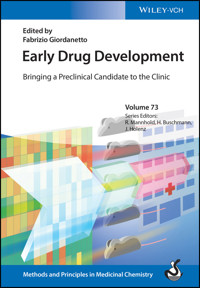
Early Drug Development E-Book
282,99 €
Mehr erfahren.
- Herausgeber: Wiley-VCH Verlag GmbH & Co. KGaA
- Kategorie: Wissenschaft und neue Technologien
- Serie: Methods and Principles in Medicinal Chemistry
- Sprache: Englisch
This one-stop reference systematically covers key aspects in early drug development that are directly relevant to the discovery phase and are required for first-in-human studies.
Its broad scope brings together critical knowledge from many disciplines, ranging from process technology to pharmacology to intellectual property issues.
After introducing the overall early development workflow, the critical steps of early drug development are described in a sequential and enabling order: the availability of the drug substance and that of the drug product, the prediction of pharmacokinetics and -dynamics, as well as that of drug safety. The final section focuses on intellectual property aspects during early clinical development. The emphasis throughout is on recent case studies to exemplify salient points, resulting in an abundance of practice-oriented information that is usually not available from other sources.
Aimed at medicinal chemists in industry as well as academia, this invaluable reference enables readers to understand and navigate the challenges in developing clinical candidate molecules that can be successfully used in phase one clinical trials.
Sie lesen das E-Book in den Legimi-Apps auf:
Seitenzahl: 1546
Veröffentlichungsjahr: 2018
Ähnliche




















Table of Contents
Cover
Dedication
Preface
References
A Personal Foreword
A Personal Foreword
Chapter 1: Early Drug Development: Progressing a Candidate Compound to the Clinics
References
Part I: Drug Substance
Chapter 2: Early Phase API Process Development Overview
2.1 Introduction
2.2 API Process Development Overview
2.3 The Transition from Discovery to Development
2.4 Process Development Organizational Construct
2.5 Process Development Equipment
2.6 Summary
References
Chapter 3: The Discovery/Development Transition
3.1 Introduction
3.2 Discovery‐to‐development Transition Before 1980
3.3 Discovery‐to‐development Transition in the 1980s
3.4 Discovery‐to‐development Transition in the 1990s
3.5 Present Practice at BMS
3.6 Application in Small Biotechnology Companies Today
3.7 Application in CROs
3.8 Conclusions
References
Chapter 4: Active Pharmaceutical Ingredient Cost of Goods: Discovery to Early Development
4.1 Introduction
4.2 Stages of Research
4.3 Synthetic Route Translatability and Scalability: Strategy
4.4 Raw Material Considerations
4.5 Continual Assessment of Alternative Routes and Technologies, Including Preparative Chromatography
4.6 Initial CoG Projections
4.7 CoG Versus Campaign Time Cycle
4.8 Synthetic Route Translatability and Scalability: Tactics
4.9 Preparing a CoG Estimate
4.10 Ancillary Expenses
4.11 Long‐Term Considerations
4.12 Summary
Acknowledgments
References
Chapter 5: New Technologies in Process Development
5.1 Introduction
5.2 Synthetic Biochemistry
5.3 Chemical Catalysis
5.4 Continuous Chemistry
5.5 Conclusion
Acknowledgments
References
Chapter 6: Vortioxetine and Early Drug Development Considerations at the Interface of R&D
6.1 Introduction
6.2 Synthesis of Vortioxetine
6.3 Metabolites of Vortioxetine
6.4 Conclusion
Nil Abbreviations
References
Chapter 7: Development of a Practical Synthesis of 4′‐Azido‐2′β‐Methyl‐2′‐Desoxycytosine and Its Prodrugs as HCV Chemotherapeutic Agents
7.1 Introduction
7.2 New Synthesis of (2′
R
)‐2′‐deoxy‐2′‐
C
‐methyl uridine (10)
7.3 Dehydration and Iodoazidation Steps
7.4 Functionalization at C‐4′
7.5 Synthesis of the API
7.6 Solid Form Selection
7.7 Process Safety
7.8 Impurity Strategy
7.9 Conclusion
References
Part II: Drug Product
Chapter 8: Solubility, Permeability, and Their Interplay
8.1 Introduction
8.2 Solubility
8.3 Permeability
8.4 The Solubility–Permeability Interplay
8.5 Summary
Nil List of Abbreviations
References
Chapter 9: Solid‐State Properties
9.1 Introduction
9.2 Amorphous and Crystalline States: Basic Concepts
9.3 Physical Properties of Drug Substance
9.4 Summary
Nil List of Abbreviations
References
Chapter 10: Salt and Cocrystal Screening
10.1 Introduction
10.2 Screening
10.3 Salt/Cocrystal Selection
10.4 Scale‐Up
10.5 Formulation Considerations
10.6 Regulatory Aspects
10.7 Case Studies
10.8 Summary
Nil List of Abbreviations
References
Chapter 11: Particle Size Reduction: From Microsizing to Nanosizing
11.1 Strategic Plans and Risk Management of Particle Size
11.2 Particle Size Reduction Techniques
11.3 Particle Size Analysis
11.4 Bioavailability and the Desired Particle Size
11.5 Enabling Formulation Approach by Particle Size Reduction in Early Drug Development
11.6 Benefits of Commercial Products Using Nanosized Crystalline Particles
11.7 Perspectives in Nanosizing Crystalline Particles
11.8 Conclusions
References
Chapter 12: Early Drug Development: From a Drug Candidate to the Clinic
12.1 Preclinical Formulation Selection
12.2 Formulation Selection for FiH
12.3 Conclusion
Acknowledgments
References
Chapter 13: A Practical Guide for the Preparation of Drug Nanosuspensions for Preclinical Studies: Including
In Vivo
Case Studies
13.1 Introduction
13.2 Selecting the Appropriate Type of Formulation Based on Compound Properties and Type of Study
13.3 Microsuspensions
13.4 Nanosuspensions
13.5 Manufacturing Methods
13.6 Additional Characterizations and Considerations Before
In Vivo
Dose Decisions and Administration Route Selection
13.7 Case Studies
13.8 Conclusions
References
Part III: Pharmacokinetics and Pharmacodynamics
Chapter 14: Integration of Pharmacokinetic and Pharmacodynamic Reasoning and Its Importance in Drug Discovery
14.1 Introduction
14.2 Understand Your Target Biology
14.3 Understand Your Concentration–Response Relationship and Time Delays
14.4 Understand Temporal Differences Between Concentration and Response
14.5 Understand Your Translational Context and Options
14.6 Communication Across Discovery Disciplines
14.7 Final Remarks
References
Chapter 15: Prediction of Human Pharmacokinetics and Pharmacodynamics
15.1 General Introduction
15.2 Predicting Human Pharmacokinetics
15.3 Predicting Human PKPD
15.4 Dose Predictions
15.5 Estimating and Conveying Uncertainty in PK and PKPD Predictions
15.6 Future Perspectives
References
Chapter 16: Translational Modeling and Simulation for Molecularly Targeted Small Molecule Anticancer Agents: Case Studies of Multiple Tyrosine Kinase Inhibitors, Crizotinib and Lorlatinib
16.1 Introduction
16.2 Translational Pharmacology in Oncology
16.3 Quantitative M&S Approach
16.4 Case Study: Crizotinib (PF02341066)
16.5 Case Study: Lorlatinib (PF06463922)
16.6 Closing Remarks
Acknowledgment
Nil List of Abbreviations
References
Chapter 17: Informing Decisions in Discovery and Early Development Research Through Quantitative and Translational Modeling
17.1 Introduction
17.2 Neuroscience: Prediction of the Clinically Efficacious Exposure and Dose Regimen for a Novel Target
17.3 Diabetes: Leveraging a Platform Approach for Two‐way Translation and Integration of Knowledge Between Clinical Lead and Backup Discovery Compounds
17.4 Antibacterials: Semi‐mechanistic Translational PK/PD Approach to Inform Optimal Dose Selection in Human Clinical Trials for Drug Combinations
17.5 Anti‐inflammation: Early Go/No‐Go Based on Differentiation Potential Compared with Competitors
17.6 Summary
Nil List of Abbreviations
References
Part IV: Toxicology
Chapter 18: Preclinical Toxicology Evaluation
18.1 Introduction
18.2 Conclusions
Nil List of Abbreviations
References
Chapter 19: Nonclinical Safety Pharmacology
19.1 Introduction
19.2 Historical Background
19.3 Regulatory Framework
19.4 Role in Discovery and Candidate Selection
19.5 Preparation for First‐in‐human Studies
19.6 Translation from Nonclinical Safety Pharmacology to the Clinic
19.7 Future Directions and Current Discussions
19.8 Summary
Nil List of Abbreviations
References
Chapter 20: Early Drug Development
20.1 Introduction
20.2 Predictive Toxicology
20.3 Predictive Modeling
20.4 Industry Perspectives
20.5 Regulatory Perspectives
20.6 Conclusion
Nil List of Abbreviations
References
Chapter 21: Addressing Genotoxicity Risk in Lead Optimization: A PDE10A Inhibitor Case Study
21.1 Introduction
21.2 Lead Optimization Project: Searching for PDE10A Inhibitors
21.3 Transcriptional Profiling to Capture Polypharmacology
21.4 High Content Imaging as an Independent Confirmation
21.5
In Vitro
Micronucleus Testing to Validate Transcriptional Signature
21.6 Data Integration
21.7 Hypothesis for a Potential Structure–Activity Relationship
21.8 Conclusion
Nil List of Abbreviations
References
Chapter 22: The Integrated Optimization of Safety and DMPK Properties Enabling Preclinical Development: A Case History with S1P
1
Agonists
22.1 Introduction to the S1P
1
Agonist Lead Optimization Program
22.2 Early Attention to Preclinical Safety
22.3 Aryl Hydrocarbon Receptor Activation Observed in Rat
22.4 CYP1A (Auto) Induction Observed in Non‐rodent Species
22.5 Introduction to the Biology and Function of the Aryl Hydrocarbon Receptor
22.6 Considerations of AhR Binding and CYP1A Induction on Compound Progression
22.7 Reacting to Data: Strategy Modification in Lead Optimization
22.8 Iterative Experimentation Identifies Molecules for Progression
22.9 Delivery of Human AhR Agonist Assay
22.10 Minimizing Cardiovascular Safety Risk Through S1P Receptor Selectivity
22.11 Positioning Dose as the Focus of Lead Optimization
22.12 Delivery of Multiple Candidates for Development
22.13 Conclusions
Acknowledgments
References
Chapter 23: From TRAIL to ONC201: Case Study on the Safety Benefit of Developing Targeted Agents Against Cancer‐selective Pathways
23.1 Introduction: Toxicity, a Reason Behind Failed Clinical Trials
23.2 Addressing Safety at the Onset: Targeting a Cancer‐specific Pathway
23.3 Maximizing Efficacy and Minimizing Toxicity at the Bench
23.4 Leveraging Preclinical Animal Studies to Predict Clinical Performance
23.5 Applying Lessons from
In Vitro
and
In Vivo
Studies to Clinical Trials
23.6 Summary
References
Part V: Intellectural Property
Chapter 24: Patent Law Relevant to Early Drug Development
24.1 Introduction
24.2 Overview of Patent Protection
24.3 Requirements for Patent Protection
24.4 Patent Infringement
24.5 Overview of Drug Development
24.6 Extending the Life of a Product
24.7 Summary
References
Chapter 25: Patent Protection Strategy
25.1 Benefits of Patent Protection
25.2 Requirements for Patentability
25.3 The Significance of a Patent Portfolio
25.4 Planning a Patent Portfolio
25.5 Timing of Patent Applications
25.6 Prosecution of Patent Applications
25.7 Extending Patent Coverage Through Additional Applications
25.8 Modifications to Issued Patents
25.9 Conclusion
Chapter 26: Intellectual Property: The Patent Landscape Viewed from Generic and Originator Perspectives
26.1 Introduction
26.2 Market Exclusivities That Protect Branded Drugs
26.3 The Patent Cliff
26.4 Paragraph IV Issues
26.5 Injunctions
26.6 The Generic Company's Goals
26.7 Strategies Adopted by Innovators
26.8 Strategies Adopted by Generic Companies
26.9 Conclusion
Chapter 27: Patent Considerations in Collaborative Drug Development
27.1 Introduction
27.2 What is Intellectual Property?
27.3 Before the Research Begins
27.4 After the Research Ends and the Patent Issues
27.5 Termination of the Relationship (Death and Divorce)
27.6 Conclusion
Nil List of Abbreviations
References
Index
End User License Agreement
List of Tables
Chapter 1
Table 1.1 Target product profile (TPP) example as an essential early drug development tool.
Chapter 3
Table 3.1 Time to the first dose in humans.
Table 3.2 Exclusivity times.
Table 3.3 Early development delay factors.
Table 3.4
FS
‐to‐
FIM
times.
Chapter 4
Table 4.1 CoG calculation, with variables.
Table 4.2 Costs of raw materials and chromatographies.
Table 4.3 Labor costs.
Table 4.4 CoGs for various scenarios.
Chapter 7
Table 7.1 Selected properties of different API solid forms.
Chapter 8
Table 8.1 Traditional definitions for estimating drug solubility.
Chapter 9
Table 9.1 Overview of marketed drug products using amorphous solid dispersions [51, 52].
Chapter 10
Table 10.1 Partial list of pharmaceutically acceptable counterions; coformers would be neutral counterparts.
Table 10.2 An example of maximum daily dose identified for counterions.
Table 10.3 Crystallization composition and processing variables.
Table 10.4 General guidelines for API properties.
Table 10.5 Form matrix for salt selection.
Table 10.6 Examples of salt selections.
Table 10.7 Cocrystal formulations reported for early development studies.
Table 10.8 Examples of process‐induced transformations of salts and cocrystals.
Table 10.9 Examples of commercial products containing different crystalline forms in a variety of dosage forms.
Chapter 11
Table 11.1 Particle size risk assessments for particle size on bioavailability of high and low solubility drugs (may be different based on specific new drug substance and corporate capabilities).
Table 11.2 Relevant guidelines for particle size sample preparation, data analysis, and types of products requiring particle size and/or particulate analysis.
Table 11.3 Particle size measurement and particulate detection techniques common in the pharmaceutical industry.
Table 11.4 Examples of particle size method questions and possible goals.
Table 11.5 Chronology of fenofibrate formulation development.
Table 11.6 Claimed sizes of fenestrations of the vasculature in different organs and selected pathological states.
Chapter 12
Table 12.1 Aims and formulation requirements of different preclinical studies.
Table 12.2 Example of the type of formulation characterization work conducted at the different stages of preclinical formulation development.
Table 12.3 Criteria used to calculate score for clinical performance of PIC formulations.
Table 12.4 Compound properties.
Table 12.5 Physiologically relevant solubility.
Table 12.6 Summary of Caco‐2 permeability data.
Chapter 13
Table 13.1 Scales of milling in Fritsch Planetary micro mill Pulverisette 7 classic line using beads of zirconium oxide.
Table 13.2 Solubility in different media. All measurements after 24 h, at 37 °C. The measurements were not performed with the fluorescence method described, but as described elsewhere [53, 54].
Table 13.3 Solubility in different vehicles. The measurements were not performed with the fluorescence method described, but with a common LC approach [54].
Chapter 14
Table 14.1 Comparison of half‐lives and rate‐limiting processes for two drug case studies.
Table 14.2 Comparisons of the basic distributional, turnover, and on/off‐binding response models with respect to the conceptual structure, parameters, auxiliary parameters, equations, baseline value, and determinants of pharmacodynamic steady state.
Table 14.3 Some typical features in response–time data interpreted by medicinal chemists, pharmacologists, and kineticists.
Chapter 15
Table 15.1 Physiological values from various animal species and humans to be used in the Øie–Tozer equation to predict the volume of distribution (
V
ss
).
Chapter 16
Table 16.1 Outlines of
in vivo
nonclinical tumor studies with crizotinib.
Table 16.2 PK parameter estimates of crizotinib in ALK
WT
– and MET– models.
Table 16.3 PKPD parameter estimates of crizotinib in ALK
WT
– and MET– models.
Table 16.4 PKDZ parameter estimates of crizotinib in ALK
WT
– and MET– models.
Table 16.5 Summary of crizotinib PK–PDDZ parameter estimates in ALK
WT
– and MET– models.
Table 16.6 Outlines of
in vivo
nonclinical tumor studies with lorlatinib.
Table 16.7 PK parameter estimates of lorlatinib in ALK
MT
– and ROS1– models.
Table 16.8 PKPD parameter estimates of lorlatinib in ALK
MT
– models.
Table 16.9 PKDZ parameter estimates of lorlatinib in ALK
MT
– and ROS1– models.
Chapter 17
Table 17.1 Summary of
in vitro
and
in vivo
data utilized in the semi‐mechanistic translational PK/PD model of MK‐7655.
Chapter 18
Table 18.1 A generic drug toxicity development program to support first‐time‐in‐man Phase I clinical studies.
Chapter 19
Table 19.1 Key elements of the core battery assessment (ICH S7A).
Table 19.2 Ventricular repolarization assessments (ICH S7B).
Table 19.3 Test parameters and domains for cerebral function evaluation.
Chapter 20
Table 20.1 Summary of representative performance metrics from testing computational toxicology predictive models applied to bacterial (
Salmonella typhimurium
) mutagenicity data sets to predict DNA‐reactive chemicals and drugs.
Table 20.2 Common statistical measures of performance for predictive computational toxicology classification models.
Table 20.3 Simple confusion matrix to describe the performance of a classification model.
Chapter 22
Table 22.1 The overall profile of exemplar molecules entering early safety studies.
Table 22.2 Comparison of the CYP1A1, CYP1A2 (rat), or CYP1A2 (human) induction observed across various
in vivo
and
in vitro
assay formats.
Table 22.3 The overall profile of
5
having optimal potency, receptor selectivity, PK, human dose, developability, and CYP1A properties suitable for further preclinical development.
Table 22.4 S1P Receptor selectivity comparing fingolimod with
5,
a novel compound from lead optimization.
List of Illustrations
Chapter 2
Figure 2.1 Typical API supply quantities and Process Development stages for a standard drug filing pathway.
Figure 2.2 Typical drug development timeline.
Figure 2.3 Process Development Organization and partner functions.
Figure 2.4 Evolution of equipment for process chemistry.
Chapter 3
Figure 3.1 Chemical structures of propranolol, 5,8‐dihydropropranolol, and Corgard.
Figure 3.2 Chemical structure of BMS‐911543. ()
Figure 3.3 Development route devised for BMS‐911543. ()
Figure 3.4 Process development timeline for BMS‐911543.
Figure 3.5 Schematic representation of the early discovery route and the optimized sequence used in development.
Chapter 4
Figure 4.1 Synthetic route focus by stage.
Figure 4.2 API drug substance cost of good attributes.
Figure 4.3 Cost of goods: iterative projections.
Figure 4.4 Cost of goods: iterative projections – front‐loading process safety.
Figure 4.5 CoG versus time cycle.
Scheme 4.1 Preparation of GSK1292263A.
Figure 4.6 Additional considerations contributing to CoGs.
Chapter 5
Scheme 5.1 Retrosynthetic steps involving some well‐known industrial biocatalytic steps. Enzyme acronyms: P450, cytochrome P450 monooxygenase; URDP, uridine phosphorylase; PNP, purine nucleoside phosphorylase; DERA, 2‐deoxyribose‐5‐phosphate aldolase.
Figure 5.1 Graph prepared from the CHEM21 EFPIA members portfolio review of synthetic routes to prepare active pharmaceutical ingredients (see footnote 1).
Scheme 5.2 Status of various biotransformations (not exhaustive).
Scheme 5.3 Transaminase‐catalyzed preparation of sitagliptin.
Scheme 5.4 Preparative scale IRED‐catalyzed reductive amination of hexan‐2‐one.
Scheme 5.5
In vitro
biohydroxylation of α‐isophorone using wt‐P450
BM3.
Scheme 5.6 Cyclopropanation reactions catalyzed by P450
BM3
lysates.
Scheme 5.7 CAR/ATA/IRED cascade for the preparation of chiral 2‐aryl piperidines.
Scheme 5.8 ω‐Transaminase/acyltransferase cascade for the conversion of aldehydes to amides.
Scheme 5.9 Example of hydrogen borrowing used in pharmaceutical synthesis.
Scheme 5.10 Amide formation by carbonylation in synthesis of lotrafiban.
Scheme 5.11 Typical classes of transition‐metal‐catalyzed C–C bond formation.
Scheme 5.12 Example of direct reductive coupling of an aryl with alkyl bromide.
Scheme 5.13 Further examples of catalytic C–C bond formation applied to pharmaceutical synthesis.
Scheme 5.14 Application of asymmetric hydrogenation with DKR in synthesis of MK‐3102.
Scheme 5.15 Application of catalytic oxidation to a Rosuvastatin precursor.
Scheme 5.16 Application of Chan–Lam coupling on 100 g scale.
Scheme 5.17 Use of asymmetric hydrogenation in synthesis of AZD2716.
Scheme 5.18 Original and improved routes to PDE4 inhibitor.
Scheme 5.19 Intramolecular C–H functionalizationin synthesis of BMS‐911543.
Scheme 5.20 Synthesis of intermediate
1
.
Scheme 5.21 Direct C–H activation using Xantphos as ligand.
Scheme 5.22 Synthesis of a nitrile intermediate in the synthesis of Doravirine.
Scheme 5.23 New conditions for synthesis of a nitrile intermediate in the synthesis of Doravirine.
Scheme 5.24 Synthesis of Elbasvir.
Scheme 5.25 Photocatalytic indoline dehydrogenation to access intermediate
12
.
Scheme 5.26 Microreactor generation of an unstable aryl lithium species.
Scheme 5.27 High temperature Diels–Alder reaction in flow.
Scheme 5.28 Application of flow to a biphasic alcohol oxidation reaction.
Scheme 5.29 Hydroformylation of a (
S
)‐naproxen intermediate.
Scheme 5.30 Use of sodium azide in flow.
Scheme 5.31 Photochemical ring opening of propellane.
Scheme 5.32 Generation and reaction of singlet oxygen in a continuous photoreactor in order to prepare an artemisinin intermediate.
Scheme 5.33 Debromination of a geminal dibromocyclopropane using a split electrochemical flow cell.
Scheme 5.34 Conversion of aldehydes to amides by anodic oxidation.
Scheme 5.35 Methoxylation of
N
‐pyrrolidine using a microelectrolysis flow cell.
Scheme 5.36 Access to five different APIs through alternative configuration of a chemical assembly system.
Scheme 5.37 Access to four different APIs through alternative configuration of a chemical assembly system.
Scheme 5.38 Continuous manufacture of Aliskiren hemifumarate.
Chapter 6
Figure 6.1 Structure of vortioxetine (
1
, Lu AA21004, Brintellix® or Trintellix®).
Figure 6.2 The three main synthesis strategies employed in the medicinal chemistry program leading to vortioxetine.
Scheme 6.1 Foundation of the iron‐mediated synthetic route.
Scheme 6.2 Preparation of vortioxetine using the iron‐mediated synthetic route on solid support.
Scheme 6.3 Synthesis of vortioxetine analog
1a
using parallel chemistry.
Scheme 6.4 Improved synthesis of vortioxetine analog
1a
using the mustard route.
Scheme 6.5 Initial version of the palladium‐mediated synthetic route.
Scheme 6.6 First synthesis of Boc‐protected vortioxetine via the palladium‐mediated synthetic route.
Scheme 6.7 Synthesis of vortioxetine via the “reversed” palladium‐mediated synthetic route.
Figure 6.3 Key building blocks for the palladium‐mediated synthetic strategy.
Scheme 6.8 Synthesis of
11
C‐ and
3
H/tritium (T)‐labeled vortioxetine.
Figure 6.4 Overview of metabolic pathways for vortioxetine.
Scheme 6.9 Synthesis of the proposed mono‐hydroxylated vortioxetine metabolite
29
.
Scheme 6.10 Synthesis of the actual mono‐hydroxylated vortioxetine metabolite
33
.
Scheme 6.11 Synthesis of major vortioxetine metabolite
24
or Lu AA34443.
Scheme 6.12 Synthesis of vortioxetine metabolite
25
.
Scheme 6.13 Failed attempt to synthesize hydroxylamine glucuronide
27
, via direct coupling of hydroxylamine
38
.
Scheme 6.14 Synthesis of
27
via a double reductive amination strategy.
Chapter 7
Figure 7.1 Targets of synthetic interest and a reasonable precursor (
1
).
Scheme 7.1 Original synthesis of (2′
R
)‐2′‐deoxy‐2′‐
C
‐methyl uridine
10
.
Scheme 7.2 Original synthesis of MV075379.
Scheme 7.3 Scalable synthesis of compound
10
.
Figure 7.2 Proposed structures of impurities in uridine protection.
Scheme 7.4 Diastereoselective reduction of compound
18
.
Scheme 7.5 5′‐Dehydration of compound
10
.
Scheme 7.6 Azidation/oxygenation sequence.
Scheme 7.7 Focus on the iodoazidation step.
Figure 7.3 Reference spectra in neat THF.
Scheme 7.8 Alternative azidation sequence via epoxide opening.
Scheme 7.9 Alternative synthesis of compound
24
.
Scheme 7.10 Overview of the end game.
Figure 7.4 Main API process impurities.
Chapter 8
Figure 8.1 The biopharmaceutics classification system as was developed.
Figure 8.2 The correlation between human fraction of dose absorbed (
F
abs
) and the effective permeability (
P
eff
) across the human jejunal membrane.
Figure 8.3 The different mechanisms for intestinal permeability. A, paracellular diffusion over tight junctions; B, transcellular simple passive diffusion; C, carrier‐mediated transcellular transport; D, carrier‐mediated efflux transport; and E, transcellular vesicular transport.
Figure 8.4 Illustration of the unstirred water layer (UWL) adjacent to the intestinal membrane.
Figure 8.5 Etoposide's theoretical (dashed line) and experimental (markers) permeability as a function of the solubility enhancement afforded by the formulation.
Chapter 9
Figure 9.1 Timescales of different crystallization methods used to screen for different physical forms.
Source
: Anderton (2004) [59]. Reproduced with permission of Russell Publishing Ltd.
Figure 9.2 Particle shape descriptors. ()
Figure 9.3 Microscopic images of (a) metformin HCl (as is); metformin HCl crystallized from (b) water, (c) formamide, (d) ethanol, (e) methanol, and (f)
n
‐propanol. ()
Chapter 10
Figure 10.1 Schematic of different crystalline forms. The red box indicates that polymorphs are possible for all the forms listed.
Figure 10.2 Screening strategies in early and late development.
Figure 10.3 Examples of homo‐ and heterosynthons.
Source
: Thakuria et al. 2013 [10]. Reproduced with permission of Elsevier.
Figure 10.4 Schematic diagram of high‐throughput screening.
Source
: Morissette et al. 2004 [21]. Reproduced with permission of Elsevier.
Figure 10.5 Example of a salt screening work flow.
Source
: Gross et al. 2007 [38]. Reproduced with permission of American Chemical Society.
Figure 10.6 Schematic representation of the pH solubility profile of a basic drug indicating that the solubilities may be expressed by two independent curves and that the point where two curves meet is the pH
max
. S
T
is the total solubility; BH
+
and B represent protonated (salt) and free base forms, respectively; the subscript “s” represents the saturation species.
Source
: Adapted from Serajuddin and Pudipeddi 2002 [77].
Figure 10.7 Example of a decision tree for salt/cocrystal selection.
Figure 10.8 (a) Phase diagram of caffeine–glutaric acid–acetonitrile in the temperature range of 10–35 °C; (b) ideal operational region in the phase diagram.
Source
: Adapted from Yu et al. 2010 and 2011 [89, 90].
Figure 10.9 Illustration of ternary phase diagram (API, active pharmaceutical ingredient; CCF, cocrystal conformer).
Source
: Aitipamula et al. 2014 [69]. Reproduced with permission of Royal Society of Chemistry.
Figure 10.10 Formulation processes used in solid oral dosage forms. Highlighted boxes indicate processes that could result in a form change for API or excipients.
Source
: Zhang et al. 2004 [127]. Reproduced with permission of Elsevier.
Chapter 11
Figure 11.1 Spherical equivalent diameters for spherical polystyrene beads (a) and microcrystalline cellulose (b).
Source
: DiMemmo et al. 2011 [18]. Reproduced with permission of Cambridge University Press.
Figure 11.2 Activities and decision points associated with particle size method development and validation.
Source
: Hubert et al. 2008 [19]. Reproduced with permission of American Pharmaceutical Review.
Figure 11.3 Case study for modeling with Bristol‐Myers Squibb Company compound A. (a) Surface response plot of simulated
C
max
change with respect to mean particle diameter and pH change. (b) Surface response plot with simulated AUC change with respect to mean particle diameter and pH change.
Source
: Mathias and Crison 2012 [33]. Reproduced with Permission of Springer.
Figure 11.4 SEM images of the reference batch and the most similar and dissimilar materials using particle size, particle morphology, and surface area as the critical factors: (a) Bx‐100 (API‐07) (reference batch); (b) Bx‐091 (API‐07) (similar batch); (c) Bx‐085 (API‐01) (similar batch); (d) Bx‐022 (API‐15) (least similar batch).
Source
: Ferreira et al. 2016 [34]. Reproduced with Permission of Springer.
Figure 11.5
In vivo
drug exposure of 5 μmol kg
−1
AC88 and BA99 nanosuspension ((a), black bar) and microsuspension ((b), gray bar). Three
in vivo
exposure metrics: (1) Maximum plasma concentration
C
max
(μmol l
−1
). (2) Area under the plasma concentration–time profile AUC(h × kg l
−1
)/dose. (3) Bioavailability (F) was determined by AUCoral/AUCiv F(%). Column charts was drawn based on original data.
Source
: Sigfridsson et al. 2011 [36]. Reproduced with the Permission of Taylor & Francis.
Chapter 12
Figure 12.1 An example of a solubilization technology application map linking formulation selection to API properties and resource required for development at the authors' lab.
Figure 12.2 Wet milling process for preparation of nanosuspension formulations at different volumes with the setup for the smaller volume (1–25 ml) shown on the left and larger volumes (50–2000 ml) shown on the right.
Figure 12.3 Factors to be considered prior to nomination for preclinical formulation work.
Figure 12.4 ASD profiles for free base and HCl salt forms of a drug candidate molecule.
Figure 12.5 Influence of permeability and gastric solubility on (a) clinically successful and (b) clinically unsuccessful PIC formulations.
Figure 12.6 Influence of permeability and intestinal solubility on (a) clinically successful and (b) clinically unsuccessful PIC formulations.
Figure 12.7 Depiction of dose numbers for PIC formulations – influence of permeability and the lowest gastrointestinal solubility measurement on (a) clinically successful and (b) clinically unsuccessful PIC formulations.
Figure 12.8 Comparison of compound T pharmacokinetic profiles for a tablet and PIC formulation.
Chapter 13
Figure 13.1 pH‐solubility profile for a simple salt (circles) of a weak basic (triangles) drug with an intrinsic solubility of 1 μM and a p
K
a
of 4.5 and where the salt form has a solubility of 1 mM. The line indicates the pH
max
, where the thermodynamic solubility of the drug is at its maximum. Below this pH the salt is the stable form and at higher pH the free base is stable.
Figure 13.2 Amorphous nanoparticles of felodipine show Ostwald ripening (filled triangles). With Miglyol present, the increase in particle size was inhibited (open circles).
Figure 13.3 Experimental results for the fraction of crystalline drug nanoparticles of felodipine versus time in dissolution experiments performed at 25 °C where milled crystalline nanoparticles are dissolved in pure water (filled circles) and in water/DMA 9/1 (v/v) (open circles). The total concentration of felodipine was 0.2 μM (water) and 2 μM (water/DMA). The solid lines are the results of theoretical predictions.
Source
: Adapted from Lindfors et al. 2007 [46]
Figure 13.4 The mean plasma concentration (±SEM) of the compound versus time after oral administration of the drug as crystalline microsuspensions (open circles) and as nanocrystals (filled triangles) to rats at 3 μmol kg
−1
(a), 30 μmol kg
−1
(b), and 300 μmol kg
−1
(c).
N
= 3 for each formulation.
Figure 13.5 (a) Aqueous solubility of ultrasonically crystallized nanoparticles of the compound, stabilized by DPPE‐PEG2000, (b) Aqueous solubility of amorphous nanoparticles of the drug in 1% DMA (v/v) at room temperature (drug/Miglyol/Pluronic L121 3 : 1 : 2, w/w/w). Pluronic was included to inhibit Ostwald ripening. Miglyol as the only additive did not inhibit particle growth. In this experiment the presented light scattering of the nanoparticles was background corrected for the light scattering from the inhibitors.
Figure 13.6 The amorphous particles of the compound increased in particle size without an Ostwald ripening inhibitor present (filled triangles). By including Miglyol/Pluronic L121, the particle growth was avoided (open circles).
Figure 13.7 The mean plasma concentration (±SEM) of the compound versus time after oral administration of 50 μmol kg
−1
drug as crystalline microsuspensions (filled squares), nanocrystals (open squares), and amorphous nanoparticles (open circles) to rats,
n
= 2. The two crystalline suspensions are superimposed.
Figure 13.8 The amorphous particles of the compound increased in particle size without an Ostwald ripening inhibitor present (filled triangles). By including Miglyol (open circles) or Miglyol/Pluronic L121 (open squares), the particle growth was avoided.
Figure 13.9 The mean plasma concentration (±SEM) of the compound versus time after oral administration of the drug as nanocrystals (open circles) and amorphous nanoparticles (filled triangles) to rats,
n
= 3. The administered dose was 100 μmol kg
−1
.
Chapter 14
Figure 14.1 Concentration–response–time relationships and how they may be utilized. (a, d) Available information about the
in vivo
pharmacokinetic parameters and dose are combined with, e.g.
in vitro
concentration–response (binding) parameters to simulate the
in vivo
response–time course prior to the execution of an
in vivo
study. (b, e) Acute concentration–time data are used to “drive” the response–time data in a kinetic/dynamic model. From the regression of acute
in vivo
response–time data, the equilibrium concentration–response is predicted. (c, f)
In vivo
response–time data are deconvoluted with an
in vivo
concentration–response model (or
in vitro
binding data) in order to obtain the exposure–time profile behind the response–time course.
Figure 14.2 Schematic presentation of data patterns from three data sets (Examples 1–3) of which the underlying mechanism of action is known (
known target biology
), and three (Examples 4–6) where the exact relation to target mechanism of action is less easy to pinpoint (
unknown target biology
) and therefore a mathematical description may suffice [4, 9].
C, R
,
S,
and
I
denote the drug concentration, the pharmacological response, and the symbols for stimulatory and inhibitory drug action, respectively. MM,
D
ip
, and irrev denote Michaelis–Menten loss, intraperitoneal dose, and irreversible action, respectively.
Figure 14.3 (a) Schematic illustration of the concentration–response relationship at equilibrium. (b) The pharmacodynamic model of drug action as stimulation of the production (turnover rate) or buildup of response. (c) Response–time courses that then show the onset, intensity, and duration of response as well as the peak shift with increasing doses. The time delay between concentration (red bar indicates time of maximum concentration in plasma) and response–time courses will manifest itself as a counterclockwise hysteresis plot (not shown). A peak shift is also seen in the response–time course with increasing doses.
Figure 14.4 (a) Schematic presentation of the
in vivo
concentration–response relationship. The red and blue double arrows depict the concentration intervals covered (graph b) and the corresponding response–time courses (graph c). (b) The red line curve demonstrates the concentration–time course and its relative position to the potency values (a low numerical value of EC
50
equals high potency; a high numerical value equals low potency). (c) The response–time courses corresponding to plasma exposure and potency is indicated in graph b. When potency (EC
50
) is 10, plasma exposure is insufficient to elicit a full response; in this case the response–time course by and large mimics the concentration–time course. For comparison, when plasma exposure exceeds the target potency (EC
50
= 0.1), the response–time course substantially differs from the shape of the concentration–time course [3].
Figure 14.5 Anti‐atherosclerotic effect of compound X across an exposure range covering more than three orders of magnitude. PD response readout dots represent single observations. The suggested anti‐atherosclerotic concentration falls within the 0.1–2 µM range.
Figure 14.6 Furosemide and schedule dependence. A single 120‐mg dose of furosemide results in less total (Na
+
‐)diuresis over 12 h than does three 40‐mg doses. The 40‐mg area under the effect curve AUC
e
= 600 mmol Na
+
/12 h; the 120‐mg AUC
e
= 430 mmol Na
+
/12 h.
Source
: Adapted from Wright et al. (2011) [19].
Figure 14.7 Unbound concentration vs free fraction of test compound X in mouse, gerbil, rat, guinea pig, rabbit, dog, and human plasma. Note the large interspecies differences at pharmacological concentrations (
C
u
< 0.1 µM), and the species‐dependent nonlinear increase in free fraction
f
u
with increasing unbound concentrations [3].
Figure 14.8 (a) Unbound (red line) concentration is equal in plasma,
C
up
, and tissue (biophase)
C
uT
at steady state due to simple diffusion. (b) Unbound concentration in plasma
C
up
is higher than in tissue
C
uT
due to different
sink
conditions in tissue such as transporters, clearance, irreversible binding, ionization (ion trapping), or bulk flows (CSF). (c) Unbound concentration in plasma
C
up
is lower than in the tissue biophase due to transporters or ionization.
Figure 14.9 (a, d) Schematic illustration of a situation with an instantaneous equilibrium between plasma concentration (red curve) and the pharmacological response (blue curve). The upper graph shows the concentration– and response–time courses which peak at the same time (➁ and ➂;
t
max
) together with two time points with the same exposure and response values, respectively (➀ and ➃). The corresponding lower graph shows the concentration–response relationship derived from the upper two time courses. Note that the rise in response when concentrations increase superimposes the decline in response when concentrations decrease. (b, e) This illustrates a small delay between concentration– and response–time curves, with a shift in their
t
max
values. Plotting the matching concentration–response relationship now results in a loop (hysteresis) for increasing and decreasing concentration–response values. (c, f) A substantial time delay is found between concentration– and response–time courses, carrying noticeably different
t
max
values and terminal slopes. The resultant lower plot also shows a large loop (large hysteresis) with the equilibrium concentration–response relationship occurring within the loop. The two time points with equal exposure (similar
C
p
; ➀ and ➁) demonstrate very different response values due to the time it takes for the pharmacological response to develop [3].
Figure 14.10 (a) Semilogarithmic plot of the concentration–time (red symbols) and suppression of response–time (blue symbols) courses after a 3‐h constant rate drug (Case Study PD21) [4] infusion. Drug action is by inhibition of the turnover rate (buildup) of response. (b) Clockwise concentration–response data from the left graph plotted in time order. Note the differences in the down and upswing of the hysteresis plot. Small gray arrows show the time order. The dotted gray line shows the equilibrium concentration–response relationship. The potency (concentration resulting in half‐maximal response, IC
50
, is approximately 30 nM) and efficacy (intensity, ∼90 response units) are also shown. Note that an initial (∼20–30 min) plasma concentration of 100 nM gives a mild suppression of the response (➀) because the onset of response lags after the rapid rise in the plasma concentration. At the same concentration but in the decay part of the exposure curve (➁), the response is much more suppressed. With a half‐life of 0.4 h for the response, 17 half‐lives (400 min) during which the response has developed will have elapsed at this stage. The response is at each time point a consequence of the prior history of drug exposure, not only total exposure but also the rise, fall, and duration of exposure.
Figure 14.11 (a) Body weight change in control (baseline), benchmark (red), and test compound A‐(magenta) and test compound B (blue)‐treated animals. Note the drift in baseline, the maximal weight gain (upper limit), and the maximum weight loss (lower limit). Drug treatment occurred between days 0 and 18. (b) Exposure vs time data of test compound B. Test compounds were given as a µmol kg
−1
body weight dose.
Figure 14.12 Schematic illustration of concentration vs time data. (a) Assuming data are only AUC
driven
gives the same effects in graph ➀ and different in graph ➁. Situation ➀ may work for strictly irreversible effects, but is questionable for reversible systems displaying saturation. Slowly developing pharmacological responses are often erroneously portrayed as being AUC
driven
. (b) Assuming data are only
C
max
driven
agrees with the differentiation in ➂ but creates a biologically implausible situation in graph ➃. Instances with a rapid equilibrium between plasma concentration and pharmacological response are often erroneously portrayed as being
C
max
driven
.
Figure 14.13 Illustration schematic depicting the iterative interdisciplinary collaboration work mode toward optimization and integration of drug pharmacokinetic and pharmacodynamic properties and a desired candidate drug profile.
Chapter 15
Figure 15.1 Illustration of the “regression‐offset” method for correcting CL
int,u
generated in human hepatocytes due to its systematic underprediction of
in vivo
CL. A regression correlates the measured CL
int,u
in hepatocytes to the observed CL
int,u
estimated from PK data in humans.
Source
: Sohlenius‐Sternbeck et al. 2012 [24]. Reproduced with permission of Taylor & Francis.
Figure 15.2 Prediction of renal clearance (CL
r
) using the KBF method, corrected for species differences in plasma protein binding (
f
u
) in rat (a) and dog (b).
Source
: Reproduced with the permission of Paine et al. 2011 [36].
Figure 15.3 Schematic illustration of a PKPD prediction model‐building framework. This captures both compound and system properties (upper panel) and the key quantitative relationships one should strive to establish, relating the level of efficacy to target engagement to drug concentration time profile (lower panel). The shaded areas in this hypothetical example illustrate the desired level of efficacy (lower panel, right) and how that translates to level of target engagement (lower panel, middle) and drug exposure (lower panel, left).
Figure 15.4 Schematic illustration of the wide range of target engagement required to elicit a meaningful pharmacological effect for different pharmacological target classes.
Figure 15.5 Illustration of the steady state (a) and temporal relationship (b) between PK and the target engagement that the PKPD model should quantify.
Figure 15.6 PKPD model diagram for the absorption and disposition of rHuEpo and its effects on reticulocytes (RET), red blood cells (RBC), and hemoglobin concentrations (Hb) (a). The model was developed in rodents and then translated to humans using a combination of allometry and known species differences in, e.g. cell life span and baseline values for blood cells. The humanized model was used to simulate the pharmacodynamic response to rHuEpo for reticulocytes (RET), red blood cells (RBC), and hemoglobin (HB) (b). Median (solid line) and 90% CI (shaded area) of predictions recapitulate well the observed data (filled circles).
Source
: Mager et al. 2009 [66]. Reproduced with permission of Elsevier.
Figure 15.7 Simulations showing the relationship between predicted daily dose (relative fold change) and the predicted CL in a case where the PKPD relationship suggests that the plasma concentration needs to be maintained over a minimal concentration,
C
e,min
, during the entire dosing interval. Two cases are presented here for an approximate fivefold range of predicted CL: A short half‐life compound ((a): midpoint half‐life estimate
ca
. 7 h) and a long half‐life compound ((b): midpoint estimate for the half‐life
ca
. 30 h). These simulations illustrate how the predicted daily dose can be very sensitive (almost exponentially related) to the predicted CL for the short half‐life compound but less so (close to linearly related) for a compound with a longer half‐life.
Figure 15.8 Examples of cumulative probability distributions of predicted daily doses from Monte Carlo simulations integrating uncertainty in the predicted individual PK and PKPD parameters. The panel (a) compares the predicted total daily dose for once daily, twice daily dosing, and an extended release (ER) formulation. The panel (b) illustrates the comparison between two competing molecules for once daily (UID) versus twice daily (BID) dosing. In both examples, the PKPD model suggested that concentration in plasma needed to be above a certain threshold.
Source
: Sundqvist et al. 2015 [54]. Reproduced with permission of John Wiley and Sons.
Chapter 16
Figure 16.1 Two key aspects for translational understanding of pharmacokinetic–pharmacodynamic‐disease relationships from nonclinical models to the clinic. MTAs, molecularly targeted agent; PK–PDDZ, pharmacokinetics–pharmacodynamics‐disease.
Figure 16.2 Main work stream of quantitative modeling and simulation approaches to characterize
in vivo
pharmacokinetic–pharmacodynamic–disease relationships of molecularly targeted agents. MTAs, molecularly targeted agents; PKPD, pharmacokinetic–pharmacodynamic response; PKDZ, pharmacokinetic–disease response.
Figure 16.3 Observed and one‐compartment PK model‐fitted plasma concentrations of crizotinib in ALK
WT
– and MET– Models. The x‐axis represents the time after dosing in hours, and the y‐axis represents the observed crizotinib plasma concentrations (Obs) with the model‐fitted typical crizotinib plasma concentration–time courses (Pred) in nanograms per milliliter on a logarithmic scale in ALK– and MET– studies.
Figure 16.4 Observed and model‐fitted ALK and MET inhibition by crizotinib in ALK
WT
– and MET–models. The x‐axis represents the time after dosing in hours, the left side of the y‐axis represents the model‐fitted typical crizotinib concentrations in plasma (Cp Pred) and the effect compartment (Ce Pred) in nanograms per milliliter on a logarithmic scale, and the right side of y‐axis represents the observed and model‐fitted typical PD responses (PD Obs and PD Pred, respectively) in the ratio to the mean value of control animal data in ALK– and MET– studies.
Figure 16.5 Observed tumor volumes and model‐fitted TGI curves by crizotinib in ALK
WT
– and MET– models. The x‐axis represents the treatment period in days, and the y‐axis represents the observed individual tumor volumes (Obs) with the model‐fitted typical tumor growth curves (Pred) in cubic millimeters in ALK (A)– and MET (B)– studies.
Figure 16.6 Comparison of crizotinib exposure–response curves for target modulation and TGI in ALK
WT
– and MET– models. Crizotinib exposure–response curves for target modulation (ALK and MET) and tumor growth inhibition (TGI) were simulated at the concentration range of 1–1000 ng ml
−1
with sigmoidal
E
max
model using the estimated PK–PDDZ parameters (EC
50
,
E
max
, and
γ
) obtained from ALK (a)– and MET (b)– studies. The
x
‐axis represents the plasma concentration of crizotinib in nanograms per milliliter on a logarithmic scale, and the
y
‐axis represents the ratios of PD responses from 0 to 1, i.e. target modulation (ALK and MET inhibition) and tumor growth inhibition
Figure 16.7 Summary of quantitative characterization of crizotinib PK–PDDZ modeling for target modulation and antitumor efficacy in ALK
WT
– and MET– models.
C
p
, plasma concentration;
t
, time after dosing;
C
e
, effect‐site concentration;
T,
tumor volume.
Figure 16.8 Prediction of crizotinib‐mediated ALK and MET inhibition in patients following oral administration of crizotinib at the doses of 250 mg twice daily. Crizotinib‐mediated ALK (a) and MET (b) inhibition in patients following 14‐day multiple‐dose oral administration of crizotinib at the clinically recommended doses of 250 mg twice daily were simulated by the link model with the estimated PD parameters obtained from nonclinical ALK– and MET– studies
Figure 16.9 Observed and one‐compartment PK model‐fitted plasma concentrations of lorlatinib in ALK
MT
– models. The
x
‐axis represents the time after dosing in hours, and the
y
‐axis represents the observed lorlatinib plasma concentrations (Obs) with the model‐fitted typical plasma concentration–time courses (Pred) in nanograms per milliliter on a logarithmic scale.
Figure 16.10 Observed and model‐fitted ALK inhibition by lorlatinib in ALK
MT
– models. The x‐axis represents the time after dosing in hours, the left side of the
y
‐axis represents the observed and model‐fitted typical PD responses (PD Obs and PD Pred, respectively) in the ratio to the mean value of control animal data, and the right side of
y
‐axis represents the model‐fitted typical plasma concentrations of lorlatinib (Cp Pred) in nanograms per milliliter on a logarithmic scale.
Figure 16.11 Observed tumor volumes and model‐fitted TGI curves by lorlatinib in ALK
M
– and ROS1– models. The x‐axis represents the treatment period in days, and the
y
‐axis represents the observed individual tumor volumes (Obs) with the model‐fitted typical tumor growth curves (Pred) in cubic millimeters in ALK (a)‐ and ROS1 (b)‐studies.
Figure 16.12 Comparison of lorlatinib exposure–response curves for target modulation and TGI in ALK
MT
– and ROS1– models. Lorlatinib exposure–response curves for ALK inhibition and tumor growth inhibition (TGI) were simulated at the concentration range of 0.01–10 000 ng ml
−1
with sigmoidal
E
max
model using the estimated PK–PDDZ parameters (EC
50
,
E
max
. and
γ
) obtained from ALK (a)‐ and MET (b)‐studies. The
x
‐axis represents the plasma concentration in nanograms per milliliter on a logarithmic scale, the left side of the
y
‐axis represents the tumor growth inhibition from 0% to 120%, and the right side of y‐axis in represents the ALK inhibition from 0% to 100% in ALK‐models.
Figure 16.13 Summary of quantitative characterization of lorlatinib PK–PDDZ modeling for target modulation and antitumor efficacy in ALK
MT
–models.
Figure 16.14 Main work stream to make a Go/No‐Go decision based upon PK–PDDZ understanding in nonclinical studies to increase confidence in drug and target in the clinic.
Chapter 17
Figure 17.1 Key application areas in which translational PK/PD can be applied in discovery and clinical development. The colored blocks indicate the different phases in which addressing these key questions is most likely to be impactful.
Figure 17.2 The translational biomarker scheme representing an overview and mapping of potential biomarkers and assays that can be used to establish PK/PD relationships of a target of interest within a single species and the opportunities for translation across species. This particular scheme shows the availability of assays and data relevant for translational modeling for MK‐1. In the nonhuman primate (NHP), data was generated for MK‐1 and standards of care; data in human was collected for standards of care alone. More generally, this translational biomarker scheme facilitates transparent communication of the perceived translational opportunities and knowledge gaps within a discovery program and promotes alignment on objectives when developing translational modeling plans.
Figure 17.3 Schematic representation of the translational PK/PD framework for MK‐1.
Figure 17.4 Concentration versus receptor occupancy relationship for MK‐1. The red solid line represents the predicted PK–TE profile of MK‐1 in humans using the developed translational modeling framework. The shaded area indicates the 90% confidence interval of the predicted curve calculated from the experimental uncertainty. The blue circles are the actual observed TE data in human, and the blue solid line is the modeled PK–TE profile using Equation 17.1. The dashed line identifies the target occupancy of MK‐1 that is hypothesized to be clinically effective.
Figure 17.5 Predicted human MK‐1 dose versus TE relationship including an explicit expression of modeling uncertainties (shaded area). These simulations graphically show the likelihood of a specific dose of MK‐1 to achieve the desired level of target occupancy hypothesized to be clinically effective.
Figure 17.6 Schematic representation of the translational integrated glucose–insulin model for GPR40 agonists.
Figure 17.7 Illustration of data incorporated in the translational analysis, including PK and temporal GK rat glucose and insulin data from a typical PK/PD study (a), human glucose and insulin data for TAK‐875 (b) [34], and the IVIVC developed to predict
in vivo
EC
50
driving insulin secretion from the
in vitro
IP1 assay EC
50
values across different compounds (middle bottom). The panel at middle top illustrates graphically how the IVIVC is used in the model to relate how increasing plasma drug concentration further enhances glucose‐dependent insulin secretion.
Figure 17.8
(
a) Simulation by the modified IGI model of the relationship between the dose of GPR40 agonist MK‐8666 and the reduction in fasting glucose after two weeks of dosing in diabetes type 2 patients. The solid line represents the mean predicted response and the shaded area the 90% confidence intervals. The black circles show the observed clinical results. (b) Simulations of potential candidates in a similar two‐week proof‐of‐concept study, with reference simulated glucose levels for 150 and 300 mg MK‐8666 shown in light purple and dark blue, respectively, to capture the corresponding projected clinical dose range for the potential candidate molecules.
Figure 17.9 Schematic representation of the semi‐mechanistic PK/PD model structure describing antibacterial effects of the MK‐7655 and imipenem (IPM) combination.
Figure 17.10 Visual predictive check upon fitting the translational model to
in vitro
hollow fiber time–kill data of the MK‐7655 and imipenem (IPM) combination. The open circles are the observed data, the solid line represents the median predicted response, and the shaded area represents the 95% prediction intervals. CFU = colony forming unit.
Figure 17.11
In vivo
model‐based simulations of the bacterial growth–kill response by the MK‐7655 and IPM combination in mouse. The open circles are the observed data, the solid line represents the median predicted response, and the shaded area represents the 95% prediction intervals.
Figure 17.12 Clinical model‐based simulations of the dose–response relationship of MK‐7655 24 h after administration. The solid reference line indicates static growth, and the dashed reference line indicates a one hundred‐fold reduction in CFU. A variety of
P. aeruginosa
strains were simulated including constitutive strains with MICs of 4–64 μg ml
−1
(a) and inducible strains with MICs of 4–64 μg ml
−1
(b).
Figure 17.13 (a) Effect sizes for doses 2 and 3 of MK‐2 from the MAD study, compared with the competitor Phase II data and the current SOC (dotted line). (b) The calculated likelihood that MK‐2 performs worse, similar, or better than either the comparator drug (left) or the SOC (right).
Chapter 18
Figure 18.1
The relation between clinical development stages and nonclinical safety activities
. To enable First Time In Man (FTIM) clinical trials, repeat dose, safety pharmacology and genetic toxicity studies are needed. The duration and timing of the toxicology studies should consider the clinical phases. Human metabolite assessments are needed to ensure the appropriateness of toxicology species, carcinogenicity assessment and reprotoxicity potential. Juvenile toxicity studies may be needed depending on the indication, the toxicological profile and the target ages of paediatric patients. Approval of the drug product may be contingent on post‐approval studies. Throughout development and the product life cycle, additional toxicological support is needed to address emerging impurities.
Chapter 19
Figure 19.1 Temporal relationship between surface ECG and cardiac action potential. Reducing repolarization of the cardiac action potential by inhibiting the
I
kr
current results in an increase in the action potential duration (APD), which, in turn, increases the surface ECG QT interval.
Chapter 21
Figure 21.1 1,3‐Alkoxy‐pyrrolidines substituted with different heteroaromatic ring systems: Q
1
is (substituted) benzofuran, phenyl, quinoxaline, pyridine, quinoline, or pyrazine. Q
2
is (substituted) quinazoline, quinoline, imidazopyridazine, or triazolopyridine.
Figure 21.2 Exploratory analysis of transcriptional effects of all quality filtered informative genes induced by 58 compounds. (a) Spectral map analysis showing on the
y
‐axis a clustering of four compounds based on a subset of tubulin genes indicated in red. (b) Gene profile plot of the tubulin genes together with a summarization of the tubulin genes at the bottom. The summarization reduces the random noise and clearly shows a subgroup of four compounds downregulating the tubulin genes. DMSO samples are indicated in red.
Figure 21.3 Boxplot of the fold changes of all quality filtered informative genes in four different cell lines for compound 8148 with tubulin genes colored in red. The tubulin genes are in general among the most downregulated genes.
Figure 21.4 High content images of U2OS cells expressing an endogenous green fluorescent TUBA1B at 8 h. (a) Nocodazole, an aneugenic MNT positive compound, showing microtubule aggregate formation at a concentration of 25 μM. (b) DMSO controls do not show the typical microtubule aggregates. (c) Compound 8148, showing tubulin downregulation, shows aggregate formation at 10 μM. (d) Compound 0558, within the same chemotype as 8148 showing neither tubulin downregulation nor aggregate formation at none of the concentrations (picture at 30 nM).
Figure 21.5 Scatterplot of the maximum microtubule aggregate score, summarizing three features, observed across the different concentrations at time point 8 h versus the summarization of the quality filtered informative tubulin genes. Only a subset of compounds, the ones profiled in high content imaging, was used to calculate the summarization score of the tubulin genes. A positive microtubule aggregate score corresponds with microtubule aggregate formation. The four compounds downregulating tubulins also show microtubule aggregate formation.
Figure 21.6 Concentration profile plot of the microtubule aggregate score at 8 h for six compounds (vinblastine, colchicine, nocodazole, 4735, 8148, and 0558) indicated with different colors. The concentration at which the image is shown in Figure 21.4 is indicated with the corresponding letter.
Figure 21.7 Scatterplot of the maximum microtubule aggregate score observed across the different concentrations at time point 8 h versus the percentage increase in cell count over 23 h at the corresponding concentration. A positive microtubule aggregate score suggests formation of microtubule aggregates. The horizontal line indicates the minimum increase in cell count over the replicates of the DMSO controls, whereas the average increase in cell count is plotted for DMSO.
Figure 21.8 Micronucleated TK6 cells induced by (a) clastogen mitomycin C and (b) compound 8148 that clearly show formation of large‐sized micronuclei, suggesting an aneugenic mode of action.
Figure 21.9 Ordered Zhang scores of all instances in CMAP based on the tubulin signature of compound 8148. A positive score indicates a similar ranking of the tubulin genes. The top scores of the three reference compounds present in CMAP (vinblastine, nocodazole, and colchicine) are indicated with red dots and annotated.
Figure 21.10 New compounds were synthesized in the quinazoline series, without substitution at R
2
and R
3
and small or electron‐with‐drawing groups at R
1
.
Figure 21.11 Gene expression profiles of all quality filtered informative tubulin genes for a new transcriptional experiment including the newly synthesized compounds, reference compounds, and some positives (colored green) and negatives (colored orange) from earlier profiling experiment. DMSO samples are indicated in red, and their variation is indicated with gray bars. The three compounds, indicated with gray vertical bars, showing different levels of tubulin downregulation are subsequently tested in MNT.
Chapter 22
Figure 22.1 Structure of
f
ingolimod (FTY‐720) and FTY‐720 phosphate.
Figure 22.2 Core elements of the screening cascade for the design and selection of S1P
1
agonists.
Figure 22.3 Upregulation of genes associated with the AhR gene panel for
2, 3
, and
4
following 7‐day oral administration to rats. The response to prototypical inducers β‐naphthoflavone (BNF) and 3‐methylcholanthrene (3MC) after 4‐day administration is included for reference. Cyp: cytochrome P450. NQO1: NAD(P)H quinone oxidoreductase. Ephx1: epoxide hydrolase.
Figure 22.4 The relationship between systemic exposure (AUC) and hepatic CYP1A1 mRNA induction for compounds 2 (squares), 3 (diamonds), and 4 (triangles) following 7‐day oral administration to the rat. Daily doses were 30 and 100 mg kg
−1
for 2 and 30 and 100 and 300 mg kg
−1
for 3 and 4, respectively. The figure illustrates the alignment of a relationship when the AUC is adjusted to represent the unbound exposure (open shapes) compared with the total exposure (closed shapes).
Figure 22.5 Compound
2
is an auto‐inducer in cynomolgus monkeys. Toxicokinetic data (exposure, as area under the curve and Cmax) for
2
on days 1 and 7 following oral dosing at 30 mg kg
−1
day
−1
to monkeys.
Figure 22.6 Upregulation of hepatic CYP1A1 and CYP1A2 mRNA in cynomolgus monkeys by
2
following 7‐day oral dosing at 30 mg kg
−1
.
Figure 22.7 The relationship between unbound systemic exposure (AUC) and hepatic CYP1A1 mRNA for the inducers
2
(squares),
3
(diamonds),
4
(triangles) and the non‐inducer
5
(circles) following 7‐day administration to the rat. Daily oral doses were 1, 30, 100, and 300 mg kg
−1
for
5
and as previously stated for
2–4
.
Figure 22.8 Structures of compounds
6–21
progressed to the 4‐day rat
in vivo
induction assay. THIQ: Tetrahydroisoquinoline.
Figure 22.9 Summary of the upregulation of CYP1A1 and CYP1A2 mRNA following 4–7‐daily oral administrations of various S1P
1
agonists to the rat. The shaded area represents the boundaries of compounds considered non‐inducers at a given dose. The compounds are colored by template: THIQ (red), aza‐THIQ (pink), indazoles (yellow), benzazepines (blue), and benzoxazepines (green), and shaped by class: acid (square), amine (circle), and zwitterions (diamond).
Figure 22.10 Consistent exposure (as shown by dose‐normalized AUC) was observed with all compounds throughout the 4‐day rat induction study, indicating the absence of auto‐induction in the rat.
Figure 22.11 Examples of reported AhR agonists of a planar hydrophobic nature. TCDD,
22,
and BNF,
23
.
Figure 22.12 Crystallographic data for
5
(a) and
3
(b) illustrating the dihedral angles.
Figure 22.13 Data comparison for 15 S1P
1
agonists comparing agonist activity in the human AhR reporter gene assay and the rat
in vivo
. The compounds are colored by template and symbols separated for clarity: THIQ (red), indazoles (yellow), benzazepines (blue), and benzoxazepines (green), and shaped by class: acid (square), amine (circle), and zwitterions (diamond).
Figure 22.14 The absence of bradycardia in telemetered rats with
5
at 1, 30, or 100 mg kg
−1
compared with
1a (
FTY720).
Chapter 23
Figure 23.1
Schematic diagram of the TRAIL signaling pathway leading to cell death
. TRAIL receptor trimerization occurs upon pathway engagement leading to caspase activation. The diagram depicts the potential for signal amplification with cross talk between the extrinsic and intrinsic pathways of cell death, and negative regulation of cell death by anti‐apoptotic molecules.
Figure 23.2 Chemical structures of some initial TRAIL‐inducing compounds identified in phenotypic screen.
Figure 23.3 Early experience with TRAIL‐inducing compounds and path toward further development of ONC201.
Chapter 26
Figure 26.1 Patentable subject matter in a new drug portfolio.
Figure 26.2 Relationship between time of filing and scope of claim for a new drug patent portfolio.
Chapter 27
Figure 27.1 Prior art: Previous toy design.
Figure 27.2 Modified toy design of invention.
Guide
Cover
Table of Contents
Begin Reading
Pages
C1
vi
vi
xv
xvi
xvii
xix
xx
xix
xx
1
2
3
4
5
6
7
8
9
11
12
13
14
15
16
17
18
19
20
21
22
23
24
25
26
27
28
29
30
31
32
33
34
35
36
37
38
39
40
41
42
43
44
45
46
47
48
49
50
51
52
53
54
55
56
57
58
59
60
61
62
63
64
65
66
67
68
69
70
71
72
73
74
75
76
77
78
79
80
81
82
83
84
85
86
87
88
89
90
91
92
93
94
95
96
97
99
100
101
102
103
104
105
106
107
108
109
110
111
112
113
114
115
116
117
118
119
120
121
122
123
125
126
127
128
129
130
131
132
133
134
136
137
138
139
140
141
142
143
144
145
146
147
148
149
150
151
152
153
154
155
156
157
158
159
160
161
162
163
164
165
166
167
169
171
172
173
174
175
176
177
178
179
180
181
182
183
184
185
186
187
188
189
190
191
192
193
194
195
196
197
198
199
200
201
203
204
205
206
207
208
209
210
211
212
213
214
215
216
217
218
219
220
221
222
223
224
225
226
227
229
230
231
232
233
234
235
236
237
238
239
240
241
242
243
244
246
247
248
249
250
251
252
253
254
255
256
257
258
259
260
261
262
263
264
265
266
267
268
269
270
271
272
273
274
275
276
277
278
279
280
281
282
283
284
285
286
287
288
289
290
291
292
293
294
295
296
297
298
299
300
301
302
303
304
305
306
307
308
309
310
311
312
313
314
315
316
317
318
319
320
321
322
323
324
325
326
327
328
329
330
331
333
334
335
336
337
338
339
340
341
342
343
344
345
346
347
348
349
350
351
352
353
354
355
356
357
358
359
360
361
362
363
364
365
367
368
369
370
371
372
373
374
376
377
378
379
380
381
382
384
385
386
387
388
389
390
391
392
393
394
395
396
397
398
399
400
401
402
403
404
405
406
407
408
409
410
411
412
413
414
415
416
417
418
419
420
421
422
423
424
425
426
427
428
429
430
431
433
434
435
436
437
438
439
440
441
442
443
444
445
446
447
448
449
450
451
452
453
454
455
456
457
458
459
460
461
462
463
464
465
466
467
468
469
470
471
472
473
474
475
476
477
478
479
480
482
483
484
485
486
487
488
489
490
491
492
493
494
495
496
497
499
500
501
502
503
504
505
506
507
508
509
510
511
512
513
514
515
516
517
518
519
520
521
522
523
524
525
526
527
528
529
530
531
532
533
534
535
536
537
538
539
540
541
542
543
544
545
546
547
549
550
551
552
553
554
555
556
557
558
559
560
561
562
563
564
565
566
567
568
569
570
571
572
573
574
575
576
577
578
579
581
582
583
584
585
586
587
588
589
590
591
592
593
594
595
596
597
598
599
600
601
603
604
605
606
607
608
609
610
611
612
613
614
615
616
617
618
619
620
621
622
623
624
625
626
627
628
629
630
631
632
633
634
635
636
637
638
639
640
641
642
643
644
645
647
649
650
651
652
653
654
655
656
657
658
659
660
661
662
663
664
665
666
667
668
669
670
671
672
673
674
675
676
677
678
679
680
681
682
683
684
685
686
687
688
689
691
692
693
694
695
696
697
698
699
700
701
702
703
704
705
706
707
708
709
710
711
712
713
714
715
716
717
718
719
721
722
723
724
725
726
727
728
729
730
731
732
733
734
735
736
737
738
739
740
741
742
743
744
745
746
747
749
750
751
752
753
754
755
756
757
758
759
760
761
762
763
764
765




