


20,99 €
Mehr erfahren.
- Herausgeber: Editions de l'Université de Bruxelles
- Kategorie: Bildung
- Sprache: Englisch
In recent decades, new paradigms have radically altered the historical understanding of the Qur'ān and Early Islam, causing much debate and controversy. This volume gathers select proceedings from the first conference of the Early Islamic Studies Seminar.
These studies explore the history of the Qur'ān and of formative Islam, with the methodological tools set forth in Biblical, New Testament and Apocryphal studies, as well as the approaches used in the study of Second Temple Judaism, Christian and Rabbinic origins. It thereby contributes to the interdisciplinary study of formative Islam as part and parcel of the religious landscape of Late Antiquity.
Das E-Book können Sie in Legimi-Apps oder einer beliebigen App lesen, die das folgende Format unterstützen:
Veröffentlichungsjahr: 2023
Ähnliche










Problèmes d’histoire des religions Problems in Religious Studies
Series edited by Guillaume Dye
An internationally renowned scientific journal, the Problèmes d’histoire des religions/Problems in Religious History currently appears in the form of thematic issues.In keeping with the research and teaching produced at the Université Libre de Bruxelles, this publication presents a non-confessional approach to religions from a pluridisciplinary perspective (history, philosophy, philology, anthropology, sociology…). It focuses on the religious phenomenon in its entirety, both through ancient and contemporary expressions, as through intellectual or popular ones. The journal concomitantly integrates, besides the domain of religious studies, the various forms of freethinking, secularism, and freemasonry.
Editorial Board
Christian Brouwer, Aude Busine, Baudouin Decharneux, Guillaume Dye, Sylvie Peperstraete, Fabrice Preyat, Jean-Philippe Schreiber, Cécile Vanderpelen-Diagre, Monique Weis, Jean Leclercq (Université catholique de Louvain), Philippe Swennen (Université de Liège).
International reading committee
Dominique Avon (École pratique des hautes études), Pierre-Yves Beaurepaire (Université de Nice), David Berliner (ULB), Patrick Cabanel (École pratique des hautes études), José Contel (Université Toulouse Jean Jaurès), Lambros Couloubaritsis (ULB et Académie royale de Belgique), Philippe Denis (UCL et Académie royale de Belgique), Jacques Ehrenfreund (Université de Lausanne), Frédéric Gugelot (Université de Reims et EHESS), John Tolan (Université de Nantes), Didier Viviers (ULB et Académie royale de Belgique).
Early Islam
The Sectarian Milieu of Late Antiquity ?
Early Islam
The Sectarian Milieu of Late Antiquity ?
Guillaume Dye (Ed.)
Éditions de l’Université de Bruxelles 2022
In the same series
Religion et tabou sexuel, éd. Jacques Marx, 1990
Apparitions et miracles, éd. Alain Dierkens, 1991
Le libéralisme religieux, éd. Alain Dierkens, 1992
Les courants antimaçonniques hier et aujourd’hui, éd. Alain Dierkens, 1993
Pluralisme religieux et laïcités dans l’Union européenne, éd. Alain Dierkens, 1994
Eugène Goblet d’Alviella, historien et franc-maçon, éd. Alain Dierkens, 1995
Le penseur, la violence, la religion, éd. Alain Dierkens, 1996
L’antimachiavélisme, de la Renaissance aux Lumières, éd. Alain Dierkens, 1997
L’intelligentsia européenne en mutation 1850-1875. Darwin, le
Syllabus
et leurs conséquences, éd. Alain Dierkens, 1998
Dimensions du sacré dans les littératures profanes, éd. Alain Dierkens, 1999
Le marquis de Gages (1739-1787). La franc-maçonnerie dans les Pays-Bas autrichiens, éd. Alain Dierkens, 2000
« Sectes » et « hérésies », de l’Antiquité à nos jours, éd. Alain Dierkens et Anne Morelli, 2002 (épuisé)
La sacralisation du pouvoir. Images et mises en scène, éd. Alain Dierkens et Jacques Marx, 2003
Maître Eckhart et Jan van Ruusbroec. Etudes sur la mystique « rhéno-flamande » (XIIIe-XIVe siècle), éd. Alain Dierkens et Benoît Beyer de Ryke, 2004
Mystique : la passion de l’Un, de l’Antiquité à nos jours, éd. Alain Dierkens et Benoît Beyer de Ryke, 2005 (épuisé)
Laïcité et sécularisation dans l’Union européenne, éd. Alain Dierkens et Jean-Philippe Schreiber, 2006
La croix et la bannière. L’écrivain catholique en francophonie (XVIIe-XXIe siècles), éd. Alain Dierkens, Frédéric Gugelot, Fabrice Preyat et Cécile Vanderpelen-Diagre, 2007
Topographie du sacré. L’emprise religieuse sur l’espace, éd. Alain Dierkens et Anne Morelli, 2008
La performance des images, éd. Alain Dierkens, Gil Bartholeyns et Thomas Golsenne, 2009
Art et religion, édité par Alain Dierkens, Sylvie Peperstraete et Cécile Vanderpelen-Diagre, 2010
Le blasphème : du péché au crime, édité par Alain Dierkens et Jean-Philippe Schreiber, 2012
Hérésies : une construction d’identités religieuses, édité par Christian Brouwer, Guillaume Dye et Anja van Rompaey, 2015
Animal et religion, édité par Sylvie Peperstraete, 2016
La Sainte Famille. Sexualité, filiation et parentalité dans l’Église catholique, édité par Cécile Vanderpelen-Diagre et Caroline Sägesser, 2017
Des saints et des martyrs. Hommage à Alain Dierkens, édité par Sylvie Peperstraete et Monique Weis
Les formes contemporaines de l’antimaçonnisme, édité par Jean-Philippe Schreiber, 2019
« Vous n’en mangerez point ». L’alimentation comme distinction religieuse, édité par Elena Mazzetto, 2020
Perspectives sur l’histoire du karaïsme / Perspectives on the History of Karaism, édité par Guillaume Dye, 2021
All volumes are available in open access on the platform “Digithèque de l’ULB” … and on our website (www.editions-ulb.be).
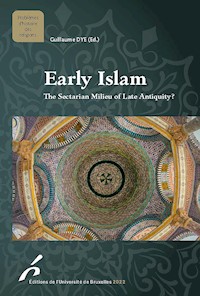
Cover : Dome of the Rock, Jerusalem.© iStock
ISBN 978-2-8004-1814-8eISBN 978-2-8004-1815-5ISSN 0778-6735 D/2023/0171/2 © 2023 by Éditions de l’Université de Bruxelles Avenue Paul Héger 26 - 1000 Brussels (Belgium)[email protected]
About the author
Guillaume Dye is professor of Islamic studies at the Université libre de Bruxelles, (ULB). His main field of research is Qur’anic and Early Islamic studies. Among his publications: M.A. Amir-Moezzi and G. Dye, eds, Le Coran des historiens, Paris, Éditions du Cerf, 2019, 3 vols (an updated and enlarged edition of the first volume, entitled Histoire du Coran. Contexte, origine, rédaction, has been published in 2022 by the same publisher); M. Bjerregaard Mortensen, G. Dye, I. W. Oliver, T. Tesei, eds, The Study of Islamic Origins. New Perspectives and Contexts, Berlin, de Gruyter, 2021; G. Dye, ed., Perspectives sur l’histoire du karaïsme/Perspectives on the History of Karaism, Bruxelles, Éditions de l’Université de Bruxelles, 2021.
About the book
In recent decades, new paradigms have radically altered the historical understanding of the Qur’ān and Early Islam, causing much debate and controversy. This volume gathers select proceedings from the first conference of the Early Islamic Studies Seminar. These studies explore the history of the Qur’ān and of formative Islam, with the methodological tools set forth in Biblical, New Testament and Apocryphal studies, as well as the approaches used in the study of Second Temple Judaism, Christian and Rabbinic origins. It thereby contributes to the interdisciplinary study of formative Islam as part and parcel of the religious landscape of Late Antiquity.
This eBook can be cited
This edition of the eBook can be cited. To enable this we have marked the start and end of a page. In cases where a word straddles a page break, the marker is placed inside the word at exactly the same position as in the physical book. This means that occasionally a word might be bifurcated by this marker.
Contents
Acknowledgements
Introduction□ Guillaume DYE
Method and Theory in the Study of Early Islam□ Stephen J. SHOEMAKER
Arabia and the Late Antique East□ Greg FISHER and Philip WOOD
Fallen Angels and the Afterlives of Enochic Traditions in Early Islam□ Annette Yoshiko REED
Cushions, Bottles and Roast Chickens! More Advertising about Paradise□ Gilles COURTIEU
The Seismic Qur’ān: On Collective Memory and Seismic Eschatology in the Qur’ān □ Thomas HOFFMANN
Dating Early Qur’anic Manuscripts: Reading the Objects, Their Texts and the Results of Their Material Analysis□ Alba FIDELI
Eschatology, Responsories and Rubrics in Eastern Christian Liturgies and in the Qur’ān: Some Preliminary Remarks□ Paul NEUENKIRCHEN
Conversion from Jewish and Christian Milieus to Islam and its Influence on the Formation of the Qur’ān□ Karl-Friedrich POHLMANN
The Qur’anic Mary and the Chronology of the Qur’ān □ Guillaume DYE
The Historical-Critical Study of Jewish, Christian, and Islamic Scriptures□ Isaac W. OLIVER
Christianity in the Arabian Peninsula and Possible Contexts for the Qur’ān □ Philip WOOD
History, Exegesis, Linguistics: A Preliminary, Multi-Discipline Approach to Ibn Hishām (d. c. 215/830) and al-?abarī (d. 310/923) on the Origins of Islam and the Qur’ān □ Ulrika MÅRTENSSON
List of contributors
← 6 | 7 →
Acknowledgements
The papers collected here were presented during the 4th Nangeroni meeting of the Enoch Seminar/Early Islamic Studies Seminar, entitled “Early Islam: The Sectarian Milieu of Late Antiquity?”, which took place at the Villa Cagnola, in Gazzada, near Milan, on 15-19 June 2015.
The conference was meant to foster dialogue between scholars from various backgrounds, and it followed the principles of the Enoch Seminars and the Nangeroni meetings, which are now famous among scholars working on Second Temple Judaism and Early Christianity. In short, papers were not read during the meeting, but pre-circulated among the about forty participants before the conference, where they were amply discussed. Most of the papers of the volume keep tracks of the lively and stimulating debates we experienced during this meeting, and I wish to thank all the participants for their energy and involvement, which made this event a huge success, from a scholarly and from a human point of view as well. Among the participants who did not write a paper for this volume, but whose comments and remarks during the meeting were particularly numerous and useful, I would like to single out Carlos Segovia, Manfred Kropp, David Powers, Jan Retsö, Anders Klostergaard Petersen, and Meira Polliack.
As chair of this conference, I greatly benefited from the help and advice of my co-chair Gabriele Boccaccini (University of Michigan), who is also the founder of the Enoch Seminar. My friend Carlos Segovia, who had already chaired a Nangeroni meeting and knows therefore the difficulties of the task, provided me with many relevant suggestions and advices, as did other members of the Board of Directors of the Early Islamic Studies Seminar, namely Manfred Kropp, Emilio González Ferrín and Tommaso Tesei. From a more practical point of view, the assistance of Rodney Caruthers (University of Michigan) in the organization of this meeting has been invaluable. Last but not least, I wish to thank the sponsorship of the Nangeroni Foundation, which has simply made such a conference possible.
In preparing this book, I also greatly benefited from the help and assistance of Julien Decharneux, whom I thank for his very attentive reading of the whole manuscript.
I would also like to thank Emilie Menz and all the team of the Éditions de l’Université de Bruxelles for their work and assistance during the last stages of the preparation of the book.
Guillaume Dye
Université libre de Bruxelles (ULB) ← 7 | 8 →
← 8 | 9 →
Introduction
□ Guillaume DYE
The following volume presents select proceedings from the first gathering of the Early Islamic Studies Seminar (EISS), which took place at the Villa Cagnola, in Gazzada, near Milan, on 15-19 June 2015.1 A few words about this institution might therefore be relevant.
The Early Islamic Studies Seminar is an emanation of, and is associated to, the Enoch Seminar: International Scholarship on Second Temple Judaism, Christian, Rabbinic, and Islamic Origins. Founded in 2001 by Gabriele Boccaccini (University of Michigan), the Enoch Seminar is an academic group of international specialists in Second Temple Judaism and Christian Origins, who share the results of their research and meet to discuss topics of common interest. The Early Islamic Studies Seminar works on the same basis (with, until the Covid crisis, a meeting every two years), except of course that its field of investigation is different: whereas the Enoch Seminar focuses on the period of Jewish history, culture and literature from the Babylonian Exile (598-537 BCE) to the Bar Kokhba revolt (132-135 CE), the Early Islamic Studies Seminar adopts a complementary approach and focuses on the period of Near Eastern and Mediterranean history which goes from the sixth century to the early/mid-tenth century. The formula “Early Islam” is thus only a convenient way to refer to the period ← 9 | 10 → which goes from Late Antiquity to, roughly, the time of al-Ṭabarī, which marks a decisive step in the shaping of Islamic identity.2
One of the main goals of the Enoch Seminar is to dismantle the misleading walls of separation that still divide its field of research, recovering the unity of the period, whose study offers an important contribution to the understanding of the common roots of Judaism, Christianity and Islam. Similarly, the Early Islamic Studies Seminar intends to eradicate arbitrary disciplinary borders, which have done so much damage to the study of Islamic origins, and to develop more innovative instruments and methods. In a word, the Early Islamic Studies Seminar aims to promote a renewed study of Early Islam as part of the complex process of religious identity formation in Late Antiquity, in close dialogue with scholars working on early Christianity, Rabbinic Judaism and other neighbouring fields of research, like Manichean, Iranian, Byzantine or Arabian studies. Qur’anic studies are thus only a part of the topics studied by the Early Islamic Studies Seminar, even if they are a central aspect of the project.
The genesis of this endeavor began in June 2013 in Brussels, during a meeting between Guillaume Dye and Carlos A. Segovia, who were soon joined by Emilio González Ferrín, Manfred Kropp, and Tommaso Tesei as board of directors to create the Early Islamic Studies Seminar (EISS). With the support of the Enoch Seminar, the EISS has since then organized three Nangeroni Meetings devoted to the Qur’ān and early Islam. In the inclusive spirit promoted by the Enoch Seminar, the EISS has accordingly invited to its meetings specialists in Qur’anic and Islamic studies as well as those who specialize in the Hebrew Bible, Second Temple Judaism, the New Testament, and other related fields.
Such an interdisciplinary gathering of scholars opens new paths and strengthens the dialogue between scholars of Early Islam and scholars from neighbouring disciplines, especially Jewish and Christian studies. This dialogue goes both ways. On one side, studies of Late Antique Jewish and Christian traditions (and other religious traditions, like Manichaeism, as well), which constitute the background of so many Qur’anic pericopes, are obviously essential for the study of Islamic origins: indeed, the Qur’ān is a literary, religious, historical and linguistic Near Eastern document of the seventh-early eighth century, whose main contents belong, or are related, to the “Biblical culture” of Late Antiquity. Therefore, it seems natural and relevant to study it using, with the relevant adaptations when necessary, the methods, tools, and concepts which have already been fruitfully applied to the study of similar religious movements.3 And since Jewish studies, Early Christian studies, Apocrypha and Pseudepigrapha studies, etc., have developed finer instruments than those generally used by traditional ← 10 | 11 → Islamicists in their study of the Qur’ān, we can hope that the expertise and experience of colleagues working in such fields will be a major asset for the Early Islamic Studies Seminar.
But on another side, the study of Early Islam is also a gold mine for Christian and Jewish studies, and more generally for the study of Late Antique and Medieval non-Muslim religious traditions. The sixth and seventh centuries were a crucial epoch in the history of Judaism and Christianity – a time of deep and fast changes, a period of transition from the religious landscape of Late Antiquity to a new one which, in the following centuries, entailed for Jews and Christians cohabitation with a new religion, Islam, which was in constant interaction, and even cross-pollination, with them. It means, in other words, that the relations between, on the one hand, pre-Islamic Christianity and Judaism, and on the other hand, Early and formative Islam, should be addressed from both sides. The title of the book – Early Islam: The Sectarian Milieu of Late Antiquity? – is therefore not only an homage to John Wansbrough;4 it also nicely encapsulates the idea that the genesis of Islam, as a historical and social phenomenon, is simply unintelligible when it is not addressed in its context, which is characterized by a mix of crosspollination, symbiosis, contest and polemics with the various religious traditions of Late Antiquity.
As said earlier, one of the goals of the Early Islamic Studies Seminar is to develop more effective tools for the study of the Qur’ān and Islamic origins. Such an agenda supposes some dissatisfaction with the way such studies have often been practiced, and the present volume seeks to renew the study of Early Islam in a way which is more consonant with the approaches, methods and tools of Second Temple Judaism and Early Christianity studies. This methodological agenda is sketched in Stephen J. Shoemaker’s contribution, “Method and Theory in the Study of Early Islam,” which shows why and how formative Islam should be fruitfully investigated using the well-established historical-critical approaches deployed in the study of Judaism and especially early Christianity. At the end of his paper, Shoemaker refers to post-colonial studies, and their focus on the way identity and difference are constructed and managed in an imperial context. This makes a nice transition to the next paper, by Greg Fisher and Philip Wood, entitled “Arabia and the Late Antique East.” Fisher and Wood afford a very useful synthesis of the history of Pre-Islamic Arabia, especially regarding its relations to its imperial neighbors, thus enlightening the historical context of the emergence of Islam.
Since the Early Islamic Studies Seminars and the Enoch Seminar are, in some way, siblings, it was relevant to invite Annette Reed to give the inaugural paper of our first Nangeroni meeting. Her article examines the afterlives, in Early Islam, of the Enochic traditions on the fallen angels, a topic whose study combines many methodological ← 11 | 12 → concerns we are sensitive to, like the importance of the longue durée, the relevance of the pseudepigrapha, the significance of angelology and demonology, or the attention to phenomena of crosspollination and symbiosis. The next paper, by Gilles Courtieu (“Cushions, Bottles and Roast Chickens! More Advertising about Paradise”) addresses a different topic – the Qur’anic description of Paradise. It shows how several of its aspects can be explained as a kind of transfert of elements which belong to the Sasanian empire’s high culture. Courtieu relies on a kind of source (sadly) seldom used by scholars in Qur’anic studies, namely material sources, including Sasanian silverware representing banquets. In his own paper (“The Seismic Qur’ān: On Collective Memory and Seismic Eschatology in the Qur’ān”), Thomas Hoffmann uses another original approach, and suggests, interestingly, that the Qur’anic discourse does not only refer to earthquakes when it describes seismic activity, but also to volcanic eruptions – a phenomenon well attested in Western Arabia.
The study of the most ancient witnesses of the Qur’anic text has become one of the crucial fields of Early Islamic studies. The issue of dating these Qur’anic fragments has especially attracted most attention these recent years. In “Dating Early Qur’anic Manuscripts: Reading the Objects, their Texts and the Results of their Material Analysis,” Alba Fedeli provides an excellent methodological survey and analysis of the merits and limits of the various methods which can be used for this task – especially C14. She convincingly shows that radiocarbon-based analyses cannot be divorced from the textual, artistic, codicological and paleographical analyses of the artifacts under scrutiny.
The next four papers explore, in different ways, the Christian background and context of the Qur’ān. Paul Neuenkirchen (“Eschatology, Responsories and Rubrics in Eastern Christian Liturgies and in the Qur’ān: Some Preliminary Remarks”) highlights striking parallels between Syriac liturgy and lectionaries and Qur’anic manuscripts. These pertain to similar scribal practices in the manuscripts themselves, as to similitudes in the liturgical lexicon and formulas. In other words, the Qur’ān seems indebted to Eastern Christian scribal techniques and to a certain form of Christian liturgy.
Karl-Friedrich Pohlmann’s chapter (“Conversion from Jewish and Christian Milieus to Islam and its Influence on the Formation of the Qur’ān”) might be considered as an English précis of his seminal book Die Entstehung des Korans: Neue Erkenntnisse aus Sicht der historisch-kritischen Bibelwissenschaft (Darmstadt: Wissenschaftliche Buchgesellschaft, 20153, 20121) – a book which, sadly, did not get the attention it deserves in the mainstream scholarship on the Qur’ān. Pohlmann argues persuasively that various Qur’anic passages point to a post-prophetic context, with Christian or Jewish literati putting their pens at the service of the new movement of the Believers in the composition of these texts. This approach is also pursued by Guillaume Dye in “The Qur’anic Mary and the Chronology of the Qur’ān”). Using the tools of redaction and source criticism, Dye, like Pohlmann, sees the Qur’ān as a layered text, and attempts to determine the relative chronology of the passages relative to Mary. He argues for the ← 12 | 13 → following chronology – Q 19:1-33 > Q 3:33-63 > Q 19:34-40 – and situates all these text in a post-conquest setting, more precisely in a Palestinian milieu, Q 19 being deeply indebted to the Jerusalem liturgical and popular Marian traditions, especially those of the Kathisma church.
The system of the Nangeroni meetings promotes debates; long papers are assigned a formal respondent, which sets the tone for the ensuing discussion during the meeting. Isaac Oliver, in his “The Historical-Critical Study of Jewish, Christian, and Islamic Scriptures,” provides a modified version of the response he gave to Guillaume Dye’s paper, promoting scholarly exchange – on thematic and methodological issues – between specialists working across fields as diverse as Second Temple Judaism, New Testament, early Christianity, early rabbinic literature, and early Islamic studies. Oliver also reflects on the question of historical-criticism by drawing from his own teaching experience in a non-confessional university in the United States. Similarly, Philip Wood (“Christianity in the Arabian Peninsula and possible contexts for the Qur’ān”) discusses the papers of Segovia,5 Pohlmann and Dye, and seeks to provide an answer to the following question: if we seek to situate the emergence of Christian Qur’anic communities, or at least the transmission of ‟Christian lore,” to what extent might this have been possible in sixth-century Arabia? He argues that several factors should increase the plausibility (though not provability) of greater Christian exposure to the Arabian Peninsula, but also notes that the different kinds of intra-Christian Qur’anic material may have developed in different Christian contexts.
The Early Islamic Studies Seminar and the Nangeroni meetings are meant as a place for debate, so that diversity of opinions and approaches should be welcome. We include therefore a dissenting voice, that of Ulrika Mårtensson. In her paper “History, Exegesis, Linguistics: A Preliminary, Multi-Discipline Approach to Ibn Hishām (d. c. 215/830) and al-Ṭabarī (d. 310/923) on the Origins of Islam and the Qur’ān,” she argues for a more traditional approach, finding in Ibn Hishām and al-Ṭabarī’s works the most valuable clues for understanding the emergence of Islam. It is to be hoped that the presence of such conflicting approaches in the same volume will stimulate a constructive discussion. ← 13 | 14 →
1The proceedings of the second and third meetings, which took place in Pratolino, near Florence, on June 12–16, 2017 and again in Gazzada, near Milan, on June 16–20, 2019, have been published in Mette BJERREGAARD MORTENSEN, Guillaume DYE, Isaac W. OLIVER, and Tommaso TESEI, eds, The Study of Islamic Origins. New Perspectives and Contexts, Berlin, De Gruyter, 2021.
2Incidentally, this period marks also the decline of apocalyptic hopes in Sunni Islam (Late ninth century) and Shi’i Islam (Late tenth century).
3It goes without saying that such an approach does not negate the Arab background of the Qur’ān – the real question is rather to assess its exact nature and range.
4See John WANSBROUGH, The Sectarian Milieu. Content and Composition of Islamic Salvation History, Oxford, Oxford University Press, 1978.
5Carlos A. Segovia’s paper at the meeting (“A Messianic Controversy Behind the Making of Muḥammad as the Last Prophet?”) is not included here, but updated parts of it can be found in Carlos A. SEGOVIA, The Quranic Jesus. A New Interpretation, Berlin, De Gruyter, 2018, esp. chapters 3 and 5.
← 13 | 14 →
← 14 | 15 →
Method and Theory in the Study of Early Islam
□ Stephen J. SHOEMAKER
It is no secret that method and theory have been relative latecomers to the study of early Islam. Only during the past few decades have we seen studies of Islamic origins comparable to the critical investigations of early Judaism and Christianity that have been underway for almost two centuries now. And these new perspectives have hardly been welcomed with open arms. The vitriol and lack of intellectual generosity that such approaches have often received – especially in the early years – is quite troubling to one trained initially in the field of early Christian studies, where diversity of opinions and approaches is celebrated. Yet despite some significant gains in these areas in recent years, it seems that an older Orientalist model of philological study and accommodation of traditional Islamic perspectives remains entrenched, even as such scholars themselves occasionally seek to brand more critical approaches instead with this scarlet “O” of Orientalism. To a certain extent, however, the prevalence of such traditional approaches is to be expected. In many respects the study of early Islam in the West is still in its infancy, at least when compared with Christian and Jewish origins. Major sources remain untranslated (or poorly translated), and accordingly the scholar of formative Islam must labor for years to obtain the necessary facility in Arabic, an endeavor which inures one to the joys of philology and also invites significant respect for the content of texts that has been obtained only through considerable toil.
Related to this problem is the institutional setting of early Islamic studies, which for generations has been situated in departments of Near Eastern Studies or Near Eastern Languages and Civilizations rather than Religious Studies. To a significant extent this isolation is largely the fault of Religious Studies itself, which in the past has not attended to Islam and especially early Islam with nearly the same interest shown for Judaism and Christianity, or even Buddhism and Indian religions. Indeed, ← 15 | 16 → many North American departments of Religious Studies have made their first hires in Islamic studies only over the two past decades or so. Nevertheless, the consequences of such disciplinary placement are significant, inasmuch as many scholars who study early Islamic religion lack any significant training in Religious Studies. The result is often a fairly limited methodological perspective dominated by philology and an understandable interest and respect for the traditions of early Islamic historiography. The various methods and theories used by scholars to study other religious traditions are by comparison largely absent, except perhaps for some exposure to the methods of Hebrew Bible/Old Testament studies. Moreover, such training, while yielding scholars impeccably skilled in Arabic and Persian, tends by its very nature to be linguistically narrow. Hebrew of course has been a common partner language, particularly in light of the Qur’ān’s biblical matrix, and Syriac is now often a welcome new addition. Yet to study the first century of Islam, one really needs more Greek and Armenian and Coptic than Persian it would seem, and specialists on early Islam who receive training in these languages are few and far between.1
Even as Islamic studies has begun to move more fully into Religious Studies, problems with method and theory remain, especially with respect to earliest Islam. Formative Islam still has yet to be investigated using the well-established historical-critical approaches deployed – with much success – in the study of early Christianity and Judaism. Thus Wansbrough’s observation to this effect over thirty years ago still rings true today: “As a document susceptible of analysis by the instruments and techniques of Biblical criticism, [the Qur’ān] is virtually unknown.”2 To be sure, the Qur’ān is a very peculiar sort of text, seemingly a kind of late antique religious miscellany, and likewise our sources are much more plentiful and diverse for the emergence of Christianity, for instance. Nevertheless, the fact remains that very little work has been done to date that would qualify as serious historical-critical study of the Qur’ān. Instead, scholars have largely preferred to concentrate on the received Islamic interpretation of the Qur’ān according to the various early tafsīrs, or to read the Qur’ān in tandem with the early biographies of Muhammad, the sīra tradition, in order to reconstruct the history of Muhammad’s prophetic activities in Medina and Mecca.
The lineage of this methodological privation can be traced back, I have elsewhere proposed, to Heinrich Ewald and especially his prize student, Theodor Nöldeke. Ewald trained many of the field’s “founding fathers,” including, in addition to Nöldeke, Julius Wellhausen. By all accounts Ewald was a doctrinaire and domineering Doktorvater, whose Christian piety and traditionalism set him sharply against the emerging ← 16 | 17 → historical-critical approaches to early Christianity of his day.3 Yet nothing was so pernicious and perverse in his view as the transformative studies of F. C. Baur and the Tübingen School that Baur inaugurated. Baur and his colleagues literally invented the field of early Christian studies in the middle of the nineteenth century and set it down the methodologically critical path that has defined the investigation of Christian origins to this day. For Ewald, however, Baur’s doubts about the New Testament’s historical accuracy amounted to an insidious “overturning and destruction of all intellectual and moral life.”4 Against Baur and his ilk Ewald insisted that the writings of the New Testament faithfully recorded the life and teachings of the historical Jesus and the beginnings of the Christian church. While Ewald was given to an agonistic temperament in general, his vitriol for Bauer was exceptional, such that one historian has remarked, “scarcely ever was a theologian attacked with such venomous invective or so spitefully maligned as Baur” was by Ewald.5 Such an intellectual context perhaps could not be expected to birth a methodologically critical study of Islam comparable to what was developing in early Christian studies at that time.
It would appear that Ewald’s forceful rejection of emerging historical criticism may have left an imprint on his students and on Nöldeke in particular. Nöldeke’s achievements as a philologist are certainly beyond question, yet unfortunately they are not always matched by his work as a historical-critical scholar, at least in comparison with his contemporaries in early Christian studies. In his studies on the Qur’ān, which astonishingly still largely control much of the discourse even today, Nöldeke adopts only a modicum of the critical perspectives that were emerging at that time within the German academy.6 In contrast to the skepticism and critique of traditional narratives that was increasingly embraced by Baur and other pioneers of early Christian studies, Nöldeke firmly maintained the Qur’ān’s attribution to Muhammad in its received ← 17 | 18 → form as well as its accuracy as historical record of earliest Islam.7 One imagines that he learned to spurn such critical approaches from his mentor Ewald, to whom Nöldeke dedicated the published version of this prize-winning dissertation.8 Instead, Nöldeke’s work largely reflects the historical positivism characteristic of nineteenth-century philology, which aimed at reconstructing the past largely “from the visible surface of history” and stood in sharp “opposition to the Geschichtskonstruktionen of the enlightenment,” reflected at the time primarily in Hegel’s philosophy, and in the study of religion, in Baur and the Tübingen School. For Nöldeke, history was made by “great men,” whose genius could be seen in the works that they had authored, making it important that Muhammad, and in no sense the later Islamic community, had to be identified as the unique source of the Qur’ān.9
The long shadow of Nöldeke’s foundational work unfortunately left Qur’anic studies largely bereft of the historical-critical approaches increasingly favored in the study of other religious traditions until relatively recently. The study of ḥadīth and the sīra traditions have shown slightly more promise, however, no doubt inspired by the Islamic tradition’s own acknowledgement that such materials were routinely fabricated within the early Islamic community on a massive scale: al-Bukhārī, for instance, is said to have rejected over 593,000 of the 600,000 ḥadīth that he examined as later forgeries.10 Ignác Goldziher, in his Muhammedanische Studien, set the tone for western studies of the ḥadīth by bringing the “hermeneutics of suspicion” to bear on these traditions right from the start.11 Over half of a century later Joseph Schacht pursued this methodological skepticism further still, even as he introduced a highly useful – if not always completely reliable – method for dating ḥadīth according to the chains of transmission identified in their isnāds. This approach, generally known as “common source analysis,” compares all the various isnāds assigned to a particular tradition in a wide range of different collections in order to identify the earliest transmitter named in all of these highly varied chains of transmission, the so-called “common link.”12 As Schacht not unreasonably concludes, this figure is most likely the person who first put a particular tradition into circulation, since numerous isnāds all unanimously identify ← 18 | 19 → him as a source. Otherwise, it is difficult to explain how these highly variegated chains of transmission could converge on this single individual as their earliest common source. The alternative, that somehow all of these different isnāds have by chance “invented” the same early transmitter, is comparatively unlikely.
Some degree of confidence may thus be placed in identifying the “common link” with the earliest history of a particular tradition, although even this seemingly fail-safe method is not without significant problems and uncertainties.13 For instance, Michael Cook has demonstrated that when applied to eschatological traditions, which often can be securely dated by their content, such common link analysis often fails to indicate the correct date. How could this happen?14 The most common explanation involves the supposed “spread of isnāds,” according to which, as Schacht was the first to propose, these chains of transmission have in fact been altered both by the complications of transmission over an extended period of time as well as by the editorial interests of an evolving Islamic tradition. Such changes can lead to the identification of false common links.15 Some contemporary scholars have protested – often aggressively – that any such spread of isnāds would require a conspiracy of forgery on a massive scale.16 Yet such a grand conspiracy is by no means needed for such changes to have occurred, as other scholars have more reasonably explained. It is simply a false dichotomy to insist that either there must have been a massive conspiracy or the traditions in question are authentic, as some have proposed.17 Therefore, in order to guard against such possible adjustments to the chains of transmission, this approach is only reliable for traditions ← 19 | 20 → bearing an extremely dense pattern of transmission from multiple, intermediate “common links,” a threshold that only few traditions are capable of meeting. In many such cases, however, this method has been used to persuasively date traditions to the beginnings of the second Islamic century. Although certain scholars have sought to argue for even earlier datings of these traditions through special pleading on behalf of the ethical qualities of the early transmitters,18 such arguments are methodologically problematic and ultimately not very convincing.19
The sīra traditions pose even greater difficulties, and indeed, the medieval Islamic traditions itself recognized that this corpus was especially unreliable and prone to pious forgeries, even more so than the legal ḥadīth.20 On the whole, western scholarship has come to acknowledge the artificial and tendentious nature of Muhammad’s earliest biographies, which were first compiled over a century after his death.21 These narratives accordingly reflect the concerns and interests of Islam during the eighth and ninth centuries more than actual historical accounts of Muhammad’s life and the formation of the Islamic community. While some nineteenth century scholars were so intoxicated by the rich detail of these biographies as to proclaim that Islam had been “born in the full light of history,” upon closer examination more recent scholarship has come to the conclusion that the sīra traditions are highly unreliable as sources for the seventh century and must be regarded with a great deal of skepticism. Against this epistemological collapse, Montgomery Watt famously protested that despite their late formation and apparent artificiality, the earliest biographies nevertheless contained at their core a historically reliable kernel of truth that could guarantee their general framework.22 Nevertheless, Watt merely asserted this point and was never able to muster any persuasive arguments for the accuracy of this narrative core, and so we are left with a mythical account of the life of Muhammad that is significantly removed from the events of the early seventh century, whatever they may have been. Indeed, what we have in these early Islamic biographies of Muhammad resembles much more ← 20 | 21 → the second and third-century apocryphal acts of the apostles from the early Christian tradition than the canonical gospels. If these legendary biographies of the Christian apostles were our only sources for reconstructing the beginnings of Christianity, our understanding of Christian origins would be alarmingly different from what we are presently able to reconstruct on the basis of earlier sources at our disposal.
A handful of scholars has recently sought to verify the authenticity of certain key elements from Muhammad’s traditional biographies using the methods of common source analysis described above. In particular, they aim to assign these traditions to ‘Urwa ibn al-Zubayr (d. 712), thereby reaching back into the later first century of Islam. Joined to this then are special pleadings of the sort mentioned above that the highly ethical character of earlier Muslims ensures that they would not have simply made up the traditions that ‘Urwa received.23 Unfortunately, this approach is flawed on multiple fronts.24 Considerable manipulation of the received patterns of transmission and reliance on transmissions known to be highly unreliable are often necessary to reach ‘Urwa. Likewise, the biographical transmissions were not transmitted as widely, and so the number of sources available for reconstructing a complex patterns of transmission is not as great as is the case with legal ḥadīth. Accordingly, the networks of transmission are often not sufficiently dense to identify ‘Urwa as the common link with much confidence. The “spread of isnāds” is perhaps in many cases responsible for ‘Urwa’s appearance as the common link. Finally, anyone who reaches a certain age gains an appreciation of how memories evolve over a relatively short period of time to reflect the way things “should have been.” The same is no less true of communities, and particularly a community as dynamic as earliest Islam, where urgent eschatological beliefs and rapidly changing circumstances would all but ensure that collective memory of the time of origins would almost unconsciously adjust itself to meet the current situation. We should hardly be surprised that memories of Muhammad and the early community changed so that the beliefs of the eighth and ninth century Muslims were inscribed onto Islam’s earliest history25. Firm conviction in the truth of what they believed – rather than a grand conspiracy of forgery! – inspired and even ← 21 | 22 → required accounts of the community’s foundation that showed harmony between “classical” Islam and the faith of Muhammad and the early Believers.
On the whole, this profound erosion of confidence in our main sources for the life of Muhammad and the formation of his religious community severely undermines any effort to reconstruct the earliest history of the Islamic tradition, and accordingly recent scholarship on early Islam has often resigned itself to effective silence regarding the first century.26 Such reticence is certainly understandable when the only other option is to rely on sources known to be unreliable. Yet difficult though the circumstances are, we need not abandon Islamic origins to historical agnosticism. We simply have to find other avenues for investigating the early history of Islam beyond relying on the much later memorializations of the period of origins offered by Ibn Isḥāq and other students of al-Zuhrī.27 One particularly useful approach that has long been in use is matn criticism, as first articulated especially by Goldziher at the end of the nineteenth century and after him by Schacht.28 Here one looks to the matn itself for signs its antiquity, and in this regard the “criterion of dissimilarity” or “criterion of embarrassment” from New Testament studies is particularly useful.29 According to this principle, traditions that are embarrassing or contradictory to what became established tradition are unlikely to have been invented in a setting where their content would have posed such dissonance. Instead, it is much more likely that such reports transmit older traditions preserved against the later tradition’s interest, perhaps in only a handful of minor sources, on account of their antiquity. Therefore, traditions that describe Muhammad or his followers as saying or doing something at odds with the classical Islam of the eighth and ninth centuries are likely to be early, having been formed before these orthodoxies and orthopraxies became established but being preserved nonetheless on account of their antiquity.
Reports about earliest Islam from contemporary non-Islamic writings offer an invaluable if underutilized source of information. To be sure, these must also be taken critically and cannot be taken simply at face value for what they report, just as we would expect of the early Islamic sources. One especially needs to take into account ← 22 | 23 → the possibility of distortion due polemic, misunderstanding, or bare ignorance. Nevertheless, these extra-Islamic reports, from the Christians, Jews, and Samaritans of the first Islamic century, frequently offer historical sources of the highest quality, written during the period in question and often on the basis of eyewitness reports. For instance the account of rise of Islam in the Armenian history attributed to Sebeos is of particularly high quality: Sebeos draws here on a written source composed in Jerusalem during the first decades of Islamic rule on the basis of eyewitness reports from those who had been taken captive by the Muslims.30 We need to mine these sources even more than we already have, and Jonathan A. C. Brown’s dismissal of their value as the equivalent of “writing a history of the Soviet Union during the Cold War using only American newspapers” is at best a clumsy and unreflective analogy.31 It is misguided to presume such partisanship and deliberate misrepresentation on the part of these early non-Islamic sources, which often seem somewhat perplexed in the midst of such sweeping change and are genuinely trying figure out who their new overlords are and what they believe. Moreover, by the same token, one certainly must observe that relying solely on the early Islamic tradition in this case would be like writing a history of the Soviet Union during Cold War using only Soviet newspapers, which is effectively what Brown and so many other Islamicists generally have done when writing the history of early Islam. And, for what it is worth, I more than suspect that an account based on the American news media would, in fact, prove more accurate than one drawn from the pages of Pravda or reports from TASS. Yet that is beside the point: surely any historian of the Cold War Soviet Union would use Soviet, American, and other sources together in a critical manner, and that is precisely what historians of formative Islam must also begin to do with more regularity and rigor.
Another important area for further exploration is the documentary evidence for early Islam, particularly early Arabic papyri, which so far have been largely neglected, and also coinage, both of which promise to reveal more about the early tradition that we have yet discovered. Michael Cook remarks that coins and official inscriptions from the last decade of the seventh century show significant variation in the Qur’anic text still at this point. Likewise Alfred Welch refers to “thousands of variants” recorded in classical Islamic literature.32 These sources need to be systematically mined for the information that they provide regarding the history of the Qur’anic text. It is true that recent radiocarbon datings of three fragmentary Qur’ān manuscripts indicate their ← 23 | 24 → production in the seventh century.33 If these early datings prove correct,34 it will be essential to reconcile somehow these variants – not to mention those of the Dome of the Rock – with these early manuscripts.35
One of the most promising approaches for reconstructing the beginnings of Islam is to proceed more or less solo corano, as some recent studies have done with impressive results. To be sure, one will want to analyze the Qur’ān in conjunction with the contemporary non-Islamic reports and critical study of the sīra traditions (but not the early tafsīr). As the sole surviving literary document from the first century of Islam, the Qur’ān merits a privileged position in any effort to understand Islam’s earliest history. Even if its final redaction may have come only at the end of the seventh century, there can be no question that the Qur’ān offers our best witness to Muhammad’s religious beliefs as interpreted by his earliest followers. Unfortunately, the Qur’ān is, as Fred Donner observes, a “profoundly ahistorical” text36 that reveals frustratingly little about the events of Muhammad’s life and the early history of the religious community that he founded. Instead, the Qurʾān serves primarily to gather together much earlier biblical and Arabian traditions and funnel them through person of Muhammad, excluding from its purview the “incidentals of time and space.”37 Therefore any information about Muhammad and his new religious community must be carefully teased out from the Qur’ān’s often cryptic oracles.
By its very nature this approach seeks to read the Qur’ān against rather than according to (as has so often been the case) the traditional narratives of Islamic origins. This is not a matter of interpreting the Qur’ān at every instance in a manner that is at odds with the received Islamic tradition. Rather, the aim is to identify instances where the traditions of the Qur’ān seem to stand in tension with later Islamic memories of the beginnings of Islam, while searching also for parallel anomalies in the early Islamic tradition that similarly resist interpretive closure, as well as confirmations from the non-Islamic sources. In this way it becomes possible to open up space between sacred text and tradition, in order to discover potential differences between the faith of Muhammad and his earliest followers and the remembrance of these events by those ← 24 | 25 → in later centuries. Both Donner and Patricia Crone have recently adopted such an approach with compelling, if also controversial results. Through close and careful reading of the Qur’ān, along with other early evidence, both Donner and Crone have demonstrated respectively that the nature of the earliest “Islamic community” and the religious and socio-economic context of the Qur’ān are quite different from how the later Islamic tradition came to remember.38 And while there are some nagging issues with Donner’s interpretation, most especially with regard to the Qur’ān’s anti-Trinitarianism (as he himself acknowledges), his hypothesis of an early “community of the Believers” makes better sense of the available evidence than the traditional Islamic narratives of origins.39
Other similar endeavors of this nature hold great promise for investigating the earliest history of Islam. Nevertheless, as we continue to excavate the Qur’ān in this fashion, a more methodologically robust toolkit will be required than what is on offer in Nöldeke and many other earlier studies of the Qur’ān. In this respect, Qur’anic studies would benefit significantly, I believe, from adopting many of the methods that have long been employed in biblical studies, and more specifically, New Testament studies and the study of the historical Jesus. It is odd that such approaches have not been more frequently utilized in analyzing the Qur’ān. Yet part of the problem seems to be that scholars of early Islam have persistently looked to study of the Hebrew Bible – rather than the New Testament – as a potential model for study of the Qur’ān. For instance, Aziz al-Azmeh, in his recent critique of more skeptical approaches to early Islamic history, persists in identifying the study of the Old Testament as the main point of comparison.40 Other similarly-minded scholars have averted this critical turn on the grounds that the methods used in studying the Hebrew Bible are not applicable because the Qur’ān “crystalized much more rapidly than the Old Testament tradition.”41 Only such restricted vision could possibly explain Nöldeke and Schwally’s assertion that the “development of the Islamic canon is utterly unique – one could say that it took place in the opposite fashion [from the Biblical texts].”42 To be sure, if one’s model is the formation of the Hebrew Bible, the period in question is indeed impossibly short, which is why study of the New Testament offers a much better model for study of the Qur’ān, despite its frequent neglect. In contrast to the Hebrew Bible, whose contents reflect a process of sedimentation that took place over several centuries with discrete periods of redaction, the Qurʾān, like the Gospels, was more hastily compiled from ← 25 | 26 → various independent fragments of tradition after a relatively brief period of oral transmission, within the context, it would seem, of imminent eschatological belief. Indeed, comparison with the New Testament suggests that the formation of the Qurʾān was not nearly so völlig abweichend as Nöldeke was once able to imagine.
Of the many methods used in the study of the New Testament criticism, form criticism seems to hold the most promise for application to the Qur’ān at this stage.43 It is true that some scholars have previously experimented with form critical approaches to the Qur’ān, most notably, Hartwig Hirschfeld, Richard Bell, and John Wansbrough.44 Yet insofar as insights from form criticism have been applied to the Qur’ān, these have been drawn largely from models developed for study of the Hebrew Bible/Old Testament, rather than New Testament form criticism, which seems much more applicable to the circumstances of the Qur’ān’s formation. Despite significant overlap between the two approaches, with their common interest in identifying the Sitze im Leben that gave rise to individual traditions, New Testament form criticism works within a much shorter time frame, when the tradition was changing much more rapidly than in the writings of the Hebrew Bible, particularly in light of the powerful eschatological impulse within earliest Christianity.45 Such circumstances seem very similar to those in which the Qur’ān was forming, and accordingly the approaches developed for studying the transmission and collection of Jesus’s sayings are more likely to bear fruit in analyzing the Qur’ān’s prophetic speech. ← 26 | 27 →
The first step in developing a distinctively Qur’anic style of form criticism would involve parsing the traditions of the Qur’ān according to the different forms of discourse that they represent.46 Alfred-Louis de Prémare has made a good start in identifying many of the main categories,47 and following such comprehensive classification, traditions adhering to a similar form could be studied in relation to one another. Such an approach could replace Nöldeke’s rather dubious classification of the Qur’anic suras according to the sequence of their revelation in Mecca and Medina. Indeed, form criticism would no longer operate at the level of complete suras but would instead analyze their individual elements according to literary form. Moreover, it would sever the connection between the Qur’ān’s traditions and Muhammad’s biography, a hermeneutic marriage that has frequently been used to construct a sense of unity and coherence out of the Qur’ān’s rather diverse assemblage of a wide range of textual material and traditions. The very nature of the Qur’ān’s traditions and the early reports of their assemblage almost cries out for such analysis. As Andrew Rippin notes, their initial piecemeal collection on “stones, palm leaves, and the hearts of men” (or as Peters has it, “on scraps of leather, bone and in their hearts”) “virtually jumps out at the scholar familiar with form criticism when faced with such Muslim testimony.”48
With the Qur’ān’s contents being newly visible following their analysis according to literary form, scholars would be in a position to begin hypothesizing as to the original Sitze im Leben of the various individual traditions. In doing so it will be essential to consider the possible origin of specific traditions outside the scope of Muhammad’s prophetic ministry, either before he began to form his religious community or after his death. Even if the radiocarbon dated manuscripts ultimately are able to validate the Qur’ān’s production only decades after the end of Muhammad’s life, the likelihood that the early “Islamic” community continued to edit and develop new Qur’anic traditions during their early transmission must be taken seriously into consideration. Comparison with study of the sayings of Jesus certainly identifies such redaction as a very real possibility. It is axiomatic in historical-critical study of the gospels that the early Christian community shaped and reshaped – even “invented” – traditions about the life and preaching of Jesus during the so-called “tunnel period” of their oral transmission, a process that did not cease even after these traditions began to be collected in writing.49 During this relatively brief interval – only about twenty ← 27 | 28 → years before the “Q” collection of Jesus’ sayings and just forty to fifty years before the first of the canonical gospels were compiled – the early Christian traditions were subjected to significant modifications on a massive scale: according to a recent estimate by a particular group of New Testament scholars, eighty-two percent of the words attributed to Jesus in the canonical gospels were not actually spoken by him.50 Accordingly, if as Chase Robinson insists, scholarship on early Islam should be “committed to the idea that the history made by Muslims is comparable to that made by non-Muslims,”51 the possibility that similar evolution is reflected within the Qur’ān’s traditions should not be ruled out as a matter of course.
Perhaps some scholars will resist a historical approach to the beginnings of Islam on the grounds that study of the historical Jesus has proven so contentious and has produced a Jesus whose image occasionally shifts with the times and frequently resembles the ideals of the investigators. There is no denying that this has happened. Nevertheless, the eschatological prophet that most biblical scholars believe Jesus to have been can hardly be seen as the result of wishful thinking. Perhaps others will object, as some New Testament theologians have, that such an endeavor holds little purpose, since it yields a reconstruction of the time of origins that is of little or no use for members of the religious tradition in question.52 Yet I doubt that many such scholarly remonstrants would actually wish that the question of the historical Jesus had never been investigated, to be replaced instead by the three volume historical biography of Jesus by Pope Benedict XVI.53 Still, it is important to be forthright about the nature of this undertaking. The quest of the historical Muhammad, like that of Jesus before him, will not reveal who Muhammad “really” was; instead, it will yield understandings of Muhammad and his earliest followers that have been analyzed through the methods of historical criticism. Surely this is a valuable and worthy ← 28 | 29 → enterprise, and one that seems essential to Islamic studies’ integration further within the discipline of religious studies more broadly.
Others may object in light of the stern critique of modernity that has been raised in the guise of post-modernity. Given that the historical-critical approach is largely a product of Enlightenment values and modern historiography, should it not be largely discarded now that we have recognized serious intellectual problems with the truth claims of modernity? One finds something like this reasoning in Jonathan A. C. Brown’s recent Misquoting Muhammad. Despite the title’s reference to Bart Ehrman’s Misquoting Jesus, Brown demurs from engaging in a similar sort of historical-critical study of early Islam. Instead, he frequently invokes the value and authority of pre-modern traditions in the face of modernity’s current crisis.54 One finds a similar sort of reaction in certain Christian theologians, for instance, in certain works aligned with the Radical Orthodoxy movement, which similarly advocate a sort of return to pre-modern ways of thinking about theology, albeit without completely abandoning many of the valuable perspectives brought about through modernity.55 Indeed, it remains a fact that post-modernity is defined primarily in terms of modernity, as being a reaction to and critique of modernity and the Enlightenment; it does not offer a positive alternative worldview capable of replacing their powerful tools for analyzing the world and the human experience of it. Some theorists would thus maintain that instead of post-modernity, we are now in a phase that better understood as a new stage of modernity, a late or “liquid” modernity, given that so much of modernity’s intellectual framework remains intact despite this forceful critique.56 Accordingly, in order to reach post- or late modernity, modernity itself must first be traversed.
Instead of developing a new-found appreciation for the value of pre-modern perspectives on religion, late modern historians of early Islam would do well to adopt an approach much like the one proposed by Dale Martin in his Sex and the Single Savior. Martin advocates a sort of hybridity between the modern and the post-modern with a method that he describes in part as “postmodern historicism.” Martin retains the methods of historical criticism which, after all, have proven themselves extremely effective for analysis of the New Testament and other ancient writings. Yet at the same time he fully accepts the postmodernist critique of modernity’s overbold truth claims – hence the term “historicism” rather than “history.” The methods of modern historical criticism will not reveal what really happened, as Leopold von Ranke once dared to imagine, nor are they objective or nonbiased. Yet they are able to establish certain probabilities about interpreting the past that derive from the rigor of the methods ← 29 | 30 → themselves. Accordingly, postmodern historicism “uses the methods of modernism without the confidence in the ‘knowledge’ produced by modernism.”57 Such historical criticism, tempered by more moderate truth claims, is equally suited for study of the Qur’ān and earliest Islam.
Finally, a more purely postmodern approach with seemingly considerable potential for study of early Islam is post-colonial studies. Post-colonialism’s attention to how identity and difference are constructed and managed in an imperial context seems ideal for investigating the formation of a distinctively Islamic faith and identity amidst the sectarian milieu of the late ancient Near East that this new Arab empire so rapidly subsumed. Both the ancient Greek and Roman empires have been the subject of numerous post-colonial studies, and the model offered by analyses of the Roman Empire in particular hold value for approaching the early Islamic empire.58 In the Greek empire initially established by Alexander the Great, identity focused largely on a binary between Greek and barbarian, marking a sharp distinction between social “self” and other. The response to difference was thus largely to Hellenize the colonized cultures. In the Roman Empire, by contrast, cultural difference was instead something to be managed largely through its incorporation within Romanness. As Jeremy Schott observes, “Rome sought to contain the threat of diversity by incorporating otherness within its borders, not through its elimination.”59 Rome expanded not through the spread of Romanitas or Latinitas but instead through the appropriation and dominance of difference. In contrast to Greek xenophobia of other inferior cultures, the Romans sought to negotiate cultural heterogeneity as a more flexible, and perhaps, ultimately more successful way of managing difference. This Roman model sounds very similar to the adaptive and inclusive strategy that characterized the early Islamic empire during the period of its initial rapid expansion. I suspect that a scholar more skilled in the methods of post-colonial analysis than I could shed considerable light on the emergence of Islam using such an approach.
1 On these disciplinary issues, see, e.g., Stephen J. SHOEMAKER, The Death of a Prophet: The End of Muhammad’s Life and the Beginnings of Islam, Philadelphia, University of Pennsylvania Press, 2012, p. 123–127; id., Creating the Qur’ān: A Historical-Critical Study, Oakland, University of California Press, 2022, p. 6–8; and Aaron W. HUGHES, Situating Islam: The Past and Future of an Academic Discipline, London, Equinox Publishing, 2008.
2 John E. WANSBROUGH, Quranic Studies: Sources and Methods of Scriptural Interpretation, Oxford, Oxford University Press, 1977, p. ix.
3 On Ewald’s fierce opposition to the new approaches that had emerged within early Christian studies, as well as his nature as a mentor, see T. Witton DAVIES, Heinrich Ewald, Orientalist and Theologian 1803-1903: A Centenary Appreciation, London, T. Fisher Unwin, 1903, p. 23, 36–40, 63–64, 68–71; Johann FüCK, Die arabischen Studien in Europa bis in den Anfang des 20. Jahrhunderts, Leipzig, Harrassowitz, 1955, p. 167, 217; Horton HARRIS, The Tübingen School, Oxford, Clarendon Press, 1975, p. 43–48; William BAIRD, History of New Testament Research, Minneapolis, Fortress Press, 1992, p. 287–293; C. SNOUCKHURGRONJE, “Theodor Nöldeke: 2. März 1836 — 25. Dezember 1930,” in Zeitschrift der deutschen morgenländischen Gesellschaft, vol. 85, 1931, p. 238–281, 245; Holger PREISSLER, “Die Anfänge der Deutschen Morgenländischen Gesellschaft,” in ibid., vol. 145, 1995, p. 241–327, 258. For remarks concerning Ewald’s methodological conservatism and resistance to the emergent historical-critical approaches within early Christian studies from perhaps the two greatest innovators of the field, see Ferdinand Christian BAUR, Die tübinger Schule und ihre Stellung zur Gegenwart, Tübingen, L. Fr. Fues, 1860, p. 122–171; and Albert SCHWEITZER, The Quest of the Historical Jesus: A Critical Study of its Progress from Reimarus to Wrede




