


Early Rome E-Book
42,99 €
Mehr erfahren.
- Herausgeber: John Wiley & Sons
- Kategorie: Geisteswissenschaft
- Serie: Blackwell Sourcebooks in Ancient History
- Sprache: Englisch
The scholarly community has become increasingly aware of the differences between Roman myths and the more familiar myths of Greece. Early Rome: Myth and Society steps in to provide much-needed modern and accessible translations and commentaries on Italian legends.
This work examines the tales of Roman pre-and legendary history, discusses relevant cultural and contextual information, and presents author biographies. This book offers updated translations of key texts, including authors who are often absent from classical mythology textbooks, such as Dionysius of Halicarnassus and Servius. Editor Jaclyn Neel debunks the idea that Romans were unimaginative copyists by spotlighting the vitality and flexibility of Italian myth — particularly those parts that are less closely connected to Greek tales, such as the story of Caeculus of Praeneste. Finally, by calling attention to the Italian rather than Roman nature of the collection, this book suggests that Roman culture was broader than the city itself. This important work offers:
- Up-to-date and accessible translations of Roman and Italic legends from authors throughout antiquity
- Examination of compelling tales that involve the Roman equivalent of Greek “heroes”
- Unique view of the strength and plasticity of Roman and Italic myth, particularly the parts less closely connected to familiar Greek tales
- Intelligent discussion of relevant cultural and contextual information
- Argument that Roman culture reached far beyond the city of Rome
Fresh and readable, Early Rome: Myth and Society offers essential reading for students of ancient Rome as well as those interested in Roman and Greek mythology.
Sie lesen das E-Book in den Legimi-Apps auf:
Seitenzahl: 653
Veröffentlichungsjahr: 2017
Ähnliche




















Blackwell Sourcebooks in Ancient History
This series presents readers with new translations of the raw material of ancient history. It provides direct access to the ancient world, from wars and power politics to daily life and entertainment, allowing readers to discover the extraordinary diversity of ancient societies.
Published
The Ancient Near EastEdited by Mark W. Chavalas
The Roman GamesAlison Futrell
Alexander the GreatWaldemar Heckel and J. C. Yardley
The Hellenistic PeriodRoger Bagnall and Peter Derow
Ancient Greek ReligionEmily Kearns
Ancient Greece from Homer to AlexanderJoseph Roisman and J. C. Yardley
Early Rome: Myth and SocietyJaclyn Neel
Early Rome
Myth and Society: A Sourcebook
Jaclyn Neel
This edition first published 2017 © 2017 John Wiley & Sons Inc
All rights reserved. No part of this publication may be reproduced, stored in a retrieval system, or transmitted, in any form or by any means, electronic, mechanical, photocopying, recording or otherwise, except as permitted by law.Advice on how to obtain permision to reuse material from this title is available at http://www.wiley.com/go/permissions.
The right of Jaclyn Neel to be identified as the author of this work has been asserted in accordance with law.
Registered OfficesJohn Wiley & Sons, Inc., 111 River Street, Hoboken, NJ 07030, USA
Editorial Office350 Main Street, Malden, MA 02148-5020, USA
For details of our global editorial offices, customer services, and more information about Wiley products visit us at www.wiley.com.
Wiley also publishes its books in a variety of electronic formats and by print-on-demand. Some content that appears in standard print versions of this book may not be available in other formats.
Limit of Liability/Disclaimer of Warranty: While the publisher and author have used their best efforts in preparing this book, they make no representations or warranties with respect to the accuracy or completeness of the contents of this book and specifically disclaim any implied warranties of merchantability or fitness for a particular purpose. It is sold on the understanding that the publisher is not engaged in rendering professional services and neither the publisher nor the authors shall be liable for damages arising herefrom. If professional advice or other expert assistance is required, the services of a competent professional should be sought.
Library of Congress Cataloging-in-Publication Data applied for.
Hardback: 9781119083795 Paperback: 9781119083801
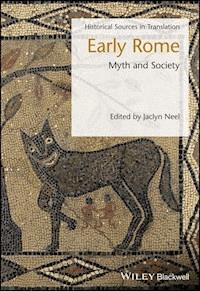
Cover image: Wolf Mosaic, Aldborough Roman Town, Yorkshire, 300 AD (mosaic) / Leeds Museums and Art Galleries (Leeds City Museum) UK / Bridgeman Images
For my parents
The scholarly community has become increasingly aware of the differences between Roman myths and the more familiar myths of Greece. Early Rome: Myth and Society steps in to provide much-needed modern and accessible translations and commentaries on Italian legends.
This work examines the tales of Roman pre- and legendary history, discusses relevant cultural and contextual information, and presents author biographies. This book offers updated translations of key texts, including authors who are often absent from classical mythology textbooks, such as Dionysius of Halicarnassus and Servius. Editor Jaclyn Neel debunks the idea that Romans were unimaginative copyists by spotlighting the vitality and flexibility of Italian myth -- particularly those parts that are less closely connected to Greek tales, such as the story of Caeculus of Praeneste. Finally, by calling attention to the Italian rather than Roman nature of the collection, this book suggests that Roman culture was broader than the city itself. This important work offers:
Up-to-date and accessible translations of Roman and Italic legends from authors throughout antiquity
Examination of compelling tales that involve the Roman equivalent of Greek “heroes”
Unique view of the strength and plasticity of Roman and Italic myth, particularly the parts less closely connected to familiar Greek tales
Intelligent discussion of relevant cultural and contextual information
Argument that Roman culture reached far beyond the city of Rome
Fresh and readable, Early Rome: Myth and Society offers essential reading for students of ancient Rome as well as those interested in Roman and Greek mythology.
Jaclyn Neel is Assistant Professor of Instruction at Temple University, USA. She is the author of Legendary Rivals: Collegiality and Ambition in the Tales of Early Rome (2014) and several articles on Italic myth.
CONTENTS
Preface
Abbreviations & Symbols
1 Introducing Early Rome
Introduction
1.1 What Is a “Myth”?
1.2 Types of Stories You Will Read in this Book
1.3 Literary Genres in this Book
1.4 Theoretical Approaches to Roman Myth
1.5 Chronology of Early Rome
Conclusion
Notes
References
Further Reading
2 Rome Before the City
Introduction
For Further Thought
2.1 The Earliest Italians
2.2 Inhabitants of the Site of Rome
2.3 Aeneas in Italy
2.4 Aeneas’ Arrival in Latium
2.5 War in Italy
2.6 The Death of Aeneas and “Pater Indiges”
2.7 Ascanius, Silvius, and Lavinia: the Alban Dynasty
Conclusion
Notes
References
Further Reading
3 Founding Rome
Introduction
For Further Thought
3.1 Conception, Birth, and Exposure
3.2 Youth of Romulus and Remus
3.3 Rome's Foundation
3.4 The Death of Remus
3.5 Wars with the Sabines
3.6 Death of Titus Tatius
3.7 Death and Apotheosis of Romulus
Conclusion
Notes
References
Further Reading
4 Images and Text
Introduction
For Further Thought
4.1 Mlacuch
4.2 Hercules and Juno
4.3 Suckling Wolf
4.4 Prophets
4.5 Wolfman
4.6 The Vibenna Brothers
Conclusion
Notes
References
Further Reading
5 Rome's Kings
Introduction
For Further Thought
5.1 The Interregnum (717–716)
5.1.1 Livy, From the Foundation 1.17
5.1.2 Plutarch, Life of Numa 2.6
5.2 Numa (716–674)
5.2.1 Numa's background
5.2.2 Egeria
5.6 Tarquin the Proud (534–509)
Conclusion
Notes
References
Further Reading
6Italy Outside Rome
Introduction
For Further Thought
6.1 Greek Founders in Italy
6.2 Hercules
6.3 Diomedes in Italy
6.4 Myths of Locri
6.5 The “Sacred Spring”
6.6 Caeculus of Praeneste
6.7 Pomona and Vertumnus
Conclusion
Notes
References
Further Reading
7 Rome's Women
Introduction
For Further Thought
7.1 The Bona Dea
7.2 Women of the Aeneid
7.3 Acca Larentia
7.4 Tarpeia
7.5 Horatia
7.6 Lucretia
7.7 Cloelia
7.8 Verginia
7.9 Slave-women and the Nonae Caprotinae
Conclusion
Notes
References
Further Reading
8 Rome's Heroes
Introduction
For Further Thought
8.1 Brutus
8.2 Publicola
8.3 The War with Porsenna
8.4 Porsenna Captures Rome?
8.5 The Battle at Lake Regillus
8.6 Stories of Self-Sacrifice for Rome
8.7 The 306 Fabii
8.8 The Conflict of the Orders
8.9 Camillus and Veii
8.10 The Gallic Sack
Conclusion
Notes
References
Further Reading
9 Conclusion
References
Appendix 1 Author Biographies
Appendix 2 Greek Mythical Characters
Appendix 3 Greek and Roman Gods
INDEX
Wiley End User License Agreement
List of Illustrations
Chapter 4
Figure 4.1
Atalanta wrestles Peleus. Mirror, Vulci, fifth century BCE. Source: Vatican Museum inv. 12247. Photo © Vatican Museum. All rights reserved. Any reproduction, duplication, or alteration is expressly prohibited.
Figure 4.2
Hercle suckles at Uni's breast. Mirror, fourth (?) century. Source: Bologna, Museo Civico inv. 1075. Image courtesy of the Museo Civico Archeologico di Bologna.
Figure 4.3
Two infants nurse at the teats of a wolf, while two men look on. Mirror from Praeneste, fourth century BCE. Source: Image © Archivio Fotografico dei Musei Capitolini and reproduced with permission of the Sovrintendenza Capitolina ai Beni Culturali – Musei Capitolini, Rome.
Figure 4.4
Tarchon bends over Tages as he emerges from the ground. Gemstone, fourth century BCE. Source: Villa Giulia. Image reproduced with the permission of the Ministero dei Beni e delle Attività Culturali e del Turismo – Soprintendenza Archeologia del Lazio e dell'Etruria Meridionale.
Figure 4.5
Cacu is captured by the Vibenna brothers. Funerary urn, Chiusi, second century BCE. Source: Museo Archeologico Firenze inv. 74233. Image reproduced with the permission of the Polo Museale Regionale della Toscana. Reproduction in any format is prohibited.
Abbreviations & Symbols
Map 0.1
Map of mythical locations in Italy and surrounding areas. © 2016 Ancient World Mapping Center.
Map 0.2
Detail of 0.1: map of mythical locations in Latium. © 2016 Ancient World Mapping Center.
Guide
Cover
Table of Contents
Preface
Pages
1
2
3
4
5
6
7
8
9
10
11
12
13
14
15
17
18
19
20
21
22
23
24
25
26
27
28
29
30
31
32
33
34
35
36
37
38
39
40
41
42
43
44
45
46
47
48
49
50
51
52
53
54
55
56
57
58
59
60
61
62
63
64
65
66
67
68
69
70
71
72
73
74
75
76
77
78
79
80
81
82
83
84
85
86
87
88
89
90
91
92
93
94
95
97
98
99
100
102
103
104
105
106
107
108
109
110
111
112
113
114
115
116
117
118
119
120
121
122
123
124
125
126
127
128
129
130
131
132
133
134
135
136
137
138
139
140
141
142
143
144
145
146
147
148
149
150
151
152
153
154
155
156
157
158
159
160
161
162
163
164
165
166
167
168
169
170
171
172
173
174
175
176
177
178
179
180
181
182
183
184
185
186
187
188
189
190
191
192
193
194
195
196
197
198
199
200
201
202
203
204
205
206
207
208
209
210
211
212
213
214
215
216
217
218
219
220
221
222
223
224
225
226
227
228
229
230
231
232
233
234
235
237
238
239
240
241
242
243
244
245
246
247
248
249
250
251
252
253
254
255
256
257
258
259
260
261
262
263
264
265
266
267
268
269
270
271
272
273
274
275
276
277
279
280
281
283
284
285
286
287
288
289
291
292
293
294
295
297
Preface
Students inspired me to write this book. I was teaching my first class on early Rome when I realized that the only translation of Dionysius was over 100 years old and so antiquated that the majority of the class simply refused to read it. After a few weeks, I couldn't blame them; I'd switched back to the Greek. I found myself skipping material that was interesting, but essentially unteachable: not only Dionysius, but also passages from Servius and other writers who lack any English translation.
This book cannot fill that gap, but I hope that it makes some progress in doing so by providing a selection of material that can be used to teach (or simply read) about early Rome. There is far more material than I've had space to provide, both textual and iconographic. Space restrictions inevitably mean that I've had to limit some authors (notably Dionysius and Plutarch) whose prose is more elaborate.
In selecting texts, I have tried to hew closely to two principles. The first is novelty: if two authors tell essentially the same story, and one of those two authors has a modern translation, I have translated the other. In doing so, I have omitted several of Rome's most famous authors almost entirely; this book contains little Vergil. But the world is so rich in translations of Vergil that I think the fault is forgivable. The other principle is variety: when many variants of a given tale exist, I have translated as many as possible. That has yielded a book whose organization is as imbalanced as surviving Roman narratives: there's far more Romulus than Numa, for example. Astute readers will notice that the variety diminishes in later chapters, again matching the character of the sources.
This book is intended for a rather disparate audience, ranging from advanced undergraduates to graduate students in non-classics fields. The explanatory material will doubtless be too detailed for some and not sufficient for others. I have assumed basic knowledge of Greek myth (e.g., the names of the gods and their major activities) and of Roman history (e.g., the identity of Julius Caesar). The chapters can be read in any order, although the organization is largely chronological. As a result, there's some repetition in the explanatory material between chapters, which I've tried to limit as much as possible. Within the chapters, the sources are organized chronologically.
The “Further Reading” sections aim to be accessible and cover a range of methods. Because the scholarship on early Rome is international, I've pointed to some important arguments in the ``Introductions'' – but there is, of course, far more available. Advanced students will benefit from the additional bibliography maintained by Alain Meurant at the excellent Lupa Capitolina Electronica website (http://lupacap.fltr.ucl.ac.be/LCE.ang/default.htm). Instructors will want to supplement to suit their own aims; my plan was undertaken with Cornell's The Beginnings of Rome (Routledge, 1995) and Richardson and Santangelo's The Roman Historical Tradition (Oxford, 2014) in mind.
All translations are my own. Generally speaking, I have translated the Greek texts from the TLG; the Latin texts came from more varied sources (Loeb, OCT, and Teubner). References to Ennius always use Skutsch. For Cicero's De Republica, I've used the Teubner. The Propertian text is my own hybrid of Fedeli, Richardson, and Goold. Although I used Lindsay for Festus, I've referred to the lemma rather than the page; anyone with good Latin can find the original in the freely-available Mueller. When necessary, I have indicated textual problems and variants in the notes; although perhaps not strictly necessary in a sourcebook, it may inspire classroom discussion. When significant textual variances exist, I have tried to put the most common reading in the text and the variant(s) in the notes. References to ancient works always cite the original language.
Books rarely succeed without assistance. The entire team at Wiley has been unfailingly helpful; I owe particular thanks to Allison Kostka, Brinda Balasubramanian, and Denisha Sahadevan for fielding inquiries, and immense gratitude to Haze Humbert for bringing the project to publication. Alessia Argento, Stefano Anastasio, Angela Carbonaro, Stefano Casciu, Elisa Dal Canto, Maria De Francesco, Rosanna Di Pinto, Maria Daniela Donninelli, Maria Cristina Guidotti, Laura Minarini, Marco Pierini, Valentina Prestigiovanni, and Manuela Santini helped me secure permissions and photographs. The Textbook and Academic Authors Association generously covered part of the permissions costs, and I am grateful to its Executive Director, Michael Spinella, for his quick communications about the process.
Gabe Moss at the Ancient World Mapping Center was unfazed by a complete map novice, and managed to corral my list of several hundred sites, mythical and real and spanning the entire Mediterranean, into the two lovely maps found here. Rebecca Sears, Amy Russell, and Gwynaeth MacIntyre read almost the entire book in draft form, as did my former student Leah Bernardo-Ciddio; I owe them an enormous debt of gratitude for their comments and suggestions, many of which I hope they will recognize in the finished product. Isabel Köster deserves special mention: she and her students road-tested the Romulus and Remus, Lucretia, and Horatii and Curiatii narratives, and pointed me to many areas that needed further clarification.
I am also immensely grateful to my team of student researchers, who read a textbook without a class in addition to their normal workload: Berat Barzanjee, Noah Brinder, Christina Cannavicci, Sandy Dief, Daniel Jankulovski, and Kim McCullough. Their diligence and enthusiasm for an independent project was exemplary, and I hope that they, too, will recognize some of their suggestions in the completed work. Their participation was funded by the Social Sciences and Humanities Research Council of Canada; Janet Friskney was a great resource in securing this grant. I'm also grateful to the students of my original Early Rome class at York University in 2012/2013, whose discussions helped me decide what material was most interesting to an undergraduate audience.
Finally, many friends and family outside the discipline provided fresh eyes and enthusiastic encouragement: my parents and sisters, Debbie Pollack, David Neel, Julia Abbott, and Tamar Zeffren. Garnet and Barb Wallace put up with me for an entire summer, during which most of the book was written in otio. As always, my most immense debts are to Chris, who knows why.
Abbreviations & Symbols
CAH
2
The Cambridge Ancient History
. 2nd ed.; 14 vols. Cambridge: Cambridge University Press, 1970–2006. Online (with subscription): https://www.cambridge.org/core/series/cambridge-ancient-history/ 010C506409EE858277F898C129759025
CIL
Corpus inscriptionum Latinarum
. 17+ vols. Königlich Preussische Akademie der Wissenschaften zu Berlin, Berlin. 1893–.
FRHist
The Fragments of the Roman Historians
(3 vols.), ed. Timothy Cornell
et al
. Oxford: Oxford University Press, 2014.
FGrHist
Die Fragmente der griechischen Historiker.
ed. Felix Jacoby. Berlin, Weidmann. 1923–. Online (with subscription):
http://referenceworks. brillonline.com/browse/die-fragmente-der-griechischen-historiker- i-iii
ILS
Inscriptiones Latinae Selectae
(3 vols.), ed. Hermann Dessau. Berlin, Weidmann. 1892. Online:
http://archive.org/search.php?query=Inscriptiones%20Latinae%20Selectae%20AND%20mediatype%3Atexts
RRC
Roman Republican Coinage
(2 vols.), ed. Michael Crawford. Cambridge: Cambridge University Press, 1974. Online (with subscription):
http://quod.lib.umich.edu/cgi/t/text/text-idx?c=acls;cc=acls;view=toc;idno=heb01433.0002.001
[…]
indicates an excerpt: material has been omitted for this book only
[lacuna]
indicates text that is missing in the original Latin or Greek
[
italics
]
indicates a summary of the omitted text; this is not ancient
[word]
indicates an explanation that is not in the original text.
Map 0.1 Map of mythical locations in Italy and surrounding areas. © 2016 Ancient World Mapping Center.
Map 0.2 Detail of 0.1: map of mythical locations in Latium. © 2016 Ancient World Mapping Center.
1 Introducing Early Rome
Introduction
In 44 BCE, graffiti appeared on the statue of Lucius Junius Brutus, the founder of the Roman Republic. It explicitly called on him for help against Julius Caesar, Rome's leader at the time, who had taken to wearing traditional royal symbols. This Brutus had received the nickname “The Liberator” for driving out Rome's kings (7.6, 8.1); by requesting his aid, the writer suggested that Caesar was a king too, and had to be eliminated.
Some men scrawled ‘If only you were alive!’ on the statue of Lucius Brutus. Similarly, on Caesar's own statue they wrote a ditty: ‘Brutus kicked out the kings and became the first consul; Caesar kicked out the consuls and then was made king.’ (Suetonius, Life of Julius Caesar 80)
Caesar's biographer Suetonius linked the graffiti to Caesar's assassination. If you know the quote et tu, Brute, you might too: Brutus' descendant Marcus Brutus, a friend of Caesar's, was one of the leaders of the conspiracy. By reminding fellow citizens of a past heroic act, the anonymous writer made a statement that was politically, socially, and culturally relevant to his own day. Nor was such historical modeling limited to periods of political strife.
Myths and legends held long-term significance in many aspects of Roman society. In fact, stories about the city's past formed a backbone of shared cultural knowledge. These tales taught men and women, natives and foreigners how to behave, what qualities were valuable, and how to make sense of the world and their community. In addition to teaching Romans about their past, these stories also gave advice about the future and helped create meaning for the entire Roman community. Modern scholars study Roman myth to learn about the city's culture, customs, history, and literature.
1.1 What Is a “Myth”?
You're probably familiar with the terms “myth” and “legend” from books, movies, or previous courses. Sometimes these words are used interchangeably, but often they refer to different types of traditional stories. These differences are sometimes defined by a spectrum of truth value (Calame 2003, 9–11). For example, a “myth” can be defined as a tale that explains the origin of natural features, such the formation of mountains or cities; it does not need to have a basis in scientific fact, but is rather a divine explanation for a visible phenomenon. In contrast, a “legend” is usually based on a factual event and has been exaggerated. The elaboration of these tales may include fantastic elements such as the use of magic or the possession of special powers by the hero or his companions – but the legend still must have a “kernel of truth.” A “folktale,” in contrast, may or may not have a basis in fact; it more often has a basis in social standing. Myth and legends tend to retell stories of extraordinary people, often of high status; folktales focus on the lives and deeds of ordinary people.
In studying the classical world, “myth” is usually applied to traditional Greek stories about gods and heroes. Similar stories from other parts of the ancient world are called “legends.” This distinction and definition are increasingly seen as problematic for a number of reasons. For one thing, we know about many Greek myths thanks to the works of Roman authors like Ovid. So “Greek” is not an exclusive category; in many ways, “Greco-Roman myth” is a better term.
But this term leads to a second problem: how do you pinpoint what is “Greek” or “Roman” about a given narrative? We do not have much information about Roman society before it had contact with Greece. Yet there are clearly traditional tales from Rome that do not appear in any surviving classical Greek evidence. Is this the best way to define “Roman” myth?
Another problem is that many Roman traditional tales do not involve gods or semi-divine humans, but rather ordinary people who do extraordinary things. This led early researchers to conclude that Romans did not have myths of their own. Instead of the anthropomorphic gods associated with Greek myth, these researchers found that early Romans believed in numina (divine powers). Because these powers did not necessarily have faces and names, like “Athena” or “Ares” in Greece, there was no need to develop stories about them. Later, Romans learned about Greek myths; they were captivated by the Greeks' creativity and adopted their gods and traditional tales as their own. As a result, Roman myths are simply copies of Greek mythology. This theory of Rome's “mythless society” was popular for many decades, and is now thought to be wrong.
Instead, scholars now realize that Roman traditional tales are quite different from Greek traditional tales. As Mary Beard (1993, 48) has written, “the observation (or complaint) that Rome has no myth is probably no more than an observation that it does not have Greek myth.” In other words, “myth” has been defined in such a way that only a limited number of story patterns will match it. Greece offers the gold standard for such tales; other societies, including Rome, inevitably fall short. In order to study Roman myths, we must first understand that not all myths match the Greek model of gods with human qualities who fall in love, misbehave, cause trouble, rescue men, or otherwise interfere in human affairs.
Together with this redefinition of Roman myth, classicists are coming to realize that even Greek myth is not unitary. Not only did Greeks recognize many variations of their “standard” tales, but they also retold narratives that we do not recognize as mythic in structure. As Claude Calame (2003) has argued, the Greeks did not recognize “myth” as a category distinct from “legend,” “folktale,” or “fiction.” These modern distinctions have been wrongly applied to the ancient material, confusing our understanding of how ancient narratives worked in context.
Some scholars have argued that Rome has a special type of mythology, which can be called “historical myth” (e.g., Fox 1996). They prefer this term to “legend,” which (as we saw above) implies that the tale contains a certain amount of truth. “Historical myth,” in contrast, shares the dubious reality of myth; it is true to the culture, but need not be true outside of that culture. Unlike the traditional category of “myth,” which tells stories from a timeless past, the tales of “historical myth” take place in a concrete and historically defined period. For those studying ancient Rome, that period is called “early Rome” (see 1.5). Roman myths take place in specific locations (in and around the city) and in specific eras. Although the dividing line between “myth” and “history” is intensely debated by modern scholars, many would agree that stories about the gods or their children are mythical, while stories that had contemporary documentary support are historical.
But there is substantial disagreement about what records were available to ancient authors. We aren't sure what records were kept before approximately 300 BCE; we also don't know how much Romans cared about preserving strict historical accuracy versus imagining the past. The debate about how to deal with the “memory” of the past through oral and visual means is ongoing in ancient history, as well as other fields. This book takes a broad view of “myth.” It includes stories about larger-than-life heroes, some of whom may have existed historically. They are “mythical” because their actions are unrealistically exaggerated. By including characters who would typically be considered “legendary,” this book suggests that the exact distinction between “myth” and “legend” may not be helpful for understanding Roman society. Rather, the myths that were told about early Rome can help us understand how Romans thought about their history. Myths tell us which stories were worth retelling; what degree of variance between different versions was acceptable; how authors decided that an event was believable (or not); and how authors expected or wanted their audiences to interpret the story's outcome.
An example of how one well-educated Roman understood the city's traditional tales can be found in Cicero, On the Laws 1.5. Discussing the material that's appropriate for history and poetry, Cicero distinguishes two types of tale: the fabula (more fictional) and the historia (more truthful). The criteria for determining what makes a fabula fictional are vague, suggesting that questions of veracity were left to individual discretion, at least to a certain degree. In reading narratives in this book, you'll come across the judgments of authors themselves. Livy, Dionysius of Halicarnassus, and Plutarch are particularly prone to reflect on the likelihood of various alternative narratives, and their judgments offer modern historians the best evidence for what was credible (or not) in antiquity. But be careful: these authors often disagree, leaving modern historians unsure about how their readers would have interpreted the story. Ancient authors also include stories that they claim are false or suspicious. The inclusion of such tales in historical writing has long puzzled scholars, and there is no currently accepted boundary between “true history” and “myth.” This boundary is something you should consider as you read, but don't worry if you can't find a single answer!
It is important to recognize that these terms – myths, legends, “historical myths” – are not universally recognized or mutually exclusive. Modern historians disagree on the appropriate vocabulary to use when discussing Rome's traditional tales. Some scholars will use the terms myth, legend, and folklore interchangeably; others use them to indicate different themes or truth values. It is in your best interest to read this scholarship carefully, paying particular attention to definitions. Be careful: these are sometimes found in footnotes (or endnotes).
From this point forward, this book will refer to all traditional tales about the regal period and early Republic as “myths,” regardless of likely historicity. This choice underlines an important aspect of Roman traditional stories: that regardless of whether modern scholars view them as true or false, they had continuing value to the elite Romans who read and wrote the works we examine. In that sense, they all try to communicate some “truth” to their audience. Stories that had no value to society were not retold.
1.2 Types of Stories You Will Read in this Book
As you probably realize by now, “Roman myth” includes a variety of different stories. These can be categorized into a number of different subtypes, which are not unique to Rome (although the stories themselves may be). These labels are not mutually exclusive – a story can easily fit into two or more categories. The point of such categorizations is not to fence in similar stories and protect them from alternative classification; rather, by identifying themes of various stories, we can better understand what interested Romans about their past and the type of question they asked (and didn't ask) about their contemporary society. You'll notice that Romans often asked different questions than we do! In understanding their questions, we can better understand how these authors understood their world, both in the past and in their own day.
Some of the uses of myth can be striking to those not used to ancient patterns of thought. Romans sometimes used tales of the city's early past as we do, to try to learn about the historical life of their ancestors. But the study of the past for its own sake (called “antiquarianism”) was different from the study of the past directed towards contemporary goals. Rome's early history could be manipulated to make a new custom seem old (or older); help Romans feel proud of their city and teach them how to behave in similar situations; advertise the crucial importance of an elite family to the city; inform foreigners of basic virtues; and reinforce the importance of traditions. Other uses of historical myths were also possible – for example, orators may cite myths in legal cases – but connecting the past to the present in some way is the most common reason to (re)tell a narrative above the past.
Foundation narratives relate the establishment of cities and peoples (a term that is broadly similar to an “ethnic group” in modern usage). They require at least one founder, and it is rare to have a large group; in Italy, however, the presence of two founders seems relatively common. A single place might have multiple foundation narratives, and these narratives can be complementary (for example, Rome's foundation tales of the Lupercalia and the walls: 3.2, 3.3) or contradictory (for example, the different accounts of Remus' death: 3.4). We should not think that there was only one “correct” narrative. Rather, one narrative might be more or less correct for a given genre or context.
Aetiological tales are similar to foundation narratives: they relate the creation of cults, customs, and other rituals. Aetiology comes from the Greek word aetia (meaning “cause”), and answers the question “why do we do this?” A single event frequently has multiple aetiologies. As with foundation narratives, these different explanations aren't necessarily mutually exclusive. It's quite common in Rome for at least one aetiology to be traced back to the foundation. Roman society, like many traditional societies, prized ancestral custom and was suspicious of novelty. Anything associated with the city's founder, Romulus, was immediately old and therefore respectable. As a result, many customs were associated with Romulus, even if they were already attributed to another figure in Rome's history. Jacques Poucet (1985) has called this process “Romulization.”
In this book, only aetiologies that take place in early Rome will be covered. But aetiologies could relate to any period in the city's history, including the quite recent past. A similar type of tale is the exemplum (plural: exempla). An exemplum can be either a person or deed, and serves as a shorthand for a particular virtue. We might say that an exemplum embodies that virtue. Exempla provided a useful way to communicate a complex cultural concept. This book opened with an exemplum in action: the exemplum of Brutus the Liberator encouraged Romans to free themselves from the “king” Julius Caesar. Exempla are more complex than they seem, and will be discussed further in chapter 8. For now, you can think of them as similar to invoking Hitler to indicate that someone is evil, with a range of associations.
Another concept that's similar to aetiologies is the eponym. Roman authors were interested in the names of locations, gods, and rites. They often tell stories that relate these names to a single individual. That person is the eponym of that place or ritual. You can probably find an eponym where you live: some examples named after European monarchs include Adelaide in Australia; Victoria in British Columbia, Canada; and the U.S. states of Georgia and Virginia.
Although Rome had fewer tales of gods and heroes than Greece, it did have some. We easily recognize heroic tales that set Greek heroes into a new location. Many Italian cities, Rome included, retold legends about the visit of Hercules on his way home from Spain. Similarly, many Italian cities claimed that they were founded or visited by heroes of the Trojan War whose ships got lost or diverted on the route between Anatolia and the Greek mainland. Early Greek colonies in central and southern Italy may have contributed to the proliferation of these tales.
Not all heroic tales go back to Greece. The hero Caeculus of Praeneste (6.6)) is an Italian original. Similarly, many of the stories told about the Roman kings lack convincing Greek parallels. The same can be said about the majority of Rome's tales about gods. These are relatively few in number, if you don't count the stories that take place in Greece. But when Roman gods do act in Italy, they often act in characteristically Roman ways, such as the hair-splitting dialogue between king Numa and Jupiter over human sacrifice (5.2.3).
Much as we all know stories about our own families that have become quasi-legendary, Roman aristocratic clans also had family legends. These narratives are almost never explicitly called family legends by Roman authors. Instead, modern scholars have guessed that such legends “belonged” to a group of family legends based on the prominence of a particular family in the story. A good example of such a family legend is the tale of the 306 Fabii (8.7), where even the name announces that it is about the Fabian gens. Similar tales may have explained the reason behind an individual family cognomen (such as Scaevola (8.3.2, 8.3.4) or Brutus (5.6.5, 8.1)) or glorified individual Roman ancestors (such as Cloelia (7.7) or Horatius (5.3.2)).
Although it is not certain, many scholars believe that such familial legends were retold at aristocratic funerals (see Polybius 6.53–54). Because some families were associated with particular cults and rites, it's also possible that these legends were publicly recounted at festivals and rituals. The average Roman may also have seen images of these tales on public buildings, monuments, or statues. Unlike the written texts that make up the majority of this book, public images were viewed by non-elite Romans. Private imagery also supplies a potential source of iconography that would be recognizable to a broader audience. Pictorial representations offer us valuable insight into the ways that Romans may have learned about their past.
Not all stories will match one of the above categories, and others will fit in to more than one. Perfect categorization of a diverse set of myths is unlikely. Instead, these categories should help you begin to conceptualize the topics Roman authors found worthy of myth. In other words, these tales give us answers to the questions Romans asked about their past. We can use these answers to help us reconstruct not only the questions, but also the potential reasons why such questions were important.
1.3 Literary Genres in this Book
We tend to think that history is transmitted in a limited number of ways: textbooks, primary source compilations (such as the one you're reading now), and documentary films are a few examples. In the ancient world, almost any type of material could contain information about the legendary past. Romans seemed to have used this period as a way to conceptualize their contemporary customs, struggles, and decisions in a way that is quite different from how modern historical thinking works. On the one hand, this openness means that students of Rome's mythic history have almost limitless options for understanding a particular story or theme. But we also must be careful to avoid falling into traps of genre.
Every style of writing has its own conventions. Academic books are annotated; depending on the discipline, they may use parenthetical references, footnotes, or endnotes. Memoirs are lightly fictionalized; autobiographies, ideally, are not. An understanding of the conventions of the different genres of ancient writing, both Greek and Roman, will help you determine the best way to evaluate your sources.
Narrative history is probably the most familiar genre. Writers in this category are primarily concerned with producing chronological accounts of Roman history that are more or less “accurate” in their own terms. A standard way for an ancient historian to differentiate himself from his predecessors was to accuse those predecessors of carelessness or even lies; you should be wary of such accusations. Many, but not all, narrative historians provided the reader with several potential historical scenarios. These options allow us to identify variants of a given narrative, and they should not be seen as mutually exclusive. As many modern scholars have pointed out, the beliefs of ancient historians are not the same as ours; therefore, what seems fantastic to us was not necessarily outside the realm of possibility in their view.
But historians also transmitted some stories that they didn't believe were true. Often the importance of these stories is attributed to “tradition”: this tale has been part of Roman culture for so long that it must be retold in its chronological place. An example of such a tale is the divine birth of Romulus (3.1). This habit has led many modern scholars to speculate about how Romans understood their past. While this book does not attempt to provide answers, the Further Reading options often do.
Before their histories were written down, Romans had other ways of transmitting details about their past. These oral and visual sources continued to be consulted after written histories came into use. In addition to the funeral orations mentioned in 1.2, we have evidence for historical painting (for example, the Esquiline Fresco of Fabius and Fannius1), probably similar to the plaques that were displayed in the Roman triumph (Holliday 2002). Other images were found on public statues, monuments, and reliefs. Peter Wiseman (1998) has also suggested that dramatic performance was a means of transmitting historical information, as were various forms of poetry (Cato, FRHist 5 F1132). Modern scholarship on oral traditions suggests that they're less fixed than written narratives, which may help explain why Roman myths, which were written down relatively late in Rome's history, vary so greatly in specific details.
Rome's earliest narrative histories were written in Greek, either by Greeks (such as the historian Timaeus of Tauromenium, in Sicily) or by Romans perhaps eager to communicate with a Greek audience (such as Quintus Fabius Pictor, a Roman patrician). These Roman authors are sometimes called “annalists,” because their works took a year-by-year structure (see Wiseman (2007)). The group of “annalists” includes authors such as Livy, whose From the Foundation may be familiar to you. You'll find more information on these authors in Appendix 1.
Another genre that frequently draws on the legendary past is epic poetry. Epic poetry refers to the large-scale poems written by authors such as Vergil. Many, but not all, of these poems take place in the legendary past. Be careful not to confuse the modern word “epic” (large-scale, impressive) with the ancient genre of epic, which is based on poetic meter. All epics, regardless of their subject matter, were written in a meter called dactylic hexameter. Many epics told the stories of past heroes who were capable of deeds that could no longer be accomplished in the writer's own day. Common features of such narratives include the personal involvement of the gods in the hero's life (in the Aeneid, for example, the hero is the son of Venus); at least one meeting of the gods (“divine council”) to determine the fate of the hero and/or his companions; a journey to the underworld (see Aeneid book 6); battles; and arming scenes (in which armor is described at length). Because these scenes are standard for the genre, they may represent authorial additions to the myth. Nevertheless, these new additions might be included in subsequent retellings.
Elegiac poetry differs from epic in both meter and typical subject matter. Just as epic poetry was defined by dactylic hexameter, elegiac poetry had to be written in a specific verse pattern called the “elegiac couplet.” Although this genre started out as a funeral lament, by the Roman period elegiac poetry was typically (but not always) about the romantic failure of a high-status male. Themes of such love elegy include the lover's lament, often outside the locked door of his girlfriend; the motifs of love as a battlefield and the lover as soldier; the lover's inability to retain the interest of his girlfriend, despite his higher status; and gender inversion, in which the high-status male becomes subservient or enslaved to his low-status female love interest. Elegiac poets such as Propertius and Ovid used these themes to redefine the past in their own terms.
You may have had experience with the first three genres in other classes dealing with antiquity. The next three genres are often less common in undergraduate courses. Although philosophy is often more closely associated with the Greeks, Romans also wrote philosophical works. The most important for this book is Cicero, who often used Rome to explore political philosophy. Cicero wrote about history of the city in various works and occasionally contradicts himself, which suggests that an individual's understanding of the past was flexible and could change over time.
Didactic treatises fall into several different categories. For us, the most important are antiquarian literature and commentaries on poetic works. Antiquarian literature may at first seem hard to differentiate from historical works. One of the major differences is how the material is arranged: antiquarian works are frequently arranged by topic, whereas histories tend to be written chronologically. There may also be a difference in methodology: antiquarians may accept traditions that do not seem true enough to be historical, but are nonetheless important to Roman self-definition, tradition, or culture. Some of these distinctions are fuzzy: Dionysius of Halicarnassus, for example, writes a history that we call the Roman Antiquities. Both genres are valuable: Cicero (Academica 1.3.9) claimed that Varro's great antiquarian works (now lost) “let us recognize where and who we are.”
Closely related to the antiquarian works are the commentaries on canonical literature, such as Vergil. These books are organized line by line (or sentence by sentence) and provide valuable contextual information on many topics. These commentaries were written several centuries after the works in question, and don't speak for the author. Instead, they show us how the work was understood in antiquity. Such commentaries often offer fragments, which are references to or quotations of earlier writers whose complete works are lost. Although any incomplete work can be considered “fragmentary,” the term is usually reserved for works that can't be understood in their existing state.
Finally, Christian apologetics offer a variety of material relating to Roman myth. In order to defend their own religion, apologists retold Roman mythic material in order to ridicule or argue with it. Sometimes they cite an author directly, providing a fragment (for example, most of our knowledge of Varro's work comes from Augustine's City of God). In other instances, they cite too vaguely to identify an author or not at all. Because these works are frequently aimed at discrediting the Roman myth in question, their information must be carefully assessed. It's rarely sufficient to reject the myth because it is found in a Christian source, or to accept it simply because it is ancient.
1.4 Theoretical Approaches to Roman Myth
For a long time, Roman myth was considered derivative of Greek myth. As a result, many of the theories used to analyze Greek myth were used to analyze Roman myth. Although most modern scholars now appreciate the creativity behind Roman myth, they continue to use many of the same theoretical tools.
A very popular way to analyze Roman myth is the historical approach. This type of analysis sees Roman myth as a type of oral history. The more improbable aspects of the stories (such as Aeneas' and Romulus' divine parents) can be explained through narrative elaboration: generations looking back to their past inflate their legendary heroes into larger-than-life figures. Although this may seem unlikely to us because we live in a heavily documented society, scholarship on modern oral traditions has shown that it takes only a few generations for traditions to become mythicized. The historical approach is a common perspective for stories that occur from the Tarquins on (see 1.5). A subtype of this model is exemplary history, which is discussed further in chapter 8; in brief, Romans used idealized stories about their past as models to guide present behavior.
Another common model is structuralism. Although the term “structuralism” derives from the theories of the French anthropologist Claude Lévi-Strauss, scholarship before Lévi-Strauss had already advocated for similar ideas in the myths of Rome. The basic model is that these myths symbolize a binary opposition in society. For Rome, the most common oppositions are primitive/civilized (also called savage/civilized), plebeian/patrician, modest/luxurious (sometimes nationalized as Latin/Sabine or Latin/Etruscan), and male/female. Because these oppositions are mutually exclusive, the myths offer contemporary audiences a way to negotiate their values in a safe space. Lévi-Strauss argued that oppositions allowed a population to negotiate the differences between ideas to produce new relationships.
Similar to structuralism in concept, but quite different in execution, is Georges Dumézil's trifunctional model. These three functions are, according to Dumézil, broadly applicable to all Indo-European cultures (including Roman, Greek, Vedic, and Norse myth) provided that they all appear in the same tale. Therefore trifunctionality is a form of comparative mythology (in which similarities between the myths of different cultures can be used to better understand the myths of a single culture or the process of cultural exchange). The three “functions” are the three areas that early societies seemed to value most: the priest, the farmer, and the warrior. Both myth and society were organized along the same lines, so myth serves to illuminate society. As Dumézil admitted, his approach did not work for every myth, but only those myths that featured a struggle for power between the three functions.
Romans themselves often suggest that their society is worse than the society of previous generations. This model of decline is also common in Greek thought, and should not be taken literally. It is a conservative way of viewing the past that seeks to preserve the status quo and promote traditional values. In some cases, these values had long been lost or disappearing (see especially the stories of women in chapter 7).
We have already seen that myths can act as aetiologies for customs and rituals. These explanations reinforce the local importance of particular tales. For example, in tales involving a Greek hero like Hercules, the aetiological model would emphasize connections to Roman religious rites, public traditions, or particular locations in the city. Tales that aim to record the reasons for religious rites may also have been retold at the rites, gaining a wider audience than the text. Studying this wider audience is part of the approach called cultural memory, which attempts to discover what Romans in general “knew” about their past and their society. You'll notice as you read that Roman authors, especially Ovid and Livy, are eager to make these connections, and that this model therefore has roots in antiquity.
It's important to recognize that although these theories are distinct, they do not need to be mutually exclusive. Current work on Roman myth often features a combination of theoretical approaches. The models outlined above are also only a selection of the most common approaches to Roman myth, and shouldn't be considered comprehensive.
1.5 Chronology of Early Rome
“Early Rome” is a loosely defined period in classical scholarship. In this book, “early Rome” refers to the years between c. 1200–c. 390 BCE (the abbreviation “c.” means “approximately”). These boundaries cover, in terms of narrative, the years from the arrival of Aeneas in Italy to the Gallic sack of Rome. It is important to realize that these dates are our society's translation of ancient dates into our own terms. The Romans did not use the dating system BC/AD or BCE/CE; these are modern, Christian dates that use year “0” as the moment of Jesus' birth. Roman authors used a variety of dating systems which had to be synchronized in complex ways. This different system of keeping records helps explain why we are often unsure of the exact year, much less month or day, in which events in ancient history occurred.
Most authors who wrote in Latin calculated the date based on how many years had passed since the foundation of the city. But this process was complicated by the fact that there was no agreement about when the city had been founded until the first century CE. Modern scholars use the “Varronian” date (see Varro in Appendix 1) of 753 BCE for the foundation of Rome; in antiquity, however, dates ranged from 815 (Timaeus (Dionysius of Halicarnassus 1.74.1)) to 750 (Eratosthenes (Solinus 1.27); see Dionysius of Halicarnassus 1.74.2). There was slightly more agreement on the era of the Trojan War: the Hellenistic chronographer Eratosthenes (third century BCE) determined that Troy fell in (our) 1184 BCE.
After the foundation of the Roman Republic in 509, dates of events in the city could be determined by the names of the yearly consuls (“eponymous” or “consular” dating). Because these two men changed every year, the combination of the consuls' names plus the number of years that had occurred since the foundation when these two men had jointly held the consulship offered a date. As you can imagine, this system was somewhat unwieldy and required much memorization! Lists were probably maintained from an early period, but our earliest lists have been lost. There's therefore a great deal of debate, both ancient and modern, about the reliability of early Republican history. Sometimes our authors express confusion about the consular dates: either they are not sure in whose consulship an event occurred, or they are not sure about the order in which the consuls held office (see Livy 2.8 for a famous example).
Greek-speaking authors of the Hellenistic period (c. 323–31 BCE) more frequently used the Olympiad dating system, which calculated one Olympiad every four years beginning in 776/5 BCE. These dates were sometimes equated (“synchronized”) with other local dating systems, such as Roman consular dates or Athenian archon dates. After the establishment of the Roman Principate, contemporary events could be dated by regnal years of the emperor; for early Rome, there were few alternatives to the consular dating system established by the very first Roman historians (for further details, see Feeney 2009 and Frier 1979).
With these cautions, we can establish a periodization for early Rome that is based on dates that are relatively canonical. That means that these dates would not have been considered firmly set by many people in antiquity, who were less concerned about “the actual date” than we are. With this in mind, “Early Rome” falls into three broad eras:
(1) Aeneas and Alba Longa (c. 1184–c. 753 BCE): This period covers the events of Aeneas' departure from Troy to the end of his dynasty. Although many Roman noble families claimed to be descended from Aeneas or his followers (1.2, 3.5.7), Aeneas' line came to an end after the death of Romulus (3.7). This contradiction was unproblematic for many, although Cicero mocked the pretensions of contemporary Roman aristocrats who invented or “rediscovered” important family heritage (Brutus 62).
After Aeneas died, his kingdom was ruled by a series of kings now known as the Alban Kings, after their capital city of Alba Longa. Little is known about Alba Longa today, and the number of kings varies; some early Roman authors omitted the dynasty altogether. It seems that all sources include the first and last kings, Ascanius/Iulus (Aeneas' son(s)) and Amulius and Numitor (the grandfather and great-uncle of the city's founder Romulus); however, even these rulers are the subjects of dispute. Because of the many discrepancies in our sources, most modern scholars now believe that this dynasty was invented (different views in Grandazzi 2008 v.2; Cornell 1995, 45–57).
Key events of this period include the arrival of Aeneas in Italy, the foundation of Alba Longa, and the Alban Kings.
(2) The Regal Period (c. 753–c. 509 BCE): This period covers the foundation of Rome itself and the seven original kings of the city. The kings may be divided in various ways; the most common methods are the division into “good” (all but the Tarquins) and “bad” (Tarquins) rulers, and the division into “Latin” (Romulus through Ancus) and “Etruscan” (Tarquin I through Tarquin II) rulers. Neither division is fully sanctioned by ancient texts or archaeological findings.
By the period of our earliest writers, these seven kings were canonical: that is, all seven consistently appear in our sources in the same order. Even in antiquity there was some dispute about which king was responsible for what; this will be discussed in more detail in chapter 5, where there is a detailed chronological breakdown of the different reigns. Key events of this period include the foundation of the city and many important monuments in it; the establishment of priesthoods and civic structures, such as voting divisions; and Rome's conquest of nearby cities, including Alba.
The Regal Period came to an end with the expulsion of the Tarquins and the foundation of the Republic. Ancient writers consistently associate this event with the rape of Lucretia (7.6) in the year 509.
(3) The Early Republic (c. 509–c. 390 BCE): This period is an invention of modern scholarship, with only limited authority in ancient writings. Roman authors conceived of “the Republic” as a single period running from the fixed date of its foundation in 509 to a variety of termination points in the late first century BCE (for detailed discussion, see Flower 2010). In contrast, modern historians have divided the Republic into three periods: early (c. 509–c. 390), middle (c. 390–c. 133), and late (c. 133–c. 27).
The rationale behind the choice of 390, the Gallic sack of Rome, can be justified by the Roman historian Livy (6.1.2): “written records, the one faithful guardian of events, in those days were short and rarely kept. And most of whatever there was, in pontifical commentaries and public or private monuments, was lost when the city burned” in the sack. Where ancient authors perceived a break in history, modern historians have been eager to follow.
Literary evidence indicates that the city was razed. The archaeological evidence for the destruction of the city in this era is less clear (Cornell 1995, 313–322). Few would deny that Italy was invaded by Gauls, perhaps numerous times, in the fourth century (contemporary evidence cited in Plutarch, Camillus 22: see 8.10.2c), but invasion should not be equated with destruction. It may be the case that written records were not kept, or not well–maintained, in the city prior to the fourth century BCE. Later Romans, who found the notion of not keeping records incredible, developed the idea that all of the records had been destroyed together with the city. The relationship of archaeological remains, textual traditions, and history “as it really was” remains contentious in modern scholarship.
Conclusion
Much of the information you've read may seem confusing, contradictory, or overwhelming. Don't worry! Early Rome is a complex and exciting topic, with many opportunities for original research and ideas. No one masters this material after only a few days.
To effectively use this book, you may find it helpful to refer to the author biographies in Appendix 1 before or after reading each selection. Particularly in cases where there are many different versions of the same tale, why might an author choose to relate only one? (Or, alternatively, why tell multiple versions?) Can you find similar themes in the stories an author chooses to tell, or which he chooses to believe? Can you make a connection with the genre of the work and variant of the story? If so, congratulations: you're well on your way to understanding early Roman myth.
In addition to the above works, there are now “Companions” to almost every major topic in this chapter and author in this book; these offer a good starting point for further research.
Notes
1
http://en.centralemontemartini.org/var/museicivici/storage/images/musei/centrale _montemartini/percorsi/galleria_fotografica/affresco_con_scene_militari_da_una_ tomba_a_camera_della_necropoli_esquilina/64857-8-eng-US/fresco_with_military_ scenes_from_a_chamber_tomb_of_the_esquiline_necropolis_gallery.jpg
2
This standard way to cite fragmentary historians is a little complicated: the format is the author's name, identifying number in a standard work (see
Abbreviations
), and the fragment number (indicated by F).
References
Beard, Mary. 1993. “Looking (harder) for Roman Myth: Dumézil, Declamation, and the problems of definition.” In
Mythos in mythloser Gesellschaft: Das Paradigma Roms
, edited by Fritz Graf, 44–64. Stuttgart and Leipzig: Teubner.
Calame, Claude. 2003.
Myth and History in Ancient Greece: The Symbolic Creation of a Colony
. tr. Daniel W. Berman. Princeton, NJ: Princeton University Press.
Cornell, Timothy J. 1995.
The Beginnings of Rome: Italy and Rome from the Bronze Age to the Punic Wars (c. 1000–264 B.C.).
London: Routledge.
Feeney, Denis. 2009. “Time.” In
The Cambridge Companion to the Roman Historians
, edited by Andrew Feldherr, 139–151. Cambridge: Cambridge University Press.
Flower, Harriet. 2010.
Roman Republics
. Princeton, NJ: Princeton University Press.
Fox, Matthew. 1996.
Roman Historical Myths: The Regal Period in Augustan Literature
. Oxford: Oxford University Press.
Frier, Bruce W. 1979. Libri Annales Pontificum Maximorum:
The Origins of the Annalistic Tradition.
Ann Arbor, MI: University of Michigan Press.
Grandazzi, Alexandre. 2008.
Alba Longa: Histoire d'un legende
, 2 vols. Rome: École française de Rome.
Holliday, Peter. 2002.
The Origins of Roman Historical Commemoration in the Visual Arts.
Cambridge: Cambridge University Press.
Poucet, Jacques. 1985.
Les origines de Rome. Tradition et histoire.
Brussels: Facultés universitaires Saint-Louis.
Wiseman, Timothy Peter. 2007. “The Prehistory of Roman Historiography.” In
The Blackwell Companion to Greek and Roman Historiography
(2 vols.), edited by John Marincola, 67–75. Malden, MA: Blackwell.
Wiseman, Timothy Peter. 1998.
Roman Drama and Roman History
. Exeter: University of Exeter Press.
Further Reading
Bremmer, Jan, and Nicholas Horsfall. 1987.
Roman Myth and Mythography
. London: Institute of Classical Studies. One of the earliest works to take Roman myth seriously in its own right, this book delves into the city's major myths. The authors present a series of case studies, rather than an introduction. The scholarship is dense, but both readable and fascinating. The book is available online (with subscription):
http://onlinelibrary.wiley.com/doi/10.1111/bics.1987.34.issue-S52/issuetoc
(last accessed November 21, 2016).
Csapo, Eric. 2005.
Theories of Mythology




