


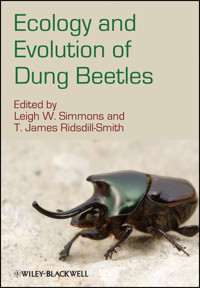
Ecology and Evolution of Dung Beetles E-Book
98,99 €
Mehr erfahren.
- Herausgeber: John Wiley & Sons
- Kategorie: Wissenschaft und neue Technologien
- Sprache: Englisch
This book describes the evolutionary and ecological consequences of reproductive competition for scarabaeine dung beetles. As well as giving us insight into the private lives of these fascinating creatures, this book shows how dung beetles can be used as model systems for improving our general understanding of broad evolutionary and ecological processes, and how they generate biological diversity. Over the last few decades we have begun to see further than ever before, with our research efforts yielding new information at all levels of analysis, from whole organism biology to genomics. This book brings together leading researchers who contribute chapters that integrate our current knowledge of phylogenetics and evolution, developmental biology, comparative morphology, physiology, behaviour, and population and community ecology. Dung beetle research is shedding light on the ultimate question of how best to document and conserve the world's biodiversity. The book will be of interest to established researchers, university teachers, research students, conservation biologists, and those wanting to know more about the dung beetle taxon.
Sie lesen das E-Book in den Legimi-Apps auf:
Seitenzahl: 777
Veröffentlichungsjahr: 2011
Ähnliche




















Contents
Cover
Title Page
Copyright
Preface
Acknowledgements
Contributing authors
Chapter 1: Reproductive competition and its impact on the evolution and ecology of dung beetles
1.1 Introduction
1.2 Competition for Mates and the Evolution of Morphological Diversity
1.3 Competition for Resources and the Evolution of Breeding Strategies
1.4 Ecological Consequences of Intraspecific and Interspecific Competition
1.5 Conservation
1.6 Concluding Remarks
Chapter 2: The evolutionary history and diversification of dung beetles
2.1 Introduction
2.2 Scarabaeinae Diversity and Tribal Classification Issues
2.3 Scarabaeine Dung Beetle Phylogenies
2.4 The Sister Clade to the Scarabaeinae
2.5 The Origin of the Dung Beetles
2.6 The Oldest Lineages and Their Geographical Origin
2.7 Evolution of Activity Period
2.8 Evolution of Feeding Habits
2.9 Evolution of Derived Alternative Lifestyles
2.10 Evolution of Nidification: dung Manipulation Strategies
2.11 Evolution of Nidification: Nesting Behaviour and Subsocial Care
2.12 Conclusions
2.13 Future Work/Gaps in Knowledge
Acknowledgments
Chapter 3: Male contest competition and the evolution of weapons
3.1 Introduction
3.2 Dung Beetle Horns as Weapons
3.3 Functional Morphology of Horns
3.4 Horns as Predictors of Victory
3.5 Are Beetle Horns Simply Tools?
3.6 The Evolution of horns: Rollers vs. Tunnellers
3.7 The Evolution of horns: Population Density
3.8 The Evolution of Horns: Sex Ratio
3.9 Future Work
Chapter 4: Sexual selection after mating: the evolutionary consequences of sperm competition and cryptic female choice in onthophagines
4.1 Introduction
4.2 Sperm Competition Theory
4.3 Evolution of Ejaculate Expenditure in the Genus Onthophagus
4.4 Evolutionary Consequences of Variation in Ejaculate Expenditure
4.5 Theoretical Models of Female Choice
4.6 Quantitative Genetics of Ejaculate Traits
4.7 Empirical Evidence for Adaptive Cryptic Female Choice in Onthophagus Taurus
4.8 Conclusions and Future Directions
4.9 Dedication and Acknowledgement
Chapter 5: Olfactory ecology
5.1 Introduction
5.2 Orientation to Dung and Other Resources
5.3 Olfactory Cues Used in Mate Attraction and Mate Recognition
5.4 Chemical Composition of Kheper Pheromones
5.5 Kairomones
5.6 Defensive Secretions
5.7 Conclusions and Future Directions
Chapter 6: Explaining phenotypic diversity: the conditional strategy and threshold trait expression
6.1 Introduction
6.2 The Environmental Threshold Model
6.3 Applying the Threshold Model
6.4 Future Directions
Acknowledgements
Chapter 7: Evolution and development: Onthophagus beetles and the evolutionary development genetics of innovation, allometry and plasticity
7.1 Introduction
7.2 Evo-Devo and Eco-Devo – a Brief Introduction
7.3 Onthophagus beetles as an emerging model system in evo-devo and eco-devo
7.4 The Origin and Diversification of Novel Traits
7.5 The Regulation and Evolution of Scaling
7.6 The Development, Evolution, and Consequences of Phenotypic Plasticity
7.7 Conclusion
Acknowledgements
Chapter 8: The evolution of parental care in the onthophagine dung beetles
8.1 Introduction
8.2 Parental Care Theory
8.3 Testing Parental Care Theory Using Onthophagine Dung Beetles
8.4 Conclusions and Future Directions
Acknowledgments
Chapter 9: The visual ecology of dung beetles
9.1 Introduction
9.2 Insect Eye Structure
9.3 Eye Limitations
9.4 Dung Beetle Vision
9.5 Visual Ecology of Flight Activity
9.6 Sexual Selection and Eyes
9.7 Ball-Rolling
9.8 Conclusions
Chapter 10: The ecological implications of physiological diversity in dung beetles
10.1 Introduction
10.2 Thermoregulation
10.3 Thermal Tolerance
10.4 Water Balance
10.5 Gas Exchange and Metabolic Rate
10.6 Conclusion and Prospectus
Acknowledgments
Chapter 11: Dung beetle populations: structure and consequences
11.1 Introduction
11.2 Study Systems
11.3 Range Size
11.4 Habitat and Resource Selection
11.5 Dung Beetle Movement
11.6 The Genetic Structure of Dung Beetle Populations
11.7 Consequences: Spatial Population Structures and Responses to Habitat Loss
11.8 Perspectives
Acknowledgements
Chapter 12: Biological control: ecosystem functions provided by dung beetles
12.1 Introduction
12.2 Functions of Dung Beetles in Ecosystems
12.3 Dung Beetles in Pasture Habitats
12.4 Seasonal Occurrence and Abundance of Native Dung Beetles in Australia
12.5 Distribution and Seasonal Occurrence of Introduced Dung Beetles in Australia
12.6 Long-Term Studies of Establishment and Abundance
12.7 Competitive Exclusion
12.8 Optimizing the Benefits of Biological Control
Acknowledgements
Chapter 13: Dung beetles as a candidate study taxon in applied biodiversity conservation research
13.1 Introduction
13.2 Satisfying Data Needs to Inform Conservation Practice
13.3 The Role of Dung Beetles in Applied Biodiversity Research in Human-Modified Landscapes
13.4 Dung Beetle Conservation
13.5 Some Ways Forward
Acknowledgements
References
Subject index
Taxonomic index
This edition first published 2011, © 2011 by Blackwell Publishing Ltd
Blackwell Publishing was acquired by John Wiley & Sons in February 2007.
Blackwell's publishing program has been merged with Wiley's global Scientific, Technical and Medical business to form Wiley-Blackwell.
Registered office: John Wiley & Sons Ltd, The Atrium, Southern Gate, Chichester, West Sussex, PO19 8SQ, UK
Editorial offices: 9600 Garsington Road, Oxford, OX4 2DQ, UK
The Atrium, Southern Gate, Chichester, West Sussex, PO19 8SQ, UK
111 River Street, Hoboken, NJ 07030-5774, USA
For details of our global editorial offices, for customer services and for information about how to apply for permission to reuse the copyright material in this book please see our website at www.wiley.com/wiley-blackwell
The right of the author to be identified as the author of this work has been asserted in accordance with the Copyright, Designs and Patents Act 1988.
All rights reserved. No part of this publication may be reproduced, stored in a retrieval system, or transmitted, in any form or by any means, electronic, mechanical, photocopying, recording or otherwise, except as permitted by the UK Copyright, Designs and Patents Act 1988, without the prior permission of the publisher.
Wiley also publishes its books in a variety of electronic formats. Some content that appears in print may not be available in electronic books.
Designations used by companies to distinguish their products are often claimed as trademarks.
All brand names and product names used in this book are trade names, service marks, trademarks or registered trademarks of their respective owners. The publisher is not associated with any product or vendor mentioned in this book. This publication is designed to provide accurate and authoritative information in regard to the subject matter covered. It is sold on the understanding that the publisher is not engaged in rendering professional services. If professional advice or other expert assistance is required, the services of a competent professional should be sought.
Library of Congress Cataloguing-in-Publication Data
Ecology and evolution of dung beetles / edited by Leigh W. Simmons & T. James Ridsdill-Smith.
p. cm.
Includes index.
ISBN 978-1-4443-3315-2 (hardback)
1. Dung beetles–Ecology. 2. Dung beetles–Evolution. I. Simmons, Leigh W., 1960- II. Ridsdill-Smith, J., 1942-
QL596.S3E26 2011
595.76'49–dc22
2010046392
A catalogue record for this book is available from the British Library.
This book is published in the following electronic formats: eBook 9781444341973;
Wiley Online Library 9781444342000; ePub 9781444341980; MobiPocket 9781444341997
Preface
Scarabaeine dung beetles feed on the dung of herbivores as adults, and bury dung masses as provisions for their offspring. The subfamily contains about 6,000 species and is found in all continents except Antarctica. Beetles of different species are attracted to the same pad of fresh dung, but they occupy many different niches, thus reducing competition. Activity of the beetles is clearly visible to the casual observer and it fascinated the early Egyptians and Greeks, who considered the rolling of dung balls as representing the sun being rolled across the sky.
In the 19th century, J.H. Fabre described cooperation between male and female beetles in the formation of brood balls, the female role in oviposition and, in some cases, brood care, while Charles Darwin used the horns of adult male beetles to illustrate his theory of sexual selection. The biology and taxonomy of many species continued to be described through the 20th century, and books have been published summarising dung beetle natural history by Halffter & Matthews (1966), reproductive biology by Halffter & Edmonds (1982), ecology by Hanski & Cambefort (1991) and, most recently, a general overview of their evolutionary biology and conservation by Scholtz, Davis & Kryger (2009).
Our thesis in this book is that the wealth of information now available on dung beetles elevates them to the status of ‘model system’. Dung beetles have proved remarkably useful for broad-scale ecological studies that address fundamental issues in community and population ecology and its extension to conservation biology. At the same time, they are providing valuable laboratory tools to explore fundamental questions in evolutionary biology; Darwin's theories of sexual selection have been validated through work on dung beetles and they are contributing to our understanding of the evolution of parental care. Moreover, their utility for studies of phenotypic plasticity is contributing to emerging research fields of evolutionary developmental biology (‘evo-devo’) and ecological developmental biology (‘eco-devo’).
The development of genomic tools for dung beetles will no doubt invigorate future research on this important taxon. Thus, our aim with this book is to provide detailed and focused reviews of the important contributions dung beetles continue to provide in evolutionary and ecological research.
Leigh W. Simmons and T. James Ridsdill-Smith
December 2010, Perth, Western Australia
Acknowledgements
We would like to thank our co-authors and the following individuals for reviewing chapters of the manuscript:
John Alcock, Andy Austin, Bruno Buzatto, Paul Cooper, Saul Cunningham, Vincent Debat, Raphael Didham, Mark Elgar, Doug Emlen, Federico Escobar, John Evans, Francisco García-Gonzáles, Mark Harvey, Richard Hobbs, Peter Holter, Geoff Parker, Alexander Shingleton, Per Smiseth, Steve Trumbo, Melissa Thomas, Craig White, Phil Whithers, and Jochem Zeal. We are indebted to Ward Cooper of Wiley-Blackwell for his enthusiasm for the project.
Contributing Authors
Barend (Ben) V Burger
Laboratory for Ecological Chemistry, Department of Chemistry, Stellenbosch University, Stellenbosch 7600, South Africa
Marcus Byrne
School of Animal, Plant and Environmental Sciences, University of the Witwatersrand, Johannesburg 2050, South Africa.
Steven L. Chown
Centre for Invasion Biology, Department of Botany and Zoology, Stellenbosch University, Private Bag X1, Matieland 7602, South Africa.
Marie Dacke
Vision Group, Zoology, Sölvegatan 35, 223 62 Lund, Sweden.
Penny B. Edwards
PO Box 865, Maleny, Queensland 4552, Australia.
Toby A. Gardner
Department of Zoology, University of Cambridge, Downing Street, Cambridge, CB2 3EJ, UK.
Wade Hazel
Department of Biology, DePauw University, Greencastle, IN 46135, USA.
Clarissa House
Centre for Ecology and Conservation, School of Biosciences, The University of Exeter, Tremough Campus, Penryn, TR10 9EZ, Cornwall, UK.
John Hunt
Centre for Ecology and Conservation, School of Biosciences, The University of Exeter, Tremough Campus, Penryn, TR10 9EZ, Cornwall, UK.
C. Jaco Klok
School of Life Sciences, Arizona State University, PO Box 874601, Tempe, AZ 85287-4601, USA.
Robert Knell
School of Biological and Chemical Sciences, Queen Mary University of London, Mile End Road, London E1 4NS, UK.
Armin Moczek
Department of Biology, Indiana University, 915 E. Third Street, Myers Hall 150, Bloomington, IN 47405-7107, USA.
Elizabeth S. Nichols
Center for Biodiversity and Conservation, Invertebrate Conservation Program, American Museum of Natural History, Central Park West at 79th St., New York, NY 10024-5193, USA.
T. Keith Philips
Systematics and Evolution Laboratory, Department of Biology, Western Kentucky University, 1906 College Heights Blvd., Bowling Green, KY 42101-3576, USA.
T. James Ridsdill-Smith
School of Animal Biology, University of Western Australia, Crawley 6009, Crawley, Western Australia.
Tomas Roslin
Department of Agricultural Sciences, PO Box 27, FI-00014 University of Helsinki, Finland.
Leigh W. Simmons
Centre for Evolutionary Biology, School of Animal Biology, University of Western Australia, Crawley, 6009, Crawley, Western Australia.
Joseph L. Tomkins
Centre for Evolutionary Biology, School of Animal Biology, University of Western Australia, Crawley, 6009, Crawley, Western Australia.
Geoffery D. Tribe
ARC-Plant Protection Research Institute, Private Bag X5017, Stellenbosch 7599, South Africa.
Heidi Viljanen
Metapopulation Research Group, Department of Biological and Environmental Sciences, PO Box 65, FI-00014 University of Helsinki, Finland.
Chapter 1
Reproductive Competition and Its Impact on the Evolution and Ecology of Dung Beetles
Leigh W. Simmons1,2 and T. James Ridsdill-Smith2
1Centre for Evolutionary Biology, The University of Western Australia, Crawley, Western Australia
2School of Animal Biology, The University of Western Australia, Crawley, Western Australia
1.1 Introduction
Beetles make up one quarter of all described animal species, with over 300,000 named species of Coleoptera, making them the most speciose taxon on planet earth (Hunt et al., 2007). One of the larger groups is the Scarabaeoidea, with approximately 35,000 known species including the stag beetles, the scarabs and the dung beetles (Scarabaeinae) (Hunt et al., 2007). Currently there are 6,000 known species and 257+ genera of dung beetles distributed across every continent on earth with the sole exception of Antarctica (Chapter 2). What better taxon could there be for the study of biodiversity, and the evolutionary and ecological processes that generate that biodiversity? Given their abundance and species richness, it is little wonder that dung beetles have attracted significant attention both from early naturalists and contemporary scientists. As we shall see throughout this volume, the unique biology of dung beetles makes them outstanding empirical models with which to explore general concepts in ecology and evolution.
The extreme diversity of beetles generally appears due to the early origin, during the Jurassic period (approx. 206–144 million years ago) of numerous lineages that have survived and diversified into a wide range of niches (Hunt et al., 2007). In Chapter 2 Keith Phillips reviews our current understanding of the phylogenetic history of the dung beetles, which seem to have appeared during the Mesozoic era (around 145 million years ago), in the region of Gondwana that would later become Southern Africa.
The majority of extant species of dung beetles feed predominantly on the dung of herbivorous or omnivorous mammals. There was probably a single origin of specialist dung-feeding (coprophagy) from detritus- (saprophagy) or fungus- (fungivory) feeding ancestors, and the dung beetles are likely to have then co-radiated with the diversifying mammalian fauna (Cambefort, 1991b; Davis et al., 2002b). However, throughout the dung beetle phylogeny there are numerous evolutionary transitions to alternative feeding modes, ranging from fungivory to predation (see Chapter 2), reflecting the divergence into new niches that characterizes the evolutionary radiation of beetles generally (Hunt et al., 2007).
In this volume, we highlight the extraordinary evolutionary lability of dung beetles, arguing that much of their radiation is driven by reproductive competition. In their work on dung beetle ecology, Hanski & Cambefort (1991) argued that competition for resources was a major driver of the population and community dynamics of dung beetles. However, they noted the paucity of empirical studies available at that time which had actually examined reproductive competition.
Much progress has since been made. The chapters in this volume examine how reproductive competition affects organism fitness at the individual, species, population and community levels, and thereby illustrates the consequences of reproductive competition for evolutionary divergence and speciation. In this first chapter, we provide an overview of the evolution and ecology of dung beetles and introduce the detailed treatments of our co-authors that constitute the majority of the volume. While the often unique behaviour and morphology of dung beetles make them interesting taxa in their own right, the chapters highlight how dung beetles have proved to be model organisms for testing general theory, and how they have, and will, continue to contribute to our general understanding of evolutionary and ecological processes.
1.2 Competition for Mates and the Evolution of Morphological Diversity
A striking morphological feature of the Scarabaeoidea is the presence in males of exaggerated secondary sexual traits. Among the 6,000 known species of dung beetles, the males of many species possess horns (Emlen et al., 2007). Darwin (1871) was the first to note the extraordinary evolutionary radiation in dung beetle horns and the general patterns of sexual dimorphism. If horns are present in females at all, they are generally – though not always – rudimentary structures compared with those possessed by the males of the species (Figure 1.1). Darwin (1871) argued that contest competition between males and female choice of males bearing attractive secondary sexual traits are general mechanisms by which sexual selection drives the evolutionary divergence of male secondary sexual traits. There is now considerable theoretical and empirical evidence to support his view that sexual selection can drive rapid evolutionary divergence among populations of animals (Lande, 1981; West-Eberhard, 1983; Andersson, 1994).
Figure 1.1 Darwin (1871) argued that sexual selection was responsible for the evolutionary diversification of secondary sexual traits such as dung beetle horns, and he used these species of beetles to illustrate the sexual dimorphism that might be expected from selection by female choice. We now know that sexual selection via contest competition can favour the evolution of horns in males and females of tunnelling species, while female choice has not yet been shown to be important for horn evolution.
Emlen et al.'s studies (2005a, 2005b; 2007) of the genus Onthophagus have taught us much about the evolutionary diversification of horns in what is one of the most species-rich genera of life on Earth (there are already more than 2,000 species of described onthophagines). Based on a phylogeny of just 48 species – a mere 2 per cent of this genus – Emlen . (2005b) identified over 25 evolutionary changes in the physical location of horns on adult male beetles (). Moreover, from the reconstructed ancestral head horn shape (a single triangular horn arising from the centre of the vortex), there have been at least seven variant forms, several of which have themselves radiated into additional forms ().
Lesen Sie weiter in der vollständigen Ausgabe!
Lesen Sie weiter in der vollständigen Ausgabe!
Lesen Sie weiter in der vollständigen Ausgabe!
Lesen Sie weiter in der vollständigen Ausgabe!
Lesen Sie weiter in der vollständigen Ausgabe!
Lesen Sie weiter in der vollständigen Ausgabe!
Lesen Sie weiter in der vollständigen Ausgabe!
Lesen Sie weiter in der vollständigen Ausgabe!
Lesen Sie weiter in der vollständigen Ausgabe!
Lesen Sie weiter in der vollständigen Ausgabe!
Lesen Sie weiter in der vollständigen Ausgabe!
Lesen Sie weiter in der vollständigen Ausgabe!
Lesen Sie weiter in der vollständigen Ausgabe!
Lesen Sie weiter in der vollständigen Ausgabe!
Lesen Sie weiter in der vollständigen Ausgabe!




