


8,99 €
Mehr erfahren.
- Herausgeber: Marco Luciano
- Kategorie: Wissenschaft und neue Technologien
- Sprache: Englisch
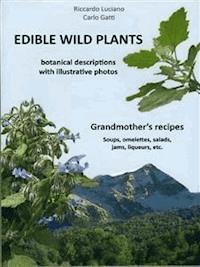
From “Tuttolibri”, La Stampa, Turin, Italy. Walking through the fields, along the lanes or in the mountains can be pleasantly surprising: botany is not just theory... ”Edible Wild Plants” is a fresh, new book. Spontaneous and easy divulgation is fascinating. Rediscovering our botanical roots and those of our places, privileging the edible aspect and retracing the many uses of a plant, suggests new approaches, while preserving the old ones. The late “reuse” of simple herbs, whose many species can be found in fields and pastures, takes us back to the past, when cuisine was poor, yet intelligent and refined. The authors, Riccardo Luciano and Carlo Gatti, have made a small miracle of applied botany. Knowing means protecting: our rich botanical heritage will have a safer, peaceful and happy future. From the back cover. Edible Wild Plants: a book that speaks for itself, with a simple and eye-catching title that invites readers to read and read it once again, as a manual providing useful and practical information. You just need to be careful and some good pieces of information to discover the varied universe of edible plants, precious as a food, as well as for medicinal and cosmetic purposes. From the presentation. In recent years there has been a keen and growing interest in wild plants and their use as an ingredient for salads, soups, omelettes or stuffed ravioli and more. For many people, and for different reasons, harvesting wild plants is a stimulating activity. Yes, because identifying the right plant is not easy and being able to do that is quite rewarding, moreover, some people believe that wild plants are richer in vitamins, mineral salts and active ingredients compared to other plants, although this has not been scientifically proven. Last but not least, what we are harvesting can be really useful, it is an outdoor activity and it could be very fun and relaxing. […] That’s why this book was written: trying to describe in a simple and linear way some wild plants which have been or can be used for cooking and, at the same time, highlighting the most common mistakes that can be made when identifying and harvesting them. So, if on the one hand harvesting wild plants can be really fun, on the other hand those who decide to devote their time to this activity must be really prepared. It is important to choose people who really know wild plants, not just their the dialect name, but everything about them.
Das E-Book können Sie in Legimi-Apps oder einer beliebigen App lesen, die das folgende Format unterstützen:
Veröffentlichungsjahr: 2017
Ähnliche



















Black bryony
Tamus communis
Family: Dioscoreaceae
Common names: black bryony, lady’s-seal, black bindweed.
Features: perennial herbaceous plant with a strong fleshy root, similar to a tuber, where, in spring, erect stems grow, similar to the shoots of the asparagus but with a curved apex; the stems grow twisted on the nearby shrubs.
The leaves are alternate with a long stem and a heart-shaped edge, the apex is sharp, the margin is entire, the young leaves surface is shiny and then becomes opaque; the main veins start all from the base and gather at the apex. Unisexual flowers are grouped in axillary racemes, male flowers are elongated, while female flowers are short. The perianth is pale green, with 6 perpendicular campanulate laciniae.
The fruit, originated from the female flowers, is a red spherical berry containing three to six small round seeds; it can be confused with that of red bryony (Bryonia dioica) and is equally poisonous.
Habitat: woods, vegetation, hedges.
AMSL 0-800 m
Flowering time: April to May
Medicinal properties: emetic, purgative, stimulant. (Drug used: the root).
As a food: poisonous plant; the fruits can be deadly. However, the young shoots are widely used and consumed like those of hops or common asparagus.
BLACK BRYONY (TAMUS COMMUNIS)
BLACK BRYONY, FLOWERS
BLACK BRYONY, FRUITS
BLACK BRYONY, LEAF
Black cumin
Bunium bulbocastanum
Family: Apiaceae
Common names: black cumin, blackseed, black caraway, great pignut.
Features: perennial plant characterised by a brown globose tuber at the base with a diameter of 2 to 4 cm. Annual cylindrical stem, 30 to 60 cm high, usually branched, willowy at the base. Two seven times pinnate lower leaves with linear segments, while upper leaves are just pinnate. 10-20 ray umbels; 5-10 pendants or reflected bracts, white petals; elliptical achene with a peduncle slightly dented on the inside.
Habitat: wheat fields, heavy soil.
AMSL 400-1900 m
Flowering time: May to July
Medicinal properties: slightly astringent.
As a food: the tuber, properly boiled and then seasoned to taste, is really great as a food. The seeds and flowers are also used as a sauce as a substitute for cumin, while leaves are used to decorate dishes.
Notes from “Phytoalimurgia pedemontana”, by Oreste Mattirolo and Bruno Gallino: after washing and cooking the tubercles, they become almost mushy. Crush them with a mortar, add salt to taste and mix everything with milk, or better with cream, then knead it with flour and shape the dough as you would do for hardtacks and bake them in the oven. Some also add sugar.
Recipe40
BLACK CUMIN (BUNIUM BULBOCASTANUM)
BLACK CUMIN, FLOWERS
BLACK CUMIN, TUBER
Black locust
Robinia pseudoacacia
Family: Papilionaceae or Leguminosae
Common name: black locust
Features: deciduous tree 20 to 25 m tall. Erect, often bifurcated trunk with smooth branches and angular and hairy reddish-brown smaller branches, and robust spines on them. Grey-brown wrinkled bark, fissured as it gets older. Compound leaves, unevenly pinnate, 20 to 35 cm long, adorned with stipules transformed into long spines up to 2 cm long; characterised by 4 to 10 pairs of leaflets, slightly petiolate, oval or oblong, green on the upper side and opaque on the lower side.
Flowers: numerous and fragrant, arranged in long, pendulous racemes.
Fruits: sessile leathery legumes, linear (5-10 cm), compressed, reddish brown when ripe.
Habitat: hilly areas. Fast growing, weed.
Medicinal properties: the leaves are purgative and cholagogue.
As a food: the flowers are harvested before they open and are good without the stalks. They can be used to prepare delicious jams, to which it adds a pleasant taste and aroma.
Like elder flowers, but much better, sweeter and fragrant, the flowers of black locust can be dipped in batter and then fried in hot oil to prepare a tasty and delicious dish.
Notes: imported to Europe at the beginning of the seventeenth century from the United States, by J. Robin, who took care of the botanical garden of the King of France, it was brought to Italy about two centuries later, but became quite important only a century ago. It is, indeed, a very frugal species suitable for any type of soil. With its extensive root system, it is used to consolidate landslides and unstable slopes. Unfortunately, it is a very invasive tree, which often tends to expand its presence to the detriment of native species. Its white flowers, arranged in fragrant bunches, attract bees, which produce a type of single flower, light, fluid and very popular honey.
Warning: do not use golden chain flowers (Laburnum, see picture), which are similar to those of black locust, even though they are yellow. They are poisonous.
Recipe10
BLACK LOCUST (ROBINIA PSEUDOACACIA)
GOLDEN CHAIN (LABURNUM), PHOTOGRAPH by MARINELLA ZEPIGI, AMINT
Bladder campion
Silene vulgaris
Family: Caryophyllaceae
Common names: bladder campion, maidenstears.
Features: this plant can reach a height of 50 to 60 cm, with thin and erect floral stems. Its green-ash grey leaves are opposite, oval, almost without a petiole. Its white flowers are arranged on the top of the stems.
Synonyms:S. cucubalus, S. inflata.
Habitat: meadows, wasteland and lawns.
AMSL 0-2800 m
Flowering time: May to October
Medicinal properties: it is not used in herbal medicine, but is great as a food.
As a food: although little known as an edible plant, bladder campion, with its delicate flavour, is one of the most delicious wild plants. Its tender shoots, harvested in spring (length: 5 to 6 cm, must be boiled for a few minutes in water and are great as a side dish along with eggs or other dishes, just like spinach. The same are also used to prepare delicate risottos, omelettes and seasonal soups. To really appreciate the flavour of bladder campion, it must be harvested in time, namely before the shoot hardens. If used to prepare risottos, we recommend cooking the rice in the water where the plant was boiled, this way the dish will be definitely tastier. If used as cooked vegetable, add olive oil and a pinch of salt. Do not add vinegar or you will cover its flavour.
In spring, young cimette (the tips) are used as a food and, if gently rubbed, they make a distinctive noise called “scruscet” in the Piedmontese dialect.
Cutting the plant does not damage it, since it grows and flowers continuously. Once you identify the plant, remember where it is located and do not eradicate it, so as to have always have fresh vegetables.
Recipes 23 - 27
BLADDER CAMPION (SILENE VULGARIS)
BLADDER CAMPION, FLOWERS
Lesen Sie weiter in der vollständigen Ausgabe!
Lesen Sie weiter in der vollständigen Ausgabe!
Lesen Sie weiter in der vollständigen Ausgabe!
Lesen Sie weiter in der vollständigen Ausgabe!
Lesen Sie weiter in der vollständigen Ausgabe!
Lesen Sie weiter in der vollständigen Ausgabe!
Lesen Sie weiter in der vollständigen Ausgabe!
Lesen Sie weiter in der vollständigen Ausgabe!
Lesen Sie weiter in der vollständigen Ausgabe!
Lesen Sie weiter in der vollständigen Ausgabe!
Lesen Sie weiter in der vollständigen Ausgabe!
Lesen Sie weiter in der vollständigen Ausgabe!
Lesen Sie weiter in der vollständigen Ausgabe!
Lesen Sie weiter in der vollständigen Ausgabe!
Lesen Sie weiter in der vollständigen Ausgabe!
Lesen Sie weiter in der vollständigen Ausgabe!
Lesen Sie weiter in der vollständigen Ausgabe!
Lesen Sie weiter in der vollständigen Ausgabe!
Lesen Sie weiter in der vollständigen Ausgabe!
Lesen Sie weiter in der vollständigen Ausgabe!
Lesen Sie weiter in der vollständigen Ausgabe!
Lesen Sie weiter in der vollständigen Ausgabe!
Lesen Sie weiter in der vollständigen Ausgabe!
Lesen Sie weiter in der vollständigen Ausgabe!
Lesen Sie weiter in der vollständigen Ausgabe!
Lesen Sie weiter in der vollständigen Ausgabe!
Lesen Sie weiter in der vollständigen Ausgabe!
Lesen Sie weiter in der vollständigen Ausgabe!
Lesen Sie weiter in der vollständigen Ausgabe!
Lesen Sie weiter in der vollständigen Ausgabe!
Lesen Sie weiter in der vollständigen Ausgabe!
Lesen Sie weiter in der vollständigen Ausgabe!
Lesen Sie weiter in der vollständigen Ausgabe!
Lesen Sie weiter in der vollständigen Ausgabe!
Lesen Sie weiter in der vollständigen Ausgabe!
Lesen Sie weiter in der vollständigen Ausgabe!
Lesen Sie weiter in der vollständigen Ausgabe!
Lesen Sie weiter in der vollständigen Ausgabe!
Lesen Sie weiter in der vollständigen Ausgabe!
Lesen Sie weiter in der vollständigen Ausgabe!
Lesen Sie weiter in der vollständigen Ausgabe!
Lesen Sie weiter in der vollständigen Ausgabe!
Lesen Sie weiter in der vollständigen Ausgabe!
Lesen Sie weiter in der vollständigen Ausgabe!
Lesen Sie weiter in der vollständigen Ausgabe!
Lesen Sie weiter in der vollständigen Ausgabe!
Lesen Sie weiter in der vollständigen Ausgabe!
Lesen Sie weiter in der vollständigen Ausgabe!
Lesen Sie weiter in der vollständigen Ausgabe!
Lesen Sie weiter in der vollständigen Ausgabe!
Lesen Sie weiter in der vollständigen Ausgabe!
Lesen Sie weiter in der vollständigen Ausgabe!
Lesen Sie weiter in der vollständigen Ausgabe!
Lesen Sie weiter in der vollständigen Ausgabe!
Lesen Sie weiter in der vollständigen Ausgabe!
Lesen Sie weiter in der vollständigen Ausgabe!
Lesen Sie weiter in der vollständigen Ausgabe!
Lesen Sie weiter in der vollständigen Ausgabe!
Lesen Sie weiter in der vollständigen Ausgabe!
Lesen Sie weiter in der vollständigen Ausgabe!
Lesen Sie weiter in der vollständigen Ausgabe!
Lesen Sie weiter in der vollständigen Ausgabe!
Lesen Sie weiter in der vollständigen Ausgabe!
Lesen Sie weiter in der vollständigen Ausgabe!
Lesen Sie weiter in der vollständigen Ausgabe!
Lesen Sie weiter in der vollständigen Ausgabe!
Lesen Sie weiter in der vollständigen Ausgabe!
Lesen Sie weiter in der vollständigen Ausgabe!
Lesen Sie weiter in der vollständigen Ausgabe!
Lesen Sie weiter in der vollständigen Ausgabe!
Lesen Sie weiter in der vollständigen Ausgabe!
Lesen Sie weiter in der vollständigen Ausgabe!
Lesen Sie weiter in der vollständigen Ausgabe!
Lesen Sie weiter in der vollständigen Ausgabe!
Lesen Sie weiter in der vollständigen Ausgabe!
Lesen Sie weiter in der vollständigen Ausgabe!
Lesen Sie weiter in der vollständigen Ausgabe!
Lesen Sie weiter in der vollständigen Ausgabe!
Lesen Sie weiter in der vollständigen Ausgabe!
Lesen Sie weiter in der vollständigen Ausgabe!
Lesen Sie weiter in der vollständigen Ausgabe!
Lesen Sie weiter in der vollständigen Ausgabe!
Lesen Sie weiter in der vollständigen Ausgabe!
Lesen Sie weiter in der vollständigen Ausgabe!
Lesen Sie weiter in der vollständigen Ausgabe!
Lesen Sie weiter in der vollständigen Ausgabe!
Lesen Sie weiter in der vollständigen Ausgabe!
Lesen Sie weiter in der vollständigen Ausgabe!
Lesen Sie weiter in der vollständigen Ausgabe!
Lesen Sie weiter in der vollständigen Ausgabe!
Lesen Sie weiter in der vollständigen Ausgabe!
Lesen Sie weiter in der vollständigen Ausgabe!
Lesen Sie weiter in der vollständigen Ausgabe!
Lesen Sie weiter in der vollständigen Ausgabe!
Lesen Sie weiter in der vollständigen Ausgabe!
Lesen Sie weiter in der vollständigen Ausgabe!
Lesen Sie weiter in der vollständigen Ausgabe!
Lesen Sie weiter in der vollständigen Ausgabe!
Lesen Sie weiter in der vollständigen Ausgabe!
Lesen Sie weiter in der vollständigen Ausgabe!
Lesen Sie weiter in der vollständigen Ausgabe!
Lesen Sie weiter in der vollständigen Ausgabe!
Lesen Sie weiter in der vollständigen Ausgabe!
Lesen Sie weiter in der vollständigen Ausgabe!
Lesen Sie weiter in der vollständigen Ausgabe!
Lesen Sie weiter in der vollständigen Ausgabe!
Lesen Sie weiter in der vollständigen Ausgabe!
Lesen Sie weiter in der vollständigen Ausgabe!
Lesen Sie weiter in der vollständigen Ausgabe!
Lesen Sie weiter in der vollständigen Ausgabe!
Lesen Sie weiter in der vollständigen Ausgabe!
Lesen Sie weiter in der vollständigen Ausgabe!




