


47,99 €
Mehr erfahren.
- Herausgeber: John Wiley & Sons
- Kategorie: Wissenschaft und neue Technologien
- Sprache: Englisch
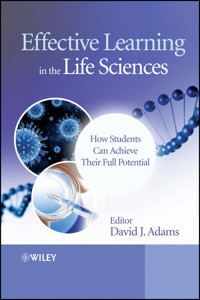
Effective Learning in the Life Sciences is intended to help ensure that each student achieves his or her true potential by learning how to solve problems creatively in laboratory, field or other workplace setting. Each chapter describes state of the art approaches to learning and teaching and will include case studies, worked examples and a section that lists additional online and other resources.
All of the chapters are written from the perspective both of students and academics and emphasize and embrace effective scientific method throughout. This title also draws on experience from a major project conducted by the Centre for Bioscience, with a wide range of collaborators, designed to identify and implement creative teaching in bioscience laboratories and field settings.
With a strong emphasis on students thinking for themselves and actively learning about their chosen subject Effective Learning in the Life Sciences provides an invaluable guide to making the university experience as effective as possible.
Sie lesen das E-Book in den Legimi-Apps auf:
Seitenzahl: 578
Veröffentlichungsjahr: 2011
Ähnliche


















Contents
Cover
Title Page
Copyright
Dedication
List of contributors
Introduction
The Book, Chapter by Chapter
Chapter 1: Creativity
1.1 Introduction
1.2 Adaptors and Creators
1.3 Defining Problems
1.4 Accessing Your Creative Potential
1.5 Creativity Techniques
1.6 Incubation
1.7 Working in Groups – Creative Environments
1.8 Working in Groups – Facilitated Creativity Sessions
1.9 How Many Uses for an Old CD?
1.10 Evaluating Your Ideas
1.11 Putting Your Ideas Into Action
1.12 How you can Achieve Your Creative Potential
1.13 References
1.14 Additional resources
Chapter 2: Problem solving – developing critical, evaluative and analytical thinking skills
2.1 What is Problem Solving?
2.2 Problem-solving strategies
2.3 Critical Thinking
2.4 Critical Reading
2.5 Using Judgement
2.6 Constructing an Argument
2.7 Visualisation – Making Representations
2.8 Other Strategies
2.9 Pulling it Together
2.10 How You Can Achieve Your Potential as a Problem Solver
2.11 References
Additional resources
Chapter 3: In the laboratory
3.1 Introduction
3.2 The Scientific Method
3.3 Preparing for a Laboratory Class
3.4 Laboratory Notebooks
3.5 Laboratory Equipment
3.6 Calculations in the Laboratory
3.7 Working in a Group
3.8 Working on Your Own
3.9 Writing-up Experiments – the Laboratory Report
3.10 Concluding Comments
3.11 How You Can Achieve Your Potential in the Laboratory
3.12 Acknowledgements
3.13 References
3.14 Additional resources
3.15 Problems associated with Koch's postulates
Chapter 4: Fieldwork
4.1 Introduction
4.2 Fieldwork – Exciting or Overwhelming?
4.3 Planning and Time Management
4.4 Group Work and Social Aspects of Fieldwork
4.5 Collecting the Right Data
4.6 Technology in the Field
4.7 Costs, Sustainability and Ethics
4.8 Safety and Permissions
4.9 Accessibility
4.10 Making the Most of Different Types of Fieldwork
4.11 Overcoming the Problems that WILL occur
4.12 Feedback and Assessment (see also Chapter 10)
4.13 Concluding Comments
4.14 How you can Achieve Your Potential During Fieldwork
4.15 References
4.16 Additional resources
4.17 Potential solutions for kick-sampling case study
Chapter 5: In vivo work
5.1 Introduction
5.2 Animal Welfare Legislation
5.3 The Principles of the 3Rs
5.4 Alternatives to the Use of Animals in the Development of New Medicines
5.5 Animal Models of Disease
5.6 Experimental Design
5.7 Recognition of Pain, Suffering or Ill Health in Animals Used for Research
5.8 Ethical Review of In Vivo Studies
5.9 Harm/Benefit Analysis
5.10 The Arguments for and Against Animal Experimentation
5.11 How You Can Achieve Your Potential in In Vivo Work
5.12 References
Chapter 6: Research projects
6.1 Introduction
6.2 Research Project – Role and Purpose
6.3 Applying the Scientific Method
6.4 Types of Project and Ideas for Research
6.5 Characteristics of Good Research Projects
6.6 Working in Groups
6.7 Writing up
6.8 The Possibility of Publication
6.9 How You Can Achieve Your Potential During Final-Year Project Studies
6.10 Tutor notes
6.11 Acknowledgements
6.12 References
6.13 Additional resources
Chapter 7: Maths and stats for biologists
7.1 Introduction
7.2 Motivation – This Chapter is Important!
7.3 Confidence – You can do it!
7.4 Skills – do It!
7.5 How you can Achieve Your Potential in Biomaths
7.6 Acknowledgements
7.7 References
7.8 Additional resources (accessed April 2011)
Chapter 8: E-learning for biologists
8.1 Introduction
8.2 Online Working Environment
8.3 Resources
8.4 Legal Considerations
8.5 Protecting Your Work
8.6 Organisation
8.7 Developing as a Professional
8.8 Information Online
8.9 Working Effectively
8.10 How you can Achieve Your Potential Using Computers and Online Resources
8.11 References
8.12 Additional resources
Chapter 9: Bioethics
9.1 Introduction
9.2 The Rise of Ethics in the Bioscience Curriculum
9.3 What Exactly is Bioethics?
9.4 Putting the Case for Ethics Education
9.5 Developing Insight Into Ethical Issues
9.6 Taking it Further
9.7 Conclusion
9.8 How You Can Achieve Your Potential in Bioethics
9.9 Tutor Notes
9.10 References
9.11 Additional resources
Chapter 10: Assessment, feedback and review
10.1 Introduction and Some Definitions
10.2 Types of Assessment
10.3 Marking Criteria
10.4 Learning Outcomes
10.5 Feedback
10.6 Peer support – learning from and with your classmates
10.7 Peer Assessment
10.8 Self-Review and Assessment
10.9 Bringing it all Together
10.10 How You Can Use Assessment, Feedback and Review to Help You Achieve Your Potential
10.11 References
10.12 Additional resources (accessed April 2011)
Chapter 11: Communication in the biosciences
11.1 Introduction
11.2 Communication Skills in the Undergraduate Curriculum
11.3 Opportunities to Develop Communication Skills
11.4 Written Communication
11.5 Visual Communication
11.6 Oral Communication
11.7 Public Engagement
11.8 How you can Achieve Your Potential as a Communicator
11.9 References
11.10 Additional resources (accessed January 2011)
Chapter 12: Bioenterprise
12.1 Introduction
12.2 Phase 1 Identifying and protecting an idea
12.3 Phase 2 Researching the Market Potential for Your Idea
12.4 Phase 3 Setting out Your Ideas and Goals – The Business Plan
12.5 Communicating your Business – the ‘Pitch’
12.6 Concluding Comments
12.7 How you can Achieve Your Enterprising and Entrepreneurial Potential
12.9 References
12.10 Additional resources (accessed April 2011)
Appendix
Index
This edition first published 2011 © 2011 by John Wiley & Sons, Ltd
Wiley–;Blackwell is an imprint of John Wiley & Sons, formed by the merger of Wiley's global Scientific, Technical and Medical business with Blackwell Publishing.
Registered office: John Wiley & Sons, Ltd, The Atrium, Southern Gate, Chichester, West Sussex, PO19 8SQ, UK
Editorial offices: 9600 Garsington Road, Oxford, OX4 2DQ, UK The Atrium, Southern Gate, Chichester, West Sussex, PO19 8SQ, UK 111 River Street, Hoboken, NJ 07030-5774, USA
For details of our global editorial offices, for customer services and for information about how to apply for permission to reuse the copyright material in this book please see our website at www.wiley.com/wiley-blackwell.
The right of the author to be identified as the author of this work has been asserted in accordance with the UK Copyright, Designs and Patents Act 1988.
All rights reserved. No part of this publication may be reproduced, stored in a retrieval system, or transmitted, in any form or by any means, electronic, mechanical, photocopying, recording or otherwise, except as permitted by the UK Copyright, Designs and Patents Act 1988, without the prior permission of the publisher.
Designations used by companies to distinguish their products are often claimed as trademarks. All brand names and product names used in this book are trade names, service marks, trademarks or registered trademarks of their respective owners. The publisher is not associated with any product or vendor mentioned in this book. This publication is designed to provide accurate and authoritative information in regard to the subject matter covered. It is sold on the understanding that the publisher is not engaged in rendering professional services. If professional advice or other expert assistance is required, the services of a competent professional should be sought.
Library of Congress Cataloging-in-Publication Data
Effective learning in the life sciences : how students can achieve their full potential / [edited by] David Adams.
p. cm.
Summary: “Draws on experience from a major project conducted by the Centre for Bioscience, with a wide range of collaborators, designed to identify and implement creative teaching in bioscience laboratories and field settings”–Provided by publisher.
Includes bibliographical references and index.
ISBN 978-0-470-66156-7 (cloth) – ISBN 978-0-470-66157-4 (paper)
1. Life sciences–Study and teaching (Higher) 2. Life sciences–Study and teaching (Higher)–Great Britain. 3. Creative teaching. 4. Biological laboratories. 5. Life sciences–Research. 6. Life sciences–Fieldwork. I. Adams, David J. (David James) II. UK Centre for Bioscience.
QH315.E33 2011
570.71'1–dc23
2011022847
ePDF: 9781119976653;
Wiley Online Library: 9781119976646;
ePub: 9781119977636;
Mobi: 9781119977643
To my colleagues in the UK Centre for Bioscience. It was a pleasure and a privilege to work with you all.
David Adams was Director of the UK Centre for Bioscience, Higher Education Academy, from 2007–2011. Currently he is Director of Science and Research at Cogent Sector Skills Council.
List of contributors
David J. Adams
UK Centre for Bioscience, Higher Education Academy
Room 9.15, Worsley Building
University of Leeds
Leeds, LS2 9JT
Jo L. Badge
School of Biological Sciences
University of Leicester
University Road
Leicester, LE1 7RH
Lee J. Beniston
Leeds University Business School
Maurice Keyworth Building
University of Leeds
Leeds, LS2 9JT
Kevin Byron
The Learning Institute
Room 3.03A, Francis Bancroft Building
Mile End Campus
Queen Mary, University of London
London, E1 4NS
Maureen M. Dawson
c/o Centre for Learning and Teaching
Manchester Metropolitan University
2nd Floor, Cavendish North
Cavendish Street
Manchester, M15 6BG
Dawn Hawkins
Department of Life Sciences
Anglia Ruskin University
East Road
Cambridge, CB1 1PT
David I. Lewis
Faculty of Biological Sciences and Interdisciplinary Ethics Applied CETL
University of Leeds
Leeds, LS2 9JT
Martin Luck
School of Biosciences
University of Nottingham
Sutton Bonington Campus
Loughborough, LE12 5RD
Alice L. Mauchline
School of Agriculture, Policy and Development
University of Reading
PO Box 237
Reading, RG6 6AR
Stephen J. Maw
UK Centre for Bioscience, Higher Education Academy
Room 9.15, Worsley Building
University of Leeds
Leeds, LS2 9JT
Terry J. McAndrew
UK Centre for Bioscience, Higher Education Academy
Room 9.15, Worsley Building
University of Leeds
Leeds, LS2 9JT
Pauline E. Millican
c/o UK Centre for Bioscience, Higher Education Academy
Room 9.15, Worsley Building
University of Leeds
Leeds, LS2 9JT
Paul Orsmond
Faculty of Sciences
Staffordshire University
Mellor Building
College Road
Stoke-on-Trent, ST4 2DE
Tina L. Overton
UK Physical Sciences Centre
Higher Education Academy
Department of Chemistry
University of Hull
Hull, HU6 7RX
Julian R. Park
School of Agriculture, Policy and Development
University of Reading
PO Box 237
Reading, RG6 6AR
Julie Peacock
UK Centre for Bioscience, Higher Education Academy
Room 9.15, Worsley Building
University of Leeds
Leeds, LS2 9JT
Jon J. A. Scott
College of Medicine, Biological Sciences & Psychology
University of Leicester
University Road
Leicester, LE1 7RH
Joanna Verran
School of Health Care Science
Manchester Metropolitan University
Chester Street
Manchester, M1 5GD
Carol Wakeford
Faculty of Life Sciences
University of Manchester
1.124 Stopford Building
Oxford Road
Manchester, M13 9PT
Chris J. R. Willmott
Department of Biochemistry
University of Leicester
Leicester, LE1 9HN
Introduction
There has never been a more exciting time to study biology. We hear almost daily of major developments in new areas such as nanobiology, stem cell research or GM technology, and the popular media are forever running stories on the global impact of the biosciences. You have the chance to participate in this ongoing revolution, and if you are to make the most of this opportunity you must be prepared to think for yourself and fully engage in the learning process. If you can make this commitment then you should benefit greatly from this book.
Many of the book's contributors have interacted closely with the UK Centre for Bioscience, and its predecessors, during the last decade. Together they offer a wealth of experience and expertise in a wide range of areas of current importance in bioscience education. For the first time in a single volume, topics such as creativity, e-learning, bioethics and bioenterprise are considered, in detail, alongside more traditional elements of bioscience degree programmes such as laboratory classes and fieldwork. In addition, the book addresses areas and issues frequently identified by bioscience students as problematic. These include lack of confidence when using maths or stats in bioscience settings, difficulties when solving problems and frustration with assessment and feedback procedures. The book is designed to help you with these issues, and you will be able to access further support through an Additional resources section at the end of each chapter.
There is emphasis on interactivity, with inclusion of worked examples and case studies throughout. If you participate in these exercises and make the most of each chapter you will acquire a wide range of skills. These include many of the skills currently sought by prospective employers. Industrialists and university research laboratory supervisors alike indicate they want well-rounded graduates who can solve problems creatively in a wide range of settings. Enthusiastic engagement with the contents of this book should therefore help ensure not only that you benefit maximally from your time at university but also that you improve your employment prospects and achieve your true potential as a life scientist.
The Book, Chapter by Chapter
Students are imaginative and inventive individuals, but unfortunately they are rarely given any help to achieve their true creative potential during bioscience degree programmes. A distinctive feature of this book is the inclusion of a chapter (Chapter 1) that will help promote your individual creativity and the creativity that often occurs when students work together in groups. As with creativity, students of the biosciences are given little help to develop their problem-solving abilities; in the second chapter you will therefore be shown how to approach algorithmic and open-ended problems with confidence. The next two chapters focus on practical skills in the biosciences with emphasis on students achieving their potential in laboratory and field. Continuing the practical theme, in vivo work (i.e. work with animals) is an area that has been identified as of paramount importance by the UK Government, researchers and educationalists, and an unusual and useful feature of this book (Chapter 5) is the consideration of a wide range of approaches and issues associated with the use of animals in the laboratory. In the final year of your studies you are likely to be engaged in a major research project. In recent years universities have offered a wide range of formats for projects, and these are considered in Chapter 6, which should help you identify the type of project best suited to your needs. The next chapter considers issues associated with maths and stats for biologists and describes how you can build your confidence in these areas. Chapter 8 contains a state-of-the-art update on e-learning in the biosciences, with advice on the use of new technologies including mobile phones, blogs, wikis, Facebook etc. You should know about traditional, as well as the most recent and innovative, assessment procedures used in universities. In addition you should be fully aware of the sort of regular feedback you can expect during your degree programme. These issues are considered in Chapter 10. It is essential that bioscientists should be able to communicate their ideas and general scientific information to other scientists and to members of the public. Chapter 11 describes traditional and novel approaches for communication in the biosciences. Two further notable features of this book are chapters on Bioethics and Bioenterprise. These are areas of great current importance to bioscientists. A considerable amount of material already exists in the field of bioethics, and Chapter 9 will raise your awareness of current approaches in this area. Bioenterprise and Knowledge Transfer are topics that are being embraced enthusiastically by many universities and the final chapter of the book considers how students of the biosciences can achieve their enterprising and entrepreneurial potential.
Tutor Notes
The bioscience knowledge base is growing at a remarkable rate, and this can lead to tutors placing great demands on students who are asked to absorb enormous amounts of information. Unfortunately this can be at the expense of course components designed to promote independent thought and real engagement with the Scientific Method. This book is intended to redress this imbalance by raising students' awareness of their own considerable potential in areas of traditional and emerging importance. It is much more than a study skills guide, in that in each of the 12 diverse chapters the authors aim to build students' confidence to the point where they can decide for themselves whether they are making the most of their time at university.
You will find Tutor notes throughout, or at the end of, chapters. The notes will direct you to a great deal of additional material in support of teaching in the biosciences. This includes a very wide range of online and other resources provided by the UK Centre for Bioscience, Higher Education Academy.
David Adams
July 2011
Chapter 1
Creativity
David J. Adams and Kevin Byron
1.1 Introduction
We should start by defining the terms ‘creativity’ and ‘innovation’. Creativity involves original and imaginative thoughts that lead to novel and useful ideas. If you are to put these ideas to good use, you must be innovative as well as creative. Innovation may be defined as the exploitation of ideas in, for example, the development of new procedures or technologies. An excellent illustration of the distinction between creativity and innovation is the invention and development of the electric light bulb. Most people would identify Thomas Edison as the light bulb's inventor, yet over 20 individuals are thought to have invented similar devices up to 80 years before Edison's contributions. Only Edison was sufficiently innovative to refine his invention until it was a practical device that could be brought into commercial use in partnership with an electrical distribution company. You will learn how to ensure that your creative ideas are brought to fruition in Chapter 12.
Students of the biosciences are rarely encouraged to be truly creative or innovative (Adams et al., 2009). A notable exception may arise during a final-year project, when you might be asked to come up with some novel ideas or solve a problem creatively. However, it is unlikely that you will be offered any help in generating original, imaginative thoughts or solutions. Indeed, in our view, bioscience students are rarely given the opportunity to develop anything like their full creative potential. This is a great shame because bioscience graduates will frequently be expected to be creative in a wide range of career settings.
In this chapter we consider a number of issues associated with the promotion of creativity in bioscientists. We start by inviting you to decide whether you consider yourself to be a ‘creator’ or whether your natural inclination is to be more of an ‘adaptor’. The outcome of this exercise will help you make the most of the subsequent sections that deal with how to define problems, then solve them creatively as an individual or as a member of a team.
1.2 Adaptors and Creators
It would seem that some people are naturally more inclined than others to take risks, challenge assumptions and be creative. Indeed, the psychologist Michael Kirton suggests that we can each be placed on a continuum based on our inclination to ‘do things better’ or to ‘do things differently’ and he labels the opposite ends of this continuum adaptive and innovative, respectively (Figure 1.1; Kirton, 1976). You may find it useful to consider where you fall on such a scale (Table 1.1). If you feel you are more of a creator/innovator than an adaptor then you are likely to benefit most from the problem-defining and problem-solving frameworks outlined in Section 1.3 of this chapter. On the other hand, adaptors should find of most value the techniques designed to promote creativity (Sections 1.4–1.9).
Table 1.1 Some of the characteristics associated with individuals located at the extremes of the adaptor–creator/innovator continuum
Lesen Sie weiter in der vollständigen Ausgabe!
Lesen Sie weiter in der vollständigen Ausgabe!
Lesen Sie weiter in der vollständigen Ausgabe!
Lesen Sie weiter in der vollständigen Ausgabe!
Lesen Sie weiter in der vollständigen Ausgabe!
Lesen Sie weiter in der vollständigen Ausgabe!
Lesen Sie weiter in der vollständigen Ausgabe!
Lesen Sie weiter in der vollständigen Ausgabe!
Lesen Sie weiter in der vollständigen Ausgabe!
Lesen Sie weiter in der vollständigen Ausgabe!
Lesen Sie weiter in der vollständigen Ausgabe!
Lesen Sie weiter in der vollständigen Ausgabe!
Lesen Sie weiter in der vollständigen Ausgabe!




