


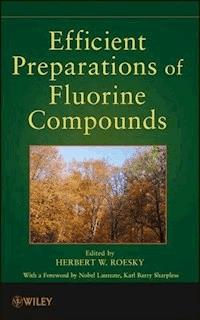
Efficient Preparations of Fluorine Compounds E-Book
120,99 €
Mehr erfahren.
- Herausgeber: John Wiley & Sons
- Kategorie: Wissenschaft und neue Technologien
- Sprache: Englisch
The definitive guide to creating fluorine-based compounds--and the materials of tomorrow Discovered as an element by the French chemist Henri Moissan in 1886, through electrolysis of potassium fluoride in anhydrous hydrogen fluoride--"le fluor," or fluorine, began its chemical history as a substance both elusive and dangerous. With a slight pale yellow hue, fluorine is at room temperature a poisonous diatomic gas. Resembling a spirit from a chemical netherworld, fluorine is highly reactive, difficult to handle, yet very versatile as a reagent--with the power to form compounds with almost any other element. Comprising 20% of pharmaceutical products and 30% of agrochemical compounds, as well as playing a key role in electric cars, electronic devices, and space technology, compounds containing fluorine have grown in importance across the globe. Learning how to safely handle fluorine in the preparation of innovative new materials--with valuable new properties--is of critical importance to chemists today. Bringing together the research and methods of leading scientists in the fluorine field, Efficient Preparations of Fluorine Compounds is the definitive manual to creating, and understanding the reaction mechanisms integral to a wide variety of fluorine compounds. With sixty-eight contributed chapters, the book's extensive coverage includes: * Preparation of Elemental Fluorine * Synthesis Methods for Exotic Inorganic Fluorides with Varied Applications * Introduction of Fluorine into Compounds via Electrophilic and Nucleophilic Reactions * Direct Fluorination of Organic Compounds with Elemental Fluorine * Efficient Preparations of Bioorganic Fluorine Compounds * Asymmetric Fluorocyclization Reactions * Preparations of Rare Earth Fluorosulfides and Oxyfluorosulfides The book offers methods and results that can be reproduced by students involved in advanced studies, as well as practicing chemists, pharmaceutical scientists, biologists, and environmental researchers. The only chemical resource of its kind, Efficient Preparations of Fluorine Compounds--from its first experiment to its last--is a unique window into the centuries old science of fluorine and the limitless universe of fluorine-based compounds.
Sie lesen das E-Book in den Legimi-Apps auf:
Seitenzahl: 791
Veröffentlichungsjahr: 2012
Ähnliche




















Copyright © 2013 by John Wiley & Sons, Inc. All rights reserved
Published by John Wiley & Sons, Inc., Hoboken, New Jersey
Published simultaneously in Canada.
No part of this publication may be reproduced, stored in a retrieval system, or transmitted in any form or by any means, electronic, mechanical, photocopying, recording, scanning, or otherwise, except as permitted under Section 107 or 108 of the 1976 United States Copyright Act, without either the prior written permission of the Publisher, or authorization through payment of the appropriate per-copy fee to the Copyright Clearance Center, Inc., 222 Rosewood Drive, Danvers, MA 01923, (978) 750-8400, fax (978) 750-4470, or on the web at www.copyright.com. Requests to the Publisher for permission should be addressed to the Permissions Department, John Wiley & Sons, Inc., 111 River Street, Hoboken, NJ 07030, (201) 748-6011, fax (201) 748-6008, or online at http://www.wiley.com/go/permission.
Limit of Liability/Disclaimer of Warranty: While the publisher and author have used their best efforts in preparing this book, they make no representations or warranties with respect to the accuracy or completeness of the contents of this book and specifically disclaim any implied warranties of merchantability or fitness for a particular purpose. No warranty may be created or extended by sales representatives or written sales materials. The advice and strategies contained herein may not be suitable for your situation. You should consult with a professional where appropriate. Neither the publisher nor author shall be liable for any loss of profit or any other commercial damages, including but not limited to special, incidental, consequential, or other damages.
For general information on our other products and services or for technical support, please contact our Customer Care Department within the United States at (800) 762-2974, outside the United States at (317) 572-3993 or fax (317) 572-4002.
Wiley also publishes its books in a variety of electronic formats. Some content that appears in print may not be available in electronic formats. For more information about Wiley products, visit our web site at www.wiley.com.
Library of Congress Cataloging-in-Publication Data:
Efficient preparations of fluorine compounds / edited by Herbert W. Roesky.
pages cm
Includes index.
ISBN 978-1-118-07856-3 (hardback)
1. Fluorine compounds. I. Roesky, H. W., editor of compilation.
QD181.F1E34 2012
546′.7312–dc23
2012025732
ISBN: 9781118078563
FOREWORD
When Herbert W. Roesky asked if I might write a foreword for his book, I accepted instantly, without even glancing at the list of authors or topics! The reason is very simple and it goes back many years.
Herbert W. Roesky and I have only met in person on a few occasions, yet I feel I know him well, mainly because I read his early papers in the Chemistry Library at Stanford where I was a graduate student in the 1960s. In hindsight, I realize we both like the idea of mixing up simple, readily available chemicals from all around the periodic table and seeing what happens. There are vast terrae incognitae of descriptive chemistry throughout “the table” still waiting to be entered that could provide access to materials and functions not yet imagined.
Berzelius was the first to make the distinction between organic and inorganic compounds, and to strictly entail their origins as animate and inanimate, respectively. The first shock for believers in the vis vitalis origin was delivered by Berzelius's own student, Friedrich Wöhler, who, in an 1828 issue of Annalen der Physik und Chemie disclosed the synthesis of “organic” urea by simple union of two “inorganics”: water and isocyanate. Organic chemists since Wöhler rationally know that natural products contain no ‘magic’ force or aura. Nevertheless, the synthesis of natural products has long been and remains a central research endeavor in organic chemistry. In retrospect, this bias was very likely ordained by the field's “birth” under vitalism.
Every chemist needs to know physical chemistry, just as every natural scientist needs to know the basic laws of physics, above all thermodynamics. But, beyond that, I prefer to just be a chemist. The idea of there being organic and inorganic chemists is bad enough, but today there are now so many qualifiers before chemist I suggest we need to start over. The only subtype of chemist I am not ashamed of being is a “reactivity” chemist or a ‘process’ chemist, which are nearly the same thing and which I will define as a real chemist for the moment. A real chemist should have a quick, hence intuitive sense, of the most likely chemical reactions occurring when any element, or simple compound thereof, is combined with others from around The Table.
In my view, process/reactivity chemists are a breed apart, and, in fact, are the only real chemists. Fluorine chemists, for example, are by definition good process chemists or they could not survive, literally! Many years of experience, together with deep and catholic knowledge of chemical reactivity principles, is the important coin in this realm. The specific backgrounds of process chemists matter little, but they are united by an intense focus on issues affecting chemical reactivity and have a sixth sense for the critical points in the overall sequence. The best of this breed take great pride in anticipating serious obstacles and avoiding them altogether. Of course, even the most carefully considered routes hit unknowable barriers in the real world. For a gifted process chemist, such unexpected encounters elicit excitement, not anxiety. I personally like the cases where the fix involves the realization that one or more of the fundamental reaction parameters is the culprit.
For example, it is not uncommon for the pH to take a damaging excursion when a process aims for production scales. On a small lab scale, with everything being added quickly the pH problem is barely noticeable. However at scale, where one of the crucial reactants must be added slowly for safety reasons, there will be predictable circumstances in which the pH will transit a wide range over the course of the addition stage. This problem is easily solved by having the right buffer system present. This may sound like trivial “reaction doctoring” but, when it works perfectly as planned, it makes my day. Reactions that proceed smoothly—as if gliding along the desired path—can leave the chemist in charge with the whimsical sense of wielding power over the molecules, which of course is just plain absurd!
The contributors to this volume are all “reactivity hounds,” hence real chemists by definition. The level of experimental detail here is extraordinary and thus fully enabling for those less experienced in dealing with highly reactive species. Nearly all the famous names in fluorine chemistry were included by the editor. I imagine he is hard to turn down in any case, but his plan was also compelling: reach out to all chemists with favorite recipes and transformations from the best in the field.
When I am with fellow process chemists or following their recipes, I love to glean the “hints” for success that inevitably pop up. These “hints” are precious gems that need years in the trenches to reach crystalline perfection. I can see this book serving researchers and students for years to come in the many fields dependent on new compounds possessed of new or better properties. Fluorine is already famous as a giver of unique, even unimagined, properties. The practical value of fluorine substitution in molecules can only continue to grow. Fluorine is abundant in the Earth's crust as gem quality crystalline forms of CaF2, so its uses in the future are limited only by existing reactivity constraints on crucial reaction paths.
Chemists' power/value to society derives almost entirely from our ability to manipulate reactivity. Some reactions are easily manipulated; at the other extreme are reactions that we may never succeed in manipulating. Fluorine chemistry is an area rich in reactivity constraints but also in compounds with valuable properties, and is thus a fertile hunting ground for chemists. As chemists, it falls to us to either lower the constraining barrier for the desired reaction, or discover workaround routes skirting the high passes.
In short, I see a very bright future for new fluorine-containing products. If you are the monovalent element at the end of the electronegativity universe, your presence in a molecule could prove absolutely crucial for function. A stand-in (e.g., C-Cl) for a C-F group might suffice in some applications but, wishful thinking aside, an honest surrogate for a C-F unit does not exist—nothing even comes close.
KARL BARRY SHARPLESS
PREFACE
The idea to publish a book with the title Efficient Preparations of Fluorine Compounds resulted on behalf of two observations. Firstly, about 20% of pharmaceutical products as well as 30% of agrochemical compounds contain fluorine, and the proportion is increasing. This indicates the importance of organofluorine compounds worldwide. Secondly, the interest in fluorine chemistry at the university level is steadily decreasing during the last two decades. Therefore authors working in the fluorine field were asked to write about their discoveries in a way that young scientists may reproduce their results, and use the fluorine-containing compounds to add new facets to their research.
This book brings together contributions written by leading researchers and covering a wide scope of fluorine chemistry. Karl O. Christe describes an easy laboratory method for the preparation of elemental fluorine as the first experiment. This method guarantees an easy access to fluorine when compared with that of Henri Moissan. He discovered fluorine in 1886 by electrolysis of potassium fluoride in anhydrous hydrogen fluoride. Moissan was awarded the Nobel Prize in Chemistry in 1906 for the discovery of “le fluor.”
Fluorine is a poisonous diatomic gas at room temperature. It is a very versatile reagent and can form compounds with almost every element. A milestone in fluorine chemistry was achieved in 1962, when Neil Bartlett obtained the noble gas compound Xenon fluoride. The general accepted view that noble gases were inert ended with this experiment. It led to the preparation of a great number of noble gas fluoride and their derivatives.
Fluorine continues to fascinate chemists who overcome the fear of handling fluorine for the preparation of new compounds and materials. Fluorine compounds play a key role in electric cars, electronic devices, space technology, pharmaceuticals, and agrochemicals. However, especially in fluorine chemistry, the words of Winston Churchill are true: “Success is the ability to go from one failure to another with no less of enthusiasm.”
Finally and most importantly, I am very thankful to the authors for their excellent contributions, and I hope that this book will inspire a young generation to do research in fluorine chemistry.
HERBERT W. ROESKY
CONTRIBUTORS
Bruno Ameduri Engineering and Macromolecular Architectures, Institute Charles Gerhardt UMR (CNRS) 5253, Ecole Nationale Supérieure de Chimie de Montpellier, 8 Rue de l'Ecole Normale, 34296 Montpellier Cedex 5, France
Aldos C. Barefoot, III Department of Chemistry, Dartmouth College, Hanover, NH 03755, USA
Rolf Bohlmann Global Drug Discovery, Bayer Pharma AG, Müllerstr. 178, D-13353 Berlin, Germany
Olga V. Boltalina Department of Chemistry, Colorado State University, Fort Collins, CO 80523, USA
Thomas Braun Department of Chemistry, Humboldt-Universität zu Berlin, Brook-Taylor-Str. 2, 12489 Berlin, Germany
Ulf Breddemann Department of Chemistry, McMaster University, Hamilton, Ontario L8S 4M1, Canada
David Breyer Department of Chemistry, Humboldt-Universität zu Berlin, Brook-Taylor-Str. 2, 12489 Berlin, Germany
Donald J. Burton Department of Chemistry, University of Iowa, Iowa City, IA 52242, USA
John M. Buzby Department of Chemistry, Dartmouth College, Hanover, NH 03755, USA
Karl O. Christe Loker Research Institute and Department of Chemistry, University of Southern California, Los Angeles, CA 90089-1661, USA
Tomasz Cytlak Faculty of Chemistry, Adam Mickiewicz University, Grunwaldzka 6, 60-780 Poznań, Poland
John R. DeBackere Department of Chemistry, McMaster University, Hamilton, Ontario L8S 4M1, Canada
A. Demourgues ICMCB-CNRS, Université Bordeaux, 87 avenue du Dr A. Schweitzer, 33608 Pessac Cedex, France
Darryl D. DesMarteau Department of Chemistry, Clemson University, Box 340973, Clemson, SC 29634-0973, USA
William R. Dolbier, Jr. Department of Chemistry, University of Florida, Gainesville, FL 32611-7200, USA
Jian-Xi Duan Department of Chemistry, University of Florida, Gainesville, FL 32611-7200, USA
Hermann-Josef Frohn Universität Duisburg-Essen, Anorganische Chemie (Campus Duisburg), Lotharstr. 1, D-47048 Duisburg, Germany
Michael Gerken Department of Chemistry and Biochemistry, University of Lethbridge, 4401 University Drive, Lethbridge Alberta, T1K3M4, Canada
V. Gouverneur Chemistry Research Laboratory, University of Oxford, 12 Mansfield Road, Oxford, OX1 3TA, UK
Michael W. Grayston Department of Chemistry, Dartmouth College, Hanover, NH 03755, USA
Rika Hagiwara Graduate School of Energy Science, Kyoto University, Yoshida Sakyo-ku, Kyoto 606-8501, Japan
Ralf Haiges Loker Research Institute and Department of Chemistry, University of Southern California, Los Angeles, CA 90089, USA
Thomas D. Hickman Department of Chemistry, Clemson University, Box 340973, Clemson, SC 29634-0973, USA
Michael J. Hughes Department of Organic Chemistry and Biochemistry, University of Colorado, Boulder, CO 80309-0215, USA
Ritesh R. Jain Advance Research Chemicals, Inc., Catoosa, OK 74015, USA
Zbyněk Janoušek Institute of Organic Chemistry and Biochemistry, Academy of Sciences of the Czech Republic, Flemingovo nám. 2, 16610 Prague 6, Czech Republic
Olesya Kazakova School of Engineering and Science, Jacobs University Bremen, Campus Ring 1, D-28779 Bremen, Germany
Nataliya Kalinovich School of Engineering and Science, Jacobs University Bremen, Campus Ring 1, D-28779 Bremen, Germany
Erhard Kemnitz Humboldt-Universität zu Berlin, Institut für Chemie, 12489 Berlin, Germany
Thomas M. Klapötke Department of Chemistry, LMU Munich, Butenandtstr. 5-13 (D), 81377 Munich, Germany
Lothar Kolditz Steinförde Steinerne Furth 16, 16798 Fürstenberg/Havel, Germany
Henryk Koroniak Faculty of Chemistry, Adam Mickiewicz University, Grunwaldzka 6, 60-780 Poznań, Poland
Silke Kremer Department für Chemie, Universität zu Köln, Institut für Anorganische Chemie, Greinstraße 6, D-50939 Köln, Germany
Moritz F. Kühnel Freie Universität Berlin, Institut für Chemie und Biochemie, Fabeckstr. 34-36, 14195 Berlin, Germany
Vivek Kumar Department of Chemistry, Dartmouth College, Hanover, NH 03755, USA
Igor V. Kuvychko Department of Chemistry, Colorado State University, Fort Collins, CO 80523, USA
Evan D. Laganis Department of Chemistry, Dartmouth College, Hanover, NH 03755, USA
Bryon W. Larson Department of Chemistry, Colorado State University, Fort Collins, CO 80523, USA
David M. Lemal Department of Chemistry, Dartmouth College, Hanover, NH 03755, USA
Dieter Lentz Institut für Chemie und Biochemie, Freie Universität Berlin, Fabeckstr. 34-36, 14195 Berlin, Germany
O. Lozano Chemistry Research Laboratory, University of Oxford, 12 Mansfield Road, Oxford, OX1 3TA, UK
Emmanuel Magnier Institut Lavoisier de Versailles, UMR CNRS 8180, Université de Versailles-St-Quentin, Bâtiment Lavoisier, 45 Avenue des Etats-Unis, 78035 Versailles cedex, France
Bartosz Marciniak Faculty of Chemistry, Adam Mickiewicz University, Grunwaldzka 6, 60-780 Poznań, Poland
N. C. Mathur Advance Research Chemicals, Inc., Catoosa, OK 74015, USA
Kazuhiko Matsumoto Graduate School of Energy Science, Kyoto University, Yoshida Sakyo-ku, Kyoto 606-8501, Japan
Dayal T. Meshri Advance Research Chemicals, Inc., Catoosa, OK 74015, USA
Rüdiger Mews Institute for Inorganic Chemistry, University of Bremen, Leobenerstr. NW2C, D-28359 Bremen, Germany
Josef Michl Institute of Organic Chemistry and Biochemistry, Academy of Sciences of the Czech Republic, Flemingovo nám. 2, 16610 Prague 6, Czech Republic; Department of Organic Chemistry and Biochemistry, University of Colorado, Boulder, CO 80309-0215, USA
Valentin N. Mitkin Nikolaev Institute of Inorganic Chemistry SB RAS, 3, Acad. Lavrentjeva Avenue, Novosibirsk, 630090, Russia
Tsuyoshi Nakajima Department of Applied Chemistry, Aichi Institute of Technology, Yakusa, Toyota 470-0392, Japan
Ba V. Nguyen Department of Chemistry, University of Iowa, Iowa City, IA 52242, USA
Dmitry V. Peryshkov Department of Chemistry, Colorado State University, Fort Collins, CO 80523, USA
Orlin Petrov Global Drug Discovery, Bayer Pharma AG, Müllerstr. 178, D-13353 Berlin, Germany
Donata Pluskota-Karwatka Faculty of Chemistry, Adam Mickiewicz University, Grunwaldzka 6, 60-780 Poznań, Poland
Maxim Ponomarenko School of Engineering and Science, Jacobs University Bremen, Campus Ring 1, D-28779 Bremen, Germany
G. K. Surya Prakash Loker Hydrocarbon Research Institute, University of Southern California, Los Angeles, CA 90089, USA
Feng-Ling Qing Laboratory of Organofluorine Chemistry, Shanghai Institute of Organic Chemistry, Chinese Academy of Sciences, 354 Fenglin Lu, Shanghai 200032, China
Xiao-Long Qiu Wisdom Pharmaceutical Co., Ltd., 601 East, Xiu-shan Road, Haimen, Jiangsu Province, 226100, China
Sudharsanam Ramanathan Department of Chemistry, Dartmouth College Hanover, NH 03755, USA
Alex J. Roche Department of Chemistry, University of Florida, Gainesville, FL 32611-7200, USA
Herbert W. Roesky Institut für Anorganische Chemie, Georg August Universität Göttingen, Tammannstrasse 4, 37077 Göttingen, Germany
Gerd-Volker Röschenthaler School of Engineering and Science, Jacobs University Bremen, Campus Ring 1, 28759 Bremen, Germany
Shlomo Rozen School of Chemistry, Tel-Aviv University, Tel-Aviv 69978, Israel
Dayong Sang Department of Chemistry, Dartmouth College, Hanover, NH 03755, USA
Matthias Schneider Global Drug Discovery, Bayer Pharma AG, Müllerstr. 178, D-13353 Berlin, Germany
Gary J. Schrobilgen Department of Chemistry, McMaster University, Hamilton, Ontario L8S 4M1, Canada
Filip Šembera Institute of Organic Chemistry and Biochemistry, Academy of Sciences of the Czech Republic, Flemingovo nám. 2, 16610 Prague 6, Czech Republic
Konrad Seppelt Institut für Chemie und Biochemie, Freie Universität Berlin, Anorganische Chemie, Fabeckstraße 34-36, 14195 Berlin, Germany
Yuriy G. Shermolovich Institute of Organic Chemistry, NAS of Ukraine, Murmanskaya str.5, 02094, Kiev, Ukraine
Jean'ne M. Shreeve Department of Chemistry, University of Idaho, Moscow, ID 83844-2343, USA
Tomaž Skapin Department of Inorganic Chemistry and Technology, Jožef Stefan Institute, Jamova 39, SI-1000 Ljubljana, Slovenia
Ivan Stibor Institute of Organic Chemistry and Biochemistry, Academy of Sciences of the Czech Republic, Flemingovo nám. 2, 16610 Prague 6, Czech Republic
Steven H. Strauss Department of Chemistry, Colorado State University, Fort Collins, CO 80523, USA
Michael Teltewskoi Institut für Chemie, Humboldt-Universität zu Berlin, Institut für Chemie, Brook-Taylor-Str. 2, 12489 Berlin, Germany
Vadim M. Timoshemko Institute of Organic Chemistry, NAS of Ukraine, Murmanskaya str.5, 02094, Kiev, Ukraine
A. Tressaud ICMCB-CNRS, Université Bordeaux, 87 avenue du Dr A. Schweitzer, 33608 Pessac Cedex, France
Wieland Tyrra Department für Chemie, Universität zu Köln, Institut für Anorgani-sche Chemie, Greinstraße 6, D-50939 Köln, Germany
Teruo Umemoto UBE America Inc., 6860 N. Broadway, Suite B, Denver, CO 80221, USA
Michal Valášek Institute of Organic Chemistry and Biochemistry, Academy of Sciences of the Czech Republic, Flemingovo nám. 2, 16610 Prague 6, Czech Republic
Stephan Vettel Global Drug Discovery, Bayer Pharma AG, Müllerstr. 178, D-13353 Berlin, Germany
Helmut Vorbrüggen Institut für Organische Chemie und Biochemie, Freie Universität Berlin, Takustr. 3, D-14195 Berlin, Germany
Roy F. Waldron Department of Chemistry, Dartmouth College Department of Chemistry, Hanover, NH 03755, USA
Justyna Walkowiak Faculty of Chemistry, Adam Mickiewicz University, Grunwaldzka 6, 60-780 Poznań, Poland
Fang Wang Loker Hydrocarbon Research Institute, University of Southern California, Los Angeles, CA 90089, USA
Falk Wehmeier Department of Chemistry, Humboldt-Universität zu Berlin, Brook-Taylor-Str. 2, 12489 Berlin, Germany
John T. Welch Department of Chemistry, University at Albany, 1400 Washington Ave, Albany, NY 12203, USA
Craig A. Wesolowski Department of Chemistry, University of Iowa, Iowa City, IA 52242, USA
Donald A. Wiebe Department of Chemistry, University of Iowa, Iowa City, IA 52242, USA
John M. Winfield School of Chemistry, University of Glasgow, Joseph Black Building, Glasgow, G12 8QQ, Scotland, UK
Hanna Wójtowicz-Rajchel Faculty of Chemistry, Adam Mickiewicz University, Grunwaldzka 6, 60-780 Poznań, Poland
Wei Xu Department of Chemistry, University of Florida, Gainesville, FL 32611-7200, USA
Ling Xue Department of Chemistry, University of Iowa, Iowa City, IA 52242, USA
Lianhao Zhang Department of Chemistry, University of Florida, Gainesville, FL 32611-7200, USA
Lesen Sie weiter in der vollständigen Ausgabe!
Lesen Sie weiter in der vollständigen Ausgabe!
Lesen Sie weiter in der vollständigen Ausgabe!
Lesen Sie weiter in der vollständigen Ausgabe!
Lesen Sie weiter in der vollständigen Ausgabe!
Lesen Sie weiter in der vollständigen Ausgabe!
Lesen Sie weiter in der vollständigen Ausgabe!
Lesen Sie weiter in der vollständigen Ausgabe!
Lesen Sie weiter in der vollständigen Ausgabe!
Lesen Sie weiter in der vollständigen Ausgabe!
Lesen Sie weiter in der vollständigen Ausgabe!
Lesen Sie weiter in der vollständigen Ausgabe!
Lesen Sie weiter in der vollständigen Ausgabe!
Lesen Sie weiter in der vollständigen Ausgabe!
Lesen Sie weiter in der vollständigen Ausgabe!
Lesen Sie weiter in der vollständigen Ausgabe!
Lesen Sie weiter in der vollständigen Ausgabe!
Lesen Sie weiter in der vollständigen Ausgabe!
Lesen Sie weiter in der vollständigen Ausgabe!
Lesen Sie weiter in der vollständigen Ausgabe!
Lesen Sie weiter in der vollständigen Ausgabe!
Lesen Sie weiter in der vollständigen Ausgabe!
Lesen Sie weiter in der vollständigen Ausgabe!
Lesen Sie weiter in der vollständigen Ausgabe!
Lesen Sie weiter in der vollständigen Ausgabe!
Lesen Sie weiter in der vollständigen Ausgabe!
Lesen Sie weiter in der vollständigen Ausgabe!
Lesen Sie weiter in der vollständigen Ausgabe!
Lesen Sie weiter in der vollständigen Ausgabe!
Lesen Sie weiter in der vollständigen Ausgabe!
Lesen Sie weiter in der vollständigen Ausgabe!
Lesen Sie weiter in der vollständigen Ausgabe!
Lesen Sie weiter in der vollständigen Ausgabe!
Lesen Sie weiter in der vollständigen Ausgabe!
Lesen Sie weiter in der vollständigen Ausgabe!
Lesen Sie weiter in der vollständigen Ausgabe!
Lesen Sie weiter in der vollständigen Ausgabe!
Lesen Sie weiter in der vollständigen Ausgabe!
Lesen Sie weiter in der vollständigen Ausgabe!
Lesen Sie weiter in der vollständigen Ausgabe!
Lesen Sie weiter in der vollständigen Ausgabe!
Lesen Sie weiter in der vollständigen Ausgabe!
Lesen Sie weiter in der vollständigen Ausgabe!
Lesen Sie weiter in der vollständigen Ausgabe!
Lesen Sie weiter in der vollständigen Ausgabe!
Lesen Sie weiter in der vollständigen Ausgabe!
Lesen Sie weiter in der vollständigen Ausgabe!
Lesen Sie weiter in der vollständigen Ausgabe!
Lesen Sie weiter in der vollständigen Ausgabe!
Lesen Sie weiter in der vollständigen Ausgabe!
Lesen Sie weiter in der vollständigen Ausgabe!
Lesen Sie weiter in der vollständigen Ausgabe!
Lesen Sie weiter in der vollständigen Ausgabe!
Lesen Sie weiter in der vollständigen Ausgabe!
Lesen Sie weiter in der vollständigen Ausgabe!
Lesen Sie weiter in der vollständigen Ausgabe!
Lesen Sie weiter in der vollständigen Ausgabe!
Lesen Sie weiter in der vollständigen Ausgabe!
Lesen Sie weiter in der vollständigen Ausgabe!
Lesen Sie weiter in der vollständigen Ausgabe!
Lesen Sie weiter in der vollständigen Ausgabe!
Lesen Sie weiter in der vollständigen Ausgabe!
Lesen Sie weiter in der vollständigen Ausgabe!
Lesen Sie weiter in der vollständigen Ausgabe!
Lesen Sie weiter in der vollständigen Ausgabe!
Lesen Sie weiter in der vollständigen Ausgabe!
Lesen Sie weiter in der vollständigen Ausgabe!
Lesen Sie weiter in der vollständigen Ausgabe!




