


95,99 €
Mehr erfahren.
- Herausgeber: John Wiley & Sons
- Kategorie: Wissenschaft und neue Technologien
- Sprache: Englisch
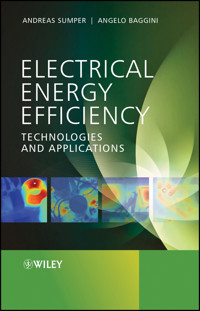
The improvement of electrical energy efficiency is fast becoming one of the most essential areas of sustainability development, backed by political initiatives to control and reduce energy demand. Now a major topic in industry and the electrical engineering research community, engineers have started to focus on analysis, diagnosis and possible solutions. Owing to the complexity and cross-disciplinary nature of electrical energy efficiency issues, the optimal solution is often multi-faceted with a critical solutions evaluation component to ensure cost effectiveness. This single-source reference brings a practical focus to the subject of electrical energy efficiency, providing detailed theory and practical applications to enable engineers to find solutions for electroefficiency problems. It presents power supplier as well as electricity user perspectives and promotes routine implementation of good engineering practice. Key features include: * a comprehensive overview of the different technologies involved in electroefficiency, outlining monitoring and control concepts and practical design techniques used in industrial applications; * description of the current standards of electrical motors, with illustrative case studies showing how to achieve better design; * up-to-date information on standarization, technologies, economic realities and energy efficiency indicators (the main types and international results); * coverage on the quality and efficiency of distribution systems (the impact on distribution systems and loads, and the calculation of power losses in distribution lines and in power transformers). With invaluable practical advice, this book is suited to practicing electrical engineers, design engineers, installation designers, M&E designers, and economic engineers. It equips maintenance and energy managers, planners, and infrastructure managers with the necessary knowledge to properly evaluate the wealth of electrical energy efficiency solutions for large investments. This reference also provides interesting reading material for energy researchers, policy makers, consultants, postgraduate engineering students and final year undergraduate engineering students.
Sie lesen das E-Book in den Legimi-Apps auf:
Seitenzahl: 681
Veröffentlichungsjahr: 2012
Ähnliche



















Contents
Cover
Title Page
Copyright
List of Contributors
Preface
Foreword
1: Overview of Standardization of Energy Efficiency
1.1 Standardization
2: Cables and Lines
2.1 Theory of Heat Transfer
2.2 Current Rating of Cables Installed in Free Air
2.3 Economic Aspects
2.4 Calculation of the Current Rating: Total Costs
2.5 Determination of Economic Conductor Sizes
2.6 Summary
3: Power Transformers
3.1 Losses in Transformers
3.2 Efficiency and Load Factor
3.3 Losses and Cooling System
3.4 Energy Efficiency Standards and Regulations
3.5 Life Cycle Costing
3.6 Design, Material and Manufacturing
3.7 Case Study – Evaluation TOC of an Industrial Transformer
3.A Annex
4: Building Automation, Control and Management Systems
4.1 Automation Functions for Energy Savings
4.2 Automation Systems
4.3 Automation Device Own Consumption
4.4 Basic Schemes
4.5 The Estimate of Building Energy Performance
5: Power Quality Phenomena and Indicators
5.1 RMS Voltage Level
5.2 Voltage Fluctuations
5.3 Voltage and Current Unbalance
5.4 Voltage and Current Distortion
6: On Site Generation and Microgrids
6.1 Technologies of Distributed Energy Resources
6.2 Impact of DG on Power Losses in Distribution Networks
6.3 Microgrids
7: Electric Motors
7.1 Losses in Electric Motors
7.2 Motor Efficiency Standards
7.3 High Efficiency Motor Technology
8: Lighting
8.1 Energy and Lighting Systems
8.2 Regulations
8.3 Technological Advances in Lighting Systems
8.4 Energy Efficiency in Indoor Lighting Systems
8.5 Energy Efficiency in Outdoor Lighting Systems
8.6 Maintenance of Lighting Systems
9: Electrical Drives and Power Electronics
9.1 Control Methods for Induction Motors and PMSM
9.2 Energy Optimal Control Methods
9.3 Topology of the Variable Speed Drive
9.4 New Trends on Power Semiconductors
10: Industrial Heating Processes
10.1 General Aspects Regarding Electroheating in Industry
10.2 Main Electroheating Technologies
10.3 Specific Aspects Regarding the Increase of Energy Efficiency in Industrial Heating Processes
11: Heat, Ventilation and Air Conditioning (HVAC)
11.1 Basic Concepts
11.2 Environmental Thermal Comfort
11.3 HVAC Systems
11.4 Energy Measures in HVAC Systems
12: Data Centres
12.1 Standards
12.2 Consumption Profile
12.3 IT Infrastructure and Equipment
12.4 Facility Infrastructure
12.5 DG and CHP for Data Centres
12.6 Organizing for Energy Efficiency
13: Reactive Power Compensation
13.1 Reactive Power Compensation in an Electric Utility Network
13.2 Reactive Power Compensation in an Industrial Network
13.3 Var Compensation
Index
This edition first published 2012 © 2012 John Wiley & Sons, Ltd
Registered office John Wiley & Sons Ltd, The Atrium, Southern Gate, Chichester, West Sussex, PO19 8SQ, United Kingdom
For details of our global editorial offices, for customer services and for information about how to apply for permission to reuse the copyright material in this book please see our website at www.wiley.com.
The right of the author to be identified as the author of this work has been asserted in accordance with the Copyright, Designs and Patents Act 1988.
All rights reserved. No part of this publication may be reproduced, stored in a retrieval system, or transmitted, in any form or by any means, electronic, mechanical, photocopying, recording or otherwise, except as permitted by the UK Copyright, Designs and Patents Act 1988, without the prior permission of the publisher.
Wiley also publishes its books in a variety of electronic formats. Some content that appears in print may not be available in electronic books.
Designations used by companies to distinguish their products are often claimed as trademarks. All brand names and product names used in this book are trade names, service marks, trademarks or registered trademarks of their respective owners. The publisher is not associated with any product or vendor mentioned in this book. This publication is designed to provide accurate and authoritative information in regard to the subject matter covered. It is sold on the understanding that the publisher is not engaged in rendering professional services. If professional advice or other expert assistance is required, the services of a competent professional should be sought.
Library of Congress Cataloging-in-Publication Data
Electrical energy efficiency : technologies and applications / Andreas Sumper and Angelo Baggini.
p. cm.
Includes bibliographical references and index.
ISBN 978-0-470-97551-0 (hardback)
1. Electric power--Conservation--Standards. 2. Energy conservation--Standards. 3. Energy dissipation. 4. Electric power transmission--Reliability. I. Baggini, Angelo B. II. Sumper, Andreas.
TJ163.3.E39 2012
621.31--dc23
2012000609
A catalogue record for this book is available from the British Library.
Print ISBN: 9780470975510
List of Contributors
Angelo Baggini
Industrial Engineering Department
University of Bergamo
Via Marconi 5 24044 Dalmine BG, Italy
Joan Bergas-Jané
Centre d’Innovació Tecnològica en Convertidors Estàtics i Accionaments (CITCEA)
Universitat Politècnica de Catalunya (UPC)
Escuela Técnica Superior de Ingeniería Industrial de Barcelona
Av. Diagonal, 647. Planta 2 08028 Barcelona, Spain
Franco Bua
ECD Engineering Consulting and Design
Vai Maffi 21
27100 Pavia, Italy
Mircea Chindris
Electrical Power Systems Dept.
Technical University of Cluj-Napoca
15, C.Daicoviciu st.
400020 Cluj-Napoca, Romania
Andrei Czicker
Electrical Power Systems Dept.
Technical University of Cluj-Napoca
15, C.Daicoviciu st.
400020 Cluj-Napoca, Romania
Wim Deprez
Dept. Electrical Engineering ESAT
K.U. Leuven, Research group ELECTA
Kasteelpark Arenberg 10
3001 Heverlee, Belgium
Stefan Fassbinder
Berantung elektrotechnische Anwendungen
Deutsches Kupferinstitut
Am Bonneshof 5
D-40474 Dusseldorf, Germany
Zbigniew Hanzelka
University of Science and Technology – AGH
30-059 Cracow, Al. Mickiewicza 30
Poland
Joris Lemmens
Dept. Electrical Engineering ESAT
K.U. Leuven, Research group ELECTA
Kasteelpark Arenberg 10
3001 Heverlee, Belgium
Annalisa Marra
ECD Engineering Consulting and Design
Vai Maffi 21
27100 Pavia, Italy
Daniel Montesinos-Miracle
Centre d’Innovació Tecnològica en Convertidors Estàtics i Accionaments (CITCEA)
Universitat Politècnica de Catalunya (UPC)
Escuela Técnica Superior de Ingeniería
Industrial de Barcelona
Av. Diagonal, 647. Planta 2 08028 Barcelona, Spain
Paola Pezzini
Centre d’Innovació Tecnològica en Convertidors Estàtics i Accionaments (CITCEA)
Universitat Politècnica de Catalunya (UPC)
Escuela Técnica Superior de Ingeniería Industrial de Barcelona
Av. Diagonal, 647. Planta 2 08028 Barcelona, Spain
Krzysztof Piątek
University of Science and Technology – AGH
30-059 Cracow, Al. Mickiewicza 30,
Poland
Edris Pouresmaeil
Centre d’Innovació Tecnològica en Convertidors Estàtics i Accionaments (CITCEA)
Universitat Politècnica de Catalunya (UPC)
Escuela Técnica Superior de Ingeniería Industrial de Barcelona
Av. Diagonal, 647. Planta 2 08028 Barcelona, Spain
Jaume Salom
Institut de Recerca en Energia de Catalunya (IREC)
Jardins de les Dones de Negre 1, 2a pl.
08930 Sant Adrià de Besòs, Spain
Antoni Sudrià-Andreu
Centre d’Innovació Tecnològica en Convertidors Estàtics i Accionaments (CITCEA)
Universitat Politècnica de Catalunya (UPC)
Escuela Técnica Superior de Ingeniería Industrial de Barcelona
Av. Diagonal, 647. Planta 2 08028 Barcelona, Spain
Andreas Sumper
Centre d’Innovació Tecnològica en Convertidors Estàtics i Accionaments (CITCEA)
Universitat Politècnica de Catalunya (UPC)
Escola Universitària d’Enginyeria Tècnica Industrial de Barcelona
Carrer Comte d’Urgell, 187 - 08036 Barcelona, Spain
and
Institut de Recerca en Energia de Catalunya (IREC)
Jardins de les Dones de Negre 1, 2a pl.
08930 Sant Adrià de Besòs, Spain
Waldemar Szpyra
University of Science and Technology – AGH
30-059 Cracow, Al. Mickiewicza 30,
Poland
Roman Targosz
Polish Copper Promotional Centre
Plac Jana Pawla II 1-2
50-136 Wrocalw, Poland
Roberto Villafáfila-Robles
Centre d’Innovació Tecnològica en Convertidors Estàtics i Accionaments (CITCEA)
Universitat Politècnica de Catalunya (UPC)
Escola Universitària d’Enginyeria Tècnica Industrial de Barcelona
Carrer Comte d’Urgell, 187 - 08036 Barcelona, Spain
Irena Wasiak
Politechnika ódzka
Wydzia Elektrotechniki, Elektroniki, Automatyki i Informatyki
Instytut Elektroenergetyki
ul. Stefanowskiego 18/22
90-924 ód, Poland
Preface
Energy efficiency technologies are common technologies from different engineering fields used to reduce the energy required to provide products and services. As electricity is the most flexible energy form known to humans and one of the most important energy forms used in industry and commercial applications, a specific focus on electrical energy efficiency is required. So, electrical energy efficiency is a set of engineering technologies that are dedicated to increasing the electrical energy efficiency of applications. These engineering technologies are very widespread and can vary from power quality engineering to the thermal engineering of electrical applications, including economic aspects.
Together with electrical safety, in the coming years electrical energy efficiency should become one of the mandatory design criteria in every process, installation or building.
The difficulty of electrical energy efficiency engineering is to obtain a holistic view of an application; in most cases a specific knowledge of the technology is needed, but a deep understanding of the industrial process and the problem to be solved is necessary in order to achieve the overall efficiency goal. Often, optimal solutions for partial problems provide a moderate contribution to the overall energy efficiency of the process. Engineers should have multidisciplinary knowledge, for instance knowledge about electrical applications, power quality, control techniques and heat transfer. Also, an important aspect to consider is the ability to analyse the industrial process and to determine what efficiency actions need to be taken.
The increase in electrical energy efficiency is closely related to the evaluation of the efficiency measures to be taken, mainly by investment analysis. Efficient solutions often need higher investments and these usually need management approval. The manager also has to understand how energy efficient solutions can improve the process efficiency and therefore a higher productivity can be achieved.
In 2000 a group of academics and industrialists launched a life-long learning programme co-funded by the European Commission dedicated to Power Quality problems called Leonardo Power Quality Initiative (LPQI). This project created a network of experts in energy that created several follow-on projects such as LPQIves and Leonardo Energy. Most of the information on these programmes is available at the Leonardo Energy webpage (http://www.leonardo-energy.org). Inspired by this project, part of this working group contributed to the Handbook of Power Quality, edited by Angelo Baggini in 2008.
In one of the project meetings in Brussels in 2008 the idea of a comprehensive book on electrical energy efficiency was born and the content of the book was worked out during the following years.
The novel approach in this book is to give the reader a straightforward introduction to the technologies and their applications used to increase electrical energy efficiency. The reader will find efficiency aspects emphasized in this comprehensive book and an expert view given on the most important industrial and commercial fields of electrical engineering. Each chapter covers a different technology in order to achieve an efficiency goal in a wide range of application fields.
Before you begin to study this book, we would like to mention the important contributions of all the authors of the chapters from all around the world. Without their expert views, this work would not be possible. We hope that you find this book interesting reading.
Andreas Sumper, Barcelona, Spain Angelo Baggini, Pavia, Italy
Foreword
There are no doubts that energy security and climate change are two of the most frequent topics discussed by policy makers. The oil price is now at around US$100 per barrel and, because of the increasing demand and the continuing depletion of the reserves, this price level will stay or may even increase. The human impact on climate change is not disputed anymore in the scientific community, as well as the worrying news that the irreversible impact has already started and only a drastic change in the level of CO2 emissions will mitigate the large and very costly impact on the society.
Energy efficiency and energy conservation are gaining importance as key components in many national and international strategies to mitigate the impact of climate change, to improve security of energy supply and increase competitiveness, to preserve natural resources (energy, material and water, amongst others) and also to reduce other energy-related environmental pollution. However, investment in energy efficiency technologies from R&D to implementation, in buildings, equipment and industrial systems, is still far too less than the economics and the energy and climate change situation would suggest.
Energy efficiency policies, programmes and support schemes are still very much needed to overcome market, institutional, financial and legal barriers, and to create a favourable market for energy efficiency investments at the level that a rational economic behaviour would justify. In particular, support schemes for energy efficient technologies are very much debated as many consider that the future energy cost savings should be enough to motivate end users.
The other major issue is the awareness that what matters in climate change is to reduce the absolute energy demand if we want to mitigate the inevitable full climate change impact. Reduction in energy demand can be achieved by improving the energy efficiency of the service provided (technological aspect) and/or by realising energy savings without necessarily making technological improvements (behavioural aspect, for instance less overheating or overcooling, less driving). Energy efficiency is an important component to achieve energy savings, as it allows having the same services (e.g. lighting, cooling, heating) with less use of energy. However, improved energy efficiency – i.e. replacing a technology with a more energy efficient one – does not per se assure energy savings, and there are numerous examples where as a result of introducing a more efficient technology the actual consumption indeed increases, because of the rebound effect or because of installing larger and more numerous appliances and equipment (larger volume of appliances, more frequent usage).
There is an increased interest in energy efficiency and energy savings amongst policy makers, economists and academics (from the technology, economy, policy and human behaviour side). There is the need to further explore energy efficiency technologies (such as control systems, solid state lighting, variable speed drives and vacuum insulation) and gather new evidence on policies and socio-economic issues related to energy use, consumption and behaviour. At the same time, with increased policy activities in the energy efficiency and energy saving field, there is a new need to evaluate the past and present policies in different countries, to show the clear contribution of energy efficiency to energy security and climate change mitigation.
Paolo Bertoldi European Commission Joint Research Centre Ispra Italy
1
Overview of Standardization of Energy Efficiency
Franco Bua and Angelo Baggini
Since the oil shocks of the 1970s, many countries worldwide have promoted energy efficiency improvements across all sectors of their economies. As a result of these policies and structural changes in their economies, these countries have been able to decouple primary energy use from economic growth.
The rate of decline in energy intensity has not remained constant over time; in most countries the rate of decline tended to be higher from 1970 to 19901.
The International Energy Agency (IEA) reports that the oil price shocks of the 1970s and the resulting energy policies have apparently been more effective in controlling the growth in energy demand and CO2 emissions than the energy efficiency and climate policies implemented in the 1990s2.
However, since the early 2000s, the rate of improvement in energy intensity has tended to increase, possibly in association with the increase in energy prices and greater attention to climate change issues.
It goes without saying that, these days, improving energy efficiency has become a priority in the political agenda of all countries, being key to addressing energy security and both environmental and economic challenges.
In order to support governments with their implementation of energy efficiency, many organizations have worked out a broad range of recommendations and proposed actions for well identified priority areas3. Each country would select the policies that best suit its efficiency commitment as well as its unique economic, social and political situation.
A classification of these policy options and measures4 is given by the World Energy Council5 as follows:
Institutions and programmes Institutions: agencies (national, regional and local), Ministry departmentNational programmes of energy efficiency with quantitative targets and lawsRegulatory measures Minimum efficiency standards and labels for electrical appliances (e.g. refrigerators, washing machines, AC, lamps, water heaters, motors), cars and buildings (new and existing)Other regulations for designated consumers: mandatory energy managers, mandatory energy consumption reporting, mandatory energy saving and mandatory maintenanceObligation of energy savings for energy companies at consumers’ premisesFinancial and fiscal measures Subsidies for audits by sector (industry, commercial, public, households, low income households transport)Subsidies or soft loans (i.e. loans with subsidised interest rates) for energy efficiency investment and equipment by sectorFiscal measures Tax creditAccelerate depreciationTax reduction for efficiency investment, by type of tax (import, VAT, purchase, annual car registration) and by type of equipment (appliances, cars, lamps)Cross-cutting measures Innovative communication toolsVoluntary agreements.Exercises have been carried out extensively to measure how effective these energy efficiency policies are. As an example, IEA reviews the state of the art of the energy efficiency policies, highlighting strengths and areas for improvement (Table 1.1 and Table 1.2).
Table 1.1 Summary of strengths and innovations in IEA member countries’ energy efficiency policies in the building, industrial and transport sectors6
BuildingsFull implementation of building certification in several EU countriesPolicies promoting passive energy housesEnergy efficiency requirements in building codesIndustryHigh coverage of industry energy statistics in all countriesPolicies for promoting energy managementAd hoc policies for SMEsPolicies for cogeneration, energy efficient electric motorsTransportPolicies aimed at rolling resistance of tyresFuel efficiency standards for light and heavy duty vehicles (JP only)Eco drive policiesScrappage schemes encouraging purchase of more efficient and less polluting new vehiclesTable 1.2 Summary of challenges and areas for improvement in IEA member countries’ energy efficiency policies in the building, industrial and transport sectors7
BuildingsEstablish stronger energy efficiency requirements for buildingsStrengthen support for Passive Houses and zero-energy buildingsIncrease promotion of energy efficiency windows and glazingIndustryEstablish measures to optimize energy efficiency in motor driven systemsSet up policies and measures to assist SMEsTransportEnsure the implementation fuel efficiency standards of planned policiesCreate fuel efficiency standards for heavy duty vehiclesDespite having a huge potential, energy efficiency policies8 are difficult to implement. Why? Energy efficiency faces pervasive barriers, including lack of access to capital for energy efficiency investments, insufficient information, and externality costs that are not reflected in energy prices. Moreover political commitment to maximizing the implementation of energy efficiency policies may also have been challenged by the current economic crisis. Energy efficiency programmes must compete for funding with other priorities such as employment, health and social security.
1.1 Standardization
As stated above, energy efficiency faces barriers to success. Examples of such barriers include: the lack of awareness of the savings potential, inadequate performance efficiency information and metrics, the tendency to focus on the performance of individual components rather than the energy yield or consumption of complete systems, split incentives and the tendency to focus on lowest initial cost rather than life cycle cost. Standards can help in overcoming some of these barriers. Standards, for instance, can provide common measurement and test methods to assess the use of energy and the reductions attained through new technologies and processes, as well as providing a means of codifying best practices and management processes for efficient energy use and conservation.
Furthermore, standards can provide design checklists and guides that can be applied to both the design of new systems and the retrofit of existing systems; they can provide standard calculation methods so that sound comparisons of alternatives can be made in specific situations and they can help with the adaptation of infrastructure to integrate new technologies and aid interoperability.
An overview of the current standardization activities on energy efficiency is given in the following sections.9
1.1.1 ISO
The work of the ISO (International Organization for Standardization) on energy efficiency began in June 2007 when the ISO Council Task Force on Energy Efficiency and Renewable Energy Sources identified five areas of high priority that were deemed to have the highest potential to contribute substantially to energy savings and greenhouse gas emission reductions, namely:
Calculation methodsEnergy management standardsBiofuelsRetrofitting and refurbishingBuildings.In line with the Council's request10, the Technical Management Board (TMB) established a Strategic Advisory Group (SAG) on Energy efficiency and renewable energy sources11 for an initial period of 2 years (until February 2010). SAG E was asked to provide advice and guidance to TMB on priority standards and actions, including involving stakeholders’ collaboration with other international organizations and co-ordination between ISO and TCs, etc. The goal was to speed up the process of devising a standardization programme in this field that will serve public policy objectives and market needs.
SAG-E produced an extensive report, providing 66 recommendations, which were endorsed by the TMB. SAG-E activity has been extended for another 3 years.
1.1.1.1 ISO 50001
In February 2008, the ISO Technical Management Board approved the establishment of a new project committee, ISO/PC 242, Energy management12, building on practices and existing national or regional standards.
ISO 50001 will establish an international framework for industrial and commercial facilities, or entire companies, to manage all aspects of energy, including procurement and use. After four committee meetings, spanning a period of two years, the document was published in June 2011 and was adopted by CEN and CENELEC as ISO EN 50001 in October 2011. The standard is intended to provide organizations and companies with a recognized framework for integrating energy efficiency into their management practices.
ISO 50001 will provide organizations and companies with technical and management strategies to increase energy efficiency, reduce costs, and improve environmental performance.
1.1.1.2 ISO/IEC JPC 2
In 2009, ISO and the International Electrotechnical Commission (IEC) created the joint project committee ISO/IEC JPC 2, Energy efficiency and renewable energy sources – Common terminology, whose primary objective is to develop a standard that will identify cross-cutting concepts with terms and definitions associated with energy efficiency and renewable energy sources, while taking into account terminology that has already been elaborated in sector-specific ISO and IEC technical committees.
Three working groups (WG) were established at the first meeting of ISO/IEC JPC in January 2010:
WG 1, Energy efficiency : Concepts and diagrams, coordinated by ANSI (USA)WG 2, Inputs from existing reference documents, coordinated by SIS/SEK (Sweden)WG 3, Renewable energy sources – Terms and definitions, coordinated by AFNOR (France).The Committee Draft (CD) step was launched in October 2011.
1.1.2 IEC
IEC's vision on Energy efficiency is outlined in its White Paper, ‘Coping with the Energy Challenge’13. Developed by the IEC Market Strategy Board (MSB), this document maps out global energy needs and potential solutions over the next 30 years and the IEC's role in meeting the challenges.
IEC thinks that a system approach that takes into account all aspects of generating, transporting and consuming energy must be considered to cope with the energy efficiency challenges and that measurement procedures and methods of evaluating energy efficiency must be specified in order to assess potential improvements properly and to optimize technological issues (Best Available Technology, BAT).
1.1.2.1 SG1 ‘Energy Efficiency and Renewable Resources’
In 2007 IEC began to establish subsidiary bodies to advise its Management Board on strategic issues that would determine future technical work. Among these was the SG1, which was established on the specific topic of energy efficiency.
SG 1 was established at the beginning of 2007 and was tasked to:
analyse the status quo in the field of energy efficiency and renewable resources (existing IEC standards, on-going projects)identify gaps and opportunities for new work in IEC's field of competenceset objectives for electrical energy efficiency in products and systemsformulate recommendations for further actions.Since then experts from other groups inside the IEC and other organizations such as IEA, CIE, etc. have met to present their activities and achievements in the areas of energy efficiency and renewable resources and to provide their input to the discussions.
The main outcomes of SG1's work are 34 recommendations that were sent to SMB and TC members for comments.
1.1.2.2 SG3 ‘Smart Grid’
In this context it is worth mentioning another Study Group (SG) that is linked to energy efficiency: SG3 ‘Smart Grid’. SG3, set up in 2008, provides advice on fast-moving ideas and technologies that are likely to form the basis for new International Standards or IEC Technical Committees in the area of Smart Grid technologies.
SG3 has developed the framework and provides strategic guidance to all Technical Committees involved in Smart Grid work and has developed the Smart Grid Roadmap14, which covers standards for interoperability, transmission, distribution, metering, connecting consumers and cyber security.
1.1.2.3 SG4 ‘LVDC Distribution Systems up to 1500 V DC’
SG 4 was set up in 2009 with the objective of having a global systematic approach and to align and coordinate activities in many areas where LVDC is used, such as green data centres, commercial buildings, electricity storage for all mobile products (with batteries), EVs, etc, including all mobile products with batteries, lighting, multimedia, ICT, etc. with electronic supply units.
SG4 is another example of an area of activity that is not directly dedicated to energy efficiency but whose role could be strategic in harvesting energy efficiency potential.
1.1.3 CEN and CENELEC
CEN and CENELEC were the most proactive standardization organizations as they started in 2002, to analyse the challenges of standardization in the field of energy efficiency and to elaborate general strategy.
Another interesting and valuable aspect is that CEN and CENELEC decided to start this activity jointly, thus implementing de facto an integrated system approach that is of utmost importance.
The CEN/CENELEC BT JWG ‘Energy management’ was set up at the beginning of 2002 to initiate a European collective view of the general strategy for improvement of energy efficiency standardization and to set an agreement between all CEN/CENELEC members on the objectives to be achieved.
The working group acted as an advisory group to CEN and CENELEC BTs on all political and strategic matters relating to standardization in the field of energy efficiency from 2002 to 2005. The main results of the work are synthesized in a report15 that gives an overview of proposals in standardization in the field of energy management, classified into three level of priorities16. This document is still the basis for CEN and CENELEC standardization activity in the field of energy efficiency.
The key technical bodies involved in energy efficiency standardization are summarised in Table 1.3 together with the most important standardisation activities (Table 1.4).
Table 1.3 CEN–CENELEC Joint Working Groups active in the field of Energy Management and Energy Efficiency standardization
Technical bodyScope of workJWG1 ‘Energy Audits’JWG2 ‘Guarantees of origin and energy certificates’Standardization on guarantees of origin for trading and/or disclosure/labelling of electricity and CHP and on energy certificatesJWG3 ‘Energy Management and related services – General requirements and qualification procedures’To elaborate EN standards in the energy management and related services field:Energy Management Systems: definition and requirementsEnergy Service Companies (ESCO): definition, requirements and qualification proceduresEnergy Managers and Experts: roles, professional requirements and qualification ProceduresJWG4 ‘Energy efficiency and saving calculation’Standards for common methods of calculation of energy consumption, energy efficiencies and energy savings and for a common measurement and verification of protocol and methodology for energy use indicatorsTable 1.4 CEN–CENELEC standards and projects in the field of Energy Management and Energy Efficiency
Publication/ProjectTitleEN 16001:2009 (pr=22320)Energy management systems – Requirements with guidance for useEN 15900:2010 (pr=22416)Energy efficiency services – Definitions and requirementsprEN 16247-1:2011 (pr=23294)Energy audits – Part 1: General requirementsprEN 50XXX (pr=23227)Guarantees of origin related to energy – Guarantees of origin for electricityprEN PT EEB Doc:2010 (pr=23079)Energy efficiency benchmarking methodologyEN ISO 50001:2011 (pr=23639)Energy management systems – Requirements with guidance for useprEN 16212:2010 (pr=23138)Standard on top down and bottom up methods of calculation of energy consumption, energy efficiencies and energy savings1.1.3.1 SFEM
In response to the CEN/CENELEC BT JWG ‘Energy management’ recommendation, CEN and CENELEC have created a horizontal structure, a Sector Forum Energy Management (SFEM), dedicated to the definition of a common strategy for standardization in the field of energy management and energy efficiency. SFEM is a platform for stakeholders to share information and experiences, and to identify priorities regarding standardization in the energy sector.
SFEM is designed:
to maintain and enlarge the network of partners created during the lifetime of the CEN/ CENELEC BT JWG “Energy Management”, especially with regards to new members;to initiate further investigation and to evaluate in which field or for which subject, further standardization work is needed and including subjects identified as Priority B or C by the former CEN/CENELEC BT JWG “Energy Management”;to coordinate on-going European Standardization activities concerning Energy Management;to organize the CEN and CENELEC response to European legislation and Europe general strategy in the Energy Management sector;to maintain the exchange of information, experience and prospecting especially on the initiatives in course in the different countries or at European level.SFEM meets twice a year, does not carry out any standardization activity and formulates recommendations to CEN and CENELEC for further actions. CEN and CENELEC usually react by setting up dedicated technical bodies (usually joint working groups) with specific scopes of work.
Further Readings
H. Geller and S. Attali, The experience with energy efficiency policies and programmes in IEA countries. Learning from the Critics, IEA Information Paper, 2005.
IEA, Implementing Energy Efficiency Policies, 2009, OECD/IEA, Paris.
WEC, WEC: Energy Efficiency: A Recipe for Success, 2010.
1. IEA (2007), Energy Use in the New Millennium – Trends in IEA countries, OECD/IEA, Paris.
2. IEA (2007), Energy Use in the New Millennium – Trends in IEA countries, OECD/IEA, Paris.
3. For example IEA recommended the adoption of a set of specific energy efficiency policy measures to the last four G8 summits; for further information on the full set of recommendations, refer to http://www.iea.org/textbase/papers/2008/cd_energy_efficiency_policy/index_EnergyEfficiencyPolicy_2008.pdf
4. A comprehensive database of energy efficiency policies and measures is provided by IEA (http//www.iea.org/textbase/pm/index_effi.asp)
5. WEC, Energy Efficiency: A Recipe for Success, 2010, p. 40.
6. IEA, Implementing Energy Efficiency Policies, 2009, p. 23.
7. IEA, Implementing Energy Efficiency Policies, 2009, p. 33.
8. It is worth mentioning that there is literature on most common criticisms of energy efficiency policies and programmes. These critics argue that energy efficiency policies and programmes are unwarranted or are a failure. IEA promoted the publication of a paper that compiles, categorises, and then evaluates those criticisms of energy efficiency policies (see 7).
9. This overview took into account standardization, directly concentrating on energy efficiency from a system approach point of view.
10. Resolution 28/2007.
11. ISO Technical Management Board Resolutions 22/2008.
12. ISO Technical Management Board Resolutions 15/2008.
13.http://www.iec.ch/smartenergy/
14.http://www.iec.ch/smartgrid/downloads/sg3_roadmap.pdf
15.http://www.cen.eu/cen/Sectors/Sectors/UtilitiesAndEnergy/Forum/Documents/BTN7359FinalReportJWG.pdf
16. Level A – for immediate action; Level B – that need further investigation or research before standardisation could be done; Level C – that need to be discussed in the context of a strategic and holistic view, i.e. policy questions.
2
Cables and Lines
Paola Pezzini and Andreas Sumper
In distribution systems the power transmission capacity is directly given by the product of the operating voltage and the maximum current that can be transmitted. The operating voltage being a fixed value, the delivery capability of the system at a given voltage depends on the conductor's capacity if carrying current.
The delivery capacity is called the ampacity of the cable system [1] and its calculation is carried out taking into consideration both steady state and transient calculations [2]. The calculations for cables in air and for buried cables are slightly different, due to the surrounding medium with which the cable has to interact. The ampacity calculations for air cables should take into account solar radiation and the amount of wind in the area in which the cable system is installed. Ampacity calculations for buried cables should consider the soil in which the cable system is installed.
Ampacity calculations require the solution of the heat transfer equations because insulation and cable size are independent parameters, inter-related by thermal considerations. Cable ampacity calculations require the determination of the temperature of the conductor for a given current loading. The ampacity rating is directly proportional to the conductor size: the larger the conductor size (lower Joule losses) the higher the ampacity. On the other hand, the insulation requirements are determined by the operating voltage and they also directly influence the ampacity value: high insulation requirements (lower heat dissipation) mean a lower ampacity. The parameters that influence the value of the ampacity are the number and types of cable, the thermal resistance of the medium surrounding the cable (soil or air), the depth of burial in the case of buried cables and the horizontal spacing between the cables of the system. The clear relationship between the conductor current and the temperature leads to a study of how the heat generated while a current is transmitted is dissipated. The resolution of the basic heat transfer equations is the first step to achieving the cable rating calculations and cable ampacity; they depend mainly on the efficiency of the dissipation process, along with the limits imposed on the insulation temperature.
Lesen Sie weiter in der vollständigen Ausgabe!
Lesen Sie weiter in der vollständigen Ausgabe!
Lesen Sie weiter in der vollständigen Ausgabe!
Lesen Sie weiter in der vollständigen Ausgabe!
Lesen Sie weiter in der vollständigen Ausgabe!
Lesen Sie weiter in der vollständigen Ausgabe!
Lesen Sie weiter in der vollständigen Ausgabe!
Lesen Sie weiter in der vollständigen Ausgabe!
Lesen Sie weiter in der vollständigen Ausgabe!
Lesen Sie weiter in der vollständigen Ausgabe!
Lesen Sie weiter in der vollständigen Ausgabe!
Lesen Sie weiter in der vollständigen Ausgabe!




