


45,99 €
Mehr erfahren.
- Herausgeber: John Wiley & Sons
- Kategorie: Wissenschaft und neue Technologien
- Sprache: Englisch
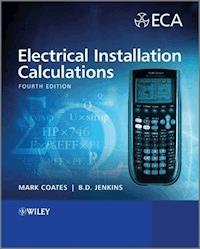
Manual calculations are still extensively used and in particular are necessary for checking and verifying various software calculation design packages. It is highly recommended that users of such software familiarise themselves with the rudiments of these calculations prior to using the software packages.
This essential book fills the gap between software and manual calculations. It provides the reader with all the necessary tools to enable accurate calculations of circuit designs. Rather than complex equations, this book uses extensive worked examples to make understanding the calculations simpler. The focus on worked examples furnishes the reader with the knowledge to carry out the necessary checks to electrical cable sizing software programmes.
Other key features include:
- Updated information on 230 volt references and voltage drop under normal load conditions
- New sections on buried cables that take into account soil thermal conductivity, trenches and grouping, allowing readers to carry out accurate cables sizing
- Information and examples of steel wired armour cables, new to this edition. This includes sufficiency during short circuits and, for cables with externally run CPCs, gives unique fault conditions.
- Covers calculations of cross-sectional areas of circuit live conductors
- Earth fault loop impedances
- Protective conductor cross-sectional areas and short circuit conditions
- Short circuit protection.
The last chapter combines all of the calculations of the previous chapters to enable the reader to complete an accurate design of an installation circuit under all conditions.
A unique tool for detailed electrical installation trade, Electrical Installation Calculations, Fourth Edition is invaluable to electricians, electrical designers, installers, technicians, contractors, and plant engineers. Senior electrical engineering students and technical colleges, junior engineers, and contracts managers will also find this text useful.
Sie lesen das E-Book in den Legimi-Apps auf:
Seitenzahl: 275
Veröffentlichungsjahr: 2011
Ähnliche




















Contents
About the authors
Preface
Acknowledgements
Symbols
Definitions
1 Calculation of the cross-sectional areas of circuit live conductors
General circuits
Circuits in thermally insulating walls
Circuits totally surrounded by thermally insulating material
Circuits in varying external influences and installation conditions
Circuits in ventilated trenches
Circuits using mineral-insulated cables
Circuits on perforated metal cable trays
Circuits in enclosed trenches
Circuits buried in the ground
Grouped circuits not liable to simultaneous overload
Circuits in low ambient temperatures
Grouped ring circuits
Motor circuits subject to frequent stopping and starting
Circuits for star-delta starting of motors
Change of parameters of already installed circuits
Admixtures of cable sizes in enclosures
Grouping of cables having different insulation
2 Calculation of voltage drop under normal load conditions
The simple approach
The more accurate approach taking account of conductor operating temperature
The more accurate approach taking account of load power factor
The more accurate approach taking account of both conductor operating temperature and load power factor
Voltage drop in ring circuits
Voltage drop in ELV circuits
3 Calculation of earth fault loop impedance
The simple approach
The more accurate approach taking account of conductor temperature
Calculations taking account of transformer impedance
Calculations concerning circuits fed from sub-distribution boards
Calculations where conduit or trunking is used as the protective conductor
Calculations where cable armouring is used as the protective conductor
4 Calculations concerning protective conductor cross-sectional area
Calculations when the protective device is a fuse
Calculations when an external cpc is in parallel with the armour
Calculations when the protective device is an mcb
Calculations when the protective device is an RCD or RCBO
5 Calculations related to short circuit conditions
a.c. single-phase circuits
The more rigorous method for a.c. single-phase circuits
a.c. three-phase circuits
6 Combined examples
Appendix
Index
This edition first published 2010
© 2010John Wiley & Sons, Ltd
First Edition published by Blackwell Publishing in 1991
Reprinted 1991, 1992, 1993, 1994, 1996
Second Edition published 1998
Third Edition published 2003
Registered office
John Wiley & Sons Ltd, The Atrium, Southern Gate, Chichester, West Sussex, PO19 8SQ, United Kingdom
For details of our global editorial offices, for customer services and for information about how to apply for permission to reuse the copyright material in this book please see our website at www.wiley.com.
The right of the author to be identified as the author of this work has been asserted in accordance with the Copyright, Designs and Patents Act 1988.
All rights reserved. No part of this publication may be reproduced, stored in a retrieval system, or transmitted, in any form or by any means, electronic, mechanical, photocopying, recording or otherwise, except as permitted by the UK Copyright, Designs and Patents Act 1988, without the prior permission of the publisher.
Wiley also publishes its books in a variety of electronic formats. Some content that appears in print may not be available in electronic books.
Designations used by companies to distinguish their products are often claimed as trademarks. All brand names and product names used in this book are trade names, service marks, trademarks or registered trademarks of their respective owners. The publisher is not associated with any product or vendor mentioned in this book. This publication is designed to provide accurate and authoritative information in regard to the subject matter covered. It is sold on the understanding that the publisher is not engaged in rendering professional services. If professional advice or other expert assistance is required, the services of a competent professional should be sought.
ECA is the trademark of the Electrical Contractors’ Association.
The ECA is the UK’s largest and leading trade association representing electrical, electronic, installation engineering and building services companies.
Website www.eca.co.uk
Whilst every care has been taken to ensure the accuracy of the information in this book, neither the author or the ECA can accept liability for any inaccuracies or omissions arising from the information provided.
Library of Congress Cataloging-in-Publication Data
Jenkins, Brian D. (Brian David)
Electrical installation calculations : for compliance with BS 7671 : 2008 / Brian Jenkins, Mark Coates. – 4th ed. p. cm.
Includes index.
ISBN 978-1-4443-2426-6 (pbk.)
1. Electric wiring–Mathematics. 2. Electric wiring–Standards–Great Britain. I. Coates, M. (Mark) II. Title. TK3211.J44 2010
621.319’24–dc22
2010010309
ISBN: 978–1444–32426–6
About the authors
Mark Coates BEng collaborated with Brian in developing the First Edition and has since been responsible for revising the subsequent editions. He joined ERA Technology Ltd (now trading as Cobham Technical Services) in July 1983 and is currently a Cable Engineering Consultant. He gained a degree in Mechanical Engineering from Sheffield University (UK) in 1977 and he worked for a chemical and textile company until 1983. Since joining ERA, he has primarily worked on projects to determine cable current ratings both experimentally and by theoretical methods. In addition to the usual cable rating problems, this work has included development of rating methods for mixed groups of cable, cables on winch drums and sub-sea umbilicals. Other projects have included assessments of new cable designs, the mechanical performance of cables and joints, failure analysis of LV, MV and HV transmission and distribution equipment, and life prediction tests for HV cables. He is a member of the UK IEE/BSI Committee concerned with electrical installations, and attends BSI and IEC meetings. He is the convenor of IEC TC20 WG19, the specialist IEC working group responsible for maintaining and updating the International Standards on steady state, cyclic and short-circuit ratings of power cables.
Brian Jenkins BSc, CEng, FIEE had many years’ industrial experience before working as a Principal Technical Officer at the British Standards Institution. He then joined the Institution of Electrical Engineers as a Senior Technical Officer. Brian passed away in 2007.
Preface
The publication of BS 7671 and its predecessors, the 15th and 16th Editions of the IEE Wiring Regulations, led to a number of guides and handbooks being published by organizations involved in the electrical contracting industry. These included the publication, by the Institution of Engineering and Technology, of an On-site Guide and a number of Guidance Notes as well as several books by independent authors and a considerable number of articles and papers in the technical press. It also led to numerous instructional courses, seminars and conferences.
It was thought that there was little else one could write about concerning the Wiring Regulations, but after talking to a number of engineers in the electrical installation contracting industry, Brian Jenkins gained the strong impression that there was one need that had not really been satisfied. The need was for a book that made considerable use of worked examples with the absolute minimum discussion of the associated theoretical aspects. In other words, a book which used such examples to show how one carried out the calculations involved in circuit design for compliance with BS 7671.
Whilst Brian designed the book to be primarily of interest and help to those in the smaller companies in the electrical installation contracting industry, we believe the student and the plant engineer will also find it of interest.
BS 7671 offers certain options. For example, when calculating voltage drop either an approximate method or a more accurate one can be used and we have attempted to show where the latter could be used to advantage. This, we believe, will make the book of interest to a wider circle.
BS 7671 does not refer to ‘touch voltages’ as such, these being the ‘voltages between simultaneously accessible exposed and extraneous conductive parts’ that may lead to a risk of electric shock in the event of an earth fault. It had long been Brian’s opinion that a fuller understanding of the touch voltage concept would assist many in the electrical contracting industry to more fully understand the requirements for automatic disconnection. For this reason we hope that the Appendix will prove to be of interest.
Since the First Edition of this book there have been a number of amendments to the Requirement for Electrical Installations. Some of the changes introduced by the amendments affect the examples given in this book. The most important changes have been the change to the nominal voltage from 240/415 V to 230/400 V, the change to the assumed temperature of conductors under fault conditions and the inclusion of current-carrying capacities for buried cables. New work has also been done to clarify the effectiveness of supplementary circuit protective conductors connected in parallel with the armour of SWA cables. This Fourth Edition is intended to keep Electrical Installation Calculations up to date with the latest version of BS 7671. Examples using semi-enclosed fuses have, mainly for legacy, been retained and updated to BS 7671: 2008; although it is recognized that these devices would not generally be used for new installations, the examples present the reader with the rudiments of the principles of calculations.
There is one final point which needs to be made in this Preface. Examination of some of the answers may suggest to the reader that there is a high intrinsic degree of accuracy in installation design calculations. This obviously cannot be true because, for example, estimated circuit lengths will be rather approximate.
Many of the answers have been given to a greater number of significant figures than is necessary in practice merely to assist the reader should he, or she, wish to check through the examples.
Mark Coates
Acknowledgements
Brian Jenkins acknowledged the initial encouragement and subsequent assistance given by M J. Dyer when he was Director of Technical Services of the Electrical Contractors’ Association and by G.E Webber BTech, CEng, MIEE, the present Head of Technical Services of that Association.
He also wished to acknowledge the considerable assistance given by a number of friends who kindly agreed to read his drafts and who offered useful suggestions. In this respect he particularly wished to thank:
F.W. Price, CEng, MIEE
J. Rickwood, BSc (Eng), CEng, FIEE
G. Stokes, BSc, CEng, MIEE, FCIBSE, MISOH
J.F. Wilson, MBE, AMIEE
Brian Jenkins passed away in 2007 having enjoyed his retirement in the North of England where his interests moved from writing on electrical matters to researching local history.
Finally, thanks are due to the Institution of Engineering and Technology for its permission to reproduce a number of the definitions from BS 7671 and to the International Electrotechnical Commission for their permission to reproduce the touch voltage curves shown in the Appendix.
In the compilation of this Fourth Edition Mark Coates wishes to acknowledge the help of Eur Ing Darrell Locke, of the Electrical Contractors’ Association, for his assistance as an advisor and critic.
Definitions
The following definitions are of terms which appear in this book and have been aligned, generally without modification, with the definitions in BS 7671: 2008.
Ambient temperature
The temperature of the air or other medium where the equipment is to be used.
Basic protection
Protection against electric shock under fault-free conditions.
Note: For low voltage installations, systems and equipment, basic protection generally corresponds to protection against direct contact, that is ‘contact of persons or livestock with live parts’.
Bonding conductor
A protective conductor providing equipotential bonding.
Bunched
Cables are said to be bunched when two or more are contained within a single conduit, duct, ducting, or trunking or, if not enclosed, are not separated from each other by a specified distance.
Lesen Sie weiter in der vollständigen Ausgabe!
Lesen Sie weiter in der vollständigen Ausgabe!
Lesen Sie weiter in der vollständigen Ausgabe!
Lesen Sie weiter in der vollständigen Ausgabe!
Lesen Sie weiter in der vollständigen Ausgabe!
Lesen Sie weiter in der vollständigen Ausgabe!
Lesen Sie weiter in der vollständigen Ausgabe!
Lesen Sie weiter in der vollständigen Ausgabe!




