


98,99 €
Mehr erfahren.
- Herausgeber: John Wiley & Sons
- Kategorie: Wissenschaft und neue Technologien
- Sprache: Englisch
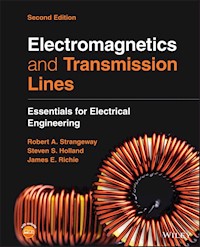
Electromagnetics and Transmission Lines
Textbook resource covering static electric and magnetic fields, dynamic electromagnetic fields, transmission lines, antennas, and signal integrity within a single course
Electromagnetics and Transmission Lines provides coverage of what every electrical engineer (not just the electromagnetic specialist) should know about electromagnetic fields and transmission lines. This work examines several fundamental electrical engineering concepts and components from an electromagnetic fields viewpoint, such as electric circuit laws, resistance, capacitance, and self and mutual inductances. The approach to transmission lines (T-lines), Smith charts, and scattering parameters establishes the underlying concepts of vector network analyzer (VNA) measurements. System-level antenna parameters, basic wireless links, and signal integrity are examined in the final chapters.
As an efficient learning resource, electromagnetics and transmission lines content is strategically modulated in breadth and depth towards a single semester objective. Extraneous, distracting topics are excluded. The wording style is somewhat more conversational than most electromagnetics textbooks in order to enhance student engagement and inclusivity while conveying the rigor that is essential for engineering student development. To aid in information retention, the authors also provide supplementary material, including a homework solutions manual, lecture notes, and VNA experiments.
Sample topics covered in Electromagnetics and Transmission Lines include:
- Vector algebra and coordinate systems, Coulomb’s law, Biot-Savart law, Gauss’s law, and solenoidal magnetic flux
- Electric potential, Ampere’s circuital law, Faraday’s law, displacement current, and the electromagnetic principles underlying resistance, capacitance, and self and mutual inductances
- The integral form of Maxwell’s equations from a conceptual viewpoint that relates the equations to physical understanding (the differential forms are also included in an appendix)
- DC transients and AC steady-state waves, reflections, and standing waves on T-lines
- Interrelationships of AC steady-state T-line theory, the Smith chart, and scattering parameters
- Antenna basics and line-of-sight link analysis using the Friis equation
- An introduction to signal integrity
Electromagnetics and Transmission Lines is an authoritative textbook learning resource, suited perfectly for engineering programs at colleges and universities with a single required electromagnetic fields course. Student background assumptions are multivariable calculus, DC and AC electric circuits, physics of electromagnetics, and elementary differential equations.
Sie lesen das E-Book in den Legimi-Apps auf:
Seitenzahl: 494
Veröffentlichungsjahr: 2022
Ähnliche



















Electromagnetics and Transmission Lines
Essentials for Electrical Engineering
Second Edition
Robert A. Strangeway
Milwaukee School of Engineering
Milwaukee, WI, USA
Steven S. Holland
Milwaukee School of Engineering
Milwaukee, WI, USA
James E. Richie
Marquette University
Milwaukee, WI, USA
This edition first published 2023© 2023 John Wiley & Sons, Inc.
Edition History“Preliminary edition”, RacademicS Publishing LLC, 20191 edition, RacademicS Publishing LLC, 2020
All rights reserved. No part of this publication may be reproduced, stored in a retrieval system, or transmitted, in any form or by any means, electronic, mechanical, photocopying, recording or otherwise, except as permitted by law. Advice on how to obtain permission to reuse material from this title is available at http://www.wiley.com/go/permissions.
The right of Robert A. Strangeway, Steven S. Holland, and James E. Richie to be identified as the authors of this work has been asserted in accordance with law.
Registered OfficeJohn Wiley & Sons, Inc., 111 River Street, Hoboken, NJ 07030, USA
Editorial Office111 River Street, Hoboken, NJ 07030, USA
For details of our global editorial offices, customer services, and more information about Wiley products visit us at www.wiley.com.
Wiley also publishes its books in a variety of electronic formats and by print‐on‐demand. Some content that appears in standard print versions of this book may not be available in other formats.
Limit of Liability/Disclaimer of WarrantyIn view of ongoing research, equipment modifications, changes in governmental regulations, and the constant flow of information relating to the use of experimental reagents, equipment, and devices, the reader is urged to review and evaluate the information provided in the package insert or instructions for each chemical, piece of equipment, reagent, or device for, among other things, any changes in the instructions or indication of usage and for added warnings and precautions. While the publisher and authors have used their best efforts in preparing this work, they make no representations or warranties with respect to the accuracy or completeness of the contents of this work and specifically disclaim all warranties, including without limitation any implied warranties of merchantability or fitness for a particular purpose. No warranty may be created or extended by sales representatives, written sales materials or promotional statements for this work. The fact that an organization, website, or product is referred to in this work as a citation and/or potential source of further information does not mean that the publisher and authors endorse the information or services the organization, website, or product may provide or recommendations it may make. This work is sold with the understanding that the publisher is not engaged in rendering professional services. The advice and strategies contained herein may not be suitable for your situation. You should consult with a specialist where appropriate. Further, readers should be aware that websites listed in this work may have changed or disappeared between when this work was written and when it is read. Neither the publisher nor authors shall be liable for any loss of profit or any other commercial damages, including but not limited to special, incidental, consequential, or other damages.
Library of Congress Cataloging‐in‐Publication Data Applied for:Hardback ISBN: 9781119881902
Cover Design: WileyCover Image: © PitukTV/Shutterstock
This textbook is dedicated to our spouses, Debby, Melissa, and Jean, whose enduring love and unselfish sacrifices made this work possible, and to the late Dr. Thomas K. Ishii, our mentor and colleague.
Preface
It is the responsibility of every author to answer the proverbial question “Why is there another text on such an established subject?” There is a plentitude of quality texts that thoroughly cover electromagnetics and transmission lines, usually in two semesters. We deviate from the norm in this text with an explicit mission and goal:
Mission: What every electrical engineer, not just the electromagnetics specialist, should know about electromagnetic fields and transmission lines.
Goal: A textbook that enables completion of static electric and magnetic fields, dynamic electromagnetic fields, transmission lines, antennas, and signal integrity within a single course.
With this mission and goal in mind, we have designed a text that conveys rigor to the depth consistent with the mission and goal of the text, yet focuses on the essential concepts of electromagnetics and transmission lines and excludes those that are generally considered specialized. Admittedly this approach involved experiential judgments and strategic trade‐offs. We mitigated some of the agony of topic exclusion by placing select topics into chapter appendices. For example, the differential forms of electromagnetics laws are not utilized in the main body of the text, but Maxwell's equations in differential form are introduced in a chapter appendix.
It is intended that the reader progresses through the sections in the main body of the text without the chapter appendices. The page count of the entire text was intentionally constrained for use in a single semester course. Overall, this focused approach on electromagnetic fundamentals provides the essentials for all electrical engineers yet also provides a solid electromagnetics foundation for students who wish to continue studies in elective or graduate‐level electromagnetics courses.
Chapter appendices can be included or excluded without compromising the pedagogic and topical flow within the body of the work. If an appendix depends on a previous appendix, this association is declared initially within the appendix. The availability of chapter appendices adds a degree of content flexibility for those programs that have covered content from the earlier chapters in other courses (such as the first chapter), have multiple courses, have more credit hours, and so forth, to accommodate additional instructional content per specific course requirements.
A primary feature of the text is the inclusion of the underlying concepts of the vector network analyzer (VNA) as well as a brief but focused introduction to the instrument. Modern VNAs are cost‐effective and utilized significantly in a wide range of electronic industries. We hope that this text serves as a primer for effective understanding of the VNA.
End‐of‐text appendices are included upon the recommendation of multiple reviewers. A valuable suggestion in this regard was to include a symbols listing (Appendices A and B). Four pages of symbols resulted! Students who are new to the subject matter often mention the difficulty of learning so many new symbols. This exercise confirmed the multitude of symbols that are used in electromagnetics (so instructors, be patient when you hear this comment). Tables with approximate values of physical constants and material properties (Appendices C and D) are given to communicate a “feel for the numbers” and for consistent usage in homework problems, not to be a reference of precise numbers which are readily available online. The equation summaries at the end of each chapter are collected in Appendix E.
The student background assumptions are multivariable calculus, DC and AC electric circuits, electromagnetic physics, and elementary differential equations. Multivariable integration is used extensively in several chapters. Cartesian vectors, the solution of two‐dimensional point charge – static electric field problems using Coulomb's law, and basic concepts of static magnetic fields are normally a subset of electromagnetic physics courses. Additional topics in the physics of electromagnetics are helpful but not necessary. Elementary differential equations, namely a second‐order linear differential equation with constant coefficients, are required for the modeling and solution of the phasor transmission line wave equation.
Organization
The latter part of this text covers applications with which any electrical engineer should be familiar: transmission lines, antennas, and basic concepts behind signal integrity. The pedagogy in the earlier chapters builds the essential concepts of electromagnetics and transmission lines that are prerequisite to these applications. The chapter descriptions follow.
Chapter 1
: Initially, vector algebra and coordinate systems are developed and examined carefully. The authors recommend that this material be mastered – do not assume it is automatically known. We have found in decades of teaching electromagnetic fields courses that students who have mastered vector algebra and coordinate systems perform and retain concepts significantly better than their counterparts who have not done so. The time spent in
Chapter 1
is more than made up for in subsequent chapters because students learn subsequent material with a stronger background in “the vector tools,” which results in more efficient and effective learning.
Chapter 2
: Coulomb's law and the Biot–Savart law, the superposition laws, are examined. We have grouped these two laws to reinforce the commonality of the superposition approach (we call this general approach “conceptual grouping”). The effective integration of a unit vector via implementation of symmetry is utilized to simplify resultant field expressions and, more importantly, to develop intuition into field behavior from canonical source geometries.
Chapter 3
: Gauss's law and solenoidal magnetic flux are similarly grouped to leverage the commonality of the flux viewpoint of fields. The visualization of an entire field pattern from canonical source distributions is the next natural step from the superposition laws of the previous chapter.
Chapter 4
: Electric potential, which we use interchangeably with the term “voltage” for static electric fields, and Ampere's circuital law are grouped to reinforce the commonality of the path law approach. Several fundamental electrical engineering applications are examined from the electromagnetic fields viewpoint, such as electric circuit laws, capacitance, self and mutual inductances, and basic magnetic circuit principles (the latter as a chapter appendix). They illustrate and reinforce the path law thinking as well as previously covered electromagnetic field concepts. Dielectric and magnetic material concepts are covered briefly. This static fields background sets the stage for time‐changing electromagnetic fields.
Chapter 5
: Faraday's law, displacement current, and the integral form of Maxwell's equations are approached from a conceptual viewpoint to relate the mathematical expressions to physical understanding. Several fundamental electrical engineering applications are again utilized to reinforce the electromagnetic fields – circuit relationships. The differential forms of Maxwell's equations, including explanations of the del operator, divergence, and curl, are covered in a chapter appendix to provide exposure to the forms often encountered in the literature.
Chapter 6
: The concept of DC transient and AC steady‐state waves and reflections on a transmission line (T‐line) are examined initially. This approach leads into measures of reflection, Smith charts, and scattering parameters. The T‐line model and electrical distance considerations are delayed until the next chapter. We have found that separating waves and reflections from electrical distance concepts improves the pedagogy because students are learning fewer concepts simultaneously. The VNA is introduced at the end of this chapter.
Chapter 7
: The concepts from
Chapter 6
are expanded by modeling the T‐line and solving for the AC steady‐state voltage, current, and impedance expressions. AC standing waves and the Smith chart are consequently expounded. The visualization of T‐line behavior via the Smith chart is emphasized. Many of the T‐line relations that are utilized in practice result from this chapter. Some of the detailed mathematical developments that are not essential to the pedagogic flow are separated into the chapter appendices.
Chapter 8
: An intuitive explanation of electromagnetic radiation is used to introduce antennas. Uniform plane wave concepts are introduced with analogies to T‐lines, and the Poynting vector is used to determine the power received from a uniform plane wave by an antenna. Basic antenna parameters such as antenna gain and beamwidths are examined. Finally, link loss is developed and applied via the Friis transmission equation to determine the power received in a link.
Chapter 9
: Signal integrity concepts are introduced. T‐line effects are considered in the context of signal integrity. Crosstalk is related to Faraday's law and displacement current from
Chapter 5
. Electromagnetic interference (EMI), especially the measurements, is explained to a somewhat greater extent given that most students will not be familiar with this topic. Ground bounce is only mentioned. Electromagnetic safety/human exposure and electrostatic discharge are not addressed in this text.
Each chapter has an equation summary and a variety of homework problems: quantitative, explanatory, and development, and some applications. Select answers are given at the end of the text so that students can check the results of their own work.
Ancillaries
Adopters of the text have the following ancillaries available to them:
Homework solution manual
Lecture notes (not slides) – blank and answered versions, to promote interactivity
VNA experiments
Acknowledgments
The authors would like to acknowledge the following reviewers for their evaluation of the manuscript during its development: Dr. Donovan Brocker, Assistant Professor at Milwaukee School of Engineering; Dr. Justin Creticos, Principal Sensor Systems Engineer at the MITRE Corporation; Dr. David Haas, Visiting Assistant Professor (Physics) at Marquette University; Dr. Jovan Jevtic, Chief Scientist at Radom Corporation and Adjunct Associate Professor at Milwaukee School of Engineering; Dr. K.C. Kerby‐Patel, Associate Professor at University of Massachusetts Boston; Dr. Owe Petersen, Professor Emeritus at Milwaukee School of Engineering; Professor Brian Petted, Technology Leader at Laird Connectivity and Adjunct Associate Professor at Milwaukee School of Engineering; Professor David J. Schmocker, P.E., Instructor at Milwaukee Area Technical College, call sign KJ9I; Mr. Eric Strangeway, P.E., Principal Field Applications Engineer at Wisconsin Public Service Corporation; Dr. Travis Thul, P.E., Senior Fellow and Director of Operations at Technological Leadership Institute, University of Minnesota, and Chair of ANSI C63.30 Working Group for Wireless Power Transfer; Dr. Mark Wolski, Senior Antenna and RF Engineer at Laird Connectivity; and Dr. Jie Xu, Professor at Loyola Marymount University. We thank them for their generous efforts, comments, and critique, all of which have improved the quality of this work. The authors request that any errors, corrections, or suggestions be forwarded to Dr. Robert Alan Strangeway ([email protected]).
Robert A. Strangeway, PhD
Steven S. Holland, PhD
James E. Richie, PhD
About the Authors
Robert A. Strangeway, PhD, is a professor of electrical engineering and a transfer track coordinator in the Department of Electrical Engineering and Computer Science at Milwaukee School of Engineering (MSOE) where he has taught electromagnetic fields and transmission lines, electric circuits, and signals and systems courses for 40 years. He has received two teaching awards at MSOE. He is also an adjunct professor in the Department of Biophysics at Medical College of Wisconsin (MCW) where he was involved in research, development, and implementation of low phase noise microwave sources and multi‐arm bridge configurations for electron paramagnetic resonance experiments for 35 years. Before this, he was a millimeter‐wave engineer at TRW for three years. He is the lead author of two educational textbooks, Electric Circuits and the current text. He is a coauthor of several publications associated with his MCW work and in engineering education. Dr. Strangeway is a member of IEEE, ASEE, Eta Kappa Nu, and Tau Alpha Pi.
Steven S. Holland, PhD, is an associate professor and the electrical engineering program director in the Department of Electrical Engineering and Computer Science at Milwaukee School of Engineering (MSOE). He earned his BSEE degree from MSOE and his MSECE and PhD from the University of Massachusetts Amherst. Prior to joining the faculty at MSOE in 2013, he was a senior sensors engineer with the MITRE Corporation. He is active in both engineering education and technical research, regularly publishing papers and presenting workshops with interests in active learning methods, mobile measurement platform curriculum integration, antenna miniaturization, UWB antenna arrays, and HF antennas. He primarily teaches courses in analog electronics, electromagnetics, and antennas, and advises undergraduate research students. Dr. Holland is a senior member of the IEEE and is also a member of ASEE and Tau Beta Pi. He holds an Extra Class amateur radio license, call sign AC9UX.
James E. Richie, PhD, has been in the Department of Electrical and Computer Engineering at Marquette University, Milwaukee, WI, since 1988, where he is currently an associate professor and associate department chair. His research interests are in antennas, electromagnetic scattering, and inverse scattering. He teaches both undergraduate and graduate classes in microwaves, antennas, and electromagnetic theory. He has received several department‐ and college‐level teaching awards. Dr. Richie is a member of IEEE, Eta Kappa Nu, Tau Beta Pi, and Sigma Xi.
About the Companion Website
This book is accompanied by a companion website.
www.wiley.com/go/Strangeway/ElectromagneticsandTransmissionLines




