


Erhalten Sie Zugang zu diesem und mehr als 300000 Büchern ab EUR 5,99 monatlich.
- Herausgeber: Salt
- Kategorie: Gesellschafts- und Liebesromane
- Sprache: Englisch
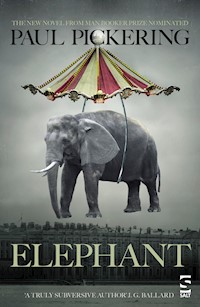
In a country house in England a precocious teenage exile from revolutionary Russia sets down his adventures on paper, beginning with his first ball in St Petersburg and how he frees a huge African elephant from a cruel circus. But a hundred years later an American academic feels the boy may have invented the elephant as the only kind and uplifting being in dark times.
Sie lesen das E-Book in den Legimi-Apps auf:
Seitenzahl: 595
Veröffentlichungsjahr: 2021
Das E-Book (TTS) können Sie hören im Abo „Legimi Premium” in Legimi-Apps auf:
Ähnliche




















v
ELEPHANT
PAUL PICKERING
vii
For Alice
viii
ix
“I loved you without hope, a mute offender;
What jealous pangs, what shy despairs I knew!
A love as deep as this, as true, as tender,
God grant another may yet offer you.”
Alexander Pushkin.
CONTENTS
ONE
THE UNEXPECTED MANUSCRIPT: PACKET I
“Elephant!” I met my elephant under a green Christmas tree hung with red candles and silver bells and high as the roof at a ball in the Tsar’s Palace outside St Petersburg. It was a small, silver elephant. I was an ornament too. I was one of the twenty children in sailor suits from the Imperial Nursery placed under the tree with the presents. I was already so excited my breath became hiccups. The kind of hiccups you get from drinking apricot juice too quick. ELEPHANT. If you are silent for a long time words become more your friends, not less. The dancers, the women in white dresses, the men in white uniforms with blue sashes, were part of the music itself and whirled near, ONE-TWO-THREE. I had not spoken much for the first five years of my life but this is a story beyond language and numbers that I write grown and educated and fearing not merely death but this story’s total annihilation. Even then I said things from dreams the woken did not want to hear. They were upset when I said JESUS IS DEAD. I was sitting on the floor in the great, mirrored ballroom of the Tsarskoye Selo palace that was also blue and white like a cake. The orchestra was playing loudly and the dresses of the young ladies caught my face and made me giggle. SLAP-ONE-TWO-THREE … SLAP-ONE-TWO-THREE 2… I was there on the warm wood floor in the creamy electric light surrounded by flashing sequins in an ocean of white satin and petticoats. There were floor to ceiling mirrors on the Christmas-tree side of the ballroom and French windows on the other, looking down to a lake, but between several of the windows there were gold-framed mirrors, so the waltzers were carried on into endless bending reflection that my tutors call INFINITY. The word was in my dreams and I asked them what it meant. The elephant and I were in the mirrors’ INFINITY too. The elephant was as little as my fingers and had red jewels for eyes, a heavy silver bauble on a dark green pine needle branch, and I began trying to draw it with my wax crayons on a piece of paper covered in my writing. Clever men came to see me, even the Holy Man with deep-pit, fall-into, midnight eyes, and listen to me and get mad and shout but come back. They didn’t like it when I ran round like a jumping jack. The pine needle branch ended in a candle and I blew out the candle and took the elephant off. The air smelt of smoke, the scented candle and pine needles. The elephant was free! In between drawing the elephant I was writing WORDS I now know the full meaning of. I was so happy I had not even had any sweets or anything to eat. NO ONE GOES TO HEAVEN was another thing I told the ladies. There were a lot of orphans in the Imperial Nursery that the old cleaning women who worked there called “bastards”, ubliduki. It is a bad word. I am not ublyudok. The nice women at the Imperial Nursery who smelt of good soap told me that my family had died in the war in the East and I was in St Petersburg because I was a minor prince (there were lots of us ornaments and bastards). THERE IS NO HELL, I shouted one night. A few of the boys and girls had been just collected on the Tsar’s travels because they were pretty. The ladies said I was pretty. I 3had been on a burning train with my parents and was saved by a nanny. I had howled like a wolf, literally like a wolf, when I got to the Imperial Nursery but then stopped and smiled and smiled. The ladies said I had been buried for days under dead passengers hearing the wolves sing their hunger songs and then them fighting over the bodies on top of me; important people, politicians and a German moral philosopher, a kind of teacher, the ladies in the nursery told me. Often I surprised them with words I did not understand from my dreams. The ladies said I was possessed when I shouted: THE DARK RIVER FLOWS TOWARD GOOD. Then they decided I heard the words when the wolves were eating the moral philosopher and mimicked them like a phonograph or a parrot. But the ladies knew that wasn’t true and it frightened them. I do not remember the burning train, which is strange, nor the fire or the smoke, or the Chinese Boxer rebels attacking, or the singing wolves eating my mother and father. I learned many cheerful songs in the Imperial Nursery yet I found it hard to remember my parents. Except when they went out to dances like this one and kissed me, and my sad-eyed mother smelt of perfume and lipstick and face powder and her furs of snow. The last time was in the dead of night, in candlelight. The old ladies said my parents had been murdered on that train. I hope it was before the wolves started their dinner. Perhaps my parents were going to a ball. With INFINITY mirrors, so they waltzed forever. I remember my mother saying to promise her to say my prayers and sleep tight. We were in the far, far East where you needed prayers. I then whirled across the ballroom with the silver elephant and sat on the floor by one of the food tables and began to write more words on my paper and draw. That is how I got into trouble with the Tsar.
TWO
The planet-wide New York sky was turning red on 20th and Broadway and Natasha wanted to get home so she could read again the start of the boy’s story she had received by email.
“God and his lovin’ angels bless you, girl.”
Natasha had reached into her suit pocket and taken out two single dollar bills of coffee money and put it in the Styrofoam cup of a large black woman in an orange tracksuit and light blue mask sprawled on the pavement a few doors from the house Natasha lived in on 20th. She knew she should not do this in New York, but more poor people were on the street due to the pandemic. Her day in Columbia University’s Low Library had been an ordeal. The acting chief librarian, a woman brought in because of the pandemic who bred and “showed” Toy Poodles, had said Natasha was probably not emotionally suited for the job, after catching her reading Nabokov. For the acting chief librarian, a library was a penitentiary for books and ideas and the woman was glad that no one could borrow any of them now. A drug deal was in play two doors on, yet outside Natasha’s doorway there was no one. There never was. The house was forbidding, a dark, dirty brown, even for a brownstone, that had never been renovated in a now fashionable area. Looking about her, she took out her keys and opened the front door and, being the only one in the building, scooped the post off the rotting mat. There 5was one envelope that made her heart beat faster. There had been a little cage to catch the bloody syringes and lighted cigarettes, but it had disappeared. The hallway was dark and carpet-less with a small window over the door and none at the back, and today she bi-passed the old, unreliable, expanding-metal-door elevator, so easy to trap your fingers in, and ran up the stairs, two at a time. On the first floor was the creepy apartment where she had first stayed, crammed full of a dead artist’s unsaleble pictures, in which you could hear the rats in the spaces behind the cream-painted walls and she had sung to them in the shower and recited her poems. She got to the top and undid the complicated locks on her apartment door. Perhaps the big, A4 envelope was from him, the man in Paris, the man who had been going to take her away from everything. She tore open the brown paper as she got inside. It wasn’t from him. Someone, probably a student who mistook her importance, had sent her the first few pages of the boy’s story photocopied, in case she did not read her emails. She went into the bedroom and put it on the bed underneath the skylight and then showered to wash the day out of her head.
Natasha towelled her hair and threw herself back on the bed and quickly read the pages.
The sky had turned fresh-blood red in the setting sun as she finished and lay back on the pillows, looking up at the skylight on that hot summer evening, a Paisley silk robe of blues and purples under her body. It had once belonged to her poor mother.
She had read the pages again, transported to Tsarist Russia and fascinated by the boy and his strange dreams and his way with capital letters, creating an emotional code, with words and phrases having an almost magical significance, using language as a game that released him from time and history. 6
Who had sent her this?
Natasha had hardly slept the night before but had dreamt. She tried to note the dreams down in a book she kept by the bed like Nabokov, but was not so tidy. Nabokov, Dreams and Time was the title of her doctorate. Last night she had dreamed of butterflies. A dream she had had many times before. In Natasha’s dream there were trays and trays of butterflies she instantly knew had been caught in nets, killed in a killing jar of bruised laurel leaves and then pinned onto cork and labelled, behind thick glass, in cases and framed in what must be in a museum because the air smelt musty and of furniture polish and mopped stone floors, like the Smithsonian in Washington, with its huge African Elephant in the entrance hall. In the first of the cases were exotic blue butterflies from the tropics as big as a hand, certainly as big as her hands, and she was consumed with sadness that a man had gone to Brazil, or some other end of the earth, to entrap and kill such a creature in his moments off from colonial duty. In the dream were stone arches of vast inner spaces of the museum sculpted with pineapples and held aloft by giant Negro slaves and there was a thick red carpet. Red was a trigger for her imagination, always, and she experienced everything about the butterflies and the tightly locked cases in an instant. The blue butterflies were not ones she recognised, but as she was about to turn away one of them moved, slightly. She looked back and there was a fluttering of the butterfly’s deep blue wings that became a strong vibrating of both wings; panicky bursts of energy, even though she could see the pin that held the insect to the cork. Natasha could not breathe. More butterflies began to move and the butterfly that had started to flutter first pushed at the cork with its long legs and unpinned itself, beating its wings strongly to press the pin from its body, bleeding liquid. 7The other butterflies imitated the first and she was about to go and try and fetch someone or at least record the moment on her phone, when the glass front of a case smashed with a crack like a pistol and she was surrounded by butterflies, this time blood red. They flew around her head, turning the museum into a carousel with Natasha at the centre. It was not long before all the cases were exploding and she was in a storm of many colours; a phenomenal resurrection. But it was beyond that. She felt inside the instant of the thousand, thousand butterflies that flew up into the darkness in the grey granite halls. It was a dream of beauty and colour and, above all, of freedom and rebellion.
It was the red in the clouds that had triggered her recollection of the dream.
Above her, a few New York clouds were still porcelain white and blue on the tops, cresting like waves, and then shades of pink and sanguine crimson underneath, as if in early summer, the summer of the lockdown, the seedy modern plague, an even more apocalyptic event had arrived to crystallise the unnamed anxieties of her generation.
A plane high above turned silver and gold, flashing briefly in the brighter light further up before disappearing into a cloud.
A slow, shabby, coat-winged bird, perhaps a heron, made its shaky way north, up Broadway, to Central Park and the ponds of Strawberry Fields, or possibly the reservoir. The sunset was strawberry now. She loved strawberries with a passion. She loved the colour red. For her it always meant change.
It was the colour of the old candlewick counterpane pulled over the head of her father, dead a year ago. One side of his face was red too, from the settled blood when they found him.
The cool, defining breeze off the ocean, redolent of ozone 8and another ocean, the Pacific, and her childhood, of kelp and pounding surf and catching crabs, was blowing through the cracks in the skylight. She liked the sensuality of the boy’s writing. Natasha’s own senses had mixed together since she was four. She saw letters as colours, Grapheme-colour Synaesthesia, like Nabokov, and, like the writer and catcher of butterflies, she had vivid, colour-haunted dreams that predicted the future. Nabokov thought the future had already happened and time was flowing in the opposite direction to the one presumed, in fact backwards, and one was quite right to be anxious about history known about, but never experienced in tooth and claw. The bad times full of pestilence and war were behind us all, but what if time was heading in that direction, making us boats against the current? The man in Paris said her generation were all so anxious because time was surging tidally back and connecting to the trauma of World War Two. Natasha loved the dandelion-seed sensitivity of the poet Emily Dickinson, to whom Natasha had been compared, and her timeless line: “I heard a fly buzz - when I died.”
She had just made her decision on her twenty-seventh birthday to quit writing poetry, after winning three national competitions and getting a Pulitzer nomination, and take a job and support her sick mother. He, the man in Paris, had wanted her to continue writing, wanted her to be his dependent, an exotic animal he could keep in a house or a flat somewhere and show off at dinner parties. Natasha rubbed at her pubic hair which was still sharp and spiky and had not grown fully back. She saw herself projected, unpinned, like one of the museum butterflies, onto that familiar, infernal sky, her blonde hair cropped in protest at what had gone down in Paris, her blue eyes that her mother said were panicky, her amused, half-smiling mouth that made her teachers think she 9was not taking things seriously enough, and her too long, slender, six-foot-in-her-Bobby-socks body. She looked at her computer on the old brass bed next to her and the email she had written in total weakness.
Natasha gazed, trembling, at the email still in the Draft folder before deciding not to delete. She had not written more. It was going to come out all wrong. It was a month now, since Paris. For her that particular piece of time meant everything. She knew she should get on with designing the creative writing class for the next semester at Columbia University where she was nominally only a librarian, allowed to do a bit of teaching. Instead, she turned back to the boy’s story. A truck horn sounded down below. One way or another she had to get away from thinking of the man in Paris. She opened the small bedside cabinet drawer and felt for her headache pills, which were not there. Instead, she found three loose tablets. They were all red and different sizes. Maybe if she took them she would grow like Alice. She left them. She had finished with all that, too, even though it was that kind of day. The truck horn sounded again. The skylight was all a magnificent ruby now, and gold. She had meant to go running. Up to the reservoir with the raggedy clothed heron, where bright blue jays fought over the trash baskets, but no way after dark. She began to read the three pages again. Here was a soul not unlike herself who lived, as she did, on the precipice of one age changing into another. The boy appeared to have all the nostalgic innocence 10 of a rebel on a path of discovery, even though Natasha’s rebellion and wanderings were over after what had happened in Paris and to her father and mother. After Paris. That’s what her life was now. Her computer beeped and she half expected it to be the man in Paris. But she saw she had another packet of the boy’s story sent from an anonymous email. She lent back on the pillows and read.
THREE
THE UNEXPECTED MANUSCRIPT: PACKET II
“He spoke!”
A princess with blonde ringlets at the ball clapped her hands and bent over me, all in white like a swan. “ELEPHANT,” I said again to the little silver animal that was mine now. Then I read the words written on the paper I was drawing on. There were drawings of the dead Tsar, all with blood everywhere, and his family. READING IS ESSENTIAL FOR FREEDOM.
“He spoke, the little man spoke. He said something clever.”
“No, he couldn’t have. He’s an idiot, that one. He speaks rubbish. He’s an idiot.”
“You’re an idiot. All the Tsar’s cavalry are idiots! No one says anything intelligent in Russia anymore.”
I liked the sound of the word IDIOT. I liked words. They were in my own head. They are jewels and do not need to have anything to do with other people. You can hide in words or let them explode like fireworks. They were my TOY SHOP.
No one seemed to know who I was or, indeed, what I was. To a few of the women at the Imperial Nursery I was a MONSTER, who had hardly spoken for the first years of his life, and when I did, I said too much that was unsettling, and quite often advised I should not be allowed to play with 12the rest of the Imperial Family, and that my outbursts had me bound for the public asylum. Others said I had joy in my heart, so I did not care. JOY!
I loved the Imperial Nursery, which smelled of biscuits and fresh-baked bread and the face powder of the ladies. Mostly they called me Mishka, little bear, and they called every boy that or little prince and there were lots of tiny princes and princesses. A few times they called me Pasha. There were thirty-two girls and boys, many who did not seem to belong to anyone but themselves. The matrons, even the strict ones, said I was a very beautiful boy, I am not boasting, as I write this many years later, but I was famous for my large green-blue eyes and a smile that quivered and broke out from a dimple in my cheek, like so much sunshine from behind a cloud. My nose is long, like Mr Gogol’s the women said, and my ears a little pointed, I have a wide mouth and haystack-coloured hair. I smile a lot. There were those who were unnerved by that smile but I do not mind. The day of the elephant on the Christmas tree was my earliest complete memory and the start of my life. I was not sure of trusting my dreams and imaginings about burning trains and singing wolves, based on the ladies’ stories. Before the Christmas ball I only remember snatches of bouncing a ball against a door and chasing grasshoppers through the warm summer meadows outside St Petersburg, counting which had red flashes in their wings and which blue, on nights when every tree and flower and bulrush hummed and crackled with life.
I did not mind at all being brushed by the silken dresses. ROBES in French. I felt part of the whirling mass of them.
With the crayons that I had taken from my tutor’s desk, I sat there in my white silk sailor suit, drawing. The girls smiled at me as they passed and so did most of the officers, hot from 13the modern heating in their blue and white cavalry jackets, as the orchestra played and played and the huge windows looked out onto the gardens and down to the frozen, moonlit lake.
The white gowns battered me gently in the face and I chuckled until I stood up and shouted out: “TOUT EST MOI ET JE SUIS TOUT.” Everything is me and I am everything. I loved the word TOUT. We learned French as well as English in the Imperial Nursery. TOUT sounded like the happy breath of God.
“He spoke again,” said the princess, clapping her hands. She was a minor princess with a long neck and kind eyes. “The little man spoke in French.”
Her partner pretended a yawn.
“His tutor is French. All tutors used to be French. Now most of them are English, thanks to the Tsarina, don’t forget. We are all meant to speak English now as the court language. I thought this one was meant to be mental?”
The princess looked at him with failing patience.
“This little one who you thought to be an imbecile is imperfectly quoting Baudelaire.”
‘Who?” said the officer. The princess hit him with her fan.
She reached for what I had been inscribing and drawing on the piece of paper on the ballroom floor. The ladies said the ballroom had come all the way from Paris and was a copy of one in the palace at Versailles.
“And he’s been writing too. Clever boy! He is a prodigy! A miracle!”
She then read my words and saw my drawings. She went very pale and gave a strangled little cry and scooped me up and took me to the side of the dance floor under the mirrors as high as the room. The dancers did not look into them or think what they were. I do not suppose for one moment the 14princess wanted to get me into trouble, but her stern mama came over to see what the commotion was about and was horrified. I laughed. Her mother looked as if she had swallowed a PIKE FISH. It may have been to do with the nice princess being German. The fleshy mama then summoned other ladies and then gentlemen and dancers. It was the fifth year of the twentieth century and there had been a revolution that didn’t work but which everyone talked and talked and talked about. More grown-ups read what was on the paper and stared back at me with increasing alarm. I was then rushed in the arms of one of the soldiers to the Amber Room, which was away from the festivities, where the Imperial Family were.
AMBER was a good word.
It was a room where the walls were solid amber and was given to Peter the Great by Frederick the Great, or that’s what an old Imperial guard had said who showed us around. I loved the room because there were flies and bits of plants embedded in the transparent honey-brown stone. It was meant to make you young and live for ever. Like the dead flies. If you told a fib there, though, you got caught up in the walls, with the flies. “That’s like Russia,” one of the ladies had said and giggled behind her hand. ‘Everyone caught up in lies.”
The Tsar was standing by the wall, to which were fixed a number of paintings, one upside down. Even I knew that. It was a pretty landscape of a lake that looked like the sky and was an easy mistake to make. But as Catherine the Great herself had hung them, no one was going to point this out.
“So you can talk?’ said the Tsar, in Russian. The Tsar was a tall and awkward man and the room was too small for him. His fists were clenched. From one protruded a cigarette. He had headaches probably because of the revolutions, the ladies said, like spinning round too much. I felt sorry for him. We 15were all taught to love and say prayers for him every night, the Tsar.
I smiled up.
“Yes,” I said.
“Perhaps it was your silence that confused us in the past?”
He was not a clever man in most ways and what he said was not a joke. But everyone laughed.
“No, sire,” I said. He was not used to the word but I was not going to tell a lie in the Amber Room and be caught in the walls with the flies and the lies forever.
He looked surprised at this reply and the Tsarina, who was sitting down by an enormous vase of white silk imitation flowers, lit a cigarette in an ebony holder and said in English, “Perhaps the boy is possessed by the devils who are loose in our sacred city.”
She rocked back and forward and hugged a black silk shawl patterned with great red roses over her white ball dress. She must have been a beautiful woman, now with dark lines under her eyes and I always thought of her as Mama, as did many of the other children at the court. The ladies said she was German but had been brought up in England by Queen Victoria. Underneath her perfume she stank of sweat and mice.
“How can you speak in French?” said the Tsar. “I gave orders that the court language is English now. That is what is taught in the nursery.”
I shrugged, possibly in a French way.
“One of my teachers in the nursery is French.”
I saw from the expression on the faces in the room that this was now regarded as unspeakable. It was the language of the revolution, I heard a lady say. REVOLUTIONS ARE IMPOSSIBLE. IDEAS DO NOT BURN, I had said to the 16ladies one night when doing cartwheels. Revolutions. It echoed in my dreams. I dreamed a lot. I did not say this to the Tsar.
The Tsar came over and peered down. He had a monocle. He assumed a stern expression and cast a shadow over me. He was wearing an ornate military uniform in white and blue and several military orders, including that of Saint Anna, around his neck.
“And you can read?” He made it sound like an insult. I was frightened now.
“I try, sire.” I answered in English.
“In French?”
“The language of chaos,” said the Tsarina. “It is how the Jews communicate with each other. The city is full of Jews! Jews! Christ protect us. It is full of these revolutionaries. They breed like rats and all shout at each other in French. It is despicable and the work of Lucifer.” She began to pray.
The Tsar was unnerved.
“In French?” he repeated.
I did not reply. Everyone was staring at me. More men in grey suits had come into the small room.
“So you know the words of French poets … but who told you to write this? The words on this paper? Was it one of your tutors? It seems I am surrounded by spies that come into my palaces with the ease that worms get into the timbers of a boat.”
The Tsarina looked up and blew a cloud of smoke.
The Tsar held the piece of paper in front of me. On it, in my shaky handwriting in capitals, were the simple words I had dreamed: LE TSAR DOIT MOURIR. The Tsar must die. The words TSAR and DOIT in particular pleased me. DOIT has almost the same letters as IDIOT in French.
‘Who told you to write the Tsar must die?” 17
He paused and then stepped forward and snatched the silver elephant I was holding in my hand.
“A thief as well, I see. That was on my writing desk. No one comes near my writing desk. How did you get that, my little thief?” he said, angry. To me, it was as if God himself was angry. He then hit me across the head with a pair of white kid gloves. It was not at all hard but I started to cry. He was about to hit me again but the very brave princess, who had discovered me writing amid the waltzing of the ball, put herself between me and the Tsar.
I was in a lake of tears. I wanted the elephant.
“This is not the way, Your Imperial Highness. He is an innocent child,” said the princess.
“No one is innocent these days,’ said one of the generals, who had shuffled into the room and was pouring himself another glass of champagne. The Tsarina then actually laughed.
“He cannot be one of yours, Nicky. Whoever heard of a clever Romanov?” she said. “We are doomed. It is prophesied in the words and drawings of a child. Fetch me the Holy Man. He can make preparation for the boy to be exorcised and healed.”
The Tsarina got up from the chair and came over to where I stood. She crouched down and took my arms, gently.
“Everyone leave,” she commanded. When they were gone she lit another cigarette with a candle on a small table. She turned to the Tsar.
I was alone with them in the tea-glass coloured room.
They both knelt down by me. Their faces were very close to mine. Suddenly they were different.
“Dear one … Look at this boy, for God’s sake. What do you see?” 18
I was really frightened now.
“I see what you see,” he said wearily, as she stroked my hair. “I know he looks like poor Alexei. Not too much. What are you thinking, my darling?”
Then with a glint in her eye, she said: “I will ask the Holy Man what he advises.”
The Tsar tugged at his collar.
“His parents died in the East. The minister said so. He is not related to us.”
“Everyone is related to us,” the Tsarina said, with a knowing laugh. “I will tell the Holy Man.”
My tears stopped. Did they mean I was somehow one of the Imperial Family? How could that be? I was excited and scared and my lower lip started to quiver. I wanted to be part of a family. Any family.
She then stood and left and the Tsar stood too. But he remained, staring at the floor.
“Not the fucking Holy Man,” he said quietly in Russian, holding his head. “Oh please, not the fucking Holy Man. I’m getting one of my headaches.”
At this, the princess who had saved me hurried into the room, curtsied and rushed me out. She hid me under a table for the rest of the ball and her beaux, of whom there were several, brought me nice things to eat and even a sip of iced champagne, which made my head dance with the music and the colours. They all waltzed and waltzed except for a pause when a very beautiful ballerina did the ‘Dance of the Sugar Plum Fairy’. I saw her searching around the base of the Christmas tree as if she had lost something among the presents.
Afterwards, the dancer came over to me and reached down to kiss me, not just once but again and again and again, and 19her lovely face contorted with great sadness and she burst into tears and left the room.
SUGAR PLUM FAIRY was in my head.
A few of the officers laughed and whispered. Christmas presents were handed out. I did not care. I only wanted the elephant that had been taken from me.
The princess, who had gone after the dancer, returned with a flower from her dress. I did not want the flower, I wanted my elephant. I trusted the elephant.
I still saw the anguished look of the SUGAR PLUM FAIRY.
“She was too upset by the emotion of her performance to remain with us. Don’t worry a bit about the Tsar,” said the princess, with a wink. She gave me a kiss on the forehead and her skin had the scent of hyacinths. “I’m sorry if I got you into trouble. This is all about more than you can know or understand. Do not worry. It will be forgotten by morning. They’ll all get drunk and forget. They’ll be glad they have a prodigy. The Tsar has plenty of other things to worry about, like the war with Japan. It will all blow over. You just see.”
I did see. But I wanted the elephant the Tsar said belonged to him. I needed the elephant.
FOUR
The next day after her dream of the rebel butterflies, after seeing the fiery red sky that set ablaze her thoughts about the boy in the manuscript, Natasha went for a run up Fifth Avenue and into Central Park. She ran in an easy lope, dodging people and hurdling a drunk near the Hans Christian Andersen statue, past the zoo, past two Audubon perfect blue jays fighting in a trash basket, and around and around the creamy, light brown water of the reservoir, looking like milky chocolate behind a high fence, with other morning pilgrims. Natasha liked the oily sensuality of the still water and the fallen leaves, almost a piece of wilderness if you got up close to the fence, until you looked up and saw the city, the lunacy of American Gothic shouting from Art Deco skyscrapers. Running was as close as she got to her butterfly moment in her dream. A girl she knew from Columbia waved and shouted “Hi” but mainly the runners were a closed sect. They were further entrapped by their Bluetooth earphones and several of the girls wore veil-like black masks. Natasha then ran back through Strawberry Fields, past the little rowing pond, wondering what had happened to the shabby heron.
When she got back to the apartment on 20th she showered. It was a better shower in the top flat under an opaque skylight. There were no rats behind the walls. The apartment she had been in first in the old building, which belonged to a friend’s family, was still entirely full of the former artist 21tenant’s paintings. These were all a uniform light grey and showed a hardly discernible image within the paint and under layers of varnish. The effect was to suggest, whatever the image was, that it was very important. There were a few more conventional Miro-like works propped against the walls and a pile of magazines with interviews about the artist. The artist, Gannin, a Russian, had sold no work before his grey period, one interview in the New York Times magazine said, and enjoyed brief and intense notoriety, as before producing them he had cut off both of his hands under local anaesthetic using a sheet metal cutter in a Queens foundry and had nearly died on the way to hospital, where he thought they could be sewn back on. (He naively trusted the correct position of the future in time in New York traffic.) Natasha had not believed the story at first and had looked up the newspaper files. A magazine cover showed the artist smiling at a table with his hands in front of him. He had been preparing with assistants for another show when he died of a painkiller overdose in the high-ceilinged room containing the paintings. When Natasha heard the rats behind the boards and tiles in the shower it sounded like someone was in the main room, the “gallery”, with the hot lights, where no one ever came. Natasha was not superstitious, but she did not like to think of the return of the artist, or even worse, just his scorned hands. She, too, had stopped her art, her poetry. She put on a clean red tracksuit and, feeling she might have pulled a hamstring, went down in the old, slow elevator that had been mysteriously cleaned and smelled of metal polish and beeswax, and hurried to the Korean diner across the road.
Natasha did not need to order. The waiter, dour, surly but almost annoyingly attentive, brought her black coffee and a glass of iced water, and then in no time at all, two eggs, sunny 22side up, by a mound of perfect hash browns. She smiled and thanked him and he turned his back and walked away, but not before a curt nod, the equivalent of three sonnets and several bouquets of long-stemmed red roses. She ate quickly but before she had finished her phone went ping. It was a friend from Harvard. Natasha felt a sad and appalling nostalgia. Now the dream times, the good times, seemed over, especially after Paris. She looked down at the email on her phone.
From: (ChiChiChica) [email protected]
Hi there, Nash, how are you? How is your marmalade cunt? It does taste exactly like marmalade. I part read the pages you sent and yes, I would say it may be the beginning of something Faustian and unsettling and a little bit Schopenhauer. Please tell me you wrote it, my darling. Or are you saying that the boy is real? That he wrote these first pages of his own history? He is a total love, I give you that. But all this is distraction. Hallucinations! Elephant is another name for PCP or angel dust. Tell me you have not been cramming down the pills? Now let’s get down to the real stuff. Why don’t you come back to me this instant and let me wrap my eighteen hundred arms around you again? Your prince charming has let you down. He has not only let you down he beat the holy shit out of you and worse. I do not understand why you feel you need a man when you have little me. No llores, mi querida. I still think you should report the grand shit to the police. You say it is not rape but it sounds like rape to me. Blood all over your blouse? Blood! All over a wrecked 1000-dollar-a-night room? That is not fucking consensual. Rape is as bad as murder in my book and I am still thinking 23of going back to Juarez and getting my half-brother’s gun and shooting your man in Paris down dead by a nameless wall somewhere. Hey, Chica, where you goin’ with that gun in your hand! Love is dangerous. I think Pushkin, who you admire so much, thought of love as a charging elephant. Elephants again! Come home to mummy. I got the case cracked and the Martini shaken to its existential core. There is no elephant in the room in this Russian tale. Nothing obvious. It’s worse than that. What darkness! Singing wolves! Terrifying! Cool! Run to me, Natasha. I can get you a job here any time you want and we can pop champagne corks into the happy Charles River and get up close and personal in the Lilac Arboretum and eat a peach or two. They need minds like yours. It’s all getting stale. I need you. Harvard beats fucking in fucking New York. You can have excitement and civilisation. You only went there because of the man. The Man. Leave all that, Natasha. Come back to me now. You know I love you.
Reloveution! ChiChi
Dr Martha Froment
Gurney Professor of English Poetry and Liberal Arts
Harvard University
Cambridge, Boston.
Natasha shook her head and ran her fingers through her short hair. What happened in Paris had gone nuclear, but it was not what ChiChi said. It was endearing that ChiChi exaggerated so much in her personal secret life when her academic one was so non-generalised and exacting. There was a desperation in her frenetic energy. A wanting to be dumbly young again. Natasha doubted that ChiChi had any Mexican relatives at 24all. Natasha was late. She paid and ran across the road, getting honked at by a yellow cab. She skipped up the steps of the building and inside, not wanting to push her hamstring too far, closed the heavy door of the elevator and pressed her floor button. The light above her head flickered and for a moment there was a clicking sound but nothing happened. In Paris there had been a similar elevator and anger and blood and now it was time for reality. The light flickered again and there was more clicking before the elevator ascended fitfully and she reached the top floor. Inside, she changed into her work clothes, a blue suit. She could not get Columbia to pay her as a lecturer. Perhaps they had heard from her friends that she had given up on her poetry. But her mom was sick now after what happened to her dad. Natasha wished he hadn’t gone and that she had been nicer to him. Her mother had loved dancing all her life in small parts in the chorus and musical theatre. The day she heard about what had happened to her husband she stopped dancing. Then her mother had stopped moving and talking and smiling and there was worse to come. Natasha helped pay the bills for the nursing home. She sighed.
Natasha’s poetry had survived assaults by post-modernism and post-structuralism and all manner of academic strait jackets. It had survived the unexpected affair with ChiChi. But there had been something poetic from the start in what Natasha felt for the man in Paris, and she had written less. She had written less too after her father died, no line seeming sufficient to embrace the loss and absurdity. But, if she were brutally honest and she tried to be, it was love, in the main, in its full unpredictable flow that came between her and the blank page. Stretching her naked body on a cold, white sheet, her cries of ecstasy substituted for rhythm and syntax and the horizontal line she put instead of the period point. You 25cannot write poetry when you are making love, and she and the man in Paris never stopped.
Natasha looked at herself in the mirror and smiled. Her hair was convict-cropped. Genet said there was a close relationship between convicts and flowers, the fragility and delicacy of the latter for him complimenting the brutal insensitivity of the former. Natasha’s hair probably made her look like an anarchist who might place a lighted cigarette or two in prized first editions of bourgeois literary gods like Emerson and Thoreau. She had to get herself focussed and on track. She had to learn to switch off and just work, like when she was running. Anyway, her poems were not that good, she thought, and she didn’t want to be like the handless artist, reaching for sensation.
With her low heels in her bag, Natasha headed down the stairs in her trainers and up 20th. She liked West 20th and how it crossed 6th with the old Limelight Club in the blackened church on the corner, now a Chinese restaurant. She preferred that way to the subway on 23rd instead of going down to Broadway. She quickened her pace, dancing around an arguing couple as more people pin-balled towards her, only socially distanced by their clothes. She thought of ChiChi. It was not rape. She hurried on as a taxi had stopped and two cars behind were already honking their horns and windows were being wound down as a New York minute was being wasted. A cop by a burlesque bar turned away. There was a cold, gritty wind from the river. She had met the man in Paris here at a gallery opening and he talked to her all night as if she was the only person in the universe, talked of how her poetry was so important, not just for herself but the world, and something shifted, changed her, changed everything. He was the first man to talk to her like this and he wrote himself into every hope 26and dream and atom of her being. The man in Paris who had not called. She shook herself and quickly disappeared down the subway, trying to give her dreams the slip. The man in Paris not calling was like a hot knife in butter. On the train she started to read the Russian story again. Always when there was trouble she hid in stories. Her grandmother had died when Natasha was seven, a woman she dearly loved who had taught her to draw and, more significantly, to love poems. Her grandmother had taken a whole winter to die at the turn of the millennium but had been so cheerful on a bed that was put up for her on the ground floor of a small house in San Francisco. No one told Natasha her grandmother was going to die, but she picked up the entire thing from the whispering adults. To keep everything at a distance, at a manageable distance (she constantly felt like crying), she read 101 Dalmations again and again. In all she read it nine times, lingering over the twilight barking and the hot sugary tea and toast, and the triumph over death and evil. It was not the crummy Disney version but the original novel by Dodie Smith. Books became an extension of Natasha’s dreams, as did her own writing. They stopped time rushing at you. There was no warning, no protection, when her father died, which was typical. The Russian boy had dreams. The trouble was deciding if they only existed on paper. Could the story she had been reading really be true? Natasha wished she had more to go on. She was hooked already and whoever sent the pages to her realised how it worked with the reader. Dickens knew the addictive power of having his work serialised in a newspaper. The subway train stopped and the lights dimmed and flickered like the lift she tried to avoid in her building.
“Is this a metaphor, I ask myself?” said the striking, tall, 27obviously gay man next to her, dressed like Sherlock Holmes but without the silly cap.
She knew enough of the city not to reply. The lights came fully on again and they sped on down the long, dark tunnel. She put the manuscript away. Natasha had a tendency to look for too many metaphors. Later that day a new “packet” of the boy’s manuscript appeared on her computer.
FIVE
THE UNEXPECTED MANUSCRIPT: PACKET III
When one of the ladies took me back to the Imperial Nursery from the Christmas Ball everyone was very quiet. I could smell incense and as I went up to the little dormitory where I slept I heard a papa saying prayers. I thought it was because of me and he was praying for my soul. That it was for stealing the Tsar’s elephant. But he was just blessing a child whose new “parents” were taking him away the next day. I wished I had real parents. Any parents. I had been crying before and the tears came again. The hairs at the back of my neck stood up. I felt a presence behind me. I saw a worried expression on the nice face of the old papa who was swinging his incense holder to make the place smell nice.
“You are not meant to come here … You are not meant to be in here,” said the lady with me to the person behind us. There was a shaking fear in her voice. A man spoke with authority:
“Leave, priest. This boy does not need you. Leave, all of you. Except you, little one.”
He clapped his hands.
“I am not leaving,” said the lady who had just spoken.
I turned and towering above me was the Holy Man. He had come to see me before after I had said things from dreams. 29He had very long, black greasy hair and a beard. He came and picked me up and held me very near to his face. “I see your future. It has been promised, I see.” I did not understand him. He smelt of sweat like the Tsarina but not of mice and there was also a curious scent like cooking cloves and pinecones and chocolate all mixed up. His face was white and thin. Then you looked into his eyes and thought you could see forever, a thousand leagues, into the endless forest, all the way to China and all in a glowing dark. You could not look away. It was not frightening but you knew, you just knew you should not be doing it, taking the step into the forest. He spoke again and his voice was deep and measured like a priest, “Kiss me. Kiss me, Pasha. When I came before we talked of power and how we distract ourselves with rosebuds and ballerinas and elephants.”
I let him lean down and kiss me on the lips.
The lady shouted hoarsely:
“Get out, Rasputin! You are Satan’s animal! Guards! We cannot have this madness in Russia, please God.”
The Holy Man did not even seem to hear her. He smiled at me in the kindest way. He had been kind to me when he came to see me in the past, sometimes with others, teachers who said they wanted to learn from me, who argued with me, but the best times were when he came alone and put his arm around me and I felt calm and at peace. His hands warmed yours like the wonderful tiled stove in the Imperial Nursery kitchens. He had a deep voice that was brown like forest honey and made the world tremble but then he smiled like sunshine. I was not afraid of him and would have gone anywhere with him. He had an immense and gentle soul. He was the only adult to treat me as an equal or as if I had any value. I remember exactly his words as if he had written them on my 30most secret self, though at the time I did not fully understand.
“Remember what you told these dear ladies after your dreams? What you then repeated to me about the world being like an endless river of dark fire?”
“I do,” I said.
“Well to myself and the learned others who came to see you, wise men, Magi, that was an image that explained the dark power of creation and our disintegrating modern times. The little houses you saw on the shores are our flimsy, ape-like ideas. All on our way to a murder! Our own. How deliciously funny. None of us escapes our fate. Not even a Tsar.”
I nodded. I noticed the lady was trembling. The very WORDS were dangerous. Rasputin ignored her.
“With your brilliant image of the dark river you described how our lives really are, without recourse to boring gods and angels. Angels cannot stop the fire that is coming. The ancients used to prize the wisdom of children, those closer to birth being more at one and sensitive to the un-reasoning forces of the universe. The elders of the temple invited Jesus to talk with them. In so-called primitive Africa they still listen closely to special children, like yourself.”
He stared deep into my eyes until it hurt.
“We may not see each other again in this world, so promise me something. Let us make a holy pact. A bargain. You must promise that you will try to discover if there is a meaning to life beyond the dark river, our pathetic mud huts on its banks and a miserable, ridiculous death. Do this, my child, and I guarantee you will find enormous happiness. Enormous![he used the word ogromnyy] This excitable lady thinks I am the Devil, or at least one of his black, twinkling imps, and, unlike God, the Devil always keeps his promises. If you do not do this I will take what used to be called your soul and crunch 31it down for my afternoon tea with French marzipan cakes, or the world will. Munch, munch! Do you trust me, my dear? Do you promise to find a meaning beyond the dark river? Do you swear?”
He was grinning and I laughed: “I swear,” I said, and he kissed me on the lips again to seal the bargain.
The lady I was with screamed, began to make the sign of the cross, and fainted. The Imperial Nursery did not approve of public diabolic bargains involving their children, just private ones with childless couples.
Then with a booming laugh that echoed to the kitchens, Rasputin slipped away before the reluctant guards finally came.
The next morning I ate my meat pancakes at breakfast in silence while a boy across from me said the penalty for theft was having my arm cut off. The penalty for theft from the Tsar was to have all my limbs cut off and be thrown in the river, with curses, by the Peter and Paul Fortress. My miserable, ridiculous death was coming sooner than I, or even Rasputin, thought and without any happiness. A lovely girl who was my friend told the boy, who had a head cold, and whose nose was running with green snot, not to be so nasty. The girl and I had cuddled together in her dormitory bed like grown-ups. At that moment a man came to take me to the Tsar’s study and I felt I was going to cry but bit my lip so I did not.
When I eventually saw the Tsar, I was ready to be dismembered. But he was in a very good mood.
The silver elephant he had accused me of stealing was on the desk in front of him with a red ribbon through a ring on its back. The Tsar put it in his pocket.
“I have had an idea,” he said. He had a very boyish smile 32this morning. He had several advisors in the room with him and they looked at me, a little askance. They appeared very worried at his idea of an idea.
I smiled at him and nodded. I don’t think he had ideas very often.
“Come with me, little one. Bring him, bring him. Do not stand on ceremony.”
The Selo palace was surrounded by beautiful gardens. It was built by Peter the Great and by his daughter Catherine who both spent time there and, in their passion for the exotic, established a menagerie to rival those in London, Paris and Berlin, said our tutors. The animals in the Imperial Zoo had a better time of it because they were not constantly being spied on and teased by the public. In Selo they lived a life of no wanting. They were purely there to be studied and drawn by a small number of scientists and artists and for the occasional polite amusement of the Imperial Family.
There was a delight on the Tsar’s face that took him back to being a child again and in that moment I loved him very dearly. Today, he was wearing a peasant shirt, buttoned at the side of the neck and with a belt around his middle. Over this he wore a fur-lined greatcoat. There were dark rings under his eyes. I felt a sadness in him and a foreboding. He just wanted to play, as I did.
He sat down in the snow by the very large cage of an old lion that knew him. I sat on his greatcoat. He was so pleased to be there he kissed me, everyone kissed everyone three times on the cheek, but this was a tender kiss on the forehead and I was glad. The day was a cold one and there was a gentle sleeting but it did not seem to bother the Tsar. The cold did not upset the lion either and the huge cat put his head against the bars and, to my surprise, the Tsar reached in and tickled 33the cat’s ears and his nose. The lion purred, so loud you felt it inside you.
“They’re not like us,” said the Tsar, gently. “They do not think like us,” he said, and the lion purred louder at the sound of his voice. “Our brains select what we see and edit and exclude things. But the lion here lets in everything. That’s why he’s easily scared, easily angry, can behave strangely. He sees too much. If we could talk to him, if we had a common language, we would still not understand him because of how he sees the world. He sees it all at once and without any filter or time. There are people like that. Poets. Perhaps you are like that?”
He was silent and continued to play with the lion.
I plucked up courage and spoke.
“Please, sire. Are you going to have my hands and feet cut off and throw my body in the Neva River? For stealing your elephant? If so, I’d like to say goodbye to the princess first.”
He laughed at this and so did all of his attendants but then he grabbed me and hugged me to him. Really hugged me passionately, with tears in his eyes.
He produced the silver elephant from his pocket and put the ribbon round my neck.
“It is now yours.”
I looked at it, disbelieving.
Then I threw my arms around his neck and kissed him on the cheek.
“Oh, thank you, thank you, Papa!”
He laughed.
“I am not vexed with you at all, dear one. I’m not vexed. Indeed, you may be of great help to our family in the future. You may be of eternal help. But I want you educated away 34from St Petersburg. Away from the Imperial Family. You’ll understand your relations to us better when you grow up.”
He saw I was upset and he sent the others away and led me around the cages and animal and birdhouses, my little hand in his long, cold one. He was trying to smile down at me. I so wanted him to be my father in that moment.
At last, as the winter light was starting to fade, in an area of fields protected by a high wooden fence we came upon a herd of elephants. I liked the sound of the word in Russian. SION. Like the city of Jerusalem.
I was amazed at the great, grey creatures and their curtain-like ears. I had seen the tame Indian elephants in the circus but never anything like these. They had tusks as long as a lion and stood above us, massive as a house.




