


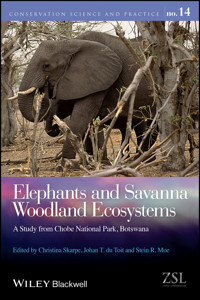
Elephants and Savanna Woodland Ecosystems E-Book
88,99 €
Mehr erfahren.
- Herausgeber: John Wiley & Sons
- Kategorie: Wissenschaft und neue Technologien
- Serie: Conservation Science and Practice
- Sprache: Englisch
During the nineteenth century, ivory hunting caused a substantial decrease of elephant numbers in southern Africa. Soon after that, populations of many other large and medium-sized herbivores went into steep decline due to the rinderpest pandemic in the 1890s. These two events provided an opportunity for woodland establishment in areas previously intensively utilized by elephants and other herbivores. The return of elephants to currently protected areas of their former range has greatly influenced vegetation locally and the resulting potential negative effects on biodiversity are causing concern among stakeholders, managers, and scientists.
This book focuses on the ecological effects of the increasing elephant population in northern Botswana, presenting the importance of the elephants for the heterogeneity of the system, and showing that elephant ecology involves much wider spatiotemporal scales than was previously thought. Drawing on the results of their research, the authors discuss elephant-caused effects on vegetation in nutrient-rich and nutrient-poor savannas, and the potential competition between elephants on the one hand and browsers and mixed feeders on the other.
Ultimately this text provides a comprehensive review of ecological processes in African savannas, covering long-term ecosystem changes and human-wildlife conflicts. It summarises new knowledge on the ecology of the sub-humid African savanna ecosystems to advance the general functional understanding of savanna ecosystems across moisture and nutrient gradients.
Sie lesen das E-Book in den Legimi-Apps auf:
Seitenzahl: 604
Veröffentlichungsjahr: 2014
Ähnliche




















Table of Contents
Cover
Conservation Science and Practice Series
Previously published
Title Page
Copyright
List of Contributors
Foreword
Preface
Part I: The Chobe Ecosystems
Chapter 1: Introduction
References
Chapter 2: The Chobe Environment
Geomorphology
Soils
Climate
Flora and vegetation in the Chobe savanna
The mammal community
Human impact
Closing remarks
References
Chapter 3: Elephant-Mediated Ecosystem Processes in Kalahari-Sand Woodlands
Large herbivore biomass density and the contribution of elephants
How can a dystrophic ecosystem support so many elephants?
An elephant ecosystem
Interactions between keystone and foundation species maintain regional biodiversity
References
Part II: The Substrate
Chapter 4: Historical Changes of Vegetation in the Chobe Area
Vegetation in the Chobe area before the decline in elephants
Elephants, germs, livestock and logging
Vegetation changes on the alluvium and on the sand
Elephants and the Chobe woodlands
References
Chapter 5: Vegetation: Between Soils and Herbivores
Habitat types
Plant communities, species diversity and structure of vegetation
Abiotic and biotic variables related to the present vegetation
Life-form and species distribution
Seed-bank of woody species
Concluding remarks
References
Part III: The Agent
Chapter 6: Guns, Ivory and Disease: Past Influences on the Present Status of Botswana's Elephants and their Habitats
Introduction
Pre- and post-colonial hunting of elephants in southern Africa
Disease and ecological transformation: the rinderpest panzootic arrives in 1896
Recovery of Botswana's elephant population in the 20th century
Overview
References
Chapter 7: The Chobe Elephants: One Species, Two Niches
Sexual size-dimorphism and social organization
Sex differences in the use of plant parts
Browsing height stratification
Sex differences in the use of food patches
Sexual segregation at the habitat scale
Implications for management and further research
References
Chapter 8: Surface Water and Elephant Ecology: Lessons from a Waterhole-Driven Ecosystem, Hwange National Park, Zimbabwe
A brief description of Hwange National Park
Movement patterns reveal the dry-season trade-off between foraging and drinking
Evidence that water defines key-resource areas: population-level processes
Beyond water, habitats and social interactions
Surface-water driven management of elephants and savanna ecosystems
Acknowledgements
References
Part IV: Controllers
Chapter 9: Soil as Controller of and Responder to Elephant Activity
The soils
Soil as a controller of elephant activities and impact
Soil controls the vegetation
Mammal communities and soil
Soil as a responder to elephant activities
Large herbivores and fire
References
Chapter 10: Impala as Controllers of Elephant-Driven Change within a Savanna Ecosystem
Introduction
Impala and seedlings
Seedling predation across eastern and southern African savannas
Impala prevent woodland regeneration
A guild-based approach to predicting the effects of ungulates on tree establishment
Cascading effects of an ecosystem controller
References
Chapter 11: Buffalo and Elephants: Competition and Facilitation in the Dry Season on the Chobe Floodplain
Introduction
Spatial and temporal overlap between elephant and buffalo in Chobe
Interference competition
Buffalo as a controller of elephant grazing
References
Part V: Responders
Chapter 12: Plant–Herbivore Interactions
A partially migratory system
Plant characteristics vary with resource availability and herbivory
Large herbivores feed selectively in response to plant traits
Plant responses to large herbivores
Herbivore responses to plant responses
Interactions between elephants, plants and ungulates
References
Chapter 13: Elephants and the Grazing and Browsing Guilds
How this chapter was compiled
Grazing and browsing ungulates in the Chobe environment
Historical changes in abundance and foraging of some grazing and browsing ungulates
The grazing, the mixed feeding and the browsing guilds
Elephants and the grazing and the browsing guild
References
Chapter 14: Cascading Effects on Smaller Mammals and Gallinaceous Birds of Elephant Impacts on Vegetation Structure
Medium-sized mammals and gallinaceous birds: large-scale habitat selection and diversity
Gallinaceous birds: selection of cover within high-density habitats
Small mammals
Discussion
Conclusion
References
Chapter 15: The Chobe Riverfront Lion Population: A Large Predator as Responder to Elephant-Induced Habitat Heterogeneity
Introduction
Habitat heterogeneity and population regulation in carnivores
The lion riverfront population
Elephant impact and the lion riverfront population
Conclusion
References
Part VI: Elephants in Social-Ecological Systems
Chapter 16: Human Dimensions of Elephant Ecology
History of human-elephant conflict (HEC) and coexistence
Elephants as threats to humans and their crops
Management and mitigation of HEC
Humans as threats to elephants
Elephant macroeconomics – ivory and tourism
Elephant microeconomics – community-based conservation initiatives
Attitudes and conflicts
Conclusions and recommendations
References
Chapter 17: Elephants and Heterogeneity in Savanna Landscapes
Elephant drinking sites, transition zones, and population regulation
Available area, distance between waterpoints, and elephant overpopulation
Are elephants agents of landscape heterogeneity or homogeneity?
Conclusion
References
Index
Supplemental Images
End User License Agreement
Pages
xi
xii
xiii
xiv
xv
xvii
xviii
xix
3
4
5
6
7
8
9
10
11
12
13
14
15
16
17
18
19
20
21
22
23
24
25
26
27
28
29
30
31
32
33
34
35
36
37
38
39
43
44
45
46
47
48
49
50
51
52
53
54
55
56
57
58
59
60
61
62
63
64
65
66
67
68
69
70
71
72
73
74
75
76
77
78
79
80
81
82
83
84
85
86
87
88
91
92
93
94
95
96
97
98
99
100
101
102
103
104
105
106
107
108
109
110
111
112
113
114
115
116
117
118
119
120
121
122
123
124
125
126
127
128
129
130
131
135
136
137
138
139
140
141
142
143
144
145
146
147
148
149
150
151
152
153
154
155
156
157
158
159
160
161
162
163
164
165
166
167
168
169
170
171
172
173
174
175
176
177
178
179
180
181
182
183
184
185
189
190
191
192
193
194
195
196
197
198
199
200
201
202
203
204
205
206
207
208
209
210
211
212
213
214
215
216
217
218
219
220
221
222
223
224
225
226
227
228
229
231
230
231
232
233
234
235
236
237
238
239
240
241
242
243
244
245
246
247
248
249
250
251
252
253
254
255
256
257
258
259
260
261
262
263
264
265
266
267
271
272
273
274
275
276
277
278
279
280
281
282
283
284
285
286
287
288
289
290
291
292
293
294
295
296
297
298
1
41
42
89
90
133
134
187
188
269
299
300
301
302
303
304
305
306
307
308
309
310
311
312
Guide
Cover
Table of Contents
Preface
Part I: The Chobe Ecosystems
Chapter 1: Introduction
List of Illustrations
Figure 1.1
Figure 2.1
Figure 2.2
Figure 2.3
Figure 3.1
Figure 4.1
Figure 4.2
Figure 5.1
Figure 5.2
Figure 6.1
Figure 6.2
Figure 6.3
Figure 7.1
Figure 7.2
Figure 8.1
Figure 8.2
Figure 8.3
Figure 9.1
Figure 9.2
Figure 10.1
Figure 10.2
Figure 10.3
Figure 10.4
Figure 12.1
Figure 12.2
Figure 14.1
Figure 15.1
Figure 15.2
Figure 15.3
Figure 15.4
List of Tables
Table 2.1
Table 2.2
Table 5.1
Table 7.1
Table 9.1
Table 9.2
Table 9.3
Table 11.1
Table 11.2
Table 11.3
Table 11.4
Table 13.1
Table 13.2
Table 14.1
Table 14.2
Table 14.3
Table 14.4
Table 14.5
Table 14.6
Table 15.1
Table 15.2
Conservation Science and Practice Series
Published in association with the Zoological Society of London
Wiley-Blackwell and the Zoological Society of London are proud to present our Conservation Science and Practice series. Each book in the series reviews a key issue in conservation today from a multidisciplinary viewpoint.
Books in the series can be single or multi-authored and proposals should be sent to:
Ward Cooper, Senior Commissioning Editor. Email: [email protected]
Each book proposal will be assessed by independent academic referees, as well as our Series Editorial Panel. Members of the Panel include:
Richard Cowling, Nelson Mandela Metropolitan University, Port Elizabeth, South Africa
John Gittleman, Institute of Ecology, University of Georgia, USA
Andrew Knight, University of Stellenbosch, South Africa
Nigel Leader-Williams, University of Cambridge, UK
Georgina Mace, University College London, UK
Daniel Pauly, University of British Columbia, Canada
Stuart Pimm, Duke University, USA
Hugh Possingham, University of Queensland, Australia
Peter Raven, Missouri Botanical Gardens, USA
Helen Regan, University of California, Riverside, USA
Alex Rogers, University of Oxford, UK
Michael Samways, University of Stellenbosch, South Africa
Nigel Stork, Griffith University, Australia.
Previously published
Biodiversity Monitoring and Conservation: Bridging the Gap between Global Commitment and Local Action
Edited by Ben Collen, Nathalie Pettorelli, Jonathan E.M. Baillie and Sarah M. Durant
ISBN: 978-1-4443-3291-9 Hardcover;
ISBN: 978-1-4443-3292-6 Paperback; April 2013
Biodiversity Conservation and Poverty Alleviation: Exploring the Evidence for a Link
Edited by Dilys Roe, Joanna Elliott, Chris Sandbrook and Matt Walpole
ISBN: 978-0-470-67478-9 Paperback;
ISBN: 978-0-470-67479-6 Hardcover; December 2012
Applied Population and Community Ecology: The Case of Feral Pigs in Australia
Edited by Jim Hone
ISBN: 978-0-470-65864-2 Hardcover; July 2012
Tropical Forest Conservation and Industry Partnership: An Experience from the Congo Basin
Edited by Connie J. Clark and John R. Poulsen
ISBN: 978-0-4706-7373-7 Hardcover; March 2012
Reintroduction Biology: Integrating Science and Management
Edited by John G. Ewen, Doug. P. Armstrong, Kevin A. Parker and Philip J. Seddon
ISBN: 978-1-4051-8674-2 Paperback;
ISBN: 978-1-4443-6156-8 Hardcover; January 2012
Trade-offs in Conservation: Deciding What to Save
Edited by Nigel Leader-Williams, William M. Adams and Robert J. Smith
ISBN: 978-1-4051-9383-2 Paperback; ISBN: 978-1-4051-9384-9 Hardcover; September 2010
Urban Biodiversity and Design
Edited by Norbert Müller, Peter Werner and John G. Kelcey
ISBN: 978-1-4443-3267-4 Paperback;
ISBN: 978-1-4443-3266-7 Hardcover; April 2010
Wild Rangelands: Conserving Wildlife While Maintaining Livestock in Semi-Arid Ecosystems
Edited by Johan T. du Toit, Richard Kock and James C. Deutsch
ISBN: 978-1-4051-7785-6 Paperback; ISBN: 978-1-4051-9488-4 Hardcover; January 2010
Reintroduction of Top-Order Predators
Edited by Matt W. Hayward and Michael J. Somers
ISBN: 978-1-4051-7680-4 Paperback; ISBN: 978-1-4051-9273-6 Hardcover; April 2009
Recreational Hunting, Conservation and Rural Livelihoods: Science and Practice
Edited by Barney Dickson, Jonathan Hutton and Bill Adams
ISBN: 978-1-4051-6785-7 Paperback; ISBN: 978-1-4051-9142-5 Hardcover; March 2009
Participatory Research in Conservation and Rural Livelihoods: Doing Science Together
Edited by Louise Fortmann
ISBN: 978-1-4051-7679-8 Paperback; October 2008
Bushmeat and Livelihoods: Wildlife Management and Poverty Reduction
Edited by Glyn Davies and David Brown
ISBN: 978-1-4051-6779-6 Paperback; December 2007
Managing and Designing Landscapes for Conservation: Moving from Perspectives to Principles
Edited by David Lindenmayer and Richard Hobbs
ISBN: 978-1-4051-5914-2 Paperback; December 2007
Conservation Science and Practice Series
Elephants and Savanna Woodland Ecosystems
A Study from Chobe National Park, Botswana
Edited by
Christina Skarpe, Johan T. du Toit and Stein R. Moe
This edition first published 2014 © 2014 by John Wiley & Sons, Ltd
Registered office: John Wiley & Sons, Ltd, The Atrium, Southern Gate, Chichester, West Sussex, PO19 8SQ, UK
Editorial offices: 9600 Garsington Road, Oxford, OX4 2DQ, UK
The Atrium, Southern Gate, Chichester, West Sussex, PO19 8SQ, UK
111 River Street, Hoboken, NJ 07030-5774, USA
For details of our global editorial offices, for customer services and for information about how to apply for permission to reuse the copyright material in this book please see our website at www.wiley.com/wiley-blackwell.
The right of the author to be identified as the author of this work has been asserted in accordance with the UK Copyright, Designs and Patents Act 1988.
All rights reserved. No part of this publication may be reproduced, stored in a retrieval system, or transmitted, in any form or by any means, electronic, mechanical, photocopying, recording or otherwise, except as permitted by the UK Copyright, Designs and Patents Act 1988, without the prior permission of the publisher.
Designations used by companies to distinguish their products are often claimed as trademarks. All brand names and product names used in this book are trade names, service marks, trademarks or registered trademarks of their respective owners. The publisher is not associated with any product or vendor mentioned in this book.
Limit of Liability/Disclaimer of Warranty: While the publisher and author(s) have used their best efforts in preparing this book, they make no representations or warranties with respect to the accuracy or completeness of the contents of this book and specifically disclaim any implied warranties of merchantability or fitness for a particular purpose. It is sold on the understanding that the publisher is not engaged in rendering professional services and neither the publisher nor the author shall be liable for damages arising herefrom. If professional advice or other expert assistance is required, the services of a competent professional should be sought.
Library of Congress Cataloging-in-Publication Data
Elephants and savanna woodland ecosystems : a study from Chobe National Park, Botswana / edited by Christina Skarpe, Johan T. du Toit and Stein R. Moe.
pages cm
Includes bibliographical references and index.
ISBN 978-0-470-67176-4 (cloth)
1. Elephants– Botswana– Chobe National Park. 2. Grassland ecology– Botswana– Chobe National Park. 3. Chobe National Park (Botswana) I. Skarpe, Christina, 1946- editor of compilation. II. Du Toit, Johan T., editor of compilation. III. Moe, Stein R., 1960- editor of compilation.
QL737.P98E443 2014
599.67096883– dc23
2013046029
A catalogue record for this book is available from the British Library.
Wiley also publishes its books in a variety of electronic formats. Some content that appears in print may not be available in electronic books.
Cover image: Front cover: Elephants Loxodonta africana browsing on Croton megalobotrys.
Photo: Stein R. Moe.
Back cover: Alerted impala ram and a group of bull elephants, Mababe, Botswana.
Photo: Christina Skarpe.
Cover design by Design Deluxe
1 2014
List of Contributors
Per Arild Aarrestad
Norwegian Institute for Nature Research, Trondheim, Norway
Kathy A. Alexander
Department of Fisheries and Wildlife Conservation, Virginia Tech, Blacksburg, USA
Harry P. Andreassen
Faculty of Applied Ecology and Agricultural Sciences, Hedmark University College, Evenstad, Norway
Roger Bergström
Gropgränd 2A, Uppsala, Sweden
Simon Chamaillé-Jammes
Centre d'Ecologie Fonctionnelle et Evolutive, Montpellier, France
Kjell Danell
Department of Wildlife, Fish, and Environmental Studies, Swedish University of Agricultural Sciences, Umeå, Sweden
Johan T. du Toit
Department of Wildland Resources, Utah State University, Logan, Utah, USA
Øystein Flagstad
Norwegian Institute for Nature Research, Trondheim, Norway
Hervé Fritz
Laboratoire de Biométrie et Biologie Evolutive, Villeurbanne, France
Peter G.H. Frost
Science Support Service, Wanganui, New Zealand
Duncan J. Halley
Norwegian Institute for Nature Research, Trondheim, Norway
Håkan Hytteborn
Department of Plant Ecology and Evolution, Evolutionary Biology Centre, Uppsala University, Uppsala, Sweden
Department of Biology, Norwegian University of Science and Technology, Realfagbygget, Trondheim, Norway
Craig Jackson
Department of Biology, Norwegian University of Science and Technology, Realfagbygget, Trondheim, Norway
Thor Larsen
Norwegian University of Life Sciences, Aas, Norway
Hillary Madzikanda
Scientific Services, Zimbabwe Parks and Wildlife Management Authority, Causeway, Harare, Zimbabwe
Shimane Makhabu
Department of Basic Sciences, Botswana College of Agriculture, Gaborone, Botswana
Gaseitsiwe Masunga
Okavango Research Institute, University of Botswana, Maun, Botswana
Stein R. Moe
Department of Ecology and Natural Resource Management, Norwegian University of Life Sciences, Aas, Norway
Rapelang Mojaphoko
Ministry for Environment, Wildlife and Tourism, Botswana
Sekgowa S. Motsumi
Department of International Environment and Development Studies, Norwegian University of Life Sciences, Aas, Norway
Department of Environmental Affairs, Gaborone, Botswana
Gosiame Neo-Mahupeleng
Poso House, Gaborone, Botswana
Norman Owen-Smith
Centre for African Ecology, School of Animal, Plant and Environmental Sciences, University of the Witwatersrand, Johannesburg, South Africa
A. H. M. Raihan Sarker
Department of Biology, Norwegian University of Science and Technology, Realfagbygget, Trondheim, Norway
Susan Ringrose
PO Box HA 65 HAK Maun, Botswana
Tuulikki Rooke
Research and Assessment Department, Swedish Environmental Protection Agency, Stockholm, Sweden
Eivin Røskaft
Department of Biology, Norwegian University of Science and Technology, Realfagbygget, Trondheim, Norway
Lucas Rutina
Okavango Research Institute, University of Botswana, Maun, Botswana
Thato B. Sejoe
Department of International Environment and Development Studies, Norwegian University of Life Sciences, Aas, Norway
P.O. Box 1826, Gaborone, Botswana
Christina Skarpe
Faculty of Applied Ecology and Agricultural Sciences, Hedmark University College, Evenstad, Norway
Sigbjørn Stokke
Norwegian Institute for Nature Research, Trondheim, Norway
Jon E. Swenson
Department of Ecology and Natural Resource Management, Norwegian University of Life Sciences, Aas, Norway
Cyril Taolo
Department of Wildlife and National Parks, Gaborone, Botswana
Marion Valeix
Laboratoire de Biométrie et Biologie Evolutive, Villeurbanne, France
Mark E. Vandewalle
CARACAL, Kasane, Botswana
Märtha Wallgren
Forestry Research Institute of Sweden (Skogforsk), Uppsala Science Park, Uppsala, Sweden
Per Wegge
Department of Ecology and Natural Resource Management, Norwegian University of Life Sciences, Aas, Norway
Foreword
Norman Owen-Smith
Centre for African Ecology, School of Animal, Plant and Environmental Sciences, University of the Witwatersrand, South Africa
After a long journey through the dry Kalahari sand woodlands stretching over northern Botswana, a spectacular sight confronts one on arrival at the Chobe River. The emerald landscape of meadows and water on the associated floodplain is thronged by elephants, buffaloes and hippos, alongside numerous smaller ungulates and birds. This is a prime example of a megaherbivore-dominated ecosystem, lacking only the rhinos that were once also there. However, the very largest of these herbivores has been disrupting the structure and diversity of the riparian woodland, to the consternation of wildlife managers, tourist operators and visitors. The Chobe River front has attained notoriety for the woodland devastation wrought by the elephant concentrations there. Gaunt trunks of dead trees stand amongst battered shrubs above a sparse herbaceous cover. Should not something be done about the elephants to rectify this situation? Along with Tsavo National Park in Kenya, the state of woodland destruction at Chobe is commonly invoked as justification for culling elephants to alleviate the vegetation transformation and its ramifications for biodiversity.
This was the context for the BONIC project, established as an institutional collaboration involving the Norwegian Institute for Nature Research, the Norwegian University of Life Sciences, and the Botswana Department of Wildlife and National Parks. Its aim was to advance local capacity to address this and other problems in the management of Botswana's rich wildlife resource, through research and training. The expectation was that participating wildlife ecologists from the far north, untainted by the polarised standpoints about the management of elephants that prevail within African countries, would be openly receptive to the prospect of culling elephants if ecologically justified. After all, Norway has persisted in harvesting of whales, despite international criticism. The crucial research needed was to interpret the impacts that elephants were obviously having on riparian woodlands within the context of other ecosystem components and processes. Hence studies were focused not merely on the elephants, but also on their effects on soil properties and tree regeneration, the consequences of woodland transformation for other browsers and grazers, and ramifying influences on predators, small mammals and even some groups of birds. The chapters of this book document the findings from this comprehensive suite of studies, summarising or elaborating numerous papers that have appeared in scientific journals as well as the contents of several unpublished theses.
Surprisingly to some, these studies did not find adverse consequences of the obvious elephant impacts on vegetation for any animal species, apart from bushbuck, which have declined in abundance from earlier times when the bush cover was much thicker. The stumbling block for restoration of the woodlands lies in the high local abundance of impala, a much smaller herbivore that is a mixed grazer-browser. Exclosure plots demonstrated that their browsing of tree seedlings is so thorough that very few of these seedlings have much chance of escaping towards tree height. Moreover, rather than competing for browse, elephants favour different woody species from those utilized by browsing ruminants. This finding reinforces the suggestion that megaherbivore extinctions largely through human hunting had negative consequences for post-Pleistocene large mammal diversity worldwide (Owen-Smith, 1987, 1989). The disturbing impacts that mammoths, mastodons and other very large herbivores must have had on woodlands and forests would have brought more browse within the reach of smaller browsers, while increasing the extent of meadows for grazers. Hence the largest herbivores can facilitate the coexistence of smaller species through these mechanisms, rather than competing with them for shared vegetation resources.
Nevertheless, the extent of the woodland destruction along the Chobe River front is regrettable negative scenically. However, happenings in the more distant past have probably contributed to this situation. After the extirpation of the elephants, browsing antelope became decimated by rinderpest, allowing unfettered growth by trees. Are the Chobe woodlands merely reverting to the messy state that had prevailed when herbivores from elephants size down had all been hugely abundant? But expanded human pressures are an exacerbating influence, funnelling elephants into a narrow section of river front between Kasane town and villages within the Kachikau enclave, and blocking movements across the international border into Namibia.
Fundamental questions remain about how riparian woodlands can withstand the elephant concentrations that develop along Africa's “pristine” rivers during the dry season. Seasonal elephant densities even greater than those near the Chobe River have become established along the Linyanti River to the west, following the drying of the Savuti Channel and other water sources in the interior. Will the vegetation transformation there progress towards the state prevalent along the Chobe? Or be averted by the wider scope that elephants have for movement in the Linyanti region? Research is in progress to assess this trend and where it might eventually lead.
Elephants and their impacts on trees have drawn most of my attention. But the chapters in this book encompassing broader ecosystem ecology will be more widely valuable as a counterpoint to the renowned studies undertaken in the grassland ecosystem prevalent in the Serengeti region of Tanzania. Most of Africa is very different in aspect from Serengeti, having vast areas of fairly well wooded savanna occupying nutrient deficient soils of granitic or Aeolian origin. In these parts the very largest grazers and browsers assume dominance of the herbivore biomass rather than the “plains game” typical of the East African plateau. Botswana is an amazingly diverse country, with dry savanna woodlands juxtaposed with the wetlands of the Okavango Delta and abutting Kalahari semi-desert in the south. Interspersed are localities where the concentration of herbivores and predators rival those in the Serengeti ecosystem. There are huge challenges in managing Botswana's rich wildlife legacy, not least because of the continuing expansion of the elephant population, approaching 150,000 animals at the time of writing. A major contribution of the BONIC programme was its fostering of local wildlife scientists equipped with the qualifications to take responsibility for this custodianship. Regional planning is well advanced for Chobe National Park to become a component of the vast Kavango-Zambezi Transfrontier Conservation Area stretching from Botswana through adjoining parts of Namibia, Zimbabwe, Zambia and Angola. The findings from the BONIC studies will help inform this ambitious development in its aim of promoting the coexistence of people and wildlife.
References
Owen Smith, N. (1987) Late Pleistocene extinctions: the pivotal role of megaherbivores.
Paleobiology
13
, 351–362.
Owen Smith, N. (1989) Megafaunal extinctions: the conservation message from 11 000 years BP.
Conservation Biology
3
, 405–412.
Preface
The common image of an African savanna, held by people living far from savanna environments, is a landscape of short-cropped grass and scattered Acacia trees that is teeming with medium-sized grazing ungulates such as plains zebra, Equus quagga, and blue wildebeest, Connochaetes taurinus. This is an image based largely on the Serengeti-Mara ecosystem in Tanzania and Kenya, well known from extensive popular science publications, films and TV programs, as well as seminal scientific publications. The woodland savannas of Chobe National Park in Botswana, the focus for this book, present a very different image. Whereas mean annual rainfall is about the same in large areas of Serengeti and Chobe, most other ecological conditions are different. Instead of the nutrient-rich volcanic soils of the Serengeti savannas, the Chobe woodlands grow on nutrient-deficient Kalahari sand and instead of scattered fine-leafed Acacia trees, the Chobe woodlands consist primarily of large, broad-leafed trees. The abundant medium-sized grazers in the Serengeti are replaced in the Chobe woodlands by a dominance of larger-bodied species such as African buffalo, Syncerus caffer, and elephant, Loxodonta africana, with more than half the herbivore biomass in Chobe National Park contributed by elephants alone.
Elephants were virtually exterminated from the Chobe ecosystem by an intense bout of commercial ivory hunting in the late 19th century. Over the following decades, woodlands established on the previously open narrow strip with alluvial soil close to the Chobe River. These woodlands were different from those on the Kalahari sand in most of the Chobe National Park. Once the elephant population eventually began recovering, elephants killed the trees in these newly established woodlands by debarking them, and since the 1960s managers and conservationists have been concerned about the destruction of the scenic woodlands along the Chobe River. This ‘Chobe elephant problem’ was the rationale for the Botswana–Norway Institutional Cooperation Project (BONIC), a research and capacity building project run in cooperation between the Botswana Department of Wildlife and National Parks (DWNP) and two Norwegian research institutions: the Norwegian Institute for Nature Research (NINA) and the Norwegian University for Life Sciences (UMB), with funding from the governments of Botswana and Norway. BONIC operated from 1997 to 2003 and encompassed studies on diverse aspects of the Chobe ecosystem, all with a focus on the ecological implications of the increasing elephant population. At the termination of the project, a workshop was held in Kasane, adjacent to the study area, over 13–15 March 2003 including about 50 people from DWNP, NINA, UMB, University of Botswana, some non-governmental organisations and three specially invited experts: Patrick Duncan, Norman Owen-Smith and Anthony R.E. Sinclair. The workshop resulted in the first compilation of preliminary results from the project in a volume of proceedings, edited by Mark Vandewalle and published by the Government Printer, Gaborone, Botswana in 2003. It was followed in 2004 by an overview article about the project in the journal AMBIO by C. Skarpe and 26 co-authors from the project.
The workshop in 2003 gave rise to the idea of an edited book drawing from the main results from the project. First, over the ten years following the completion of the project, the results of various sub-projects were written up as graduate theses and peer-reviewed journal publications. Finally, this book synthesizes the ecological research conducted under the auspices of BONIC. The book's aim is to present results from the project related to the effects of elephants on ecosystem dynamics and heterogeneity, and finally to discuss the extent to which there is an ‘elephant problem’ in Chobe. The book compiles information from a nutrient-poor and elephant-rich savanna to allow comparison with other African savannas, for example: the nutrient-rich Serengeti-Mara ecosystem as presented in the three books edited by A.R.E. Sinclair and colleagues (University of Chicago Press 1979, 1995, 2008); the Kruger National Park on mixed soil types, as described in the book edited by J.T. du Toit, K.H. Rogers and H.C. Biggs (Island Press 2003); the nutrient-poor and elephant-free Nylsvley savanna described by R.J. Scholes and B.H. Walker (Cambridge University Press, 1993).
Most studies in the BONIC project are included in this book, some constituting individual chapters. We refer as far as possible to published data from the project, although data from PhD and MSc theses are also referred to along with some previously unpublished data, which are included without references. Four staff members from DWNP completed their PhD projects within BONIC and all of them contributed as authors to this book: Shimane W. Makhabu, Gaseitsiwe S. Masunga, Lucas P. Rutina and Cyril L. Taolo. Eight staff members from DWNP completed their MSc studies within BONIC: Kingsley M. Leu, Itani Mathumo, Thato B. Morule, David K. Mosugelo, Sekgowa S. Motsumi, Elsie T. Mvimi, Gosiame Neo-Mahupeleng and Claudia S. Zune. Their work has directly and indirectly contributed to this book.
Neither the BONIC project nor this book could have come into existence without DWNP, being the project leader, and the Ministry of Environment, Wildlife and Tourism of Botswana and their staff. Apart from staff members appearing as authors in the book, we particularly thank Jan Broekhuis, Joe Matlhare, Sedia Modise, Dan Mughogho, Bolt Othomile and Botshabelo Othusitse. Further, Thatayaone Dimakatso, Frederick Dipotso, Wilson Marokane, Moses Mari, Mpho Ramotadima, Ditshoswane Modise (now deceased), Zenzele Mpofu (now deceased), Lettie Sechele and many others helped as counterparts and field assistants in data collection and research. Abraham Modo (now deceased), then District Coordinator for Ngamiland, contributed by allowing his staff to participate in the project as field assistants.
The Norwegian Embassy in Gaborone provided valuable support to the project, and we are particularly indebted to Jan Arne Munkeby, who was the Norwegian Chargé d'Affaires at the time of project inception. Britt Hilde Kjølås, Embassy Secretary, also provided invaluable assistance during the initial phase of the project.
The chapters of this book were improved by the critical comments of independent expert reviewers and the following are thanked for their valuable contributions: George Batzli, Jane Carruthers, David H. M. Cumming, Hervé Fritz, Jacob R. Goheen, Ricardo Holdo, R. Norman Owen-Smith, Steward T.A. Pickett, Robert J. Scholes, Peter Scogings, Anthony R.E. Sinclair, Izak Smit, Marion Valeix and George Wittemyer. We sincerely thank the editing team at Wiley-Blackwell, particularly Ward Cooper, Kelvin Matthews and Carys Williams for encouraging and efficient collaboration as well as great patience. We further thank Ola Diserud and Andreas Brodén for contributions to Chapters 5 and 9, respectively; Marit Hjeljord for drawing many of the figures; and Lin Cassidy for drawing the map in Figure 1.3.
Finally, the entire text of this book was copyedited by Peter Frost who applied his writing skills, understanding of the English language, broad knowledge of African savannas and, above all, his meticulous professionalism, to substantially enhance the final product. For his valued contributions the editors owe Peter a large debt in gratitude.
References
Sinclair, A.R.E. & Northon-Griffiths, N. (1979)
Serengeti: Dynamics of an Ecosystem
. University of Chicago Press.
Scholes, R.J. & Walker, B.H. (1993)
An African Savanna: Synthesis of the Nylsvley Study
. Cambridge University Press.
Sinclair, A.R.E. & Arcese, P. (1995)
Serengeti II: Dynamics, Management, and Conservation of an Ecosystem
. University of Chicago Press.
du Toit, J.T., Rogers, K.H. & Biggs, H.G. (2003)
The Kruger Experience: Ecology and Management of Savanna Heterogeneity
. Island Press.
Sinclair, A.R.E., Packer, C., Mduma, S.A.R. & Fryxell, J.M. (Eds.) (2008)
Serengeti III: Human Impacts on Ecosystem Dynamics
. University of Chicago Press.
Part I
The Chobe Ecosystems
Lesen Sie weiter in der vollständigen Ausgabe!
Lesen Sie weiter in der vollständigen Ausgabe!
Lesen Sie weiter in der vollständigen Ausgabe!
Lesen Sie weiter in der vollständigen Ausgabe!
Lesen Sie weiter in der vollständigen Ausgabe!
Lesen Sie weiter in der vollständigen Ausgabe!
Lesen Sie weiter in der vollständigen Ausgabe!
Lesen Sie weiter in der vollständigen Ausgabe!
Lesen Sie weiter in der vollständigen Ausgabe!
Lesen Sie weiter in der vollständigen Ausgabe!
Lesen Sie weiter in der vollständigen Ausgabe!
Lesen Sie weiter in der vollständigen Ausgabe!
Lesen Sie weiter in der vollständigen Ausgabe!
Lesen Sie weiter in der vollständigen Ausgabe!
Lesen Sie weiter in der vollständigen Ausgabe!
Lesen Sie weiter in der vollständigen Ausgabe!
Lesen Sie weiter in der vollständigen Ausgabe!
Lesen Sie weiter in der vollständigen Ausgabe!
Lesen Sie weiter in der vollständigen Ausgabe!
Lesen Sie weiter in der vollständigen Ausgabe!
Lesen Sie weiter in der vollständigen Ausgabe!
Lesen Sie weiter in der vollständigen Ausgabe!
Lesen Sie weiter in der vollständigen Ausgabe!
Lesen Sie weiter in der vollständigen Ausgabe!




