


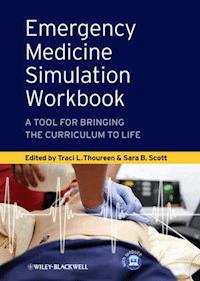
Emergency Medicine Simulation Workbook E-Book
44,99 €
Mehr erfahren.
- Herausgeber: John Wiley & Sons
- Kategorie: Fachliteratur
- Sprache: Englisch
Medical simulation has been a transformative force in medical education. Through the use of increasingly sophisticated technology, we are now able to simulate everything from yearly family doctor visits and simple procedures to complex operations such as heart surgery. Now more than ever, simulation is an essential tool for delivering the highest quality training, and it can be particularly valuable to physicians who teach in the acute care setting, where it is not always possible or practical to allow students to learn by working directly with patients.
This book is written and designed specifically to guide medical educators in emergency medicine on how to integrate medical simulation into their teaching and achieve optimal results. Inside you’ll find:
• Clinical cases drawn from faculty at major teaching centers, formatted and annotated so that they can be tailored to novice or advanced learners and easily deployed in a diverse range of settings.
• Cases that cover the full spectrum of EM pathology.
• Valuable ‘tips or tricks’ accompanying images and patient data.
• A Companion Website including imaging and laboratory results pertinent to each case study – presented in Powerpoint format for easy download; video clips to simulate sonogram results.
An invaluable new resource for training emergency physicians, nurses, and EMTs/paramedics, Emergency Medicine Simulation Workbook: A Tool for Bringing the Curriculum to Life provides a roadmap to the unique educational benefits of medical simulation along with a wealth of material educators can adapt for use in their own teaching and assessment portfolios.
Sie lesen das E-Book in den Legimi-Apps auf:
Seitenzahl: 318
Veröffentlichungsjahr: 2012
Ähnliche




















Contents
Cover
Companion website
Title Page
Copyright
List of contributors
Foreword
Chapter 1: Introduction: How to use this book
Chapter 2: Vascular emergencies
Pulmonary embolism
Selected reading
Aortic dissection
Selected reading
Abdominal aortic aneurysm
Selected reading
Chapter 3: Resuscitation emergencies
Supraventricular tachycardia
Selected reading
Bradycardia – third-degree heart block
Selected reading
Ventricular tachycardia/therapeutic hypothermia
Selected reading
Chapter 4: Gastrointestinal emergencies
Esophageal perforation (Boerhaave’s syndrome)
Selected reading
Intestinal perforation
Selected reading
Mesenteric ischemia
Selected reading
Variceal bleeding
Selected reading
Chapter 5: Renal/electrolyte emergencies
Hypomagnesemia
Selected reading
Hypercalcemia
Selected reading
Renal failure
Selected reading
Chapter 6: Endocrine emergencies
Diabetic ketoacidosis
Selected reading
Adrenal insufficiency
Selected reading
Thyroid storm
Selected reading
Chapter 7: Environmental emergencies
Carbon monoxide toxicity with hypothermia
Selected reading
Snake bites
Selected reading
Dive injury
Selected reading
Chapter 8: Obstetric emergencies
Eclampsia
Selected reading
Ruptured ectopic pregnancy
Selected reading
Trauma in pregnancy
Selected reading
Chapter 9: Pulmonary/critical care emergencies
Status asthmaticus
Selected reading
Hemoptysis
Selected reading
Sepsis
Selected reading
Chapter 10: Toxicologic emergencies
Digoxin overdose
Selected reading
Opioid overdose
Selected reading
Sympathomimetic overdose
Selected reading
Chapter 11: Pediatric emergencies
Neonatal resuscitation
Selected reading
Bronchiolitis
Selected reading
Seizure
Selected reading
Non-accidental trauma
Selected reading
Chapter 12: Medical error/interpersonal communication
Doctor–patient communication
Selected reading
Professionalism and communication between specialties
Selected reading
Opiate-induced respiratory depression: managing medical mistakes
Selected reading
Notifying family of patient death
Selected reading
Chapter 13: Trauma emergencies
Major burn
Selected reading
Polytrauma – pneumothorax and pelvic fracture
Selected reading
Pulseless lower extremity fracture with rhabdomyolysis/cervical spine fracture
Selected reading
Index
Companion website
This book is accompanied by a companion website:
www.wiley.com/go/thoureen/simulation/workbook
The website includes:
Imaging and laboratory results pertinent to each case study.Powerpoint format suitable for printing out, downloading, or real-time use on-screen during the simulation sessio.Additional video clips to simulate sonogram results are presented for the ruptured ectopic pregnancy case study (Chapter 8).This edition first published 2013 © 2013 by John Wiley & Sons.
Wiley-Blackwell is an imprint of John Wiley & Sons, formed by the merger of Wiley's global Scientific, Technical and Medical business with Blackwell Publishing.
Registered office: John Wiley & Sons, Ltd, The Atrium, Southern Gate, Chichester, West Sussex, PO19 8SQ, UK
Editorial offices: 9600 Garsington Road, Oxford, OX4 2DQ, UK The Atrium, Southern Gate, Chichester, West Sussex, PO19 8SQ, UK 111 River Street, Hoboken, NJ 07030-5774, USA
For details of our global editorial offices, for customer services and for information about how to apply for permission to reuse the copyright material in this book please see our website at www.wiley.com/wiley-blackwell.
The right of the author to be identified as the author of this work has been asserted in accordance with the UK Copyright, Designs and Patents Act 1988.
All rights reserved. No part of this publication may be reproduced, stored in a retrieval system, or transmitted, in any form or by any means, electronic, mechanical, photocopying, recording or otherwise, except as permitted by the UK Copyright, Designs and Patents Act 1988, without the prior permission of the publisher.
Designations used by companies to distinguish their products are often claimed as trademarks. All brand names and product names used in this book are trade names, service marks, trademarks or registered trademarks of their respective owners. The publisher is not associated with any product or vendor mentioned in this book. This publication is designed to provide accurate and authoritative information in regard to the subject matter covered. It is sold on the understanding that the publisher is not engaged in rendering professional services. If professional advice or other expert assistance is required, the services of a competent professional should be sought.
Library of Congress Cataloging-in-Publication Data
Emergency medicine simulation workbook : a tool for bringing the curriculum to life / edited by Traci L. Thoureen, Sara B. Scott. p. ; cm. Includes bibliographical references and index. ISBN 978-0-470-65787-4 (pbk.) I. Thoureen, Traci L. II. Scott, Sara B. [DNLM: 1. Emergency Medicine–education. 2. Teaching Materials. 3. Emergencies–Case Reports. 4. Manikins. 5. Patient Simulation. 6. Teaching–methods. WB 18.2] 616.02′5–dc23 2012023968
A catalogue record for this book is available from the British Library.
Wiley also publishes its books in a variety of electronic formats. Some content that appears in print may not be available in electronic books.
List of contributors
Ani Aydin, MDResident Physician Bellevue/NYU Langone Emergency Department New York, NY
Andrew BardMedical Student Loma Linda University School of Medicine Loma Linda, CA
Moira Davenport, MDAssistant Professor Associate Residency Director Allegheny General Hospital Drexel University College of Medicine Pittsburgh, PA
T. Kent Denmark, MDMedical Director, Medical Simulation Center Associate Professor of Emergency Medicine and Pediatrics Associate Professor of Basic Science Department of Emergency Medicine Loma Linda University Loma Linda, CA
Sarah B. Dubbs, MDResident Physician University of Maryland Medical Center Baltimore, MD
Sarah Farris, MDAssistant Professor Department of Surgery Division of Emergency Medicine Duke University Durham, NC
Corey R. Heitz, MDAssistant Professor of Emergency Medicine Boonshoft School of Medicine Wright State University Dayton, OH
Harry E. Heverling, DOResident Physician Johns Hopkins Hospital Baltimore, MD
Torrey A. Laack, MD, FACEPAssistant Professor of Emergency Medicine Mayo Clinic Rochester, MN
Heather Mahoney, MDAssistant Professor Assistant Residency Director Bellevue/NYU Langone Emergency Department New York, NY
Jacqueline Nemer, MD, FACEPDirector of Simulation Education Emergency Medicine Associate Professor of Emergency Medicine Department of Emergency Medicine University of California, San Francisco San Francisco, CA
Albert T. Nguyen, MDResident Physician Loma Linda University Medical Center Loma Linda, CA
Rodney Omron, MD, MPHAssistant Residency Director Department of Emergency Medicine Johns Hopkins Hospital Baltimore, MD
Catherine Pettit, MDResident Physician University of Maryland Medical Center Baltimore, MD
James W. Rhee, MD, FACEP, FAAEMAssistant Program Director of Emergency Medicine Residency Assistant Professor and Director of Medical Toxicology Loma Linda University Medical Center Loma Linda, CA
Sara B. Scott, MDClinical Assistant Professor Department of Emergency Medicine University of Maryland School of Medicine Baltimore, MD
Dustin D. Smith, MDAssociate Professor of Emergency Medicine Program Director, Emergency Medicine Residency Loma Linda University Medical Center Loma Linda, CA
Andrew I. Stolbach, MDAssistant Professor Department of Emergency Medicine Johns Hopkins Hospital Baltimore, MD
Raymond P. Ten Eyck, MD, MPHProfessor of Emergency Medicine Director of Simulation Boonshoft School of Medicine Wright State University Dayton, OH
Traci L. Thoureen, MD, MHS-CL, FACEPClinical Assistant Professor Department of Emergency Medicine University of Maryland School of Medicine Baltimore, MD
Sandrijn van Shaik, MD, PHDAssistant Clinical Professor and Associate Fellowship Director Pediatric Critical Care Medicine University of California, San Francisco Director of Education, Kanbar Center for Simulation, Clinical Skills and Telemedicine Education Director of Pediatric Transport, UCSF Benioff Children's Hospital San Francisco, CA
Foreword
The growth of technology-enhanced simulation training in health care over the last decade represents a transformative era in the history of medical education. No longer do “time and chance” clinical encounters alone dictate the experiential training profile of the learner; rather, realistic clinical scenarios can be animated through a combination of advanced technology and role-play, creating a safe and standardized environment in which to practice care of even the sickest patients.
This latter concept – caring for the sickest patients in the safest environment – captures a unique intersection between Emergency Medicine and modern simulation-based learning. Only with the benefit of advanced simulation tools can the sickest patients be realistically portrayed for real-time teaching and learning. This creates a unique opportunity for educators in the field of Emergency Medicine to make important contributions to modern medical education, across disciplines. This book, essentially providing a ready-to-deploy experiential curriculum that touches all specialties, represents just such an advance.
The synergy between Emergency Medicine and simulation education is not only practical, but also highlights important aspects of human cognition and learning theory that we are only just beginning to understand. Encountering a critically ill robot simulator, as paradoxical as that may sound, can reliably stimulate a unique level of emotional engagement among learners. This kind of intense engagement, in and of itself, provides a foundation for critical thought, action, and memory that many associate only with key moments of actual clinical experience – but without any of the inherent risk to real patients. Not surprisingly, medical simulation is becoming a core element of the global patient safety effort, and simulation practice across all fields is increasingly viewed as a quality and safety imperative.
While this book represents an invaluable resource to any Emergency Medicine educator, it also provides a roadmap to help all medical educators explore the unique benefits of medical simulation. The cases chosen for inclusion are drawn from a diverse group of faculty authors across a wide range of medical teaching centers, and represent a full spectrum of pathology. The material is formatted and annotated so that cases can be tailored to novice or advanced learners, and easily deployed in a diversity of settings. Key “tips or tricks” are included to accompany case images and other patient data which complete the compendium, allowing for standardized use as part of a tailored teaching and assessment portfolio.
I have been fortunate to witness the evolution of modern simulation in health care from a handful of pioneering initiatives to a unified specialty field that is flourishing across the globe. This book represents a movement to consolidate and distribute lessons learned during this period of extraordinary growth, providing a key tool to make simulation more accessible to all medical educators.
James A. Gordon, MD, MPA
Director, MGH Learning Laboratory
Chief, Division of Medical Simulation
Department of Emergency Medicine
Massachusetts General Hospital
Director, Gilbert Program in Medical Simulation
Associate Professor of Medicine
Harvard Medical School
Boston, MA
CHAPTER 1
Introduction: How to use this book
Traci L. Thoureen and Sara B. Scott
University of Maryland School of Medicine, Baltimore, MD
Simulation has become an integral tool in medical education and the specialty of emergency medicine (EM) is no exception. Simulation curriculums have increasingly become integrated into standard EM training. In fact, as of 2008, one study reported that of 134 EM residencies surveyed in the United States, 91% used some form of simulation in their postgraduate training.1
With increasing utilization of simulation as a teaching tool, there has been more demand from educators for workshops and training that focus on how to teach using simulation. This workbook is designed with those demands in mind. It is meant to act as a “lesson plan” for physician educators to use at the “bedside” in the simulation laboratory or in any space that is used to conduct simulation.
This workbook is organized with the basic clinical competencies of EM in mind. The chapters incorporate topics listed by the American Board of Emergency Medicine as included in the certification examination. Each chapter includes 3–4 individual simulation cases that highlight subject material pertinent to the chapter topic. In many of the cases, alternative options are described for use with multiple levels of learners (students, junior or senior postgraduate learners).
Although each individual simulation case is unique, the presentation format for all of the cases is the same. The layout for each case starts with specific educational objectives for that case, together with a list of suggested critical actions. For those who are working within the United States postgraduate training system, we have notated the relevant Accreditation Council of Graduate Medical Education (ACGME) clinical competencies for each learning objective and critical action.
Immediately following the critical actions, you will find an outline for the case set-up. This includes a description of the physical environment, mannequin, props, distractors, and actors that are recommended for each simulation. To aid in the case set-up, an online resource is provided with this workbook (at www.wiley.com/go/thoureen/simulation/workbook) and includes imaging and laboratory studies pertinent to each case. The online resource is presented in a PowerPoint format and can be printed out, downloaded, or shown in real time on computer screens/monitors during the simulation session.
After the section on set-up, you will find a brief narrative of the case, which essentially contains the information found on most emergency department triage sheets. There is a description of the initial mannequin conditions and a case narrative which details the changes in conditions that will occur in the mannequin after a specific time interval or in response to a learner intervention. Accompanying flow sheets also outline the general sequence of actions for each case.
Throughout the case, you will see text boxes. These text boxes highlight specific details in the case that can be altered based on the degree of fidelity of your mannequin or on the skill level of your learner. In this way, each case can be manipulated to fit your teaching needs and available resources.
At the end of each case, you will find information to aid in debriefing. Instructor notes provide basic background information for your facilitators about the specific case topic. There is also a list of potential questions that can be used during the debriefing session with your learners. Finally, you will find a list of selected reading that can be used in preparing for the simulation and some are suitable to be distributed to learners either prior to or following the simulation.
We hope that you will find this workbook a useful tool in the development or continuation of a successful emergency medicine simulation curriculum at your institution. Keep in mind that each simulation case is dynamic and can be modified in a variety of ways to suit best the needs of your learners and/or the fidelity of your mannequin. As such, this workbook provides a basic template for the design of an emergency medicine simulation curriculum for learners at any stage in their education and for facilities with varying levels of technical capability.
Reference
1. Okuda Y, Bond W, Bonfante G, et al. National growth in simulation training within emergency medicine residency programs, 2003–2008. Acad Emerg Med 2008;15(11):1113–1116.
CHAPTER 2
Vascular emergencies
Sarah B. Dubbs and Traci L. Thoureen
University of Maryland School of Medicine, Baltimore, MD
Pulmonary embolism
Educational goals
Learning objectives
Primary:
Secondary:
Critical actions checklist
Assess airway, breathing, and circulation [Patient Care]
Place patient on cardiac monitor and establish IV access [Patient Care]
Order CT angiography (or locally appropriate imaging) and recognize signs of PE [Medical Knowledge]
Initiate proper therapy: (1) heparin and/or thrombolytic for PE, (2) high-flow oxygen/non-invasive positive-pressure ventilation/intubation for hypoxia, and (3) IV vasopressor for hypotension/shock [Medical Knowledge, Patient Care]
Call and communicate to ICU for disposition [Interpersonal and Communication Skills, Professionalism]
Lesen Sie weiter in der vollständigen Ausgabe!
Lesen Sie weiter in der vollständigen Ausgabe!
Lesen Sie weiter in der vollständigen Ausgabe!
Lesen Sie weiter in der vollständigen Ausgabe!
Lesen Sie weiter in der vollständigen Ausgabe!
Lesen Sie weiter in der vollständigen Ausgabe!
Lesen Sie weiter in der vollständigen Ausgabe!
Lesen Sie weiter in der vollständigen Ausgabe!
Lesen Sie weiter in der vollständigen Ausgabe!
Lesen Sie weiter in der vollständigen Ausgabe!
Lesen Sie weiter in der vollständigen Ausgabe!
Lesen Sie weiter in der vollständigen Ausgabe!




