


9,59 €
Mehr erfahren.
- Herausgeber: Pushkin Press
- Kategorie: Gesellschafts- und Liebesromane
- Sprache: Englisch
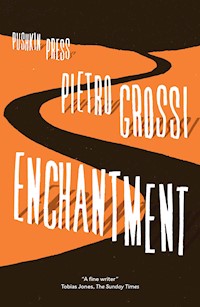
Three boys, three diverging destinies - but what, or who, is pulling the strings? It was a memorable summer: with the broken-down old road that suddenly turned into a strip of gleaming asphalt, and the abandoned motorbike the three boys found as a rusty heap and built into a racer. But it was also more than that, more than a distraction from the boredom of their small Tuscan town, than a few weeks of racing and dodging the attentions of the local Marshal. For Jacopo and his two friends, it began their journeys out into the world, separated by thousands of miles, steered by something other than fate-helped on their way, and controlled... Tautly written and deeply moving, Enchantment is more than a simple coming-of-age story, it is a powerful, original novel from an important, compelling new author. Pietro Grossi, writer and translator, was born in 1978 in Florence and currently lives and works in Tuscany. His collection of short stories, Fists, and his novel The Breakare also published by Pushkin Press. "A fine writer" Tobias Jones, The Sunday Times Praise for The Break: "Small and perfectly formed ... reaching its end leaves the reader desirous to start all over again" Amanda Hopkinson, Independent Praise for Fists: "There is more power and pathos in this short piece of spare, timeless prose than in most densely-written novels" Daniel Hahn, Independent
Das E-Book können Sie in Legimi-Apps oder einer beliebigen App lesen, die das folgende Format unterstützen:
Veröffentlichungsjahr: 2013
Ähnliche


















PIETRO GROSSI
ENCHANTMENT
Translated from the Italian by Howard Curtis
Contents
ENCHANTMENT
SO HERE I WAS AT LAST, standing in a daze with the receiver of my parents’ old grey telephone in my hand, those damned words echoing in my head like the first rumblings of an earthquake, and the most lucid part of me immediately sensed that the tremor would leave behind it nothing but debris.
If anyone had asked me, even a short while earlier, I would have declared with a touch of naïve pride that the walls of what I persisted in calling “my life”, which had taken me so much effort to build, were quite solid. And yet now, it was as if overnight I had detected some alarming cracks, and was gradually starting to suspect that someone had mixed the mortar in the wrong proportions. Now, as everything started to shake and I was forced to admit that pieces of plaster were coming loose from the walls, I felt an overwhelming need to discover the exact moment when it all started.
A few hours later, lying staring at the ceiling, I managed to pin down the moment of time when the tectonic plates that were now shifting had given the first signs of drift. When it had happened, nobody had realized that the ground was moving, and even if we had noticed that the landscape was tilting slightly, the view in front of our eyes had been anything but unpleasant.
And yet the exact moment when that cosmic roar invaded my universe was the imperceptible fraction of a second during which a small area of skin struck the shiny surface of my window. That had been my Big Bang: the muted rapping of knuckles on a window pane in the dead of night.
ONE
Rocky Road
1
MY HEART AND LUNGS trapped in a vortex of terror, I instinctively pulled the blankets over my head. My breath warmed the sheets, draining the oxygen from my body. More sinister knocking. My heart thumped in my chest. After a few seconds I turned down the blankets slightly and took a look.
A dark figure was curled up outside the window. I huddled under the blankets again, trying to convince myself I was still asleep and this was only a nightmare. In a moment I would calm down and wake up properly: the figure would be gone and I would laugh and fall asleep again and have something to tell my friends the next day.
But the figure was still there, still tapping at the window pane and waving at me, motioning for me to approach. With the blankets still up to my nose, I squinted, trying to see better, then dropped my head back on the pillow and cursed. I immediately lifted my head again and took another look. For a moment, I concentrated on catching my breath and listening to my heartbeat slowly getting back to normal. I threw off the sheets and blankets, sat up on the edge of the bed, glanced at the window another couple of times, then got up and walked to it. I quietly opened one shutter, closing the other and trying not to make a noise.
Outside, squatting on the roof of the back porch beneath the window, was Biagio. He was chewing a long piece of wood and looking at me as if everything was perfectly normal.
“Are you mad?”
“Get dressed. There’s something you have to see.”
“What time is it?”
“I don’t know. Get dressed.”
I again looked down and around. The moonlight glinted on the lawn in front of the house.
“How did you get up here?”
Biagio gestured with his head, behind him and to his left. Beyond the roof on which he was squatting, down the corner of the main wall of the house, ran an old copper pipe, blackened with age, which I seemed to be seeing for the first time.
“All right, I’ll put something on. In the meantime, go to the shed behind the house and find Enzo’s ladder. I’m not going down that pipe.”
“You big cissy,” Biagio said with a smile as he turned away.
Once I had climbed down the ladder and crossed the garden as silently as possible, we headed left and out of the village.
It was one of those nights at the end of May when the air, although still crisp, starts to smell of summer. I tried to ask Biagio where we were going, but he simply told me to wait and not to worry. When we got to the end of the street, we turned right, and when we came level with the old school buildings Biagio started down the stone steps that led to the washhouses. I had never seen anybody there, but my dad always said he could remember the women washing the clothes, singing and beating the linen on the edges of the tubs. As children we had sometimes bathed there, and in summer, when they were overrun with tadpoles, we would fish out frogs using the heads of daisies.
For some reason Biagio was always going out for walks by himself at night. The first time his mother had discovered it, he was nine. She had woken up in the middle of the night and, on her way to the kitchen to get herself a glass of water, she had half opened the door of the boys’ room and glanced in. Biagio’s brother, Graziano, was sleeping like a stunned animal. Of Biagio, though, there was no trace: his bed, which was opposite Graziano’s, was unmade and empty. Betta took the length of the tiny corridor in a single step and looked in the bathroom, and again in the kitchen. Then she went back into her sons’ bedroom and shook Graziano. He snored and turned over.
“Graziano!” she cried, shaking him more violently.
A grunt rose at last from that mass of limp flesh.
“Biagio. Where is he?”
Graziano raised his big square head and looked at the empty bed opposite. “How should I know?” he muttered.
“Haven’t you seen him?”
“No.”
“Are you sure?”
Graziano turned, gave his mother an angry look, grunted again, and went back to sleep.
Betta got the keys from the kitchen and went outside. She first checked the yard, then walked up and down the road for a few hundred metres, and finally went behind the house, over towards the farms, softly calling her son’s name. The only response was a flutter of wings in the hen house and a dog barking in the distance. Before going back inside, Betta knocked at her sister’s window—her sister lived in the house opposite—and asked her if by any chance she had seen Biagio. She hadn’t.
“He’ll be back soon,” her sister said, already closing the window again and disappearing inside.
So Betta went back home and sat down in the kitchen with a cup of hot milk. At the first light of dawn, by which time she had already decided to go and see the Marshal with her husband, she saw Biagio pop up at the kitchen window, which was fixed from the outside with a piece of cardboard. Biagio had jumped up and and laid his stomach on the window still, but once he saw his mum he froze. For a moment or two, they were both quite still, staring at each other, Biagio wondering what was the best thing to do, whether to keep going in or retreat, his mother trying with all her might to hold back her tears. But the next moment, Betta leapt to her feet and Biagio, his eyes wide, hesitated for an instant, then tried to jump back out. But big as she was, Betta was too quick for him. Darting forward, she grabbed Biagio by the sweater and pulled him in. Then, when he was on the kitchen floor, Betta began raining slaps down on his head. Shielding himself with his hands as best he could, Biagio tried to crawl to his bedroom. Betta’s big hands, as hard as pieces of wood, still managed to land sharp blows on his head, which in the silence of the dawn must have rung out like thwacks of a stick. I remember those hands well: they were as tough as leather and it didn’t take much for Betta to raise them. One day she had caught us throwing firecrackers in the hen house behind the house. I can still feel those sharp shovel blows on our heads as she screamed at us that the hens would stop laying eggs if we did that.
In the end, Biagio managed to get to his bed and Betta stopped in the doorway.
“We’ll talk about it over breakfast,” she said, closing the door.
A couple of hours later, as Betta was heating the milk and coffee on the stove, Biagio sat down at the little pink formica table in the kitchen.
“Where were you?” Betta asked without even turning round.
“Walking around.”
“Around where?”
“Just around.”
Betta turned with the saucepan of hot milk in her hand and slammed it down in front of Biagio on a small wooden plate covered with burn marks. “If you do it again I’ll lock you indoors until you’re twenty.”
In the following five or six months, Biagio was caught a few more times and there were more slaps and more threats. And whenever his mum or dad asked him where he went, he would simply say, “Just for a walk.” They even tried barring the doors and windows, but the only result was to find Biagio in a dejected mood in the morning, as white as a sheet and with two deep black pits under his eyes. He even had a fever. In the end, his parents reconciled themselves to the fact that every morning Biagio calmly came back to his bed, and that wherever he went on those walks of his, it couldn’t be doing him any harm. So they decided to postpone their anxiety for two or three hours, until dawn, and then start worrying if they had to. They never had to.
At the time, I myself often wondered where exactly Biagio went, and I liked to see that place, wherever it was, in a heroic, adventurous light. Now, though, I can’t help imagining him simply walking around, looking at the mounds of snow in winter, listening to the crickets in the fields in summer. And I wonder if, when you come down to it, that was all he ever asked.
Biagio led me through the Sardinian’s rapeseed field and beyond the old river bed and up again through Ninno’s dad’s olive grove. And every time I asked him where the hell we were going he would tell me to keep quiet and follow him. Then all at once we found ourselves on the edge of that big field under the cliff, where we’d stolen sunflower seeds the previous summer.
“Close your eyes,” Biagio said.
“And then?”
“And then follow me.”
“Are you mad?”
“Don’t start crying. I’ll lead you. Close your eyes.”
I stared at him for a moment and sighed. “What a drag.”
Biagio got into position behind me, grabbed my belt and started guiding me like a puppet. If I close my eyes I can still smell the scent of the night and hear the cry of an owl in the distance and feel the ears of corn caressing my trousers.
“Wait,” Biagio said after a while, stopping.
“What is it?”
“The cliff.”
“Can I open my eyes?”
“No.”
“Come on, Biagio, what do I do?”
“I’ll jump and pull you up.”
I’d have liked to complain, to say that it was night and I was sleepy and had no desire to be there in the middle of the countryside with my eyes closed. It was quite cold. Biagio’s feet slipped on the loose earth. Then I thought I heard him steady himself.
“Give me your hand,” Biagio said, from somewhere a bit higher up.
“Where?”
“Here.”
I reached up my right hand like a blind man, and Biagio grabbed me. As I climbed I felt him also going up a few steps, pieces of wood and branches cracking under his feet.
“There, relax now,” Biagio said as I touched the ground with my other hand to steady myself and pulled my right foot out from under a root.
Suddenly I couldn’t find any ground to touch and my right foot landed on what felt like grass. There was a strange, bitter odour of tar, which jarred with the fresh smell of the countryside, an odour I didn’t want to recognize at the time, but which, when I think about it now, was unmistakable.
“Are you there?” Biagio asked.
I braced myself, as if expecting a sudden gust of wind. “Yes. I think so.”
“Go on then, open your eyes.”
All this drama made me smile suddenly, and I slowly opened my eyes. I stood there motionless, turning my head first to the left, then a long way to the right.
“Jesus.”
Biagio was also looking right and left and nodding with a smile.
We were standing on the weed-strewn verge of the Rocky Road. The Rocky Road, as we had dubbed it several years earlier, was a stretch of more than three kilometres, part of the old road that joined San Filippo and Posta, twisting and turning between fields and hollows and low hills. The road had been in use for more than two hundred years, until the mayor and the leader of the local council had suddenly turned ambitious and decided to improve the provincial highway and build approach roads, roundabouts and fast lanes. Of the old winding road that had joined the two villages—the scene, so it was said, of bloody battles that were probably more like tavern brawls—all that survived were three sections, bordered on one side by the modified version of the provincial highway and on the other by a big new road which was always deserted, and which bypassed Posta and then led downhill.
The part of the old road that led to San Filippo had become the semi-private access road to a new complex of detached houses, where even Mauro, the butcher’s son, had ended up. Mauro hadn’t much liked the new arrangement and had suddenly disappeared, one day at the end of March. The boys said he was somewhere in South America, or travelling the oceans on a merchant ship, but the old men said only that he was a rotten fruit and the spring had replaced him. What he had been replaced with, the old men were always vague about.
Towards Posta, the old road had simply become an ordinary stretch leading from the roundabout to the cinema and the centre of the village. The leader of the council had been very pleased with that roundabout and, in his euphoria, had used words in his inaugural speech which at the time, as I listened, holding my dad’s hand, seemed filled with wonders: Europe, progress, the new millennium. Apparently the idea had indeed been his, and it had come to him after a holiday in France with his wife, just before discovering that she was carrying on with a detergent salesman from Rome. The roundabout had been the poor councillor’s attempt at redemption, which was why it would for ever after be called the Horn.
In the middle stretch there were still those three kilometres and more of bare, now useless road, at the mercy of brambles and brushwood and blocked on both sides by the barriers of the new roads. When we were smaller, we had often gone there on our bikes, or to try out an older brother’s moped, but gradually the branches had taken away half the fun, and the blackthorn scratches and potholes were no longer worth those few metres of free road. It was at that time that we started to call it the Rocky Road. First, for just a few weeks, carried away by our innocent desire for a more glittering world, we had tried calling it the Runway, but the title didn’t fit it well, and as well as creating new potholes, a few showers soon did away with that name.
And now there it was in front of me like a cobra, all black and clean, all covered and coated and polished: who had done it, and why, would long remain a mystery, and would also secretly eat away at our studied cynicism.
I shook my head and squatted on the ground. The asphalt glittered with millions of diamonds beneath the almost full moon. I moved my hand over it, and it was as if I could hear the roar of the engines, and the tyres clinging like claws at the rough surface. I picked up a handful of black powder from the edge: it seemed to have fallen straight from the sky, and to be made of the same material as the night.
Biagio was still standing there, looking at me and smiling.
“When did this happen?”
“I don’t know. I was here last week and everything was exactly the same as before.”
“Jesus,” I said again, looking at that black snake disappearing into the countryside.
Later, as we walked home in silence, with our hands in our pockets, we felt like two mountaineers returning to base camp. Maybe, when you come down to it, all that separates men capable of amazing feats from everyone else is a single moment: the moment when—consciously or not—you smell the universe and realize that everything is possible. A man may ride the waves, understand the laws of electromagnetism or build a skyscraper, but sooner or later he is overwhelmed by the insidious, shattering intuition that the limits of his body and of the world are not as solid as he had always imagined. I wonder if that wasn’t my moment: the moment when the palm of my hand brushed against the mystery of the fresh asphalt on the Rocky Road.
2
THE RUMOUR bounced around the walls of the school like a clandestine murmur. It spread so quickly that in the space of barely three quarters of an hour, after break, it came back to me from the side opposite to where I had myself launched it.
After almost two hours of lessons, as Signor Torello was trying in vain in his Calabrian accent to draw our attention to the wonders of the Renaissance, I couldn’t resist any more: I leant slightly to my right and, while still pretending to listen, simply whispered, “They’ve tarred the Rocky Road.”
Antonio, known as Tonino, the always neat and tidy son of a lawyer who had once resolved a spot of bother my dad had got into because of an accident, looked up from the exercise book in which he was making notes and frowned.
“What?” he whispered.
Again I shifted towards him, with my back resting on the chair and my legs stretched in front of me.
“They’ve tarred the Rocky Road,” I said, with a complacent half-smile, like a film actor.
Tonino continued taking notes. “Oh.”
I looked at him and shook my head, with the same contempt I would have felt if I’d told him that Giulia Morelli would show her private parts to everyone that afternoon. Giulia Morelli was the blonde, green-eyed daughter of a watchmaker, who had joined the school just a year earlier and would leave again the following year to go to school abroad. A tall, generous girl, she had, in that short time, entertained various young men: her memory and the stories about her would haunt our masturbatory fantasies for years.
During the break, Biagio, Greg and I mostly kept to ourselves, thinking hard about what to do. We had the feeling that everyone was looking at us strangely and, although we didn’t say it, we were convinced that those looks were the prelude to a great and imminent future.
We had told Greg at the main entrance as soon as we arrived. Even after several years, having to go to school in Posta every day had the frustrating taste of defeat. The bitterest moment had been almost six years earlier, on the morning of the first day of the fifth year of primary school. The previous year, the local council had decided that it wasn’t worth refurbishing the old school buildings in San Filippo and had decided to amalgamate them with the schools in Posta. That first morning, as we looked out at the lime trees lining the road to Posta, we realized, reluctantly and unconsciously, what nasty tricks were concealed by the word modernity. And however many years had passed since then, and however many things had changed, having to go down to Posta every day, thus paying tribute to its subtle but unchallenged supremacy, always annoyed us. It was basically unacceptable that we, the historic inhabitants of San Filippo, had to lower ourselves to travelling every day to what until a couple of generations earlier had simply been a place where wayfarers and mail coaches stopped for rest and refreshment, without the inconvenience of having to go up the hill to the village. The full name of Posta was actually Posta di San Filippo—as indicated on the half-rusted sign at the entrance to the village and underlined, in parenthesis, by a superfluous and wonderful “hamlet of San Filippo”. It was our guest room, and that was something that occasionally got us into slanging matches or scraps. The hamlet, however, had rapidly grown in size. Encouraged by its easy access to the plain and its lenient housing policy, Posta had expanded over the course of time, and apart from attracting entrepreneurs from all over had taken away our businesses and our shops and our schools and most of our inhabitants.
A few days after the great disappointment of the fifth year, Biagio and I had decided to mount our little campaign for dignity and austerity by refusing to take the bus the school provided for us. “Thanks—we prefer to walk,” we told the bus driver every morning for more than two months, with heads held high, until we stopped to ask ourselves why the rest of the boys pointed at us and made fun of us. It was now years later, and we were in secondary school, but arriving alone on foot every day still seemed in some absurd way to be a reassertion of our freedom. Greg, on the other hand, more to his embarrassment than ours, continued to arrive in a shiny dark chauffeur-driven car.
“Well?” he said, coming up to us, looking almost peeved.
“It’s happened.”
“What’s happened, Jacopo?”
I looked at him some more. “They’ve tarred the Rocky Road.”
It was a great moment, the kind where you delude yourself that life could be like a beautiful woman, full of surprises.
“What are you talking about?” Greg asked, coming closer and lowering his voice.
“I swear to you, they’ve tarred the Rocky Road.”
“Who has?”
“How should I know who? All I know is that it’s all nice and clean and tarred. Biagio discovered it last night.”
“I was over that way and I saw it,” Biagio said.
“You were on the Rocky Road?”
“Yes.”
“Doing what?”
“Nothing, just walking around.”
“I see.” Greg looked at us for another moment and gave a little smile.
Later, back in the classroom after break, after barely ten minutes or so, Mario the Redhead leant towards me from the side opposite Tonino, and continuing to look straight ahead whispered, “They’ve tarred the Rocky Road.”
I stared at him for a moment, then burst out laughing, bent forward and banged my head on the desk.
We didn’t go back to the Rocky Road until the afternoon of the next day. From a distance, as we came past the old riverbed and moved on to the road that ran alongside the last field, we could hear the vroom-vroom of mopeds. Marco was there, going backwards and forwards on one wheel of his souped-up Garelli, in front of Giorgia and her friends. On either side of the road, under the trees and on the grass, were various people. After a while, Tino’s brother came round a bend on his Lambretta: he turned for a second, clung to the brakes and, halfway round the bend, a bit shaky but with his body nicely tilted to one side, gunned the engine. As soon as he saw us, he did everything he could to pass as close as possible to us and started laughing. Even Giorgia and her friends laughed and clapped. After a few seconds Giorgia waved to us, then said something to her friends and they burst out laughing.
Marco passed us on one wheel, turned back and approached us. “What are you doing here, wankers?”
Greg and I stood there motionless, not quite sure what to say.
“Nothing,” I ventured.
Marco looked at me, then turned to Greg. “Won’t your mummy buy you a moped?”
“Marco, come on,” Biagio said. Biagio’s brother Graziano had been a schoolmate of Marco, and prided himself on actually having belted him one day, which—surely wrongly—had always made us feel partially protected.
After a few moments, even Tino’s brother Luca came up to us, sitting astride his Lambretta.
“What’s up?” he asked Marco, raising his head slightly. His eyes were a strange opaque yellow colour, and his voice was so harsh it gave you a sore throat just to hear it. His long, unkempt ponytail and the scar on his cheek had always struck me as quite alarming, and ever since I was small I had tried my best to stay away from him, especially as years earlier he had amused himself beating us up. It was at least two years since I had last seen Luca, and during that time people had been telling all kinds of stories about him: they said he had been in prison, that he had done a robbery, that he was on heroin, that he was a drug dealer. They said a whole lot of things about Luca, things that might not have been true at all but that contributed to making him a sinister and legendary character.
“Nothing,” Marco said. “I was asking these cissies what they’re doing here.”
Marco was the good-looking bully of the village, the one who, among other things, was always the first to use his fists in feuds with Posta. Next to Luca, he was like a puppy wagging its tail.
“Come on, boys, leave them alone,” Giorgia shouted from the distance with a smile on her lips.
“You don’t own this place,” Greg whispered. I turned and looked at him with a mixture of admiration and disquiet: half of me wondered where he had suddenly acquired all that initiative, the other half wanted to hide my head in my hands.
Marco pulled the Garelli back a couple of paces and leant towards us, scowling. “What did you say?”
Greg stared straight in front of him and I could sense an inexorable slide towards one of those situations that was bound to end in some kind of pain.
But thank heaven, at that moment the sound of an engine echoed through the countryside. Marco stopped and looked towards the village. Luca also turned and, as we listened to the sound and after a while saw that red and silver animal approaching, the sense of gratitude to a god I didn’t know, plus a wave of excitement, swept through my stomach like melted chocolate. The shiny red animal was carrying on its back a large figure in tight black leathers and an old white helmet with two green stripes. Arriving at the entrance to the Rocky Road, the animal roared again a few times and went up a couple of gears, then slipped between the verge and the guardrail and came towards us.
Marco and Luca stood there motionless, watching that thing come closer. Luckily, they seemed to have lost interest in us and what we had to say.
“What’s this?” Luca asked in bewilderment, shouting over the scream of the engine, when the animal and its rider came to a halt right next to him.
The rider took off the two snap-fasteners of the half-scratched visor and from under it appeared the squinting face of Paolino. The sides of the old helmet had creased the skin around his eyes and squeezed his cheeks.
“This is Sandra,” Biagio said with a smile.
It had started on a day like any other, a few months earlier, an ordinary cold morning at the beginning of February. Greg had come up to us during the break and after saying hello told us to come to his house after lunch, because he had something to show us. Biagio said he had to give his dad a hand with something, and it wasn’t an ideal day for me either: I had promised to go and study at Francesca’s. Francesca was the quiet, well-brought-up daughter of the owner of the general store, and I had been going out with her for more than a year. Greg looked at us seriously for a second and said it was important, and it wouldn’t take long. We weren’t used to Greg being that intense, and we thought it might be best to go.
By five to three, we were already at the gates. When we got to the end of the long avenue of cedars, the butler was there as usual waiting for us at the front door, at the top of the stone steps. He greeted us with an imperceptible nod and led us into the small room filled with rugs and leather-bound books, which they called “the small drawing-room”.
“The young master will be here in a minute,” the butler said. “Can I get you anything?”
Biagio collapsed into a huge blue velvet armchair, which greeted him with a big snort.
“I don’t know. You fancy anything?” I asked him, feeling a bit awkward. He played with a fold of the armchair and shrugged.
The butler stared at us for a moment or two, unable entirely to conceal his annoyance.
Greg appeared at the door. “Come on, let’s go,” he said, motioning to us slightly irritably.
“Remember the appointment with your mother,” the butler said as Biagio and I slid past him and followed Greg towards the front door.
“Yes, Franco, yes,” Greg sighed. “I’ll be back in a minute. I promise I won’t run away.”
Once through the door, we went down the steps and walked around the outside of the villa.
“Do you wind that guy up in the morning,” I asked, “or is he always like that?”
“I don’t know,” Greg said. “He belongs to my mum. I found him already assembled.”
For a while now, a few weeks at the most, Greg’s impeccable politeness had started to turn into something more obscure and elusive. He was brisker, more distracted, and sometimes his sense of humour took on a slightly bitter tone. Thinking about it now, I can’t help seeing in those little signs the real beginning of everything, but at the time it was simply something strange I happened to notice, nothing but a slight deviation from a person who even at the age of seven had greeted my mother with a kiss of the hand and always let us through a door first.
We walked along one side of the villa, then down a little stone drive, and entered the grounds. We went around the pond, which was half covered with the flat leaves of water lilies. On the edges, a slight crust of ice had formed. Three years earlier, during the great frost, we had even run on it and had some spectacular falls.
We descended some steps covered in lichen and came to the big, white-painted glass and metal greenhouses. Next to them was a long wooden shed full of mowers and agricultural machines that we had often sneaked into and played in as children. There was also a dark old car covered in dust, which for some reason had always scared us.
We entered the shed and, taking care where we put our feet in the gloom, went all the way to the back, where we couldn’t remember ever having been before.
“The other day,” Greg said, clambering with some difficulty over a plough and two rusty carts, “I came here to take a look and… shit, I just caught my trousers on a nail… and as I was looking around I discovered this.”
Abruptly, he pulled away a thick greyish tarpaulin, raising a cloud of dust as he did so to reveal what, to all appearances, was a motorcycle.
Biagio and I finished climbing over the plough and, taking care not to catch ourselves on any spikes, got past the first cart. We stopped before the second, but close enough to get a better look at what Greg was showing us. It was indeed an old motorcycle, covered in dust, its short handlebars, red fuel tank and thin leather saddle forming a single line. Under the fuel tank and the thin plates of the cylinder was what looked like a kind of metal egg and on the front mudguard an iron tag that resembled a flipper. The engine seemed oxidized, and the chrome plating was spotted with rust. And yet, despite everything, it was still a beautiful sight.
“Well?” Biagio said.
“What do you mean, ‘well’?” Greg replied, visibly disappointed.
“Can’t you see how beautiful she is?”
“Greg, it’s a heap of rust.”
“Who cares? We can fix her.”
“But whose is it?”
“How should I know? Nobody’s. I asked, but they didn’t even know it was here.”
“Incredible,” I said. “I don’t even know what to ask for this Christmas, and he finds a motorbike in his garden.”
Biagio let out a laugh. Greg gave us both a surprising look, as if from a long way away, both enthusiastic and desperate. “But don’t you understand? This is our bike.”
He seemed really terrified, and his tone was imploring. Our bike. All at once, driven by Greg’s sudden urgency, those simple words sounded like the last footholds we had before we sank into a crevasse. It was as if a cloud of diamonds had fallen from on high and that heap of old iron had suddenly coughed and come back to life. As if that bike had been ours for ever, hidden somewhere in our memories by some trivial trick of the mind.
We stood there a while longer looking at it. Then Greg carefully covered it up again and we left the shed. Once outside, in a ray of sunlight, the frozen grass crunching beneath our feet, we formed a kind of circle, facing each other. Greg took from the breast pocket of his shirt one of those cigarettes he had always loved smoking, home-made and tied up with sewing thread. He always rolled the leaves in a kind of fern which he found in the garden, tied them with the thread, and left them to dry for a few days on a slice of apple or an orange peel.
“Well, what do we do?”
“Good question,” Biagio said. “Give me a drag.”
Greg took a puff of the cigarette and passed it to Biagio. Biagio took it between his thumb and index finger and, keeping an eye on it, took a big drag.
“I don’t know anything about engines,” I said.
Biagio let out the smoke slowly, then continued looking at the cigarette. “These are good, Greg,” he said, his voice half furred by smoke. “Really good.”
“They are, aren’t they?” Greg said, really pleased, taking back his cigarette.
“Yes, really good.”
They both nodded.
“Hey,” I said.
They looked at me. “Huh?”
“Well?”
“Well what?” Greg said, letting the smoke out of his mouth and screwing up his eyes a bit.
“The bike.”
“Oh, right, the bike.”
Biagio turned to Greg. “Give me another drag.”
Greg handed him the cigarette again and looked at me thoughtfully. “The bike, right. It’s quite a problem.” He nodded again, and stroked his chin. Biagio looked at him and burst out laughing. Greg, who had turned serious, now glanced at the hand he was massaging his chin with and also burst out laughing. I stood there listening to them laugh and watching him stroke his chin theatrically for at least two minutes until, fortunately, they pulled themselves together.
“Everything all right?” I asked.
“Yes,” Greg said, laughing again with Biagio and passing his hands over his eyes, “everything’s fine.”
“Well?”
“Well, the only thing to do is talk to Paolino,” Biagio said.
Paolino had been our classmate for one year in secondary school, before he took the wise decision that school was not for him and left to work in his father’s workshop. Every day there were fists flying. He was like a caged animal. Outside school, he was fairly quiet: touchy perhaps, and you certainly wouldn’t have wanted to tease him, but all things considered, he minded his own business. In class, though, stuck between those desks, you could almost see his nerves throbbing beneath his skin, and after a while he would blow up like a pressure cooker with whatever he had within reach.
“I can’t go, boys,” Greg said. “You heard the tailor’s dummy: I have to see Mum.”
Biagio looked at him gravely for a moment, then dismissed that hint of scorn with a slight shake of the head.
When we got to Paolino’s, he was bent over the handlebars of a Lambretta. He still occupied the old workshop in the corner of the square: it was narrow and greasy and stank of petrol and stale oil, with motorbikes and mopeds stacked one on top of the other any old how. The glass panes in the front door were held in somehow by rickety frames with their blue paint peeling, and on days when the north wind blew a draught came in that could blow out a match at a distance of a metre. The inside of the workshop was so narrow and smelly that Paolino always preferred working outside, even on really cold days, as long as it didn’t rain. I had seen him there on the pavement even when it was snowing. As we came close, Biagio gave me a glance and a nod, motioning me to go forward. I looked up, wondering when all these roles had been assigned.
“Hi,” I said.
Paolino raised his eyes from the brake lever on which he was working, glanced at us, and without saying a word resumed his work.
Biagio and I looked at each other for a moment, not sure what to do.
“Listen,” I said, “we need to talk to you about something.”
Paolino continued working on the lever of the Lambretta. I turned towards Biagio, who simply shrugged, then I looked again at Paolino.
“We have a motorbike,” I said after another little while, for a moment feeling taller by at least half a head.
Paolino picked up a spanner from the saddle of the Lambretta and started tightening a nut on the lever, still without saying anything.
I was rather embarrassed, but after a few moments I summoned up a crumb of courage. “Paolo?” I ventured timidly.
Paolino stopped and sighed, then raised his eyes and stared at us. “Listen, you wankers, I don’t have time to waste on your bullshit. I don’t know what you want. You talk to me about a motorbike that isn’t here and—”
“You could come and see it. It’s at Gregorio’s.”
Paolino stood up straight and pointed the spanner he’d just been tightening the nut with at us. “I wouldn’t even go with you lot to see your mothers’ tits. If you have something to show me, bring it here, and if you’re not out of here in three seconds I’ll kick you so hard that when you get home you won’t be able to get through the door, your arses’ll be that swollen.”
“All right.” I raised my hands. “Forget I said it.”
“Okay,” Biagio said.
The day afterwards, at school, Greg asked us how it had gone.
“He wasn’t very keen on the idea.”
It took us more than two hours to drag the motorbike with its deflated tyres from Greg’s shed to Paolino’s workshop. It was even colder than the day before. There were still patches of ice at various points in the grounds of Greg’s house and in the village, and both Biagio and I slipped several times. On a couple of occasions—though to be honest without much enthusiasm—Greg offered to help, but we tacitly agreed that Greg was practically giving us a share in a motorbike, and the least we could do was sweat in his place.
We felt big and tough, and pride prevented us from asking for help: despite the cold we were sweaty, dirty with dust, and in one of the falls I hit my knee against the ignition lever, tearing my trousers and cutting my skin. Muscles I didn’t even know I had were hurting.
I’m convinced that when Paolino saw us appear in the square, dishevelled and bloody, sliding on the frozen slabs of the pavement and steaming in the cold like hot linen, he felt a touch of respect for us for the first time. He leant on the wooden doorpost at the entrance to his workshop and waited for us.
“Here it is,” I said once we were close, as soon as I had recovered my breath.
“What do you want me to do with this?” Paolino asked after a few seconds.
We looked at each other, not sure what to say.
“Make it go, I suppose.”
Paolino looked at the bike for a while and then at us. “And who’s paying?”
A wave of cold went through me, freezing every drop of sweat on my skin and making the cut on my knee throb with pain. How could we not have thought of it? Did we really think that Paolino would go to all the trouble of fixing up a heap of old iron like that, just for fun?
“I’ll pay.”
I turned. Greg was looking Paolino right in the eyes. For the first time, he had a hardness on his face that I’d learn to recognize only much later. Paolino looked at Greg, then again at the bike. He took a few steps forward to get a closer look at it. He crouched on the ground, passed a hand over the chain guard, removing a little dust, and for a few moments went over the bike from top to bottom. Between his teeth he had a small piece of rolled-up paper, which he kept shifting from one side of his mouth to the other. Then he stood up again and went back to the entrance.
“It’ll need a lot of work.”
Greg continued looking at him, as serious and motionless as a statue. “No problem.”
They were like two gunfighters in an American western. Paolino looked at all of us again, trying to work out if he was being swindled or not.




