


5,99 €
Mehr erfahren.
- Herausgeber: Pushkin Press
- Kategorie: Gesellschafts- und Liebesromane
- Sprache: Englisch
As in his widely praised Fists, Pietro Grossi's The Break brings out the epic human drama in a tale of everyday life in his characteristically lucid, stripped-down prose. Dino is a placid, unambitious man. Living in a small provincial town, he and his wife spend their time planning journeys to faraway places - journeys they never take. Dino's only passion is billiards, and he spends his evenings in the local billiards hall honing his technique. One day, however, Dino's quiet life is interrupted: his wife is pregnant. This the first in a series of events that shake him from his slumber and force him to test himself for the first time. Translated from the Italian by award-winning translator Howard Curtis, Pietro Grossi''s The Break echoes the styles of Hamingway, Salinger and is published by Pushkin Press 'Small and perfectly formed ... reaching its end leaves the reader desirous to start all over again' — Amanda Hopkinson, Independent 'Howard Curtis's translation moves with the swiftness of Dino's cueball' — Guardian Pietro Grossi, writer and translator, was born in 1978 in Florence and currently lives and works in Tuscany. His novel Fists is also available from Pushkin Press.
Das E-Book können Sie in Legimi-Apps oder einer beliebigen App lesen, die das folgende Format unterstützen:
Veröffentlichungsjahr: 2011
Ähnliche


















PIETRO GROSSI
THE BREAK
Translated from the Italian by Howard Curtis
Copyright
Original text © Sellerio Editore English translation © Howard Curtis 2011
The Break first published in Italian as L’Acchito in 2007
This edition first published in 2011 by Pushkin Press 12 Chester Terrace London NW1 4ND
ISBN 978 1 906548 69 8
All rights reserved. No part of this publication may be reproduced, stored in a retrieval system or transmitted in any form or by any means, electronic, mechanical, photocopying, recording or otherwise, without prior permission in writing from Pushkin Press
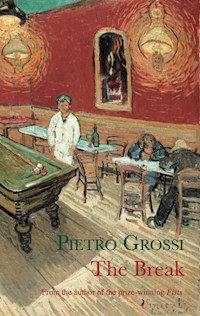
Cover Illustration The Night Café Vincent Van Gogh © Yale University Art Gallery 2011
Frontispiece Pietro Grossi
Set in 11 on 15 Monotype Baskerville by Tetragon and printed in Great Britain on Munken Premium White 90 gsm by TJ International, Cornwall
www.pushkinpress.com
THE BREAK
Contents
Title PageCopyrightTHE BREAKDedicationTranslator’s NoteChapter OneChapter TwoChapter ThreeChapter FourChapter FiveChapter SixChapter SevenChapter EightChapter NineChapter TenChapter ElevenChapter TwelveChapter ThirteenChapter FourteenChapter FifteenChapter SixteenChapter SeventeenChapter EighteenChapter NineteenChapter TwentyChapter Twenty-OneChapter Twenty-TwoChapter Twenty-ThreeChapter Twenty-FourChapter Twenty-FiveChapter Twenty-SixChapter Twenty-SevenChapter Twenty-EightAlso by Pietro Grossi
It is impossible to determine simultaneously the position andmomentum of a given object with any degree of precision.
Werner Heisenberg’s uncertainty principle 1927
Translator’s Note
The form of billiards played in this book is what is known as ‘Italian billiards’ or ‘Italian five-pins’. This game is played with only three balls—a white and a yellow cue ball, one for each of the two players, and a red ball, or object ball. Five miniature skittles, or ‘pins’ are arranged in a diamond-shaped formation—four white pins surrounding a red one—in the centre of the table.
This formation is known as the ‘castle’. The table has no pockets. The objective of the game is to knock down one or more of the pins by getting either one’s opponent’s ball or the object ball to hit the castle. Points are awarded according to which and how many of the pins are knocked down.
Chapter One
THE BALL SET OFF, as soft as a bread roll, towards the opposite cushion, lightly touched the ball to its right, and before stopping a few inches from the castle sent the opposing ball straight into the red pin, which tipped over onto the baize as if by chance.
“OK, Cirì,” Dino said, quickly rubbing his cue with the blue cloth and putting it back in the rack behind him. “I think I’ll go home.”
“Already?” Cirillo said, setting up the pins again with two fingers and putting the balls back in position.
“Yes, it’s not my night tonight.”
“Because you’re not winning?”
“Don’t be stupid, Cirì.”
Cirillo gave a half-smile and watched Dino put on his old light-brown leather jacket, which was all threadbare by now. He had never seen him wear anything else. “It’s never a good idea to go home earlier than usual,” he said.
“I know,” Dino said. He turned away, walked to the far end of the room and raised a hand to say goodbye. As he passed, two young guys at the last table but one lowered their heads slightly by way of goodbye, and when Dino put his foot on the bottom step of the stairs they moved closer together and whispered something to each other.
The days were already drawing in. It was the beginning of that time of year when, as evening fell, people seemed to be wandering through a darkened theatre. A man and a woman waved to Dino as they passed, and he replied with as little energy as possible. That was something he’d never been crazy about, greeting people in the street—it was like someone suddenly coming into the bathroom without asking permission, but someone you couldn’t reprimand.
During the day, when he was at work, it was different, it was as if, there, his world was everyone’s world. There, he liked to stop for a few seconds at the side of the road for a chat, or else if someone passed and happened to wave to him he would calmly get to his feet and raise his arm and return the greeting, with a smile on his face, just as you were supposed to. If those same people met him later on, though, on his way home from the billiard parlour for instance, without his work clothes, they would wonder if something had happened to him, or if he was just plain rude and stand-offish. But that was something else entirely, and even Dino couldn’t quite explain it.
When Dino got home, Sofia was at the far end of the living room, making soup at the kitchenette, surrounded by steam and sliced vegetables.
“Hi,” Dino said.
Sofia turned with soiled hands, a look of surprise on her face. “Oh,” she said. “You’re early.”
“Yes, it wasn’t my night,” Dino said.
“Weren’t you winning?” Sofia asked, turning away again, and although she had her back to Dino, he knew there was an ironic smile hovering on her lips.
“No,” Dino said, “I wasn’t winning.” He hung his threadbare old jacket on one of those ugly pieces of pine that a few years earlier he had convinced himself would look good stuck on the wall as a coat rack.
“It isn’t a good idea to come home earlier than usual,” Sofia said.
“Has Cirillo been here?” Dino asked, almost irritably.
“No, why?” Sofia said, turning for a moment.
“No reason,” Dino said, and he went to the wooden table in front of the little kitchenette and sat down on the chair furthest from the door. For a while they were both silent, Dino playing with the grain of the table and Sofia finishing the soup. For some reason, it had always made him feel good, being close to each other like this but slightly distant, and not talking. By the time Sofia brought over the dishes, Dino had already started making a little furrow in the wood.
“Stop that,” Sofia said as she put the pot down on the table, on the thin piece of cork Dino had bought a few months earlier. “It’s minestrone.”
That wasn’t a bad idea, Dino thought, but for some reason he didn’t feel like saying it out loud.
They ate in silence, both sucking the soup from their spoons as softly as they could and playing their old game of trying to see shapes in the vegetables.
After dinner, Dino and Sofia took the plates to the kitchenette, then Sofia came back carrying an apple and a knife with a wooden handle, and put them down in front of Dino.
Dino looked at her with raised eyebrows.
“I got them from Doni,” Sofia said. “They’re good.”
He looked at the apple, slightly glumly, then made up his mind, gave a slight nod and started peeling it.
“Listen,” Sofia said, after a few moments’ silence in which the only noise was the sound of his knife cutting through the peel. “I’m pregnant.”
Dino had cut off a piece of apple with his knife, and now, holding it with his thumb on the blade, he stopped just as it was going in his mouth. Then, having bitten and chewed the piece of apple for a few seconds, he said, “Oh.”
Sofia also started to peel an apple, making a continuous strip that curled round, the way Dino liked it.
Dino tried to keep chewing his apple, but suddenly it was as if one of those hot winds from the south, one of those winds full of sand, was blowing through his teeth and making his mouth dry. “But didn’t they say it wasn’t possible?” he said, pouring himself a glass of water, his hand a bit less steady than usual.
“They must have been wrong,” Sofia said.
Dino looked at his wife for a moment, then lifted the glass and took two or three long gulps. Then he put the glass down again on the table and sat looking at it for a few seconds. “Well?” he asked eventually.
“Well what?”
“Well, what are we going to do?”
Sofia looked at him in silence. She seemed slightly puzzled. “I think we’re going to have a baby,” she said.
Dino thought about it for a second. “Oh,” he said again.
They sat in silence for a while, concentrating on their apples, with their thoughts dancing a jig in front of their eyes.
“What about the travelling we were going to do?” Dino asked, realising suddenly that years had passed, and then more years, and he had long left his youth behind him, and yet had never travelled, not even when he was young and free and not a father.
“Dino,” Sofia said. “We’ve never been anywhere, where do you think we’re going to go now?”
Dino nodded slowly, then, with his head still half in the clouds, put the knife and what was left of the apple down on the table, planted a kiss on his wife’s forehead, and went and put his jacket back on.
Chapter Two
BY THE TIME Dino walked back into the room full of green tables, all of them lit, the young guys who had waved to him earlier had already gone. Pairs of men had taken the last tables at the far end of the room, and one pair were talking just slightly louder than they should.
Cirillo saw Dino walking slowly between the tables, with his hands in the pockets of his jacket as usual, and immediately realised that something had happened. “I told you you shouldn’t have gone home earlier than usual,” he said.
Dino gave a slight smile, along with a little laugh that came from somewhere inside his chest. “I’ll take seven,” Dino said, going to the display case and taking out his cue.
“No game?” Cirillo asked, seeing Dino walk away.
“Not tonight, Cirì, thanks all the same,” he heard Dino say, already with his back to him.
Dino got to Table Seven, turned on the light switch under the scoreboard, took the little tray with the pins and the three balls from the drawer and put it down on a corner of the table. Then he picked up the blue cloth, sat down at the edge of the table and started calmly polishing the balls. It was something he almost never did, even though he liked doing it. He liked wiping away those little blue chalk marks from other people’s games, games he would never know the end of anyway. It was as if those balls were being wiped clean of the world and becoming new again.
Dino dropped the shiny clean ball on the green baize, got up from the table, grabbed the little tray and turned it over, spilling the pins into his hand, then put the tray back in its place. Usually when he shot a few balls for himself he only put down the central red pin, so that he didn’t have to stand the pins back up again every time, but that evening he wanted everything to be just right.
Once he had put all five pins of the castle in their places, he picked up the blue cloth again, wiped the whole of the cue with it, then took an almost new piece of chalk and stroked the tip of the cue with it a couple of times, looking down at the green surface of the table and the three balls, that spider’s web of perfect geometries in which bad luck and the evil gods had no place. That was the way it was, at the billiard table—bad luck didn’t exist. If you got a shot wrong, if the balls didn’t come out the way you wanted or your own ball ended up in the castle, it was because you’d made a bad shot, not because of the gods or bad luck. On the other hand, it sometimes happened that even if you hadn’t made the shot the way you should have, your ball went the right way, and even, if fate was really smiling on you, ended up in the cover on the other side of the pins, out of reach of the opposing ball. When that happened, it was called stealing, but no one had ever suggested that it didn’t count. When you came down to it, it was comforting to know that there was a place covered in green baize, one hundred and forty-two centimetres wide by two hundred and eighty-four centimetres long, not much more than four square metres, where bad luck had no place, where if you were good you managed to keep the gods under control and, if things worked out well, even let them give you a little nudge.
But that wasn’t why Dino was here every night—it had been a long time now that he had been getting the balls to go where he wanted, without needing to control any gods or curse his good or bad luck. Dino was here because he needed things to be clear and precise, to know where they were going to end, to know that there was still a piece of the world where lines and forces and movements followed exact trajectories, without frills, without flights of fancy.
Dino put the piece of chalk to one side, grabbed the cue from the bottom end and touched the lighter-coloured ball with the tip, moving it ever so slightly in his direction. There was something electric in that clack produced by the contact of the cue and the ball, a vibration that, for a second, shook the world and made you feel more human. He remembered when as a child, without his aunt knowing, he would go with his dad from time to time to play a couple of games. He hadn’t been particularly fascinated—as a friend of his had confessed years later he had been—by the sight of all those men joking among themselves, surrounded by a fog of cigarette smoke and the litter of wine bottles. He had found nothing to admire in those red noses and those yellowed teeth and those swollen bellies. What Dino hadn’t been able to take his eyes off was the surface of the table—those hands forming a bridge on the baize to support the cue, those perfectly polished pieces of wood moving like silk over those hard, calloused workers’ hands, that clacking of the cues on the surface of the balls and that sharp but muted noise of the balls hitting each other and rebounding off the cushions, that imperceptible sound of the pins as they were knocked down by the balls and fell on the baize. And above all, the automatic, elegant movements of the men at the table. It was as if there, on that green fragment of the world, each man found his own dignity.
Dino stretched across the baize, placed his hand very close to one of the balls, laid the cue across it and moved it backwards and forwards a couple of times, then let it slide until it touched the ball, which slowly rolled across the table, rebounded off the furthest cushion and returned to its starting position, neither a millimetre more nor a millimetre less, no further to the right, no further to the left, but the exact same point from which it had started.
That was the first thing Cirillo had told him to learn. Dino had got it into his head that there was nobody else from whom he’d rather learn the secrets of billiards. To Dino, Cirillo was the only one who mattered, he was the master—a skinny little man with long hair like a gypsy, who beat everyone and held the cue as if it were made of crystal and stroked the balls as if they were a baby’s cheeks. Dino was there every minute of his free time, making shots that were askew at best with kids his own age who shot them even more askew than he did, and every minute that he spent there he would glance over at Cirillo and watch how he moved, how he held the cue, how he used the chalk, how he looked at the table before leaning across it to shoot. He would try to understand what secret, what magical mysterious alchemy there was in stroking the balls that way. Until, one day, he had come to the conclusion that he had to have him as his teacher, that the world had no meaning without his guidance, that the answer to all questions—what questions they were he didn’t even know himself—were inescapably to be found in the perfect geometries created by that thin, long-haired man. He had spent three months trying to speak to him—he was ashamed to go over to his table, especially with his friends all around him, so every evening he waited, following his every move, hoping to find a moment, a split second, when Cirillo walked off by himself or was alone at his table. But it never came, and every evening, when Dino had to return home to avoid a thrashing from his aunt or his father, Cirillo would still be there, calmly playing with his friends.




