


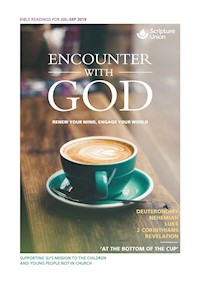
Encounter with God E-Book
Erhalten Sie Zugang zu diesem und mehr als 300000 Büchern ab EUR 5,99 monatlich.
- Herausgeber: Scripture Union
- Kategorie: Religion und Spiritualität
- Sprache: Englisch
Encounter with God is Scripture Union's daily Bible reading guide designed to lead you to a deeper understanding about what God is saying to you and to his world today. You'll find its thorough and energetic investigation of the whole Bible inspiring and stimulating. And you'll discover that its biblical exposition is complemented by pastoral warmth from a strong field of writers and contributors. As well as daily content, feature articles provide insights into Christian spirituality, tackle contemporary issues, and profile teachers who inspire.
Sie lesen das E-Book in den Legimi-Apps auf:
Seitenzahl: 196
Veröffentlichungsjahr: 2019
Das E-Book (TTS) können Sie hören im Abo „Legimi Premium” in Legimi-Apps auf:
Ähnliche




















Scripture quotations taken from The Holy Bible, New International Version (Anglicised edition) Copyright © 1979, 1984, 2011 Biblica (formerly International Bible Society). Used by permission of Hodder & Stoughton Publishers, an Hachette UK Company. All rights reserved.
Scripture taken from The Message copyright © 1993, 1994, 1995, 1996, 2000, 2001, 2002 Eugene H. Peterson. Used by permission of NavPress Publishing Group.
Scripture quotations marked NLT are taken from the Holy Bible, New Living Translation, copyright © 1996. Used by permission of Tyndale House Publishers, Inc., Wheaton, Illinois 60189 USA. All rights reserved.
Design by Heather Knight
Image credit: James Owen/Unsplash
This edition of Encounter with God copyright © Scripture Union 2018. All rights reserved.
ISBN 978 1 78506 719 8 (ePub edition)
ISSN 2050-537X (Online)
ISSN 1350-5130 (Print)
Scripture Union, Trinity House, Opal Court, Opal Drive, Fox Milne, Milton Keynes MK15 0DF, UK.
About Scripture Union
Scripture Union is an international Christian charity working with churches in more than 130 countries.
Thank you for purchasing this book. Any profits from this book support SU in England and Wales to bring the good news of Jesus Christ to children, young people and families and to enable them to meet God through the Bible and prayer.
Find out more about our work and how you can get involved at:
www.scriptureunion.org.uk (England and Wales)
www.suscotland.org.uk (Scotland)
www.suni.co.uk (Northern Ireland)
www.scriptureunion.org (USA)
www.su.org.au (Australia)
contents
Editorial: Firm foundations
The writers
Using this guide
Deuteronomy 8–34; Psalms 59,60
Tanya Ferdinandusz
Revelation 10–22; Psalms 61,62,63
Colin Sinclair
Ezra 1–7; Psalm 64
Andrew Heron
2 Corinthians; Psalms 65,66,67
Peter Morden
Worldview:At the bottom of the cup
Emily Spademan
Nehemiah; Psalms 68,69
Fergus Macdonald
Luke 9–12; Psalms 70,71
Nigel Wright
Firm Foundations
The summer of 2018 was unusually hot in most of Europe. The extreme temperatures caused practical challenges, with an additional unusual consequence in the UK: after weeks with no rain, observations from the air showed some amazing lost archaeological features. Clearly visible on the parched ground across the country were the shapes of the foundations of ancient settlements.
Hints of past worlds got me pondering the people who previously walked on this earth – but after just one day of rain these features disappeared as things began to return to ‘normal’. Who knows when such strange weather will return and allow them to reappear?
Testing conditions can reduce built structures to bare foundations, while people under duress may be reduced to their core convictions – a recurring theme in this quarter. In 2 Corinthians we see how Paul refers to the multiple stresses afflicting the early believers, and refers to his own mysterious ‘thorn in the flesh’, clearly a persistent trial as he sought to serve the Lord. He exhorts us to stand firm in faith throughout our trials. Similarly, several notes refer to the modern persecuted church, and perhaps we may be challenged by the reminder that brothers and sisters in Christ may today be experiencing severe testing. What would be revealed if our own churches and lives were put to the test as theirs are?
Even small things can test our deepest convictions. Drinking coffee may not seem like a major moral dilemma – but Worldview calls us to be thoughtful even in the banal decisions of daily life. If we follow Jesus, we care for the wellbeing of others: this is an ethical and an economic imperative. Under pressure, will we choose an easier way out, or stick to our principles?
We affect God’s beautiful world with every personal decision, just as those ancient people have permanently marked our land. May our choices under pressure be founded on gospel values and may the image of the Lord Jesus be formed in us.
Sally NelsonEditor
Angela GrigsonContent Project Manager
ON THE COVER Emily Spademan considers how small decisions, such as our coffee choices, can reflect the love of God for his people (Worldview)
Writers
Tanya Ferdinandusz and her husband Roshan have been married for 25 years, and they have two grown sons, Daniel and Joshua. Tanya has been writing Bible reading notes, articles and devotionals for 20 years and has recently published Marriage Matters – a book for married couples.
Colin Sinclair is Moderator of the Church of Scotland and minister of a city centre church in Edinburgh. He is married to Ruth and has four children. He is former Chair of Scripture Union’s International Council and a former General Director of SU Scotland.
Andrew Heron was a missionary and pastor for almost 25 years in France. He currently serves as Pastoral Ministries Associate at West Church, Bangor, Northern Ireland.
Peter Morden is Senior Pastor of South Parade Baptist Church, Leeds and Distinguished Visiting Scholar at Spurgeon’s College. He was formerly Vice Principal at Spurgeon’s.
Fergus MacDonald is the former General Secretary of the United Bible Societies. He is Chair Emeritus of the Forum of Bible Agencies International and an Honorary Chairperson of the Lausanne Committee. His major interest is in facilitating Scripture engagement.
Nigel Wright is a Baptist minister, Principal Emeritus of Spurgeon’s College, London and former President of the Baptist Union of Great Britain.
Emily Spademan works for a Christian evangelisation organisation, training and equipping churches in the north of England. She is passionate about churches finding ways of reaching those they’re uniquely positioned to reach, and good coffee.
Using this guide
Encounter with God is designed for thinking Christians who want to interpret and apply the Bible in a way that is relevant to the problems and issues of today’s world. It is based on the NIV translation of the Bible, but can easily be used with any other version.
Each set of readings begins with an Introduction to the section you are about to study. The Call to Worship section at the start of each note should help you consciously to come into God’s presence before you read the passage. The main Explore section aims to bring out the riches hidden in the text. The Growing in Faith section at the end suggests ways of applying the message to daily living.
The Bible in a Year readings at the foot of the page are for those who want this additional option.
Introduction
Deuteronomy
Remember the Covenant
Deuteronomy begins where Numbers ended, on the plains of Moab. It stays there until the very end.1 The picture remains frozen, while Moses speaks on… and on… and on…
God’s people are assembled on the threshold of the Promised Land. Their sin had lengthened a straightforward 11-day journey into 40 years of meandering in the wilderness. The older generation has passed away; only Moses, Joshua and Caleb remain. After the fall of communism, playwright Vaclav Havel undertook the task of leading Czechoslovakia in finding its feet as an independent nation. He said it felt like ‘a parent trying to teach an unruly bunch of children how to behave as adults’.2 Moses probably felt the same!
Having lost their heart’s desire through disobedience, the Israelites now stand poised to gain it – that land flowing with milk and honey – but they stand on dangerous ground. Their gravest danger would be forgetfulness of God’s faithfulness, leading to unfaithfulness to the covenant. The overarching theme of Deuteronomy, therefore, is covenant renewal. Moses repeatedly (at least a dozen times) exhorts the people to ‘Remember’! They are to remember, both to avoid past mistakes and as an encouragement to trust God for their future. But ‘the simple act of remembering would require daily acts of concentration’,3 so remembrance is woven into the fabric of everyday life: the Shema (6:4–9,20–25); the feasts (16:16); the ritual of the first-fruits offering (26:5–10); writing the laws (27:1–8); even a song (32:1–43)! The psalmist declared, ‘Your decrees are the theme of my song wherever I lodge’.4 If covenant renewal is Moses’ theme song, wholehearted obedience is its refrain. Both then and now, it is through obedience that God’s people must give expression to their love and loyalty.5
Tanya Ferdinandusz
For Further Reading
JA Thompson, Tyndale Old Testament Commentaries: Deuteronomy, IVP, 1974
Gordon McConville, New Bible Commentary: 21st Century Edition, OM Books, 2001
Philip Yancey, The Bible Jesus Read, OM Books, 2000, p75–105
1 Num 36:13; Deut 34:1 2 Philip Yancey, The Bible Jesus Read, OM Books, 2000, p76 3 Yancey, 2000, p87 4 Ps 119:54 5 John 14:15,21
Monday 1 July
Land of Promise and Peril
‘Guide me, O thou great Jehovah, / Pilgrim through this barren land; / I am weak, but thou art mighty; / Hold me with thy powerful hand.’1
Deuteronomy 8
Saturday’s reading warned that Israel’s covenant loyalty would be undermined by the influence of the pagan inhabitants of the land. Today’s reading looks inward, at the dangers lurking within the hearts of God’s people.
Their wilderness experiences in ‘that thirsty and waterless land, with its venomous snakes and scorpions’ (v 15) taught the Israelites humble dependence on God (vs 2,3,16). It should have been an unforgettable reminder of God’s power and care (vs 3a,4,15,16). The problems faced in the desert stand in contrast to the promise of a good life in a ‘good land’ (vs 7–9). This prosperity is affirmed – it is God-given (v 10), for their satisfaction and enjoyment – but the delightful promise of prosperity is tempered by warnings about its perils. With their bellies full, their buildings standing tall, their businesses flourishing and everything they touch turning to gold (vs 12,13), there would soon loom before the people of God not fearsome giants or fortified cities, as in former times,2 but the deadly and destructive temptation to ‘forget’ God, shown in disobedience, pride or idolatry (vs 11,14,19). Verse 17 reminds us that ‘great wealth can lead to the delusion of self-sufficiency’.3 It is a delusion because ‘people do not live on bread alone but on every word that comes from the mouth of the Lord’ (v 3b, TNIV). Our need of God is both precedent and greater than every other need. Without God, the richest among us remains a pauper, while the ‘poor in spirit’ are heirs to God’s kingdom.4
The antidote to pride (vs 14a,17) is praise (v 10b). Pride looks inward, to self; praise looks upward, to God. Praise remembers what God has done, recognises who God is and responds with an uplifted voice and a life of grateful and faithful obedience (v 11).
Lord, rid me of the pride that constantly seeks to take up residence in my heart. Let my praise rise up to glorify you.
1 William Williams, 1717–91 2 Deut 1:28 3 Gordon McConville, NBC: 21st Century Edition, OM Books, 2001, p209 4 Matt 5:3
2 Chronicles 33,34; Psalms 75,76
Tuesday 2 July
Possessing the Promise
‘He has given us new birth into a living hope through the resurrection of Jesus Christ from the dead, and into an inheritance that can never perish.’1
Deuteronomy 11
While making the promise (vs 9,21) and keeping the promise (vs 17,23a,29,31) are done by God, taking possession of the Promised Land is something Israel must do (vs 8,11,29b,31a). The land ‘flowing with milk and honey’ (v 9) is Israel’s inheritance, but successful occupation of the land – as well as enjoyment of its abundance – is contingent upon a right response to this gift. Throughout Deuteronomy, the divine confirmation that God is ‘giving’ the land and the divine command to Israel to ‘take possession’ of it go hand in hand.2
If Israel fails fully and faithfully to ‘take possession’ of the land, her inheritance will lie fallow and, ultimately, she risks losing it. Several factors threaten to jeopardise possession. Externally, there are those ‘larger and stronger’ pagan nations, who must be dispossessed (v 23) and from whom a stringent separation must be maintained or God’s people will be exposed to the snare of syncretism (v 16). In the land, Israel must live in careful obedience and humble dependence on God. In Egypt, fruitfulness depended on human effort (v 10); they must now learn to trust in God’s provision (vs 11–15).
We, too, have an inheritance from our Father. Our salvation is neither earned nor merited, but a gift from God; nevertheless, salvation becomes effective only when we take hold of it by faith,3 just as Israel had to lay hold of the land. Salvation is about new birth, but also a new life of holiness. Sanctification is a cooperative effort: the Spirit partners with us to the extent of our assent. Paul captures the tension of God’s grace and our responsibility: ‘continue to work out your salvation with fear and trembling, for it is God who works in you to will and to act in order to fulfil his good purpose.’4
How much of you does the Holy Spirit possess?
1 1 Pet 1:3,4 2 Deut 3:18; 4:1 3 Rom 3:23–25 4 Phil 2:12,13
2 Chronicles 35,36; Luke 1:39–80
Wednesday 3 July
Give Boundlessly
‘Give, and it will be given to you. A good measure, pressed down, shaken together and running over, will be poured into your lap.’1 Does your giving measure up?
Deuteronomy 15:1–18
God sets many boundaries for his people, but in the matter of giving, there are no boundaries. God’s people are to give boundlessly, reflecting the way God has blessed (v 14) and will continue to bless them (vs 4–6). They are commanded to help the needy (vs 7,8) and, every seventh year, to write off debts (vs 1,2) and free any who have been reduced to selling themselves into slavery (v 12). The emphasis, however, is less on the act of giving, more on the underlying attitudes. God’s people must not be ‘hard-hearted’ or ‘tight-fisted’ (v 7), but ‘open-handed’, lending ‘freely’ (v 8); not constrained by cold-blooded calculations (v 9), but giving ungrudgingly (vs 10,18) and ‘liberally’ (v 14). God seeks a generosity compelled by love, not laws.
No figures or formulae are spelt out. The overwhelming thrust of the passage is on unsparing, unstinting generosity, taking its cue from God himself (v 15). Not only had God delivered his people from slavery, but he had not allowed them to leave Egypt as empty-handed refugees. Having instructed them to ask the Egyptians for silver, gold and clothing, ‘The Lord had made the Egyptians favourably disposed towards the people, and they gave them what they asked for’.2
Obedience does indeed breed blessing (vs 5,10,18), but this passage does not support or promote prosperity theology. We don’t give in order that we may be blessed, but because we are blessed. In this light, consider Jesus’ words: ‘But love your enemies, do good to them, and lend to them without expecting to get anything back. Then your reward will be great, and you will be children of the Most High, because he is kind to the ungrateful and wicked.’3 By imitating God’s generosity, we show ourselves to be true children of the Most High – the greatest blessing of all.
In the light of God’s bountiful blessings, how should Christians respond to the current refugee crisis?
1 Luke 6:38 2 Exod 12:36 3 Luke 6:35
Ezra 1,2; Luke 2
Thursday 4 July
Happy Anniversaries!
Think about anniversaries you celebrate. Why, and how, do you celebrate? How do these celebrations enrich your life and relationships?
Deuteronomy 16
The three main Jewish feasts – Unleavened Bread, Weeks, Tabernacles (v 16) – are linked to the Exodus event, in which God’s people experienced his great power in delivering them from slavery, as well as his gracious provision for them throughout the wilderness years. The Exodus was Israel’s defining moment. Just as a wedding anniversary both commemorates the inauguration of the marriage covenant and celebrates the couple’s ongoing love-relationship, these feasts commemorated the birth of a nation and celebrated the relationship between God and his covenant people.
Forgetfulness of God frequently led to idolatry, against which stern warnings are issued (vs 21,22). The way to avoid forgetfulness is planned and purposeful remembering. Today, increasingly, God is being removed from our public squares. Moses, in contrast, weaves remembrance of God into the very fabric of everyday life, taking existing agricultural festivals and investing them with new meaning. The carefully detailed instructions focus on making the observance of these feasts both meaningful and memorable (vs 2,3,5–8,10,15a). Yet these are not mere ritual observances, but an expression, an experience, and also an enjoyment, of the people’s covenant relationships – with God, and also with one another.
The festivals promised blessing but they also imposed demands. The people must journey to the place that God dictates (vs 6,11,15,16), setting aside their work and setting apart extended time. They are to gather as a community (vs 11,14), not just in solemn commemoration but also to ‘celebrate’ (vs 1,10,13) and rejoice (vs 11,14). Grateful remembrance of God’s great deliverance and gracious provision must also give rise to willing and generous giving (vs 10,17).
We have our own festival of remembrance, the Lord’s Supper, which Jesus instituted.1 How does your preparation and participation in this celebration compare with what you’ve read today?
1 Luke 22:14–20
Ezra 3,4; Luke 3
Friday 5 July
Listen to Him
Do you lean towards either of these errors that CS Lewis identified: disbelieving in the existence of devils, or believing but feeling an unhealthy interest in them?1
Deuteronomy 18:9–22
Deuteronomy repeatedly revisits the subject of boundaries and choices. In today’s passage, the boundaries concern knowledge and power. Occult, from the Latin word occultus, refers to what is hidden or secret. The occult practices listed (vs 10,11) involve attempts to obtain supernatural knowledge through dealings with the spirit world. ‘Knowledge is power’:2 underlying the quest for knowledge is the desire for power, recalling that age-old temptation to ‘be like God’.3
Once God’s people crossed over to Canaan (v 9), they would have to choose to whose voice they would listen (vs 14,15). Although God’s boundary lines are tightly drawn, they are designed for blessing. Satan is the deceiver and the destroyer. He denied God’s word, cast doubt on God’s goodness and deceived Eve with an empty promise.4 The occult practices that God deems ‘detestable’ (vs 9,12) are also deceptive, offering an illusion of control but in reality giving Satan a foothold to seize control of hearts and destroy lives. The ‘spiritual forces of evil in the heavenly realms’5 are frighteningly real and powerful. We flirt with them at our peril (v 12).
‘The secret things belong to the Lord our God, but the things revealed belong to us and to our children for ever, that we may follow all the words of this law.’6 God alone is the real deal. Through his prophets – and finally and most fully through Jesus – he reveals, not necessarily what we want to know, but what we need to know for salvation. The command ‘listen to him’ (v 15) is echoed by the Father at Jesus’s transfiguration.7 His words are all we need, his voice is the only one we must heed.
Where do you think the boundary lines of our faith need to be made clearer? What issues need to be addressed? By whom? How? What can you do?
1 CS Lewis, The Screwtape Letters (in the Preface) 2 After Francis Bacon, 1561–1626 3 Gen 3:5 4 Gen 3:1–5 5 Eph 6:126 Deut 29:29 7 Matt 17:5
Ezra 5,6; Psalm 77
Saturday 6 July
Presumed Innocent
‘In each heart’s imagination, / In the church’s adoration, / In the conscience of the nation, / Hallowed be thy name.’1
Deuteronomy 19:1–14
God had set a boundary to protect life: ‘You shall not murder’.2 What is to be done when this boundary is breached? Some foundational principles of modern legal and judicial systems are evident in today’s passage.
Because God placed a high value on human life, he decreed that anyone who intentionally takes a life must pay with his life.3 Because life is so highly valued, he also made elaborate provisions to protect the innocent (vs 3,9).4 Ancient Israel had no police force, so an ‘avenger of blood’ (vs 6,12) – the closest male relative – was responsible for safeguarding the family property, name and honour. In ancient societies, blood revenge was the norm. God-ordained respect for life is strikingly different from a sinful desire for revenge. The avenger’s actions had to be tempered by caution and directed by justice. He could not act hastily or hatefully (v 6); nor might he proceed on his own authority, but only as empowered by a duly constituted jury of elders (v 12). He could not initiate revenge, but served as an instrument of justice, responsible for executing the sentence of an impartial court, but only after a fair trial.5
The passage makes the vital distinction between unintentional killing (involuntary or constructive manslaughter) – where the emphasis is on protecting the innocent (vs 4–10) – and premeditated or intentional killing (murder), where the focus is on ensuring that justice is done (vs 11–13). In both instances, the killer is entitled to flee to a city of refuge and is presumed innocent until proven guilty – a principle that continues to be upheld today, both as a legal right and as an internationally recognised human right. Justice demands both that due process is followed6 and that the guilty are punished (v 13).
Prayerfully reflect on Genesis 9:5 and 6, Numbers 35, Deuteronomy 19, Joshua 20:1–9 and Romans 13:1–4. How do these passages shape your views on the issue of capital punishment?
1 Timothy Rees, 1874–1929 2 Deut 5:17 3 Gen 9:6 4 Num 35:9–12 5 Num 35:12 6 Deut 19:12–19; Num 35:9–34
Ezra 7,8; Luke 4
Sunday 7 July
A Mighty Fortress
‘A mighty fortress is our God, a bulwark never failing; / Our helper he, amid the flood of mortal ills prevailing.’1
Psalm 59
‘A man’s home is his castle’ is a proverbial expression signifying both privacy and protection. It’s also a legal maxim, embedded in English case law. The jurist William Blackstone wrote, ‘For every man’s house is looked upon by the law to be his castle of defence and asylum, wherein he should suffer no violence.’2
The superscription tells us the occasion of this psalm: ‘When Saul had sent men to watch David’s house in order to kill him.’ The full story is recorded in 1 Samuel 19:11–17. Clearly, David’s home was not his castle: Saul had turned against him; evil-doers were after his blood, lying in wait for him, conspiring against him (vs 1–3). The safety of his home was severely compromised. However perilous the situation, however powerful the adversary, however painful the attacks (v 7), David relies on a safe haven that can never be compromised – the mighty ‘fortress’ that is God himself (vs 1,9,16,17). When under attack, what is the fortress to which you flee? Your well-honed skills? The wealth you have amassed? Influential contacts? Or the Lord Almighty?
‘The longing to see God acknowledged is a mark of the true servant.’3 David’s youthful challenge to the Philistines4 finds an echo in his cry, ‘You, Lord




