


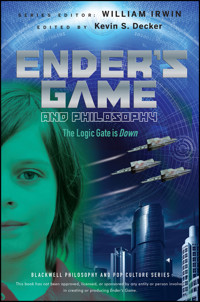
Ender's Game and Philosophy E-Book
12,99 €
Mehr erfahren.
- Herausgeber: John Wiley & Sons
- Kategorie: Geisteswissenschaft
- Serie: The Blackwell Philosophy and Pop Culture Series
- Sprache: Englisch
A threat to humanity portending the end of our species lurks in the cold recesses of space. Our only hope is an eleven-year-old boy. Celebrating the long-awaited release of the movie adaptation of Orson Scott Card's novel about highly trained child geniuses fighting a race of invading aliens, this collection of original essays probes key philosophical questions raised in the narrative, including the ethics of child soldiers, politics on the internet, and the morality of war and genocide. * Original essays dissect the diverse philosophical questions raised in Card's best-selling sci-fi classic, winner of the Nebula and Hugo Awards and which has been translated in 29 languages * Publication coincides with planned release of major motion picture adaptation of Ender's Game starring Asa Butterfield and Harrison Ford * Treats a wealth of core contemporary issues in morality and ethics, including child soldiers, the best kind of education and the use and misuse of global communications for political purposes * A stand-out addition to the Blackwell Philosophy and Pop Culture series
Sie lesen das E-Book in den Legimi-Apps auf:
Seitenzahl: 411
Veröffentlichungsjahr: 2013
Ähnliche




















Contents
Introduction: What Is Ender’s Game?
Notes
Part One THIRD: THE MAKING OF AN IMPOSSIBLE CHILD
CHAPTER 1 “The Teachers Got Me Into This”: Educational Skirmishes … with a Pinch of Freedom
Liberal Education Is Paideia’s Game
Vocational Prep: A Heaping Tablespoon, or the Main Dish?
Is Battle School Just Trade School?
Should Critical Inquiry Be Socratic or Social?
Critical Inquirer for the Dead
Educational Skirmishes
Notes
CHAPTER 2 Illusions of Freedom, Tragedies of Fate: The Moral Development of Ender Wiggin
Putting a Name to Evil
Evil and Its Refrain
Graff’s Sacrifice
The Moral Development of Ender Wiggin
Notes
CHAPTER 3 Xenocide’s Paradox: The Virtue of Being Ender
“A Little Private Moral Dilemma”
“The Name of Ender is One to Conjure With”
Plato or Aristotle?
Notes
CHAPTER 4 Teaching to the Test: Constructing the Identity of a Space Commander
“They’re Gonna Make You Do Time Out in the Belt …”
“Leader’s Aren’t Born, They Are Made”
Battle School Panopticon
Testing 1, 2, 3 …
“I’m Sure You Can Get Your Training at Someone Else’s Expense”
Every Action Has an Equal and Opposite Reaction
Notes
Part Two GAME: COOPERATION OR CONFRONTATION?
CHAPTER 5 The Enemy’s Gate Is Down: Perspective, Empathy, and Game Theory
Understanding Your “Enemy”
Understanding, Empathy, and Love
Loving Your Enemy
Back to the Game
The Enemy’s Gate
Notes
CHAPTER 6 War Games as Child’s Play
Paradox of the Heart and the Head
War Games
The Problem of Dirty Hands
Death Games and Moral Decision-Making
Moral Distance Makes the Heart Grow Fainter
Ender’s a Willing Pawn
Notes
CHAPTER 7 Forming the Formless: Sunzi and the Military Logic of Ender Wiggin
“Of Course We Tricked You Into It”
“The Enemy Outnumbered Him a Thousand to One”
Mazes and Formlessness
Notes
CHAPTER 8 Do Good Games Make Good People?
So What Is a Game, Anyway?
Games Without Goals?
This Game Is Deadly Serious
Do Good Games Make Good People?
Notes
Part Three HIVE-QUEEN: ALL TOGET HER NOW
CHAPTER 9 Bugger All!: The Clash of Cultures in Ender’s Game
Two Sides of the Same Coin, but Which Side Is Which?
When One Face Is Up, the Other Face Is Down
Two Faces of the Same Coin, and I Am the Metal in Between
Notes
CHAPTER 10 Why Ender Can’t Go Home: Philotic Connections and Moral Responsibility
Communicating Across the Galaxy
That Blasted Fantasy Game
Ender’s Quest for a New Home
Notes
CHAPTER 11 Of Gods and Buggers: Friendship in Ender’s Game
Ender, the Superman
Happiness or Power?
Ender, the Political Animal
“I the Sweetest Friend You Got”
Notes
Part Four WAR: KILL OR BE KILLED
CHAPTER 12 “I Destroy Them”: Ender, Good Intentions, and Moral Responsibility
“He Didn’t Just Beat Him. He Beat Him Deep”
“I Didn’t Want to Hurt Him!”
“All His Crimes Weighed Heavy on Him”
“Nevertheless, It’s Still You Doing Those Things”
Notes
CHAPTER 13 Ender’s Beginning and the Just War
“The More You Obey, the More Power They Have Over You”
“I Don’t Have Murder in My Heart”
The Moral Equivalent of War
A Waste of Brief Mortality
“At Least You Have Some Survival Instinct Left”
Notes
CHAPTER 14 “You Had to Be a Weapon, Ender … We Aimed You”: Moral Responsibility in Ender’s Game
Involuntary Bugger-Slaughter
Why It’s Not Okay to Let Rich Kids Drown
“You Tricked Me Into It”
“The Real Education Was the Game”
“I’ll Tell Your Story to My People, So That Perhaps in Time They Can Forgive You …”
Notes
CHAPTER 15 The Unspoken Rules of Manly Warfare: Just War Theory in Ender’s Game
Peace Is the End of War
The Rules of the Game
Playing by the Rules
The Justice of Ender’s Games
Ender’s Last Game: The Justice of the Third Invasion
Notes
Part Five HEGEMON: THE TERRIBLE THINGS ARE ONLY ABOUT TO BEGIN
CHAPTER 16 Locke and Demosthenes: Virtually Dominating the World
A Child’s Rise to Power
“Every Citizen Started Equal, on the Nets”
“[He] Knew How to Exploit Fear in His Writing”
New Friend Request from Hannah Arendt
“We’ll Be Too Entrenched to Suffer Much Loss”
The Heart of the Matter
Notes
CHAPTER 17 Ender’s Dilemma: Realism, Neoliberalism, and the Politics of Power
Survival of the Fittest
Why Can’t We Be Friends?
Ender’s Dilemma
The Power to Persuade
Fighting for the Future
Notes
CHAPTER 18 People Are Tools
Chosen to Save Humanity
The Tragedy of Ender’s Game
The Court-Martial of Colonel Hyrum Graff
What Is Ender’s Game?
Lessons from Ender’s Game
Notes
Convening Authorities of the Court Martial of Colonel Hyrum Graff
The Ansible Index
The Blackwell Philosophy and Pop Culture Series
Series Editor: William Irwin
A spoonful of sugar helps the medicine go down, and a healthy helping of popular culture clears the cobwebs from Kant. Philosophy has had a public relations problem for a few centuries now. This series aims to change that, showing that philosophy is relevant to your life—and not just for answering the big questions like “To be or not to be?” but for answering the little questions: “To watch or not to watch South Park?” Thinking deeply about TV, movies, and music doesn’t make you a “complete idiot.” In fact it might make you a philosopher, someone who believes the unexamined life is not worth living and the unexamined cartoon is not worth watching.
Already published in the series:
24 and Philosophy: The World According to JackEdited by Jennifer Hart Weed, Richard Brian Davis, and Ronald Weed
30 Rock and Philosophy: We Want to Go to ThereEdited by J. Jeremy Wisnewski
Alice in Wonderland and Philosophy: Curiouser and CuriouserEdited by Richard Brian Davis
Arrested Development and Philosophy: They’ve Made a Huge MistakeEdited by Kristopher Phillips and J. Jeremy Wisnewski
The Avengers and Philosophy: Earth’s Mightiest ThinkersEdited by Mark D. White
Batman and Philosophy: The Dark Knight of the SoulEdited by Mark D. White and Robert Arp
Battlestar Galactica and Philosophy: Knowledge Here Begins Out ThereEdited by Jason T. Eberl
The Big Bang Theory and Philosophy: Rock, Paper, Scissors, Aristotle, LockeEdited by Dean Kowalski
The Big Lebowski and Philosophy: Keeping Your Mind Limber with Abiding WisdomEdited by Peter S. Fosl
Black Sabbath and Philosophy: Mastering RealityEdited by William Irwin
The Daily Show and Philosophy: Moments of Zen in the Art of Fake NewsEdited by Jason Holt
Downton Abbey and Philosophy: The Truth IsNeither Here Nor ThereEdited by Mark D. White
Ender’s Game and Philosophy: The Logic Gate Is DownEdited by Kevin S. Decker
Family Guy and Philosophy: A Cure for the PetardedEdited by J. Jeremy Wisnewski
Final Fantasy and Philosophy: The Ultimate WalkthroughEdited by Jason P. Blahuta and Michel S. Beaulieu
Game of Thrones and Philosophy: Logic Cuts Deeper Than SwordsEdited by Henry Jacoby
The Girl With the Dragon Tattoo and Philosophy: Everything is FireEdited by Eric Bronson
Green Lantern and Philosophy: No Evil Shall Escape this BookEdited by Jane Dryden and Mark D. White
Heroes and Philosophy: Buy the Book, Save the WorldEdited by David Kyle Johnson
The Hobbit and Philosophy: For When You’ve Lost Your Dwarves, Your Wizard, and Your WayEdited by Gregory Bassham and Eric Bronson
House and Philosophy: Everybody LiesEdited by Henry Jacoby
The Hunger Games and Philosophy: A Critique of Pure TreasonEdited by George Dunn and Nicolas Michaud
Inception and Philosophy: Because It’s Never Just a DreamEdited by David Johnson
Iron Man and Philosophy: Facing the Stark RealityEdited by Mark D. White
Lost and Philosophy: The Island Has Its ReasonsEdited by Sharon M. Kaye
Mad Men and Philosophy: Nothing Is as It SeemsEdited by James South and Rod Carveth
Metallica and Philosophy: A Crash Course in Brain SurgeryEdited by William Irwin
The Office and Philosophy: Scenes from the Unfinished LifeEdited by J. Jeremy Wisnewski
South Park and Philosophy: You Know, I Learned Something TodayEdited by Robert Arp
Spider-Man and Philosophy: The Web of InquiryEdited by Jonathan Sanford
Terminator and Philosophy: I’ll Be Back, Therefore I AmEdited by Richard Brown and Kevin S. Decker
True Blood and Philosophy: We Wanna Think Bad Things with YouEdited by George Dunn and Rebecca Housel
Twilight and Philosophy: Vampires, Vegetarians, and the Pursuit of ImmortalityEdited by Rebecca Housel and J. Jeremy Wisnewski
The Ultimate Harry Potter and Philosophy: Hogwarts for MugglesEdited by Gregory Bassham
The Ultimate Lost and Philosophy: Think Together, Die AloneEdited by Sharon Kaye
The Walking Dead and Philosophy: Shotgun. Machete. Reason.Edited by Christopher Robichaud
Watchmen and Philosophy: A Rorschach TestEdited by Mark D. White
X-Men and Philosophy: Astonishing Insight and Uncanny Argument in the Mutant X-VerseEdited by Rebecca Housel and J. Jeremy Wisnewski
Superman and Philosophy: What Would the Man of Steel Do?Edited by Mark D. White
The Ultimate Daily Show and Philosophy: More Moments of Zen, More Moments of Indecision TheoryEdited by Jason Holt
The Ultimate South Park and Philosophy: Respect My Philosophah!Edited by Robert Arp and Kevin S. Decker
Forthcoming:
Sons of Anarchy and PhilosophyEdited by George Dunn and Jason Eberl
Supernatural and PhilosophyEdited by Galen A. Foresman
This edition first published 2013© 2013 John Wiley & Sons, Inc
Wiley-Blackwell is an imprint of John Wiley & Sons, formed by the merger of Wiley’s global Scientific, Technical and Medical business with Blackwell Publishing.
Registered OfficeJohn Wiley & Sons, Ltd, The Atrium, Southern Gate, Chichester, West Sussex, PO19 8SQ, UK
Editorial Offices350 Main Street, Malden, MA 02148-5020, USA9600 Garsington Road, Oxford, OX4 2DQ, UKThe Atrium, Southern Gate, Chichester, West Sussex, PO19 8SQ, UK
For details of our global editorial offices, for customer services, and for information about how to apply for permission to reuse the copyright material in this book please see our website at www.wiley.com/wiley-blackwell.
The right of Kevin S. Decker to be identified as the author of the editorial material in this work has been asserted in accordance with the UK Copyright, Designs and Patents Act 1988.
All rights reserved. No part of this publication may be reproduced, stored in a retrieval system, or transmitted, in any form or by any means, electronic, mechanical, photocopying, recording or otherwise, except as permitted by the UK Copyright, Designs and Patents Act 1988, without the prior permission of the publisher.
Wiley also publishes its books in a variety of electronic formats. Some content that appears in print may not be available in electronic books.
Designations used by companies to distinguish their products are often claimed as trademarks. All brand names and product names used in this book are trade names, service marks, trademarks or registered trademarks of their respective owners. The publisher is not associated with any product or vendor mentioned in this book.
Limit of Liability/Disclaimer of Warranty: While the publisher and author(s) have used their best efforts in preparing this book, they make no representations or warranties with respect to the accuracy or completeness of the contents of this book and specifically disclaim any implied warranties of merchantability or fitness for a particular purpose. It is sold on the understanding that the publisher is not engaged in rendering professional services and neither the publisher nor the author shall be liable for damages arising herefrom. If professional advice or other expert assistance is required, the services of a competent professional should be sought.
Library of Congress Cataloging-in-Publication Data
Ender’s Game and Philosophy : the Logic Gate is Down / edited by Kevin S. Decker. pages cm. – (The Blackwell Philosophy and PopCulture Series) Includes bibliographical references and index.
ISBN 978-1-118-38657-6 (pbk. : alk. paper)
1. Card, Orson Scott. Ender’s game. 2. Science fiction, American–History and criticism. 3. Wiggin, Ender (Fictitious character) 4. Philosophy in literature. I. Decker, Kevin S., editor of compilation. PS3553.A655Z59 2013 813′.54–dc23
2013006641
A catalogue record for this book is available from the British Library.
Cover image: Background © Roman Okopny; spacecraft © Sven Herrmann; city © Murat Giray Kaya (all istockphoto); Boy © Tim Kitchen/Getty Images.Cover design by: http://www.simonlevy.co.uk/
Introduction
What Is Ender’s Game?
In his introduction to Ender’s Game written six years after the book was originally published, author Orson Scott Card goes both backwards and forwards in time to talk about the inspiration for the story and its public reception. One of the most interesting things about Card’s novel is the diversity of its audiences. Now with the 2013 film adaptation of Ender’s Game, starring Asa Butterfield as Andrew “Ender” Wiggin and Harrison Ford as Colonel Hyrum Graff, the story of a young boy under siege from all quarters in a not-too-distant future will get its widest reception yet, and never at a better time.
Card tells us in his introduction that he was fascinated by the underlying premise of Isaac Asimov’s original Foundation series, the epitome of Golden Age science fiction, celebrating the marriage of reason and technological progress. Granted a one-time-only Hugo Award in 1966 for “Best All-Time Series,” Asimov’s Foundation (1951), Foundation and Empire (1952), and Second Foundation (1953) use the conceit of “psychohistory,” an incredibly advanced form of mathematical sociology, to plot the decline, fall, and rise of a Galactic Empire and the secret “Foundation” colonies of scientists whose job it is to make sure that the cosmos doesn’t descend into a new dark age. About Foundation, Card writes:
The novel set me, not to dreaming, but to thinking, which is Asimov’s most extraordinary ability as a fiction writer. What would the future be like? How would things change? What would remain the same? The premise of Foundation seemed to be that even though you might change the props and the actors, the play of human history is always the same. And yet that fundamentally pessimistic premise (you mean we’ll never change?) was tempered by Asimov’s idea of a group of human beings who, not through genetic change, but through learned skills, are able to understand and heal the minds of other people.1
This idea had immense appeal to Card when he read of Asimov in the late sixties, near the peak of American entanglement in Vietnam and social unrest tied to the war and the civil rights movement. It’s no surprise, then, that as a young person Card turned to sci-fi for healing rather than mere entertainment.
Like Asimov’s predictions about the distant future, Card’s (although centered closer to the present) concern things that haven’t happened yet and some things that may never happen. This doesn’t make them wholly fantastical, though, as Card’s uncanny predictions of the Internet, the use of child soldiers, and biological warfare (in Speaker for the Dead) show. Like Card, philosophers often pose questions about the intersection of time, change, and human nature: can we ever change? What resources from our past have we forgotten? Is human nature inherently violent and disruptive, does society or some malevolent force guide us to be so, or can we ever transcend our temptation to cruelty and the use of brute force?
As Card himself admits, Ender’s Game is a disturbing novel. It’s unrelenting in the degree to which its protagonist is oppressed in social, military, and ethical ways. In the chapters in the first part of this book, “Third: The Making of an Impossible Child,” four philosophers and educators consider how Ender’s character and moral development are affected by the system of monitoring children on Earth for the correct temperament and abilities to become a child soldier. Ender’s existence as a “Third” is a rarity in an overpopulated world in which parents are restricted to two children. So not only is Ender’s very birth a consequence of the policies of the military regime that both protects and controls the Earth, but his education and socialization—at least after Colonel Graff spirits him away to Battle School—are carefully controlled to produce the result Earth needs. But is this any way to treat a child?
In one of the letters Card received after the publication of Ender’s Game, an army helicopter pilot confesses:
I read Ender’s Game during flight school four years ago. I’m a warrant officer, and our school, at least the first six weeks, is very different from the commissioned officers’. I was eighteen years old when I arrived at Ft. Rucker to start flight training, and the first six weeks almost beat me. Ender gave me courage then and many times after that. I’ve experienced the tiredness Ender felt, the kind that goes deep to your soul. It would be interesting to know what caused you to feel the same way.2
Of the many audiences that have appreciated Card’s book, the men and women in uniform are the most surprising in their identification with the main character. As in the case of the army aviator, their sympathy mainly has to do with the shared experience of training and combat and the resultant transformation of a person’s entire worldview. In the second section of this book, “Game: Cooperation or Confrontation?” four authors take on the philosophical connections between war and games that make up the bulk of the novel’s adventures. These chapters show that empathy as well as strategy, and the ability to commit oneself to something for its own sake, are all vital needs of space commanders.
And what about the poor buggers? The hive-queens and their drones are portrayed by the International Fleet Command of Ender’s time as merciless and predatory. All they care about is eliminating every human from the face of the galaxy. Only a select few—Mazer Rackham, and eventually Ender—can understand what they might do next. But Leon Perniciaro, who wrote a master’s thesis entitled “Shifting Understandings of Imperialism: A Collision of Cultures in Starship Troopers and Ender’s Game,” points out how different the portrayal of giant, insect-like alien invaders appears in Robert Heinlein’s 1959 shoot-em-up StarshipTroopers versus Ender’s Game, with Card’s surprising use of the buggers, or Formics, as foils but not enemies.3 Card’s sympathetic portrayal of the aliens opens up the possibility that philosophy can assist us in understanding, rather than demonizing, those who seem to present themselves as our enemies. So in the third section of this book, “Hive-Queen: All Together Now,” three philosophers discuss all things Formic and philotic, showing how “others” from different cultures have contributed to the development of humanity’s image of itself.
“We’re saving the world, after all. Take him,” says one of Graff’s colleagues when the decision is made to recruit and train Ender Wiggin. Some of Ender’s most peculiar and incompatible traits—his ability to empathize with and even love his enemy as well as his violent streak—have emerged in the I.F.’s analyses as “the right stuff” for a commander who will lead a strike at the bugger homeworld. From the very beginning—as a number of the authors in these pages point out—Ender knows what he’s being trained for, and the logical limit of what he’s being asked to do is complete destruction of the buggers—xenocide. So why does he continue to play along? In the fourth section of this book, “War: Kill or Be Killed,” four authors—including an Air Force colonel—scrutinize ethics in times of war to assess the degree to which Ender, Graff, the International Fleet Command, and humanity as a whole are responsible for the “evil that men do” in times of conflict.
Ender’s Game may be unique in science fiction in that it has at least two sets of sequels. On the one hand, three books, beginning with Speaker for the Dead (1986), continue the sociocultural prophecies as Ender travels the universe and gets married on the planet Lusitania. On the other hand, the “Shadow” series, beginning with Ender’s Shadow (1999), tells the story of Ender’s Game from Bean’s perspective and then dives into the fate of Earth after the Third Invasion. No one can fault Orson Scott Card for the “big picture” thinking of his Enderverse, with developments that are both shocking and challenging to our sense of what’s good and true. In the final section of this book, “Hegemon: The Terrible Things are Only About to Begin,” four philosophers sketch the world that war and invasion have created—a future Earth in which the experience of every child is electronically overseen by the military and in which anonymous personalities on the nets determine international relations.
So it’s time to begin the exercise. The battleroom door is opening. Your reactions will be monitored. Don’t settle for anything less than victory, and remember: the enemy’s gate is down.
Notes
1. Orson Scott Card, “Introduction” to Ender’s Game, Author’s Definitive Edition (New York: TOR Books, 1991), xii.
2. Ibid., xxii.
3. Leon Perniciaro, “Shifting Understandings of Imperialism: A Clash of Cultures in Starship Troopers and Ender’s Game,” MA Thesis, University of New Orleans, May 2011, http://scholarworks.uno.edu/cgi/viewcontent.cgi?article=2322&context=td, accessed October 1, 2012.
Part One
THIRD
THE MAKING OF AN IMPOSSIBLE CHILD
CHAPTER 1
“The Teachers Got Me Into This”
Educational Skirmishes … with a Pinch of Freedom
Cam Cobb
What does Ender’s Game tell us about the art of education, or pedagogy? And what on Earth does this have to do with freedom? To answer these questions, we need to step back in time. For thousands of years, people have debated the structure learning should take. For Socrates (469–399 BC), education was an interactive experience involving critical inquiry, dialogue, and a collaborative process that encouraged people to question the world around them by reasoning things out. Socrates left quite an impression on his students, most notably Plato (429–347 ). Intermingling his own views with Socrates’ in a long dialogue called the , Plato envisioned education as the identification of natural skills of children with the aim of preparing them to take on roles in society that corresponded to their perceived abilities. Children gifted in the use of reasoning, for instance, would join the “guardians” and rule the state. For Plato, then, education would be highly selective, and would also train the young for their future work. In this regard, Plato emphasizes his own kind of vocational education, centering on training in a skill or trade to prepare for a career. While Socratic critical inquiry and Platonic “vocational prep” aren’t exactly opposing philosophies of education, they do at times conflict with one another.
Lesen Sie weiter in der vollständigen Ausgabe!
Lesen Sie weiter in der vollständigen Ausgabe!
Lesen Sie weiter in der vollständigen Ausgabe!
Lesen Sie weiter in der vollständigen Ausgabe!
Lesen Sie weiter in der vollständigen Ausgabe!
Lesen Sie weiter in der vollständigen Ausgabe!
Lesen Sie weiter in der vollständigen Ausgabe!
Lesen Sie weiter in der vollständigen Ausgabe!
Lesen Sie weiter in der vollständigen Ausgabe!
Lesen Sie weiter in der vollständigen Ausgabe!
Lesen Sie weiter in der vollständigen Ausgabe!
Lesen Sie weiter in der vollständigen Ausgabe!
Lesen Sie weiter in der vollständigen Ausgabe!
Lesen Sie weiter in der vollständigen Ausgabe!
Lesen Sie weiter in der vollständigen Ausgabe!
Lesen Sie weiter in der vollständigen Ausgabe!
Lesen Sie weiter in der vollständigen Ausgabe!
Lesen Sie weiter in der vollständigen Ausgabe!
Lesen Sie weiter in der vollständigen Ausgabe!
Lesen Sie weiter in der vollständigen Ausgabe!
Lesen Sie weiter in der vollständigen Ausgabe!
Lesen Sie weiter in der vollständigen Ausgabe!
Lesen Sie weiter in der vollständigen Ausgabe!




