


113,99 €
Mehr erfahren.
- Herausgeber: John Wiley & Sons
- Kategorie: Wissenschaft und neue Technologien
- Serie: Analytical Methods in Earth and Environmental Science
- Sprache: Englisch
A digital elevation model (DEM) is a digital representation of ground surface topography or terrain. It is also widely known as a digital terrain model (DTM). A DEM can be represented as a raster (a grid of squares) or as a vector based triangular irregular network (TIN). DEMs are commonly built using remote sensing techniques, but they may also be built from land surveying. DEMs are used often in geographic information systems, and are the most common basis for digitally-produced relief maps. The terrain surface can be described as compromising of two different elements; random and systematic. The random (stochastic) elements are the continuous surfaces with continuously varying relief. It would take an endless number of points to describe exactly the random terrain shapes, but these can be described in practice with a network of point. It is usual to use a network that creates sloping triangles or regular quadrants.
This book examines how the methods and data sources used to generate DEMs and calculate land surface parameters have changed over the past 25 years. The primary goal is to describe the state-of-the-art for a typical digital terrain modeling workflow that starts with data capture, continues with data preprocessing and DEM generation, and concludes with the calculation of one or more primary and secondary land surface parameters. Taken as a whole, this book covers the basic theory behind the methods, the instrumentation, analysis and interpretation that are embedded in the modern digital terrain modeling workflow, the strengths and weaknesses of the various methods that the terrain analyst must choose among, typical applications of the results emanating from these terrain modeling workflows, and future directions.
This book is intended for researchers and practitioners who wish to use DEMs, land surface parameters, land surface objects and landforms in environmental projects. The book will also be valuable as a reference text for environmental scientists who are specialists in related fields and wish to integrate these kinds of digital terrain workflows and outputs into their own specialized work environments.
Sie lesen das E-Book in den Legimi-Apps auf:
Seitenzahl: 775
Veröffentlichungsjahr: 2018
Ähnliche



















Table of Contents
Cover
Title Page
List of Figures
List of Tables
Preface
Abbreviations
1 Introduction
1.1 Role of DEMs
1.2 Role of Scale
1.3 Survey of Applications
1.4 Study Site and Software Tools
1.5 Structure of Book
2 Constructing Digital Elevation Models
2.1 Elevation Data Networks
2.2 Elevation Data Sources
2.3 Fitness‐For‐Use
2.4 Data Preprocessing and DEM Construction
2.5 US National Elevation Dataset
3 Calculating Land Surface Parameters
3.1 Primary Land Surface Parameters
3.2 Secondary Land Surface Parameters
3.3 Final Comments
4 Delineating Land Surface Objects and Landforms
4.1 Extracting and Classifying Specific Landform Elements
4.2 Extraction and Classification of Land Surface Objects Based on Flow Variables
4.3 Extracting and Classifying Specific (Fuzzy) Landforms
4.4 Extracting and Classifying Repeating Landform Types
4.5 Discrete Geomorphometry: Coupling Multiscale Pattern Analysis and Object Delineation
5 Measuring Error and Uncertainty
5.1 Identification and Treatment of Error and Uncertainty
5.2 Fitness‐for‐Use Revisited
5.3 Multiscale Analysis and Cross‐scale Inference
5.4 The US National Water Model
6 Terrain Modeling Software and Services
6.1 Changes in Data Capture and Computing Systems
6.2 Esri’s ArcGIS Ecosystem
6.3 Third‐party Esri Add‐ons
6.4 Other Software Choices
6.5 Future Trends
7 Conclusions
7.1 Current State of the Art
7.2 Future Needs and Opportunities
7.3 Call To Action
References
Index
End User License Agreement
List of Tables
Chapter 02
Table 2.1 List of key characteristics of elevation data sources described in this chapter.
Table 2.2 Horizontal National Map Accuracy Standards (NMAS) used in the USA since 1947.
Table 2.3 SRTM‐3 versions produced and distributed by CGIAR‐CSI.
Table 2.4 Elevation data sources included in the US National Elevation Dataset (NED) as of August, 2015.
Chapter 03
Table 3.1 List of primary land surface parameters and their significance.
Table 3.2 List of single‐ and multiple‐flow direction algorithms.
Table 3.3 Rankings of RMSEs for the TFM and eight other flow‐direction algorithms on the four mathematical surfaces illustrated in Figure 3.14 (with 1 assigned to the flow‐direction algorithm with the lowest RMSE and 9 to the flow‐direction algorithm with the largest RMSE).
Table 3.4 List of secondary land surface parameters and their significance.
Chapter 04
Table 4.1 Conceptual landform units defined by Conacher and Dalrymple (1977).
Table 4.2 Morphologic type (i.e. topographic position) classes of Speight (1990).
Table 4.3 List of channel attributes and their significance.
Table 4.4 List of basin attributes and their significance.
Table 4.5 Landform classification criteria used by Dikau et al. (1991).
Table 4.6 Landform classes and subclasses used by the Dikau method.
Table 4.7 Comparison of landform classes used by the Dikau and Karagulle methods and their assignment to landform types.
Table 4.8 Comparison of global Hammond landform classes and types modeled by Sayre et al. (2014) and Karagulle et al. (2017).
Chapter 05
Table 5.1 Land surface parameters calculated and tested for correlation with GLOBE data.
Table 5.2 Model experiments for different parameterization schemes and corresponding DEM products used by Zhang et al. (2016).
Chapter 06
Table 6.1 List of Spatial Analyst toolsets and tools.
Table 6.2 List of Interpolation tools.
Table 6.3 List of Surface tools.
Table 6.4 List of Hydrology tools.
Table 6.5 List of Solar Radiation tools.
Table 6.6 List of 3D Analyst toolsets and tools.
Table 6.7 List of the Data Management – Terrain Dataset tools.
Table 6.8 List of the Data Management – TIN Dataset tools.
Table 6.9 List of the Data Management – LAS Dataset tools.
Table 6.10 List of Triangulated Surface tools.
Table 6.11 Terrain analysis and modeling functions included in ArcGeomorphometry.
Table 6.12 Class limits used in QGIS to classify ruggedness index values into categories that describe different types of terrain.
Table 6.13 List of SAGA module libraries and modules focused on calculation of terrain parameters and objects.
Chapter 07
Table 7.1 List of 25 influential digital terrain analysis and modeling papers.
List of Illustrations
Chapter 01
Figure 1.1 Scales at which various biophysical processes dominate calculation of primary environmental regimes.
Figure 1.2 Map of Cottonwood Creek, MT study site.
Figure 1.3 NED 10‐m contour and NHD‐Plus streamline data for the Cottonwood Creek, MT study site, with the catchment boundary overlaid.
Chapter 02
Figure 2.1 The main tasks associated with digital terrain modeling.
Figure 2.2 The three principal methods of structuring an elevation data network: (a) a contour‐based network; (b) a square‐grid network showing a 3 × 3 moving window; and (c) a triangulated irregular network (TIN).
Figure 2.3 Streamline data in green and (a) initial gridded streamlines at 1‐second resolution in red and (b) adjusted gridded streamlines at 1‐second resolution in red.
Chapter 03
Figure 3.1 Schematic showing site‐specific, local, and regional interactions as a function of time.
Figure 3.2 A 3 × 3 moving grid used to calculate selected local land surface parameters.
Figure 3.3 Node numbering convention used for calculation of local land surface parameters.
Figure 3.4 Percent slope grid derived for Cottonwood Creek, MT study site using the finite difference equation, with the catchment boundary overlaid.
Figure 3.5 Aspect in degrees from north derived for Cottonwood Creek, MT study site using the finite difference equation, with the catchment boundary overlaid.
Figure 3.6 Northness derived for Cottonwood Creek, MT study site, with the catchment boundary overlaid.
Figure 3.7 Eastness derived for Cottonwood Creek, MT study site, with the catchment boundary overlaid.
Figure 3.8 Profile curvature (radians per 100 m, convex curvatures are positive) derived for Cottonwood Creek, MT study site using the finite difference formula, with the catchment boundary overlaid.
Figure 3.9 Plan curvature (radians per 100 m, convex curvatures are positive) derived for Cottonwood Creek, MT study site using the finite difference formula, with the catchment boundary overlaid.
Figure 3.10 Single‐ and multiple‐flow directions assigned to the central grid cell in a 3 × 3 moving window using the D8 and FMFD flow‐direction algorithms. Gray shading represents elevation decreasing with the darkness of the cell. Multiple‐flow directions are assigned in (b) and a fraction of the flow of the central cell is distributed to each of the three cells that the arrows point to.
Figure 3.11 Concept of flow apportioning in D∞.
Figure 3.12 Upslope contributing area (ha) derived for Cottonwood Creek, MT study site using the D8 single‐flow direction algorithm, with the catchment boundary overlaid.
Figure 3.13 Upslope contributing area (ha) derived for Cottonwood Creek, MT study site using the D∞ single‐flow direction algorithm, with the catchment boundary overlaid.
Figure 3.14 The four mathematical surfaces commonly used for data‐independent assessment of different flow‐direction algorithms.
Figure 3.15 Concept of flow apportioning in MD∞ based on the construction of triangular facets around one cell.
Figure 3.16 Distribution of the number of cells that receive accumulated area (i.e. flow) from one cell in a sample DEM for an area in central Sweden.
Figure 3.17 Flow apportioning between two cardinal neighbors in the Mass Flux method.
L
1
and
L
2
denote the projected flow widths into the upper and right neighbor and together equal the projected flow width ω.
n
1
and
n
2
are vectors normal to the cell boundaries,
q
is the flow vector and θ is the flow direction.
Figure 3.18 (a) Two triangular facets are formed in a 2 × 2 cell moving window using the spot heights at the center of each grid cell; (b) a 4 × 4 cell moving window is used to estimate elevation at
P
by fitting a bivariate cubic spline surface.
Figure 3.19 Flow line over a TFN: the numbers at the nodes of triangles represent elevation, the light lines show the original grid cells, and the flow lines represented by the arrow chains are formed by tracking the movement of flow (i.e. the flow directions).
Figure 3.20 The decomposition of grid cells into a set of eight triangular facets defined by the nine‐cell kernel nodes (black circles) in D
trig
. The node’s elevations are listed next to each node and facet boundaries are denoted by dashed lines. The surface extent is limited to the central cell so that the only node within this domain is the element‐centered node. The contours and gray scale illustrate the elevation variability within the element and the rounding of the contours adjacent to facet boundaries is an artifact of the contouring algorithm.
Figure 3.21 Examples of flow partitioning from a triangular facet. (a) A triangular facet, the local coordinates, and the
î
,
ĵ
directions. (b) The case where the line oriented in the direction of
intersects node [
x
2
,
y
2
,
z
2
] and is plunging toward this node. The dashed lines that bound
denote the range of orientations where
intersects this node and divides the area into two triangles. In this case, the facet’s drainage area is partitioned proportionally to the area of each of the triangles bounded by the facet’s drainage divide (i.e. the dashed intersecting line) and the facet’s bounding legs. The area is partitioned into the two facets sharing the bold colored facet legs. (c) Same as (b) except that
is dipping toward node [
x
1
,
y
1
,
z
1
]. (d) Same as (b) except
is plunging away from node [
x
2
,
y
2
,
z
2
]. (e) Same as (d) except that
is plunging away from node [
x
1
,
y
1
,
z
1
].
Figure 3.22 The center cell in a 3 × 3 grid cell window divided into eight triangular facets (1–8) with each facet formed from three points; one is the center of the central grid cell (
M
) and the other two are the centers of two adjacent grid cells (e.g.
C
1
and
C
2
).
Figure 3.23 Upslope contributing area (ha) derived for the Cottonwood Creek, MT study site using the MD∞ multiple‐flow direction algorithm, with the catchment boundary overlaid.
Figure 3.24 Upslope contributing area (ha) derived for the Cottonwood Creek, MT study site using the TFM multiple‐flow direction algorithm, with the catchment boundary overlaid.
Figure 3.25 An idealized stream tube originating at a hilltop and terminating at a contour on a hillslope. The average specific catchment area
a
along the contour segment is the ratio of contributing area
A
to flow width
w
.
Figure 3.26 Difference from mean elevation for the Cottonwood Creek, MT study site using a 15 × 15 cell moving window, with the catchment boundary overlaid.
Figure 3.27 Elevation percentile for the Cottonwood Creek, MT study site using a 15 × 15 cell moving window, with the catchment boundary overlaid.
Figure 3.28 Standard deviation of elevation for the Cottonwood Creek, MT study site using a 15 × 15 cell moving window, with the catchment boundary overlaid.
Figure 3.29 A comparison of the shape complexity index values for a perfectly oval shape (left) and for different levels of complexity (right).
Figure 3.30 (a) The local gradient in the original topographic wetness index and (b) with the new slope term proposed by Hjerdt et al. (2004). The dotted lines represent the gradient of the groundwater table that is constant in the original topographic wetness index (a) and variable in the slope‐adjusted topographic wetness index (b).
Figure 3.31 Steady‐state topographic wetness index derived for the Cottonwood Creek, MT study site using Equation 3.46, with the catchment boundary overlaid.
Chapter 04
Figure 4.1 The modified Dikau (1989) classification of form elements based on the profile and tangential curvatures. The elements have been further classified as positive or negative based on the radius of curvatures (>600 or <600 m) and the planform curvature in the original classification was replaced by tangential curvature based on Shary and Stepanov (1991).
Figure 4.2 Shary’s complete system of classification of landform elements based on signs of tangential, profile, mean difference, and total Gaussian curvatures.
Figure 4.3 Landscape elements on a hillslope profile between two interfluves as delineated by Ruhl (1960) and Ruhl and Walker (1968).
Figure 4.4 Schematic showing the derivation of fuzzy memberships using (a) the definition of thresholds and (b) the definition of class centers.
Figure 4.5 D8 (O’Callaghan & Mark, 1984) flow direction derived for the Cottonwood Creek, MT study site with the catchment boundary overlaid.
Figure 4.6 Contour maps showing the results of using three methods to predict channel head locations for a catchment in Indian Creek, Ohio. The circles indicate mapped channel heads and the contour intervals are 10 m. The stream networks resulting from the (a) Passalacqua et al. (2010) method, (b) Pelletier (2013) method, and (c) DrEICH (Clubb et al., 2014) methods are shown in the three maps as well.
Figure 4.7 Schematic showing how the morphometric class at the point indicated by the vertical arrow varies as shown with the scale over which it is measured.
Figure 4.8 Comparison of major landform types between the Sayre et al. (2014) and Karagulle et al. (2017) maps.
Figure 4.9 Schematic showing local variance (LV) method applied to the grid cells in a DEM.
Chapter 05
Figure 5.1 Number of papers focused on DEM error and uncertainty cited in Section 5.1 by year of publication.
Figure 5.2 Composition of the rule set for the scale adaptive digital elevation model (S‐DEM) algorithm.
Figure 5.3 Data structure for S‐DEM: (a) the original DEM (the number in each cell represents elevation); (b) the index array using DOI (the number in each cell represents the largest adaptable cell size in meters).
Chapter 06
Figure 6.1 Schematic showing some of the capabilities and how the elevation and hydrology tools are accessed in Esri’s ArcGIS Online platform (as of February 2017).
Guide
Cover
Table of Contents
Begin Reading
Pages
ii
iii
iv
v
x
xiv
xi
xii
xiii
xiv
xv
xvi
xvii
xviii
xix
xx
xxi
xxii
xxiii
1
2
3
4
5
6
7
8
9
10
11
12
13
14
15
16
17
18
19
20
21
22
23
24
25
26
27
28
29
30
31
32
33
34
35
36
37
38
39
40
41
42
43
44
45
46
47
48
49
50
51
52
53
54
55
56
57
58
59
60
61
62
63
64
65
66
67
68
69
70
71
72
73
74
75
76
77
78
79
80
81
82
83
84
85
86
87
88
89
90
91
92
93
94
95
96
97
98
99
100
101
102
103
104
105
106
107
108
109
110
111
112
113
114
115
116
117
118
119
120
121
122
123
124
125
126
127
128
129
130
131
132
133
134
135
136
137
138
139
140
141
142
143
144
145
146
147
148
149
150
151
152
153
154
155
156
157
158
159
160
161
162
163
164
165
166
167
168
169
170
171
172
173
174
175
176
177
178
179
180
181
182
183
184
185
186
187
188
189
190
191
192
193
194
195
196
197
198
199
200
201
202
203
204
205
206
207
208
209
210
211
212
213
214
215
216
217
218
219
220
221
222
223
224
225
226
227
228
229
230
231
232
233
234
235
236
237
238
239
240
241
242
243
244
245
246
247
248
249
250
251
252
253
254
255
256
257
258
259
260
261
262
263
264
265
266
267
268
269
270
271
272
273
274
275
276
277
278
279
280
281
282
283
284
285
286
287
288
289
290
291
292
293
294
295
296
297
298
299
300
301
302
303
304
305
306
307
308
309
310
311
312
313
314
315
316
317
318
319
320
321
322
323
324
325
326
327
328
329
330
331
332
333
334
335
336
New Analytical Methods in Earth and Environmental Science
Introducing New Analytical Methods in Earth and Environmental Science, a new series providing accessible introductions to important new techniques, lab and field protocols, suggestions for data handling and interpretation, and useful case studies.
This series represents an invaluable and trusted source of information for researchers, advanced students, and applied earth scientists wishing to familiarize themselves with emerging techniques in their field.
All titles in this series are available in a variety of full‐color, searchable e‐book formats. Titles are also available in an enhanced e‐book edition which may include additional features such as DOI linking and high‐resolution graphics and video.
Ground‐Penetrating Radar for Geoarchaeologyby Lawrence B. Conyers
Rock Magnetic Cyclostratigraphyby Kenneth P. Kodama and Linda A. Hinnov
Techniques for Virtual Palaeontologyby Mark Sutton, Imran Rahman, and Russell Garwood
Structure from Motion in the Geosciencesby Jonathan L. Carrivick, Mark W. Smith, and Duncan J. Quincey
ENVIRONMENTAL APPLICATIONS OF DIGITAL TERRAIN MODELING
JOHN P. WILSON
Spatial Sciences Institute, University of Southern California and Institute of Geographical Sciences and Natural Resources Research, Chinese Academy of Sciences
This edition first published 2018© 2018 John Wiley & Sons Ltd
All rights reserved. No part of this publication may be reproduced, stored in a retrieval system, or transmitted, in any form or by any means, electronic, mechanical, photocopying, recording or otherwise, except as permitted by law. Advice on how to obtain permission to reuse material from this title is available at http://www.wiley.com/go/permissions
The right of John P. Wilson to be identified as the author of this work has been asserted in accordance with law.
Registered OfficesJohn Wiley & Sons, Inc., 111 River Street, Hoboken, NJ 07030, USAJohn Wiley & Sons Ltd, The Atrium, Southern Gate, Chichester, West Sussex, PO19 8SQ, UK
Editorial Office9600 Garsington Road, Oxford, OX4 2DQ, UK
For details of our global editorial offices, customer services, and more information about Wiley products visit us at www.wiley.com
Wiley also publishes its books in a variety of electronic formats and by print‐on‐demand. Some content that appears in standard print versions of this book may not be available in other formats.
Limit of Liability/Disclaimer of WarrantyWhile the publisher and authors have used their best efforts in preparing this work, they make no representations or warranties with respect to the accuracy or completeness of the contents of this work and specifically disclaim all warranties, including without limitation any implied warranties of merchantability or fitness for a particular purpose. No warranty may be created or extended by sales representatives, written sales materials or promotional statements for this work. The fact that an organization, website, or product is referred to in this work as a citation and/or potential source of further information does not mean that the publisher and authors endorse the information or services the organization, website, or product may provide or recommendations it may make. This work is sold with the understanding that the publisher is not engaged in rendering professional services. The advice and strategies contained herein may not be suitable for your situation. You should consult with a specialist where appropriate. Further, readers should be aware that websites listed in this work may have changed or disappeared between when this work was written and when it is read. Neither the publisher nor authors shall be liable for any loss of profit or any other commercial damages, including but not limited to special, incidental, consequential, or other damages.
Library of Congress Cataloging‐in‐Publication Data
Names: Wilson, John P. (John Peter), 1955– author.Title: Environmental applications of digital terrain modeling / John P. Wilson.Description: First edition. | Hoboken, NJ : Wiley‐Blackwell, 2018. | Series: New analytical methods in earth and environmental science | Includes bibliographical references and index.Identifiers: LCCN 2017048368 (print) | LCCN 2018001634 (ebook) | ISBN 9781118936207 (pdf) | ISBN 9781118938171 (epub) | ISBN 9781118936214 (hardback)Subjects: LCSH: Digital elevation models | Three‐dimensional imaging. | Digital mapping. | BISAC: SCIENCE / Earth Sciences / Geology.Classification: LCC GA139 (ebook) | LCC GA139 .W55 2018 (print) | DDC 551.410285–dc23LC record available at https://lccn.loc.gov/2017048368
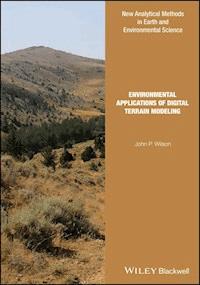
Cover Design: WileyCover Image: Photograph taken to the north of the main channel looking southward to the highest peak which marks the southeast corner of the Cottonwood Creek, MT catchment. Photograph courtesy of William K. Wyckoff.
For Duncan, Ha and Vanessa who made a project like this all the more meaningful for me and to Richard Bedford, Pip Forer, Kenneth Hare, Bruce Leadley, Michael Hutchinson, Ian Moore, and John Gallant and the many others I have encountered along the way for helping to lead me to this place.
List of Figures
1.1
Scales at which various biophysical processes dominate calculation of primary environmental regimes.
1.2
Map of Cottonwood Creek, MT study site.
1.3
NED 10‐m contour and NHD‐Plus streamline data for the Cottonwood Creek, MT study site, with the catchment boundary overlaid.
2.1
The main tasks associated with digital terrain modeling.
2.2
The three principal methods of structuring an elevation data network: (a) a contour‐based network; (b) a square‐grid network showing a 3 × 3 moving window; and (c) a triangulated irregular network (TIN).
2.3
Streamline data in green and (a) initial gridded streamlines at 1‐second resolution in red and (b) adjusted gridded streamlines at 1‐second resolution in red.
3.1
Schematic showing site‐specific, local, and regional interactions as a function of time.
3.2
A 3 × 3 moving grid used to calculate selected local land surface parameters.
3.3
Node numbering convention used for calculation of local land surface parameters.
3.4
Percent slope grid derived for Cottonwood Creek, MT study site using the finite difference equation, with the catchment boundary overlaid.
3.5
Aspect in degrees from north derived for Cottonwood Creek, MT study site using the finite difference equation, with the catchment boundary overlaid.
3.6
Northness derived for Cottonwood Creek, MT study site, with the catchment boundary overlaid.
3.7
Eastness derived for Cottonwood Creek, MT study site, with the catchment boundary overlaid.
3.8
Profile curvature (radians per 100 m, convex curvatures are positive) derived for Cottonwood Creek, MT study site using the finite difference formula, with the catchment boundary overlaid.
3.9
Plan curvature (radians per 100 m, convex curvatures are positive) derived for Cottonwood Creek, MT study site using the finite difference formula, with the catchment boundary overlaid.
3.10
Single‐ and multiple‐flow directions assigned to the central grid cell in a 3 × 3 moving window using the D8 and FMFD flow‐direction algorithms. Gray shading represents elevation decreasing with the darkness of the cell. Multiple‐flow directions are assigned in (b) and a fraction of the flow of the central cell is distributed to each of the three cells that the arrows point to.
3.11
Concept of flow apportioning in D∞.
3.12
Upslope contributing area (ha) derived for Cottonwood Creek, MT study site using the D8 single‐flow direction algorithm, with the catchment boundary overlaid.
3.13
Upslope contributing area (ha) derived for Cottonwood Creek, MT study site using the D∞ single‐flow direction algorithm, with the catchment boundary overlaid.
3.14
The four mathematical surfaces commonly used for data‐independent assessment of different flow‐direction algorithms.
3.15
Concept of flow apportioning in MD∞ based on the construction of triangular facets around one cell.
3.16
Distribution of the number of cells that receive accumulated area (i.e. flow) from one cell in a sample DEM for an area in central Sweden.
3.17
Flow apportioning between two cardinal neighbors in the Mass Flux method. L1 and L2 denote the projected flow widths into the upper and right neighbor and together equal the projected flow width ω. n1 and n2 are vectors normal to the cell boundaries, q is the flow vector and θ is the flow direction.
3.18
(a) Two triangular facets are formed in a 2 × 2 cell moving window using the spot heights at the center of each grid cell; (b) a 4 × 4 cell moving window is used to estimate elevation at P by fitting a bivariate cubic spline surface.
3.19
Flow line over a TFN: the numbers at the nodes of triangles represent elevation, the light lines show the original grid cells, and the flow lines represented by the arrow chains are formed by tracking the movement of flow (i.e. the flow directions).
3.20
The decomposition of grid cells into a set of eight triangular facets defined by the nine‐cell kernel nodes (black circles) in Dtrig. The node’s elevations are listed next to each node and facet boundaries are denoted by dashed lines. The surface extent is limited to the central cell so that the only node within this domain is the element‐centered node. The contours and gray scale illustrate the elevation variability within the element and the rounding of the contours adjacent to facet boundaries is an artifact of the contouring algorithm.
3.21
Examples of flow partitioning from a triangular facet. (a) A triangular facet, the local coordinates, and the î, ĵ directions. (b) The case where the line oriented in the direction of intersects node [x2, y2, z2] and is plunging toward this node. The dashed lines that bound denote the range of orientations where intersects this node and divides the area into two triangles. In this case, the facet’s drainage area is partitioned proportionally to the area of each of the triangles bounded by the facet’s drainage divide (i.e. the dashed intersecting line) and the facet’s bounding legs. The area is partitioned into the two facets sharing the bold colored facet legs. (c) Same as (b) except that is dipping toward node [x1, y1, z1]. (d) Same as (b) except is plunging away from node [x2, y2, z2]. (e) Same as (d) except that is plunging away from node [x1, y1, z1].
3.22
The center cell in a 3 × 3 grid cell window divided into eight triangular facets (1–8) with each facet formed from three points; one is the center of the central grid cell (M) and the other two are the centers of two adjacent grid cells (e.g. C1 and C2).
3.23
Upslope contributing area (ha) derived for the Cottonwood Creek, MT study site using the MD∞ multiple‐flow direction algorithm, with the catchment boundary overlaid.
3.24
Upslope contributing area (ha) derived for the Cottonwood Creek, MT study site using the TFM multiple‐flow direction algorithm, with the catchment boundary overlaid.
3.25
An idealized stream tube originating at a hilltop and terminating at a contour on a hillslope. The average specific catchment area a along the contour segment is the ratio of contributing area A to flow width w.
3.26
Difference from mean elevation for the Cottonwood Creek, MT study site using a 15 × 15 cell moving window, with the catchment boundary overlaid.
3.27
Elevation percentile for the Cottonwood Creek, MT study site using a 15 × 15 cell moving window, with the catchment boundary overlaid.
3.28
Standard deviation of elevation for the Cottonwood Creek, MT study site using a 15 × 15 cell moving window, with the catchment boundary overlaid.
3.29
A comparison of the shape complexity index values for a perfectly oval shape (left) and for different levels of complexity (right).
3.30
(a) The local gradient in the original topographic wetness index and (b) with the new slope term proposed by Hjerdt et al. (2004). The dotted lines represent the gradient of the groundwater table that is constant in the original topographic wetness index (a) and variable in the slope‐adjusted topographic wetness index (b).
3.31
Steady‐state topographic wetness index derived for the Cottonwood Creek, MT study site using
Equation 3.46
, with the catchment boundary overlaid.
4.1
The modified Dikau (1989) classification of form elements based on the profile and tangential curvatures. The elements have been further classified as positive or negative based on the radius of curvatures (>600 or <600 m) and the planform curvature in the original classification was replaced by tangential curvature based on Shary and Stepanov (1991).
4.2
Shary’s complete system of classification of landform elements based on signs of tangential, profile, mean difference, and total Gaussian curvatures.
4.3
Landscape elements on a hillslope profile between two interfluves as delineated by Ruhl (1960) and Ruhl and Walker (1968).
4.4
Schematic showing the derivation of fuzzy memberships using (a) the definition of thresholds and (b) the definition of class centers.
4.5
D8 (O’Callaghan & Mark, 1984) flow direction derived for the Cottonwood Creek, MT study site with the catchment boundary overlaid.
4.6
Contour maps showing the results of using three methods to predict channel head locations for a catchment in Indian Creek, Ohio. The circles indicate mapped channel heads and the contour intervals are 10 m. The stream networks resulting from the (a) Passalacqua et al. (2010) method, (b) Pelletier (2013) method, and (c) DrEICH (Clubb et al., 2014) methods are shown in the three maps as well.
4.7
Schematic showing how the morphometric class at the point indicated by the vertical arrow varies as shown with the scale over which it is measured.
4.8
Comparison of major landform types between the Sayre et al. (2014) and Karagulle et al. (2017) maps.
4.9
Schematic showing local variance (LV) method applied to the grid cells in a DEM.
5.1
Number of papers focused on DEM error and uncertainty cited in
Section 5.1
by year of publication.
5.2
Composition of the rule set for the scale adaptive digital elevation model (S‐DEM) algorithm.
5.3
Data structure for S‐DEM: (a) the original DEM (the number in each cell represents elevation); (b) the index array using DOI (the number in each cell represents the largest adaptable cell size in meters).
6.1
Schematic showing some of the capabilities and how the elevation and hydrology tools are accessed in Esri’s ArcGIS Online platform (as of February 2017).
List of Tables
2.1
List of key characteristics of elevation data sources described in this chapter.
2.2
Horizontal National Map Accuracy Standards (NMAS) used in the USA since 1947.
2.3
SRTM‐3 versions produced and distributed by CGIAR‐CSI.
2.4
Elevation data sources included in the US National Elevation Dataset (NED) as of August, 2015.
3.1
List of primary land surface parameters and their significance.
3.2
List of single‐ and multiple‐flow direction algorithms.
3.3
Rankings of RMSEs for the TFM and eight other flow‐direction algorithms on the four mathematical surfaces illustrated in
Figure 3.14
(with 1 assigned to the flow‐direction algorithm with the lowest RMSE and 9 to the flow‐direction algorithm with the largest RMSE).
3.4
List of secondary land surface parameters and their significance.
4.1
Conceptual landform units defined by Conacher and Dalrymple (1977).
4.2
Morphologic type (i.e. topographic position) classes of Speight (1990).
4.3
List of channel attributes and their significance.
4.4
List of basin attributes and their significance.
4.5
Landform classification criteria used by Dikau et al. (1991).
4.6
Landform classes and subclasses used by the Dikau method.
4.7
Comparison of landform classes used by the Dikau and Karagulle methods and their assignment to landform types.
4.8
Comparison of global Hammond landform classes and types modeled by Sayre et al. (2014) and Karagulle et al. (2017).
5.1
Land surface parameters calculated and tested for correlation with GLOBE data.
5.2
Model experiments for different parameterization schemes and corresponding DEM products used by Zhang et al. (2016).
6.1
List of Spatial Analyst toolsets and tools.
6.2
List of Interpolation tools.
6.3
List of Surface tools.
6.4
List of Hydrology tools.
6.5
List of Solar Radiation tools.
6.6
List of 3D Analyst toolsets and tools.
6.7
List of the Data Management – Terrain Dataset tools.
6.8
List of the Data Management – TIN Dataset tools.
6.9
List of the Data Management – LAS Dataset tools.
6.10
List of Triangulated Surface tools.
6.11
Terrain analysis and modeling functions included in ArcGeomorphometry.
6.12
Class limits used in QGIS to classify ruggedness index values into categories that describe different types of terrain.
6.13
List of SAGA module libraries and modules focused on calculation of terrain parameters and objects.
7.1
List of 25 influential digital terrain analysis and modeling papers.
Preface
I started writing this book in January 2015 and the journey that produced the book you see now proved to be both an exhilarating and humbling one. My primary goal from start to finish has been to write a book that describes the typical digital terrain modeling workflow that starts with data capture, continues with data preprocessing and DEM generation, and concludes with the calculation of land surface parameters and objects.
The book itself consists of seven chapters The first introduces digital elevation models, the role of scale in this work, the applications that have exploded in number and sophistication during the past 30–40 years, and a study site that is used throughout the remainder of the book to illustrate key concepts and outcomes. The second chapter describes some of the ways in which LiDAR and radar remote sensing technologies have transformed the sources and methods for capturing elevation data. It next discusses the need for and various methods that are currently used to preprocess DEMs along with some of the challenges that confront those who tackle these tasks. The third and largest of the seven chapters describes the subtleties involved in calculating the primary land surface parameters that are derived directly from DEMs without additional inputs and the two sets of secondary land surface parameters that are commonly used to model the energy and thermal regimes and accompanying interactions between the land surface and the atmosphere on the one hand and water flow and soil redistribution on the other hand. The fourth chapter examines how the primary and secondary land surface parameters have been adopted and used to extract and classify landforms and other kinds of land surface objects from digital elevation data. The role of error pops up in various guises in the second, third and fourth chapters and this state of affairs motivated Chapter 5, which explores the various errors that are embedded in DEMs, how these may be propagated and carried forward in calculating various land surface parameters and objects, and the consequences of this state of affairs for the modern terrain analyst. The sixth chapter introduces the software and services that can be used to implement and execute the digital terrain modeling workflows illustrated in the first five chapters. The seventh and final chapter reviews how terrain analysis got started, where things stand today, and what will likely happen to digital terrain modeling in the future.
This was an exciting and exhilarating project for me once I realized how much had changed since I had published my first journal article on the topographic factor in the Universal Soil Loss Equation (Wilson, 1986) and the terrain analysis book I had helped to write and co‐edit with John Gallant in 2000 (Wilson & Gallant, 2000a). The methods and data have changed tremendously along with the numbers and kinds of scholars and practitioners working with terrain and the results have exceeded my wildest expectations if I compare where things stand nowadays with the status quo in the early 1980s (when I was a PhD student at the University of Toronto in Canada). This book took me two years to write as I worked simultaneously to familiarize myself with all that has been accomplished thus far, which made it both the exhilarating and humbling journey it was for me.
Given this state of play, I would be remiss if I did not thank all those scholars who have shared their knowledge and showed me the way forward over the past four decades. Some I have come to know personally because I have been afforded the opportunity and pleasure to work with them directly – this group includes John Gallant, Michael Hutchinson, Ian Moore and Tian‐Xiang Yue, among others – but there are many more whose work I have come to know and appreciate from afar. You will see the works of some of these individuals listed in Table 7.1 towards the end of the book because I have taken the opportunity to list the 25 works that both guided and inspired the contents and layout of the book that you now see.
A group of institutions and people have helped me with the preparation of the book itself. I owe thanks to all those connected with the Spatial Sciences Institute at the University of Southern California and the Institute of Geographic Sciences and Natural Resource Research at the Chinese Academy of Sciences for giving me the time and freedom to devote the many months it took me to write this book. Three people, in particular, deserve special thanks. The first is Petter Pilesjö who graciously shared the code for his TFM algorithm that I used to construct Figure 3.24; the second is Beau MacDonald who helped me to prepare the many maps and diagrams you will find scattered throughout the book and who graciously read the manuscript from start to finish and helped to identify numerous omissions and errors; and the third is my partner and confidant, Ha Nguyen, without whom none of what I have accomplished here would have been possible.
This said, I hope you will find something of value as you read this book and that you will remember that any shortcomings, blunders and errors you find were completely of my own making.
Abbreviations
3DEP
(USGS) 3D Elevation Program
ADK
aspect‐driven kinematic single‐flow direction algorithm
AGNPS
agricultural non‐point source pollution model
AIC
Akaike’s information criterion
ALOS
Advanced Land Observing Satellite
ALSM
airborne laser swath mapping
AML
Arc Macro Language
ANGD
Australian National Gravity Database
ANI
anisotropy index
ANUDEM
Australian National University Digital Elevation Model spline interpolation method
AOI
area of interest
API
application program interface
ASTER
Advanced Spaceborne Thermal Emission and Reflection Radiometer
BR
Braunschweiger relief model
cCVT
curvature‐based centroidal Voronoi tessellation
CFS
Climate Forecast System
CGIAR
(CIAT) Consultative Group for International Agricultural Research
CIAT
International Center for Tropical Agriculture
CIT
channel initiation threshold
CPE
compound point extraction
CSI
(CGIAR) Consortium for Spatial Information
CTI
compound topographic index (same as TWI)
CVT
centroidal Voronoi tessellation
D4
deterministic four‐node single‐flow direction algorithm
D6
deterministic six‐node single‐flow direction algorithm
D8
deterministic eight‐node single‐flow direction algorithm
D8‐LAD
deterministic eight‐node least angular deviation single‐flow direction algorithm
D8‐LTD
deterministic eight‐node least transversal deviation single‐flow direction algorithm
D∞
infinity single‐flow direction algorithm
D∞‐LAD
deterministic infinite least angular deviation single‐flow direction algorithm
D∞‐LTD
deterministic infinite least transversal deviation single‐flow direction algorithm
DCW
Digital Chart of the World
DEM
digital elevation model
DEMON
digital elevation model network extraction multiple‐flow direction algorithm
Dev
deviation from mean elevation
Diff
difference between elevation at the center of a local neighborhood and the mean elevation in this neighborhood
DGPS
Differential Global Positioning System
DLG
digital line graph
DOI
degree of importance
DrEICH
Drainage Extraction by Identifying Channel Heads channel initiation method
DSM
digital surface model
DTED
(US NGA) Digital Terrain Elevation Data
DTM
digital terrain model
D
trig
Shelef and Hilley multiple‐flow direction algorithm
ECIT
expanded channel initiation threshold
EDM
electronic distance measurement unit
ESA
European Space Agency
EVAAL
Erosion Vulnerability Assessment for Agricultural Land
FCM
fuzzy c‐means clustering method
FMFD
Freeman multiple‐flow direction algorithm
FGDC
(US) Federal Geographic Data Committee
GAM
general additive model
GAT
(Whitebox) Geospatial Analysis Tools
GCP
ground control point
GDAL
Geospatial Data Abstraction Library
GDEM
(ASTER) Global Digital Elevation Model
GEOS
Geometry Engine – Open Source software suite
GFS
Global Forecasting System
GIS
geographic information system
GLM
generalized linear model
GLMM
generalized linear mixed model
GLOBE
Global Land One‐km Base Elevation Data
GLWD
Global Lake and Wetland Dataset
GMTED
Global Multi‐resolution Terrain Elevation Dataset (with a horizontal spacing of 15 arcseconds)
GPS
Global Positioning System
GRASS
Geographic Resources Analysis Support System
GTL
geomorphic transport law (‐based landscape development models)
GTOPO30
Global Digital Elevation Model (with a horizontal spacing of 30 arcseconds)
GUI
graphical user interface
HBV
Hydrologiska Byråns Vattenbalansavdelning model
HHSM
hierarchical hexagonal surface model
HIP
hexagonal imaging processing system levels
HLI
heat load index
HRRR
High Resolution Rapid Refresh weather forecasting system
HRS
hillslope–riparian–stream
HYDRO1k
global topographic dataset derived from GTOPO30 DEM
HydroSHEDS
hydrologic data and maps based on Shuttle Elevation Derivatives at Multiple Scales
ICESat
Ice, Cloud, and Land Elevation Satellite
IDL
Interactive Data Language
IDW
inverse distance weighted interpolation method
ILWIS
Integrated Land and Water Information System
IfSAR
interferometric synthetic aperture radar
IMI
integrated moisture index
InSAR
interferometric synthetic aperture radar
JAXA
Japanese Aerospace Exploration Agency
LAPSUS
Landscape Process Modeling at Multi‐dimensions and Scales landscape evolution model
LAS
laser scanning standard data exchange file format
LiDAR
light detection and ranging point cloud (i.e. data)
LoD
level of detail
LOS
large‐over‐small ratio
LPJ‐DH
Lund–Potsdam–Jena‐distributed hydrology
LPJ‐GUESS
Lund–Potsdam–Jena general ecosystem simulator
LPJ‐wsl
Lund–Potsdam–Jena Wald Schnee und Landschaft version
LS
length–slope (or topographic) factor in USLE and RUSLE
LSM
land surface model
LV
local variance method
MCS
Monte Carlo simulation
MDEMON
Moore digital elevation model network extraction multiple‐flow direction algorithm
MD∞
triangular multiple‐flow direction algorithm
MDTA
maximum depth tracing algorithm
METI
(Japanese) Ministry of Economy, Trade, and Industry
MF
mass flux multiple‐flow direction algorithm
MFD
multiple‐flow direction algorithm
MFD‐md
multiple‐flow direction local maximum downslope gradient algorithm
MMFD1
Moore multiple‐flow direction algorithm (variant 1)
MMFD2
Moore multiple‐flow direction algorithm (variant 2)
MoRAP
Missouri Resource Assessment Partnership
MPI
message parsing interface
MRDB
multiple representation database
MRMS
Multi‐Radar/Multi‐Sensor weather forecasting system
MRRTF
multi‐resolution ridgetop flatness index
MRS
multi‐resolution segmentation algorithm
MRVBF
multi‐resolution valley bottom flatness index
MTD
mass transport and deposition index
NAD83
North American Datum 1983
NAIP
(US) National Agriculture Imagery Program
NASA
(US) National Aeronautics and Space Administration
NAW
neighborhood analysis window
NCAR
National Center for Atmospheric Research
NCEP
National Centers for Environmental Protection
NED
(US) National Elevation Dataset
NEE
net ecosystem exchange
NetCDF
set of software libraries and self‐describing, machine‐independent data formats
NGA
(US) National Geospatial‐Intelligence Agency
NHD
(US) National Hydrography Dataset
NHDPlus
(US) National Hydrography Dataset (Enhanced)
NIMA
(US) National Imagery and Mapping Agency (which has been subsumed in the NGA)
NLCD
(US) National Land Cover Database
NMAS
(US) National Map Accuracy Standards
NOAA
(US) National Oceanic and Atmospheric Administration
NOMADS
NOAA Operational Model Archive and Distribution System
NRCS
(USDA) Natural Resources Conservation Service
NumPy
numerical Python library for scientific computing
NWM
(US) National Water Model
ORI
ortho‐rectified image
PaRGO
parallel raster‐based geocomputation operators
PCTG
measures the elevation of the point in the center of a local neighborhood as a percentage of the elevation range
PCTL
ranking of the point in the center of a local neighborhood relative to all points within this local neighborhood
probability distribution function
Pe
Péclet number
PMFD
Pilesjö form‐based multiple‐flow direction algorithm
PRISM
Panchromatic Remote‐sensing Instrument for Stereo Mapping
PROMETHEE
Preference Ranking Organization Method for Enrichment Evaluations
QGIS
Quantum GIS
QMFD1
Quinn multiple‐flow direction algorithm (variant 1)
QMFD2
Quinn multiple‐flow direction algorithm (variant 2)
OpenMP
Open‐Multi‐Processing programming model
Range
full range of elevations reported in a local neighborhood
RAP
(short‐range) Rapid Refresh weather forecasting system
REST
representational state transfer web services architecture
Rho8
randomized eight‐node single‐flow direction algorithm
RMSE
root mean square error
ROC‐LV
rate of change of local variance
Rotor
third measure of curvature describing the curvature of flow lines
RRMSE
relative root mean square error
RST
Regularized Spline with Tension interpolation method
RUGN
ruggedness index
RUSLE
revised universal soil loss equation
SAGA
System for Automated Geoscientific Analyses
SAR
synthetic aperture radar
SCA
specific catchment area
SCI
shape complexity index
SD
standard deviation of elevation within a user‐defined local neighborhood
SDFAA
spatially distributed flow‐apportioning algorithm
SEI
site exposure index
SFD
single‐flow direction algorithm
SI
semantic import model fuzzy classification approach
SLP
stream longitudinal profile
SOF
saturation overland flow
SPI
stream power index
SPOT
Satellite Pour l’Observation de la Terre
SQL
Structured Query Language
SR
similarity relation model fuzzy classification approach
SRAD
solar radiation program included in TAPES suite
SRF
surface roughness factor
SRI
surface roughness index
SRTM
Shuttle Radar Topographic Mission
SSURGO
(US State) Soil Survey Geographic Database
STI
sediment transport index
SWAMPS
Surface Water Microwave Product Series (satellite‐based)
SWAT‐VSA
Soil and Water Assessment Tool, variable source area model
SWBD
SRTM water body data
TAPES
Terrain Analysis Programs for the Environmental Sciences
TAS
Terrain Analysis System
TauDEM
Terrain Analysis Using Digital Elevation Models
TDR
time‐domain reflectometry
TFM
triangular form‐based multiple‐flow direction algorithm
TFN
triangular facet network multiple‐flow direction algorithm
TI
topographic index (same as TWI)
TIN
triangulated irregular network
TOPOGRID
variant of topo‐to‐raster interpolation algorithm that was part of the ArcGIS platform
TOPMODEL
topography‐based hydrology model
TPI
topographic position index
TUCL
total upstream channel length
TWHC
total water‐holding capacity
TWI
topographic wetness index (same as CTI)
UK
United Kingdom
USA
United States of America
USDA
US Department of Agriculture
USGS
US Geological Survey
USLE
universal soil loss equation
UTM
Universal Transverse Mercator coordinate system
VBF
valley bottom flatness (score)
VNIR
visible and near‐infrared portion of electromagnetic spectrum
VR
valley recognition drainage network delineation method
VRT
virtual raster format
VSLF
Variable Source Loading Function model
WBD
Watershed Boundary Dataset
WEPP
Water Erosion Prediction Project
WGS
World Geodetic System
WRF‐Hydro
Weather and Forecasting Hydrologic Model
1Introduction
The land surface plays a fundamental role in modulating several of the Earth’s dynamic systems including a large number of atmospheric, geologic, geomorphic, hydrologic, and ecological processes. The topography or shape of this surface constrains the operational scale of surface processes, and partially governs both climate and tectonic forcing (e.g. Molnar & England, 1990; Bishop et al., 2010; Koons, Upton & Barker, 2012). The strength of the linkage between form and process can range from weak to strong, and may or may not be inherently visible on the landscape depending on the history and complexity of the topography. Nevertheless, moderate to strong linkages have been observed, such that an understanding of the character of the land surface can provide insights about the nature and magnitude of the aforementioned processes (e.g. Zhu et al., 1997; Hutchinson & Gallant, 2000; Bishop et al., 2012b). Consequently, there is growing interest in quantitatively characterizing the land surface and segmenting the topography into fundamental spatial units, as the topography inherently represents the results of the interplay between various systems, and records an imprint of landscape dynamics (over some varying but typically finite time).
Applications that exploit this knowledge usually rely on digital elevation models (DEMs) to represent the surface and a steadily increasing and sophisticated range of techniques for topographic analysis, modeling, and visualization. Many of these innovations have accompanied the rapid proliferation of geographic information technologies, which have provided new data, algorithms, analysis, and modeling techniques for characterizing the Earth’s surface. These techniques and the accompanying digital data represent the evolution of the field of geomorphometry, which in its broadest sense refers to the science of quantitative land surface characterization (Pike, 1995, 2000) or digital terrain modeling. For more details regarding the history, definitions and terminology used in geomorphometry, see Wilson and Gallant (2000a), Li, Zhu and Gold (2005), Peckham and Jordan (2007), Zhou, Lees and Tang (2008), Hengl and Reuter (2009), Wilson (2012), and Wilson and Bishop (2013).
Modern geomorphometry focuses on the extraction of land surface parameters and the segmentation of the landscape into spatial entities or features (i.e. land surface objects) from digital topography. This characterization relies on the general and specific modes of geomorphometric analysis that were first defined by Evans (1972). The general mode attempts to describe the continuous land surface and the specific mode describes discrete surface features (i.e., landforms). Pike, Evans and Hengl (2009) have since updated these definitions, such that a land surface parameter is a descriptive measure of surface form (e.g. slope, slope azimuth or aspect, or curvature) and a land surface object is a discrete surface feature (e.g. a watershed, cirque, alluvial fan, stream, or drainage network). Although this definition represents an improvement, it is worth noting that this is a somewhat arbitrary distinction and there are already examples of work that show these two views are closely linked to one another (e.g. Gallant & Dowling, 2003; Hengl, Gruber & Shrestha, 2003; Fisher, Wood & Cheng, 2004; Deng & Wilson, 2008) and that anticipating and representing these linkages will likely grow in importance in future applications.
Geomorphometry is simultaneously a rapidly evolving and yet complicated field. This is partly due to its multidisciplinary nature and the rapid growth of geographic information and remote sensing technologies during the past 30 years. Similar to the field of geographic information science, it draws key concepts and ideas from and provides a variety of inputs and insights to many related disciplines. It not only attempts to deal with theoretical issues involving representation and spatiotemporal variation, but also includes issues of data collection and analysis, numerical modeling, and the utilization of knowledge from other domains for conceptual and practical problem‐solving (Wilson & Bishop, 2013). Technological advances have provided an increasing number of digital remote sensing data sources and have transformed the computing platforms used to calculate selected terrain attributes. However, there are many subtleties involved in creating DEMs from these new as well as traditional sources, and it is important to recognize the empirical nature of many forms of spatial analysis and modeling and the implications this has for the assumptions and validity of various approaches (Goodchild, 2011; Bishop et al., 2012b).
Many questions still remain, and both scientists and practitioners must be aware of the advantages and disadvantages associated with various representations and data structures, metrics and indices, spatial modeling approaches, and their utility for scientific investigations. Furthermore, investigators must be familiar with the role of scale and the mathematical underpinnings of geomorphometric analysis in order to adequately use information and interpret the results (e.g. Wilson & Burrough, 1999; Bishop & Shroder, 2004; Yue et al., 2007; Minár & Evans, 2008; Bishop et al., 2012a,b; Florinsky, 2012; Evans, 2013).
These subtleties point to a series of key questions that at the highest or most general level include the following.
How should the land surface be represented?
What is the preferred scale and why?
What elevation sources are available and which would work best for the opportunity and/or problem at hand?
What preprocessing is required to produce a usable DEM?
How will DEM error get propagated and how should this uncertainty be handled throughout subsequent analyses?
What methods are best for calculating specific land surface parameters?
What methods are best for delineating specific land surface objects?
Is there a need to develop new land surface parameters and objects to address particular problems?
What approaches and metrics or indices are best suited to a particular mapping application and do methods even exist?
Does an adequate model exist or do we need to develop or modify one for the opportunity and/or problem at hand?
Many of these questions can be attributed to the steady growth in the number of parameters and algorithms for processing DEMs and extracting both the descriptive measures (parameters) and surface features (objects). The values of these parameters and/or the characteristics of the objects will vary depending on a variety of factors, including the parameterization scheme, the measurement scale of the data, the mathematical model by which they are calculated, the size of the search window, and the grid resolution.
Two sets of issues – the role of DEMs and scale in terrain analysis, modeling, and visualization – are taken up next since the ways we conceptualize and handle this pair of issues will influence all that we do.
1.1 Role of DEMs
The DEM has three components, as the name implies (Liu, Hu & Hu, 2015). The “D” in DEM, for example, stands for digital and of course refers to the kinds of digital data, such as digital line graphs (DLGs), triangulated irregular networks (TINs), grids, and light detection and ranging (LiDAR) point clouds, used to represent the terrain surface. Similarly, the “E” normally refers to the bare‐earth elevation void of vegetation and non‐natural features and the elevation of the surfaces of water bodies, but the term may include the aforementioned features on the land surface and/or the bathymetry of water bodies. These first two components have been described in great detail from a variety of perspectives during the past few decades and are discussed in more detail in Chapter 2.
The “M” in DEM, on the other hand, has received much less attention. Liu et al. (2015) have argued that a DEM can be expected to (i) serve as a schematic description of the terrain; (ii) account for the known or inferred properties of the terrain; and (iii) be used to further our understanding of terrain characteristics. The first of these requirements is straightforward because every DEM is made up of a finite number of points whereas the terrain itself has an infinite number of points. The challenge, therefore, is to be able to construct DEMs that account for the known and/or inferred properties of the terrain surface.
Making matters worse, much of the work has focused on the DEMs themselves rather than the terrain properties thus far. Two notable exceptions – the work of Hutchinson and colleagues (e.g. Hutchinson, 1989; Hutchinson & Gallant, 2000; Hutchinson et al., 2013) and Liu and colleagues (e.g. Hu, Liu & Hu, 2009a,b; Liu et al., 2012, 2015) – focus on the terrain properties and their role in building DEMs. Hutchinson and colleagues have long stressed the importance of surface shape and drainage structure when evaluating DEMs. Liu et al. (2015), on the other hand, recently described why a DEM must take account of three known or inferred properties: (i) that each terrain point has a single, fixed elevation; (ii) that terrain points have an order and sequence that is determined by their elevations; and (iii) that the terrain has skeletons which can provide a schematic description of the terrain surface. The views of these authors complement one another because the three aforementioned properties would capture the terrain shape and drainage structure. The three terrain properties noted by Liu et al. (2015) are explored in more detail below.
The first property, that each terrain point has a single fixed although possibly unknown elevation, has two implications for DEM generation. The first is that we need a DEM generation function that produces one estimate of elevation and ensures a one‐to‐one relationship between the predicted and real‐world elevation values. Liu et al. (2015) refer to such a generation function as a bijective function or bijection and in previous work showed how first‐order interpolators, such as linear interpolation in one dimension, TINs, and bilinear interpolation in a rectangle satisfy this bijection requirement automatically (Hu et al., 2009a). However, some higher‐order, piecemeal, polygonal interpolation methods (e.g. Kidner, 2003; Li, Taylor & Kidner, 2005; Shi & Tian, 2006) that divide the topographic surface into contiguous and non‐overlapping pieces so that the interpolation can be conducted piece‐by‐piece cannot guarantee that this correspondence holds everywhere and therefore fail this test. The second implication concerns the vertical accuracy and methods used to evaluate and ensure that the vertical error is acceptable. The root mean square error (RMSE) used by the US National Standards for Spatial Data Accuracy (FGDC, 1998) has been heavily criticized because it will only be effective if the vertical errors are random, independent and identically distributed, which seldom occurs in real‐world landscapes (Fisher & Tate, 2006; Shortridge, 2006; Höhle & Höhle, 2009; Liu et al., 2012).
Hu et al. (2009b) have demonstrated how approximation theory can be used to evaluate vertical accuracy. This approach asks whether the largest error at a point in the entire terrain is acceptable and, if so, assumes that the errors at any other point must be acceptable. Liu et al. (2012) have shown how the error bands produced with this approach could be used to assess the vertical accuracy, and thus control the quality, of a DEM created by linear interpolation. They have argued that approximation theory can be used to not only assess overall accuracy, but also to point to those areas where user‐desired accuracy is not met and more effort might be expended to collect additional reference data and reduce these errors further.
The sequence created by ordering or ranking terrain points according to their elevation constitutes the second important property of terrain (Liu et al., 2015). This property is related to the concept of isomorphism in set theory and means that any property true for one dataset (i.e. the real‐world terrain values) is true for the other (i.e. the DEM). This property speaks to the shape of the terrain surface and means, for example, that if the DEM suggests that the flow direction is from point a to point b, then, in theory, this must be true in the field. However, the ability to achieve this result may be compromised by the limitations of the flow‐direction algorithm used and/or the discretization of the landscape (O’Neil & Shortridge, 2013), as will be explained in subsequent chapters.
Hu et al. (2009a) described two requirements that must be satisfied to create an isomorphic DEM. The first is the ability to divide the terrain into a set of contiguous, monotonic patches with no “bumps” or “dips” so that each value can be reasonably modeled as a smooth facet and the second is that the DEM function as a bijection (Liu et al., 2015).




