


53,99 €
Mehr erfahren.
- Herausgeber: John Wiley & Sons
- Kategorie: Wissenschaft und neue Technologien
- Sprache: Englisch
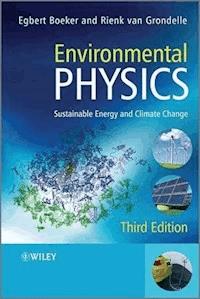
This thoroughly revised and updated third edition focuses on the utilization of sustainable energy and mitigating climate change, serving as an introduction to physics in the context of societal problems. A distinguishing feature of the text is the discussion of spectroscopy and spectroscopic methods as a crucial means to quantitatively analyze and monitor the condition of the environment, the factors determining climate change, and all aspects of energy conversion.
This textbook will be invaluable to students in physics and related subjects, and supplementary materials are available on a companion website: http://www.nat.vu.nl/environmentalphysics
Instructor support material is available at: http://booksupport.wiley.com
Sie lesen das E-Book in den Legimi-Apps auf:
Seitenzahl: 892
Veröffentlichungsjahr: 2011
Ähnliche




















Contents
Cover
Title Page
Copyright
Preface
Acknowledgements
Chapter 1: Introduction
1.1 A Sustainable Energy Supply
1.2 The Greenhouse Effect and Climate Change
1.3 Light Absorption in Nature as a Source of Energy
1.4 The Contribution of Science: Understanding, Modelling and Monitoring
Chapter 2: Light and Matter
2.1 The Solar Spectrum
2.2 Interaction of Light with Matter
2.3 Ultraviolet Light and Biomolecules
Chapter 3: Climate and Climate Change
3.1 The Vertical Structure of the Atmosphere
3.2 The Radiation Balance and the Greenhouse Effect
3.3 Dynamics in the Climate System
3.4 Natural Climate Variability
3.5 Modelling Human-Induced Climate Change
3.6 Analyses of IPCC, the Intergovernmental Panel on Climate Change
3.7 Forecasts of Climate Change
Chapter 4: Heat Engines
4.1 Heat Transfer and Storage
4.2 Principles of Thermodynamics
4.3 Idealized Cycles
4.4 Electricity as Energy Carrier
4.5 Pollution from Heat Engines
4.6 The Private Car
4.7 Economics of Energy Conversion
Chapter 5: Renewable Energy
5.1 Electricity from the Sun
5.2 Energy from the Wind
5.3 Energy from the Water
5.4 Bio Energy
5.5 Physics of Photosynthesis
5.6 Organic Photocells: the Grätzel Cell
5.7 Bio Solar Energy
Chapter 6: Nuclear Power
6.1 Nuclear Fission
6.2 Nuclear Fusion
6.3 Radiation and Health
6.4 Managing the Fuel Cycle
6.5 Fourth Generation Nuclear Reactors
Chapter 7: Dispersion of Pollutants
7.1 Diffusion
7.2 Dispersion in Rivers
7.3 Dispersion in Groundwater
7.4 Mathematics of Fluid Dynamics
7.5 Gaussian Plumes in the Air
7.6 Turbulent Jets and Plumes
Chapter 8: Monitoring with Light
8.1 Overview of Spectroscopy
8.2 Atomic Spectra
8.3 Molecular Spectra
8.4 Scattering
8.5 Remote Sensing by Satellites
8.6 Remote Sensing by Lidar
Chapter 9: The Context of Society
9.1 Using Energy Resources
9.2 Fresh Water
9.3 Risks
9.4 International Efforts
9.5 Global Environmental Management
9.6 Science and Society
Appendix A: Physical and Numerical Constants
Appendix B: Vector Algebra
B.1 Vectors: Definition and Properties
B.2 The Vector Field
Appendix C: Gauss, Delta and Error Functions
Appendix D: Experiments in a Student's Lab
D.1 Determine the Hydraulic Conductivity of Soil
D.2 Determine the Thermal Conductivity of Sand
D.3 Heat Transfer by Radiation and Convection
D.4 Laser Doppler Anemometry
D.5 Radon in the Environment
D.6 Laser Remote Sensing
Appendix E: Web Sites
E.1 General
E.2 Climate (Chapter 3)
E.3 Traditional Energy (Chapter 4)
E.4 Renewable Energy (Chapter 5)
E.5 Nuclear Power (Chapter 6)
E.6 The Social Context (Chapter 9)
Appendix F: Omitted Parts of the Second Edition
Color Plate
Index
This edition first published 2011 © 2011 John Wiley & Sons, Ltd
Registered office John Wiley & Sons Ltd, The Atrium, Southern Gate, Chichester, West Sussex, PO19 8SQ, United Kingdom
For details of our global editorial offices, for customer services and for information about how to apply for permission to reuse the copyright material in this book please see our website at www.wiley.com.
The right of the author to be identified as the author of this work has been asserted in accordance with the Copyright, Designs and Patents Act 1988.
All rights reserved. No part of this publication may be reproduced, stored in a retrieval system, or transmitted, in any form or by any means, electronic, mechanical, photocopying, recording or otherwise, except as permitted by the UK Copyright, Designs and Patents Act 1988, without the prior permission of the publisher.
Wiley also publishes its books in a variety of electronic formats. Some content that appears in print may not be available in electronic books.
Designations used by companies to distinguish their products are often claimed as trademarks. All brand names and product names used in this book are trade names, service marks, trademarks or registered trademarks of their respective owners. The publisher is not associated with any product or vendor mentioned in this book. This publication is designed to provide accurate and authoritative information in regard to the subject matter covered. It is sold on the understanding that the publisher is not engaged in rendering professional services. If professional advice or other expert assistance is required, the services of a competent professional should be sought.
The publisher and the author make no representations or warranties with respect to the accuracy or completeness of the contents of this work and specifically disclaim all warranties, including without limitation any implied warranties of fitness for a particular purpose. This work is sold with the understanding that the publisher is not engaged in rendering professional services. The advice and strategies contained herein may not be suitable for every situation. In view of ongoing research, equipment modifications, changes in governmental regulations, and the constant flow of information relating to the use of experimental reagents, equipment, and devices, the reader is urged to review and evaluate the information provided in the package insert or instructions for each chemical, piece of equipment, reagent, or device for, among other things, any changes in the instructions or indication of usage and for added warnings and precautions. The fact that an organization or Website is referred to in this work as a citation and/or a potential source of further information does not mean that the author or the publisher endorses the information the organization or Website may provide or recommendations it may make. Further, readers should be aware that Internet Websites listed in this work may have changed or disappeared between when this work was written and when it is read. No warranty may be created or extended by any promotional statements for this work. Neither the publisher nor the author shall be liable for any damages arising herefrom.
Library of Congress Cataloging-in-Publication Data
Boeker, Egbert. Environmental physics : sustainable energy and climate change / Egbert Boeker and Rienk van Grondelle. – 3rd ed. p. cm. Includes bibliographical references and index. ISBN 978-0-470-66675-3 (cloth) – ISBN 978-0-470-66676-0 (pbk.) 1. Environmental sciences. 2. Physics. 3. Atmospheric physics. I. Grondelle, Rienk van. II. Title. GE105.B64 2011 628–dc22 2011011525
A catalogue record for this book is available from the British Library.
Print ISBN: Cloth 978-0-470-66675-3, Paper 978-0-470-66676-0
ePDF ISBN: 978-1-119-97418-5
oBook ISBN: 978-1-119-97417-8
ePub ISBN: 978-1-119-97519-9
Mobi ISBN: 978-1-119-97520-5
Preface
This third edition of the textbook ‘Environmental Physics’ has been thoroughly revised to give more focus on sustainable energy and climate change. As fossil fuels and nuclear power will be with us for many years to come, the physical and environmental aspects of these ways of energy conversion are given ample attention as well.
The textbook is suitable for second year students in physics and related subjects as physical chemistry and geophysics. It assumes a basic knowledge in physics and mathematics, but all equations are derived from first principles and explained in a physical way. Therefore the book may serve as an introduction to physics in the context of societal problems like energy supply, pollution, climate change and finite resources of fossil fuels and uranium. Even where parts of the text will be familiar from other courses it is advisable to read those parts in order to grasp the way the material is presented here.
At some places we included parts that may be too ‘heavy’ for most second year students, but will not easily be found in the literature. They will be suitable for the final undergraduate year or for a Master course. They are indicated by at the beginning and with at the end. Usually we will indicate them in the introductory lines of each section as well.
As in any text, later chapters refer to concepts and properties discussed in earlier chapters. But the book is written such that the reader may read any chapter on its own. Therefore the teacher may select a few chapters as a module or for background reading.
A distinguishing feature of the text is the discussion of spectroscopy and spectroscopic methods, again from basic concepts, as a crucial means to quantitatively analyze and monitor the condition of the environment, the factors determining climate change and all aspects of energy conversion.
The emphasis in the book is on physics, on the concepts and principles that help in understanding the ways to produce energy efficiently or to mitigate climate change. Extra attention is given to photosynthesis, not only because of its importance in the field of renewable energy, but also because a comprehensive physics approach is lacking in the literature.
With regard to international treaties and conventions, we discuss the most important one for the subject matter of this book: the climate convention (Chapter 9) and more briefly the non-proliferation treaty (Chapter 6). The actual political situation is heavily influenced by the internal situation in major actors like the United States, Russia and China. That may change rapidly. As the need for a guaranteed energy supply is a constant in international relations, this book should give the reader enough background to judge the policy which his or her country is putting forward.
The structure of the book follows its emphasis. After an introduction, solar radiation is discussed as the input for most of the renewable energies (Chapter 2), next the factors influencing climate change (Chapter 3), then energy from fossil fuels with an excursion to the private car (Chapter 4) and renewable energy (Chapter 5). Because of its importance and the ongoing discussion of safety we have devoted a separate chapter to nuclear power (Chapter 6). Most if not all ways of energy conversion produce pollution as an inevitable side effect; therefore we discuss transport of pollutants in Chapter 7, albeit less detailed than in the second edition of this book. Monitoring is the subject of Chapter 8 and, finally, in Chapter 9 the social aspects are discussed. In the Appendices some helpful information is compiled.
The changed emphasis of this third edition results in many new sections and paragraphs and the omission or condensing of several sections of the earlier editions. For the interested reader these parts of the second edition may be downloaded free of charge from the website http://www.few.vu.nl/environmentalphysics. From this website also a description of environmental experiments for a student’s lab may be downloaded, described briefly in Appendix D. The site also contains a few computer codes that will illuminate some points made in the text. Finally, any mistakes or omissions we discover will be put on the site as well.
Almost all equations in this book will be derived from first principles. After a, perhaps lengthy, derivation we often analyze the resulting formula by looking at the units on both sides of the equality sign (=). This provides more physical insight than comparing dimensions length, mass and time only. This same procedure was followed in the authors’ book ‘Environmental Science, Physical Principles and Applications’ which is meant for a general science readership; there it worked very well. For clarity, units are given between square brackets [ ]; also dimensions are given between these brackets. In practice no confusion will arise.
Finally we mention some practical points. References are given between square brackets [ ] and printed at the end of each chapter. Also exercises are put there and for teachers the publisher has a teachers’ manual available with the worked out solutions. In the final chapter ‘social questions’ ask for a considered opinion of the student. The student of course is entitled to have his or her own opinion, so there is no ‘right’ answer. But the arguments should be physically sound. In the teacher’s manual some arguments on a certain statement will be given, without the pretention to present the ultimate truth.
Amsterdam, 20 January 2011
Acknowledgements
The authors acknowledge help and suggestion as follows:
Chapter 2: Dr Annemarie Huijser for her contribution on melanins.
Chapter 3: Dr Schuurmans for his suggestions on the first edition of the book and for suggesting table 3.5. The authors are indebted to Dr Aad van Ulden for his suggestions; dr Rob van Dorland has provided a simple model for radiative transfer, discussed in Sect. 3.2.2 which is grateful acknowledged. IPCC staff kindly provided us with high resolution versions of Plates 1 and 2.
Chapter 4: Dr Andriesse for pointing out the real heat engine of Sect. 4.2.3
Chapter 5: Dr Jo Hermans for suggesting an alternative explanation for the Lift force in Sect. 5.2.2. We are grateful to Drs Barzda, Cisek, Roszak, Nield, Nelson, Schulten, Magnuson, Cogdell, T. Moore, Dekker, Boekema, Novoderezhkin and Hambourger for providing us with high resolution pictures of their work, which we used in our colour plates.
Chapter 6: Dr Hugo van Dam for valuable suggestions to improve the text of the second edition; Dr Adri Bos for suggestions on sect. 6.3.2; Dr Frank Barnaby for suggestions on sects. 6.1.7 and 6.4.6; Dr Wim Hogervorst for his helpful contribution to Sect. 6.4.2; Dr Joern Harry for helping us with a description of the Japan Fukushima calamity, which was added in proof.
Chapter 8: Dr Ilse Aben for introducing us to the secrets of Sciamachy and correcting our draft; Dr Apituley and Dr Donovan for providing a text and illustrations for backscatter lidar of sect. 8.6.2
Chapter 9: Dr John Grin for his valuable social insights
Prof Karel Wakker is gratefully acknowledged for his careful reading of chapters 1 to 4 and his many suggestions.
The authors are pleased with the way in which Dr Bart van Oort and Ademir Arapovic patiently have drawn and redrawn the many figures in this book and acknowledge the help of Joris Snellenburg with the colour plates.
Lesen Sie weiter in der vollständigen Ausgabe!
Lesen Sie weiter in der vollständigen Ausgabe!
Lesen Sie weiter in der vollständigen Ausgabe!
Lesen Sie weiter in der vollständigen Ausgabe!
Lesen Sie weiter in der vollständigen Ausgabe!
Lesen Sie weiter in der vollständigen Ausgabe!
Lesen Sie weiter in der vollständigen Ausgabe!
Lesen Sie weiter in der vollständigen Ausgabe!
Lesen Sie weiter in der vollständigen Ausgabe!
Lesen Sie weiter in der vollständigen Ausgabe!
Lesen Sie weiter in der vollständigen Ausgabe!
Lesen Sie weiter in der vollständigen Ausgabe!
Lesen Sie weiter in der vollständigen Ausgabe!
Lesen Sie weiter in der vollständigen Ausgabe!
Lesen Sie weiter in der vollständigen Ausgabe!
Lesen Sie weiter in der vollständigen Ausgabe!




