


59,99 €
Mehr erfahren.
- Herausgeber: John Wiley & Sons
- Kategorie: Wissenschaft und neue Technologien
- Sprache: Englisch
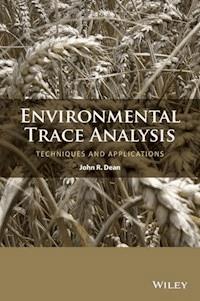
This book covers all aspects of environmental trace analysis from sampling through to preparation of the sample to the analytical techniques used to quantify the level of trace metals or organic compounds. The book is divided into two areas: sample preparation for inorganic analysis and sample preparation for organic analysis. This allows the reader to focus on key aspects related to the preparation of samples for their subsequent analysis. Selected case studies provide the reader with the opportunity to consider how the sample preparation approach can be optimized for their own area of expertise.
Sie lesen das E-Book in den Legimi-Apps auf:
Seitenzahl: 301
Veröffentlichungsjahr: 2013
Ähnliche

















Contents
Cover
Title Page
Copyright
Dedication
About the Author
Preface
Acknowledgements
Acronyms and Abbreviations
Chapter 1: Basic Laboratory Procedures
1.1 Introduction
1.2 Health and Safety Issues
1.3 Sample Handling: Solid Samples
1.4 Sample Handling: Liquid Samples
1.5 Sample Handling: Gases/Vapour Samples
1.6 Summary
Further Reading
Chapter 2: Investigative Approach for Environmental Analysis
2.1 Introduction
2.2 Recording of Practical Results
2.3 Significant Figures
2.4 Units
2.5 Summary
Appendix
Further Reading
Chapter 3: Principles of Quantitative Environmental Analysis
3.1 Introduction
3.2 Preparing Solutions for Quantitative Work
3.3 Calibration Graphs
3.4 Limits of Detection/Quantitation
3.5 Calculations: Dilution or Concentration Factors
3.6 Quality Assurance
3.7 Summary
References
Further Reading
Chapter 4: Environmental Sampling
4.1 Introduction
4.2 Sampling Soil (and Sediments)
4.3 Sampling Water
4.4 Sampling Air
4.5 Summary
Further Reading
Chapter 5: Storage of Samples for Analysis
5.1 Introduction
5.2 Choice of Storage Container for Liquid Samples
5.3 Preservation Techniques for Liquid Samples
5.4 Storage and Preservation of Solid Samples
5.5 Storage and Preservation of Gaseous Samples
5.6 Summary
Further Reading
Chapter 6: Preparation of Environmental Solid Samples for Inorganic Analysis
6.1 Introduction
6.2 Decomposition Techniques
6.3 Selective Extraction Methods
6.4 Physiologically-Based Extraction Test or in vitro Gastrointestinal Extraction
6.5 Earthworms
6.6 Summary
Appendix A: Extraction Reagents for Single Extraction Methods
Appendix B: Extraction Reagents for Sequential Extraction Method
Appendix C: Extraction Reagents for in vitro Gastrointestinal Extraction Using the Unified Bioaccessibility Method (and the FOREhST Method)
References
Further Reading
Chapter 7: Preparation of Environmental Liquid Samples for Inorganic Analysis
7.1 Introduction
7.2 Liquid–Liquid Extraction of Metals
7.3 Ion Exchange
7.4 Co-Precipitation
7.5 Summary
References
Further Reading
Chapter 8: Preparation of Environmental Solid Samples for Organic Analysis
8.1 Introduction
8.2 Liquid–Solid Extraction
8.3 Pressurised Fluid Extraction
8.4 Microwave-Assisted Extraction
8.5 Supercritical Fluid Extraction
8.6 Matrix Solid Phase Dispersion
8.7 Physiologically-Based Extraction Test or In Vitro Gastrointestinal Extraction
8.8 A Comparison of Extraction Techniques
8.9 Summary
Appendix A: Suppliers of Instrumental Techniques
Appendix B: Extraction Reagents for In Vitro Gastrointestinal Extraction using the FOREhST Method (and the Unified Bioaccessibility Method)
References
Further Reading
Chapter 9: Preparation of Environmental Liquid Samples for Organic Analysis
9.1 Introduction
9.2 Liquid–Liquid Extraction
9.3 Solid Phase Extraction
9.4 Purge and Trap Extraction
9.5 Headspace Extraction
9.6 Solid Phase Microextraction
9.7 Stir-Bar Sorptive Extraction
9.8 Microextraction in a Packed Syringe
9.9 Liquid Phase Microextraction
9.10 Membrane Extraction
9.11 A Comparison of Extraction Techniques
9.12 Summary
References
Further Reading
Chapter 10: Preparation of Environmental Air Samples for Organic Analysis
10.1 Introduction
10.2 Thermal Desorption
10.3 Summary
Further Reading
Chapter 11: Pre-concentration and Clean-up Procedures for Organic Sample Extracts
11.1 Introduction
11.2 Methods for Solvent Evaporation
11.3 Sample Extract Clean-UP Procedures
11.4 Summary
Further Reading
Chapter 12: Instrumental Techniques for Environmental Trace Analysis
12.1 Introduction
12.2 Environmental Inorganic Analysis
12.3 Environmental Organic Analysis
12.4 Other Techniques for Environmental Organic Analysis
12.5 Portable Techniques for Field Measurements
12.6 Summary
Further Reading
Chapter 13: Selected Case Studies
13.1 Introduction
13.2 Total Analysis of Metals from Soils
13.3 Single Extraction of Metals from Soils
13.4 Sequential Extraction of Metals from Soils
13.5 Oral Bioaccessibility Testing of Metals from Soils
13.6 Pressurised Fluid Extraction of Organic Compounds from Soils
13.7 Solid Phase Extraction of Organic Compounds from Liquid Samples
13.8 Headspace Solid Phase Microextraction of Organic Compounds
13.9 Dynamic Headspace Analysis of Organic Compounds
13.10 An Environmental Case Study: from Site to Analysis to Data Interpretation and Contextualisation
13.11 Summary
References
Chapter 14: Some Numerical Worked Examples
14.1 Introduction
Index
This edition first published 2014
© 2014 John Wiley & Sons, Ltd
Registered office
John Wiley & Sons Ltd, The Atrium, Southern Gate, Chichester, West Sussex, PO19 8SQ, United Kingdom
For details of our global editorial offices, for customer services and for information about how to apply for permission to reuse the copyright material in this book please see our website at www.wiley.com.
The right of the author to be identified as the author of this work has been asserted in accordance with the Copyright, Designs and Patents Act 1988.
All rights reserved. No part of this publication may be reproduced, stored in a retrieval system, or transmitted, in any form or by any means, electronic, mechanical, photocopying, recording or otherwise, except as permitted by the UK Copyright, Designs and Patents Act 1988, without the prior permission of the publisher.
Wiley also publishes its books in a variety of electronic formats. Some content that appears in print may not be available in electronic books.
Designations used by companies to distinguish their products are often claimed as trademarks. All brand names and product names used in this book are trade names, service marks, trademarks or registered trademarks of their respective owners. The publisher is not associated with any product or vendor mentioned in this book.
Limit of Liability/Disclaimer of Warranty: While the publisher and author have used their best efforts in preparing this book, they make no representations or warranties with respect to the accuracy or completeness of the contents of this book and specifically disclaim any implied warranties of merchantability or fitness for a particular purpose. It is sold on the understanding that the publisher is not engaged in rendering professional services and neither the publisher nor the author shall be liable for damages arising herefrom. If professional advice or other expert assistance is required, the services of a competent professional should be sought.
The advice and strategies contained herein may not be suitable for every situation. In view of ongoing research, equipment modifications, changes in governmental regulations, and the constant flow of information relating to the use of experimental reagents, equipment, and devices, the reader is urged to review and evaluate the information provided in the package insert or instructions for each chemical, piece of equipment, reagent, or device for, among other things, any changes in the instructions or indication of usage and for added warnings and precautions. The fact that an organization or Website is referred to in this work as a citation and/or a potential source of further information does not mean that the author or the publisher endorses the information the organization or Website may provide or recommendations it may make. Further, readers should be aware that Internet Websites listed in this work may have changed or disappeared between when this work was written and when it is read. No warranty may be created or extended by any promotional statements for this work. Neither the publisher nor the author shall be liable for any damages arising herefrom.
Library of Congress Cataloging-in-Publication Data
Dean, John R., author.
Environmental trace analysis : techniques and applications / John R. Dean.
pages cm
Includes bibliographical references and index.
ISBN 978-1-119-96270-0 (hardback) — ISBN 978-1-119-96271-7 (pbk.)
1. Trace analysis—Methodology. 2. Environmental chemistry—Methodology. 3. Sampling. I. Title.
TD193.D428 2014
577.27028′7–dc23
2013024965
A catalogue record for this book is available from the British Library.
HB ISBN: 978-1-119-96270-0
PB ISBN: 978-1-119-96271-7
To my wife LynneAnd our children Sam and Naomi
About the Author
John R. Dean D.Sc., Ph.D., D.I.C., M.Sc., B.Sc., FRSC, C.Chem., CSci. Cert.Ed.
John R. Dean took his first degree in Chemistry at the University of Manchester Institute of Science and Technology (UMIST), followed by an M.Sc. in Analytical Chemistry and Instrumentation at Loughborough University of Technology and finally a Ph.D. and D.I.C. in Physical Chemistry at Imperial College of Science and Technology, London. He then spent two years as a postdoctoral research fellow at the Food Science Laboratory of the Ministry of Agriculture, Fisheries and Food in Norwich in conjunction with Polytechnic South West in Plymouth. This was followed by a temporary lectureship in Inorganic Chemistry at Huddersfield Polytechnic. In 1988 he was appointed to a lectureship in Inorganic/Analytical Chemistry at Newcastle Polytechnic (now Northumbria University). This was followed by promotion to Senior Lecturer (1990), Reader (1994), Principal Lecturer (1998) and Associate Dean (Research) (2004). In 2004 he was appointed as Professor of Analytical and Environmental Science. Since 2008 he has held dual responsibility as Head of the Graduate School and Research Professor in the Department of Applied Sciences.
In 1998 he was awarded a D.Sc. (London) in Analytical and Environmental Science and was the recipient of the 23rd SAC Silver Medal in 1995. He has published extensively in analytical and environmental science. He is an active member of the Royal Society of Chemistry Analytical Division (RSC/AD) having served as a member of the atomic spectroscopy group for 15 years (10 as honorary secretary) as well as a past chairman (1997–99); he has been a member of the North East Region RSC/AD since 1992 serving as chairman (2001–03; 2013-present) and Honorary Secretary (2011 onwards). He has served on Analytical Division Council for four terms as well as being Vice-President (2002–04).
He is an active member of Tyne Valley Canoe Club and can be found most weekends on a river, lake or the sea. He has achieved BCU personal performance awards in white water kayaking (4 star leader), sea kayaking (4 star) and open canoe (5 star leader trainee). He holds BCU Level 3 coach status in white water kayaking and sea kayaking and is moderate water endorsed in open canoe. In addition, he is a UKCC Level 3 coach in white water kayaking and a UKCC Level 3 open canoe trainee.
Preface
The field of environmental trace analysis continues to develop and expand both in terms of its application and in the range of analytical techniques that are applied. While this book is not a direct update of a previous publication by the author (Methods for Environmental Trace Analysis, John R. Dean, AnTS, Wiley, 2003: ISBN 0-470-84421-3) it does build upon the knowledge presented. By taking a different style and format to the original text, by updating where appropriate and by adding new areas of investigation that have developed over the intervening 10 years a new text has emerged.
The book is arranged into 14 chapters covering the essentials of good laboratory housekeeping, making and recording practical results, principles of quantitative analysis, through to sampling protocols and sample storage. The book is sub-divided to allow the specific techniques that are used to prepare solid, liquid and, where appropriate, volatile samples for inorganic and organic analyses to be described. Emphasis is also placed on the use of pre-concentration techniques and clean-up procedures for organic samples. Chapter 12 focuses briefly on the wide range of analytical techniques that are applied to environmental trace elemental and organic analyses as well as a consideration of portable techniques for field measurements. Chapter 13 looks at some selected case studies used to highlight the application of the techniques in environmental trace analysis.
Finally, a special mention to all the students (past and present) who have helped to contribute to my interest in the field of environmental trace analysis. Our achievements have been many and varied across a broad area of environmental trace analysis – and mostly enjoyable!
John R. DeanApril 2013
Acknowledgements
Thank you to Lynne Dean for drawing Figures 4.2, 4.3, 4.4, 8.4, 12.11, 12.15(b), 12.16 and 13.8.
Thank you to Naomi Dean for drawing Figure 4.5.
Thank you to Dr Pinpong Kongchana for drawing Figures 8.2 and 8.7 as well as Figures in Box 6.1 illustrating conventional and microwave heating.
Thank you to Edwin Ludkin for drawing Figures 12.15a and 12.19.
Thank you to Thermo Fisher Scientific for permission to publish Figure 12.22; to Geotechnical Services for permission to publish Figure 12.23; to Spectral International, Inc. for permission to publish Figure 12.24; to InPhotonics, Inc. for permission to publish Figure 12.25; to RAE Systems for permission to publish Figure 12.26; and, to Smiths Detection for permission to publish Figure 12.27.
Thank you to Dr Jane Entwistle for Figure 13.1.
Thank you to Dr Nwabueze Elom for Figure 13.2.
Thank you to Dr Katherine Stapleton for Figures 13.3, 13.4 and 13.5.
Thank you to Dr Michael Deary for Figures 13.6 and 13.7.
Acronyms and Abbreviations
AAacetic acidAASatomic absorption spectroscopyAESatomic emission spectroscopyAFSatomic fluorescence spectroscopyAPCIatmospheric pressure chemical ionisationAPDCammonium pyrrolidine dithiocarbamateASEaccelerated solvent extractionBCRCommunity Bureau of ReferenceBSAN, O-bistrimethylsilyl-acetamideBSTFAN,O-bis-trimethylsilyl-trifluoroacetamideBTEXbenzene, toluene, ethylbenzene and xylene'sCCDcharged coupled deviceCIchemical ionisationCIDcharged injection deviceCISEDChemometric Identification of Substrates and Element DistributionsCLEAContaminated Land Exposure AssessmentCOSHHControl of Substances Hazardous to HealthCRMcertified reference materialDadalton (atomic mass unit)DADdiode array detectionDCMdichloromethane (also known as methylene chloride)Lesen Sie weiter in der vollständigen Ausgabe!
Lesen Sie weiter in der vollständigen Ausgabe!
Lesen Sie weiter in der vollständigen Ausgabe!
Lesen Sie weiter in der vollständigen Ausgabe!
Lesen Sie weiter in der vollständigen Ausgabe!
Lesen Sie weiter in der vollständigen Ausgabe!
Lesen Sie weiter in der vollständigen Ausgabe!
Lesen Sie weiter in der vollständigen Ausgabe!
Lesen Sie weiter in der vollständigen Ausgabe!
Lesen Sie weiter in der vollständigen Ausgabe!
Lesen Sie weiter in der vollständigen Ausgabe!
Lesen Sie weiter in der vollständigen Ausgabe!
Lesen Sie weiter in der vollständigen Ausgabe!
Lesen Sie weiter in der vollständigen Ausgabe!
Lesen Sie weiter in der vollständigen Ausgabe!




