


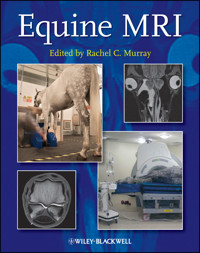
Equine MRI E-Book
136,99 €
Mehr erfahren.
- Herausgeber: John Wiley & Sons
- Kategorie: Fachliteratur
- Sprache: Englisch
Equine MRI is a unique, comprehensive guide to MRI in the horse. Edited by Rachel Murray, a leading authority and researcher in the field with over ten years of equine clinical MRI experience, the book also includes contributions from worldwide experts in the subject. Divided into the following four sections, the book presents key information based on previous validation work and clinical practice: * Principles of MRI, including the practicalities of image acquisition and interpretation * Normal MRI anatomy and normal variations * Different types of pathological change * Options for clinical management and prognosis for different conditions MRI is a rapidly expanding area in veterinary medicine that confers detailed, three-dimensional information on both bone and soft tissue. Expanding clinical knowledge, improvements in technology, and practical application of MRI to the standing and recumbent horse means this useful imaging modality has become an integral and essential part of the diagnostic evaluation in lameness and is a realistic option for investigation of ophthalmological, neurological and cranial pathology. Equine MRI enables readers to understand the best ways to achieve good quality images, and provides a detailed explanation of the problems that may occur. With close to 950 normal and abnormal images, this book offers considerable detail and examples of both common and uncommon problems, making it a great reference for equine veterinarians, veterinary students, specialists in equine surgery, and specialists in veterinary imaging.
Sie lesen das E-Book in den Legimi-Apps auf:
Seitenzahl: 1014
Veröffentlichungsjahr: 2010
Ähnliche




















Table of Contents
Cover
Table of Contents
Half title page
Title page
Copyright page
Contributors
Foreword
Preface
Acknowledgements
Part A: Principles of MRI in horses
Chapter 1 Basic MRI principles
INTRODUCTION
HOW THE IMAGE IS CREATED
PULSE SEQUENCES
MRI HARDWARE
IMAGE QUALITY AND ARTEFACTS
GLOSSARY
ACKNOWLEDGEMENTS
Chapter 2 High-field MRI in horses: practicalities and image acquisition
2A Practicalities and image acquisition
2B General anaesthesia for MRI
2C Contrast agents in equine MRI
Chapter 3 Low-field MRI in horses: practicalities and image acquisition
INTRODUCTION
MACHINE PREPARATION, PATIENT PREPARATION AND SEDATION TECHNIQUE
IMAGE ACQUISITION AND OPTIMIZING IMAGE QUALITY
A NORMAL MRI STUDY IN A LAME HORSE
Chapter 4 Image interpretation and artefacts
INTRODUCTION
MAGNETIC RESONANCE IMAGE APPEARANCE
IMAGE ACQUISITION TO OPTIMIZE INTERPRETATION
ARTEFACTS
COMPARISON OF HIGH- AND LOW-FIELD IMAGES
IMAGE EVALUATION
NORMAL APPEARANCE OF TISSUES AND DETECTION OF PATHOLOGICAL CHANGE
DETECTION OF PATHOLOGICAL CHANGE
USING INFORMATION FROM SCINTIGRAPHIC IMAGING TO ASSIST MR IMAGE INTERPRETATION
CONCLUSION
Part B: Normal MRI anatomy
Chapter 5 The foot and pastern
5A Adult horse
5B Foal anatomical development
Chapter 6 The fetlock region
ANATOMY
MRI OF THE METACARPOPHALANGEAL AND METATARSOPHALANGEAL REGIONS
THE THIRD METACARPAL/METATARSAL BONE AND PROXIMAL PHALANX
THE PROXIMAL SESAMOID BONES
SOFT TISSUE STRUCTURES OF THE FETLOCK REGION
NORMAL VARIATION IN APPEARANCE ON MR IMAGES
Chapter 7 The metacarpal/metatarsal region
INTRODUCTION
MR EXAMINATION AND IMAGE ACQUISITION
ARTEFACTS
PULSE SEQUENCES
ANATOMY: METACARPAL REGION
ANATOMY: METATARSAL REGION
Chapter 8 The carpus
INTRODUCTION
ANATOMY
NORMAL VARIATIONS AND SOME DIFFERENCES BETWEEN LOW-FIELD AND HIGH-FIELD MR FINDINGS
ACKNOWLEDGEMENTS
Chapter 9 The tarsus
INTRODUCTION
ANATOMICAL DESCRIPTION OF THE NORMAL TARSUS
INCIDENTAL FINDINGS IN THE DISTAL ASPECT OF THE TARSUS OF NORMAL HORSES
Chapter 10 The stifle
INTRODUCTION
PROTOCOLS FOR STUDY PLANNING
MRI ANATOMY
Chapter 11 The head
OVERVIEW
CHALLENGES WITH IMAGING OF THE HEAD
LIMITATIONS OF MRI IN THE HEAD
IMAGE ACQUISITION
NORMAL MR ANATOMY
Part C: Pathology
Chapter 12 The foot and pastern
INTRODUCTION
INDICATIONS FOR MAGNETIC RESONANCE IMAGING
SPECTRUM OF INJURY
TYPES OF PATHOLOGICAL CHANGE
CONCLUSIONS
Chapter 13 The fetlock region
INTRODUCTION
INDICATIONS AND CASE SELECTION
PROTOCOLS
SLICE POSITIONING
OSSEOUS INJURY
SOFT TISSUE INJURIES
Chapter 14 The metacarpal/metatarsal region
INTRODUCTION
SPECIFIC INJURIES
Chapter 15 The carpal region
INTRODUCTION
INDICATIONS FOR MRI OF THE CARPAL REGION
IMAGE ACQUISITION
OSSEOUS PATHOLOGY
OSTEOCHONDRAL PATHOLOGY
JOINT CAPSULE/SYNOVIAL PATHOLOGY
PROXIMAL METACARPAL PATHOLOGY
LIGAMENTAR PATHOLOGY
Chapter 16 The distal tarsal region
INTRODUCTION
INDICATIONS FOR MAGNETIC RESONANCE IMAGING
ABNORMALITIES
Chapter 17 The proximal tarsal region
INTRODUCTION
OSSEOUS PATHOLOGY
INFECTION
OSTEOCHONDRAL PATHOLOGY
LIGAMENT PATHOLOGY
TENDON PATHOLOGY AND TARSAL SHEATH
CALCANEAL BURSA
Chapter 18 The stifle
INTRODUCTION
PATIENT AND SCANNER PREPARATION
IMAGING SEQUENCES
INDICATIONS
MRI STIFLE PATHOLOGY
CONCLUSION
Chapter 19 The head
INTRODUCTION
PITUITARY ABNORMALITIES
INFLAMMATORY DISEASE
TRAUMA
CONGENITAL CNS ABNORMALITY
CNS MASSES
OCULAR AND OPTIC NERVE MASSES
NEURODEGENERATIVE LESIONS
SINUS AND NASAL SEPTUM
SINUS MASSES
SPHENOPALATINE SINUSITIS
MR FEATURES OF LARYNGEAL ABNORMALITIES
GUTTURAL POUCH AND EAR INFECTIONS
SUMMARY
Part D: Clinical management and outcome
Chapter 20 The foot and pastern
INTRODUCTION
DEEP DIGITAL FLEXOR TENDON INJURIES
COLLATERAL DESMOPATHY OF THE DISTAL INTERPHALANGEAL JOINT
NAVICULAR DISEASE
DISTAL INTERPHALANGEAL JOINT
BONE TRAUMA/BRUISING
MISCELLANEOUS CONDITIONS OF THE FOOT
PASTERN
ACKNOWLEDGEMENT
Chapter 21 The fetlock region
21A General
INTRODUCTION
SELECTION OF HORSES TO UNDERGO MRI OF THE FETLOCK REGION AT THE ANIMAL HEALTH TRUST
SPECTRUM OF INJURY
OTHER DOCUMENTED LESIONS IN THE FETLOCK
OPTIONS FOR CLINICAL MANAGEMENT
21B Thoroughbred racehorses
Introduction
Lesions Detected
Treatment and Follow-up
Monitoring Fetlock Pathology on MRI – General Observations
Discussion
Chapter 22 The metacarpal/metatarsal region
22A US perspective
INTRODUCTION
FORELIMB PROXIMAL SUSPENSORY DESMITIS
HIND LIMB PROXIMAL SUSPENSORY DESMITIS
SUSPENSORY LIGAMENT ADHESIONS TO SPLINT EXOSTOSES
ACCESSORY LIGAMENT OF THE DEEP DIGITAL FLEXOR TENDON
CONCLUSIONS
22B UK perspective
22C Thoroughbred racehorses
Chapter 23 The carpus
23A Osseous injury
INTRODUCTION
FINDINGS AND FOLLOW-UP OF THOROUGHBREDS USED FOR RACING UNDERGOING CARPAL MRI
23B Soft tissue injury
Chapter 24 The tarsus
INTRODUCTION
OSTEOARTHRITIS OF THE DISTAL TARSAL JOINTS
OSTEOARTHRITIS OF THE TALOCALCANEAL JOINT
DESMITIS OF THE COLLATERAL LIGAMENTS
DESMITIS OF THE INTERTARSAL LIGAMENTS
LUXATION OF THE TARSUS
CUNEAN TENDONITIS AND BURSITIS
IDIOPATHIC TARSAL SYNOVITIS
OSTEOCHONDROSIS
OSSEOUS CYST-LIKE LESIONS AND SUBCHONDRAL BONE CYSTS
TARSAL FRACTURES
TARSAL BONE TRAUMA/BRUISE
ASEPTIC CALCANEAL BURSITIS
SEPTIC CALCANEAL BURSITIS
TENOSYNOVITIS OF THE DEEP DIGITAL FLEXOR TENDON SHEATH (TARSAL SHEATH)
SEPTIC TENOSYNOVITIS OF THE TARSAL SHEATH
EXTENSOR TENDON LACERATIONS
SEPTIC ARTHRITIS/OSTEOMYELITIS
INCOMPLETE OSSIFICATION OF THE TARSAL BONES
Chapter 25 The head
Index
Equine MRI
This edition first published 2011
© 2011 by Blackwell Publishing Ltd
Blackwell Publishing was acquired by John Wiley & Sons in February 2007. Blackwell’s publishing program has been merged with Wiley’s global Scientific, Technical and Medical business to form Wiley-Blackwell.
Registered office: John Wiley & Sons Ltd, The Atrium, Southern Gate, Chichester, West Sussex, PO19 8SQ, UK
Editorial offices: 9600 Garsington Road, Oxford, OX4 2DQ, UK
The Atrium, Southern Gate, Chichester, West Sussex, PO19 8SQ, UK
2121 State Avenue, Ames, Iowa 50014-8300, USA
For details of our global editorial offices, for customer services and for information about how to apply for permission to reuse the copyright material in this book please see our website at www.wiley.com/wiley-blackwell.
The right of the author to be identified as the author of this work has been asserted in accordance with the UK Copyright, Designs and Patents Act 1988.
All rights reserved. No part of this publication may be reproduced, stored in a retrieval system, or transmitted, in any form or by any means, electronic, mechanical, photocopying, recording or otherwise, except as permitted by the UK Copyright, Designs and Patents Act 1988, without the prior permission of the publisher.
Designations used by companies to distinguish their products are often claimed as trademarks. All brand names and product names used in this book are trade names, service marks, trademarks or registered trademarks of their respective owners. The publisher is not associated with any product or vendor mentioned in this book. This publication is designed to provide accurate and authoritative information in regard to the subject matter covered. It is sold on the understanding that the publisher is not engaged in rendering professional services. If professional advice or other expert assistance is required, the services of a competent professional should be sought.
Library of Congress Cataloging-in-Publication Data
Equine MRI edited by Rachel C. Murray.
p. ; cm.
Includes bibliographical references and index.
ISBN 978-1-4051-8304-8 (hardback : alk. paper) 1. Horses–Diseases–Diagnosis.
2. Magnetic resonance imaging. 3. Veterinary diagnostic imaging. I. Murray, Rachel C.
[DNLM: 1. Horses–anatomy & histology. 2. Magnetic Resonance Imaging–methods.
SF 765 E64 2011]
SF951.E577 2011
636.1'089607548–dc22
2010022799
A catalogue record for this book is available from the British Library.
This book is published in the following electronic formats: ePDF 9781444329193; ePub 9781444329209
Contributors
Fabrice AudigiéCIRALE-IPC, Ecole Nationale Vétérinaire d’Alfort, RD 675, 14430, Goustranville, France
Andrew P. BatheRossdales Equine Hospital, Cotton End Road, Exning, Newmarket, Suffolk CB8 7NN, UK
Nick BolasHallmarq Veterinary Imaging Ltd, Unit 5, Bridge Park, Merrow Lane, Guildford, Surrey GU4 7BF, UK
Matthew T. BrokkenCleveland Equine Clinic, 3340 Webb Rd, Ravenna, OH 44266, USA
Simon CollinsAnimal Health Trust, Lanwades Park, Kentford, Newmarket, Suffolk CB8 7UU, UK. School of Veterinary Science, The University of Queensland, Gatton Campus, Gatton, Queensland 4343, Australia
Jean-Marie DenoixCIRALE -IPC, RD 675, 14430, Goustranville, France
Sue DysonCentre for Equine Studies, Animal Health Trust, Lanwades Park, Kentford, Newmarket, Suffolk CB8 7UU, UK
Katherine S. GarrettRood and Riddle Equine Hospital, PO Box 12070, Lexington, KY 40580, USA
Shannon HolmesCollege of Veterinary Medicine, University of Georgia, Athens, GA 30602-7382, USA
Carter E. JudyAlamo Pintado Equine Medical Centre, 2501 Santa Barbara Avenue, PO Box 249, Los Olivos, CA 93441, USA
Elizabeth LeeceDepartment of Veterinary Clinical Medicine, University of Cambridge, Madingley Road, Cambridge, CB3 0ES, UK
Tim MairBell Equine Hospital, Butchers Lane, Mereworth, Maidstone, Kent ME18 5GS, UK
Rachel C. MurrayAnimal Health Trust, Lanwades Park, Kentford, Newmarket, Suffolk CB8 7UU, UK
Annamaria NagyAnimal Health Trust, Lanwades Park, Kentford, Newmarket, Suffolk CB8 7UU, UK
Henrik NybergATG Horse Hospital, Grabrodragatan 6, 53231 Skara, Sweden
Sarah PowellRossdales Equine Hospital, Cotton End Road, Exning, Newmarket, Suffolk CB8 7NN, UK
Stephen ReedRood and Riddle Equine Hospital, PO Box 12070, Lexington, KY 40514, USA
Michael SchrammeNorth Carolina State University of Veterinary Medicine, Department of Clinical Sciences, 4700 Hillsborough Street, Raleigh, NC 27606, USA
Thorben SchulzePferdeklinik Burg Müggerhausen, 53919 Weilerswist, Germany
Ceri SherlockDepartment of Large Animal Medicine, University of Georgia, Athens, GA 30602, USA
Meredith SmithAnimal Health Trust, Lanwades Park, Kentford, Newmarket, Suffolk CB8 7UU
Bert Van Thielen33, rue Philippe Lebon, 80000, Amiens, France
Russell TuckerCollege of Veterinary Medicine, Washington State University, Pullman, Washington 99164-7010, USA
Natasha WerpyOrthopaedic Research Centre, Colorado State University, 300 West Drake Road, Fort Collins, Colorado 80523-1678, USA
Foreword
No aspect of medical imaging requires the understanding of such complex physics as that required for magnetic resonance imaging (MRI). However, since Röntgen first produced a radiographic image of his wife`s hand, no imaging technique has excited such interest nor presented such potential opportunities. MR scanning owes its origin to a number of scientists and physicians during a period of over a hundred years. These include Tesla, Lamor, Rabi, Bloch, Purcell, Lauterbur and Mansfield, who all contributed to the recognition and application of the phenomenon we call nuclear magnetic resonance. However, it was not until 1977 that Damadian, Goldsmith and Minkoff produced the first human MR scanner. Since then the technique has come to occupy a central role in medical imaging throughout the developed world.
MRI was first used in veterinary medicine in the 1990s, predominantly for the evaluation of anaesthetised or heavily sedated small animal patients. The high field magnets employed in imaging human patients were also adapted to be used on anaesthetised horses and ponies. However it was the development of low field magnets which could be used on standing equine patients, which really saw widespread recognition of the potential value of the technique for equine use. Initially restricted to the foot and distal limb, the development of software packages to correct for patient movement, plus increasing expertise of clinicians in obtaining and interpreting the images, now allows examination of the more proximal limb to include the carpus and hock.
This is not to say that the high field magnet has been superseded. The superior image quality possible makes it the diagnostic method of choice along with computed tomography for imaging the equine head. However, risks associated with general anaesthesia in equine patients have encouraged the use of MRI in standing patients whenever possible. Numerous clinics around the world have introduced MR scanning into their protocols for investigating equine lameness. Consequent understanding of the technique, with its benefits and limitations, has accelerated dramatically in the last few years.
As a surgeon benefitting from the skill of those who obtain and interpret MR images of patients with orthopaedic problems, it never ceases to astonish just what information about tendon, ligament, bone and articular cartilage can be collected. Exquisite detail of the anatomy and pathology of, for example, the foot is clear, provided one is equipped with an expert in the sophisticated language so alien to those of us brought up solely on a diet of radiographic and ultrasound images. This allied to additional information obtained by complementary techniques such as radiography, computed tomography, ultrasound, arthroscopy or gamma scintigraphy and of course underpinned by a thorough physical examination, has armed the modern clinician with investigative powers undreamt of by veterinary predecessors.
The future is hard to predict. It is likely that improvements in both hard and software will enable imaging of more proximal portions of the limb or other parts of the body. We can anticipate the development of a standing system using a more powerful magnet, new sequences and further improvements in motion correction by the physicists, with concurrent clinical research to enable more accurate interpretation of the images. For those of us being carried along by and experiencing the benefits of this wave of development of MR imaging, it is difficult to believe that the momentum will cease. Whilst inevitably there may be practical limitations to further progress, imagination should not be allowed to constrain those enthusiasts who have taken up the challenge of this technology and created a valuable diagnostic resource.
This first book dedicated to equine MRI will I am quite certain assume its rightful role as the “bible” of equine MR imaging. It endeavours to explain some of the complex physics which underpin the technology and gives practical guidance to obtaining and interpreting images of the limbs and head. At the current speed of development, I am certain that future editions will be necessary to keep pace with this.
Tim Greet
President, World Equine Veterinary Association
Preface
When I started clinical veterinary diagnostic work in the horse, I could only have dreamed of an imaging modality that could provide detailed anatomical and physiological information of both soft tissues and bone. Using magnetic resonance imaging (MRI) in the horse has transformed my expectations of how much can potentially be evaluated and how much more there is to learn about normal structure, normal variation and pathology. There are increasing demands on the athletic horse, and improvements in diagnosis and management are constantly being sought. Application of MRI has revolutionized our understanding of foot pathology and demonstrated the presence of numerous previously unrecognized or poorly understood conditions in the limbs and head. Early work with MRI was focused on validation and investigation into the significance of MRI findings. However, expanding clinical knowledge, improvements in technology and practical application of MRI to the standing and recumbent horse has meant that MRI has become an integral and essential part of the diagnostic evaluation in lameness, and a realistic option for investigation of ophthalmological, neurological and cranial pathology. Despite the rapidly expanding use of MRI for equine clinical investigation, until now there has been no reference book that covers this field. This book seeks to fill that gap.
The aim of Equine MRI is to provide a comprehensive guide to MRI in the horse, based on the information currently known worldwide. It aims to cover information from the basics of MRI to the practicalities of image acquisition and interpretation, to describe normal anatomy and normal variations, to describe different types of pathological change and to discuss options for clinical management and prognosis for different conditions. MRI produces large amounts of data with great potential for over-interpretation due to image acquisition problems or insufficient knowledge or experience. This book should help the reader understand the best ways to achieve good-quality images, and give a guide to the problems that may occur. As image interpretation is based on an understanding of MR physics, normal variation and detection of pathology, this book should guide the inexperienced reader towards their initial steps in interpretation; it also provides considerable detail, with numerous examples of both common and uncommon problems to expand knowledge for the more advanced reader. The information given is based on previous validation work and clinical experience of many experts, which should allow the reader to improve their understanding and clinical application of MRI faster than the trial and error often needed in clinical practice.
Equine MRI is for the radiologist interpreting MR images from horses, for the diagnostic imaging technician who is acquiring MR images in the horse, for the clinical veterinarian using MRI for diagnosis, and for veterinary and science students. The clinical aspect of the book is of particular use for the practising and specialist veterinarian, and the diagnostic imaging technician. The detailed anatomy and image interpretation is for the specialist and practising veterinarian who is either using MRI or referring to a centre with MRI, and for both scientists and students. The detailed anatomy visible on the images make MR images ideal for teaching anatomy to veterinary and equine science students. As the book is divided into sections based around the principles of MRI and image acquisition, normal anatomy, pathology and clinical outcome, with use of numerous examples in each section it should be clear for the reader to navigate around the sections most applicable for their specific uses.
We are still on a steep learning curve in our understanding of the applications of MRI in the horse. I hope that this book provides a small step forward in distributing current knowledge as a basis for future work with MRI and in helping our patient – the horse.
Rachel C. Murray
Acknowledgements
I would like to thank the individuals who have provided their time and expertise in contributing to this book. We are continuing to learn with every patient, and it is this combined information that is improving our understanding to help future patients, so I am grateful to everyone who has given permission for use of images and material. Many people have been involved in developing MRI in the horse, and it is their dedication and skill that has led to the recognition of MRI as a vital diagnostic tool in the horse – and from which this book has been derived. I am grateful to so many of these people for passing on their knowledge and for questioning what the images actually represent in the horse. These include the authors of the chapters in this book, the veterinary surgeons who have been involved in validation and clinical use of MRI, and the medical radiologists who have helped translate MRI from the veterinary field. I need to mention in particular the members of the diagnostic imaging and clinical teams at the Animal Health Trust, the MR radiologists and physicists from Addenbrookes Hospital, University of Cambridge, and Russ Tucker from Washington State University, who have been integral in developing my understanding of high field MRI and its applications. I am indebted to the physicists from Hallmarq for continually improving my understanding of MRI physics and interpretation during development of practical MRI in the standing horse.
On a personal basis, I will be forever grateful to my parents for showing me that editing a book is achievable, and to Duncan, Ruth and Clare for allowing me the time to do so.
Part A: Principles of MRI in horses
1 BASIC MRI PRINCIPLES 3
Nick Bolas
2 HIGH-FIELD MRI IN HORSES: PRACTICALITIES AND IMAGE ACQUISITION 39
2A Practicalities and image acquisition 39
Rachel Murray
2B General Anaesthesia for MRI 51
Elizabeth Leece
2C Contrast Agents in Equine MRI 63
Carter Judy
3 LOW-FIELD MRI IN HORSES: PRACTICALITIES AND IMAGE ACQUISITION 75
Natasha Werpy
4 IMAGE INTERPRETATION AND ARTEFACTS 101
Rachel Murray and Natasha Werpy




