


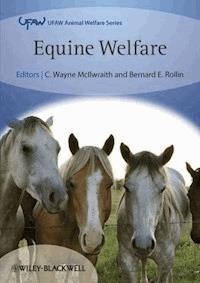
Equine Welfare E-Book
62,99 €
Mehr erfahren.
- Herausgeber: John Wiley & Sons
- Kategorie: Fachliteratur
- Serie: UFAW Animal Welfare
- Sprache: Englisch
A rational exploration of the ethical and welfare issues in all areas of equine use. This book addresses controversial and emotive issues surrounding these iconic creatures, providing a reliable source of information to support informed debate. It will enable all those with an interest in horses and the uses they are put to gain an awareness of the problems and abuses that occur. The book draws on the expertise of a range of acknowledged leaders in equine health and welfare. The first part of the book explores general issues of the horse’s needs and nature. The second part contains chapters each covering a specific human use of horses and the abuses that arise as a result.
This book is part of the UFAW/Wiley-Blackwell Animal Welfare Book Series. This major series of books produced in collaboration between UFAW (The Universities Federation for Animal Welfare), and Wiley-Blackwell provides an authoritative source of information on worldwide developments, current thinking and best practice in the field of animal welfare science and technology. For details of all of the titles in the series see www.wiley.com/go/ufaw.
Sie lesen das E-Book in den Legimi-Apps auf:
Seitenzahl: 990
Veröffentlichungsjahr: 2011
Ähnliche




















Contents
Contributors
Foreword
Preface
Part I Respecting the Horse’s Needs and Nature
1 Equine Welfare and EthicsBernard Rollin
2 A Historical Survey of Human–Equine InteractionsDavid W. Ramey
3 Equine Health and Disease – General Welfare AspectsD. Paul Lunn and C. Wayne McIlwraith
4 Nutritional Management of the HorseJoe D. Pagan
5 Equine Psychological Needs and Quality of LifeMarthe Kiley-Worthington
6 Spirit and Wellness in the HorseAndrew F. Fraser
7 Pain and its Management in HorsesLaurie Goodrich and Khursheed Mama
8 Euthanasia as an Equine Welfare ToolJay G. M
9 Equine Welfare and Integrative Veterinary MedicineKevin K. Haussler
10 Alternative Medicine and Equine Welfare – Challenging the ScienceDavid W. Ramey
Part II Human Uses and Abuses – Welfare Issues
11 Welfare Issues in Horse RacingRick M. Arthur
12 Abusive Treatment and Subsequent Policy Development within Various Breeds of Show Horses in the USAJim Heird
13 The Horse as a Companion AnimalNancy S. Loving
14 Welfare Issues in the Rodeo HorseDoug Corey
15 Welfare Concerns in the Training and Competition of the Cutting, Reining, and Reined Cow HorseJerry B. Black and David Frisbie
16 PMU Ranching and Equine WelfareNat T. Messer
17 Welfare in the Discipline of DressageMidge Leitch
18 Raising Welfare Standards for Endurance RidingNancy S. Loving
19 Welfare Concerns in the Care, Training, and Competition of the Hunter–JumperRichard D. Mitchell
20 Welfare of Horses, Mules, and Other Equids in US AgricultureJosie L. Traub-Dargatz
21 Welfare Issues with the Carriage HorseJay Baldwin
22 The Horse and its Use in ResearchC. Wayne McIlwraith
23 The Unwanted Horse – a Major Welfare IssueTom R. Lenz
24 The Welfare of Wild Horses in the Western USAAlbert J. Kane
25 Welfare Issues in the Event HorseKent Allen
Index
Equine Welfare
The Universities Federationfor Animal Welfare
UFAW, founded 1926, is an international, independent, scientific and educational animal welfare charity that works to improve high standards of welfare for farm, companion, laboratory and captive wild animals, and for those animals with which we interact in the wild. It works to improve animals’ lives by:
Promoting and supporting developments in the science and technology that underpin advances in animal welfare;Promoting education in animal care and welfare;Providing information, organising meetings, and publishing books, videos, articles, technical reports and the journal Animal Welfare;Providing expert advice to government departments and other bodies and helping to draft and amend laws and guidelines;Enlisting the energies of animal keepers, scientists, veterinarians, lawyers and others who care about animals.“Improvements in the care of animals are not now likely to come of their own accord, merely by wishing them: there must be research … and it is in sponsoring research of this kind, and making its results widely known, that UFAW performs one of its most valuable services.”
Sir Peter Medawar CBE FRS, 8th May 1957
Nobel Laureate (1960), Chairman of the UFAW Scientific Advisory Committee (1951–1962)
UFAW relies on the generosity of the public through legacies and donations to carry out its work improving the welfare of animal now and in the future. For further information about UFAW and how you can help promote and support its work, please contact us at the address below.
Universities Federation for Animal WelfareThe Old School, Brewhouse Hill, Wheathampstead, Herts AL4 8AN, UKTel: 01582 831818 Fax: 01582 831414 Website: www.ufaw.org.ukEmail: [email protected]
UFAW’s aim regarding the UFAW/Wiley-Blackwell Animal Welfare book series is to promote interest and debate in the subject and to disseminate information relevant to improving the welfare of kept animals and of those harmed in the wild through human agency. The books in this series are the works of their authors and the views they express do not necessarily reflect the views of UFAW.
This edition first published 2011 by Blackwell Publishing Ltd.
© 2011 by UFAW
Series EditorsJames K. Kirkwood and Robert C. Hubrecht
Blackwell Publishing was acquired by John Wiley & Sons in February 2007. Blackwell’s publishing program has been merged with Wiley’s global Scientific, Technical and Medical business to form Wiley-Blackwell.
Registered OfficeJohn Wiley & Sons Ltd, The Atrium, Southern Gate, Chichester, West Sussex, PO19 8SQ, UK
Editorial Offices9600 Garsington Road, Oxford, OX4 2DQ, UKThe Atrium, Southern Gate, Chichester, West Sussex, PO19 8SQ, UK2121 State Avenue, Ames, Iowa 50014-8300, USA
For details of our global editorial offices, for customer services and for information about how to apply for permission to reuse the copyright material in this book please see our website at www.wiley.com/wiley-blackwell.
The right of the authors to be identified as the authors of this work has been asserted in accordance with the UK Copyright, Designs and Patents Act 1988.
All rights reserved. No part of this publication may be reproduced, stored in a retrieval system, or transmitted, in any form or by any means, electronic, mechanical, photocopying, recording or otherwise, except as permitted by the UK Copyright, Designs and Patents Act 1988, without the priorpermission of the publisher.
Designations used by companies to distinguish their products are often claimed as trademarks. All brand names and product names used in this book are trade names, service marks, trademarks or registered trademarks of their respective owners. The publisher is not associated with any product or vendor mentioned in this book. This publication is designed to provide accurate and authoritative information in regard to the subject matter covered. It is sold on the understanding that the publisher is not engaged in rendering professional services. If professional advice or other expert assistance is required, the services of a competent professional should be sought.
Library of Congress Cataloging-in-Publication Data
Equine welfare / edited by C. Wayne McIlwraith, Bernard E. Rollin.
p. ; cm.
Includes bibliographical references and index.
ISBN 978-1-4051-8763-3 (pbk. : alk. paper)
1. Horses. 2. Animal welfare. I. McIlwraith, C. Wayne. II. Rollin, Bernard E. [DNLM: 1. Horses. 2. Animal Husbandry. 3. Animal Welfare. 4. Horse Diseases. SF 285.3]
HV4749.E68 2011
179’.3–dc22
2010041319
A catalogue record for this book is available from the British Library.
This book is published in the following electronic formats: ePDF 9781444397802; ePub 9781444397819
Contributors
Kent Allen, DVM
Virginia Equine Clinic
Middleburg, VA
USA
Rick M. Arthur, DVM
Equine Medical Director
School of Veterinary Medicine
University of California
Davis, CA
USA
Jay Baldwin, DVM
First Equine Horse Health Services, LLC
Dover, DE
USA
Jerry B. Black, DVM
Director of Equine Sciences Undergraduate Program
Colorado State University Equine Center
Colorado State University
Fort Collins, CO
USA
Doug Corey, DVM
Associated Veterinary Medical Center
Walla Walla, CA
USA
Andrew F. Fraser, DVM, PhD
Carbonear
Newfoundland
Canada
David Frisbie, DVM, PhD, DACVS
Associate Professor
Gail Holmes Equine Orthopaedic Research Center
Department of Clinical Sciences
Colorado State University
Fort Collins, CO
USA
Laurie Goodrich, DVM, PhD, DACVS
Assistant Professor
Gail Holmes Equine Orthopaedic Research Center
Department of Clinical Sciences
Colorado State University
Fort Collins, CO
USA
Kevin K. Haussler, DVM, DC, PhD
Assistant Professor
Gail Holmes Equine Orthopaedic Research Center
Department of Clinical Sciences
Colorado State University
Fort Collins, CO
USA
Jim Heird, PhD
Executive Professor and Coordinator
College of Veterinary Medicine and Biomedical Sciences
Texas A & M University
College Station, TX
USA
Albert J. Kane, DVM, MPVM, PhD
Senior Staff Veterinarian
APHIS/BLM Wild Horse and Burro Partnership
US Department of Agriculture, APHIS, Veterinary Services
Fort Collins, CO
USA
Marthe Kiley-Worthington, PhD
Centre d’Eco-Etho Recherche et Education
La Combe, Drome
France
Midge Leitch, VMD, DACVS
Staff Veterinarian in Radiology
University of Pennsylvania
School of Veterinary Medicine
Kennett Square, PA
USA
Tom R. Lenz, DVM, MS, DACT
Senior Director
Equine Veterinary Operations
Pfizer Animal Health
USA
Nancy S. Loving, DVM
Loving Equine Clinic
Boulder, CO
USA
D. Paul Lunn, BVSc, PhD, DACVIM
Department of Clinical Sciences
James L. Voss Veterinary Teaching Hospital
College of Veterinary Medicine and Biomedical Sciences
Colorado State University
Fort Collins, CO
USA
Khursheed Mama, DVM, DACVA
Department of Clinical Sciences
James L. Voss Veterinary Teaching Hospital
College of Veterinary Medicine and Biomedical Sciences
Colorado State University
Fort Collins, CO
USA
Jay G. Merriam, DVM
Massachusetts Equine Clinic
Uxbridge, MA
USA
Nat T. Messer, IV, DVM, DABVP
Professor
University of Missouri
Columbia, MO
USA
C. Wayne McIlwraith, BVSc, PhD, DSc, DACVS, FRCVS, DECVS
University Distinguished Professor
Barbara Cox Anthony University Endowed Chair in Orthopaedics
Director, Gail Holmes Equine Orthopaedic Research Center
Department of Clinical Sciences
Colorado State University
Fort Collins, CO
USA
Richard D. Mitchell, DVM
Fairfield Equine Associates
Newtown, CT
USA
Joe D. Pagan, PhD
Founder and President
Kentucky Equine Research
Versailles, KY
USA
David W. Ramey, DVM
Porter Ranch, CA
USA
Bernard Rollin, PhD
University Distinguished Professor
Professor of Philosophy
Professor of Animal Sciences
Professor of Biomedical Sciences
University Bioethicist
Department of Philosophy
Colorado State University
Fort Collins, CO
USA
Josie L. Traub-Dargatz, DVM, MS, DACVS
Animal Population Health Institute
College of Veterinary Medicine and Biomedical Sciences
Colorado State University
Fort Collins, CO
USA
and
US Department of Agriculture, APHIS, Veterinary Services
Center for Epidemiology and Animal Health
Fort Collins, CO
USA
Foreword
Having evolved to help us maximize our evolutionary fitness – most recently as we (our ancestors) lived in the trees, descended to the savannahs, and emigrated as hunter-gatherers to the far ends of the Earth – our brains are wired to raise all sorts of ‘gut feelings,’ ‘instincts,’ and preferences. Regardless of their relevance to the very different habitats we have since created for ourselves, these default biases – ‘Don’t touch snakes,’ ‘Be wary of spiders,’ ‘Try tasting the red berries,’ and many others far less apparent to us – remain subtly powerful and very influential. Unless we take time to stop and consider, using evidence and reason, our brains are inclined to make, and stick to, hasty judgments about what is good or bad, and about what they like and what they don’t (to the detriment of the welfare of some species). This can have adverse consequences for animal welfare.
There is something about horses that makes us tend to feel very fondly toward them. Nancy Loving (Chapter 13) captures this very evocatively: ‘The whicker of welcome, the soft blow of a horse’s sweet breath on one’s face, and the velvet touch of a warm muzzle add to the special emotional attachment an owner feels for a horse.’ So, too, in more muscular but equally eloquent style, does David Ramey (Chapter 2): ‘To ride a horse at speed gives its rider metaphorical wings, freeing man from the constraints of the ground, even if only for a short time. Throughout history, these needs have been celebrated in poetry, writing, sculpture, paintings, and drawings. The horse has been given high marks for honor, intelligence, and wisdom, and has been given a wide and diverse range of symbolic meanings. The horse has been treated with reverence, and man has used the horse as a symbol for his highest aspirations.’ As this book shows, such warmth and admiration often foster great concern and effort to provide for the welfare – the quality of life – of horses. Are all animals so fortunate?
Toads, rats, and the very many other species that, in contrast, tend to be judged the other way by our brains are more used to the harsher facets of human behavior. However, they might console themselves by observing that there can be some significant risks in having such close relationships with humans. In the case of horses, as we see in this book, these can include: ‘firing’ (see Chapter 11), ‘soring’ to adjust gait and impress show judges (see Chapter 12), suboptimal housing leading to behavioral abnormalities, inappropriate feeding (often reflecting generosity unconstrained by knowledge, or overwhelming it), and being at risk (often for similar reasons) of ‘alternative’ therapies that have no scientific basis.
UFAW works to improve the welfare of animals by promoting and supporting research aimed at determining animals’ needs and how these can be met (both of which can be much more difficult than our hasty, biased, brains often assume) and through education, including publishing information relevant to animal welfare. One way that animal welfare improvements can be brought about is through becoming aware that standards for animal care in some situations fall short of those in others. It is therefore very helpful to look across the range of ways in which animals are kept and used, both between and, as most valuably done in this book, within species. As UFAW’s founder, Charles Hume, stated in his foreword to one of the charity’s first books, The UFAW Handbook on the Care and Management of Farm Animals (Churchill Livingstone, 1971): ‘UFAW does not necessarily support all the procedures that are described, and hopes that as knowledge accumulates some alternative and more humane methods will be developed.’ Although horses have been kept for thousands of years, it is only very recently that practices have begun to be scientifically scrutinized from the welfare point of view and there are, no doubt, many improvements to be made, as recognized by the editors in their preface.
We are very grateful to Wayne McIlwraith and Bernie Rollin for their excellent work in drawing together and editing this book (and patiently dealing with all of the editorial comments from UFAW), and to all the authors for their very interesting, informative, valuable, and New- and Old-World flavored chapters on aspects of our interactions with this very appealing animal.
James K. KirkwoodUFAW
Preface
Western society is in the midst of a major cultural revolution in how animals are viewed and in how they ought to be treated in the course of human use. Despite the fact that rats and mice continue to be viewed by some as vermin, society has nonetheless demanded that the pain and distress they undergo in the process of research be regulated in law. Similar demands are being made regarding the animals used for food. Indeed, in 2004, no fewer than 2100 laws pertaining to animal welfare were proposed in state legislatures across the USA. Inevitably, the ethical searchlight illuminating animal use has focused on the horse, an animal second only to the dog in its iconic stature. Those who view horses as livestock have been outpaced by those who see them as companion animals. Equine uses long taken for granted or ignored by society in general have been thrown into stark relief as emerging animal welfare issues.
The equine industry has often tended to ignore the animal welfare issues following in its wake, and has historically not attracted a great deal of opprobrium. This is even true of the Tennessee Walking Horse show industry, which, despite federal legislation promulgated in the 1970s aimed at correcting welfare abuses, continued to behave as it always had. That this social inattention will not last is patent, given all else that has occurred regarding animal welfare. If society is shocked by a practice, it will act, even if it has not thought through the consequences of its actions – witness what has occurred in regard to horse slaughter. If the industry wishes to retain its autonomy, it must address animal welfare issues in an anticipatory way, even if the issues have not yet reached societal consciousness.
This book is intended to stimulate thought and discussion in the equine industry regarding horse welfare in general and various issues specific to different industries. Toward this end, we have gathered knowledgeable experts in diverse aspects of equine use. Their chapters are not meant to be the final word on the topic, but the first word. They review what has been done regarding equine welfare and where we are going.
The book has grown out of a thirty-year collegial and friendship relationship between the two editors, one of us an equine surgeon and researcher, and the other a philosopher focusing on animal ethics. Our extensive history of watching yesterday’s acceptable practices turn into today’s social issues, combined with our close tracking of animal welfare concerns, convinced us of the timeliness – indeed exigency – of such a book.
We are grateful to our authors for their willingness to address the issues in their areas of expertise. Virtually no one refused our invitation. We are also grateful to Paula Vanderlinden for her tireless organizational efforts.
Wayne McIlwraithBernard RollinFort Collins
Part IRespecting the Horse’sNeeds and Nature
1 Equine Welfare and Ethics
Bernard Rollin
There is an ancient curse that is most appropriate to the society in which we live: ‘May you live in interesting times.’ From the point of view of our social ethics, we do indeed live in bewildering and rapidly changing times. The traditional, widely shared, social ethical truisms that gave us stability, order, and predictability in society for many generations are being widely challenged by women, ethnic minorities, homosexuals, the handicapped, animal rights advocates, internationalists, environmentalists, and more.
It is very likely that there has been more and deeper social ethical change since the middle of the twentieth century than occurred during centuries of an ethically monolithic period such as the Middle Ages. Anyone over forty has lived through a variety of major ethical changes: the questioning of IQ differentiation, the rise of homosexual militancy, the end of ‘in loco parentis’ in universities, the advent of consumer advocacy, the end of mandatory retirement age, the mass acceptance of environmentalism, the growth of a ‘sue the bastards’ mind-set, the implementation of affirmative action programs, the rise of massive drug use, the designation of alcoholism and child abuse as diseases rather than moral vices, the rise of militant feminism, the emergence of sexual harassment as a major social concern, the demands by the handicapped for equal access, the rise of public suspicion of science and technology, the mass questioning of animal use in science and industry, the end of colonialism, the rise of political correctness – all provide patent examples of the magnitude of ethical change during this brief period.
It is arguable that morally based boycotting of South African business was instrumental in bringing about the end of apartheid, and similar boycotting of some farm products in the USA led to significant improvements in the living situations of farm workers. It is de rigueur for major corporations to have reasonable numbers of minorities visibly peopling their ranks, and for liquor companies to advertise on behalf of moderation in alcohol consumption. Cigarette companies now press upon the public a message that cigarettes kill and extol their involvement in protecting battered women; forestry and oil companies spend millions (even billions) to persuade the public of their environmental commitments. The news station, CNN, reported that ‘green’ investment funds grew significantly faster than ordinary funds, and reports of child labor or sweatshop working conditions can literally destroy product markets overnight. Monitoring such societal ethical changes and operating in accord with them is essential for all professions, businesses, and governmental agencies.
Not only is success tied to social ethics, but even more fundamentally, freedom and autonomy are as well. Every profession – be it medicine, law, or agriculture – is given freedom by the social ethic to pursue its aims. In return, society basically says to professions it does not understand well enough to regulate: ‘You regulate yourselves the way we would regulate you if we understood what you do, which we don’t. But we will know if you don’t self-regulate properly and then we will regulate you, despite our lack of understanding.’ For example, some years ago, the US Congress became concerned about excessive use of antibiotics in animal feeds and concluded that veterinarians were a major source of the problem. As a result, Congress was about to ban extra-label drug use by veterinarians, a move that would have killed veterinary medicine as we know it. However, through extensive efforts to educate legislators, such legislation did not proceed to law. In the same vein, it is much more difficult to be an accountant, post-Enron, because of the proliferation of regulatory restrictions.
One major social ethical concern that has developed over the last three decades is a significant emphasis on the treatment of animals used by society for various purposes. It is easy to demonstrate the degree to which these concerns have seized the public imagination. According to both the US National Cattlemen’s Beef Association and the National Institutes of Health (the latter being the source of funding for the majority of biomedical research in the USA), neither group inclined to exaggerate the influence of animal ethics; by the early 1990s, the US Congress had been consistently receiving more letters, phone calls, faxes, emails, and personal contacts on animal-related issues than on any other topic (C. McCarthy, NIH, personal communication; NCBA, 1991).
Whereas twenty years ago, one would have found no bills pending in the US Congress relating to animal welfare, the last decades has witnessed 50 to 60 such bills annually, with even more proliferating at the state level (A. Douglas, American Human Association, Washington, DC, personal communication). The federal bills range from attempts to prevent duplication in animal research, to saving marine mammals from becoming victims of tuna fishermen, to preventing importation of ivory, to curtailing the parrot trade. State laws passed in large numbers have increasingly prevented the use of live or dead shelter animals for biomedical research and training and have focused on myriad other areas of animal welfare. Eight states have abolished the steel-jawed leghold trap (HSUS, 2003). When Colorado’s politically appointed Wildlife Commission failed to act on a recommendation from the Division of Wildlife to abolish the spring bear hunt (because hunters were liable to shoot lactating mothers, leaving their orphaned cubs to die of starvation), the general public ended the hunt through a popular referendum. Seventy percent of Colorado’s population voted for this as a constitutional amendment (, 1994). In Ontario, the environmental minister stopped a similar hunt by executive fiat in response to social ethical concern (Animal People, 1999). California abolished the hunting of mountain lions, and state fishery management agencies have been taking a hard look at catch-and-release programs on human grounds (Laitenschloger and Bowyer, 1985).
Lesen Sie weiter in der vollständigen Ausgabe!
Lesen Sie weiter in der vollständigen Ausgabe!
Lesen Sie weiter in der vollständigen Ausgabe!
Lesen Sie weiter in der vollständigen Ausgabe!
Lesen Sie weiter in der vollständigen Ausgabe!
Lesen Sie weiter in der vollständigen Ausgabe!
Lesen Sie weiter in der vollständigen Ausgabe!
Lesen Sie weiter in der vollständigen Ausgabe!
Lesen Sie weiter in der vollständigen Ausgabe!
Lesen Sie weiter in der vollständigen Ausgabe!
Lesen Sie weiter in der vollständigen Ausgabe!
Lesen Sie weiter in der vollständigen Ausgabe!
Lesen Sie weiter in der vollständigen Ausgabe!
Lesen Sie weiter in der vollständigen Ausgabe!
Lesen Sie weiter in der vollständigen Ausgabe!
Lesen Sie weiter in der vollständigen Ausgabe!
Lesen Sie weiter in der vollständigen Ausgabe!
Lesen Sie weiter in der vollständigen Ausgabe!
Lesen Sie weiter in der vollständigen Ausgabe!
Lesen Sie weiter in der vollständigen Ausgabe!
Lesen Sie weiter in der vollständigen Ausgabe!
Lesen Sie weiter in der vollständigen Ausgabe!
Lesen Sie weiter in der vollständigen Ausgabe!
Lesen Sie weiter in der vollständigen Ausgabe!
Lesen Sie weiter in der vollständigen Ausgabe!
Lesen Sie weiter in der vollständigen Ausgabe!




