


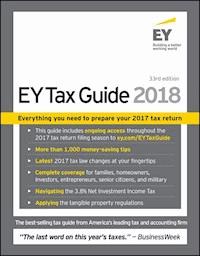
Ernst & Young Tax Guide 2018 E-Book
16,99 €
Mehr erfahren.
- Herausgeber: John Wiley & Sons
- Kategorie: Fachliteratur
- Sprache: Englisch
Minimize your tax and maximize your 2017 return The EY Tax Guide 2018 offers professional guidance for DIY tax prep. As one of the nation's most trusted resources for tax advice, this book can help you keep more of your money while filing completely, correctly, and on time. Fully updated to reflect the latest changes to the law, this new 2018 edition cuts through impenetrable tax codes and IRS rulings to give you the answers you need quickly and easily. Whether you're a homeowner, self-employed entrepreneur, business executive, or senior citizen, you'll discover the best tax strategy for your particular situation. At-a-Glance reference sheets give you quick answers to common questions regarding new laws, breaks and deductions, and how to avoid common errors. No two tax years are alike. The laws change constantly, and even small changes can affect your return. This book cuts to the chase and tells you what's new, what it means for you, and what you can do to keep more of your money. * Get up to date on changes to tax law, and how they affect you * Identify breaks and deductions that can reduce your tax burden * Zero in on the best tax strategy for your particular situation * Find answers at a glance from globally-respected tax advisors Avoid the headaches that come with parsing IRS worksheets and documentation--EY has already done it for you! The EY Tax Guide 2018 gives you the answers you need and clarity you crave, backed by globally-trusted expertise.
Sie lesen das E-Book in den Legimi-Apps auf:
Seitenzahl: 3432
Veröffentlichungsjahr: 2017
Ähnliche




















The EY Tax Guide 2018
Years of critical acclaim for America’s no. 1 tax guide...
“This is the best tax guide of the bunch . . . the most up-to-date guide.”
USA Today
“Hard to beat . . . [EY professionals] elucidate each point, giving examples, definitions and strategies that you won’t learn about from the IRS.”
Money
“This book . . . has more up-to-date information on tax changes than its competitors—or even the IRS.”
Chicago Sun-Times
“Best of the commercially available guides.”
New York Daily News
“Destined to become the ‘old standard,’ all written in plain English. . . . If you can afford just one tax book, this could be the one.”
Seattle Post-Intelligencer
“The text-with-commentary approach makes the book both authoritative and easy-to-use.”
People
“The simplest tax guide to understand.”
CBS This Morning
“The explanations, examples, and planning advice are top-drawer.”
Orlando Sentinel
“Exceptionally detailed.”
The Sunday Denver Post
“An excellent book, full of clear explanations, planning hints, tax savers and sample forms.”
Atlanta Journal-Constitution
“Our brand-name choice for filers with lots of questions for filing and planning situations.”
Fort Worth Star-Telegram
“. . . a veritable fountain of information.”
Milwaukee Sentinel
“. . . the best of the bunch for return preparation.”
Des Moines Register
2018 tax calendar
Date in 2018
Action required
January
16
Final estimated tax payment for 2017 due if you did not pay your income tax (or enough of your income tax) for that year through withholding. Use Form 1040-ES.
31
If you did not pay your last installment of estimated tax by January 16, file your income tax return for 2017 on this date and pay the entire balance due with your return, thereby avoiding any penalty for late payment of the last installment. Use Form 1040 or 1040A. However, see below for special rules for farmers and fishermen.
February
15
File a new Form W-4 if you can claim exemption from withholding.
March
1
Farmers and fishermen must file their 2017 income tax return (Form 1040) and pay all tax to avoid a penalty for underpayment of 2017 estimated taxes.
April
17
File your income tax return for 2017 (Forms 1040, 1040A, or 1040EZ) and pay any tax due.
Individuals who have a financial interest in or signature authority or other authority over certain bank, securities, or other financial accounts in a foreign country must file FinCEN Form 114.
Make your 2017 IRA contribution.
If you are not extending your return, make your Keogh or SEP-IRA contribution if you have self-employment income.
For an automatic 6-month extension, file Form 4868 and pay any tax that you estimate will be due. Then file Form 1040 or 1040A by October 15. If you get an extension, you can’t file Form 1040EZ. (You can use one Form 4868 to file for both your income tax and gift tax extensions.)
Pay the first installment of your 2018 estimated tax if you are not paying your 2018 income tax (or enough of it) through withholding tax.
If you made any taxable gifts during 2017 (more than $14,000 per donee), file a gift tax return for that year (Form 709 or 709-A) and pay any tax due.
June
15
Pay the second installment of 2018 estimated tax.
If you are a U.S. citizen or resident alien living and working (or on military duty) outside the United States and Puerto Rico, file Form 1040 and pay any tax, interest, and penalties due. Otherwise, see April 17.
September
17
Pay the third installment of your 2018 estimated tax.
Last day for employers to make a required minimum contribution to a defined benefit or money purchase plan.
October
15
If you requested an automatic 6-month extension to file your 2017 income tax return, file Form 1040 or Form 1040A and pay any tax, interest, and penalty due, and file any gift tax return if due.
If you received a 6-month extension to file FinCEN Form 114, you must file it on or before October 15.
Last day to make a Keogh or SEP-IRA contribution deductible for calendar year 2017 if you requested a 6-month extension of time to file your tax return.
December
3
If you claimed exemption from withholding in 2018 but you expect to owe income tax for 2019, you must file a new Form W-4 by December 3, 2018.
31
Last day to establish a Keogh plan for 2018.
The EY Tax Guide Editorial Board 2018
Chair
Gary N. Cohen
Contributing Authors
Akron
Jason M. Belot
Trish Dillinger
Kim McFarlane
Atlanta
Paul A. Mayberry
Jason C. Sweatt
Boston
Caroline Cardillo
Chester J. Godfrey
Susan B. Lambeth
Lynn McLaughlin
Buffalo
Susan R. Bork
Shieke A. Brown
Kelley C. DuVal
Chicago
Brian A. Fisk
Barbara Kirchheimer
Laura K. Rossi
Renee R. Zalatoris
Cleveland
Christopher Neuman
Columbus
Sam P. Weiler
Dallas
Mohamed Jabir
Houston
Hillary R. Ellender
Tina M. Taylor
Los Angeles
Daniel Johnson
New York
Devon N. Kulp
McLean
Arjun Mahajan
Pittsburgh
Michelle N. Ammon
Providence
Jenna Lewis
Susan Simoneau
Heather C. Spangler
Sarah Willard
San Francisco
Tony Aires
Daniel Novak
Edmond W. Zhou
Seattle
Alex Bray
Secaucus
Tom DiLorenzo
Raymond A. Echevarria
Janine Gordon
Stamford
Christopher R. Williams
Tampa
Gregory A. Rosica
Washington, D.C.
Nickolas K. Davidson
John M. Fusco
David H. Kirk
Scott T. Mackay
Justin Ransome
Ifeyinwa S. Spears
Ankur Thakkar
Kathy S. Schatz-Guthrie
Special thanks to
Mark A. Weinberger, Global Chairman and CEO; Stephen R. Howe, Americas Area Managing Partner; Mike Inserra, Americas Deputy Managing Partner, Kathryn J. Barton, Americas Vice Chair—Tax Services; Eric Solomon and Michael Mundaca, Co-Directors of National Tax; Marnix vin Rij, Global Director of Private Client Services; Steven L. Shultz, Americas Director of Private Client Services.
Special awards and acknowledgments
The EY Tax Guide is a proud recipient of a Communications Concept, Inc. 2016 Award of Excellence (Electronic Publications); 2013 Apex Grand Award for Electronic Media; a 2012 Apex Grand Award for Content Excellence for Content and Design (Brochures, Manuals & Reports category); an Independent Publisher 2016 Bronze Medal for Business Reference book, and a 2012 Axiom Award for Best Business Reference Book.
Thanks to Ron Anes, Amy Koeppl, Melissa L. Banning, and Lizzie McWilliams.
The EY global network of member firms has more than 43,000 tax practitioners worldwide, with more than 9,000 practitioners in the United States. This book draws upon the experience of many of those professionals for its content.
Copyright © 2009–2018, Ernst & Young LLP Copyright © 1989–2008 by Ernst & Young LLP and Peter W. Bernstein Corporation Copyright © 1984–1988 by Arthur Young & Company and Peter W. Bernstein Corporation
All rights reserved. No part of this publication may be reproduced or transmitted in any form or by any means, electronic or mechanical, including photocopying or recording, or by any information storage or retrieval system, without written permission from Ernst & Young LLP. No part of this publication may be reproduced, stored in a retrieval system, or transmitted in any form or by any means, whether electronic, mechanical or otherwise, and including without limitation photocopying, recording, scanning, except as permitted under Section 107 or 108 of the 1976 United States Copyright Act, without either the prior written permission of the Publisher, or authorization through payment of the appropriate per-copy fee to the Copyright Clearance Center, Inc., 222 Rosewood Drive, Danvers, MA 01923, (978) 750-8400, fax (978) 646-8600, or on the Web at www.copyright.com. Requests to the Publisher for permission should be addressed to the Permissions Department, John Wiley & Sons, Inc., 111 River Street, Hoboken, NJ 07030, (201) 748-6011, fax (201) 748-6008, or online at http://www.wiley.com/go/permissions. Published by John Wiley & Sons, Inc.
Notice: In the preparation of this book, every effort has been made to offer the most current, correct, and clearly expressed information available prior to publication: the Internal Revenue Code as of August 2017, the 2016 version of Internal Revenue Service Publication 17, Your Federal Income Tax (rev. Dec. 2016), updated by the author for 2017 and portions of other pertinent Internal Revenue Service publications. Readers may obtain the 2017 version of Publication 17 at www.irs.gov. Note also that inadvertent errors can occur, and tax rules and regulations often change.
Limit of Liability/Disclaimer of Warranty: The information in the text is intended to afford general guidelines on matters of interest to taxpayers. The application and impact of tax laws can vary widely, from case to case, based upon the specific or unique facts involved. Readers are encouraged to consult with professional advisors for advice concerning specific matters before making any decision, and the author and publisher disclaim any responsibility for positions taken by taxpayers in their individual cases or for any misunderstanding on the part of readers. While the publisher and author have used their best efforts in preparing this book, they make no representations or warranties with respect to the accuracy or completeness of the contents of this book and specifically disclaim any implied warranties of merchantability or fitness for a particular purpose. No warranty may be created or extended by sales representatives or written sales materials. Neither the publisher nor author shall be liable for any loss of profit or any other damages, including but not limited to direct, indirect, special, incidental, consequential, or other damages.
For general information on Ernst & Young LLP's other products and services or for technical support, please contact our Customer Care Department within the United States at (800) 762-2974, outside the United States at (317) 572-3993 or fax (317) 572-4002.
Wiley publishes in a variety of print and electronic formats and by print-on-demand. Some material included with standard print versions of this book may not be included in e-books or in print-on-demand. If this book refers to media such as a CD or DVD that is not included in the version you purchased, you may download this material at http://booksupport.wiley.com. For more information about Wiley products, visit www.wiley.com.
ISBN 978-1-119-38376-5 (paper); 978-1-119-38382-6 (epdf); 978-1-119-38379-6 (epub)
ISSN 1059-809X
How to use this guide
The EY Tax Guide 2018 is an easy-to-use, step-by-step guide to preparing your own tax return. It has been designed with you in mind, and its format should help highlight information to save you time and money.
The book explains, in clear and simple English, important aspects of the tax laws that affect you. It covers what you need to know about your taxes—from how to file your return to how to lower the tax you’ll pay next year. Throughout the book, you will find hundreds of examples illustrating how the tax laws work. Sample tax forms and schedules show you how to fill out your return line by line. Here are some of the book’s special features and how to use them:
Two Books in One
. The
EY Tax Guide 2018
is really two books. The first book is the 2016 version of the official Internal Revenue Service tax guide, Publication 17, Your Federal Income Tax, which is reproduced here. Published annually, it contains the IRS’s position on many of the tax questions taxpayers face. To make the
EY Tax Guide 2018
available to the public as quickly as possible, we have updated the text of the 2016 version of IRS Publication 17 to take into account developments during 2017. These updates are noted throughout the text. Upon release, the 2017 IRS Publication 17 can be found at
www.irs.gov
. The second book is the EY guide. Here are comments, explanations, and tax-saving tips on what the IRS tells you—and doesn’t tell you. It’s no surprise that the IRS doesn’t tell you everything, and what it does say often favors the U.S. government. Courts and tax professionals frequently differ with IRS opinions. The EY text provides you this additional material. The two books have been spliced together to give you the most well-rounded tax guide on the market. To distinguish between the two perspectives, the original IRS text appears in black throughout the book, our updates of the IRS text are underlined, and EY’s comments appear in the green boxes.
TAXSAVERS, TAXPLANNERS, TAXALERTS, AND TAXORGANIZERS
. Among this book’s biggest attractions are the more than 400
TAXSAVERS, TAXPLANNERS, TAXALERTS,
and
TAXORGANIZERS
that you’ll find appropriately placed throughout the text.
TAXSAVERS
are tips that help you slash your tax bill this year and next—legally.
TAXPLANNERS
outline ideas that help you plan better for the upcoming year.
TAXALERTS
point out tax rules and regulations that have just changed or may change in the near future; they give you important current filing advice about issues you will want to consider as you prepare your return.
TAXORGANIZERS
point out steps you can take now to make it easier to file your taxes later.
Tax Breaks and Deductions You Can Use Checklists
You will find a checklist of key tax breaks and deductions for which you may be eligible at the beginning of each chapter, immediately following the Introduction. You should review each checklist to make sure you are taking all the deductions and tax breaks that you deserve.
Companion Website
. Purchase of this guide includes access throughout the 2017 tax return filing season to
ey.com/EYTaxGuide
. This website contains up-to-date information you need about changes in the tax laws that occur throughout the year.
Special Contents
. We’ve taken great pains to ensure that this book is clearly organized for easy access. If you can’t find the section you want in the regular Contents, check the
Special Contents
. All told, there are eight of these—one each for families, homeowners, investors in stocks and bonds, investors in real estate, self-employed entrepreneurs, business executives, senior citizens, and members of the Armed Forces. Each
Special Contents
section contains a listing of the major tax issues for members of that group and tells where you can find the answers in the book. In addition, we have a table of contents at the beginning of each chapter to help you find what you need.
We have drawn from the tax experience of scores of Ernst & Young LLP partners, professionals, and staff from all parts of the United States to create this tax guide. Among the major accounting firms, only Ernst & Young LLP publishes a complete tax guide that is available to the general public. It provides the most complete and up-to-date tax information of any tax guide published.
CONTENTS
Changes in the tax law you should know about
IRS help for hurricane victims: a recap of key tax relief provisions available following Harvey, Irma, and Maria
Important 2017 tax reminders
How to avoid 25 common errors
50 of the most easily overlooked deductions
Individual tax organizer
Income and expense records you should keep in addition to your income tax return
Part 1: The income tax return
Chapter 1: Filing information
Do I Have To File a Return?
Which Form Should I Use?
Why Should I File Electronically?
When Do I Have To File?
How Do I Prepare My Return?
Where Do I File?
What Happens After I File?
Chapter 2: Filing status
Marital Status
Single
Married Filing Jointly
Married Filing Separately
Head of Household
Chapter 3: Personal exemptions and dependents
Exemptions
Phaseout of Exemptions
Social Security Numbers for Dependents
Chapter 4: Tax withholding and estimated tax
What’s New for 2018
Reminders
Introduction
Tax Withholding for 2018
Estimated Tax for 2018
Credit for Withholding and Estimated Tax for 2017
Underpayment Penalty for 2017
Part 2: Income
Chapter 5: Wages, salaries, and other earnings
Employee Compensation
Miscellaneous Compensation
Special Rules for Certain Employees
Sickness and Injury Benefits
Chapter 6: Tip income
Keeping a Daily Tip Record
Reporting Tips To Your Employer
Reporting Tips on Your Tax Return
Allocated Tips
Chapter 7: Interest income
General Information
Taxable Interest
When To Report Interest Income
How To Report Interest Income
Chapter 8: Dividends and other corporate distributions
General Information
Ordinary Dividends
Capital Gain Distributions
Nondividend Distributions
Other Distributions
How To Report Dividend Income
Chapter 9: Rental income and expenses
Introduction
Rental Income
Rental Expenses
Repairs and Improvements
Property Changed To Rental Use
Renting Part of Property
Not Rented for Profit
Personal Use of Dwelling Unit (Including Vacation Home)
Tangible Property Regulations
Depreciation
Limits on Rental Losses
How To Report Rental Income and Expenses
Chapter 10: Retirement plans, pensions, and annuities
General Information
Cost (Investment in the Contract)
Taxation of Periodic Payments
Taxation of Nonperiodic Payments
Rollovers
Special Additional Taxes
Survivors and Beneficiaries
Chapter 11: Social security and equivalent railroad retirement benefits
Are Any of Your Benefits Taxable?
How To Report Your Benefits
Examples
Deductions Related To Your Benefits
Repayments More Than Gross Benefits
Chapter 12: Other income
Bartering
Canceled Debts
Host or Hostess
Life Insurance Proceeds
Partnership Income
S Corporation Income
Recoveries
Rents from Personal Property
Repayments
Royalties
Unemployment Benefits
Welfare and Other Public Assistance Benefits
Other Sickness and Injury Benefits
Other Income
Passive Activity Limitations and At-Risk Limitations
Part 3: Gains and losses
Chapter 13: Basis of property
Cost Basis
Adjusted Basis
Basis Other Than Cost
Chapter 14: Sale of property
Sales and Trades
Capital Gains and Losses
Chapter 15: Selling your home
Main Home
Figuring Gain or Loss
Excluding the Gain
Business Use or Rental of Home
Reporting the Sale
Special Situations
Recapturing (Paying Back) a Federal Mortgage Subsidy
CHAPTER 16: Reporting gains and losses
Reporting Capital Gains and Losses
Capital Gain Tax Rates
Part 4: Adjustments to income
CHAPTER 17: Individual retirement arrangements (IRAs)
What’s New for 2017
Traditional IRAs
Roth IRAs
CHAPTER 18: Alimony
General Rules
Instruments Executed After 1984
How To Deduct Alimony Paid
How To Report Alimony Received
Recapture Rule
Chapter 19: Education-related adjustments
Student Loan Interest Deduction
Educator Expenses
Tuition and Fees Deduction
Figuring the Deduction
Effect of the Amount of Your Income on the Amount of Your Deduction
Claiming the Deduction
Chapter 20: Moving expenses
Part 5: Standard deduction and itemized deductions
Chapter 21: Standard deduction
Standard Deduction Amount
Standard Deduction for Dependents
Who Should Itemize
Chapter 22: Medical and dental expenses
What Are Medical Expenses?
What Expenses Can You Include This Year?
How Much of the Expenses Can You Deduct?
Whose Medical Expenses Can You Include?
What Medical Expenses Are Includible?
How Do You Treat Reimbursements?
Damages for Personal Injuries
How Do You Figure and Report the Deduction on Your Tax Return?
Impairment-Related Work Expenses
Health Insurance Costs for Self-Employed Persons
Chapter 23: Taxes you may deduct
Tests To Deduct Any Tax
Income Taxes
State and Local General Sales Taxes
Real Estate Taxes
Personal Property Taxes
Taxes and Fees You Cannot Deduct
Where To Deduct
Chapter 24: Interest expense
Home Mortgage Interest
Mortgage Insurance Premiums
Investment Interest
Items You Cannot Deduct
Allocation of Interest
How To Report
Chapter 25: Contributions
Organizations That Qualify To Receive Deductible Contributions
Contributions You Can Deduct
Contributions From Which You Benefit
Contributions You Cannot Deduct
Contributions of Property
When To Deduct
Limits on Deductions
Records To Keep
How To Report
Chapter 26: Nonbusiness casualty and theft losses
Casualty
Theft
Loss on Deposits
Proof of Loss
Figuring a Loss
Deduction Limits
When To Report Gains and Losses
How To Report Gains and Losses
Chapter 27: Car expenses and other employee business expenses
Travel Expenses
Entertainment Expenses
Gift Expenses
Transportation Expenses
Recordkeeping
How To Report
Chapter 28: Tax benefits for work-related education
Qualifying Work-Related Education
Education To Meet Minimum Requirements
What Expenses Can Be Deducted
Reimbursements
Deducting Business Expenses
Recordkeeping
Chapter 29: Miscellaneous deductions
Deductions Subject to the 2% Limit
Deductions Not Subject to the 2% Limit
Nondeductible Expenses
Chapter 30: Limit on itemized deductions
Are You Subject to the Limit?
Which Itemized Deductions Are Limited?
Which Itemized Deductions Are Not Limited?
How Do You Figure the Limit?
Part 6: Figuring your taxes and credits
Chapter 31: How to figure your tax
Figuring Your Tax
Alternative Minimum Tax
Additional Medicare Tax
Net Investment Income Tax (NIIT)
Tax Figured by IRS
Chapter 32: Tax on unearned income of certain children
Which Parent’s Return to Use
Parent’s Election To Report Child’s Interest and Dividends
Tax for Certain Children Who Have Unearned Income
Chapter 33: Child and dependent care credit
Can You Claim the Credit?
How To Figure the Credit
How To Claim the Credit
Do You Have Household Employees?
Chapter 34: Credit for the elderly or the disabled
Are You Eligible for the Credit?
How To Claim the Credit
Chapter 35: Child tax credit
Qualifying Child
Amount of Credit
Claiming the Credit
Additional Child Tax Credit
Completing Schedule 8812 (Form 1040A or 1040)
Chapter 36: Education credits and other education tax benefits
Who Can Claim an Education Credit
Qualified Education Expenses
Chapter 37: Premium Tax Credit (PTC)
What Is the Premium Tax Credit (PTC)?
Who Can Take the PTC?
How To Take the PTC?
Chapter 38: Other credits including the earned income credit
Nonrefundable Credits
Refundable Credits
Earned Income Credit (EIC)
Reminders
Do You Qualify for the Credit?
Part 7: Special situations and tax planning
Chapter 39: Self-employment income: How to file Schedule C
Who Must File Schedule C
What Is Included In Net Self-Employment Earnings?
How To Determine Items of Income and Expenses
Sales of Business Property Used in Your Business
Business Tax Credit
Special Situations
How To Complete Schedule SE Line By Line, Briefly
Chapter 40: Mutual funds
Tax Treatment of Distributions
Sales, Exchanges, and Redemptions
Keeping Track of Your Basis
Gains and Losses
Holding Period
How To Figure Gains and Losses on Form 8949 and Schedule D
Capital Losses
Investment Expenses
Limit on Investment Interest Expense
Chapter 41: What to do if you employ domestic help
Reminder
Employment Taxes for Household Employers
Chapter 42: U.S. citizens working abroad: Tax treatment of foreign earned income
How To Qualify for the Foreign Earned Income Exclusion
The Foreign Earned Income Exclusion
The Foreign Housing Exclusion
Employer-Provided Meals and Lodging
Foreign Tax Credit
Chapter 43: Foreign citizens living in the United States
Determining Your Status
Election To Be Treated as a Resident
How Resident Aliens Are Taxed
Rules for Individuals Giving Up U.S. Citizenship or U.S. Residency
Dual-Status Aliens
How Nonresident Aliens Are Taxed
Departing from the United States
Chapter 44: Decedents: Dealing with the death of a family member
Personal Representative
Final Return for the Decedent
Tax Effect on Others
Chapter 45: Estate and gift tax planning
Getting Started
Estate Tax Fundamentals
How Your Estate Is Taxed
The Fundamentals of the Gift Tax
The Generation-Skipping Transfer (GST) Tax
How To Use Trusts
How To Raise Cash To Pay Estate Taxes
Concerns Regarding Community Property
Estate Planning—Steps To Take Now
Chapter 46: Everything you need to know about e-filing
Information You’ll Need to
E-File
Making Tax Payments
Methods of E-Filing
Chapter 47: If your return is examined
IRS Declaration of Taxpayer Rights
Examinations, Appeals, Collections, and Refunds
Appeals
Collections
Potential Third-Party Contacts
Claims for Refunds
Chapter 48: Rules for expensing and capitalizing tangible property used in a trade or business
Chapter 49: Net investment income tax
Chapter 50: Planning ahead for 2018 and beyond
Year-End and Ongoing Tax Planning Considerations
Affordable Care Act (ACA) Individual Provisions
Inflation Adjustments for 2018
Chapter 51: 2017 tax rate schedules
Index
EULA
List of Tables
Chapter 1
Table 1.1
Table 1.2
Table 1.3
Table 1.4
Table 1.5
Table 1.6
Table 1.7
Chapter 2
Table 2.1
Chapter 3
Table 3.1
Chapter 5
Table 5.1.
Chapter 7
Table 7.1
Chapter 8
Table 8.1
Chapter 10
Table 10.1
Chapter 13
Table 13.1
Chapter 16
Table 16.1
Chapter 17
Table 17.1
Table 17.2
Table 17.3
Chapter 18
Table 18.1
Chapter 19
Table 19.1
Table 19.2
Table 19.3
Table 19.4
Chapter 20
Table 20.1
Chapter 21
Table 21.1
Table 21.2
Table 21.3
Chapter 22
Table 22.1
Chapter 23
Table 23.1
Chapter 24
Table 24.1
Chapter 25
Table 25.1
Table 25.2
Chapter 26
Table 26.2
Chapter 27
Table 27.1
Table 27.2
Table 27.3
Chapter 34
Table 34.1
Chapter 36
Table 36.1
Table 36.2
Chapter 38
Table 38.1
Chapter 40
Table 40.1
Table 40.2
Chapter 41
Table 41.2
Table 41.3
Table 41.4
Chapter 45
Table 45.1
Guide
Cover
Table of Contents
1
Pages
ii
v
viii
x
xiv
xvi
xvii
xviii
xxvi
1
3
4
6
8
9
10
11
12
13
14
15
16
17
18
19
20
21
22
23
24
25
26
27
28
29
30
31
32
33
34
35
36
37
38
39
40
41
42
43
44
45
46
47
48
49
50
51
52
53
54
55
56
57
58
59
60
61
62
63
64
65
66
67
68
69
70
71
72
74
75
76
77
78
79
80
81
82
83
84
85
86
87
88
89
90
91
92
93
94
95
96
97
98
99
100
101
102
103
104
105
106
107
108
109
110
111
112
113
114
115
116
117
118
119
120
121
123
124
125
126
127
128
129
130
131
132
133
135
136
137
138
139
140
141
142
143
144
145
146
147
148
149
150
151
152
153
154
155
156
157
158
159
160
161
162
163
164
165
166
167
168
169
170
171
172
173
174
175
176
177
178
179
180
181
182
183
184
185
186
187
188
189
190
191
192
193
194
195
196
197
198
199
200
201
202
203
204
205
206
207
208
209
210
211
212
213
214
215
216
217
218
219
220
221
222
223
224
225
226
227
228
229
230
231
232
233
234
235
236
237
240
241
242
243
244
245
246
247
248
249
250
251
252
253
254
255
256
257
258
259
260
261
262
263
264
265
266
267
268
269
270
271
272
273
274
275
276
277
278
279
280
282
283
284
285
286
287
288
289
290
291
292
293
294
295
296
297
298
299
300
301
302
303
304
305
306
307
308
309
310
311
312
313
314
315
316
317
318
319
320
321
322
323
325
326
327
328
329
330
331
332
333
334
335
336
337
338
339
340
341
342
343
344
345
346
347
348
349
350
351
352
353
354
355
356
357
358
359
360
361
362
363
364
365
366
367
368
369
370
371
372
373
374
375
376
377
378
379
380
381
382
383
384
385
386
387
388
389
390
391
392
393
394
395
396
397
398
399
400
401
402
403
404
405
406
407
408
409
410
411
412
413
414
415
416
417
418
419
420
421
422
423
424
425
426
427
428
429
431
433
434
435
436
437
438
439
440
441
442
443
444
445
446
447
448
449
450
451
452
453
454
455
456
457
458
459
460
461
462
463
464
465
466
467
468
469
470
471
472
473
474
475
476
477
478
479
480
481
482
483
484
485
486
487
488
489
490
491
492
493
494
495
496
497
498
499
500
501
502
503
504
505
506
507
508
509
510
511
512
513
514
515
517
519
519
520
521
522
523
524
525
526
527
528
529
530
531
532
533
534
535
536
537
538
539
540
541
542
543
544
545
546
546
547
548
549
550
551
552
553
554
555
556
557
558
559
560
561
562
563
564
565
566
567
568
569
570
571
572
573
574
575
576
577
578
579
580
581
582
583
584
585
586
587
588
589
590
591
592
593
594
595
596
597
598
599
600
601
602
603
604
605
606
607
608
609
610
611
612
613
614
615
616
617
618
619
620
621
622
623
624
625
626
627
628
629
630
631
632
633
634
635
636
637
638
639
640
641
642
643
644
645
646
647
648
649
650
651
652
653
654
655
656
657
658
659
660
661
662
663
664
665
666
667
668
669
670
671
672
673
674
675
676
677
678
679
680
681
682
683
684
685
686
687
688
689
690
691
692
693
694
695
696
697
698
699
700
701
702
703
704
705
706
707
708
709
710
711
712
713
714
715
716
717
718
719
720
721
722
723
724
725
726
727
728
729
730
731
732
733
734
735
736
737
739
740
741
742
743
744
745
746
747
748
749
750
751
752
753
754
755
756
757
759
760
762
763
764
765
767
768
769
770
771
772
773
774
775
776
777
778
779
780
781
782
785
786
787
788
789
790
791
792
793
794
795
796
797
798
799
800
802
803
804
805
806
807
808
809
810
811
812
813
814
815
816
817
818
819
820
821
822
823
824
825
826
827
828
829
830
831
832
833
834
835
836
837
838
839
840
841
842
843
844
845
846
847
848
849
853
855
856
857
858
859
860
861
862
863
864
865
866
867
868
869
870
871
872
873
874
875
876
877
878
879
880
881
889
890
891
892
893
894
895
896
897
898
899
900
901
902
903
904
905
906
907
908
909
910
911
912
913
914
915
916
917
918
919
922
923
924
925
926
927
928
929
930
931
932
933
934
935
936
937
938
939
940
941
942
943
944
945
946
947
948
949
950
951
952
953
954
955
956
957
958
959
960
961
962
963
964
965
966
967
968
969
970
971
972
973
974
975
976
977
978
979
980
981
982
983
984
985
986
987
988
989
990
991
992
993
994
995
996
997
998
999
1000
1001
1002
1003
1004
1005
1006
1007
1008
1009
1010
1011
1012
1013
1014
1015
1016
1017
1018
1019
1020
1021
1022
1023
1024
1025
1026
1027
1028
1029
1031
1032
1033
1035
Changes in the tax law you should know about
2017 has, to date, been a quiet year for tax changes, although the focus in Washington on tax reform may mean future changes are coming. On the regulatory front, President Trump issued directives early in the year that slowed the pace of tax regulatory activity within the Treasury Department and the IRS. On the legislative front, with Congress’s failure to repeal and replace the Affordable Care Act (ACA), tax reform has regained its high-priority position on the legislative agenda. The two issues had been linked by revenue and procedural concerns, but with ACA repeal put aside for now, policymakers have turned their attention to crafting a tax plan that can win enough votes to get through Congress.
Major tax reform ideas continue to be debated, many of which stem from past tax reform efforts. As of this writing, congressional tax writers and leaders were working with the Trump administration to develop a tax reform plan that would lower tax rates, eliminate many targeted tax provisions, and move the United States toward a territorial international tax regime. If tax reform does gain traction, there is a chance some provisions might be retroactive, so it will be important to check back for potential updates on tax areas that may be of interest.
There also remain a number of tax provisions that expired at the end of 2016 or are set to expire at the end of 2017. Policymakers have not taken action on them yet, in hopes of addressing them as part of the larger tax reform effort.
While these developments create challenges for taxpayers wrestling with an uncertain tax and ACA landscape, they also present opportunities to take a fresh look at existing structures and planning, in anticipation of forthcoming changes. The EY Tax Guide is a great place to start that analysis. Check our website for updated information on tax legislation enacted after this book is published at ey.com/EYTaxGuide.
Tax changes effective for 2017
Personal exemption phaseout
Under the personal exemption phaseout, taxpayers lose 2% of their total personal exemption amount ($4,050 for 2017) for each $2,500 (or portion thereof) of adjusted gross income (AGI) in excess of an applicable threshold amount based on their tax filing status. For 2017, the phaseout begins and ends at the following amounts of AGI:
Filing status
Phaseout begins
Phaseout ends
Single
$261,500
$384,000
Married filing jointly and qualifying widow(er)
313,800
436,300
Married filing separately
156,900
218,150
Head of household
287,650
410,150
Itemized deductions limitation
The amount of itemized deductions you can claim for 2017 is reduced by 3% of the amount of your adjusted gross income (AGI) in excess of applicable thresholds, although no more than 80% of these otherwise allowable deductions will be eliminated. The thresholds are $261,500 for individual filers, $287,650 for heads of households, $313,800 for married couples filing jointly, and $156,900 for married couples filing separately.
Itemized deductions that are subject to this limitation include taxes, home mortgage interest, charitable contributions, and most miscellaneous itemized deductions. This limitation will be applied after you have used any other limitations that specifically apply with respect to affected itemized deductions, such as the AGI limitation for charitable contributions and the mortgage interest expense limitations. Medical expenses, casualty and theft losses, investment interest expense, and deductible gambling losses are not subject to this overall limitation.
Standard mileage rates
The standard mileage rate for the cost of operating your car decreased to 53½ cents a mile for all business miles driven for 2017 (the rate was 54 cents per mile in 2016). See chapter 27, Car expenses and other employee business expenses.
The standard mileage rate allowed for the use of your car for medical reasons or a qualified move decreased to 17 cents per mile for 2017 (the rate was 19 cents per mile in 2016). See chapter 22, Medical and dental expenses, and chapter 20, Moving expenses.
The standard mileage rate allowed for charitable purposes remains at 14 cents per mile for 2017. See chapter 25, Contributions.
Alternative minimum tax (AMT) exemption
The tax laws give preferential treatment to certain kinds of income and allow special deductions and credits for certain kinds of expenses. The AMT attempts to ensure that anyone who benefits from these tax advantages pays at least a minimum amount of tax. You pay AMT if it exceeds your regular tax liability for the year. The amount subject to AMT is separately computed by adding a number of preference items that essentially eliminate many of the deductions and credits that are allowed in computing your regular tax liability and subtracting an exemption amount.
The exemption amount is based on your tax filing status and is adjusted for inflation each year. For 2017, the exemption amounts increased to $54,300 for single taxpayers, $84,500 for married couples filing jointly, and $42,250 for married filing separately. The exemption phases out at higher levels of alternative minimum taxable income (AMTI). For 2017, a taxpayer’s exemption amount is reduced (but not below zero) by 25 percent of the amount by which alternative minimum taxable income exceeds the following: $120,700 (single), $160,900 (married filing jointly), and $80,450 (married filing separately).
For an explanation of the AMT, see chapter 31, How to figure your tax.
Itemized deduction for mortgage insurance premiums paid expired; not available for 2017
The itemized deduction for the cost of mortgage insurance premiums paid on a qualified personal residence expired at the end of 2016 and is not available for 2017. Although Congress had previously extended this deduction after it expired in prior tax years, no such legislation to extend it again had been passed as of the time this book went to press. A summary of this deduction is included below in case Congress acts to extend it. For updated information on this and any other tax law changes that occur after this book was published, see our website, ey.com/EYTaxGuide.
In 2016, eligible taxpayers were able to take an itemized deduction for the cost of mortgage insurance premiums paid on a qualified personal residence. The insurance must have been obtained in connection with home acquisition debt and the insurance contract must have been issued after 2006. The deduction was phased out by 10% for each $1,000 by which adjusted gross income (AGI) exceeded $100,000 ($500 and $50,000, respectively, if you were married filing separately). Therefore, the deduction was unavailable for a taxpayer with AGI over $109,000 ($54,500 if married filing separately). For more information, see Mortgage Insurance Premiums in chapter 24, Interest expense.
Exclusion from gross income of certain discharged mortgage debt further limited for 2017
The exclusion from gross income of income realized from a discharge received during 2017 of up to $2 million ($1 million if married filing separately) of qualified personal residence indebtedness is available only if that discharge was obtained pursuant to a binding written agreement entered into before 2017.
Congress had previously extended this deduction after it expired in prior tax years. However, no such legislation to extend it again and make it applicable to debt discharged based on an agreement obtained during 2017 and/or future years had been passed as of the time this book went to press. For updated information on this and any other tax law changes that occur after this book was published, see our website, ey.com/EYTaxGuide.
Qualified principal residence indebtedness is defined as acquisition indebtedness (within the meaning of Internal Revenue Code Section 163(h)(2)(B), except that the dollar limitation is $2 million) with respect to the taxpayer’s principal residence. Acquisition indebtedness generally means indebtedness incurred in the acquisition, construction, or substantial improvement of the principal residence of the individual, and secured by the residence. It also includes refinancing of such indebtedness to the extent the amount of the indebtedness resulting from such refinancing does not exceed the amount of the refinanced debt. The basis of the individual’s principal residence is reduced by the amount excluded from income. That will increase the amount of gain (or decrease any loss) you realize when you ultimately sell your home.
Above-the-line deduction for qualified tuition-related expenses expired; not available for 2017
The above-the-line deduction for tuition and fees expired at the end of 2016 and is not available for 2017. Although Congress had previously extended this deduction after it expired in prior tax years, no such legislation to extend it again had been passed as of the time this book went to press. A summary of this deduction is included in below in case Congress acts to extend it. For updated information on this and any other tax law changes that occur after this book was published, see our website, ey.com/EYTaxGuide.
In 2016, you were be able to deduct as an adjustment to reduce gross income qualified education expenses you paid during the year for tuition and fees at a college, university, or other qualifying postsecondary education institution. This deduction for tuition and fees was allowed as an adjustment in figuring your AGI; therefore, it reduced your taxable income even if you did not itemize deductions. The maximum deduction was $4,000 if your modified adjusted gross income (MAGI) was less than $65,000 ($130,000 if you were married filing jointly). The maximum available deduction shrank to $2,000 if your MAGI was over $65,000 ($130,000 if filing jointly) and below $80,000 ($160,000 if filing jointly). No deduction was available if your MAGI exceeded $80,000 ($160,000 if filing jointly).
The deduction was also unavailable—regardless of your MAGI—if your filing status for the year was married filing separately or you could be claimed as a dependent on the tax return of another person. In addition, the deduction was disallowed if you or anyone else claimed an American opportunity credit or lifetime learning credit with respect to the same student.
For more information, see Tuition and Fees Deduction, in chapter 19, Education-related adjustments.
Section 179 small business expensing amounts
Section 179 of the tax code allows you to make an election to deduct all or part of the cost—up to specified yearly limits—of certain qualifying property in the year in which the property is purchased and placed in service, rather than capitalizing the cost and depreciating it over its life. “Qualifying property” is property purchased for use in a trade or business and property that would have qualified for the investment tax credit. Under the PATH Act, off-the-shelf computer software can now be treated as qualifying property. For taxable years beginning after 2015, investments in air conditioning and heating units are also treated as qualifying property. The election is made for each item of qualifying property whether to deduct, subject to the yearly limit, or capitalize and depreciate its cost.
Specified limits. The maximum amount you can elect to deduct for Section 179 property placed into service in 2017 is $510,000. For enterprise zone businesses, this amount is increased by the lesser of: (1) $35,000, or (2) the cost of Section 179 property that is qualified zone property placed in service during 2017. The allowable deduction is reduced dollar for dollar once the cost of qualifying property placed into service during 2017 exceeds $2,030,000.
For more information about the Section 179 deduction, see Depreciation and Section 179 deduction, in chapter 13, Basis of property.
Special depreciation allowance extended through 2019
A tax law passed in late 2015 (The PATH Act) extended the availability of the special depreciation allowance (also known as bonus depreciation) under Section 168(k) for property acquired after December 31, 2007, and placed in service before January 1, 2020. Fifty percent bonus depreciation is available for property placed in service during 2015, 2016, and 2017. This decreases to 40% in 2018 and 30% in 2019. The types of property that qualify for the 50% bonus or special depreciation allowance are Section 168 (tangible) property with a recovery period of 20 years or less, off-the-shelf computer software, water utility property, and qualified leasehold improvement property.
Tax benefits for adoption
The adoption credit and the maximum exclusion from income of benefits under an employer’s adoption assistance program increased to $13,570 for 2017. These benefits are phased out for taxpayers with AGI between $203,540 and $243,540. See Adoption Credit in chapter 38, Other credits including the earned income credit.
Recapture of first-time homebuyer credit for home purchased on or after April 9, 2008, and before May 1, 2010
If you claimed the first-time homebuyer credit for a home you bought on or after April 9, 2008, and before May 1, 2010, you may be required to repay the credit. If so, your annual installment will be due with your 2017 tax return. You generally must repay the credit over a 15-year period in 15 equal installments. Each installment is reported as additional tax on your tax return. However, if you sold or stopped using your home as your principal residence before the 15-year period is up, you must include all remaining annual installments as additional tax on the return for the tax year that happened. See Recapturing (Paying Back) the First-Time Homebuyer Credit in chapter 38, Other credits including the earned income credit, for additional information.
2017 disaster area tax relief
You may be eligible for tax relief if you were the victim of various storms, including Hurricanes Harvey, Irma, and Maria that occurred during 2017. The IRS website, www.IRS.gov (click on “Tax relief for victims of recent disasters”), contains links to related news releases for the victims of affected areas. A list of the 2017 Federal Disaster Declarations is available on the FEMA website at fema.gov/news/disasters.
Examples of tax relief include extensions of time to file certain tax returns and make certain tax payments, as well as the ability for those who suffered uninsured or unreimbursed losses to elect to claim them on either the return for the year the loss occurred (in this instance, the 2017 return normally filed next year), or the return filed for the prior tax year (2016). For more information about deducting disaster losses, see Disaster Area Loss in chapter 26, Nonbusiness casualty and theft loss.
Credit for alternative fuel vehicle refueling property expired; not available for 2017
Although Congress had previously extended this credit after it expired in prior tax years, no such legislation to extend this credit again had been passed as of the time this book went to press. A summary of this credit is included in below in case Congress acts to extend it. For updated information on this and any other tax law changes that occur after this book was published, see our website, ey.com/EYTaxGuide.
The credit for qualifying alternative fuel refueling property was generally limited to the lesser of 30% of the cost of installing qualified clean-fuel vehicle refueling property in your principal home (up to $1,000 per tax year maximum) or used in your trade or business (up to $30,000 per tax year, per location).
Credits for residential qualified refueling property could not exceed the difference between your regular tax and tentative minimum tax. Credits for trade or business qualified refueling property could be carried back one year and forward 20 years. Your basis in the qualified refueling property is reduced by the amount of the credit claimed. You could not claim the credit for property used outside the United States or for property expensed under Section 179.
Credit for alternative motor vehicles expired; not available for 2017
The alternative motor vehicle credit was available for new fuel cell vehicles purchased before 2017 that are propelled by chemically combining oxygen with hydrogen and creating electricity. The base credit was $4,000 for vehicles weighing 8,500 pounds or less. Heavier vehicles qualified for up to a $40,000 credit, depending on their weight. An additional $1,000 to $4,000 credit was available to cars and light trucks to the extent their fuel economy exceeded the 2002 base fuel economy set forth in the Internal Revenue Code. The vehicle must be used predominantly in the United States to qualify for the credit. Although Congress had previously extended this credit after it expired in prior tax years, no such legislation to extend this credit again had been passed as of the time this book went to press. For updated information on this and any other tax law changes that occur after this book was published, see our website, ey.com/EYTaxGuide.
Credit for qualifying two-wheeled, plug-in electric drive motorcycles expired; not available for 2017
The credit for qualifying two-wheeled, plug-in electric drive motorcycles was limited to 10% of cost up to a maximum of $2,500. Although Congress had previously extended this credit after it expired in prior tax years, no such legislation to extend this credit again had been passed as of the time this book went to press. For updated information on this and any other tax law changes that occur after this book was published, see our website, ey.com/EYTaxGuide.
Nonbusiness energy property credit expired; not available for 2017
The credit for certain nonbusiness energy property was limited to 10 percent of the amount paid or incurred by a taxpayer for qualified energy improvements made to existing homes before 2017 (e.g., new HVAC systems, hot water systems, lighting), up to $500; but no more than $200 of such credit can be attributable to expenditures on windows.
Although Congress had previously extended this credit after it expired in prior tax years, no such legislation to extend this credit again had been passed as of the time this book went to press. For updated information on this and any other tax law changes that occur after this book was published, see our website, ey.com/EYTaxGuide.
Estate, gift, and generation-skipping transfer taxes
US citizens and residents are entitled to a $5 million lifetime exemption from estate and gift tax and a $5 million lifetime exemption from generation-skipping transfer (GST) tax. The exemptions are indexed annually for inflation. For 2017, the exemption amount is $5.49 million. There is also an annual, per-donee gift tax exclusion. For 2017, the gift tax annual exclusion amount is $14,000. The maximum tax rate on transfers of property subject to gift, estate, and GST tax is 40%. For more information on estate and gift tax, see chapter 45, Estate and gift tax planning.
Inflation adjustments for 2017
Each year, a number of tax benefits and income limitations for tax benefits are adjusted for inflation. In recent years these changes, if any, were very small due to the low rate of inflation—and this holds true for 2017. The adjustments for 2017 are as follows:
Tax Rate Tables: The income brackets for each tax rate have been increased slightly. See
chapter 51
,
Tax rate schedules
.
Personal Exemption: The personal exemption amount is $4,050 in 2017. See
chapter 3
,
Personal exemptions and dependents
.
Standard Deduction: The standard deduction for 2017 is $12,700 for married individuals filing joint returns and surviving spouses, $6,350 for unmarried individuals and married individuals filing separate returns, and $9,350 for heads of household. The additional standard deduction for blind people and senior citizens is $1,250 for married individuals or a surviving spouse, and $1,550 for unmarried individuals and not a surviving spouse. See
chapter 21
,
Standard deduction
.
The elective contribution limit for employees who participate in 401(k), 403(b), most 457 plans, and the federal government’s Thrift Savings Plan remained unchanged for 2017 from 2016 at $18,000.
For married couples filing jointly, in which the spouse who makes the IRA contribution is an active participant in an employer-sponsored retirement plan, the income phaseout range is $99,000 to $119,000 for 2017; for singles and heads of household, the income phaseout range is $62,000 to $72,000.
For an IRA contributor who is not an active participant in an employer-sponsored retirement plan, but who either lives with his or her spouse or files jointly, and the spouse is an active participant, the deduction is phased out if the couple’s income is between $186,000 and $196,000 for 2017.
The AGI phaseout range for 2017 for taxpayers making contributions to a Roth IRA is $186,000 to $196,000 for married couples filing jointly or a qualifying widow(er); for singles, heads of household, or married filing separately who did not live with his or her spouse at any time during 2017, the income phaseout range is $118,000 to $133,000; and the phaseout range for married taxpayers filing separately who lived with their spouse at any time during the year is $0 to $10,000. See
chapter 17
,
Individual retirement arrangements (IRAs)
.
Saver’s Credit Limitations: The AGI limit for the saver’s credit (also known as the retirement savings contributions credit) in 2017 is $62,000 for married couples filing jointly. For heads of household, the AGI limit is $46,500. For married individuals filing separately and for singles, the AGI limit is $31,000. See
chapter 38
,
Other credits including the earned income credit
.
Earned Income Credit: The maximum earned income credit (EIC) varies by family size, filing status, and other factors, with the maximum credit going to joint filers with three or more qualifying children. The credit amount and phaseout amounts are adjusted annually for inflation. See Earned Income Credit (EIC) in
chapter 38
,
Other credits including the earned income credit
.




