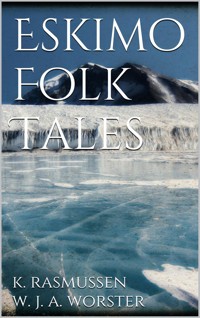
Knud Rasmussen, W. J. Alexander Worster
Eskimo Folk Tales
UUID: d9de48e4-5ac4-11e5-b224-119a1b5d0361
This ebook was created with StreetLib Write (http://write.streetlib.com)by Simplicissimus Book Farm
Table of contents
Introduction
The Two Friends Who Set Off to Travel Round the World
The Coming of Men, A Long, Long While Ago
Nukúnguasik, Who Escaped from the Tupilak1
Qujâvârssuk
The Woman Who Had a Bear As a Foster-Son
Ímarasugssuaq, Who Ate His Wives
Qalagánguasê, Who Passed to the Land of Ghosts
Isigâligârssik
The Insects that Wooed a Wifeless Man
The Very Obstinate Man
The Dwarfs
The Boy from the Bottom of the Sea, Who Frightened the People of the House to Death
The Raven and the Goose
When the Ravens Could Speak
Makíte
Asalôq
Ukaleq
Íkardlítuarssuk
The Raven Who Wanted a Wife
The Man Who Took a Vixen to Wife
The Great Bear
The Man Who Became a Star
The Woman with the Iron Tail
How the Fog Came
The Man Who Avenged the Widows
The Man Who Went Out to Search for His Son
Atungait, Who Went A-Wandering
Kumagdlak and the Living Arrows
The Giant Dog
The Inland-Dwellers of Etah
The Man Who Stabbed His Wife in the Leg
The Soul that Lived in the Bodies of All Beasts
Papik, Who Killed His Wife’s Brother
Pâtussorssuaq, Who Killed His Uncle
The Men Who Changed Wives
Artuk, Who Did All Forbidden Things
The Thunder Spirits
Nerrivik
The Wife Who Lied
Kâgssagssuk, The Homeless Boy Who Became a Strong Man
Qasiagssaq, The Great Liar
The Eagle and the Whale
The Two Little Outcasts
Atdlarneq, The Great Glutton
Ángángŭjuk
Âtârssuaq
Puagssuaq
Tungujuluk and Saunikoq
Anarteq
The Guillemot that Could Talk
Kánagssuaq
Introduction
These
stories were collected in various parts of Greenland, taken down from
the lips of the Eskimo story tellers themselves, by Knud Rasmussen,
the Danish explorer.No
man is better qualified to tell the story of Greenland, or the
stories of its people. Knud Rasmussen is himself partly of Eskimo
origin; his childhood was spent in Greenland, and to Greenland he
returned again and again, studying, exploring, crossing the desert of
the inland ice, making unique collections of material, tangible and
otherwise, from all parts of that vast and little known land, and his
achievements on these various expeditions have gained for him much
honour and the appreciation of many learned societies.But
it is as an interpreter of native life, of the ways and customs of
the Eskimos, that he has done his greatest work. “Kunúnguaq”—that
is his native name—is known throughout the country and possesses
the confidence of the natives to a superlative degree, forming
himself, as it were, a link between them and the rest of the world.
Such work, as regards its hither side, must naturally consist to a
great extent of scientific treatises, collections of facts and
specimens, all requiring previous knowledge of the subject for their
proper comprehension. These have their great value as additions to
the sum of human knowledge, but they remain unknown to the majority
of men. The present volume is designed to be essentially a popular,
as distinct from a scientific work.The
original collection of stories and legends made by Knud Rasmussen
under the auspices of the Carlsberg Foundation has never yet been
published. In making the present selection, I have endeavoured to
choose those which are most characteristic and best calculated to
give an idea of the life and thought of the people. The clearest
variants have been chosen, and vague or doubtful passages omitted, so
as to render the narratives easily understandable for the ordinary
reader. In many cases also, the extreme outspokenness of the
primitive people concerned has necessitated further editing, in
respect of which, I can confidently refer any inclined to protest, to
the unabridged English version, lodged with the Trustees of the
Carlsberg Foundation in Copenhagen, for my defence. For the rest, I
have endeavoured to keep as closely as possible to the spirit and
tone of the originals, working from the Eskimo text and Knud
Rasmussen’s Danish version side by side.The
illustrations are by native Eskimo artists. They are not drawn to
illustrate the particular stories, but represent typical scenes and
incidents such as are there described. In the selection of these,
preference has been given to those of unusual character, as for
instance those dealing with the “tupilak” theme, and matters of
wizardry or superstition generally, which the reader would find more
difficult to visualize for himself than ordinary scenes of daily
life.As
regards their contents, the stories bring before us, more clearly,
perhaps, than any objective study, the daily life of the Eskimos,
their habit of thought, their conception of the universe, and the
curious “spirit world” which forms their primitive religion or
mythology.In
point of form they are unique. The aim of the Eskimo story-teller is
to pass the time during the long hours of darkness; if he can send
his hearers to sleep, he achieves a triumph. Not infrequently a
story-teller will introduce his chef-d’œuvre with the proud
declaration that “no one has ever heard this story to the end.”
The telling of the story thus becomes a kind of contest between his
power of sustained invention and detailed embroidery on the one hand
and his hearers’ power of endurance on the other. Nevertheless, the
stories are not as interminable as might be expected; we find also
long and short variants of the same theme. In the present selection,
versions of reasonable length have been preferred. The themes
themselves are, of course, capable of almost infinite expansion.In
the technique of an ordinary novel there is a certain balance, or
just proportion, between the amount of space devoted to the various
items, scenes and episodes. The ordinary reader does not notice it as
a rule, for the simple reason that it is always there. The Eskimo
stories are magnificently heedless of such proportion. Any detail,
whether of fact or fancy, can be expanded at will; a journey of many
hundred miles may be summarized in a dozen words: “Then he went
away to the Northward, and came to a place.” Thus with the little
story of the Man who went out to search for his Son; the version here
employed covers no more than a few pages, yet it is a record of six
distinct adventures, threaded on to the main theme of the search. It
is thus a parallel in brief to the “Wandering” stories popular in
Europe in the Middle Ages, when any kind of journey served as the
string on which to gather all sorts of anecdote and adventure. The
story of Atungait, who goes on a journey and meets with lame people,
left-handed people, and the like, is an example of another well-known
classical and mediæval type.The
mythical stories present some interesting features when compared with
the beliefs and folk-lore of other peoples. The legend of the Men who
travelled round the World is based on a conception of the world as
round. There is the tradition of a deluge, but here supported by
geological evidence which is appreciated by the natives themselves:
i.e. the finding of mussel shells on the hills far inland. The
principle of the tides is recognized in what is otherwise a fairy
tale; “There will be no more ebb-tide or flood if you strangle me,”
says the Moon Man to the Obstinate One.The
constellation of the Great Bear is explained in one story, the origin
of Venus in another. The spirits of the departed are “stellified”
as seen in “The Coming of Men.” There seems to be a considerable
intermingling of Christian culture and modern science in the general
attitude towards life, but these foreign elements are coated over, as
it were, like the speck of grit in an oyster, till they appear as
concentrations of the native poetic spirit that forms their
environment.We
find, too, constant evidence of derivation from the earliest, common
sources of all folk-lore and myth; parallels to the fairy tales and
legends of other lands and other ages. There is a version of the
Bluebeard theme in Ímarasugssuaq, “who, it is said, was wont to
eat his wives.” Instances of friendship and affection between human
beings and animals are found, as in the tale of the Foster-mother and
the Bear. Various resemblances to well-known fairy tales are
discernible in such stories as that of the Eagle and the Whale, where
the brothers set out to rescue their sisters from the husbands who
hold them captive. Here too, we encounter that ancient and classical
expedient of fugitives; throwing out objects behind to check pursuit.The
conception of the under-world, as shown in the story of Kúnigseq and
others, is a striking example of this kinship with ancient and
well-known legends. Kúnigseq comes to the land of shades, and meets
there his mother, who is dead. But she must not kiss him, for “he
is only here on a visit.” Or again: “If you eat of those berries,
you will never return.” The under-world is partly an Elysium of
existence without cares; partly Dantesque: “Bring ice when you come
again, for we thirst for cold water down here.” And the traveller
who has been away from earth for what seems an hour, finds that years
of earthly time have passed when he returns.Spirits
of the departed appearing to their kin upon earth do so with an
injunction “not to tell.” (In England we write to the newspapers
about them.) Magic powers or gifts are lost by telling others how
they came. Spirit gifts are made subject to some condition of
restraint: “Choose only one and no more.” “If you kill more
than one seal to-day, you will never kill seal again hereafter.”The
technique of the fairy tale is frequently apparent. One test
fulfilled is followed by the demand for fulfilment of another.
Qujâvârssuk, having found the skeleton as instructed, is then sent
off to search for a lamb stone. This, of course, apart from its
æsthetic value as retardation, is particularly useful to the
story-teller aiming principally at length. We also find the common
progression from one great or splendid thing to other greater or more
splendid; a woman appears “even more finely dressed than on the day
before.” English children will perhaps remember Hans Andersen’s
dog with “eyes as big as saucers ... eyes as big as Rundetaarn.”The
use of “magic power” is of very frequent occurrence; it seems,
indeed, to be the generally accepted way of solving any difficulty.
As soon as the hero has been brought into a situation from which no
ordinary way of escape appears, it then transpires—as an
afterthought—that he is possessed of magic powers, when the rest,
of course, is easy. A delightful instance of the extent to which this
useful faculty can be watered down and yet remain effective is seen
in the case of the village where no wizard can be found to help in
time of famine, until it is “revealed” that Íkardlítuarssuk
“had formerly sat on the knee of one of those present when the
wizards called up their helping spirits.” In virtue of which very
distant connection he proceeds to magic away the ice.There
is a general tendency towards anthropomorphic conception of
supernatural beings. The Moon Man has his stock of harpoons like any
mortal hunter; the Mountain Spirit has a wife and children. The life
and domestic arrangements of “spirits” are mostly represented as
very similar to those with which the story-teller and his hearers are
familiar, much as we find, in early Italian paintings, Scriptural
personages represented in the costume and environment of the artist’s
own place and period.The
style of narrative is peculiar. The stories open, as a rule, with
some traditionally accepted gambit. “There was once a man ...” or
“A fatherless boy lived in the house of the many brothers.” The
ending may occasionally point a sort of moral, as in the case of
Ukaleq, who after having escaped from a Magic Bear, “never went out
hunting bear again.” But the usual form is either a sort of
equivalent to “lived happily ever after,” or a frank and direct
intimation: “Here ends this story,” or “That is all I know of
so-and-so.” Some such hint is not infrequently necessary, since the
“end” of a story often leaves considerable scope for further
development.It
is a characteristic feature of these stories that one never knows
what is going to happen. Poetic justice is often satisfied, but by no
means always (Kâgssagssuk). One or two of them are naïvely weak and
lacking in incident; we are constantly expecting something to happen,
but nothing happens ... still nothing happens ... and the story ends
(Puagssuaq). It is sometimes difficult to follow the exact course of
a conversation or action between two personages, owing to the
inadequate “he” which is used for both.The
story-teller, while observing the traditional form, does not always
do so uncritically. Occasionally he will throw in a little
interpolation of his own, as if in apology: “There was once a
wifeless man—that is the way a story always begins.” Or the
entertainer starts off in a cheerfully familiar style: “Well, it
was the usual thing; there was a Strong Man, and he had a wife. And,
of course, he used to beat her....”Here
and there, too, a touch of explanation may be inserted. “This
happened in the old days,” or “So men thought in the olden time.”
There is a general recognition of the difference between old times
and new. And the manner in which this difference is viewed reveals
two characteristic attitudes of mind, the blending of which is
apparent throughout the Eskimo culture of to-day. There is the
attitude of condescension, the arrogant tolerance of the proselyte
and the parvenu: “So our forefathers used to do, for they were
ignorant folk.” At times, however, it is with precisely opposite
view, mourning the present degeneration from earlier days, “when
men were yet skilful rowers in ’kayaks,’ or when this or that
might still be done ’by magic power.’”And
it is here, perhaps, that the stories reach their highest poetic
level. This regret for the passing of “the former age,” whether
as an age of greater strength and virtue, greater courage and skill,
or as the Golden Age of Romance, is a touching and most human trait.
It gives to these poor Eskimo hunters, far removed from the leisure
and security that normally precede the growth of art, a place among
the poets of the world.W.
W. Worster.
The Two Friends Who Set Off to Travel Round the World
Once
there were two men who desired to travel round the world, that they
might tell others what was the manner of it.This
was in the days when men were still many on the earth, and there were
people in all the lands. Now we grow fewer and fewer. Evil and
sickness have come upon men. See how I, who tell this story, drag my
life along, unable to stand upon my feet.The
two men who were setting out had each newly taken a wife, and had as
yet no children. They made themselves cups of musk-ox horn, each
making a cup for himself from one side of the same beast’s head.
And they set out, each going away from the other, that they might go
by different ways and meet again some day. They travelled with
sledges, and chose land to stay and live upon each summer.It
took them a long time to get round the world; they had children, and
they grew old, and then their children also grew old, until at last
the parents were so old that they could not walk, but the children
led them.And
at last one day, they met—and of their drinking horns there was but
the handle left, so many times had they drunk water by the way,
scraping the horn against the ground as they filled them.
“The
world is great indeed,” they said when they met.They
had been young at their starting, and now they were old men, led by
their children.Truly
the world is great.
Lesen Sie weiter in der vollständigen Ausgabe!
Lesen Sie weiter in der vollständigen Ausgabe!
Lesen Sie weiter in der vollständigen Ausgabe!
Lesen Sie weiter in der vollständigen Ausgabe!
Lesen Sie weiter in der vollständigen Ausgabe!
Lesen Sie weiter in der vollständigen Ausgabe!
Lesen Sie weiter in der vollständigen Ausgabe!
Lesen Sie weiter in der vollständigen Ausgabe!
Lesen Sie weiter in der vollständigen Ausgabe!
Lesen Sie weiter in der vollständigen Ausgabe!
Lesen Sie weiter in der vollständigen Ausgabe!
Lesen Sie weiter in der vollständigen Ausgabe!
Lesen Sie weiter in der vollständigen Ausgabe!
Lesen Sie weiter in der vollständigen Ausgabe!
Lesen Sie weiter in der vollständigen Ausgabe!
Lesen Sie weiter in der vollständigen Ausgabe!
Lesen Sie weiter in der vollständigen Ausgabe!
Lesen Sie weiter in der vollständigen Ausgabe!
Lesen Sie weiter in der vollständigen Ausgabe!
Lesen Sie weiter in der vollständigen Ausgabe!
Lesen Sie weiter in der vollständigen Ausgabe!
Lesen Sie weiter in der vollständigen Ausgabe!
Lesen Sie weiter in der vollständigen Ausgabe!
Lesen Sie weiter in der vollständigen Ausgabe!
Lesen Sie weiter in der vollständigen Ausgabe!
Lesen Sie weiter in der vollständigen Ausgabe!
Lesen Sie weiter in der vollständigen Ausgabe!
Lesen Sie weiter in der vollständigen Ausgabe!
Lesen Sie weiter in der vollständigen Ausgabe!
Lesen Sie weiter in der vollständigen Ausgabe!
Lesen Sie weiter in der vollständigen Ausgabe!
Lesen Sie weiter in der vollständigen Ausgabe!
Lesen Sie weiter in der vollständigen Ausgabe!
Lesen Sie weiter in der vollständigen Ausgabe!
Lesen Sie weiter in der vollständigen Ausgabe!
Lesen Sie weiter in der vollständigen Ausgabe!
Lesen Sie weiter in der vollständigen Ausgabe!
Lesen Sie weiter in der vollständigen Ausgabe!
Lesen Sie weiter in der vollständigen Ausgabe!
Lesen Sie weiter in der vollständigen Ausgabe!
Lesen Sie weiter in der vollständigen Ausgabe!
Lesen Sie weiter in der vollständigen Ausgabe!
Lesen Sie weiter in der vollständigen Ausgabe!
Lesen Sie weiter in der vollständigen Ausgabe!
Lesen Sie weiter in der vollständigen Ausgabe!
Lesen Sie weiter in der vollständigen Ausgabe!
Lesen Sie weiter in der vollständigen Ausgabe!
Lesen Sie weiter in der vollständigen Ausgabe!
Lesen Sie weiter in der vollständigen Ausgabe!