


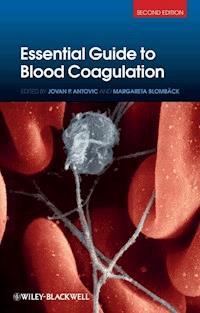
Essential Guide to Blood Coagulation E-Book
60,99 €
Mehr erfahren.
- Herausgeber: John Wiley & Sons
- Kategorie: Fachliteratur
- Sprache: Englisch
A practical guide to laboratory diagnosis and treatment of hemostatic disorders.
This concise book distils the most clinically up-to-date information on thrombotic and bleeding disorders, including the latest treatment strategies, for key conditions and diseases. Essential Guide to Blood Coagulation covers both the stable and the acute stages of hereditary and acquired bleeding and thrombotic disorders.
Faced with a bleeding patient, it may be difficult to determine whether blood loss is due to a local factor, or an underlying hemostatic defect. There are a range of laboratory tests which can be performed to identify the cause of bleeding in a patient. This book highlights the tests that can be used in the laboratory to aid diagnosis.
Essential Guide to Blood Coagulation has been updated to include the new anticoagulants and now has a dedicated chapter on antiplatelet drugs. This invaluable guide will help all those treating patients to expand their knowledge of hemostatic disorders.
TITLES OF RELATED INTEREST
Hemophilia and Hemostasis: A Case-Based Approach to Management
Second Edition
Alice Ma, Harold Roberts, Miguel Escobar
ISBN: 978-0-470-65976-2
Quality in Laboratory Hemostasis and Thrombosis
Second Edition
Steve Kitchen, John Olson, Eric Preston (due May 2013)
ISBN: 978-0-470-67119-1
Sie lesen das E-Book in den Legimi-Apps auf:
Seitenzahl: 309
Veröffentlichungsjahr: 2013
Ähnliche




















Contents
Cover
Title Page
Copyright
List of contributors
Preface
Abbreviations
Part 1: General Hemostasis
Chapter 1: Schematic Presentation of the Hemostatic System
Chapter 2: Proposals for Sampling Instructions
Points to note prior to sampling
Sampling time and patient preparation
Referrals for coagulation analyses
Sampling
Technique
For DNA investigation (genetic analyses)
Chapter 3: Laboratory Investigations
Nomenclature
Reference intervals for laboratory investigations
Screening analyses
Special analyses
Markers of coagulation activation (hypercoagulation markers)
DNA analyses
Global hemostatic assays and bedside methods
Useful components in research studies
Platelet-activating predictors
Part 2: Bleeding Disorders
Chapter 4: Hereditary Bleeding Disorders
General remarks about hemophilia A and B
General remarks about von Willebrand disease
Factor concentrates used for treatment of hemophilia A and B and VWD in Sweden in 2012
Treatment strategy in severe forms of hemophilia and VWD
Recommendations for desired initial plasma concentrations at different types of bleedings
Surgery in patients with bleeding disorders
Tooth extraction in a hemophilia patient
Caution in patients with bleeding disorders
Treatment principles for different types of bleeding disorders (severe, moderate, and milder forms of hemostatic defects)
Rare bleeding disorders
Blood sampling in bleeding disorders
Bleeding risk charts
Chapter 5: Critical Bleeding
Introduction
Definition of massive bleeding
Transfusion coagulopathy
Recommendations to obtain optimal hemostasis
Choice of plasma
Local procedures
Additional treatment
Fibrinogen concentrate
Prothrombin complex concentrate (PCC)
Recombinant factor VIIa
Concentrates of other coagulation factors
Cryoprecipitates
Tranexamic acid
Desmopressin
Local hemostatic drugs
Complicating factors
Ongoing treatment with antiplatelet and anticoagulant drugs
Chapter 6: Investigation of Increased Bleeding Tendency
Introduction
Diagnosis
Reasons for pathologic screening analyses and further actions
Causes of thrombocytopenia
Causes of prolonged activated partial thromboplastin time (APT time)
Causes of elevated PT(INR)
Investigation of bleeding tendency: practical aspects
Part 3: Thromboembolic Disorders
Chapter 7: Venous Thrombosis and Pulmonary Embolism
Introduction
Venous thrombosis
Pulmonary embolism
Primary prophylaxis against VTE
Chapter 8: Investigation of thromboembolic tendency
Introduction
Venous thromboembolism
Arterial thromboembolism
Disseminated intravascular coagulation
Chapter 9: Heart disease
Ischemic heart disease
Atrial fibrillation
Cardiac valve prosthesis
New oral anticoagulants in the treatment of heart disease
Chapter 10: Antiplatelet drug therapy and reversal of its effects
Introduction
ASA
ADP (P2Y12) receptor antagonists
GPIIb/IIIa receptor antagonists
Phosphodiesterase inhibitors and other antiplatelet compounds
Combined antithrombotic treatment
Benefit–risk assessment
Platelet transfusion
Chapter 11: New oral anticoagulants: focus on currently approved oral factor Xa and thrombin inhibitors
Clinical pharmacology of NOACs
Possibility of and need for therapeutic monitoring of NOACs
Clinical aspects of NOACs
Results of clinical trials
Some characteristics of the individual NOACs
Considerations to be taken when using NOACs in some emergency situations
Chapter 12: Stroke and transient ischemic attack
Antithrombotic secondary stroke prevention
Atrial fibrillation and TIA or stroke
Thrombolysis in stroke
Cerebral venous thrombosis and dissection of precerebral arteries
Recurrent TIA
Prophylactic treatment against DVT and PE
Chapter 13: Peripheral Artery Surgery
Prophylaxis against reocclusion in peripheral vascular surgery or percutaneous transluminal angioplasty (PTA)
Peri- and postoperative treatment
Thrombolysis in acute ischemia
Part 4: Special Hemostasis
Chapter 14: Hemostasis in obstetrics and gynecology
Introduction
Thrombosis during pregnancy
Heart disease: treatment of women with mechanical heart valve prostheses
Thromboprophylaxis in obstetrics and gynecology
Blood sampling in children of women with severe forms of thrombophilia
Obstetric epidural/spinal analgesia (anesthesia)
Complications during pregnancy
Postpartum bleeding
Thromboprophylaxis in legal and spontaneous abortions
Thromboprophylaxis in gynecologic surgery
Investigation prior to artificial insemination (IVF)
Investigation in repeated miscarriages
Investigation in menorrhagia (for treatment see Chapter 4)
Chapter 15: Hemostasis in children
Introduction
Bleeding disorders in children
Thromboembolic disorders in children
Chapter 16: Emergency conditions associated with coagulation: DIC, HIT and TTP/HUS
Disseminated intravascular coagulation
Heparin-induced thrombocytopenia
Thrombotic microangiopathies
Index
This edition first published 2013; © 2013 by John Wiley & Sons, Ltd
Wiley-Blackwell is an imprint of John Wiley & Sons, formed by the merger of Wiley's global Scientific, Technical and Medical business with Blackwell Publishing.
Registered office: John Wiley & Sons, Ltd, The Atrium, Southern Gate, Chichester, West Sussex, PO19 8SQ, UK
Editorial offices: 9600 Garsington Road, Oxford, OX4 2DQ, UK The Atrium, Southern Gate, Chichester, West Sussex, PO19 8SQ, UK 111 River Street, Hoboken, NJ 07030-5774, USA
For details of our global editorial offices, for customer services and for information about how to apply for permission to reuse the copyright material in this book please see our website at www.wiley.com/wiley-blackwell.
The right of the author to be identified as the author of this work has been asserted in accordance with the UK Copyright, Designs and Patents Act 1988.
All rights reserved. No part of this publication may be reproduced, stored in a retrieval system, or transmitted, in any form or by any means, electronic, mechanical, photocopying, recording or otherwise, except as permitted by the UK Copyright, Designs and Patents Act 1988, without the prior permission of the publisher.
Designations used by companies to distinguish their products are often claimed as trademarks. All brand names and product names used in this book are trade names, service marks, trademarks or registered trademarks of their respective owners. The publisher is not associated with any product or vendor mentioned in this book. This publication is designed to provide accurate and authoritative information in regard to the subject matter covered. It is sold on the understanding that the publisher is not engaged in rendering professional services. If professional advice or other expert assistance is required, the services of a competent professional should be sought.
The contents of this work are intended to further general scientific research, understanding, and discussion only and are not intended and should not be relied upon as recommending or promoting a specific method, diagnosis, or treatment by physicians for any particular patient. The publisher and the author make no representations or warranties with respect to the accuracy or completeness of the contents of this work and specifically disclaim all warranties, including without limitation any implied warranties of fitness for a particular purpose. In view of ongoing research, equipment modifications, changes in governmental regulations, and the constant flow of information relating to the use of medicines, equipment, and devices, the reader is urged to review and evaluate the information provided in the package insert or instructions for each medicine, equipment, or device for, among other things, any changes in the instructions or indication of usage and for added warnings and precautions. Readers should consult with a specialist where appropriate. The fact that an organization or Website is referred to in this work as a citation and/or a potential source of further information does not mean that the author or the publisher endorses the information the organization or Website may provide or recommendations it may make. Further, readers should be aware that Internet Websites listed in this work may have changed or disappeared between when this work was written and when it is read. No warranty may be created or extended by any promotional statements for this work. Neither the publisher nor the author shall be liable for any damages arising herefrom.
WARNING: Always check that the prescribed dose is reasonable!
Library of Congress Cataloging-in-Publication Data
Essential guide to blood coagulation/edited by Jovan P. Antovic, MargaretaBlombäck. – 2nd ed. p. ; cm. Includes bibliographical references and index. ISBN 978-1-118-28879-5 (pbk. : alk. paper) I. Antovic, Jovan P. II. Blombäck, Margareta. [DNLM: 1. Blood Coagulation. 2. Blood Coagulation Disorders. 3. Embolism – physiopathology. 4. Thrombosis – physiopathology. WH 310] 616.1'57–dc23 2012044500
A catalogue record for this book is available from the British Library. Wiley also publishes its books in a variety of electronic formats. Some content that appears in print may not be available in electronic books. Cover image: Copyright Boehringer Ingelheim Pharma GmbH, photo Lennart Nilsson, Bonnier Fakta AB
List of contributors
Anna Ågren, MD, PhD Department of Medicine, Coagulation Unit, Karolinska Institutet; Hematology Centre, Karolinska University Hospital, Stockholm, Sweden
Jovan P. Antovic, MD, PhD Department of Molecular Medicine and Surgery, Coagulation Research, Karolinska Institutet; Clinical Chemistry, Karolinska University Hospital, Stockholm, Sweden
Bo-Michael Bellander, MD, PhD Department of Neurosurgery, Karolinska Institutet; Karolinska University Hospital, Stockholm, Sweden
Margareta Blombäck, MD, PhD Department of Molecular Medicine and Surgery, Coagulation Research, Karolinska Institutet; Clinical Chemistry, Karolinska University Hospital, Stockholm, Sweden
Katarina Bremme, MD, PhD Department of Women and Child Health, Karolinska Institutet; Obstetrics and Gynecology, Karolinska University Hospital, Stockholm, Sweden
Maria Bruzelius, MD Department of Medicine, Coagulation Unit, Karolinska Institutet; Hematology Centre, Karolinska University Hospital, Stockholm, Sweden
Anders Carlsson, MD, PhD Department of Medicine, Karolinska Institutet, Danderyd Hospital, Stockholm, Sweden
Nils Egberg, MD, PhD Department of Molecular Medicine and Surgery, Coagulation Research, Karolinska Institutet; Clinical Chemistry, Karolinska University Hospital, Stockholm, Sweden
Margareta Holmström, MD, PhD Department of Medicine, Coagulation Unit, Karolinska Institutet; Hematology Centre, Karolinska University Hospital, Stockholm, Sweden
Hans Johnsson, MD, PhD Department of Emergency Medicine, Karolinska Institutet; Karolinska University Hospital, Stockholm, Sweden
Rickard Linder, MD, PhD Department of Clinical Sciences, Karolinska Institutet; Cardiology, Danderyd Hospital, Stockholm, Sweden
Lars-Göran Lundberg, MD Department of Medicine, Coagulation Unit, Karolinska Institutet; Hematology Centre, Karolinska University Hospital, Stockholm, Sweden
Rickard E. Malmström, MD, PhD Department of Clinical Pharmacology, Karolinska Institutet; Clinical Pharmacology, Drug Safety and Evaluation Sector, Karolinska University Hospital, Stockholm, Sweden
Liselotte Onelöv, PhD Clinical Chemistry, Karolinska University Hospital, Stockholm, Sweden
Pia Petrini, MD Department of Women and Child Health, Karolinska Institutet; Head of Division for Children with Hemostatic Disorders, Pediatrics Department, Karolinska University Hospital, Stockholm, Sweden
Susanna Ranta, MD Department of Women and Child Health, Karolinska Institutet; Pediatrics Department, Karolinska University Hospital, Stockholm, Sweden
Jesper Swedenborg, MD, PhD Department of Molecular Medicine and Surgery, Karolinska Institutet; Vascular Surgery, Karolinska University Hospital, Stockholm, Sweden
Mia von Euler, MD, PhD Department of Clinical Science and Education, Södersjukhuset, Karolinska Institutet Stroke Research Network at Södersjukhuset, Stockholm, Sweden
Nils Wahlgren, MD, PhD Department of Neurology, Karolinska Institutet; Neurology, Karolinska University Hospital, Stockholm, Sweden
Håkan Wallen, MD, PhD Department of Clinical Sciences, Karolinska Institutet; Cardiology, Danderyd Hospital, Stockholm, Sweden
Preface
The Swedish edition of this book, Coagulation News, has existed for many years. The English edition has been largely rewritten to include additional medical topics and recent developments in the field.
Essential Guide to Blood Coagulation is a practical guide to laboratory diagnosis and treatment of hemostatic disorders. The book covers both the stable and the acute stages of hereditary and acquired bleeding and thrombotic disorders. This edition includes a much revised chapter on new anticoagulants and a new chapter on antiplatelet drugs.
The book has been edited in cooperation with physicians now or previously employed at the Karolinska University Hospital and by doctors working at Danderyd Hospital and Södersjukhuset, Stockholm, Sweden.
Essential Guide to Blood Coagulation will appeal to interns, hematologists, anesthesiologists, cardiologists, neurologists, pediatricians, laboratory doctors, gynecologists, surgeons, primary care physicians, dentists, and students. It can also be used by nurses, hospital chemists, biomedical technicians, and midwives.
Jovan P. Antovic, Margareta Blombäck
Abbreviations
ACoTSAcute coagulopathy of trauma and shockACSAcute coronary syndromeACTActivated clotting timeADHAntidiuretic hormoneADPAdenosine diphosphateAFLPAcute fatty liver of pregnancyAPCActivated protein CAPTActivated partial thromboplastinASAAcetylsalicylic acidAUCArea under the concentration curveAVKAnti-vitamin K drugsBMIBody mass indexCABGCoronary artery by-pass graftingCADCoronary artery diseaseCRPC-reactive proteinCTComputed tomographyDESDrug-eluting stentDICDisseminated intravascular coagulationDVTDeep venous thrombosis ECTEcarin clotting timeEDAEpidural anesthesiaEDTAEthylene-diamine-tetra-acetic acideGFREstimated glomerular filtration rate ETEssential thrombocytosisETPEmergency trauma packagesHELLPHemolysis, elevated liver enzymes, low platelet countsHITHeparin-induced thrombocytopeniaHRTHormone replacement therapyHUSHemolytic uremic syndromeINRInternational normalized ratioISIInternational sensitivity indexITPIdiopathic thrombocytopenic purpuraIUFDIntrauterine fetal deathIVIntravenousLALupus anticoagulantLDALow-dose aspirinLMHLow molecular weight heparinMOFMultiple organ failureMPHVMechanical prosthetic heart valveMRAMagnetic resonance angiographyMRIMagnetic resonance imagingNOACNew oral anticoagulant drugNSAIDNonsteroidal anti-inflammatory drugNSTEMINon ST-elevation myocardial infarctionOCOral contraceptivesPAI-1Plasminogen activator inhibitorPCCProthrombin-complex concentratePCIPercutaneous coronary interventionPCRPolymerase chain reactionPEPulmonary embolismPOCTPoint-of-care testPTProthrombin timePTAPercutaneous transluminal angioplastyPVTPortal vein thrombosisrt-PARecombinant tissue plasminogen activatorSCSubcutaneousSLESystemic lupus erythematosusSSRISelective serotonin re-uptake inhibitorSTEMIST-elevation myocardial infarction TAFIThrombin activatable fibrinolysis inhibitorTARThrombocytopenia with absent radiusTATThrombin-antithrombinTDMTherapeutic drug monitoringTFTissue factorTFPITissue factor pathway inhibitorTIATransient ischemic attackTMThrombomodulint-PATissue plasminogen activatorTSHThyroid-stimulating hormoneTTPThrombotic thrombocytopenic purpuraUFHUnfractionated heparinVKAVitamin-K antagonistVTEVenous thromboembolism VWDvon Willebrand diseaseVWFvon Willebrand factorPART 1
GENERAL HEMOSTASIS
CHAPTER 1
Schematic presentation of the hemostatic system
Nils Egberg
Department of Molecular Medicine and Surgery, Coagulation Research, Karolinska Institutet; Clinical Chemistry, Karolinska University Hospital, Solna, Stockholm, Sweden
Lesen Sie weiter in der vollständigen Ausgabe!
Lesen Sie weiter in der vollständigen Ausgabe!
Lesen Sie weiter in der vollständigen Ausgabe!
Lesen Sie weiter in der vollständigen Ausgabe!
Lesen Sie weiter in der vollständigen Ausgabe!
Lesen Sie weiter in der vollständigen Ausgabe!
Lesen Sie weiter in der vollständigen Ausgabe!
Lesen Sie weiter in der vollständigen Ausgabe!
Lesen Sie weiter in der vollständigen Ausgabe!
Lesen Sie weiter in der vollständigen Ausgabe!
Lesen Sie weiter in der vollständigen Ausgabe!
Lesen Sie weiter in der vollständigen Ausgabe!
Lesen Sie weiter in der vollständigen Ausgabe!
Lesen Sie weiter in der vollständigen Ausgabe!
Lesen Sie weiter in der vollständigen Ausgabe!
Lesen Sie weiter in der vollständigen Ausgabe!
Lesen Sie weiter in der vollständigen Ausgabe!
Lesen Sie weiter in der vollständigen Ausgabe!
Lesen Sie weiter in der vollständigen Ausgabe!




