


111,99 €
Mehr erfahren.
- Herausgeber: John Wiley & Sons
- Kategorie: Wissenschaft und neue Technologien
- Serie: Wiley - IEEE
- Sprache: Englisch
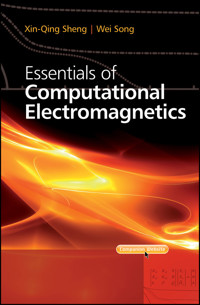
Essentials of Computational Electromagnetics provides an in-depth introduction of the three main full-wave numerical methods in computational electromagnetics (CEM); namely, the method of moment (MoM), the finite element method (FEM), and the finite-difference time-domain (FDTD) method. Numerous monographs can be found addressing one of the above three methods. However, few give a broad general overview of essentials embodied in these methods, or were published too early to include recent advances. Furthermore, many existing monographs only present the final numerical results without specifying practical issues, such as how to convert discretized formulations into computer programs, and the numerical characteristics of the computer programs. In this book, the authors elaborate the above three methods in CEM using practical case studies, explaining their own research experiences along with a review of current literature. A full analysis is provided for typical cases, including characteristics of numerical methods, helping beginners to develop a quick and deep understanding of the essentials of CEM.
- Outlines practical issues, such as how to convert discretized formulations into computer programs
- Gives typical computer programs and their numerical characteristics along with line by line explanations of programs
- Uses practical examples from the authors' own work as well as in the current literature
- Includes exercise problems to give readers a better understanding of the material
- Introduces the available commercial software and their limitations
This book is intended for graduate-level students in antennas and propagation, microwaves, microelectronics, and electromagnetics. This text can also be used by researchers in electrical and electronic engineering, and software developers interested in writing their own code or understanding the detailed workings of code.
Companion website for the book: www.wiley.com/go/sheng/cem
Sie lesen das E-Book in den Legimi-Apps auf:
Seitenzahl: 344
Veröffentlichungsjahr: 2012
Ähnliche



















Contents
Cover
Title Page
Copyright
Preface
Chapter 1: Mathematical Formulations for Electromagnetic Fields
1.1 Deterministic Vector Partial Differential System of the Electromagnetic Fields
1.2 Vector Wave Equation of the Electromagnetic Fields
1.3 Vector Integral Equation of the Electromagnetic Fields
Chapter 2: Method of Moments
2.1 Scattering from 3D PEC Objects
2.2 Scattering from Three-Dimensional Homogeneous Dielectric Objects
2.3 Scattering from Three-Dimensional Inhomogeneous Dielectric Objects
2.4 Essential Points in MoM for Solving Other Problems
Chapter 3: Finite-Element Method
3.1 Eigenmodes Problems of Dielectric-Loaded Waveguides
3.2 Discontinuity Problem in Waveguides
3.3 Scattering from Three-Dimensional Objects
3.4 Node-Edge Element
3.5 Higher-Order Element
3.6 Finite-Element Time-Domain Method
3.7 More Comments on FEM
Chapter 4: Finite-Difference Time-Domain Method
4.1 Scattering from a Three-Dimensional Objects
4.2 Treatment for Special Problems
4.3 Comparison of the MoM, FEM and FDTD Methods
Chapter 5: Hybrid Methods
5.1 Hybrid High-Frequency Asymptotic Methods and Full-Wave Numerical Methods
5.2 Hybrid Full-Wave Numerical Methods
Index
This edition first published 2012
© 2012 John Wiley & Sons Singapore Pte. Ltd.
Registered office
John Wiley & Sons Singapore Pte. Ltd., 1 Fusionopolis Walk, #07-01 Solaris South Tower, Singapore 138628
For details of our global editorial offices, for customer services and for information about how to apply for permission to reuse the copyright material in this book please see our website at www.wiley.com.
All Rights Reserved. No part of this publication may be reproduced, stored in a retrieval system or transmitted, in any form or by any means, electronic, mechanical, photocopying, recording, scanning, or otherwise, except as expressly permitted by law, without either the prior written permission of the Publisher, or authorization through payment of the appropriate photocopy fee to the Copyright Clearance Center. Requests for permission should be addressed to the Publisher, John Wiley & Sons Singapore Pte. Ltd., 1 Fusionopolis Walk, #07-01 Solaris South Tower, Singapore 138628, tel: 65-66438000, fax: 65-66438008, email: [email protected].
Wiley also publishes its books in a variety of electronic formats. Some content that appears in print may not be available in electronic books.
Designations used by companies to distinguish their products are often claimed as trademarks. All brand names and product names used in this book are trade names, service marks, trademarks or registered trademarks of their respective owners. The Publisher is not associated with any product or vendor mentioned in this book. This publication is designed to provide accurate and authoritative information in regard to the subject matter covered. It is sold on the understanding that the Publisher is not engaged in rendering professional services. If professional advice or other expert assistance is required, the services of a competent professional should be sought.
Library of Congress Cataloging-in-Publication Data
Sheng, Xin-Qing, 1968-
Essentials of computational electromagnetics / Xin-Qing Sheng, Wei Song.
p. cm.
Includes bibliographical references and index.
ISBN 978-0-470-82962-2 (hardback)
1. Electromagnetism–Data processing. 2. Electromagnetism–Mathematical models. I. Song, Wei. II. Title.
QC760.54.S54 2012
537.0285–dc23
2011045255
Preface
Computational electromagnetics (CEM) has evolved as an independent, vibrant discipline since the early 1960s. A large number of scholarly written works are already available which are exclusively dedicated to various aspects of numerical methods and their applications to electromagnetic (EM) problems. Despite the wide variety of these works, they all follow the same research paradigm, which essentially consists of discretizing the Maxwell's equations, obtaining the numerical solutions through writing computer programs, and validating the numerical solution by using theoretical values and/or experimental data. This research paradigm shows that discretization and computer realization are the essentials in CEM. Without discretization, the digital computer cannot be utilized; without computer realization, the numerical method cannot be validated and thus is not convincing. Although large amount of papers and books have been published in CEM, there are only three main full-wave numerical methods as far as discretization is concerned. These include the method of moment (MoM), the finite-element method (FEM), and the finite-difference time-domain (FDTD) method. These methods have distinct ways of discretization and possess fundamentally different numerical characteristics and performances. Generally, MoM discretizes the integral equation representations of EM problems, FEM discretizes the variational functional formulations of EM problems, while FDTD directly discretizes the Maxwell's equations in differential form. Numerous published works can be found which are exclusively devoted to either of the aforementioned methods. However, only few give a broad and general overview of the essential features innate in these methods, or the summary was made too early to include recent developments. As far as program realization is concerned, practical issues, such as numerical techniques and tricks in the conversion of discretized formulations into computer programs, play important roles. However, the majority of existing works primarily restrict themselves to presenting the final numerical results without specifying the aforementioned issues. Not addressing these practical aspects is very unfortunate in CEM, since it is not at all straightforward to convert discretized formulations into reliable computer programs as the designers would expect. In fact, significant effort is spent on the program realization in CEM. Obviously, writing a good computer program requires years of experience – and it is in general rather difficult, if not impossible, to set rules for good programming practices. Nontheless, experience shows that studying typical programs can provide useful guidelines for writing efficient and professional computer programs. More to the point, it is hard to expect a monograph without discussions on numerical characteristics of the methods can serve the reader to acquire an in-depth understanding of the subject matter.
In this book, the authors will elaborate the above three methods in CEM in a paratactic manner, based on the authors' own research experiences as well as the information available in the current literatures, by thoroughly analyzing typical cases. If you look at the evolving history of CEM, several typical EM problems can be identified, which play a key role. The landmarks of progress in CEM are achieved by pursuing better solutions for these problems. This book focuses on these EM problems. Through solving these problems, the numerical methods are introduced and the essential principles, i.e., the techniques improving the numerical efficiency, and the skills in writing computer programs, are detailed. In addition, the numerical performances of the methods are discussed by analyzing the numerical results presented in the book. To help the reader obtain a fast and deep understanding of the major essentials about CEM, three codes are attached in this book, which are the computation of 3D scattering using MoM, FEM, and FDTD respectively. For issues related to broadening the scopes of the individual numerical techniques and their applications to other relevant problems, and aspects related to rigorous mathematical proofs, the reader is referred to the references available - they will not be elaborated further here.
Xin-Qing ShengJanuary, 2012, Beijing
Chapter 1
Mathematical Formulations for Electromagnetic Fields
There are various mathematical formulations for representing electromagnetic fields. They are equivalent to each other mathematically, but distinct in terms of numerical behavior. In this chapter, we will give a brief introduction of the three kinds of mathematical formulations employed in computational electromagnetics: vector partial differential equations, vector wave equations, and vector integral equations, which are the mathematical foundations of the finite-difference time-domain (FDTD) method, the finite-element method (FEM), and the method of moment (MoM) respectively.
1.1 Deterministic Vector Partial Differential System of the Electromagnetic Fields
A complete system of vector partial differential equations to determine the electromagnetic (EM) fields in an interested domain comprises three parts: the Maxwell's equations, the constitutive relations, and the boundary conditions. We will introduce them in the consecutive sections.
1.1.1 Maxwell's Equations
Based on fundamental studies carried out by Ampere and Faraday et al., Maxwell introduced the concept of displacement current density (measured in A/m2) and established the following system of equations that gives a complete mathematical description of the electromagnetic fields:
(1.1)
(1.2)
(1.3)
(1.4)
Here, the variables on the left-hand side (LHS) of the equations are the physical EM field quantities:
: electric field intensity (vector), in ,
: electric flux density (vector), in ,
: magnetic field intensity (vector), in ,
: magnetic flux density (vector), in ;
The variables on the right-hand side (RHS) of the equations are quantities depicting the sources that excite the EM fields:
: volume current density (vector), in ,
: free volume charge density (scalar), in .
A further link to Maxwell's equations is established by the law of charge conservation
(1.5)
By applying the divergence operation to both sides of (1.1) we can obtain (1.4). Again, applying divergence operation to (1.2) and plugging (1.5) lead to (1.3). These indicate only three out of the above five equations are independent. Moreover, the three independent equations are not all required in solving a particular problem. For example, in solving electrostatic problems, we only use (1.1) and (1.3), because magnetic fields don't exist in this kind of problem and all other equations become irrelevant. Similarly, only (1.2) and (1.3) are used in magnetostatic problems. As far as EM waves excited by time-varying electric current, time-varying equivalent electric or magnetic current are concerned, generally, using (1.1) and (1.2) is enough. Obviously, these equations are not adequate in determining the unknown physical quantities. Take the EM wave problem as an example. Vector equations (1.1) and (1.2) provide us with 6 scalar equations and 12 unknowns contained in , , , and , if we assume the driving sources of the system is known. Therefore, in order to render the above equations solvable, we need to invoke further relations, that is, the constitutive relations depicting the relationship between , and , , together with the relationship between and .
1.1.2 Constitutive Relations
The constitutive relations of a material are conventionally obtained by experiments or by establishing a microcosmic model of the material. Generally speaking, for many real-world materials, the constitutive relations can be written as
(1.6)
(1.7)
(1.8)
Here , and stands for permittivity, in , permeability, in , and electrical conductivity, in , respectively. If these constitutive parameters vary with the spatial position, the material is inhomogeneous. Otherwise, the material is homogeneous. If these parameters are frequency dependent, the material is dispersive. Plasma, water, biological tissues and wave-absorbing materials are examples of dispersive materials. Otherwise, the material is nondispersive. If the material has directional properties so that the constitutive parameters take a tensor form, the material is termed anisotropic. For example, permittivity in plasma and permeability in ferrite are tensors. Of course, there are also special materials whose constitutive relations are so complex that they cannot be expressed by (1.6)–(1.8). Take chiral medium for example. The electric displacement vector is related to not only the electric field intensity, but also the magnetic flux density. On the other hand, the magnetic flux density is related to both the magnetic field intensity and the electric field intensity. In this text, we will limit our discussion to the normal materials with constitutive relations expressed by –. In particular for time-independent constitutive relations, and can be written as
Lesen Sie weiter in der vollständigen Ausgabe!
Lesen Sie weiter in der vollständigen Ausgabe!
Lesen Sie weiter in der vollständigen Ausgabe!
Lesen Sie weiter in der vollständigen Ausgabe!
Lesen Sie weiter in der vollständigen Ausgabe!




